Lead Gen Ads: The Ultimate Guide to High-Quality Leads

Master lead gen ads in 2026. Our guide covers platforms, video creative formulas, optimization, and how to scale with AI for high-quality B2B & B2C leads.
You launch a campaign. The click-through rate looks healthy. The comments are decent. A few people even save the ad.
Then the leads come in, and the sales team hates them.
That’s the point where a lot of marketers start blaming the platform. Meta sends junk. Google is too expensive. LinkedIn costs too much. The form was too short. The audience was too broad. Sometimes those complaints are true. Usually, the bigger problem is simpler. The campaign was built to generate form fills, not to generate buying intent.
Lead gen ads work when you treat them as a system. The ad attracts the right kind of attention. The offer filters for the right kind of problem. The form catches useful qualification data. The follow-up happens fast. The creative keeps refreshing before performance stalls. If one piece is weak, the whole thing turns noisy.
That’s why this topic matters now. 90.7% of marketers use their websites as the primary channel to generate leads and sales, while blogs are used by 89.2%, email by 69.2%, and PPC ads by 53.7% according to Email Vendor Selection’s lead generation statistics roundup. Many teams already have the channels. What they don’t always have is a clean operating model for turning attention into qualified pipeline.
Beyond Clicks Why Lead Gen Ads Are Your Growth Engine
The most common failure pattern looks like this. A business runs ads optimized for traffic or cheap form submissions. The dashboard says volume is coming in. Sales says nobody is serious. Marketing responds by lowering CPL again, which usually makes the quality problem worse.
That spiral happens because lead gen ads are not a format first. They’re an objective.
Lead gen ads are a value exchange
A lead gen ad asks someone to trade contact information for something useful. That “something” might be a webinar, a buying guide, a quote, a consultation, a product demo, a checklist, or a template. The contact field is the transaction. The offer is the reason the transaction happens.
When that offer is weak, you get curiosity clicks. When it’s misaligned, you get irrelevant leads. When it’s too broad, you fill the CRM with people who liked the ad but never intended to buy.
Practical rule: If the offer would appeal equally to buyers and non-buyers, it’s too loose for serious lead generation.
A generic “free guide” often underperforms a sharper promise tied to a clear pain point. The ad doesn’t need to sell the entire product. It needs to sell the next step to the right person.
Clicks don’t build pipeline
Plenty of teams still judge lead gen ads by surface metrics. That’s fine for diagnosing creative engagement. It’s weak for diagnosing business impact.
A campaign with fewer leads can outperform a campaign with more leads if the leads are easier to qualify, easier to contact, and more likely to move into sales conversations. That’s why experienced operators look beyond platform-reported success and ask different questions:
- Was the offer relevant enough to attract an in-market prospect?
- Did the form screen for intent instead of encouraging empty submissions?
- Did follow-up happen fast enough to capitalize on interest?
- Did the ad promise match the landing experience or form experience?
The real role of lead gen ads
Used well, lead gen ads create a repeatable front-end acquisition engine. They let you test market message, offer design, audience fit, and qualification logic at the same time.
They also force discipline. You can’t hide behind vanity metrics when a sales team starts reviewing lead quality. That pressure is useful. It pushes marketing to stop chasing cheap clicks and start engineering demand capture that a business can close.
Choosing Your Battlefield Comparing Lead Gen Ad Platforms
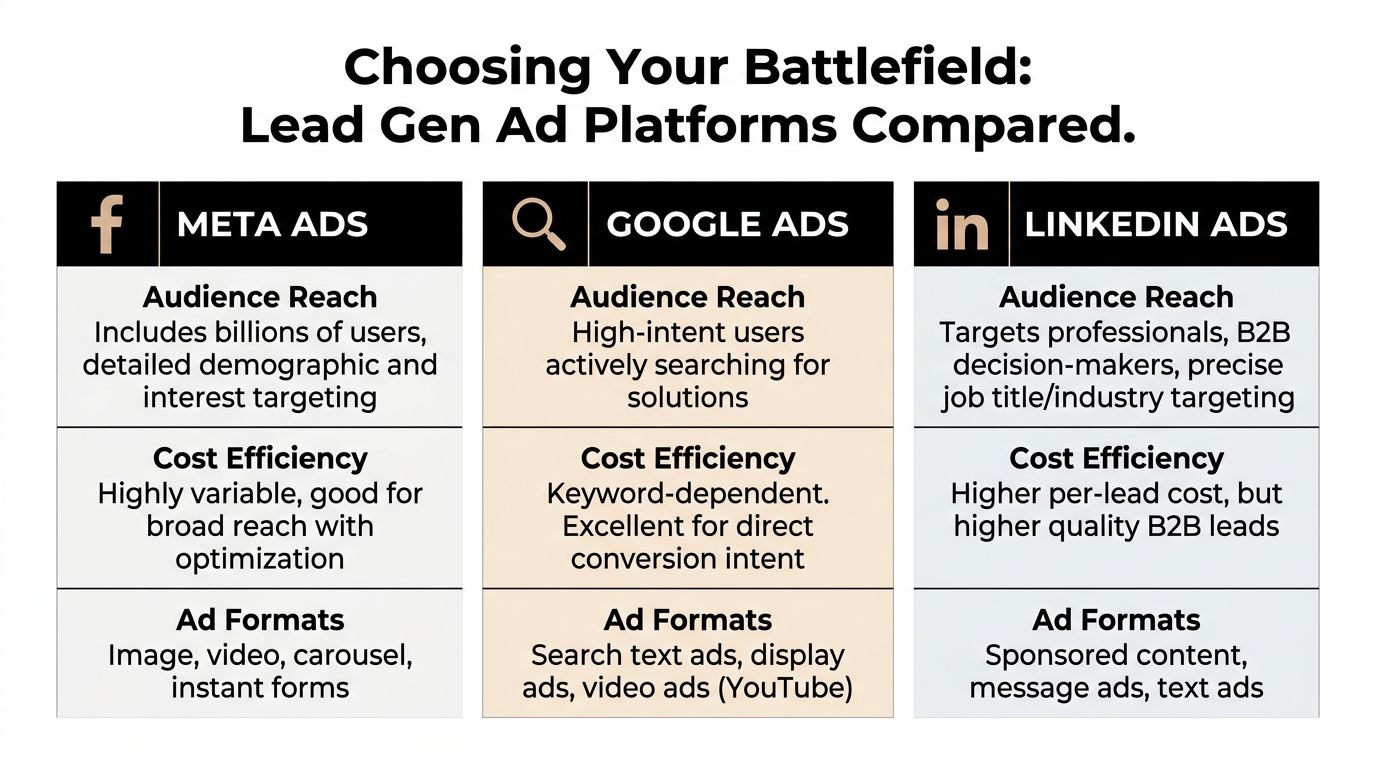
Platform choice shapes lead quality more than commonly understood. Not because one platform is “good” and another is “bad,” but because each one captures a different kind of intent.
Some channels are interruption channels. Some are demand capture channels. Some are filtering layers for a narrow professional audience. If you ignore that, you end up comparing CPLs that shouldn’t be compared.
The fast comparison
| Platform | Best For | Typical CPL | Lead Quality |
|---|---|---|---|
| Meta Ads | Broad reach, retargeting, visually driven offers, many B2C and some B2B plays | Can be very efficient when audience inputs are strong | Ranges from weak to excellent depending on offer, form friction, and audience quality |
| Google Ads | High-intent demand capture, urgent problem solving, local services, bottom-funnel search | Keyword dependent | Often strong when search intent is clear |
| LinkedIn Ads | Narrow B2B targeting by role, company type, industry, or seniority | Usually higher than other major platforms | Often strongest for precise B2B targeting |
| Landing-page-first approach | Brands that need tighter qualification, longer copy, and stronger message control | Varies by traffic source | Usually better filtered than low-friction native forms |
Meta Ads
Meta is still one of the most flexible environments for lead gen ads, especially if you know how to control quality. It’s strong for broad top-of-funnel reach, retargeting, short-form video, local services, coaching offers, education products, and many DTC-adjacent lead flows.
The biggest mistake on Meta is relying on broad interest stacks and low-friction forms without enough qualification. That setup often invites impulsive submissions.
The upside is that Meta rewards strong signal quality. Using lookalike audiences from high-quality clients plus demographic filters can achieve a cost per lead as low as $3.10, with 8% of leads converting to active users, according to Zapier’s write-up on Facebook lead ads best practices. The key idea is more important than the benchmark itself. Good seed data gives the algorithm a much clearer definition of what a valuable prospect looks like.
Where Meta shines
- Visual persuasion: It handles video, testimonial clips, founder-led creative, before-and-after framing, and educational hooks well.
- Speed of testing: You can rotate new concepts quickly.
- Retargeting depth: Website visitors, engagers, and customer lists create practical remarketing layers.
Where Meta struggles
- Low-intent browsing: Many users weren’t planning to solve your problem today.
- Form inflation: Instant forms make submission easy. Sometimes too easy.
- Creative fatigue: Winning ads degrade if you don’t refresh often.
Better Meta campaigns usually start with customer quality and work backward. Bad Meta campaigns start with audience size and work forward.
Google Ads
Google is less forgiving creatively, but often stronger on intent. Search traffic can be excellent when someone knows the problem they want solved and is actively looking for a solution.
Here, lead gen ads benefit from sharp commercial phrasing. If your category has urgent, expensive, or recurring pain, search can produce cleaner lead flow than social. The traffic is usually less “inspired by an ad” and more “trying to fix something now.”
Google gets harder when your offer needs education before the prospect understands why they should care. In those cases, social or YouTube-style video often creates demand more effectively than search text alone.
LinkedIn Ads
LinkedIn is expensive enough that sloppy offers get punished fast. But if you need operations leaders, HR buyers, IT managers, finance teams, or department heads at defined company types, few platforms can match its filtering power.
That doesn’t mean LinkedIn automatically produces better campaigns. It means the targeting can be better. The offer still has to justify the interruption, and the form still has to separate mild curiosity from active need.
LinkedIn works best when your sales process is consultative and your deal value can support a higher acquisition cost. It works worse when the offer is generic, the audience is overly broad, or the creative reads like corporate wallpaper.
Native lead forms versus landing pages
This is the practical trade-off many teams avoid.
Native forms reduce friction. That can lower CPL and increase volume. They’re useful when response speed is high and your qualification process can happen immediately after submission.
Landing pages add friction, but useful friction. They let you control message order, explain the offer in depth, introduce proof, and pre-frame the prospect before the form. That often improves lead quality, especially in B2B or higher-consideration purchases.
Use native forms when speed and simplicity matter. Use landing pages when context and filtering matter more.
Crafting Your Offer The Psychology of a High-Converting Lead Magnet
A campaign can have clean targeting, a decent budget, and strong click-through rate, then still hand sales a pile of junk.
The offer usually caused it.
I see this constantly in lead gen accounts. The team obsesses over hooks, edits, landing page tweaks, and form fields, but the lead magnet asks for contact details before it has earned the exchange. Then they blame the platform for low intent. Platforms do have quirks, but a weak offer will fail on any of them.

A good offer fits the buyer's current job
High-converting lead magnets match a specific moment. They answer the question the prospect already has, at the level of detail they want.
A checklist works for someone who already knows the task and wants speed. A webinar works for someone who needs context before they can judge solutions. A demo, consultation, or audit works when the buyer has moved past education and wants to know whether your product fits their situation.
Broad offers tend to pull in broad intent. That is how you get leads who happily download the asset and disappear the second sales follows up.
Buyer awareness should shape the offer
The easiest way to improve lead quality is to stop asking one asset to serve every stage.
Top of funnel
Early-stage prospects need orientation. They may feel the problem, but they are not ready for a sales conversation yet.
Offers that work here include:
- Educational guides
- Explainer videos
- Trend briefings
- Problem-framing content tied to a clear pain point
This stage also benefits from creative that feels native to the platform instead of polished into ad fatigue on day three. If you are building creator-style assets to warm cold audiences, this guide on how to make UGC-style ads that feel natural in-feed is a useful reference.
Middle of funnel
Mid-funnel prospects are comparing options, methods, or vendors. The offer should help them evaluate, not just learn.
Useful formats include:
- Templates
- Checklists
- Comparison sheets
- Recorded trainings
- Live workshops or webinars
This is also where a lot of teams create unnecessary creative bottlenecks. They have one webinar, one template, one static ad, and then wonder why volume stalls. In practice, the offer can stay the same while the packaging changes. New hooks, angles, intros, and proof points often revive a strong mid-funnel asset without changing the asset itself. That matters because lead gen scale usually breaks on creative production long before it breaks on audience size.
Bottom of funnel
Late-stage buyers do not want another educational download. They want clarity, specificity, and a next step that feels commercially relevant.
Use offers like:
- Free consultation
- Demo request
- Quote
- Audit
- Trial or custom plan
At this stage, the best lead magnet barely feels like a magnet. It feels like progress.
The offer has to be easy to package into multiple ad angles
This is the part a lot of lead gen guides skip.
A strong offer is not just persuasive. It is also producible. If your offer only makes sense in one polished explainer video or one founder monologue, scaling gets expensive fast. You need an offer that can support many creative angles: pain-led, proof-led, objection-led, audience-led, and outcome-led.
That is where AI-assisted production starts to matter. Tools like ShortGenius help teams turn one core offer into many video variants without rebuilding the creative process from scratch every week. That does not fix a bad offer. It does let a good offer survive contact with real testing volume.
What weak offers usually have in common
Weak lead magnets usually fail for one of three reasons:
- Too general. They attract curiosity instead of buying intent.
- Too early. They give beginner education to buyers who want proof, pricing, or process.
- Too disconnected from the sale. They generate opt-ins from people who were never a fit for the product.
The best offers do the filtering before the form does. That is how lead gen gets more predictable.
The Creative Formula Designing Ads That Stop the Scroll
A lead gen account often breaks in the same place. The offer is solid, targeting is acceptable, the form works, but the ads all look like they came from one brainstorm and one edit session. Performance stalls because the market has already seen the whole creative playbook.
Creative has a harder job in lead gen than in ecommerce. It has to stop attention, qualify the click, and set expectations for the form. If the ad wins attention from the wrong people, sales feels it a week later.
Why video gives you more control over lead quality
Video keeps winning in lead gen for a practical reason. It lets you filter earlier.
You can call out the audience in the first line, show the problem in context, add proof, and frame the next step before someone ever opens the form. That extra context matters because weak clicks are expensive. As noted earlier, marketers consistently report that video improves lead generation results. In-platform, the bigger advantage is usually diagnostic. Video gives teams more pieces to test, so you can see whether the drop is coming from the hook, the promise, the proof, or the CTA.
If you need a clean breakdown of video structure, this guide on how to create video ads is a useful reference.
Video also gives you more room to test presentation style without changing the offer. A founder clip, customer-style testimonial, screen recording, UGC-style script, or product explainer can all sell the same lead magnet from different angles. That matters when creative fatigue sets in fast.
For brands that rely on polished lifestyle visuals or virtual presenters, AI model creation can also help produce new visual setups without booking another shoot every time you need a fresh variant.
A video structure that qualifies instead of just attracting clicks
The simplest framework I keep coming back to is Hook, Problem, Proof, Next Step.
It works because it matches how buyers screen offers in-feed.
Hook
Open with a concrete situation, not a vague benefit.
Examples:
- “Still paying for demo requests that never reply?”
- “If your sales team is chasing bad inbound leads, this is usually why.”
- “For local service companies, this form mistake kills quote quality.”
Specific hooks reduce wasted attention. Broad hooks inflate CTR and leave the sales team with junk.
Problem
Name the friction in plain language. Show that you understand the sales process behind the lead, not just the click.
Good lead gen creative talks about missed appointments, low-fit demos, bloated CAC, slow follow-up, bad qualification, or channels that produce volume without pipeline. It sounds like an operator wrote it.
Proof
This is the section weak ads skip.
Proof can be a result, a process screenshot, a customer quote, a before-and-after workflow, or a sharp operational point like “we changed the form flow and cut low-intent submissions.” For lead gen, proof does more than build trust. It filters out casual curiosity.
Next Step
Present one action. Keep it narrow.
Book the audit. Request the quote. Watch the demo. Get the plan. The ad should make the next step feel useful on its own, even for someone who is not ready to buy today.
Static ads still work, but they need tighter message control
Static can still produce excellent leads, especially in retargeting, local offers, straightforward services, and branded search support. But static has less room to explain. That means every element has to carry its weight.
Use this checklist:
- One idea in the visual
- One promise in the headline
- One audience cue
- One CTA
- One proof element, if space allows
If the image, headline, and primary text are all making different promises, the ad feels generic. Generic creative gets cheap engagement and expensive lead review.
Creative fatigue is usually a production problem
Teams often blame targeting when CPL rises and lead quality slips. In many accounts, the issue is simpler. The same hooks, same edit rhythm, same spokesperson, and same CTA framing have been running for too long.
The fix is not “make better ads.” The fix is to produce enough distinct variations that testing becomes real instead of ceremonial.
Useful variables to rotate include:
- Hook angle
- Opening visual
- Spokesperson type
- Proof format
- Offer framing
- CTA wording
- Video length
This is the bottleneck many lead gen guides barely address. The strategy is easy to say. Production is where teams get stuck. If every new test needs a fresh script, a new shoot day, and a full editing cycle, creative velocity collapses. The accounts that scale are usually the ones with a system for turning one offer into many usable ad variants before fatigue forces the issue.
Scaling Creative Production with an AI Workflow
The bottleneck in lead gen ads usually isn’t campaign setup. It’s creative output.
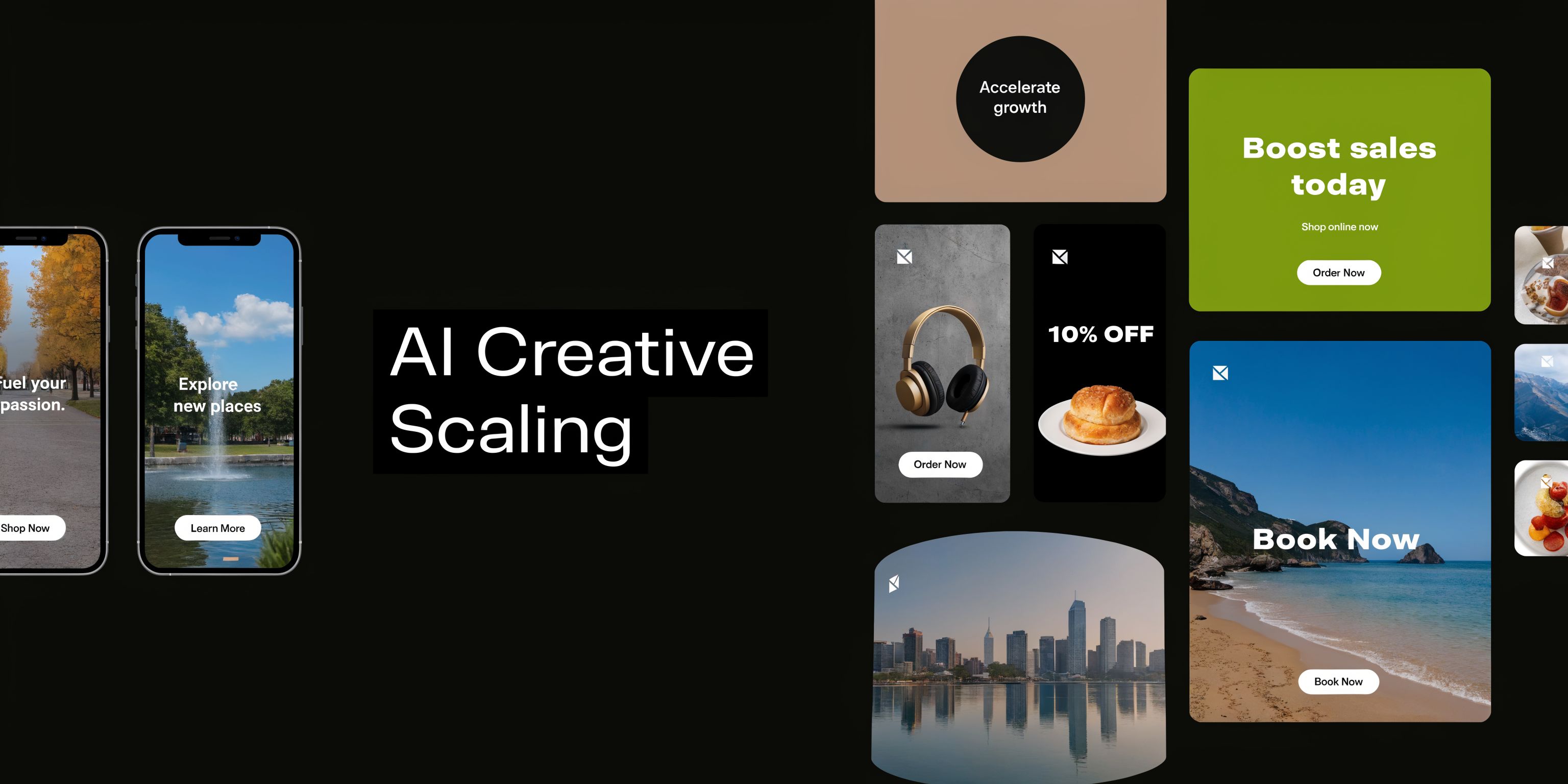
Many teams can come up with one decent angle. Some can produce three. Very few can reliably generate enough new hooks, edits, formats, and variants every week to keep learning curves clean across Meta, Instagram, TikTok, YouTube Shorts, and landing page support assets.
That gap matters because modern lead gen performance depends on testing velocity.
Why static-first testing has limits
A lot of advertisers still build lead gen around a few image ads and one form. That can work for a while, but it breaks when the audience has seen the concept too many times or when the product needs nuance that one image can’t deliver.
An underserved angle in this space is AI-generated short-form video built specifically for lead gen. AdEspresso notes that dynamic video hooks can boost engagement by 30% to 50% and that video can outperform images by 2x in CTR on Meta in this context, as covered in its piece on ad angles and Facebook ads. The useful lesson isn’t just “use video.” It’s that richer creative gives you more ways to pre-qualify interest before someone ever opens a form.
What a workable AI creative workflow looks like
The right workflow starts with one offer and turns it into multiple testable expressions.
Start with angle expansion
Take a single lead magnet and generate several distinct ad angles:
- pain-first
- outcome-first
- regret-driven
- myth-busting
- founder story
- customer objection
- niche audience callout
Many teams don’t lose because they lack ideas. They lose because turning each idea into a polished ad takes too long.
Build hook variants before full edits
Don’t fully produce every concept. Generate opening lines, on-screen text options, voiceover versions, and first-scene alternatives first. That lets you test the top of the funnel where most ad performance is decided.
Create modular assets
Use interchangeable scenes, B-roll, captions, voiceovers, and CTAs. A modular system makes one base concept stretch much further. Here, AI image and video generation also becomes useful. If you need fresh visual styles or product-adjacent scenes without organizing a full shoot, resources around AI model creation can help teams think more flexibly about visual production inputs.
Resize and repackage by placement
Don’t assume one export works everywhere. Story placements, reels, feeds, and landing page embeds all need different framing. A creative system should adapt the same idea to each environment without rebuilding from scratch.
What this changes for small teams
Before AI-assisted production, high-tempo testing was mostly reserved for brands with editors, motion designers, copywriters, and paid media operators under one roof. Now smaller teams can run a sharper process if they think in batches.
A useful reference point is this guide to the best AI ad generator, especially if you’re comparing how different tools handle scripting, voiceover, editing, and asset generation in one workflow.
The core shift is operational. Instead of treating creative as a campaign asset, treat it as an always-on testing pipeline. That’s how lead gen ads stay efficient without collapsing into stale hooks and low-intent submissions.
From Setup to Launch A Practical Lead Gen Ad Walkthrough
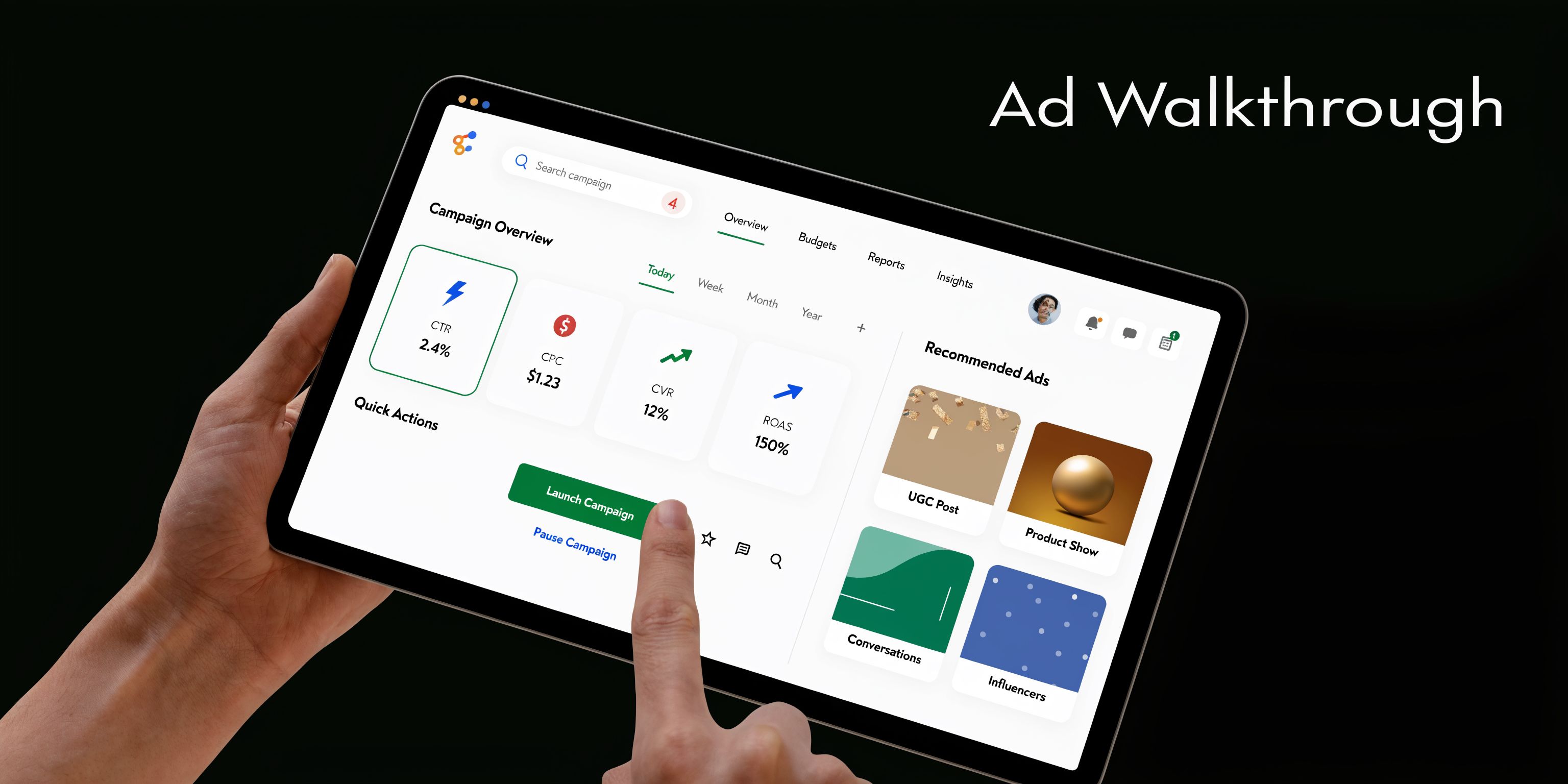
The fastest way to understand lead gen ads is to build one clean campaign from scratch. Meta is a good example because it’s flexible, widely used, and unforgiving when your setup is sloppy.
Step 1 Choose the right campaign objective
Pick the lead objective, not traffic or engagement.
That sounds obvious, but a lot of weak lead programs start with the wrong optimization goal. If you ask the platform for clicks, it will find clickers. If you ask it for leads, it will try to find converters.
Within that setup, decide early whether you want:
- Instant forms on Meta
- Website conversion flow to a landing page
- A hybrid setup with retargeting layers
If your offer needs explanation, website flow is often cleaner. If your sales team can move fast and your form includes qualification, instant forms can work well.
Step 2 Define an audience with signal quality in mind
Start with the best customer data you have, not the biggest audience you can imagine.
Good audience setup usually combines:
- a customer list or qualified lead list
- website visitor audiences with meaningful behavior
- exclusions for existing customers or bad-fit segments
- lookalike modeling where available
- demographic or role filters when the offer demands it
Meta tends to perform better when your seed list reflects actual quality. A list of all leads is often worse than a smaller list of qualified leads.
Uploading weak data teaches the algorithm weak patterns.
Step 3 Build the ad around one idea
Use one offer and one angle per ad. Don’t stack five messages into one unit.
A clean ad usually includes:
- a direct hook
- quick context for the problem
- one proof point or credibility signal
- a clear next step
For lead gen, the ad should pre-frame the prospect. If the person watches or reads and still doesn’t understand who it’s for, the form will collect noise.
Step 4 Create the form with useful friction
At this stage, many campaigns go off track. They remove too much friction in the name of volume.
Add enough friction to protect quality:
- Ask fit questions: Role, company type, need, timeline, or service category.
- Use multiple choice where possible: It keeps form completion cleaner than open-ended fields.
- Make the offer explicit again: The confirmation screen should restate what happens next.
- Set expectations: Tell the lead whether they’ll get an email, call, text, or booking link.
A form should screen out the wrong person without punishing the right one.
Here’s a walkthrough video if you want to see campaign mechanics in action:
Step 5 Connect follow-up before launch
Never launch a lead form that dumps submissions into a dashboard nobody checks.
Connect the campaign to a CRM, email tool, spreadsheet automation, or SMS workflow before spending starts. The first response matters more than many teams think, especially with social leads that cool off quickly.
Your handoff should answer four questions immediately:
- Who submitted
- What they requested
- How qualified they appear
- What action happens next
Step 6 Review the full path like a buyer
Open the ad. Fill out the form. Read the confirmation. Trigger the email. Check the CRM entry. Listen to the sales handoff if there is one.
Most lead quality complaints aren’t caused by one dramatic failure. They come from small disconnects between promise, form, and follow-up. Review the whole path before scale.
Measure and Optimize The Metrics That Drive Lead Quality
The easiest way to ruin lead gen ads is to optimize for the wrong success signal.
A low CPL can hide a terrible campaign. A higher CPL can be a bargain if those leads move through qualification and into revenue. That’s why mature lead gen programs use platform metrics for diagnosis, but use business metrics for decisions.
Start with the funnel, not the ad account
At minimum, track the movement from lead to qualified lead to sales conversation. The exact labels vary by team. Some use MQL and SQL. Some use pipeline stages. The naming matters less than the feedback loop.
What matters is whether marketing can answer:
- Which campaigns produce reachable leads
- Which produce qualified leads
- Which produce sales-worthy conversations
- Which offers attract the wrong intent entirely
If you can’t map that progression, the ad account will always look noisier than it really is.
A practical troubleshooting framework
When a campaign underperforms, diagnose by failure mode.
If CPL is too high
Look at:
- creative fatigue
- weak hooks
- poor audience signal quality
- mismatch between ad and offer
- placement issues
This is usually a front-end problem. The platform isn’t finding enough people willing to take the next step efficiently.
If lead volume is fine but quality is poor
Look at:
- loose offer positioning
- low-friction forms
- vague CTA wording
- missing qualification questions
- bad-fit audience sources
This is usually a filtering problem. You’re generating attention, but not screening intent.
If quality looks decent but pipeline stalls
Look at:
- follow-up speed
- handoff quality
- CRM routing
- nurturing gaps
- sales process mismatch
Here, marketing and sales often blame each other. The better approach is to inspect timestamps, lead notes, and first-touch messaging.
The campaign doesn’t end at the form submit. That’s where evaluation starts.
First-party data improves optimization quality
At this point, serious lead gen programs separate from casual ones.
First-party data strategies can increase lead quality by up to 10x in AI-driven lead gen campaigns by giving ad platforms better measurement and optimization signals, as discussed in this YouTube analysis of first-party data and lead quality. In practical terms, that means sending platforms stronger downstream signals from your CRM instead of asking them to optimize blindly on raw lead count.
That loop gets even better when your internal qualification logic is clear. If you need help tightening that framework, these lead scoring best practices are a useful companion for deciding what should count as a valuable lead versus a casual inquiry.
The metrics that deserve attention
A clean lead gen reporting view usually prioritizes:
| Metric | Why it matters |
|---|---|
| CPL | Useful for efficiency, but only as an entry metric |
| Lead-to-qualified rate | Shows whether the offer and form are filtering well |
| Qualified-to-opportunity rate | Shows whether targeting and promise align with sales reality |
| Speed to first contact | Strong indicator of whether intent gets captured or wasted |
| Source-level quality by campaign and creative | Shows which messages attract buyers versus browsers |
Once those are in place, optimization gets calmer. You stop reacting to every dashboard wobble and start making cleaner decisions about audience inputs, offer design, and creative rotation.
Conclusion Building Your Predictable Lead Engine
Good lead gen ads don’t come from clever targeting alone. They come from alignment.
The platform has to match the kind of intent you need. The offer has to match the buyer’s stage. The creative has to stop the right person, not everybody. The form has to filter without choking volume. The follow-up has to happen before interest fades. The reporting has to tell you which leads deserve more budget.
That’s why messy lead generation usually feels random. Too many teams treat each part separately. They tweak copy without fixing the offer. They change audiences without checking form friction. They lower CPL while quality keeps sliding.
A predictable engine works differently. It treats lead gen ads like an operating system. Creative testing runs continuously. Qualification data feeds the platform. Sales feedback shapes audience inputs. Offers get sharper over time.
If you’re trying to improve results, start smaller than you think. Audit one active offer. Rewrite one form. Launch one new creative angle that speaks to a narrower pain point. Then watch what happens to lead quality, not just volume.
If your bottleneck is producing enough ad variations to test seriously, ShortGenius (AI Video / AI Ad Generator) is worth a look. It helps creators and teams turn one concept into multiple video ad versions quickly, so you can test new hooks, formats, voiceovers, and platform cuts without slowing the rest of your lead gen machine.