How to Create Video Ads That Actually Convert

Learn how to create video ads that drive real results. This guide covers proven strategies for scripting, production, and optimization to boost your ROI.
Crafting a video ad that genuinely connects with people and drives results isn't just a four-step process. It's an art that starts long before you ever think about hitting the record button. It all boils down to a solid plan, a compelling story, smart production, and a bit of finessing after you launch. Get these right, and you'll do more than just get views—you'll create customers.
Building Your Video Ad Strategy Before You Press Record

Here's a hard truth: the success or failure of your video ad is decided before a single frame is shot. This initial planning phase is where you lay the groundwork for everything that follows. Jumping straight into production without a clear strategy is like trying to build a house without a blueprint. It might look okay for a moment, but it's destined to fall apart.
The whole thing starts with one deceptively simple question: What are you actually trying to achieve? Your answer will shape every creative choice you make.
- Brand Awareness: The goal here is simple—get on people's radar. The ad needs to be memorable, maybe a little emotional, and tell a story about your brand instead of pushing for a hard sell.
- Lead Generation: Need to capture contact info? Your ad has to offer something valuable in return, like a free guide or webinar seat, with a crystal-clear call-to-action that sends them to a landing page.
- Direct Sales: If you want an immediate purchase, the ad needs to be laser-focused. Highlight the product's benefits, create a bit of urgency, and make it incredibly easy for them to buy right now.
Before you go any further, it's worth taking a moment to fully understand: What Are the Objectives of a Campaign?
Know Your Audience Inside and Out
Once you know your "why," you have to figure out your "who." A generic ad made for "everyone" will ultimately resonate with no one. This is where creating detailed buyer personas is non-negotiable. Go beyond basic demographics and dig into their real-world pain points, what motivates them, and where they hang out online.
Ask yourself the practical questions. Is your audience scrolling TikTok or networking on LinkedIn? The fast-paced, trend-heavy vibe of TikTok is a world away from the professional polish of LinkedIn, and an ad that works on one will almost certainly fail on the other.
See What the Competition Is Doing
You're not creating content in a bubble. Your competitors are already out there, fighting for the attention of the exact same people. Take some time to actually watch their video ads. What’s working for them? More importantly, where are they dropping the ball? Look for those gaps in their messaging or a unique angle you can own.
This isn't about copying what they do. It’s about learning from their wins and losses to carve out your own distinct space. Maybe all their ads are super polished and corporate; that’s your opening to be more authentic and show the real people behind your brand.
Before you dive into scripts and storyboards, getting these strategic pieces on paper is essential. We've put together a simple table to help you map it out.
Your Pre-Production Strategy Blueprint
This table is a quick summary of the core components you need to define before starting production. It ensures every decision is focused and contributes to your end goal.
| Strategic Component | Key Question to Answer | Example |
|---|---|---|
| Campaign Goal | What's the #1 thing we want viewers to do? | Drive sign-ups for a free 14-day trial of our new software. |
| Target Audience | Who are we talking to? What do they care about? | Small business owners (1-10 employees) struggling with time management. |
| Core Message | What is the single, most important idea to convey? | Our software saves you 5+ hours a week on administrative tasks. |
| Distribution Channel | Where will this video be seen? | Instagram Reels & Facebook in-feed ads. |
| Unique Angle | How will we stand out from the competition? | Use a humorous, relatable "day-in-the-life" format instead of a generic product demo. |
Answering these questions first will save you countless headaches and wasted dollars down the line.
A great strategy is the difference between an ad that gets scrolled past and an ad that gets shared. It ensures every second of your video serves a purpose, guiding the viewer from curiosity to conversion.
The numbers don't lie. The commitment to video marketing is massive, with global spending on video ads projected to fly past $190 billion in 2025. And with 93% of marketers claiming a positive ROI from their video efforts, it’s clear that a well-planned strategy isn't just a creative exercise—it's a smart financial move.
Ultimately, this strategic work makes the creative part easier and more effective. When it's time to write the script and set up the cameras, you'll have a clear roadmap. Every decision, from that crucial opening hook to the final call-to-action, will be rooted in a plan built to hit your business goals. For those looking to fast-track the process, an AI ad generator like https://shortgenius.com can help you turn that strategy into a finished video in a fraction of the time.
Scripting a Story That Stops the Scroll
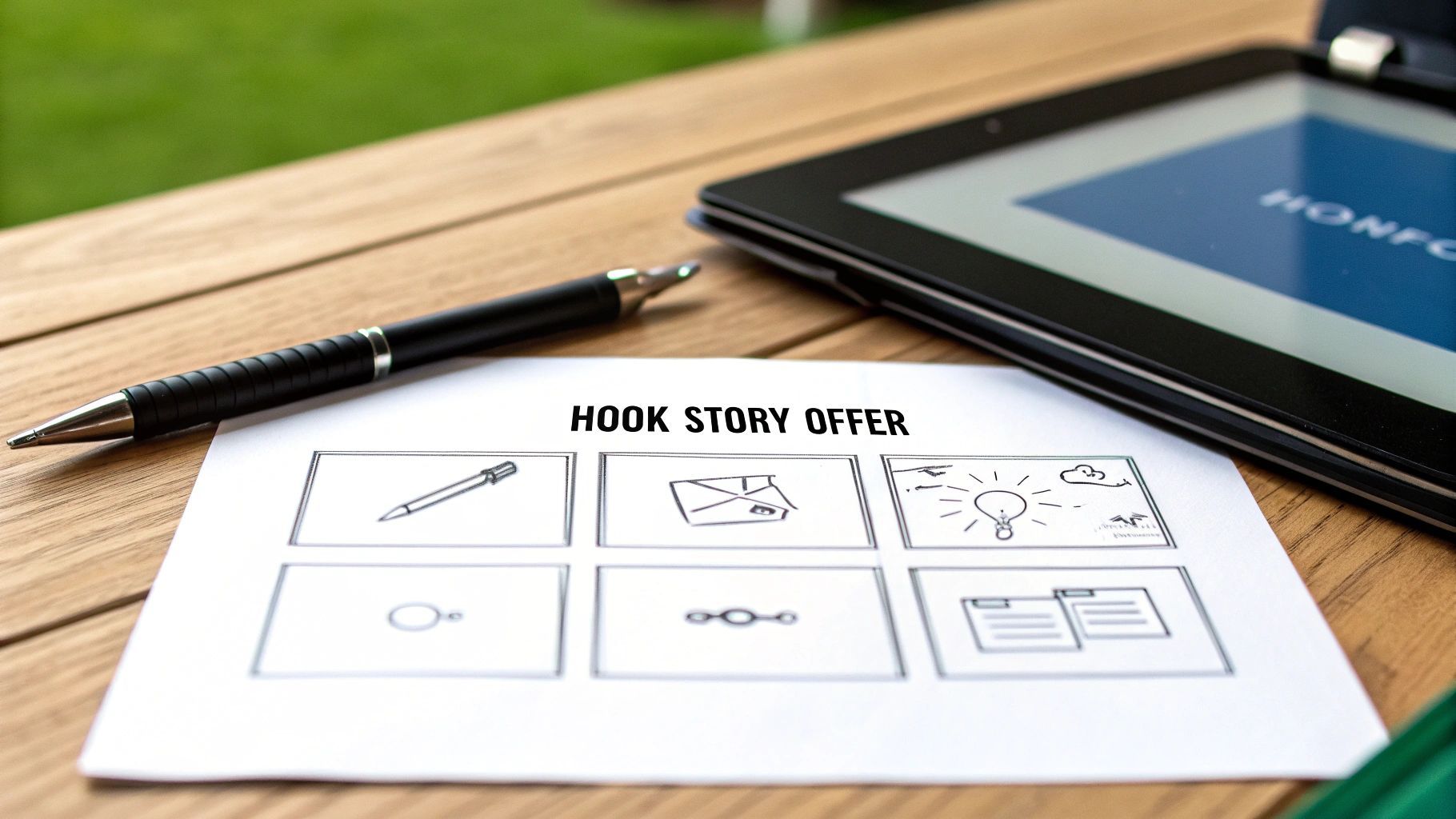 Okay, you've got your strategy nailed down. Now for the fun part: turning those insights into something that makes people feel something. This is where we shift from spreadsheets and personas to storytelling and emotion.
A great script is the absolute backbone of a video ad that works. It's what makes the difference between an ad that gets instantly skipped and one that genuinely connects with a viewer. The best ads don’t just list features; they tell a compelling story. We’re going to build ours using a classic but powerful framework: Hook, Story, Offer. It’s tailor-made for today's fast-paced, scroll-happy world.
The First Three Seconds: Your Hook
Let’s be brutally honest: you have about three seconds to grab someone's attention. That’s it. In a crowded social feed, that’s your entire window to stop their thumb from moving.
This means you have to get straight to the point. No long, fancy intros. No slow, cinematic build-ups. Your hook needs to be disruptive and immediately relevant to your viewer's life.
A great hook often kicks off with a relatable problem or a bold, surprising statement. For example, instead of a boring opening like, "Introducing our new project management tool," try something that hits a nerve: "Still drowning in spreadsheets to manage your team?" That line instantly resonates with anyone who’s ever felt that specific pain.
"The first three seconds of your video ad are your entire pitch. If you don't win their attention then, you've already lost. Make it count."
This is your moment to be provocative. Ask a question. Show a visually jarring scene. Flash a shocking statistic on the screen. Your only goal is to make them curious enough to stick around for what’s next.
Building an Emotional Bridge: The Story
Once you’ve hooked them, the story is your chance to build a real connection. This is where you prove you understand their problem and, more importantly, that you have the solution.
Forget listing product specs. The story is about illustrating a transformation. You're painting a clear "before" and "after" picture for your audience.
- The "Before" State: Briefly touch on the frustration, the chaos, or the challenge they're facing. This validates their feelings and makes them feel understood.
- The "After" State: Introduce your product or service as the hero that makes it all better. Show the relief, the success, or the pure joy that your solution brings.
Imagine you're selling meal-prep kits. The story isn't about the carrots and the chicken. It’s about the transformation from stressful, chaotic weeknight dinners to calm, healthy family meals. You’re selling the feeling of relief, not just the food. That emotional bridge is what makes people remember and trust your brand.
A Natural Next Step: The Offer
The final piece of the puzzle is your offer, which includes a clear call-to-action (CTA). If you’ve done the story part right, the CTA won't feel like a pushy sales tactic. It should feel like the obvious, helpful next step for someone who wants the transformation you just showed them.
Be direct and specific. Don’t confuse people by asking them to do five things at once ("Like, comment, subscribe, and visit our website!"). Pick one, primary action you want them to take.
- Weak CTA: "Check out our product."
- Strong CTA: "Start your free 14-day trial and save 5 hours a week. Click the link below."
See the difference? The strong CTA is benefit-driven and tells them exactly what to do and why they should do it.
From Script to Storyboard
With your script locked in, it’s time to create a storyboard. This sounds way more complicated than it is. A storyboard is just a visual outline of your video, shot by shot.
You don't need to be an artist. Stick figures and messy notes work just fine.
The whole point of a storyboard is to translate your words into a visual sequence. It helps you map out camera angles, text overlays, and transitions before you even think about filming. This little bit of planning saves an incredible amount of time (and money) during production because everyone involved knows exactly what needs to happen. Think of it as the blueprint for your ad.
Filming High-Quality Ads Without a Hollywood Budget
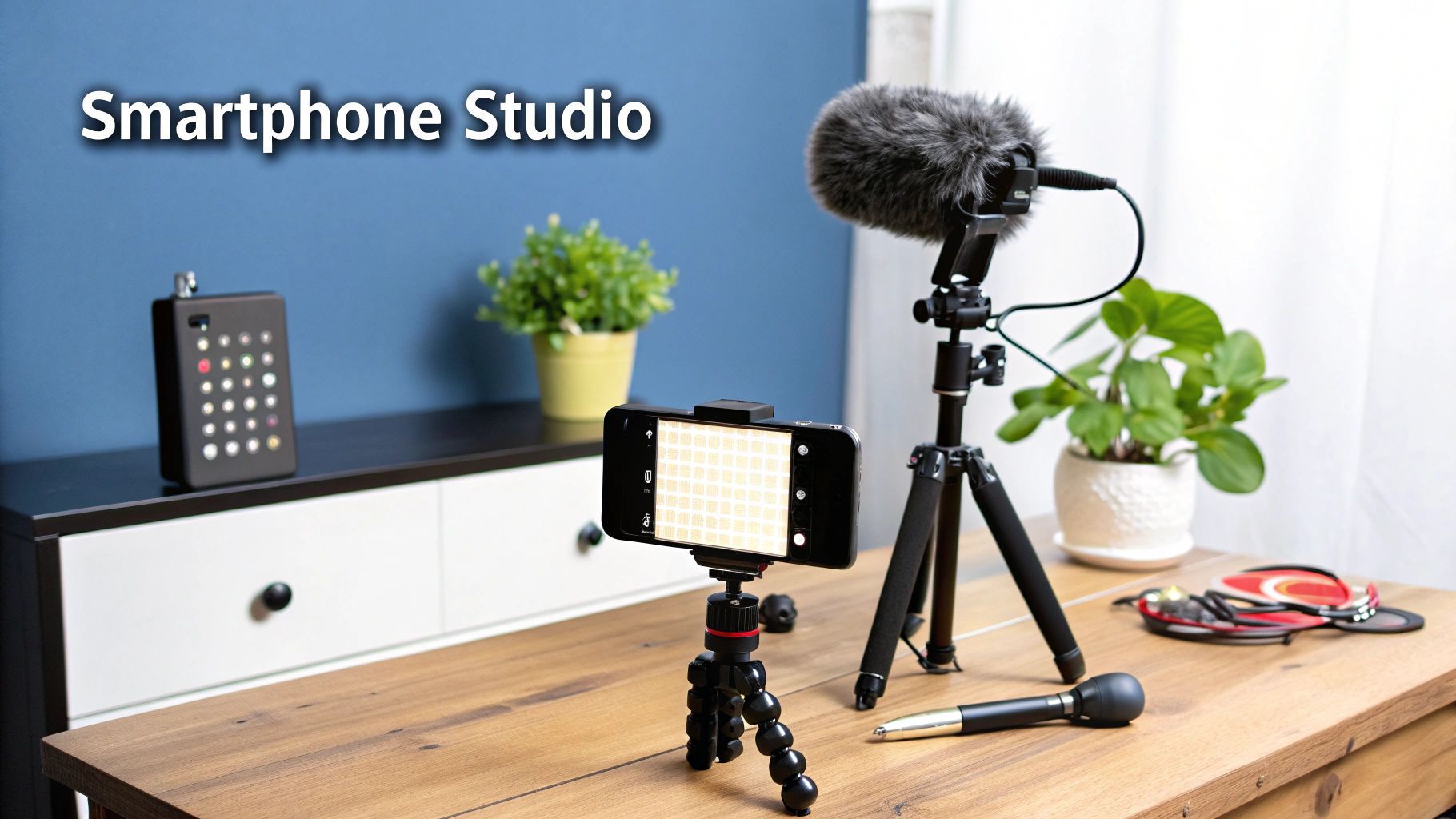
Okay, you’ve got your script and storyboard mapped out. Now for the fun part: bringing it all to life on camera. The word "production" can be intimidating, conjuring up images of expensive cameras, big crews, and pricey studio time. But for social media video ads, that whole Hollywood setup is overkill.
In fact, it can even hurt your performance. Authenticity nearly always beats slick, overproduced commercials online. The great news is you probably already have a powerful 4K camera sitting right in your pocket. Modern smartphones are absolute powerhouses for capturing crisp, professional-looking footage.
So, forget about dropping cash on a new camera. Instead, put your energy (and a very small budget) into the two things that really separate amateur videos from pro-level content: lighting and audio.
Master Your Lighting and Audio
I've seen it a thousand times: a brilliant ad concept completely ruined because the audience can't see or hear what's going on. Viewers will scroll past in a heartbeat. People are surprisingly forgiving of a video that isn't perfectly cinematic, but bad audio? That’s an instant deal-breaker.
These two areas give you the biggest bang for your buck when it comes to boosting production value.
- Lighting: Your best friend here is natural light. If you can, film facing a window to get soft, even light on your face. When that's not an option, a simple ring light is a game-changing—and cheap—investment. It gets rid of harsh shadows and gives you that clear, professional look.
- Audio: Your phone’s built-in mic is designed to pick up everything—your voice, the echo in the room, the air conditioner, the dog barking next door. A simple lavalier (or "lav") mic that clips onto your shirt costs next to nothing and makes your voice sound ten times more crisp and clear.
Poor audio is the fastest way to lose a viewer. Investing in a basic external microphone will do more for your video quality than a camera upgrade ever could.
Once you have those two fundamentals nailed down, you can start thinking about making your shots look great.
Simple Steps for Professional Shots
You don’t need to be a film school grad to compose shots that look polished and intentional. A few basic principles will instantly elevate your footage and keep viewers locked in on your message.
First, stabilize your shot. Nothing screams "amateur" like shaky, handheld video. It’s distracting and just looks sloppy. A small, inexpensive smartphone tripod is an absolute must-have for clean, steady footage.
Next, check your background. Is it cluttered? Is there anything distracting happening back there? A messy background pulls the focus right off you and your product. Find a simple, clean spot—a plain wall, a tidy bookshelf, or an uncluttered corner of your office will do the trick. The goal is to keep the viewer’s eye right where you want it.
Finally, think about the rule of thirds. Picture your screen with a 3x3 grid laid over it. Instead of sticking your subject smack in the middle, try placing them along one of the vertical lines or where two lines intersect. It’s a classic technique for creating a more balanced and visually appealing shot. Most phone cameras even have a grid overlay you can turn on to help you line it up perfectly.
This is especially critical for ads viewed on mobile, where every pixel of screen real estate counts. Good framing makes sure your message doesn't get lost. And when you're ready to put it all together, tools like ShortGenius can help you quickly assemble your clips, add professional touches, and get your ad out into the world.
Polishing Your Footage for Maximum Impact
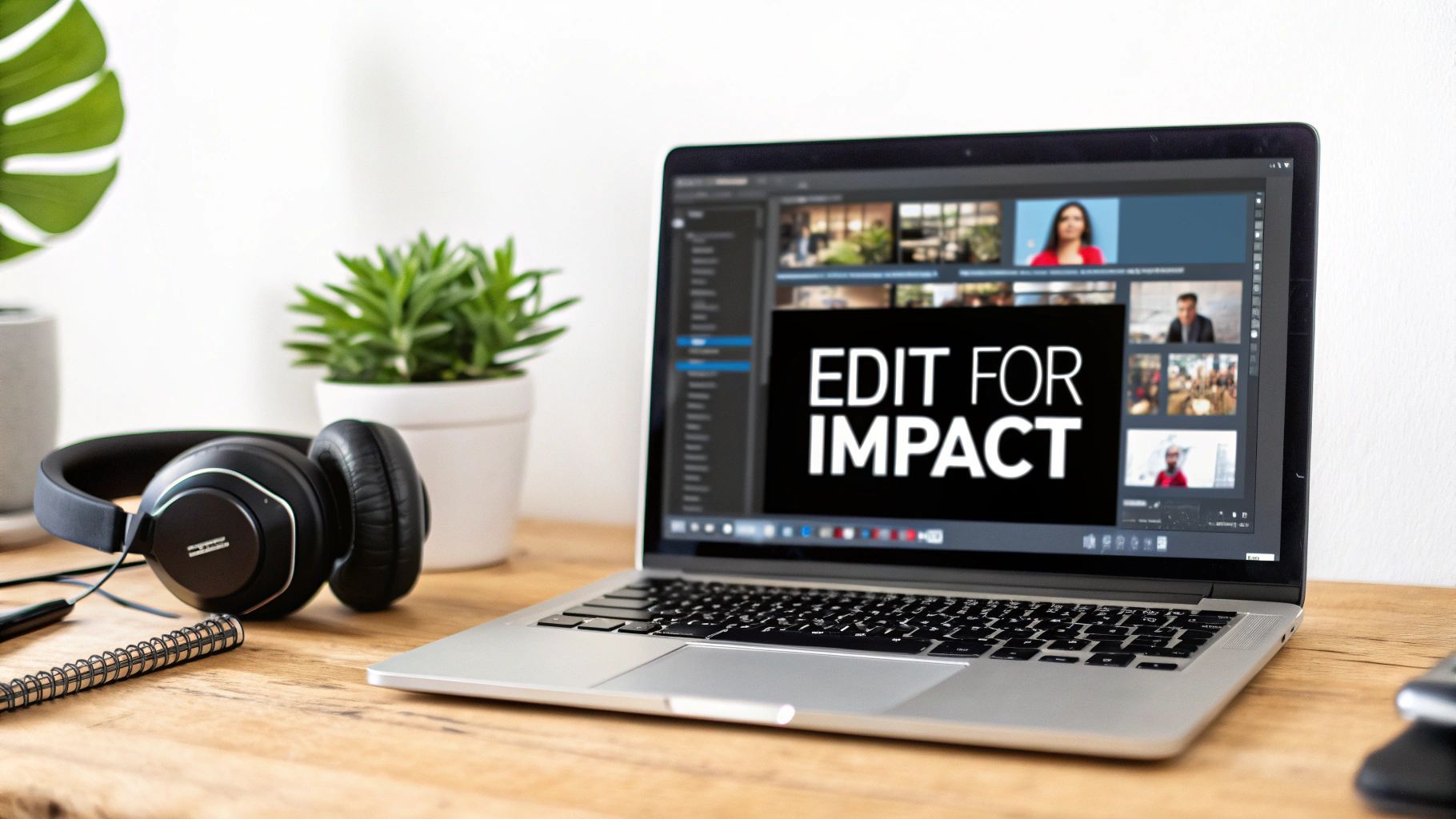
Alright, you've captured all your raw footage. Now for the fun part—this is where the magic really happens. Editing is far more than just stringing clips together; it's where you shape a jumble of takes into a tight, persuasive story that actually gets people to act. You're injecting pace, emotion, and clarity into every single frame.
If the thought of "post-production" sounds intimidating, don't let it be. There are incredible tools out there for every skill level, from super-intuitive mobile apps to the powerhouse software the pros use. Choosing the right one just comes down to your team's needs and budget.
- Just Starting Out? You can create absolutely stunning ads without spending a dime. Check out free, user-friendly options like CapCut on your phone or the surprisingly powerful DaVinci Resolve on a desktop.
- Need More Firepower? For those who need granular control over color, effects, and audio, industry workhorses like Adobe Premiere Pro or Final Cut Pro are the way to go.
Honestly, the specific tool you land on is less important than how you use it. The mission is always the same: craft a narrative that grabs attention from the first second and refuses to let go.
The Art of the Cut
Your first job is to sift through all your takes and assemble the A-team. This is where you have to be ruthless. Cut out the awkward pauses, the flubbed lines, and any shot that doesn't actively push the story forward. A great video ad has zero fluff—every second must earn its place on the timeline.
Think about the rhythm. You want to keep your cuts quick and the pacing dynamic to build a sense of momentum. As a general rule, try not to let any single static shot linger for more than a few seconds. Of course, you can break this rule, but only when you're doing it intentionally for emotional impact.
The edit is your final chance to perfect the story. It's where you control the rhythm of the ad, ensuring the viewer feels exactly what you want them to feel, right when you want them to feel it.
With your core sequence locked in, it's time to layer in the elements that will make your ad pop off the screen.
Adding the Essential Layers
A video ad without sound is just moving pictures. But "sound" isn't just about the words people are saying; it's about the feeling. Find a royalty-free music track that hits the right emotional note. Are you going for upbeat and energetic? Or something more subtle and heartfelt? The music does a lot of the heavy lifting.
Next up, text overlays. These are completely non-negotiable, especially for social media. A staggering 85% of users on platforms like Facebook watch videos with the sound off. Your on-screen text has to carry the message all by itself. Use bold, easy-to-read fonts that feel like they belong to your brand.
Finally, bring in your branding. Your logo needs to be there, but don't shout with it. A small, persistent logo in the corner (often called a "watermark") or a clean, branded end-screen is usually far more effective than plastering it all over the place. The goal is brand recognition, not brand interruption.
One Size Never Fits All: Optimizing for Each Platform
You can't just edit one video and blast it everywhere. To get real results, you have to tailor your final export for each platform you're running ads on. This is about more than just changing the video dimensions; it's about respecting how people actually use each app.
Here’s a quick cheat sheet for the big players:
| Platform | Recommended Aspect Ratio | Key Editing Considerations |
|---|---|---|
| Instagram/TikTok Reels | 9:16 (Vertical) | Go for fast, punchy edits. Use trending audio if it fits. Keep your text inside the "safe zones" so the app's interface doesn't cover it. |
| Facebook/Instagram Feed | 4:5 (Vertical) or 1:1 (Square) | Assume the sound is off and make your captions impossible to ignore. That first three-second hook is everything. |
| YouTube | 16:9 (Horizontal) | Here, you have a bit more room to breathe and tell a story. But those first five seconds are critical for convincing viewers not to smash that "Skip Ad" button. |
Taking the extra time to create these platform-specific versions is what separates the pros from the amateurs. It’s that final layer of polish that ensures your ad feels native to the feed and gives it the best possible chance to convert.
Launching and Optimizing Your Campaign for Results
You’ve done the hard work—your video is polished and ready to go. Now comes the part that really counts: getting your creation in front of the right people and turning those views into actual value.
Launching a video ad isn't a "set it and forget it" task. Think of it as the starting line. The real work is in the continuous process of testing, learning from the data, and making smart adjustments along the way. Your first move is to upload the ad into your chosen platforms, whether that's Meta, Google, or TikTok. Each ad manager is its own little universe, packed with powerful tools to help you find your ideal customer.
Choosing Your Channels and Targeting Your Audience
Don't just blast your ad out everywhere. Go back to your original strategy and think about those buyer personas you created. Where does your audience actually spend their time online?
- Meta (Facebook & Instagram): This is the king of detailed demographic and interest-based targeting. You can get incredibly granular, targeting people by their age, location, job title, pages they’ve liked, and even recent purchase activity.
- Google Ads (for YouTube): This is where you connect with user intent. You can target people based on what they're actively searching for on Google or the kind of content they're watching on YouTube. Since YouTube is ground zero for video ads, it pays to really get into the weeds of campaign setup. For a deep dive, check out this guide on Mastering YouTube PPC Advertising.
- TikTok: If you're trying to reach a younger audience, this is your playground. The algorithm is ridiculously good at finding people who will engage with your video, even if they have no idea who you are.
Once you’ve picked your channels, you need to write some solid ad copy to go with your video. It should echo your main message and give people a clear, compelling reason to click. And please, don't overlook the thumbnail. It’s the cover of your book, and it’s often the single biggest reason someone decides to watch (or not).
Your ad campaign is a living experiment. The launch is just your first hypothesis. The real work begins when you start gathering data and learning what truly resonates with your audience.
The Metrics That Truly Matter
It’s easy to drown in a sea of data inside your ad manager. Sure, clicks and views feel good, but they don't pay the bills. To figure out if your ad is actually delivering, you need to laser-focus on the key performance indicators (KPIs) that connect back to your original goal.
These are the metrics that will give you real insight:
| Metric | What It Tells You | Why It Matters |
|---|---|---|
| View-Through Rate (VTR) | The percentage of people who watched your ad to the end (or close to it). | A high VTR is a great sign that your creative is working and holding attention. If it's low, your hook is probably weak or the pacing is off. |
| Click-Through Rate (CTR) | The percentage of viewers who actually clicked your ad's call-to-action. | This shows how well your offer and CTA are pushing people to take that next step. |
| Conversion Rate | The percentage of people who completed the goal (like making a purchase or filling out a form). | This is your bottom-line metric. It directly connects your ad spend to real business results. |
| Return on Ad Spend (ROAS) | The revenue you generate for every single dollar you spend on advertising. | This is the ultimate measure of profitability. If your ROAS is above 1, your campaign is officially making you money. |
Focusing on these KPIs helps you look past the vanity metrics and start making decisions that directly impact your bottom line.
A/B Testing Your Way to Success
Never, ever assume your first ad is the best it can be. A/B testing, or split testing, is the engine that drives optimization. All it means is running two slightly different versions of your ad at the same time to see which one performs better.
The key is to only change one thing at a time. That way, you know exactly what caused the shift in performance.
- Test your hook: Try two completely different opening scenes for the first three seconds.
- Test your creative: Pit a raw, user-generated style video against a polished, animated one.
- Test your call-to-action: See what works better: "Shop Now" or "Learn More."
- Test your audience: Run the exact same ad to two different interest groups.
The data doesn't lie. When you find a clear winner, pause the underperforming ad and put that budget behind the one that's working. This simple, continuous cycle of testing and refining is how you turn a good campaign into a growth machine that consistently delivers results.
Your Top Video Ad Questions, Answered
Even with the best game plan, a few questions always pop up when you're in the trenches creating video ads. Getting those nagging doubts cleared up can be the difference between hitting a wall and confidently pushing your campaign live.
Let's tackle some of the most common questions I hear from marketers and creators. Think of this as your personal FAQ, designed to get you unstuck and back to making ads that actually work.
How Long Should My Video Ad Be?
This is the big one, and the honest answer is always the same: it depends entirely on the platform. There's no magic number. You have to play by the rules of the environment you're in.
- TikTok & Instagram Reels: Fast is the name of the game here. You've got to land your punch in under 30 seconds, and frankly, if you haven't hooked them by the 15-second mark, they're already gone. The scroll is ruthless.
- YouTube: You get a little more breathing room, but that first five seconds of a skippable ad is everything. It has to be an absolute showstopper to prevent that skip. If you have a compelling story, you can go longer, but don't waste a single second.
- Facebook & Instagram Feed: The sweet spot is usually somewhere between 15 and 60 seconds. This gives you just enough runway to build a micro-story and drop a clear call-to-action before their thumb starts to get itchy.
The golden rule I always follow: be as long as you need to be, but as short as you possibly can. Get to the point, deliver value, and respect the viewer's time.
Do I Really Need Expensive Filming Gear?
Nope. Not even a little bit. This is probably the biggest myth that stops people from even starting. The high-end camera in your pocket is more than capable of shooting crisp 4K video, which is plenty for creating professional-looking social ads.
Honestly, audiences often connect more with authentic, less-polished content than they do with a Hollywood-level production. It feels more real.
Instead of dropping a ton of cash on a fancy camera, put a small part of your budget into two things that will give you a massive leap in quality: good audio and good lighting.
A simple lavalier mic clipped to your shirt makes you sound a hundred times more professional. A basic ring light smooths out shadows and gives your video an instant, polished look. These two small upgrades will do more for your ad's quality than a multi-thousand-dollar camera ever could.
What Are the Biggest Mistakes People Make?
I see the same handful of rookie mistakes sink otherwise great ad concepts all the time. If you can sidestep these three pitfalls, you’re already way ahead of the curve.
- A Weak Hook: You have three seconds. That's it. If your opening isn't disruptive, intriguing, or immediately relevant to your viewer, you've lost them.
- Terrible Audio: This is the cardinal sin of video. Viewers might forgive slightly grainy footage, but they will bounce immediately if they can't understand what you're saying. Muffled, echoey, or noisy audio screams amateur and erodes trust.
- No Clear Call-to-Action (CTA): So you got their attention and told a great story... now what? You have to explicitly tell people what to do next. "Shop Now," "Learn More," "Download the Guide"—be direct and make it easy.
How Do I Know if My Video Ad Is Successful?
Success isn't about getting a million views; it's about hitting the goal you set from the very beginning. Before you even peek at the analytics, you need to know what you’re measuring against.
- For Brand Awareness: Look at reach (how many unique people saw your ad) and view-through rate (the percentage who stuck around to watch the whole thing).
- For Lead Generation: The numbers that matter are your conversion rate (the percentage of people who filled out your form) and your cost per lead (CPL).
- For Direct Sales: It all comes down to your cost per acquisition (CPA) and the most important metric of all: your return on ad spend (ROAS).
Always tie your metrics back to your original campaign objective. Your ad platform’s dashboard has all this data—use it to get a clear, honest picture of your performance.
Ready to turn your ideas into high-performing video ads in minutes? ShortGenius uses AI to handle everything from scripting and voiceovers to editing and scheduling, so you can focus on growing your brand. Create your first video ad for free!