YouTube Shorts Promote: Your 2026 Growth Playbook

Learn how to YouTube Shorts promote effectively in 2026. Our guide covers SEO, analytics, paid ads, and scaling for rapid channel growth.
YouTube Shorts now sits at a scale that changes how promotion works. Recent reporting on the format points to more than 200 billion daily views by mid-2026, which makes Shorts less of an add-on and more of a core discovery channel.
That scale creates a simple reality. Promotion is not a post-publish task.
Creators who treat Shorts promotion as “upload, tag, and hope” usually waste both reach and budget. The stronger approach is a connected workflow: build for retention first, shape metadata for discovery, publish in patterns that train the audience, extend distribution off-platform, and measure paid promotion against real business outcomes instead of vanity views.
I've seen the same trade-off repeatedly. A weak Short with paid support gets more impressions and still stalls. A strong Short with a clear hook, solid packaging, and a repeatable testing process keeps pulling traffic after the initial push. That is why the best channels promote Shorts as a system, from the first three seconds to the campaign data they review after spend.
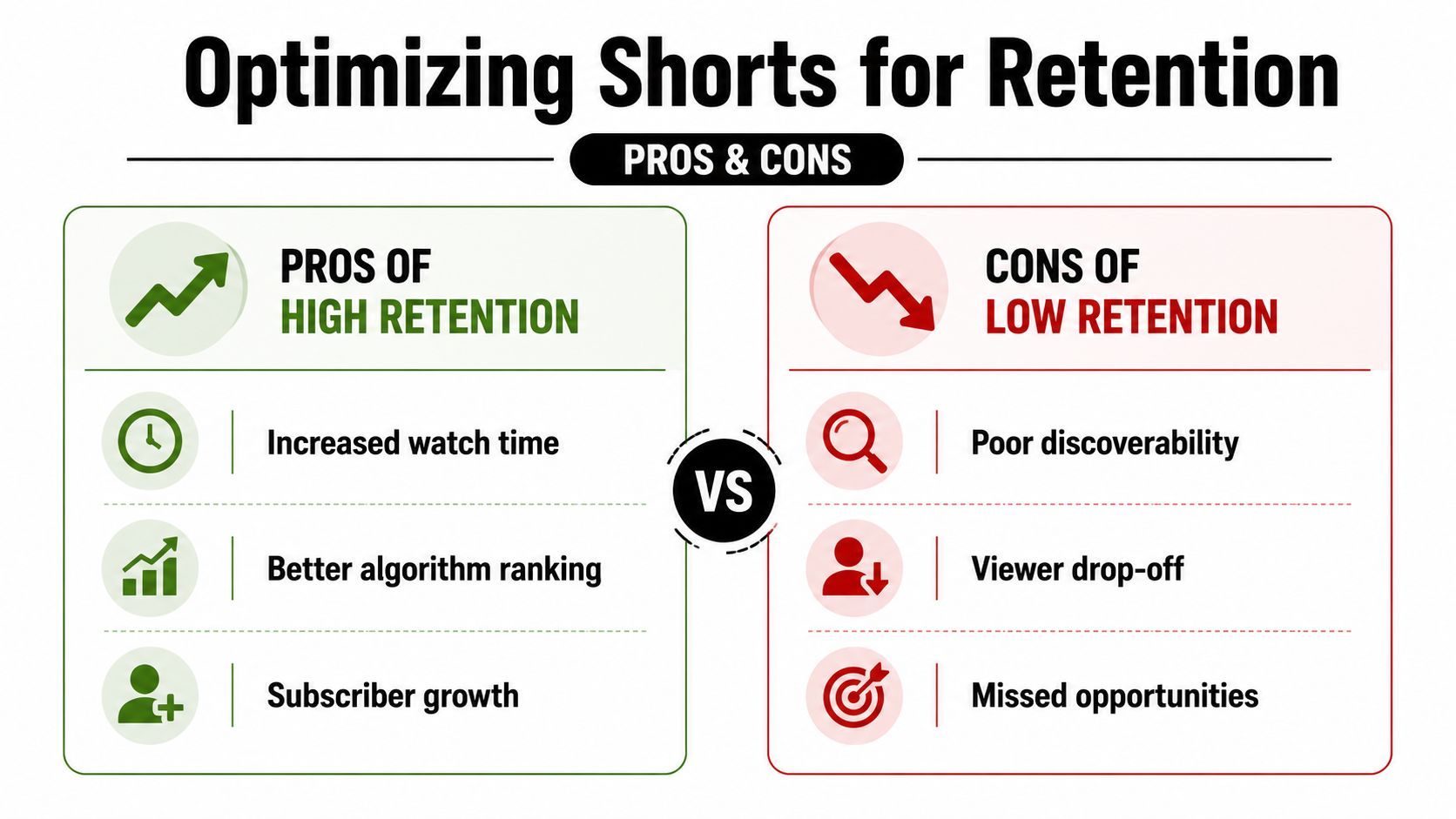
The Foundation Optimizing Shorts for Retention
Promotion starts with the Short itself. If viewers swipe in the first second, distribution only buys you more wasted impressions.
The most important metric here is viewed vs. swiped away. A target of 80 to 85% signals a strong hook, and viewing percentages above 80% are considered strong, according to this breakdown of Shorts retention and hook benchmarks. If you go 90 days with serious promotion and still don't have at least one Short reaching that 80% viewed benchmark, that usually points to a content strategy fit problem, not just a publishing issue.
Read the first two seconds like a diagnostic test
Most underperforming Shorts fail before the audience even understands the value. Open your retention graph and look for what I call the first break point. If viewers leave immediately, the opening frame didn't create enough tension, clarity, or payoff.
Common causes:
- Slow setup: You're warming up instead of starting.
- Context overload: You explain the background before delivering the insight.
- Weak first frame: The visual doesn't stop the scroll.
- Mismatched promise: The title or opening text suggests one thing, but the video begins somewhere else.
Practical rule: If the payoff appears after the viewer has already had to “wait,” the intro is too long.
A lot of creators think the solution is more editing. Usually it's less. Cut the preamble. Lead with the result, the mistake, the visual surprise, or the strongest claim.
Fix early cliffs and middle cliffs
The retention graph usually reveals two different problems.
| Retention pattern | What it usually means | What to change |
|---|---|---|
| Early cliff | The hook failed in the first moments | Start closer to the payoff, replace generic opening text, use a stronger first visual |
| Middle cliff | The pacing drags after the opening | Trim pauses, tighten wording, remove duplicate points, vary visuals faster |
An early cliff means the viewer never bought into the premise. Don't patch that with extra captions or louder music. Rewrite the opening.
A middle cliff means the idea was good enough to earn attention, but the structure lost it. At this stage, creators often over-explain. Shorts reward compression. One insight, one example, one clear ending.
Use a pre-promotion checklist
Before spending money or pushing a Short across other channels, check these points:
- The first frame makes a promise. A face, object, screen, or text line should instantly signal why this matters.
- The first spoken line isn't throat clearing. Cut “so today I want to talk about.”
- The edit removes dead air. Silence, repeated phrases, and visual stalling hurt momentum.
- The Short lands cleanly. A weak ending can flatten rewatch behavior and reduce shares.
- The topic fits the format. Some ideas need long-form context. Don't force them into Shorts.
High view counts can mislead you. Strong Shorts promotion depends more on whether the content holds attention than whether one upload got a temporary spike.
If you want a practical threshold, don't ask, “Did this get views?” Ask, “Did this stop the scroll and keep the viewer long enough to earn the next recommendation?” That question produces better edits, better promotion decisions, and better channels.
Mastering Shorts SEO and Discovery
A Short with solid retention still needs the right metadata. Not because metadata can save weak content. It can't. But because YouTube needs clear signals about who should see the video beyond its first push.
Write titles for clarity first
Most Shorts titles fail in one of two ways. They're either too vague to map to a topic, or too clever to communicate intent.
A strong Shorts title usually does three things at once:
- Names the topic
- Hints at the payoff
- Uses language your audience already uses
That doesn't mean stuffing keywords. It means matching search and browse language. If your Short teaches a tactic, say the tactic. If it solves a problem, say the problem. If it corrects a misconception, lead with the mistake.
Try formulas like these:
- The mistake format: “Most creators ruin Shorts retention with this intro”
- The payoff format: “How to hook viewers before they swipe”
- The comparison format: “Why standalone Shorts beat teaser clips”
Short titles don't need to sound like blog headlines. They need to be specific enough that YouTube can classify them and viewers can recognize the value instantly.
Make descriptions useful for machines
Most viewers won't read your Shorts description. YouTube will.
Use the description to reinforce topic relevance in plain language. Keep it tight. One or two sentences is enough if they clearly restate the core idea, the niche, and the use case.
A practical template:
- Sentence one: Restate the exact lesson or problem.
- Sentence two: Add adjacent terms your niche audience would associate with the topic.
Example structure:
“This YouTube Short shows how to improve hook strength and retention in short-form video. Useful for creators working on YouTube Shorts promotion, audience retention, and subscriber growth.”
For a broader strategic reference, this guide on mastering YouTube Shorts in 2026 from Nereo is worth reviewing because it helps frame Shorts as part of a bigger content engine, not just a standalone posting habit.
Use hashtags as a tiered signal, not decoration
Hashtags still work best when they help categorize, not clutter.
Use a three-layer approach:
- Broad tag: Helps YouTube place the content in a large topic bucket
- Specific tag: Narrows the niche or tactic
- Branded tag: Groups your own recurring series or content theme
Example stack:
- Broad: #YouTubeShorts
- Specific: #ShortsGrowth
- Branded: #CreatorHookLab
Don't overload the field. A messy hashtag block can dilute the signal. Shorts discovery works better when your title, description, and hashtags all point to the same audience instead of trying to chase every possible one.
Strategic Upload and Series Planning
One-off Shorts create one-off results. Series create momentum.
That's the difference most channels miss. They keep looking for a single breakout upload when the stronger play is to make the next Short easier to watch because the previous one already established the premise, tone, and value. That pattern compounds. Viewers recognize the format. YouTube gets cleaner audience signals. You stop reinventing the wheel every time you publish.
Why series beat random uploads
A good Shorts series does two jobs at once. It reduces creative friction for the producer and increases familiarity for the viewer.
If one Short performs, don't “move on” to a completely different concept just because you're bored. Extend the angle. Build variants. Turn one topic into a repeatable structure.
Examples:
- A creator education channel can run “1 hook mistake in 20 seconds”
- A tech channel can run “1 useful setting you should change today”
- A coach can run “1 client mistake I fix every week”
Each format teaches the audience what to expect. That predictability matters. Viewers don't subscribe only because one Short was good. They subscribe because they can see what the next ten videos will likely do for them.
The fastest-growing Shorts libraries usually feel organized, even when the videos are short and casual.
Plan around audience behavior, not generic posting advice
Ignore generic “best time to post” lists. Your channel already tells you more than those articles can.
Look at your own audience activity patterns in YouTube Analytics and answer three practical questions:
- When does your audience appear?
- Which upload windows lead to stronger early retention and interaction?
- Which topics hold attention at different times of day?
Sometimes creators assume timing is the issue when packaging is the primary problem. But timing still matters once your core format works. You want your best Shorts entering the system when your viewers are active enough to send useful feedback quickly.
Build a content calendar that creates a flywheel
A workable Shorts calendar doesn't need to be fancy. It needs to answer four things:
| Calendar element | What to define |
|---|---|
| Series theme | The repeatable content angle |
| Publishing rhythm | The schedule you can actually sustain |
| Format rules | Hook style, visual style, CTA style |
| Review point | When you decide whether to repeat, refine, or retire the idea |
Creators protect themselves from burnout. Random ideation burns energy. Structured variation saves it.
A useful pattern is to batch by series instead of by day. Write several hooks on the same topic, shoot them in one session, then review results together. That makes performance easier to read because the variables are cleaner. You're not comparing unrelated videos. You're comparing controlled variations inside the same concept.
The result is a channel that feels intentional, not noisy. That consistency does more for growth than chasing a viral hit you can't replicate.
Amplifying Reach Beyond the Algorithm
Relying only on the Shorts feed leaves reach on the table. A stronger system treats every Short as an asset that can travel across surfaces, formats, and audience touchpoints.
The key is to avoid turning that distribution into repetitive self-promotion. The best-performing approach isn't “watch my full video.” It's giving enough value in the Short that the viewer wants more on their own.
A useful data point backs that up. A 2024 study of top tech channels found that Shorts built around standalone tips outperformed teaser clips by 3x in converting viewers to long-form subscriptions, as noted in this guide on how to promote YouTube Shorts. That's the practical case for the value-first appetizer model.
Use standalone value, not trailer energy
Teaser clips often fail because they ask for commitment before earning trust. They feel like an ad for another piece of content.
Standalone Shorts work better because they solve a small problem immediately. The viewer gets a complete win, even in under a minute. That creates trust. Trust creates curiosity. Curiosity creates the long-form click and the subscription.
Here's the difference in practice:
- Weak teaser: “I explain the full strategy in my latest video.”
- Value-first Short: “Here's the one reason your hook loses viewers in the first second.”
The second format still promotes the broader channel. It just does it indirectly, by proving competence first.
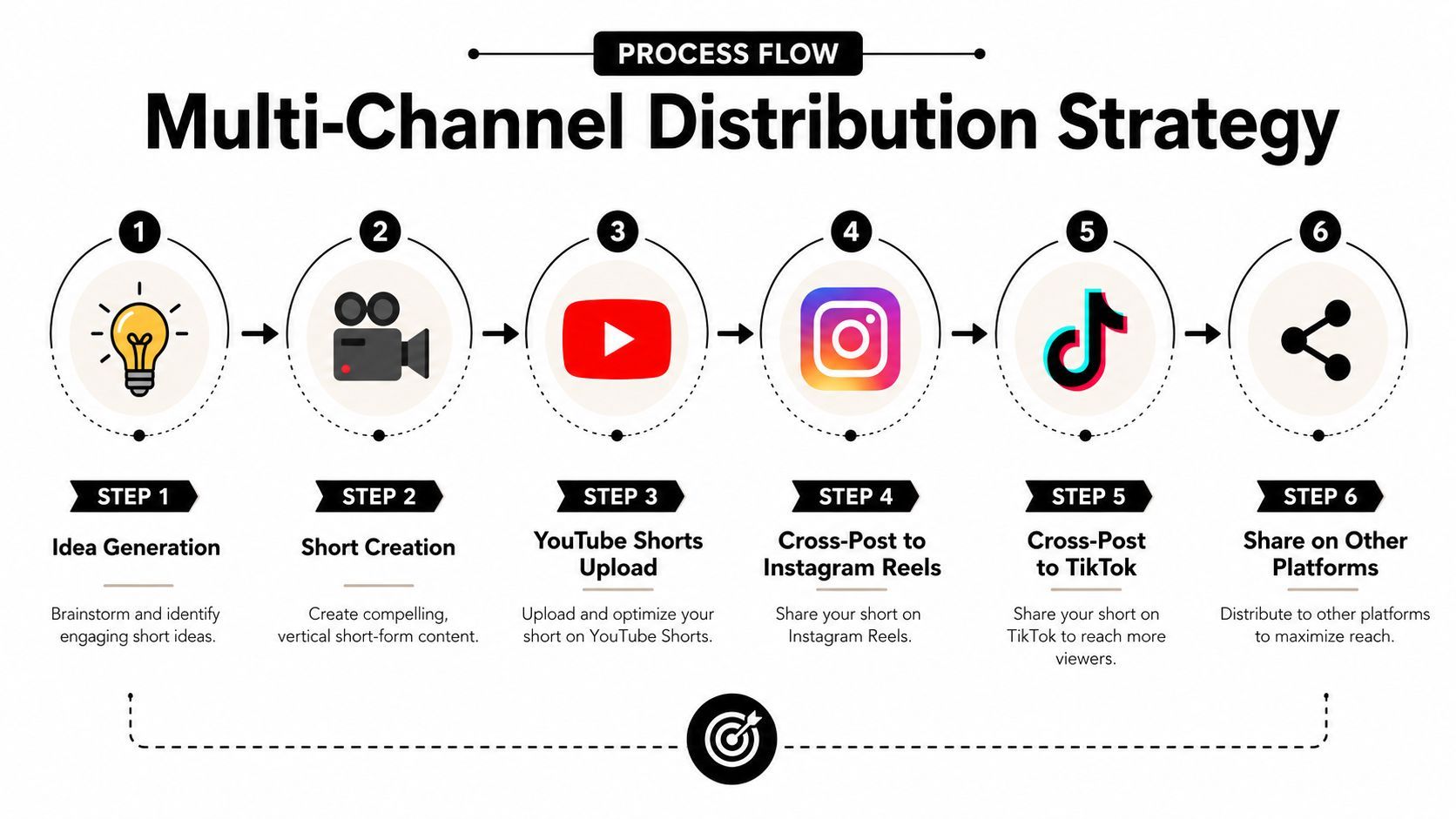
Build one Short, then adapt it outward
Cross-posting works when you adapt lightly instead of duplicating blindly.
A simple distribution system looks like this:
- YouTube Shorts: Use the cleanest educational or entertainment framing
- Instagram Reels: Lean harder into caption readability and visual punch
- TikTok: Let the opening feel slightly more conversational or trend-aware
- Community channels and newsletters: Position the Short as a quick lesson, not just an embed
That doesn't mean re-editing from scratch every time. Usually you only need to adjust the caption style, on-screen CTA, or opening text.
Connect Shorts to your existing channel assets
Most creators underuse the assets they already have.
A stronger promotion loop includes:
- Community tab posts that resurface a Short with a question
- Related long-form links where the Short naturally supports a deeper video
- Pinned comments that guide viewers to the next useful step
- Email newsletters that package several Shorts around a single theme
Don't think of promotion as “getting more views on one clip.” Think of it as building an ecosystem where every piece of content supports the next one.
That's what effective YouTube Shorts promotion really looks like. The algorithm may start the process, but your distribution system decides whether the attention turns into an audience.
Paid Promotion and Measuring True ROI
A Short that converts paid traffic at under 30 cents per subscriber can be worth scaling. A Short that attracts cheap views but weak follow-on watch behavior usually is not. That distinction is what separates useful promotion from wasted spend.
Paid promotion works best as the fifth step in the system, not the first. First, the Short has to hold attention. Then it has to earn clicks into the channel, subscriptions, or another defined action. Only after that should you pay to push it. If the creative is weak, ads just buy faster feedback on a bad asset.
One documented Promotions campaign spent $180 total with a $10/day max and generated 146,000 impressions, more than 2,000 views, and 273 new subscribers, with an average cost of 9 cents per view and 66 cents per subscriber, according to this YouTube campaign breakdown. After optimization, the creator reduced cost per view to below 4 cents and cost per subscriber to below 30 cents. This is the fundamental benefit of paid Shorts promotion. It gives you a controlled testing environment for creative that already shows signs of life organically.
Where paid promotion fits
Use paid distribution for Shorts in three situations.
- Audience testing at speed for a format that already has strong retention
- Monetization acceleration when the channel is close to an eligibility threshold
- Offer validation when the channel supports a product, service, or lead funnel and a subscriber has clear downstream value
The trade-off is simple. Paid reach can increase speed, but it also exposes weak conversion paths fast. If viewers watch the ad, subscribe, and then ignore the next five uploads, the campaign looked efficient on paper and failed in practice.
Measure ROI at the channel level
Cost per view is a starting metric, not a decision metric. The better workflow is to track paid Shorts the same way you would track a customer acquisition channel. Start with the creative. Then measure whether the viewers you bought behave like the viewers you most want.
| Metric | Why it matters |
|---|---|
| Cost per subscriber | Shows whether promotion is building an audience you can reach again |
| Subscriber quality | Helps you verify niche fit instead of collecting broad, low-value signups |
| Post-campaign watch behavior | Reveals whether acquired viewers return for future uploads |
| Monetization proximity | Clarifies whether faster growth changes the business case |
That last point matters. The expanded YouTube Partner Program allows earlier qualification at 500 subscribers, 3 uploads in 90 days, and 3 million Shorts views in 90 days, while full ad revenue sharing requires 1,000 subscribers and 10 million valid public Shorts views in the past 90 days. Creators also receive 45% of their allocated Shorts revenue pool, as noted in the same campaign analysis cited earlier. Those thresholds do not justify running ads by themselves. They do help frame whether paying for faster audience growth has a realistic payoff window.
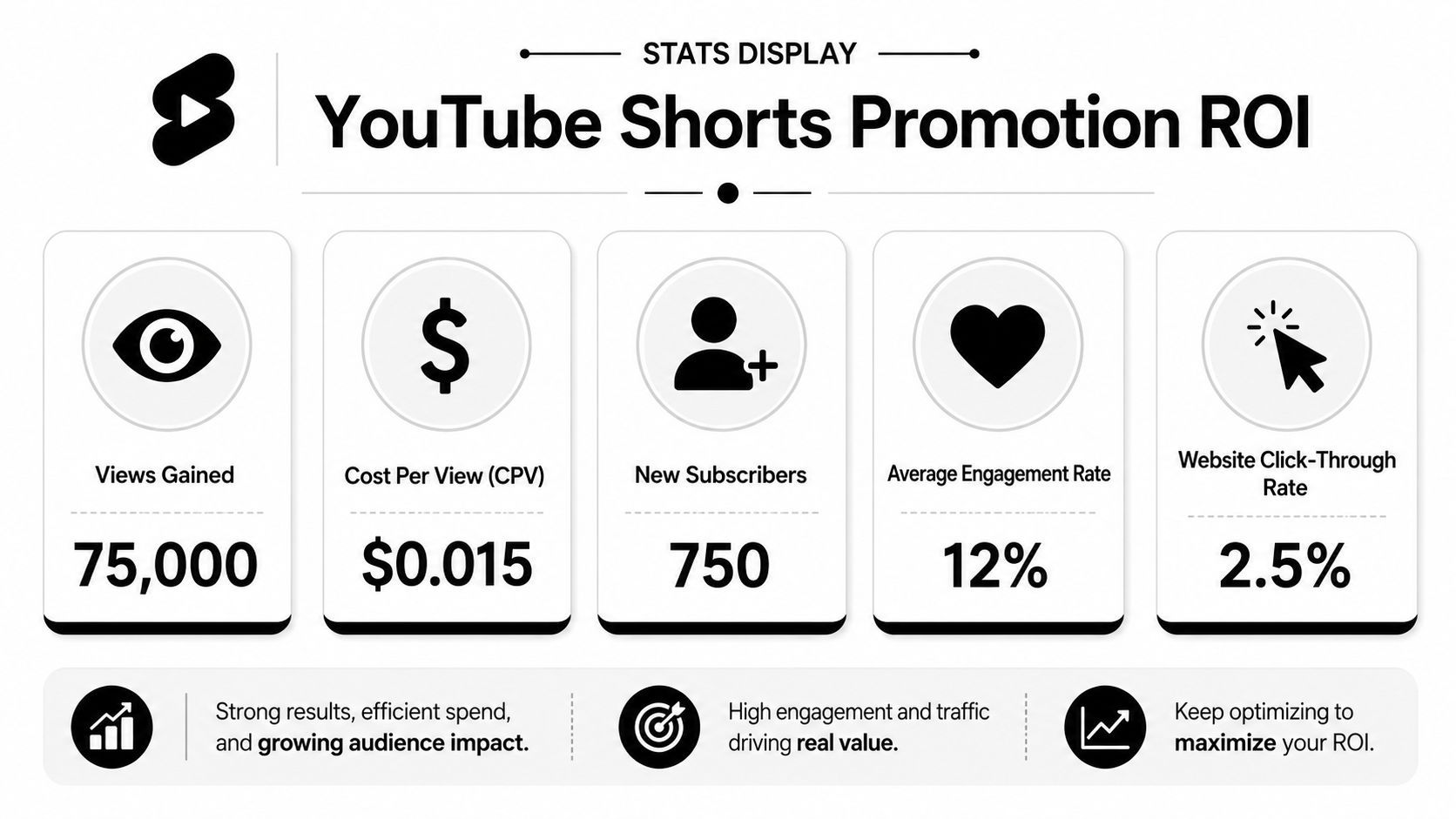
Use campaign data to improve the whole Shorts system
The best operators treat paid promotion as a diagnostic layer. If one Short acquires subscribers cheaply, compare it against your baseline. Look at the first three seconds, the topic framing, the promise, and the audience segment it attracted. Then build the next batch around those patterns.
This is also where systems matter. A tracked workflow inside a Shorts production and testing stack like ShortGenius makes it easier to compare hooks, retention patterns, and conversion outcomes across both organic and paid traffic. That turns promotion into a repeatable input for content decisions instead of a one-off boost.
If Shorts also support sponsorship revenue, brand deals, or creator partnerships, ROI needs a wider lens than ad revenue alone. Sponsor pricing often depends on audience fit, repeat engagement, and category relevance, which is why unlocking YouTube influencer success is useful context for creators who monetize beyond the platform.
Paid promotion should produce two outputs. More qualified viewers now, and better creative decisions on the next round.
Scaling Your Shorts Production Workflow
A Shorts strategy stops growing when execution stays manual. The bottleneck is rarely ideas alone. It is the handoff between ideation, scripting, recording, editing, publishing, and review. If that chain breaks at any point, upload volume drops, testing slows down, and promotion gets less efficient.
The fix is not producing more content at any cost. The fix is building a workflow that keeps quality stable while increasing output.
Build a repeatable production stack
Teams that scale Shorts well usually standardize five layers of the process.
-
Capture ideas by content role
Store hooks, objections, tutorials, product angles, and story formats in separate buckets. This makes it easier to match a strong topic with the right opening instead of writing every Short from scratch. -
Use script frameworks, not fixed scripts
Keep a few proven structures ready, such as problem to solution, myth to correction, before versus after, and quick demonstration. Frameworks speed up production without making every video sound the same. -
Batch recording by setup
Film multiple Shorts with the same camera angle, lighting, wardrobe, and energy level in one session. That cuts setup waste and usually leads to more consistent pacing on camera. -
Build a reusable asset library
Save B-roll, caption styles, text overlays, transitions, and approved sound beds in one place. If legal audio slows down editing, this music guide for content creators can help tighten that part of the workflow. -
Review performance at the format level
Do not just ask which Short got views. Ask which hook style, topic category, edit pace, and CTA pattern produced the best retention and subscriber conversion. That is how a content workflow turns into a testing system.
This process works because it reduces low-value decisions. Creative energy goes into stronger angles, clearer hooks, and better audience targeting.
Use AI for throughput, not for generic content
AI helps most when it removes repetitive work that does not improve the idea itself. Good uses include generating hook variations, creating first-pass captions, resizing assets for multiple platforms, assembling rough cuts, and scheduling posts across channels.
The trade-off is real. The more AI touches your workflow, the easier it is to publish content that feels flat or interchangeable. Keep the strategic parts human. Topic selection, opening promise, proof, and final edit judgment should stay close to the creator or strategist.
A connected system makes that easier to manage. A Shorts creation and scheduling workflow in ShortGenius can centralize scripting, editing, testing, and publishing so the team spends less time jumping between tools and more time improving what drives results.
A quick demo helps make the production side more concrete:
The strongest Shorts operators do not scale by pushing harder every week. They scale by turning promotion, production, and performance analysis into one system that gets sharper with each batch.