What Is the Most Viewed YouTube Shorts: 2026 Record Holder

Learn what is the most viewed youtube shorts as of 2026. We break down the record-breaking stats of ColinAmazing and tips for going viral on the platform.
“BEST Duo Trick Shots” by @ColinAmazing is the most viewed YouTube Short, with 4.66 billion views as of March 10, 2026. That's the direct answer, but it's also the least useful way to understand what is the most viewed youtube shorts, because the record keeps moving and stale articles fall behind fast.
Much advice regarding viral Shorts rests on a flawed assumption. People treat the leaderboard like a static hall of fame, as if one magic format cracked the code once and everyone else should copy it. That misses the actual story. The record changes because YouTube Shorts is now large enough, fast enough, and global enough to keep producing new outliers.
The creators who learn from that dynamic do better than the ones who memorize one champion video. They stop asking only, “What's number one?” and start asking better questions. What kind of format survives broad distribution? What travels across languages? What makes a Short rewatchable enough to keep compounding long after upload?
The Unstable Throne of the Most Viewed YouTube Short
If you search what is the most viewed youtube shorts, you'll find a lot of confident answers that are already outdated. The current record holder, according to Guinness World Records' listing for the most viewed YouTube Shorts video, is “BEST Duo Trick Shots” by @ColinAmazing with 4.66 billion views as of March 10, 2026.
That figure matters, but the shift matters more. A popular roundup from an earlier period could name a totally different leader with less than half that count. The gap tells you something important about Shorts. Rankings don't freeze when an article is published. They keep moving because the distribution system keeps testing videos against fresh audiences.
Why static answers fail
Most “most viewed” articles break because they answer a live question with a dead snapshot. They publish a title, lock in one winner, and never explain the timestamp problem.
A smarter way to read any leaderboard is this:
- Check the date: A Shorts ranking without a date is weak evidence.
- Check the method: Some lists track current public counts, others summarize older snapshots.
- Check whether the clip is still compounding: Shorts can keep getting served long after the first wave.
Practical rule: Treat “most viewed” as a time-stamped record, not a permanent truth.
What the moving record tells creators
This instability isn't noise. It's a clue. It means YouTube Shorts still allows massive delayed upside for videos that fit the system well enough.
That changes how creators should think. The goal isn't to chase one passing viral moment. The goal is to build assets that can keep re-entering recommendation cycles. The top of the chart is less like breaking news and more like an endurance contest for highly rewatchable formats.
A creator who understands that will design for replay, clarity, and broad appeal. A creator who doesn't will keep copying trends that burn out before they compound.
Case Study The Current Champion's Viral Formula
“BEST Duo Trick Shots” didn't reach the top by being complicated. It likely won because it's easy to process, easy to replay, and satisfying without explanation. That's the pattern seasoned YouTube strategists should notice first.

Trick shots are strong Shorts material because the viewer understands the premise immediately. No setup is required. No language barrier gets in the way. The viewer sees a challenge, anticipates an outcome, and gets a payoff in seconds.
Why trick shots scale so well
This format compresses the entire entertainment arc into a tiny window.
- Instant premise: People know what success looks like at a glance.
- Built-in suspense: The shot either lands or it doesn't.
- Clear payoff: The result creates a small hit of surprise or satisfaction.
- Replay value: Viewers often rewatch to confirm what they saw.
That's a rare combination. Many creators can get one of those elements. Few formats deliver all four at once.
The hidden strength is loopability
The best Shorts don't just earn one watch. They reduce friction between one watch and the next. Trick-shot videos are especially good at this because the ending often sends the viewer mentally back to the start. They want to inspect the mechanics, timing, or improbable finish one more time.
A Short doesn't need dialogue if the action itself creates a question and then answers it.
That's why visual precision matters more than verbal explanation in this tier of performance. If the clip works with the sound low, on a small screen, and in any country, it has a far better chance of surviving YouTube's broad distribution testing.
What ambitious creators should copy, and what they shouldn't
Don't copy the surface. Copy the mechanics.
A weak imitation says, “I should make trick shots.” A better analysis says, “I should build a format with immediate clarity, compressed suspense, and replayable payoff.” Those are not the same thing.
Here's the practical takeaway from the current champion:
| Element | Why it matters |
|---|---|
| No explanation needed | Reduces viewer drop-off at the start |
| One visual objective | Makes the clip easy to follow |
| Fast reward | Gives the viewer a reason to stay |
| Rewatch trigger | Helps the clip keep compounding |
That framework applies far beyond sports content. You can use it in comedy, transformation clips, illusion content, product demos, and family-friendly visual setups.
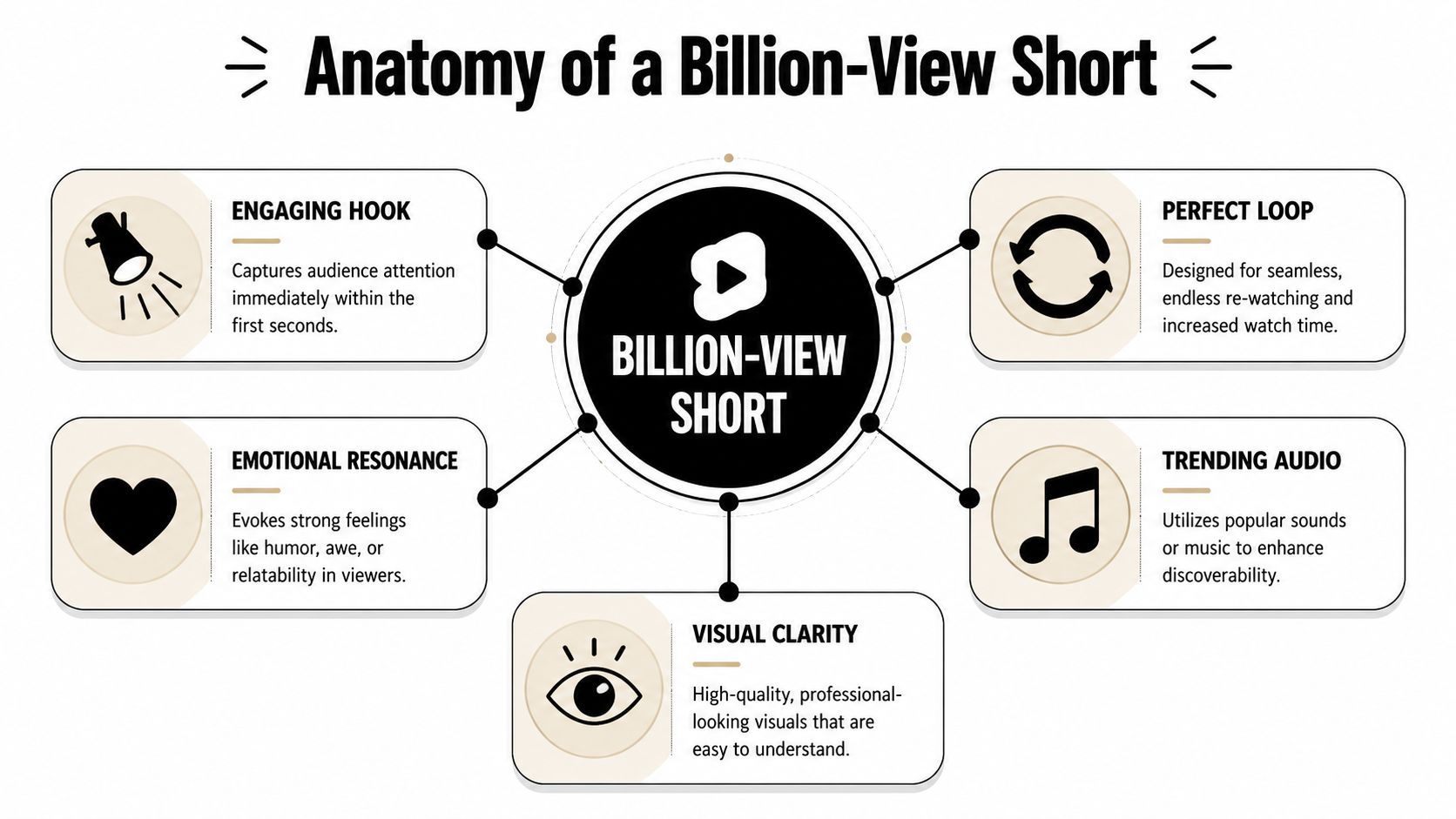
The Anatomy of a Billion-View YouTube Short
A billion-view Short usually looks simple because complexity has been stripped out of it.
That is the pattern hiding in the leaderboard. According to Wikitubia's list of the most-viewed YouTube Shorts, top entries include “Spider - Man VS T - Rex” at about 3.08B views and “Maa Kitna Khayal Rakhti Hai Giggy Ka 🤗❣️” at about 3.07B views. Those videos target different emotions and audiences, yet they share the same structural advantage. A viewer can grasp the premise almost instantly, stay through the payoff, and often watch again without effort.
The five traits that keep showing up
Across categories, the biggest Shorts tend to share five underlying traits:
- Instant visual comprehension: the viewer understands the setup in the first beat.
- Emotion without translation: surprise, affection, tension, or absurdity reads across languages.
- Minimal context load: no backstory is required to care about the outcome.
- Format repeatability: the concept can produce multiple variations without losing clarity.
- Cross-market portability: the same clip can travel from local audiences to global ones.
This is why the all-time leaders span stunts, family moments, visual effects, comedy, and simple physical scenarios. Genre changes. The viewing mechanics stay consistent.
Why broad readability scales harder than originality
Creators often overrate novelty and underrate legibility. On Shorts, the distribution system tests content with viewers who do not know the creator, do not share the same language, and may be watching with sound off. In that environment, a clever idea with heavy context has a smaller ceiling than a straightforward idea with immediate payoff.
That helps explain why repeatable, evergreen formats keep resurfacing near the top of the leaderboard. Some record-setting clips feel almost too obvious in hindsight. That is part of the point. If the concept survives first contact with a cold audience, YouTube can keep widening distribution.
Strategic insight: Context is friction. Every extra second needed to understand the premise reduces how far a Short can travel.
A useful way to examine this pattern beyond one leaderboard snapshot is ProdShort's video trend report, which connects recurring short-form formats to broader audience behavior across platforms.
A practical scoring framework for creators
Before publishing, test the idea like a strategist instead of a fan:
- Is the premise visible before it is explained?
- Does the emotional reaction register on a small screen?
- Can a first-time viewer follow the entire clip with the sound low or off?
- Is there a clear payoff, reversal, or reveal worth waiting for?
- Can this format generate a series instead of one hit?
A concept that scores well on all five is built for reach. A concept that fails three or four may still please existing followers, but it is less likely to compete for all-time scale. That distinction matters if the goal is not just views, but leaderboard-level views.
A Brief History of Shorts Records and Platform Growth
The fastest way to misunderstand the most viewed YouTube Short is to treat the title like a fixed fact. It behaves more like a market price. The leader changes because the platform underneath it keeps expanding, and every surge in distribution raises the ceiling for what a single clip can do.
That historical context matters more than the name at the top of any one leaderboard. A clip that looked untouchable in an earlier phase of Shorts can look transitional a year later, not because it became less impressive, but because YouTube gave the format a much larger audience pool and more recommendation inventory.
The platform got large enough to produce extreme winners
LoopEx Digital's YouTube Shorts statistics estimates that Shorts generated over 9 trillion cumulative views by late 2025, with more than 200 billion daily views and roughly 2 billion monthly users. At that scale, all-time records stop being rare anomalies. They become a predictable output of a recommendation system testing huge volumes of content against huge volumes of attention.
That changes how creators should read the leaderboard.
A record-setting Short is partly a content event and partly a distribution event. The format matured at the same time YouTube kept increasing user adoption, watch frequency, and feed velocity. That combination creates more chances for a clip with broad appeal to keep getting reintroduced to fresh viewers long after its initial spike.
How the record pattern changed
A simple timeline explains the shift:
| Period | What changed |
|---|---|
| Early Shorts era | Billion-view clips established the category and looked unusually large relative to the platform |
| Expansion phase | New records became easier to imagine because Shorts distribution widened and audience volume increased |
| Current era | The top spot is unstable because multiple formats can now reach record territory under the right distribution conditions |
The useful conclusion is not just that Shorts got bigger. It is that leaderboard volatility is now part of the product. A moving target tells you the platform is still creating new surface area for breakout clips.
Why old Shorts can return to relevance
This also explains why some older Shorts keep resurfacing. If the premise remains clear without context and the payoff still works on a cold viewer, YouTube can test that clip again against newer audience cohorts. A Short does not need to be new to grow. It needs to stay legible and satisfying inside the feed.
Creators using AI should pay attention to that durability. Tools that help with ideation, fast variation, and version testing are most useful when applied to formats with replay value, not one-off novelty. A workflow built around AI short-form video testing and creation tools is stronger when the concept can survive repeated distribution cycles. That is also why creator guides on how to automate social media clips matter more now than they did in the early Shorts era. Volume and iteration have become part of the competitive advantage.
The most viewed Short is not only the best-performing clip of a moment. It is the best-performing clip inside the largest short-form distribution machine YouTube has ever built.
History makes one point clear. The throne keeps moving because the platform keeps growing, and the creators who benefit are usually the ones building for repeat exposure rather than a single viral spike.
How to Engineer Your Own Viral Shorts with AI
AI matters less at the idea stage than at the testing stage. The creators who gain an edge are usually the ones who can turn one promising format into ten clean variations, then learn from the response fast.
That distinction matters because the top of the Shorts leaderboard is unstable. If the winner keeps changing, creators should stop asking for a single formula and start building a repeatable system for producing, testing, and refining ideas that fit how Shorts are consumed. AI helps with speed, coverage, and consistency across that loop.
Build around a format that can survive repeated testing
A useful workflow starts with format selection, not brainstorming prompts. Shorts that travel widely tend to have a clear viewing mechanism: a reveal, a stunt, a visual contradiction, a challenge, or an immediate before-and-after. Once that mechanism is obvious, AI can help you produce variations without drifting away from what made the concept strong in the first place.
A practical sequence looks like this:
-
Define the watch driver
Identify what creates tension or curiosity in the clip. If you cannot name the mechanism in one line, the concept is usually too vague. -
Generate several hook options
Use AI to draft multiple openings built around the same payoff. Then choose the version that makes sense fastest without explanation. -
Storyboard for silent viewing
A strong Short should still work with the sound off. Visual planning tools help simplify the sequence until the premise is obvious at a glance. -
Edit for compression
Remove shots that explain instead of show. In high-performing Shorts, every second either builds anticipation or delivers payoff. -
Create controlled variants
Change one variable at a time: first frame, caption, pacing, or visual order. That makes the result easier to interpret after posting.
Purpose-built tools can save time in this context. A platform for AI short-form video testing and creation workflows can reduce the production drag between idea, variant, edit, and upload.
Use AI where the bottleneck is operational
The strongest AI use cases in Shorts are rarely flashy. They solve throughput problems.
- Hook variation: Produce multiple first-second options around one concept.
- Series expansion: Turn one working premise into a repeatable format.
- Captioning and reframing: Adapt the same asset for different feeds and aspect requirements.
- Visual swaps: Test alternate scenes while keeping the same core structure.
- Batch production: Build a pipeline of experiments instead of betting everything on one upload.
That is also why guides on how to automate social media clips are useful. They treat AI as a production system for clipping, formatting, and iteration, not as a button that magically creates a hit.
Protect the creative judgment layer
AI can increase output. It cannot reliably identify the strongest human payoff on its own.
That final choice still belongs to the creator: which version feels clearest, which moment earns the replay, which cut makes the joke, stunt, or reveal land instantly. The repeatable advantage comes from combining machine speed with selective judgment. High-volume testing without taste produces generic Shorts. Taste without output usually produces too few shots on goal.
Execution rule: Use AI to increase the number of quality experiments, then apply human judgment to the hook, payoff, and final cut.
A useful walkthrough of the production mindset looks like this:
The practical goal is not to automate originality. It is to shorten the distance between a promising idea and a tested, publishable Short. Creators who treat AI that way usually build something more valuable than one viral clip. They build a system that can keep producing contenders while the leaderboard keeps changing.
Your Next Short Could Be the One
A record-holder is useful as a clue, not as a template.
The practical takeaway from the Shorts leaderboard is that breakout clips tend to compress three things into a few seconds: a premise anyone can decode instantly, a payoff that reads without explanation, and a structure that rewards rewatching. That combination matters more than the current #1 title because the top spot keeps changing as the platform grows, viewing behavior shifts, and new formats spread faster across global audiences.
The scale at the top also changes how creators should value the format. As noted earlier, the biggest Shorts are not disposable posts that spike for a day and disappear. They can become long-lived audience assets that keep collecting views, comments, shares, and subscriber momentum long after publication.
What to carry into your next upload
A stronger Shorts strategy usually comes from a small set of disciplined decisions:
- Choose instantly legible ideas. If a viewer needs context, the hook is already weak.
- Make the payoff visual. The audience should see the reward, surprise, or transformation without waiting for explanation.
- Build around formats, not one-offs. A repeatable concept gives you more shots at breakout distribution.
- Audit the first second. Strong Shorts start with motion, tension, novelty, or a clear question.
Passive viewing does not produce better Shorts. Diagnosis does.
Study high-performing clips like an operator. What is the viewer supposed to understand in the first beat? Where does curiosity rise? What makes the ending satisfying enough to replay? Those questions reveal patterns that travel across niches, from comedy to stunts to education.
That is also where ambitious creators separate themselves. They do not treat virality as a lucky event. They treat it as a testing problem. More specifically, they build concepts that can survive contact with cold audiences, then use fast production workflows to iterate on hooks, pacing, captions, and visual clarity until one version breaks through.
Creators who win consistently build formats that can produce multiple contenders, not one clip they hope the algorithm rescues.
That approach matters even more now because AI has changed the economics of experimentation. A creator who can script faster, generate variations, and publish more high-quality tests has a real distribution advantage, but only if the underlying idea is strong enough to earn attention on sight.
Your next Short does not need to copy the current champion. It needs to borrow the principles behind every champion, then apply them with better speed, sharper judgment, and more iterations.