Video Distribution Platform: A Guide for Creators & Brands

Discover what a video distribution platform is, how it works, and how to choose the right one to scale your content across every channel efficiently.
You finish editing a strong video. The hook lands. The captions are clean. The pacing feels right. Then the actual work starts.
You open TikTok, YouTube, Instagram, Facebook, and maybe X. Each platform wants a different aspect ratio, caption style, title length, thumbnail, posting rhythm, and sometimes a slightly different version of the same creative. By the time you've uploaded everything manually, the part that was supposed to create reach has turned into repetitive admin.
That's where a video distribution platform starts to matter. It isn't just a place to store a file. It's the system that turns one finished asset into coordinated publishing across channels, with the metadata, formatting, delivery, and reporting handled in a way you can scale.
The timing makes sense. The global online video platforms market is projected to grow from USD 12.4 billion in 2024 to USD 117.35 billion by 2034, at a 25.20% CAGR, according to Market.us research on online video platforms. That projection tells you something practical. Serious creators and brands are moving away from scattered, manual workflows and toward centralized software that manages and monetizes video across channels.
Beyond Publish The Challenge of Modern Video Content
A lot of creators think they have a content problem when they in fact have a systems problem.
A solo creator records one useful tutorial. A brand team produces one product demo. An agency cuts one ad concept into a few variants. In each case, the hard part should be the strategy and the creative judgment. But many teams still spend a surprising amount of time on renaming files, rewriting descriptions, resizing exports, checking whether the right caption was pasted into the right field, and trying to remember what went live where.
That's manageable when you post occasionally. It breaks down when you publish every day.
Where the workflow starts to crack
The modern video ecosystem is fragmented by design. Every platform has its own native behavior. A vertical clip that feels natural on TikTok might need different framing on YouTube Shorts. A polished explainer that works on YouTube may need a faster opening and heavier on-screen text for Instagram Reels. The same core message can travel, but the packaging usually can't stay identical.
People often get confused. They assume distribution means “copy and paste the video everywhere.” It doesn't. Distribution means building a repeatable process for adapting, publishing, and learning from the same core asset across multiple destinations.
Practical rule: If publishing the same video to five places feels like doing the same job five different times, you don't have a distribution system yet.
The challenge gets bigger once AI enters the workflow. AI can help you script, storyboard, generate visuals, assemble scenes, and create voiceovers quickly. But speed in creation creates a new bottleneck in publishing. If you can make content faster than you can organize and distribute it, your output rises while your operation gets messier.
Why manual posting stops working
Manual workflows create three quiet problems:
- Inconsistency builds up: Titles, tags, descriptions, and thumbnails drift across platforms.
- Repurposing becomes guesswork: You know you should adapt content for each channel, but you don't have a clean system for doing it.
- Performance lives in silos: One platform tells you one story, another tells you a different story, and you never get a clear view of what the content is doing as a whole.
A video distribution platform solves that by acting as the layer between creation and audience reach. It helps you keep one source of truth, push content outward in channel-ready formats, and bring the resulting performance signals back into one place.
That's the shift. Publishing is a task. Distribution is an operating model.
What Is a Video Distribution Platform
A video distribution platform is best understood as a logistics hub for your content.
Think of a warehouse and shipping center used by a modern retail brand. Inventory comes in once, gets organized, labeled, packaged for different destinations, and then routed through different carriers depending on where it needs to go. The brand doesn't rebuild the product every time someone places an order. It uses a system.
Video works the same way. You create or upload a master asset once. The platform helps store it, prepare it for different channels and devices, send it where it needs to go, and collect the performance data afterward.
The business importance is hard to ignore. The video streaming market was valued at USD 129.26 billion in 2024 and is projected to reach USD 416.8 billion by 2030, based on Grand View Research's video streaming market analysis. Distribution infrastructure sits underneath that growth.
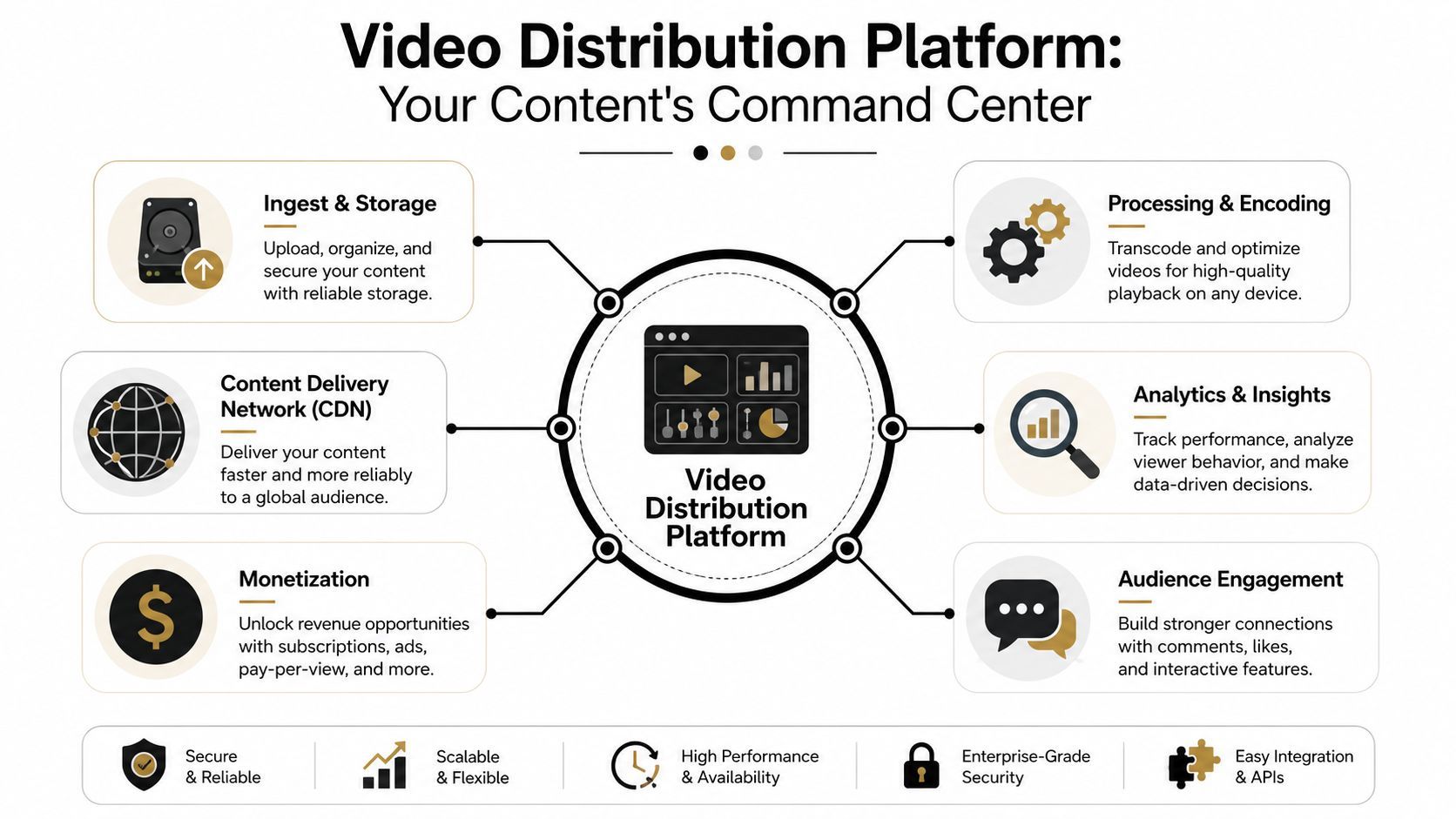
The centralized content hub
At the core is a single source of truth.
The platform houses your master files, thumbnails, captions, metadata, and versions. Instead of hunting through folders, cloud drives, editing tools, and social schedulers, you work from one organized library. That matters more than it sounds. Once content starts multiplying, version control becomes a real problem.
A strong hub answers simple but important questions fast:
- Which version is approved
- Which thumbnail belongs to which cut
- Which title and description should stay consistent
- Which asset has already been repurposed
Without that center, creators often rebuild context from scratch every time they publish.
The multi channel publishing engine
The second pillar is delivery.
A true video distribution platform doesn't stop at hosting. It prepares content for the places your audience watches. That may include social platforms, websites, apps, or owned video libraries. The platform handles scheduling, formatting, packaging, and pushing the content out through the appropriate destination.
This is what separates it from a private hosting account or a lightweight social scheduler.
| Tool type | Main job | Limitation |
|---|---|---|
| Basic host | Stores and plays video | Doesn't manage full multi-channel publishing workflows well |
| Basic scheduler | Posts to social channels | Usually treats each post as a separate task, not part of a unified content system |
| Video distribution platform | Manages, adapts, publishes, and tracks video across channels | Requires more thoughtful setup, but supports scale |
The unified intelligence layer
The third pillar is feedback.
A platform becomes strategic when it brings results back into one view. You can compare how the same creative idea performs in different environments, rather than reading each platform in isolation. That helps you spot useful patterns. Maybe a concept earns deeper watch time on YouTube but stronger initial engagement on TikTok. Maybe one thumbnail style travels better across platforms than another.
A distribution platform earns its keep when it reduces repeated manual work and increases clarity about what to make next.
That's why the category matters. It's not just a publishing convenience. It's an operating system for multi-channel video.
How Modern Distribution Platforms Work Under the Hood
Most of the magic happens after you upload the file.
From a creator's point of view, you press upload and expect the video to play smoothly everywhere. Behind the scenes, the platform has to do a lot of work to make that happen. It needs to prepare multiple versions of the file, organize how those versions are delivered, and make sure viewers with different devices and internet speeds all get a usable experience.
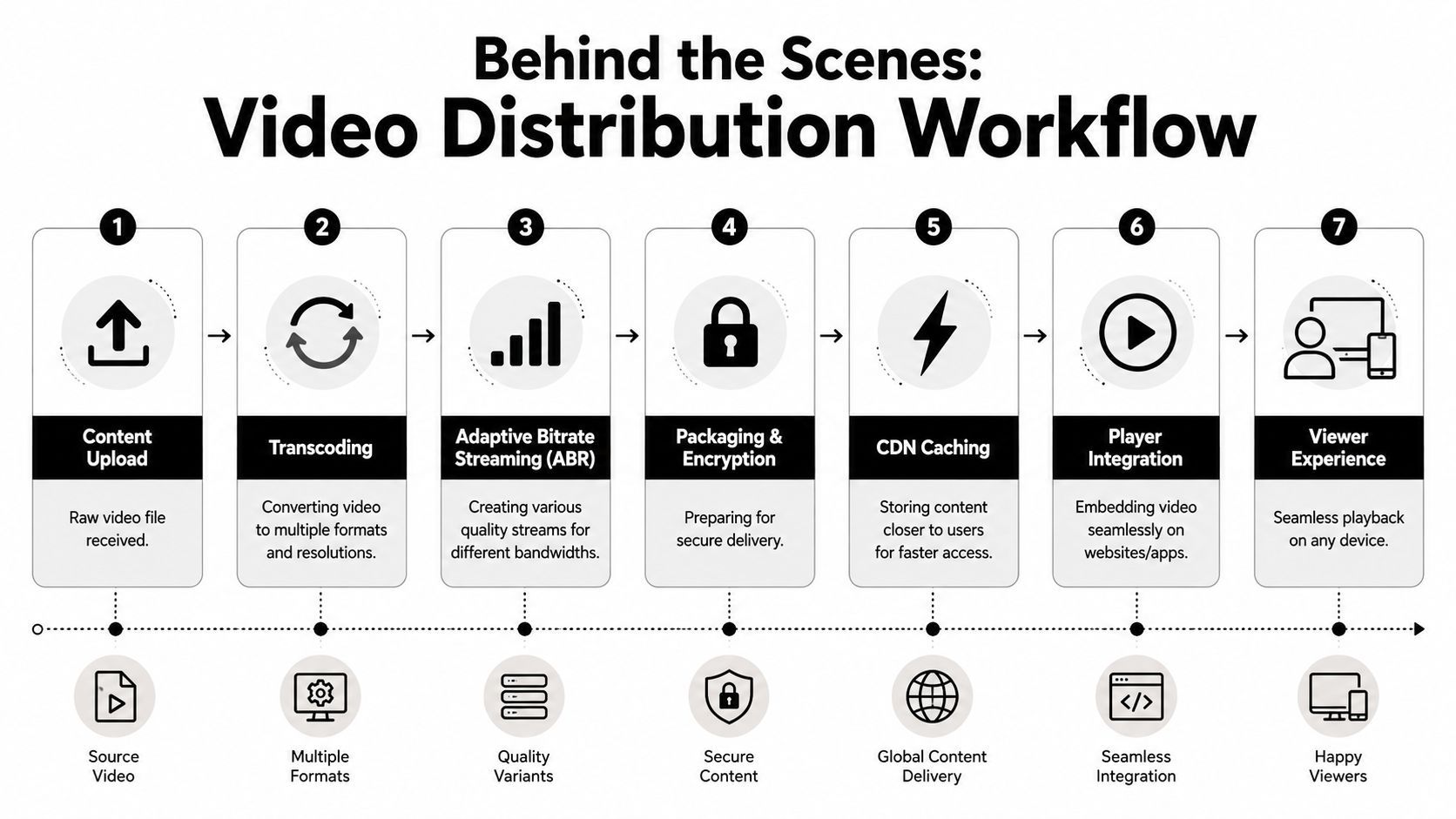
One upload becomes many delivery versions
When you upload a master video, the platform usually doesn't serve that original file directly. It transforms it into multiple sizes, resolutions, and bitrates. This process is called transcoding.
A simple analogy helps. If your source file is a single recipe, transcoding is the kitchen preparing that recipe in different portion sizes for different customers. A phone on weak mobile data doesn't need the same file version as a smart TV on fast home internet.
That processing speed matters. In Abstract Algorithms' system design breakdown of video streaming, a transcoding pipeline that splits a video into chunks and processes them in parallel can reduce a 6-hour transcoding job to about 6 minutes. That's a huge operational difference when you're publishing at volume.
Adaptive Bitrate Streaming keeps playback smooth
Once multiple quality versions exist, the player can switch between them while the viewer watches. This is Adaptive Bitrate Streaming, often shortened to ABR.
Think of ABR like a navigation app rerouting you during traffic. The destination stays the same. The route changes in real time so the trip stays smooth. If the viewer's connection weakens, the player shifts to a lower-quality segment. If bandwidth improves, it moves up again. The viewer keeps watching instead of staring at buffering.
That's why a good platform doesn't just “host videos.” It actively manages playback quality moment by moment.
Smooth viewing usually depends less on one perfect file and more on a system that can adapt while the video is already playing.
CDNs move the video closer to the viewer
The next concept that confuses people is the Content Delivery Network, or CDN.
A CDN is a distributed network of servers that stores copies of video content closer to where viewers are located. If everyone had to fetch every segment from one origin server in one place, playback would slow down during high demand. A CDN spreads that load across edge locations.
A helpful mental model is a chain of local fulfillment centers. Instead of shipping every order from one warehouse, the system places inventory near customers ahead of time.
According to a technical architecture deep dive on building a video streaming platform, the core mechanics include a bitrate ladder, segmentation into short chunks, and a manifest file that tells the player where those chunks live. Add caching layers and asynchronous background processing, and the system can serve large audiences without turning the origin server into a bottleneck.
The practical workflow creators experience
From your side, a modern workflow often looks like this:
- Upload the master asset once.
- Transcoding creates channel-ready variants for different playback conditions.
- Metadata gets attached so the content carries the right title, caption, tags, and identifiers.
- Scheduling and publishing rules push the asset out to the selected destinations.
- Viewer behavior and platform performance flow back into one reporting view.
That sequence matters because it turns one file into a scalable publishing unit. For creators using AI, this is the missing bridge. AI may generate the asset quickly, but distribution architecture is what makes that asset usable across the internet.
Key Features That Drive Creator Growth
The difference between a tool you outgrow and a system that supports real publishing volume usually comes down to a few features. Not flashy ones. Operational ones.
Creators often shop for distribution tools by asking, “Can it post to all my channels?” That's a fair starting point, but it's too narrow. Posting is the baseline. Growth comes from how well a platform helps you adapt content, preserve context, and learn across channels.
Multi channel scheduling is the floor, not the ceiling
Scheduling matters because consistency matters. If your workflow depends on being online at the exact moment every post should go live, your publishing cadence won't hold for long.
But scheduling alone doesn't solve the deeper problem. Many social tools queue separate posts to separate channels. That still leaves you doing the strategic work manually. You're still managing versions in your head.
A better system connects the publish action to the asset itself. The caption, visual variant, aspect ratio, and destination all live in one coordinated workflow.
Repurposing is where a lot of growth comes from
This is one of the most common creator questions: how do you post the same core idea to multiple platforms without making it look repetitive or triggering algorithmic issues?
The useful answer is not “make it different somehow.” The useful answer is structured adaptation.
According to Zype's guide to video content distribution platforms, 65% of successful multi-channel strategies involve repurposing core assets with platform-specific tweaks. That might mean changing the opening frames, resizing the composition, rewriting the caption, adjusting subtitle density, or swapping the thumbnail logic depending on the platform.
Here's what that looks like in practice:
- For TikTok: Open faster. Put the payoff or tension early.
- For YouTube Shorts: Keep the title and first line of context more searchable.
- For Instagram Reels: Use cleaner visual framing and stronger on-screen text for silent scrolling.
- For Facebook: Package the clip with more direct context if the audience is colder.
That's why a centralized content library matters. If your raw material, edits, captions, and alternate hooks all live in one place, repurposing becomes a workflow instead of a scramble.
The fastest-growing creators usually aren't making brand-new ideas for every platform. They're building stronger systems for reusing the same idea intelligently.
Optimization tools reduce friction between idea and publish
This is where integrated AI workflows start to matter. If your platform can help draft titles, generate descriptions, create captions, swap aspect ratios, and manage variant exports, you remove a lot of low-value production friction.
The gain isn't just speed. It's consistency.
A creator who can rapidly test one concept in several channel-specific forms learns faster than a creator who posts one version and hopes it works everywhere. For teams managing client accounts or brand portfolios, optimization tools also reduce handoff problems. Everyone works from the same asset set and the same publishing logic.
If you want a broader complete guide for creators and brands on the business side of creator workflows, that resource is useful alongside the distribution lens.
Unified analytics changes what you learn
When each platform reports separately, you end up optimizing for whatever dashboard you checked most recently. Unified analytics creates a better feedback loop.
You can ask smarter questions:
- Which hook style travels well across multiple channels
- Which topics earn engagement quickly versus sustained watch behavior
- Which platform is best for discovery and which is better for deeper consideration
- Which creative elements are worth standardizing
That's the key growth driver. Not more posting for its own sake. Better decisions because your publishing system preserves context and returns usable signals.
How to Choose the Right Video Distribution Platform
A creator finishes one strong video on Monday. By Friday, that same idea needs to exist as a vertical short, a square cutdown, a captioned version for silent viewing, a platform-specific post with the right title and tags, and a scheduled asset the team can still find two months later.
That is the selection problem.
Choosing a video distribution platform starts with a simpler question than feature comparison. Where does your workflow break today? For some teams, the problem is scheduling. For others, it is version control, missing metadata, scattered assets, or the gap between AI-generated content and actual publishing.
A solo creator posting daily shorts will judge a platform differently than a media brand with an archive, approval steps, and multiple destinations. An agency has another layer to manage. Client accounts, repeated formats, and a higher cost when naming or publishing details drift out of sync.
Three categories to evaluate
A useful comparison starts with the job each category is built to do.
Basic social schedulers
These tools help with calendars, queues, and posting cadence. They are a good fit if your main challenge is getting approved content live on time across several social accounts.
They usually start to strain when one source video turns into many variants. If your team needs to track captions, thumbnails, aspect ratios, naming rules, and channel-specific metadata from one asset, a scheduler alone often feels like using a wall calendar to run a warehouse.
Enterprise online video platforms
These platforms are built for organizations that need secure hosting, playback control, delivery infrastructure, access permissions, and monetization support. They fit larger publishers, education companies, and businesses managing formal video libraries.
They can be more system than a creator or lean team needs. If your daily work is less about operating a video portal and more about turning new ideas into distributed social content quickly, the setup may feel heavier than necessary.
Integrated creator platforms
This category is becoming more important for one reason. Creation and distribution now affect each other.
If a video begins as an AI-assisted script, becomes several edits, and then gets published across multiple channels, the handoff points become the source of errors. Titles change. Captions disappear. A strong concept gets repurposed, but the context around it does not travel with it.
Platforms such as ShortGenius bring AI-assisted creation together with scheduling and publishing. That matters less as a convenience feature and more as a workflow decision. The closer creation and distribution sit together, the easier it is to keep assets, metadata, and repurposed versions aligned.
The selection criterion many buyers miss
Posting destinations and pricing are easy to compare. Metadata behavior is harder to spot, which is exactly why it causes so many problems.
According to Nielsen's analysis of scaling video content distribution, 70% of publishers lose discoverability due to inconsistent metadata across channels. That often shows up as a performance problem even when the video itself is solid.
A small mismatch can break continuity. One platform gets a polished title, another gets a rushed placeholder. A description is updated in one place but not another. The clip is resized for a new channel, but the tags, captions, or series label do not follow. Over time, your content library stops acting like one connected system and starts acting like a stack of unrelated uploads.
A good platform protects context, not just files.
Selection test: Ask how the platform manages titles, descriptions, tags, captions, and asset naming across channels before you ask how many destinations it supports.
A practical checklist for decision making
Use this checklist to compare options in a more useful way:
- Match the platform to your publishing model: Are you sending videos to social channels, a website, an app, or a mix of all three?
- Check repurposing workflow: Can one source asset produce multiple edits, aspect ratios, and channel-specific variants without creating confusion?
- Review metadata controls: Can your team keep titles, descriptions, tags, captions, and naming conventions consistent?
- Examine library structure: Does the system support reusable organization, or does every upload feel isolated?
- Look at analytics in context: Can you compare results across channels in a way that helps you adjust future creative decisions?
- Assess workflow proximity: Does your team create in one place and publish in another, or does the platform keep those steps connected enough to reduce errors?
A product walkthrough helps because interface design reveals the assumptions behind the tool. Some products are built for scheduling finished files. Others are built for managing the full path from draft to distribution.
What ambitious creators should optimize for
Low-volume publishing hides weak systems. High-volume publishing exposes them fast.
Creators using AI to increase output need more than speed. They need a platform that keeps the logic of the content intact as it moves from idea to channel-specific versions. That means the source asset, the metadata, the repurposed edits, and the publishing schedule should stay connected.
That is the fundamental decision. You are choosing more than a place to send videos. You are choosing whether your content operation can stay organized as creation gets faster and distribution spreads wider.
The Future From Idea to Omnipresence in Minutes
The old workflow treated creation and distribution like separate departments. First you make the video. Then you figure out where to put it. That model made sense when publishing was slower and content volume was lower.
It makes less sense now.
A creator might start with a rough idea in the morning, use AI to turn it into a script, generate visual scenes, add voiceover, assemble the edit, apply a brand look, create captions, resize for multiple channels, and schedule the week's posts before the day is over. The speed is new, but the deeper shift is structural. The entire path from concept to audience can now happen inside one connected workflow.
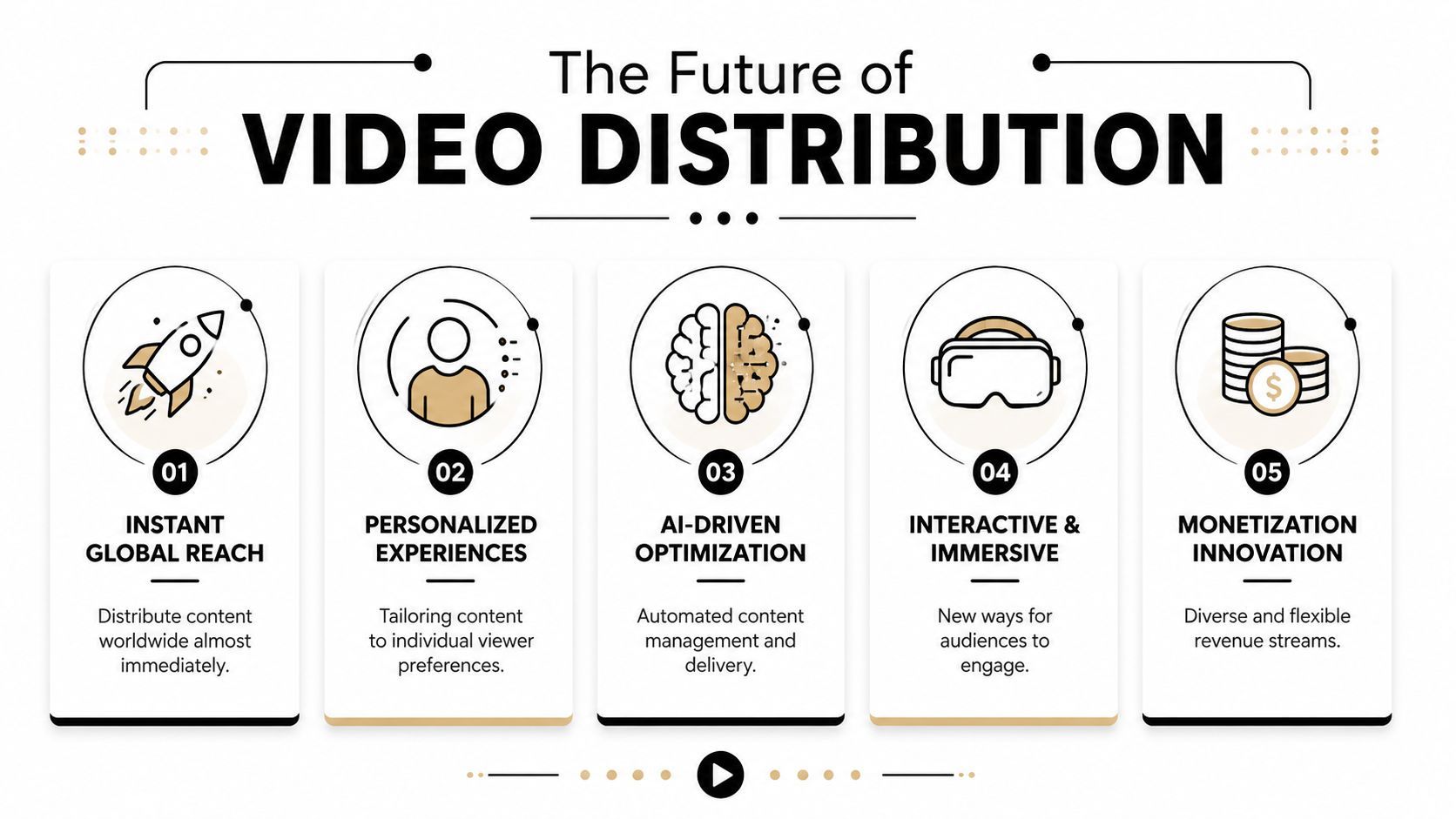
What changes when the workflow is unified
When creation and distribution live together, several things improve at once:
- The asset stays organized from the beginning: You don't lose track of versions after export.
- Metadata gets carried forward: The context travels with the content.
- Repurposing becomes built in: You adjust for platforms without rebuilding from zero.
- Publishing stops being a separate production phase: It becomes part of how the content is made.
That matters because the bottleneck has moved. For many creators, the hard part is no longer making one video. It's building a repeatable machine that can turn ideas into dependable multi-channel presence.
A unified workflow doesn't just save time. It protects strategic quality while output increases.
The mindset shift that matters
The strongest creators and brands won't think in terms of “make, then distribute.” They'll think in terms of content systems.
One idea becomes a master asset. That asset becomes platform-ready variants. Those variants carry consistent metadata. Publishing happens on schedule. Results feed back into the next round of creation. The loop tightens.
That's what a modern video distribution platform really represents. Not another app in the stack, but the layer that connects creative speed with durable reach.
If you want one place to move from idea to finished video to scheduled multi-channel publishing, ShortGenius (AI Video / AI Ad Generator) is built for that connected workflow. It combines AI-assisted scripting, visuals, voice, editing, resizing, and social scheduling so creators and teams can produce and distribute content without stitching together a long chain of separate tools.