User Generated Content Ads: The 2026 Performance Playbook

Learn how user generated content ads drive 4x CTR and 73% more positive comments. A practical guide to sourcing, formats, testing, and scaling UGC ads.
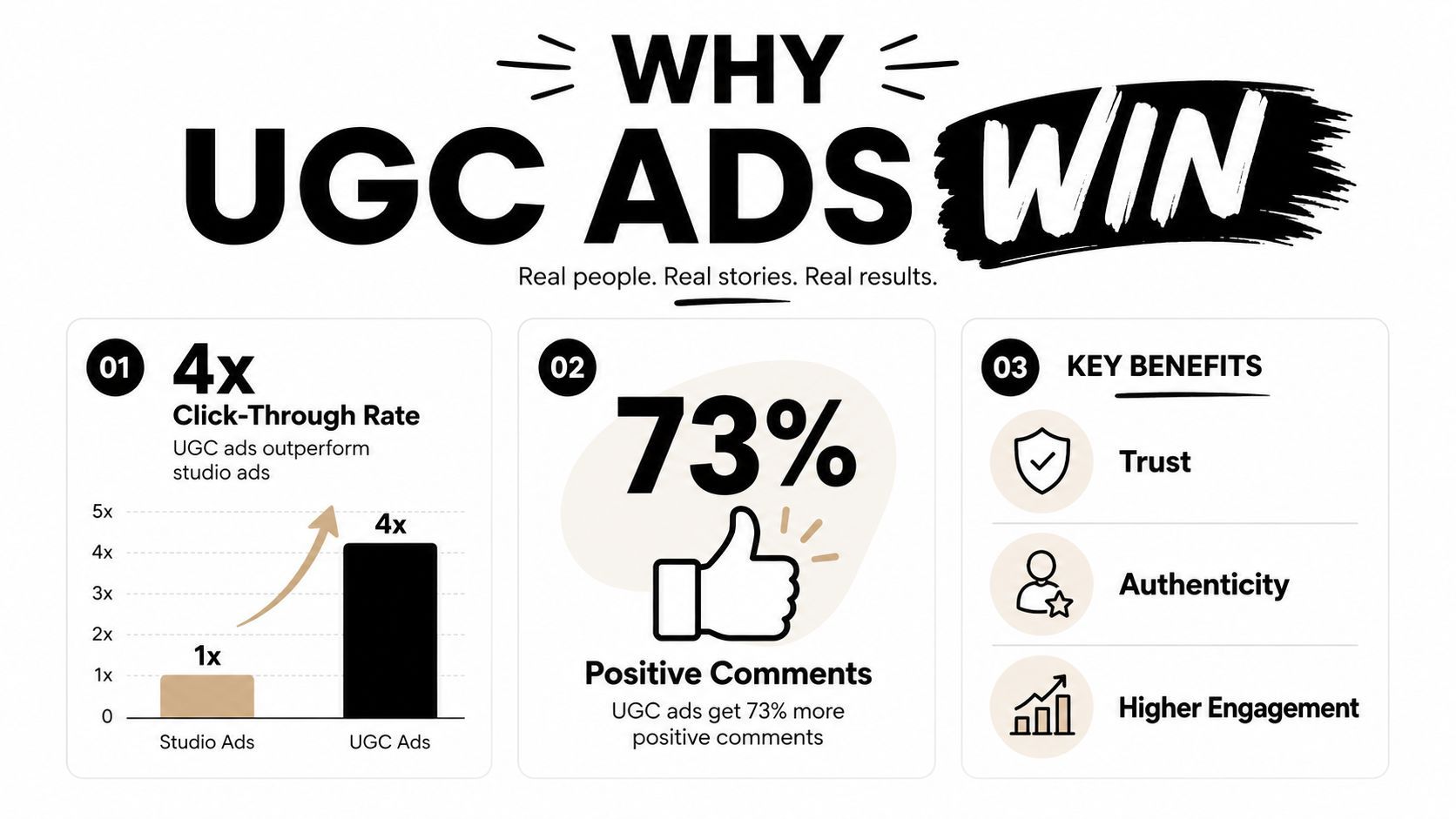
4x higher click-through rates is the headline reason UGC-based ads belong in the media plan, and they also earn 73% more positive comments than traditional ads. That gap exists because the best user generated content ads look like something a person would post, not something a brand would push, so they interrupt feeds without tripping the same ad-recognition reflex.
That matters more in crowded cold audiences than in almost any other environment. When a shopper sees a phone-shot demo, a candid reaction, or a creator speaking in a normal register, the ad feels closer to peer proof than to a polished pitch, which changes how long people stay, whether they comment, and whether they click. The practical question isn't whether UGC works, it's how to turn it into a repeatable production system that wins on trust without turning into sloppy creative.
Why User Generated Content Ads Outperform Studio Creative
The strongest reason user generated content ads outperform studio creative is simple, they lower resistance. HubSpot's summary of UGC research reports 73% more positive comments on ads featuring UGC than on traditional ads, while 31% of consumers said those ads are more memorable and 28% said they are more unique, which is a useful reminder that people don't just notice UGC, they react differently to it HubSpot's UGC statistics summary.
Native looking creative breaks the pattern
Studio ads often lose the first second because the feed has already trained people to ignore polished brand language. A phone-shot testimonial, a rough unboxing, or a creator talking straight to camera feels native to the platform, so the brain classifies it as social content first and advertising second. That pattern interrupt is what creates the opening for the click.
Practical rule: if the first frame looks like a commercial, your hook has already lost part of the audience.
UGC also benefits from perceived peer endorsement. People do not process a stranger's casual recommendation the same way they process a brand claim, and that is why a creator saying “this solved the exact problem I had” often lands harder than a cinematic product montage. The same HubSpot summary cites Stackla findings that 79% of people say UGC strongly impacts purchasing decisions, a finding that helps explain why brands moved from treating it as social proof to treating it as a paid-media asset HubSpot's UGC statistics summary.
Platforms reward the behavior UGC tends to trigger
The algorithmic side matters too. Feeds tend to reward content that gets watched and discussed, and UGC is naturally better at provoking a response because it feels less like an interruption and more like a recommendation. That is one reason the click-through gap is so persistent in paid social.
Multiple industry summaries also report UGC-based ads deliver about 4x higher click-through rates than standard brand-produced ads Vovv statistics roundup. In practical media buying terms, that is not just a creative preference, it is an efficiency lever that can change acquisition cost math. If the ad is built to feel credible fast, it has a better chance of surviving the three-second scroll and earning the next action.
The production trade-off matters as much as the performance upside. Human-shot UGC usually wins on authenticity, creator-sourced UGC gives you more control over messaging, and AI-generated UGC-style ads can scale variants quickly when the offer is already proven. The catch is governance, because the more synthetic the asset becomes, the more you have to manage consistency, disclosure, and brand fit. A paid social lead who has shipped a lot of these creatives treats the format like an industrial system, not a single clever ad, and that is why teams often separate creator briefs, human-shot captures, and AI-assisted edits into different lanes. For teams looking for more ideas for church volunteers, see UGC ideas for church volunteers.
What Counts as a UGC Ad and What Does Not
A UGC ad is paid creative built to look and feel like content a real user, customer, or creator would post in the wild. It isn't the same thing as a brand video with a social filter, and it isn't automatically the same as influencer marketing either. The distinction matters because your reporting, rights management, and creative analysis get messy fast if everything is labeled “UGC” by habit.
The three production models inside the umbrella
There are three common ways to make these ads. Customer-sourced UGC comes from actual buyers, creator-sourced UGC comes from freelance creators who are briefed to speak like users, and AI-generated UGC-style ads use synthetic talent or AI assembly to imitate the same format. Those models can coexist in the same account, but they shouldn't be mixed into one bucket in your dashboard.
Recommendations in real life work this way. A friend's advice feels different from a celebrity endorsement, even if both are positive. UGC works because it borrows the trust texture of the friend recommendation, while a typical polished brand spot carries the weight of an announcement.
UGC isn't “anything casual.” If the asset can't be traced to a clear source and a clear production path, you can't really learn from it.
That's why internal labeling has to stay clean. Tag each asset by source. Tag it again by format, such as talking head, unboxing, or testimonial mashup. Then tag the hook angle, because the hook is usually where performance differences show up.
For teams that want a practical example of how creators are prompted in mission-driven communities, the strategy framing in UGC ideas for church volunteers shows how source and intent can be aligned without making the content feel forced. The principle transfers well to paid social, even if the category is completely different.

Sourcing Creators, Footage, and Rights
Good UGC programs don't start with editing. They start with a sourcing process that makes it easy to collect usable footage without chasing creators one by one every time you need a new angle. The fastest teams I've worked with treat sourcing like operations, not inspiration.
Build a creator list before you need assets
Start with a shortlist of people who can fit the product and the audience. Customers work best when their experience is relevant, while freelance creators are useful when you need volume, speed, or specific on-camera energy. AI-generated talent can fill gaps when you need rapid variation, but it should be tracked separately because the trust and disclosure questions are different.
The brief should push for reaction, not script recitation. Ask for the problem they had, what changed, and what surprised them. If the instruction sounds like copywriting, the result usually looks like copywriting too, and that's exactly what you don't want in a feed built for casual behavior.
Lock usage rights before the asset enters media
Usage rights are where a lot of UGC programs break. You need to define the window, the channels, and the edit permissions before the footage goes into the ad account. That includes whether you can cut the video, add text, swap audio, or run the same asset in multiple placements.
Operational rule: if the release lives in someone's inbox, the asset isn't really usable at scale.
Centralized asset storage matters as much as the creator brief. Keep the original file, the permission note, and the usage terms in one library so media buyers and editors aren't guessing later. If you're building ad cuts with music, a resource like where to find royalty free rap can help teams stay practical about soundtrack selection without treating audio as an afterthought.
Brand safety and disclosure also have to be handled up front. A raw-looking ad can still be compliant, but it can't be reckless. The teams that scale UGC well make governance part of the workflow, not a cleanup step after the campaign ships.
Creative Formats and Hook Templates That Convert
UGC wins or loses in the first few seconds, which is why format choice matters more than many admit. Different layouts solve different jobs, and the hook has to match the job. A cold audience needs friction reduction, while a warm audience usually needs proof, specificity, or a reason to come back.
| Format | Best Funnel Stage | Primary KPI |
|---|---|---|
| Hook-first talking head | Cold prospecting | Click-through rate |
| Before-and-after | Cold to warm | Hold rate |
| Unboxing and POV demo | Cold prospecting | Hook rate |
| Stitched testimonial | Warm retargeting | Conversion rate |
| Creator-react | Cold prospecting | Comment density |
Hooks that fit the format
A hook-first talking head should start with the problem, not the product. The first line needs to sound like something a real person would say in a text thread, not in a brand meeting. A strong opener is usually specific enough to create self-selection, but not so detailed that it slows the scroll.
Before-and-after works because the contrast does the persuading. The opener can be visual, such as showing the result first, then explaining what changed. That format is especially useful when the product solves a visible problem, because the audience understands the outcome before they hear the mechanism.
Unboxing and POV demos survive on motion and curiosity. The first three seconds should show hands, packaging, or a clear in-use moment so the viewer knows something is about to happen. That's better than starting with a logo or a slow intro, which usually wastes the highest-value moment in the clip.
Match the call to action to the proof style
A stitched testimonial needs a lighter CTA because the proof is already social. A demo often deserves a more direct ask because the viewer has seen the product work. Creator-react content can support softer CTAs, especially when the point is to normalize the product rather than hard-sell it.
Here's the simplest rule I use: the more direct the proof, the more direct the CTA can be. The less obvious the proof, the more the hook has to do before you ask for the click.
Producing and Distributing Ads With ShortGenius
Once the footage exists, the job shifts to assembly. That's where a tool like ShortGenius fits into the workflow, because the bottleneck is usually not ideas, it's turning raw parts into enough finished cuts for testing. The useful part is the handoff between script, scene building, voice, captions, and distribution.
Turn one asset into many testable variants
A practical sequence looks like this. Draft a few hook lines, map them to scenes, and build multiple edits from the same raw source. Then swap voice, avatar, captions, and framing so each version feels distinct enough to test.
You also want platform-specific exports. A cut that works in TikTok's vertical feed may need caption spacing or pacing changes before it's ready for Reels, Shorts, or a Facebook placement. If the creative is resized and captioned separately for each channel, you avoid the lazy habit of shipping one generic file everywhere and hoping the feed forgives it.
Organize the output like a media system
The second job is distribution. Put related creatives into themed series so your team can see which hook family is being tested, which audience it serves, and which platform it belongs on. That makes rotation easier and stops winning angles from getting buried in a folder named “final final 2.”
Scheduling matters because UGC programs decay when nobody ships consistently. Auto-posting to TikTok, Instagram, YouTube, Facebook, and X turns the creative library into an operating system instead of a pile of exports. The more repeatable the assembly process, the easier it is to keep the pipeline full without asking editors to reinvent every asset by hand.
Measuring Performance and Running A/B Tests
UGC needs a different measurement stack than polished brand creative. The fastest signal is usually the first few seconds, because that's where the format either earns attention or loses it. If you wait for final conversion data before judging the creative, you'll keep overpaying for weak hooks.
Read the metrics in the right order
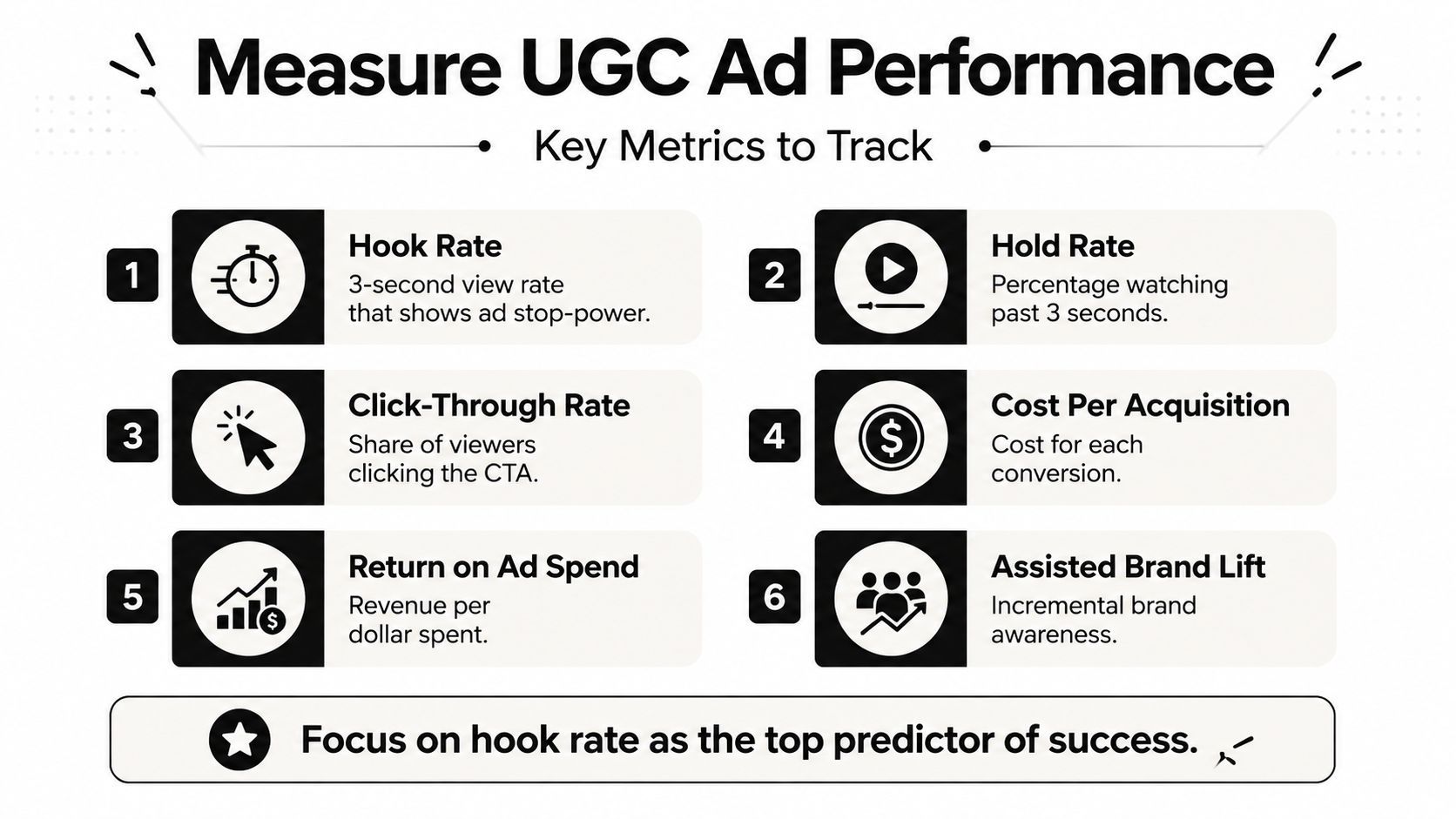
Start with hook rate, which is the 3-second view rate. Then look at hold rate, because a video can stop the scroll and still fail to hold interest. After that, check click-through rate, cost per acquisition, return on ad spend, and any assisted brand lift signals you have available.
The reason hook rate matters so much for UGC is that the format lives or dies on initial plausibility. If the opening feels real, people keep watching long enough for the value prop to land. If the opening feels staged, the rest of the clip often never gets a fair shot.
Don't judge a UGC ad by the edit alone. Judge it by the hook family, because that's usually where the win or loss begins.
Test hooks, not just creatives
A strong testing setup compares at least three UGC variants against three control creatives over a two-week window. Keep spend equal where you can, and segment the results by hook type rather than by a generic creative label. That way you learn whether the problem is the voice, the opening promise, or the visual structure.
The goal isn't to crown a permanent winner. It's to identify a repeatable pattern you can scale into the next batch. If one hook family consistently pulls the best early attention, that becomes the template for the next production run.
Clean testing also depends on discipline. Don't mix audience types, don't swap landing pages mid-test, and don't declare victory because one ad got a burst of cheap clicks on day one. The more closely you isolate the creative variable, the more useful the result becomes when budgets get real.
When UGC Ads Underperform and How to Avoid Authenticity Fatigue
UGC is not a universal creative format. It often performs best in cold-prospecting environments for DTC ecommerce and skeptical categories, but it tends to weaken in branded search, warm retargeting, premium positioning, and high-consideration B2B offers, where the casual look can dilute trust signals rather than strengthen them Opascope's UGC ads guidance.
Know where the native look helps, and where it hurts
That split is the main guardrail. In a cold feed, a casual video can feel credible because it looks like lived experience. In a warm or high-consideration context, the same casualness can feel underdeveloped, especially when the buyer already knows the brand and wants sharper proof, clearer positioning, or a more premium presentation.
Authenticity fatigue shows up when audiences start recognizing the same template over and over. The creator may change, but the hook, the framing, and the pacing feel identical, so the ad starts to look like a format instead of a story. Rotation matters here, not because novelty is always better, but because sameness kills attention.
Human-shot and AI-generated UGC are not the same bet
Academic marketing research describes UGC as a double-edged sword, because the same openness that creates trust can also expose brands to lower-quality or off-brand material when governance is weak UC Berkeley's review of UGC. Adobe also emphasizes that scaling UGC depends on goals, permissions, and centralized asset control, which is a good reminder that authenticity alone doesn't make a campaign safe or scalable Adobe's UGC guide.
AI-generated creator-style ads raise the same tension in a different form. They can speed output and create variation, but they also bring disclosure and platform-policy questions that human-shot footage doesn't. If the goal is trust, synthetic realism needs to be evaluated like a business decision, not a novelty feature.
The cleanest rule is simple. Use human-shot UGC when trust is the primary job, creator-sourced UGC when you need speed and variety, and AI-generated UGC-style ads when you need scalable testing, but keep the source, disclosure, and performance data separate. That's the difference between an ad system and a pile of lookalike clips.
If you want to turn these ideas into a working production pipeline, ShortGenius (AI Video / AI Ad Generator) gives you one place to draft scripts, assemble scenes, swap voices and avatars, add captions, resize assets, and schedule distribution across channels. That makes it easier to test user generated content ads at the pace paid social demands, without rebuilding every cut from scratch.