10 Best Training Video Creator Tools in 2026

Compare 10 training video creator tools for AI video, screen recording, LMS export, voiceovers, pricing considerations, and practical use cases.
Your team has a lesson, product process, or software walkthrough ready to teach, but turning it into a publishable training video still feels like a production project. Someone needs to shape the script, record or generate narration, build scenes, add captions, create the right formats, secure approval, and deliver the result where learners can use it.
The best training video creator depends on the training job. AI presenters suit repeatable, presenter-led modules. Animation works well for scenarios and abstract ideas. Screen-recording tools are stronger for software instruction, while authoring suites matter when quizzes, branching, and LMS tracking are central. Enterprise video libraries solve a different problem, secure storage, search, permissions, and delivery at scale.
This comparison looks at the core creation workflow, voice and template support, export and LMS readiness, audience fit, pricing considerations, strengths, limitations, and setup effort. It also separates tools that create learning content from platforms that manage it. If you're still mapping the broader production workflow, this guide to the video ad production process explained offers useful context for planning, assembly, review, and distribution.
1. ShortGenius
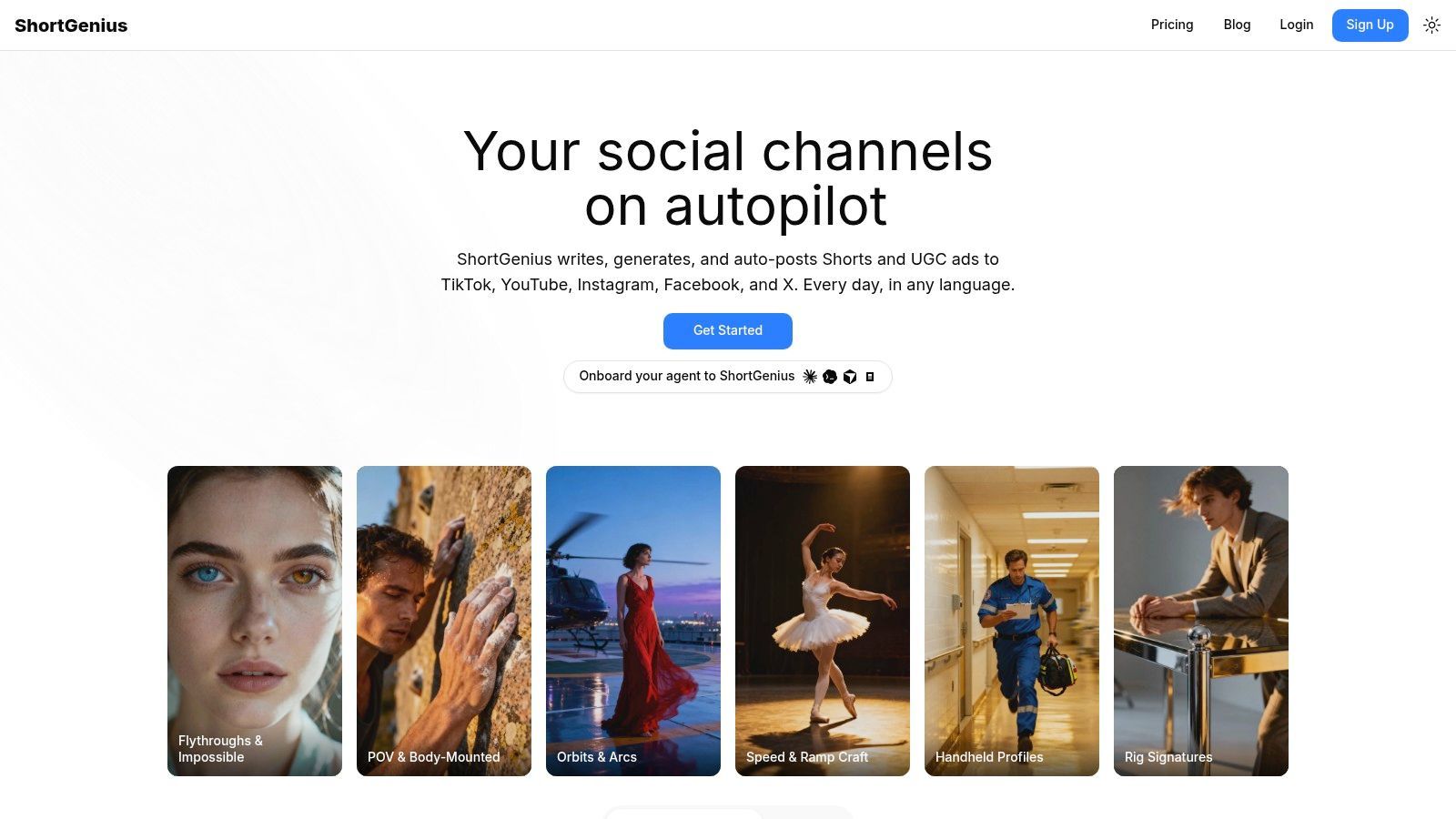
A lesson plan can become a polished training video in the same work session when the production workflow handles scripting, scene assembly, narration, editing, and publishing together. ShortGenius supports that process from a prompt, script, source document, slide deck, SOP, or product note, reducing the need to move content between separate specialist tools.
The practical advantage is speed during the first draft. Start with the source material, review the generated structure, then adjust the narration and visual sequence before rendering. Teams can replace scenes, trim clips, add captions, apply brand assets, and create versions suited to different channels. Its model integrations also provide flexibility across planning, visual generation, and voice production instead of tying every stage to one engine.
That workflow suits bite-sized modules, refresher lessons, product explainers, and public education series. Training teams show a strong preference for presentation-to-video production. According to the 2026 State of Video Report, training users are four times more likely than other users to create videos directly from presentations. ShortGenius fits that repurposing pattern, while a dedicated LMS remains necessary for enrollment, completion records, assessments, and formal compliance reporting.
Practical rule: Create and distribute the video in ShortGenius. Use a learning system to manage enrollment, assessment, completion, and learner records.
Where ShortGenius works best
- Fast production: Produce a workable first draft without scheduling a shoot, hiring voice talent, or opening a separate editing application.
- Consistent series: Organize related lessons into themed collections, then reuse the same visual and editorial approach across the series.
- Multi-channel delivery: Schedule versions for TikTok, YouTube Shorts, Instagram, Facebook, and X when training content also serves public education or audience growth.
- Team workflows: Shared assets, brand kits, advertising workflows, support, secure payments, and an API give teams and agencies more control than a one-off editor.
The main limitation is review. Generated content still needs subject-matter approval for accuracy, tone, accessibility, and compliance, particularly when the video explains regulated processes or customer-facing product behavior. ShortGenius also does not replace interactive course authoring when learners need branching scenarios, graded quizzes, simulations, or detailed LMS reporting.
Pricing, rendering quotas, seat limits, and publishing restrictions were not provided here, so confirm those details on the ShortGenius website before selecting a plan. For teams producing short instructional videos across several channels, the platform can shorten production. The learning system still determines how that content is assigned, measured, and maintained.
2. Synthesia
A policy explainer recorded in 12 languages without booking a studio captures Synthesia's appeal. Teams can write a script, select an AI presenter, add supporting media and subtitles, and produce a consistent module without coordinating filming or external voice talent. That suits onboarding, internal communications, policy explainers, and global training that needs localized narration.
Its library includes 150+ AI avatars and 120+ languages and accents, according to the Synthesia pricing information. Custom avatars, training templates, brand controls, collaboration features, and enterprise SSO support repeatable L&D production. Teams can standardize presenter-led lessons across updates and regions.
The trade-off is human presence. An avatar delivers a consistent message, but it may lack the warmth, authority, or cultural fit of a real instructor. That concern matters in training. A discussion about AI video for training modules raised limited human energy as a stronger objection than visual quality.
Best use cases and limitations
Synthesia fits content that is scripted, repeatable, and likely to require updates or localization. It is less suitable for detailed software simulations, complex learner choices, or demonstrations where a practitioner's physical presence carries the lesson.
- Production speed: No filming, studio booking, or external voice talent is required.
- Learning fit: Presenter-led explanations work well for orientation, policy content, and concise knowledge transfer.
- LMS delivery: The video can support a course, but teams still need a learning system for assignment, completion tracking, assessment, and reporting.
- Operational caution: Credit-based rendering can affect heavy iteration, so check how drafts and final renders consume plan allowances.
- Workflow choice: Teams producing short-form training for several channels can also evaluate ShortGenius AI video and ad generator, especially when series publishing and distribution sit alongside presenter delivery.
Use Synthesia for efficient scripted communication, then add dedicated authoring or LMS tools when learners need branching, graded quizzes, simulations, or detailed progress data.
3. Vyond
When a compliance scenario needs to be staged repeatedly without reshooting real employees, Vyond's character library becomes the practical solution. It suits animated explainers, workplace scenarios, and policy training, allowing instructional designers to show conversations, decisions, customer interactions, and abstract processes without arranging a live shoot. Built-in text-to-speech, brand palettes, screen and webcam recording, and training-focused assets support visual variety without requiring a dedicated animation department.
Vyond Go can turn text or a URL into a draft. The editor then lets teams adjust characters, settings, dialogue, and pacing. Higher tiers may include Shutterstock access and expanded collaboration features, so plan selection matters when a department needs a larger media library or multiple contributors. SCORM export can package video-based learning for LMS delivery. Current plan and export details are listed on Vyond's plans page.
When animation improves the lesson
Animation works well when filming a realistic situation would be expensive, awkward, or privacy-sensitive. A difficult customer conversation, workplace safety example, or compliance decision can be revised and staged again without coordinating employees or reshooting footage. Designers also control emphasis, visual metaphors, and pacing more precisely than they would with a live recording.
The style will not fit every audience. Cartoon characters may feel too informal for technical, medical, or executive training, where real-person footage or a software demonstration may carry more credibility. Real-person footage is secondary to Vyond's animation workflow, and Shutterstock access or collaboration features may require higher tiers. Teams that also publish short-form training or promotional content can use ShortGenius AI video and ad generator alongside Vyond, while keeping instructional projects organized by purpose.
Animation earns its place when the scenario matters more than visual realism.
4. TechSmith Camtasia
For software tutorials that demand cursor highlights, callouts, and step-by-step cuts, Camtasia's desktop timeline remains a straightforward workflow. Trainers can record a screen and camera feed, remove mistakes, add annotations, emphasize cursor movement, and assemble a focused lesson without adopting a complex professional editing suite. It suits process walkthroughs and instructor-led demonstrations where visual guidance matters more than rapid template-based production.
The current Camtasia Suite combines the editor with Snagit and Audiate, adding screen capture, text-based audio editing, filler-word removal, stock assets, quizzes, and SCORM export depending on the plan. The Camtasia product page provides current purchasing information. Screen and camera recording can support high-resolution work, including up to 4K, while multitrack editing lets producers control narration, demonstrations, annotations, and music separately.
Camtasia works especially well when learners need to follow the instructor's cursor and actions. It is a stronger fit than an avatar tool for configuring software, completing a workflow, or troubleshooting an interface. Quizzes and SCORM export can also keep simple assessment tasks within the same production workflow, although a dedicated learning system may still be better for detailed learner tracking.
The cost of control
The trade-off is production control versus speed. The editor takes longer to learn than a lightweight browser-based tool, and its annual subscription structure may not suit every team. There is no monthly option in the supplied plan notes, while advanced AI and stock features can depend on the selected tier.
Camtasia is also a poor fit for elaborate branching simulations or large-scale video governance. It creates the lesson effectively, but another system may still need to manage the catalog, permissions, and learner records.
5. Articulate 360
When learners must answer questions, make branching decisions, and generate completion data, Articulate 360's Storyline and Rise tools cover the full authoring spectrum. Storyline supports slide-based courses, simulations, branching scenarios, and detailed interactions. Rise creates responsive, web-based lessons and microlearning. Together, they fit structured learning programs more closely than a conventional video editor.
The suite includes AI-assisted authoring, templates, assets, review workflows, and publishing to SCORM, xAPI, cmi5, and AICC, according to Articulate's pricing and product information. That format range helps teams connect a course with an existing LMS, learning record store, or compliance reporting process.
Choose it for learning design, not just video speed
Articulate 360 fits courses that require questions, decisions, controlled progression, or completion records. Its review tools also let instructional designers bring subject-matter experts and stakeholders into the approval process before release. Rise is quicker for responsive lessons, while Storyline provides deeper interaction control and requires more development and testing.
The trade-off is a steeper learning curve and higher cost than basic video tools. A narrated explainer may take longer to build in a full authoring environment. Rich interactions also need testing across devices and LMS configurations, because inconsistent behavior can affect the learner experience.
For a small team choosing between course authoring and a focused video workflow, define the required learning evidence first. If assessment and completion records are optional, a simpler creator can publish the lesson faster. If they are required, Articulate 360 provides the authoring and reporting formats to support that workflow.
6. Adobe Captivate
When a learner must practice a software task and receive immediate feedback within the course, Adobe Captivate's simulation engine makes that interaction possible. It supports responsive eLearning, software simulations, and interactive video, while also converting PowerPoint material into responsive lessons and combining narration, media, and structured activities.
Captivate also connects with Adobe's wider ecosystem. Generative AI assets and Firefly capabilities can assist visual development, while team and enterprise administration features support collaboration across larger organizations. Review the Captivate buying guide carefully, since capabilities and generative credit arrangements vary by product tier.
Its clearest use case is practice-based training. A simulation can demonstrate the correct action, let learners attempt it, and provide feedback inside the course. That fits system training better than a standard video editor when incorrect steps carry operational consequences.
What slows teams down
Captivate is a heavier authoring environment. Producers creating only a narrated screen walkthrough may find its interface and publishing choices excessive. Simulation projects also require planning, testing, and maintenance whenever the underlying software changes.
Pricing is harder to compare across individual, team, and enterprise arrangements, particularly when generative features are included. Use Captivate when responsive layouts and learner interaction justify the added production effort. For short training clips that change often, a lighter creator may be easier to update and deliver.
7. iSpring Suite
When a team's bottleneck is converting approved slide decks into trackable courses without adopting a new platform, iSpring Suite turns PowerPoint files into structured learning content. It adds quizzes, surveys, interactions, narration, screen capture, and LMS publishing while keeping the authoring workflow familiar to subject-matter experts.
An instructor can start with an existing deck, record narration or a software walkthrough, add knowledge checks, and publish the course. Product information lists support for SCORM, xAPI, and cmi5 export, plus iSpring Suite AI and Cloud AI options. Compare current packages and plan differences on the iSpring pricing page.
A sensible fit for deck-heavy teams
iSpring suits onboarding, compliance, and internal training when approved material already exists as slides. It handles slide content, video, narration, and learner activities in one authoring workflow, then packages the result for an LMS. That makes it more appropriate than a standalone video editor when completion tracking matters.
The trade-off is production depth. Teams creating highly polished video may miss the timeline control of a dedicated editor, while complex branching and simulations can require extra configuration. Features are also split across different SKUs, so procurement should verify the exact package instead of assuming every iSpring-branded capability is included.
Choose iSpring for converting approved presentations into structured courses with limited workflow change. Choose Camtasia or Descript when the lesson depends mainly on a refined screen demonstration rather than LMS-ready course authoring.
8. Descript
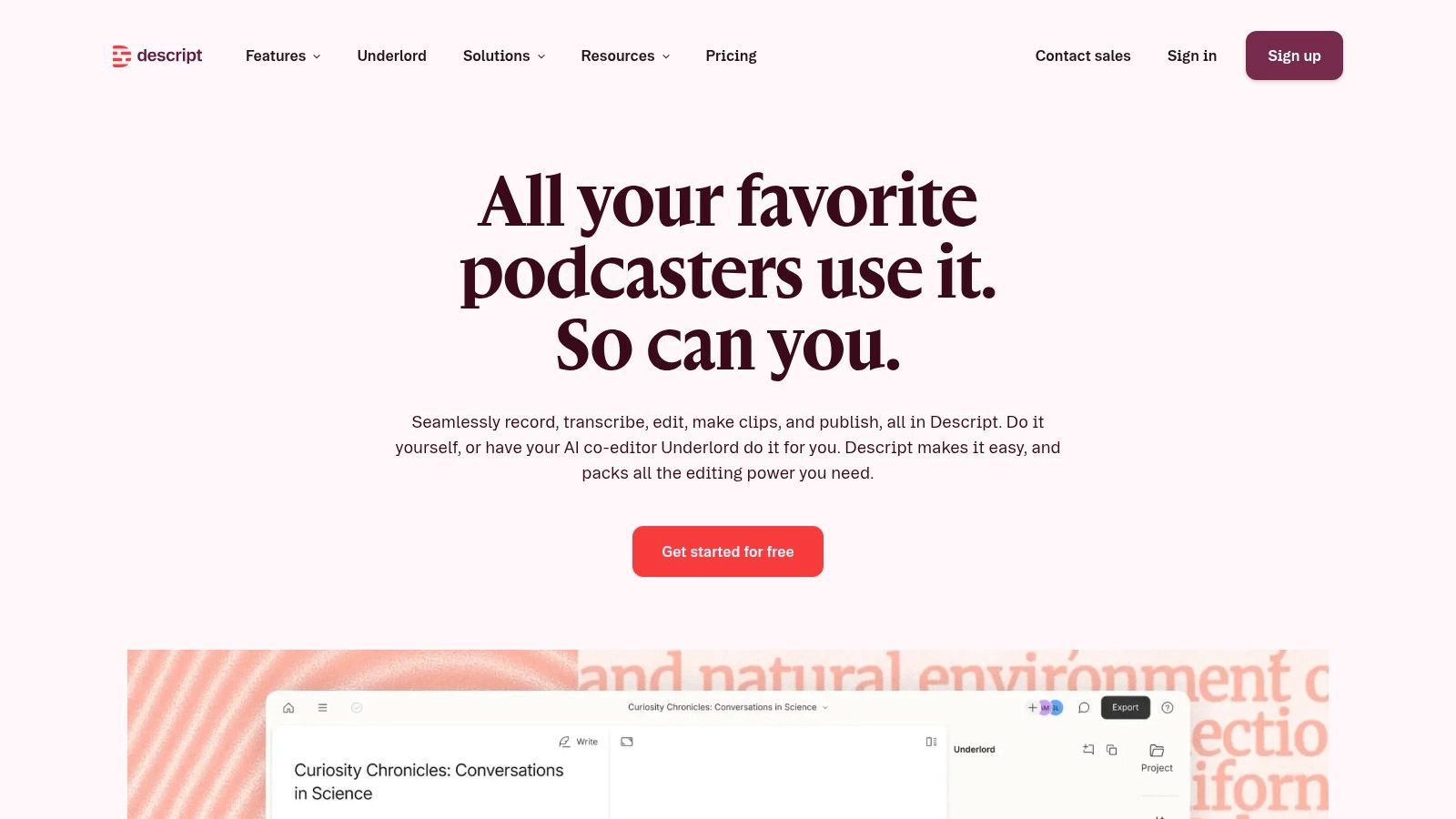
Delete a sentence from Descript's transcript, and the matching video segment disappears. That transcript-first workflow makes it practical for tutorials, walkthroughs, interviews, and instructor voiceovers when editing speed matters more than interactive course features.
Screen recording, remote capture, multitrack editing, captions, subtitles, translation workflows, and 4K support cover many small training teams' production needs. Its AI co-editor can assist with summaries, chapters, and clip creation. Current product direction and plan details are available on Descript's podcasting page.
Fast editing, limited LMS depth
A subject-matter expert can record a rough explanation, then an editor can remove repetition, tighten the lesson, add chapters, and create captions without learning a traditional non-linear editor. Collaboration supports review when several people need to revise the same tutorial.
Descript does not replace an interactive eLearning authoring suite. It lacks SCORM packaging, while advanced color grading and audio finishing may require another editor. AI credit limits on lower tiers can also constrain teams processing many recordings.
Use Descript for the human-led master recording and its editorial cleanup. For short, branded, multi-platform learning clips, an integrated ShortGenius video workflow can handle derivative versions. Keep the source recording and captions organized so each clip remains accurate. Formal assessments, learner completion tracking, and LMS reporting still belong in a dedicated learning system.
9. Loom
When a product engineer needs to record a six-second screen demo and share it with the team before the bug report loses relevance, Loom's instant capture link is the fastest path from idea to distribution. A trainer can record the screen, camera, or both, explain the task, and share the result through a link. This workflow suits new-tool announcements, short SOP reminders, team handoffs, and answers to recurring questions.
Loom adds captions, transcript-based editing, AI-generated titles, summaries, chapters, tasks, and meeting recaps. Team libraries help people find shared recordings, while SSO, SCIM, and Atlassian Guard integration support larger deployments. Check plan differences on Loom's pricing page, especially when purchasing through Atlassian instead of directly from Loom.
Use Loom for speed and context
Loom captures the presenter's explanation inside the actual interface. An employee can point out a current issue, demonstrate the task, and distribute the recording before the context becomes outdated. For quick internal guidance, that can work better than scheduling a meeting or writing a long process document.
The trade-off is limited course functionality. Loom does not provide SCORM or xAPI authoring, so formal completion and assessment records still require an LMS or course builder. Heavy editing, motion design, and polished branded production need another tool. Feature availability can also vary between Loom.com plans and Atlassian-purchased arrangements.
10. Panopto
When an organization needs a searchable, permission-controlled video library spanning hundreds of onboarding recordings and compliance sessions, Panopto's CMS architecture addresses the discovery problem that individual editors cannot. It supports recording, hosting, search, streaming, access controls, analytics, and knowledge sharing across a centralized catalog.
The platform connects with major LMS environments, enterprise identity systems, and security controls. Employees can locate a specific explanation inside a large collection instead of receiving one isolated training link. Review Panopto's pricing information through a sales conversation, since organization-scale deployments depend on requirements and configuration.
A library, not a creative studio
Panopto fits governance-heavy training operations. Administrators can organize content, restrict access, support search, and manage delivery across departments. It suits internal processes, private sessions, regulated material, lectures, webinars, and live training better than a consumer video host.
The trade-off is production flexibility. Panopto is not designed for rapid animation, AI scene generation, or detailed timeline editing. Training teams may create content in Camtasia, Descript, an authoring suite, or an AI video creator, then use Panopto for storage, permissions, discovery, and distribution.
Smaller organizations with a modest catalog may find this enterprise orientation excessive. If centralized search, permissions, analytics, and LMS integrations are unnecessary, a simpler hosting or course-authoring tool may involve less setup and administration.
Top 10 Training Video Creators, Comparison
| Platform | Core features | UX / Quality (★) | Pricing / Value (💰) | Target audience (👥) | Unique edge (✨) |
|---|---|---|---|---|---|
| 🏆 ShortGenius (AI Video / AI Ad Generator) | Script-to-video, image/scene gen, natural voiceovers, editor (trim/captions/resize), brand kit, presets, auto-scheduling, API | ★★★★☆ Integrated, fast pipeline | 💰Tiered, see site (creator & team plans) | 👥Creators, social teams, agencies, DTC brands, educators | ✨All-in-one multi-model workflow + auto-posting |
| Synthesia | 150+ AI avatars, 120+ languages, templates, brand controls, credit-based renders | ★★★★☆ Consistent presenter-led UX | 💰Credit-based; enterprise pricing | 👥L&D, corporate comms, localization teams | ✨Lifelike presenters & fast localization |
| Vyond | Character animation, TTS, templates, SCORM export, integrations | ★★★☆☆ Cartoon-style, easy learning | 💰Subscription tiers; media gated by plan | 👥Training teams, educators, explainer creators | ✨Deep animation library + LMS packaging |
| TechSmith Camtasia | 4K screen & camera capture, multitrack editor, quizzes, Audiate, SCORM | ★★★★☆ Robust desktop editing | 💰Annual subscription (no monthly) | 👥Software tutors, instructors, how-to creators | ✨Advanced screen-recording + timeline control |
| Articulate 360 | Storyline + Rise, AI-assisted authoring, SCORM/xAPI/cmi5, review tools | ★★★★☆ Enterprise authoring power | 💰Higher-priced enterprise/subscription | 👥Enterprise L&D, instructional designers | ✨Full-featured interactive course authoring |
| Adobe Captivate | Responsive courses, software simulations, generative AI, Firefly assets | ★★★☆☆ Powerful but steeper learning curve | 💰Complex SKUs; enterprise credits | 👥Enterprises needing simulations & responsive courses | ✨Simulation tooling + Adobe ecosystem |
| iSpring Suite | PowerPoint-based authoring, quizzes, screen capture, SCORM/xAPI export | ★★★★☆ Very fast for PPT teams | 💰Perpetual & subscription options | 👥SME trainers, subject-matter experts using PPT | ✨PowerPoint-native rapid conversion to LMS-ready |
| Descript | Edit-by-transcript, screen recording, AI co-editor, captions & translation | ★★★★☆ Fast transcript-first editing | 💰Tiered plans with AI credit limits | 👥Podcasters, tutorial creators, small teams | ✨Document-style editing + AI clip generation |
| Loom | Instant screen & camera capture, auto-summaries/chapters, team libraries | ★★★★☆ Quick capture & sharing | 💰Free & paid team plans | 👥Internal comms, product, ops, remote teams | ✨Asynchronous video messages + Atlassian ties |
| Panopto | Video CMS: capture, hosting, search, analytics, LMS integrations | ★★★☆☆ Enterprise-grade video management | 💰Org-scale pricing, contact sales | 👥Large enterprises, universities, training ops | ✨Searchable video library & governance at scale |
Match Production Speed With Learning Requirements
Choosing a training video creator becomes easier when the learning job comes before the feature list. Start by deciding whether learners need to watch, practice, answer, find, or repeatedly search for the content. A polished video can explain a process, but it won't automatically provide assessment records, branching practice, or enterprise governance.
For fast AI-led production, choose ShortGenius or Synthesia. ShortGenius is the better fit when the same lesson needs to become a series of short videos, branded derivatives, or channel-specific exports. Synthesia is stronger when the central experience is a consistent AI presenter with multilingual delivery and enterprise controls. In both cases, human review remains essential. The concern many training teams have isn't only whether AI footage looks polished, but whether the lesson still feels credible and human (discussion about human energy in AI training video).
Choose Vyond for animated scenarios and explainers. Choose Camtasia, Descript, or Loom for screen-based instruction. Camtasia gives the most traditional editing control and supports quizzes and SCORM through its suite. Descript is faster for transcript-led editing and instructor recordings. Loom wins when the priority is capturing and sharing a useful walkthrough immediately.
When interaction and LMS tracking are central, choose Articulate 360, Adobe Captivate, or iSpring Suite. Articulate offers the broadest authoring range across responsive courses and complex interactions. Captivate is compelling for software simulations and responsive layouts. iSpring is the natural choice for PowerPoint-native teams that need dependable course packaging without a long transition.
Choose Panopto when secure enterprise video management is the priority. It's the home for a governed, searchable library, not a substitute for every editor or authoring tool. Teams comparing delivery infrastructure should also review guidance on the best learning management system for small businesses, especially when deciding whether a video host, LMS, or combined stack fits the organization.
A practical ShortGenius workflow
- Outline the lesson: Define the learner, outcome, source material, and one clear action or concept for each module.
- Generate and refine the script: Use the first draft as a starting point, then verify terminology, sequence, examples, and instructional tone with a subject-matter expert.
- Create scenes and voiceovers: Select visuals and narration that match the audience. Don't let decorative scenes compete with the procedure being taught.
- Apply captions and brand assets: Review captions manually, add logos or approved visual elements, and ensure text remains readable on mobile screens.
- Review accuracy and accessibility: Check names, numbers, UI steps, pronunciation, contrast, captions, and transcript quality before publishing.
- Resize for the channel: Export the format that matches the intended destination instead of treating one aspect ratio as universal.
- Build a series and schedule publication: Organize related lessons into a series, then schedule releases across the relevant channels when public distribution supports the training goal.
Before signing up, verify current pricing, seat limits, rendering quotas, export formats, publishing allowances, security requirements, and LMS compatibility. Product plans change, and a feature that looks ideal in a demo may be restricted by the tier your team requires.
ShortGenius combines scriptwriting, scene and image generation, natural voiceovers, captions, resizing, brand kits, asset organization, and multi-channel scheduling in one workflow for training creators. Visit ShortGenius (AI Video / AI Ad Generator) to turn lesson plans, SOPs, and slide-based ideas into consistent training video content faster.