TikTok Ad Prices 2026: A Realistic Budgeting Guide

Understand 2026 TikTok ad prices. Our guide covers real CPM & CPC costs, budget minimums, and how to lower your spend with better creative and smart bidding.
TikTok ad prices in 2026 usually land around $5.00 to $12.00 CPM and $0.30 to $1.50 CPC. Those ranges are real, but they're also misleading if you treat them like your actual budget plan instead of loose auction benchmarks.
Most advice on TikTok ad costs starts and ends with platform minimums. That's the wrong frame. The useful question isn't "What's the cheapest way to get ads live?" It's "What budget gives the algorithm enough data to produce a result worth paying for?"
A lot of advertisers learn this the expensive way. They see the minimums, launch at the floor, and then assume TikTok is overpriced when performance stalls. In practice, the biggest gap in TikTok budgeting isn't between cheap and expensive. It's between being eligible to run and being funded enough to learn.
Your Guide to TikTok Ad Costs in 2026
A common question is what TikTok ads cost, as if there's a stable answer. There isn't a stable answer, and the bigger mistake is asking only for the platform minimum instead of the budget required to get performance.
TikTok is large enough that weak budgeting assumptions get exposed fast. On a platform with global scale and a crowded auction, cost shifts with audience competition, campaign objective, and, more than anything, creative response. The price to launch and the price to learn are two different numbers.
That distinction is where many first-time advertisers get stuck. They see the minimum spend requirement and treat it like a workable testing budget. In practice, minimums only buy access to the auction. They do not guarantee enough delivery, clicks, or conversion signal for TikTok to optimize toward a business outcome.
The common budgeting mistake
Advertisers new to TikTok often want a single benchmark they can plug into a spreadsheet. CPM and CPC ranges help with rough planning, but they do not answer the harder question: can this budget produce enough data for the campaign to leave the learning phase and find efficient traffic?
For awareness, a smaller budget can still produce a readable result. For conversions, the bar is higher. If the campaign is trying to find purchasers, leads, or app events, TikTok needs enough volume to identify who responds and who does not. A budget that is technically valid can still be too small to train the system.
Practical rule: TikTok's official entry price tells you when ads can run. Your performance budget tells you whether the algorithm has a real chance to optimize.
I have seen accounts blame targeting, bids, or seasonality when the actual issue was simple underfunding during the learning period. The campaign stayed live, but it never gathered enough feedback to separate poor creative from weak audience fit. That is how cheap traffic turns into expensive traffic. You pay for spend that produces very little decision-making value.
What actually determines your real cost
Three layers shape what TikTok ads really cost:
- Platform access: the minimum budget required to publish and keep campaigns active.
- Performance budget: the spend needed to generate enough conversion signal for TikTok to optimize with confidence.
- Creative efficiency: the factor that most directly changes CPM, click-through rate, and conversion rate.
Creative is the biggest cost lever in the stack. Strong videos earn better engagement, hold attention longer, and give the auction better signals. That usually lowers effective costs faster than small bid adjustments or minor targeting changes.
Get the order right. Fund the campaign enough to learn, then improve creative aggressively. That is the difference between a TikTok budget that looks affordable on paper and one that can produce ROI.
Decoding TikTok Ad Pricing Models
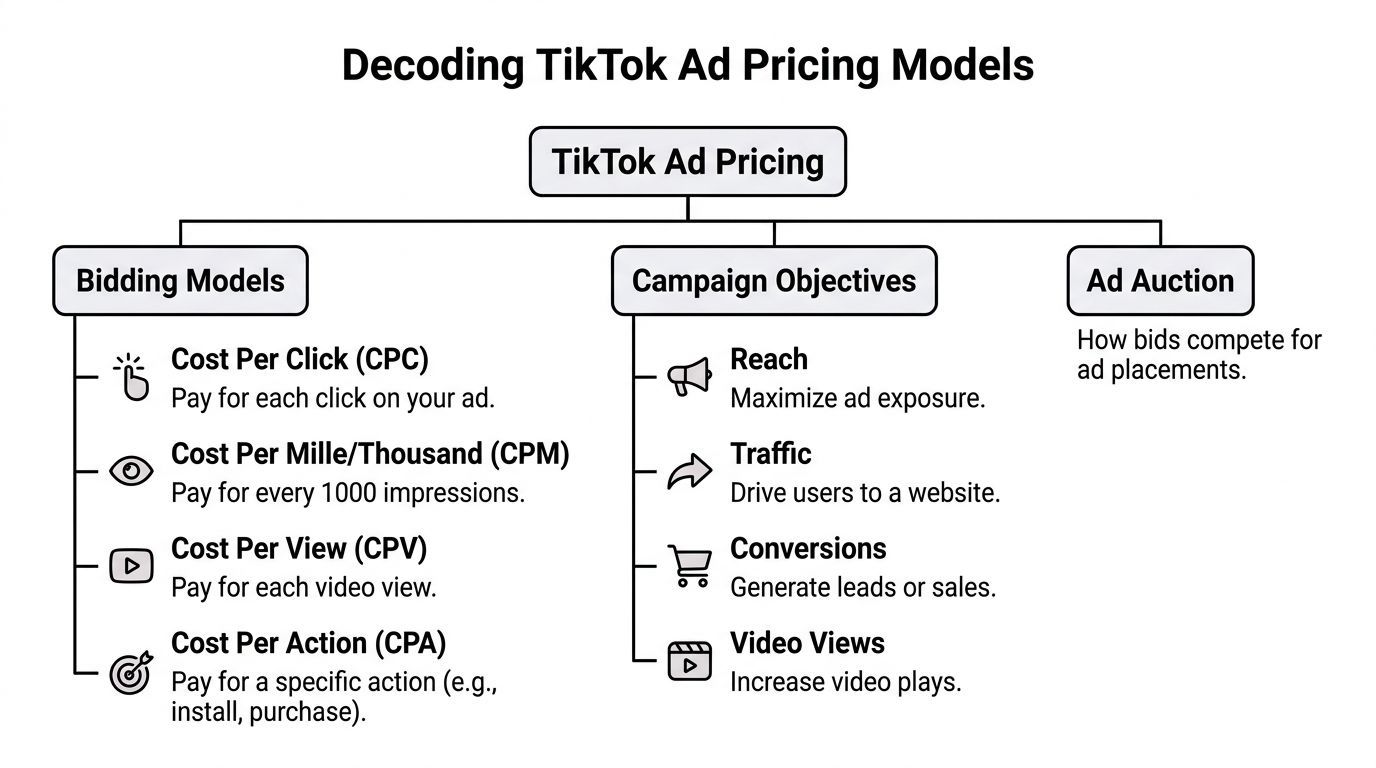
TikTok sells ad delivery through an auction. You aren't buying inventory at a fixed shelf price. You're competing for attention, and TikTok decides who wins based on bid logic, targeting, and performance signals.
The main pricing models
For most advertisers, these are the practical models to understand:
| Model | What you pay for | Best use |
|---|---|---|
| CPM | Impressions | Reach, awareness, broad testing |
| CPC | Clicks | Traffic-focused campaigns |
| CPV | Video views | Content amplification |
| CPA or conversion optimization | A target action | Sales, leads, app events |
Here's the simplest way to think about them.
CPM is like paying for foot traffic past your storefront. You're buying attention opportunities.
CPC is paying when someone walks in the door.
Conversion optimization is closer to telling the platform, "Find me people most likely to buy," then letting the system bid toward that outcome.
The non-negotiable minimums
TikTok sets hard budget floors. Campaigns must start at $500, with a $50 daily campaign minimum and a $20 daily ad-group minimum, based on Trendtrack's TikTok ad cost guide.
Those numbers matter operationally. They force advertisers to spend enough for the system to gather basic delivery data. TikTok isn't being arbitrary here. The platform wants enough signal to distribute ads without starving the auction.
That same source also notes that premium placements sit in a completely different tier. Brand Takeovers range from $65,000 to $150,000 per day, which makes them a brand visibility product, not a realistic starting point for most small and mid-sized advertisers.
What these costs look like in practice
For standard buying, In-Feed inventory is where most performance advertisers begin. Premium placements are useful if your goal is reach and dominance, but they don't solve the learning problem for an inexperienced account.
If you're new to TikTok, don't start by asking which format is most prestigious. Start by asking which format gives you the fastest feedback on message, hook, and audience fit.
That usually means keeping things simple:
- In-Feed first: easiest place to test creative angles and landing page intent.
- Traffic or conversion objective: choose based on your tracking confidence and sales cycle.
- Avoid premium formats early: they can create exposure, but they won't rescue weak offers or bad creative.
Why the auction feels unpredictable
Two advertisers can run similar products and see very different costs because the auction isn't only pricing audience access. It's pricing expected response.
A narrow targeting setup, a competitive vertical, or creative that looks like a recycled ad from another platform can all make delivery less efficient. The reverse is also true. Native-looking ads often earn cheaper delivery because users engage with them instead of swiping past.
Key Factors That Influence Your Ad Costs
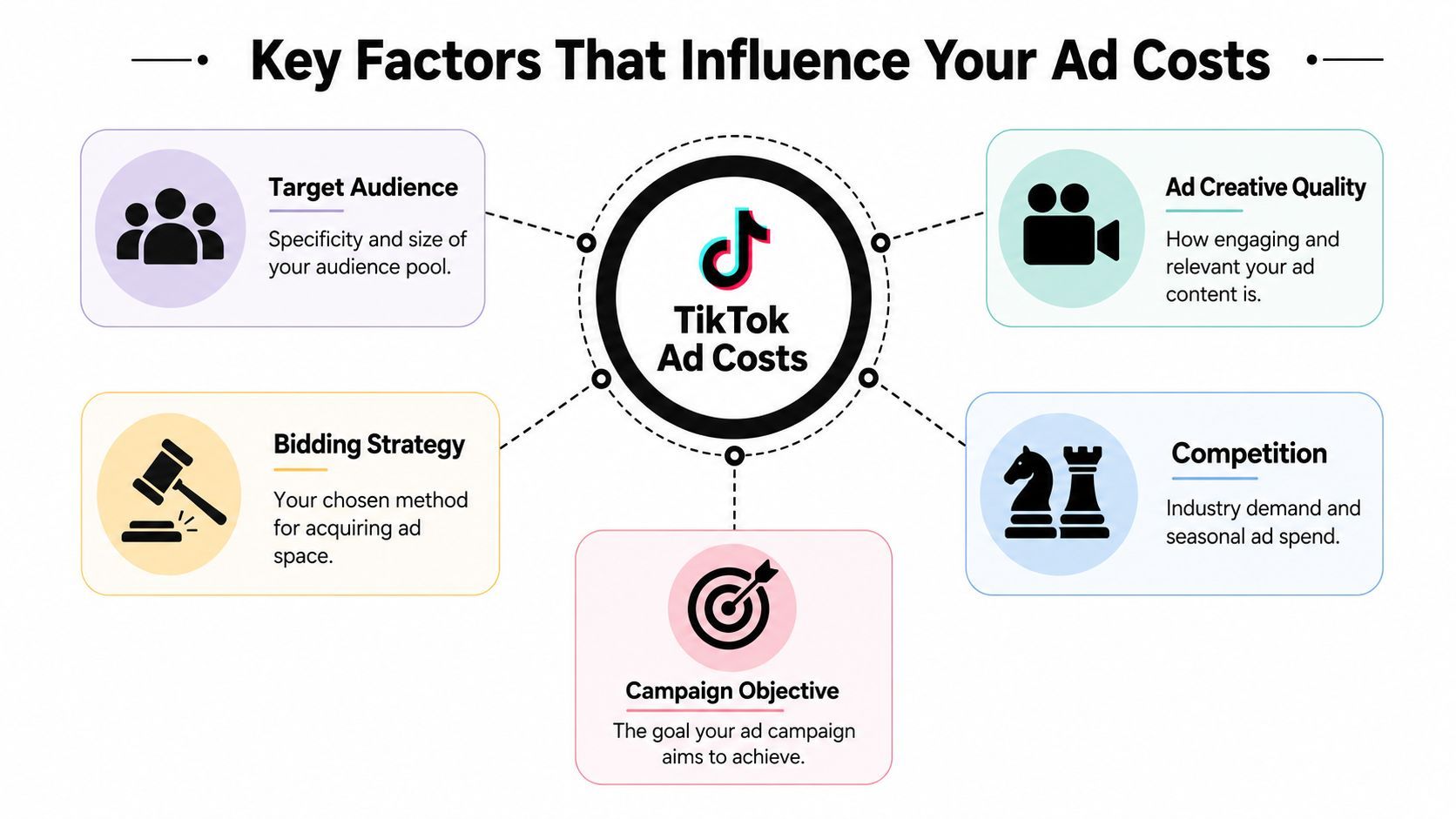
TikTok costs rarely rise for one simple reason. Usually, a few variables stack together, and the biggest one is often creative. That is also the part you can change fastest.
Audience size and targeting precision
Broader targeting usually gives TikTok more room to find lower-cost impressions and conversion pockets. Narrow targeting can still work, especially for local businesses or clear niche offers, but it often raises CPMs and slows delivery.
A lot of new advertisers bring a Meta habit with them. They stack interests, behaviors, and exclusions too early. On TikTok, that can choke the system before it gets enough signal to learn.
There is a budget implication here. Tight targeting often needs more patience and more spend to get stable results. Broad targeting can look less controlled, but it often produces cheaper learning.
Campaign objective
Your objective changes what TikTok is trying to buy for you.
Video views are easier to generate than purchases. Clicks are easier to generate than qualified leads. Purchases are harder and usually cost more up front, but they are often the only numbers that matter if your goal is revenue.
Many accounts confuse platform minimums with performance minimums. You can launch a conversion campaign on a small budget, but if that budget cannot generate enough optimization events, the ad group may stay in learning and report unstable costs. A cheap cost per click does not help much if the campaign never gets enough downstream signal to improve.
If tracking is weak, aggressive conversion optimization can also make the account look more expensive than it really is. TikTok can only optimize against the events it receives.
Geography and market competition
Geography affects pricing fast. The United States, Canada, the UK, and Australia usually cost more than lower-income markets because more advertisers compete there and customer value is often higher.
That does not make cheaper regions better by default. Lower CPMs in a market you cannot ship to, support well, or retain profitably are wasted spend. Expensive traffic in the right market can still be the better buy.
The question is margin, not just media cost.
Seasonality and advertiser demand
Auction pressure rises when more brands want the same audience at the same time. Retail events, holiday periods, and heavy promotional windows usually push costs up.
Good advertisers plan for that before the spike hits. They refresh creative early, widen testing windows, and avoid entering peak periods with one tired ad and no backup.
If your account is already struggling to exit learning in a normal week, peak-season auctions make that problem worse.
Creative quality
Creative is the strongest cost lever on TikTok. It affects thumb-stop rate, watch time, click-through rate, and conversion rate. Those signals shape how efficiently you win auctions and how much useful data the system gets back.
That is why weak creative makes budget conversations misleading. A business owner sees the official daily minimum and assumes the problem is spend. In practice, the campaign often needs two things at once: enough budget to generate signal and enough creative variation to earn it. If the ad is weak, increasing spend just buys more low-quality impressions and delays clear learning.
Admetrics' TikTok ads cost guide explains the same underlying principle. Ads that drive stronger engagement and click behavior can earn more efficient delivery in the auction.
Better creative lowers costs in two places. It can reduce what you pay to get the click, and it can improve what happens after the click.
In actual account work, this is why I treat creative volume as a budget tool, not just a production task. A campaign with four real creative angles often outperforms a larger budget running one average ad.
What you can and can't control
Use a simple priority order:
- Hard to control: seasonal demand, category competition, regional pricing
- Partly controllable: targeting breadth, campaign objective, bid strategy
- Highly controllable: hook, first three seconds, creator fit, offer framing, landing page continuity
That split matters because advertisers often spend too much time tweaking bids and too little time replacing bad ads. On TikTok, the cheapest optimization is often a new creative concept, not a more complicated campaign setting.
Sample Budgets From Your First $500 to $5000
Budget planning gets clearer when you stop treating every spend level as if it serves the same purpose. A first test budget, a learning budget, and a scaling budget should behave differently.
The $500 launch budget
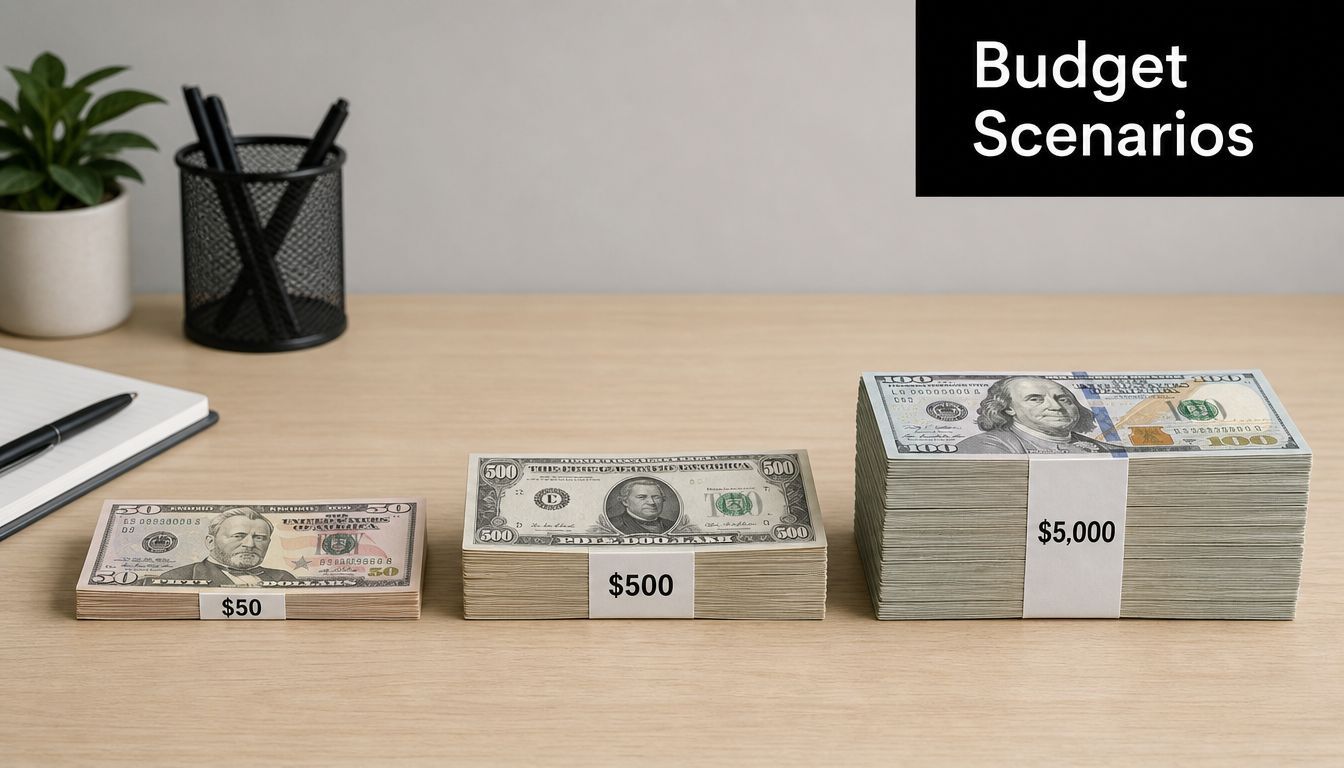
This is the platform minimum. It's enough to get in the game. It is not automatically enough to get a reliable answer.
A lot of blogs present the ad-group floor as if it's a practical starting strategy. That framing misses the actual issue. WordStream's TikTok ads cost analysis notes that while many guides point to the minimum as an entry point, real campaign data shows algorithms often need $300 to $500 per day in testing to exit the learning phase and generate profit.
So what is a $500 budget for?
It's for collecting early directional data:
- Creative signal: Which hook gets attention?
- Audience signal: Is there any obvious mismatch in targeting?
- Offer signal: Do people click but fail to convert, or do they ignore the ad entirely?
What it usually isn't for is proving profitability. If you expect a minimum-budget launch to deliver stable returns immediately, you're setting the campaign up to fail.
The $2,000 learning budget
At this point, TikTok starts to become a serious testing environment instead of a lightweight trial.
With a budget in this range, you can give the platform more room to compare creative variants, sustain delivery long enough to gather meaningful engagement patterns, and avoid shutting things off before the system has enough feedback. You still need discipline, though. More budget doesn't justify more complexity.
A smart setup at this level usually means:
- Fewer ad groups, more focused creative tests
- One core offer, not multiple competing messages
- Broad enough targeting to let the algorithm search
This is the tier where many advertisers finally discover whether they have a TikTok problem or a creative problem. Usually it's the second one.
The $5,000 scaling budget
At this level, the goal shifts. You're no longer asking, "Can this work at all?" You're asking, "Which winners deserve more capital?"
That means your budget should move behind evidence. Don't spread it evenly. Concentrate spend on the combinations already showing traction, then use a smaller portion to continue testing fresh variations so the account doesn't stall.
Here's a practical view of the three tiers:
| Budget | Best use | Main risk |
|---|---|---|
| $500 | Initial validation and data gathering | Expecting profit too early |
| $2,000 | Learning and structured testing | Testing too many variables at once |
| $5,000 | Scaling proven concepts | Scaling weak creative instead of replacing it |
A useful offset for new advertisers
If you're eligible, TikTok's startup coupon program changes first-campaign math in a meaningful way. Darkroom Agency's breakdown of TikTok advertising costs in 2026 notes that the 2025 to 2026 startup coupon program, active until October 21, 2025, matches up to 50% of ad spend, up to $6,000 total, which can lower the effective cost of a $200 test to $100 for a new advertiser.
That's one of the rare situations where the "minimum budget" conversation becomes more flexible. If you qualify, use the program to buy learning, not to justify sloppy testing.
How to Lower TikTok Ad Prices with Smarter Creative
TikTok rarely gets cheaper because of a bidding tweak. It gets cheaper when the ad earns better behavior from the right people.
That distinction matters. TikTok's published minimum spend can get a campaign live, but creative is what determines whether that spend produces enough qualified clicks and conversions to move through learning without wasting budget. If the ad does not hold attention or attract the right user, the platform burns through your test budget without giving the algorithm much useful feedback.
What stronger creative actually changes
On TikTok, creative is not just a branding input. It directly affects delivery efficiency.
A better ad usually improves four things at once:
- Thumb-stop rate: more people pause instead of swiping past.
- Engagement quality: users signal interest through watch time, clicks, saves, comments, or shares.
- Click qualification: the message filters for people who want the offer.
- Conversion signal density: better traffic gives TikTok clearer feedback during learning.
That last point gets missed. Advertisers often assume they have an audience problem or a bidding problem when the actual issue is weak signal quality. If the first few hundred dollars bring in curiosity clicks instead of buying intent, costs stay high and the campaign struggles to stabilize.
Weak creative makes TikTok search for buyers with limited signal. Strong creative helps TikTok find them faster.
The creative traits that usually lower costs
High-performing TikTok ads usually feel native, specific, and immediate. They do not need polished production. They need a clear reason to watch.
Patterns that tend to help:
- A sharp opening: the first second needs tension, payoff, or a clear statement.
- Native framing: creator-style delivery often beats brand-polished footage.
- One angle per ad: one problem, one promise, one story.
- Visible outcome: show the result early, not just the product.
- Clear next step: tell viewers what to do after the click.
If you're repurposing long-form content, this guide on how to turn podcast clips into TikTok Shorts is a useful reference for adapting source material into something that fits the feed.
What pushes TikTok ad prices up
Expensive campaigns often start with creative that looks safe. Safe usually means slow, generic, and over-produced.
Common cost drivers include:
- Brand-first intros: the viewer has no reason to care yet.
- Reused assets from Meta or YouTube: the pacing and framing feel wrong on TikTok.
- Broad claims: vague benefits attract weak clicks.
- One ad stretched across multiple ad groups: you cannot tell whether fatigue, audience mismatch, or offer friction is causing the problem.
- Too much setup before the payoff: attention drops before value appears.
These issues do more than lower click-through rate. They make it harder to reach the performance budget needed to exit learning with usable data. A campaign can meet TikTok's minimum spend and still fail because the creative never generates enough qualified actions.
Iteration speed matters more than production quality
Workflow becomes critical here.
The accounts that reduce costs fastest are usually the ones shipping the most thoughtful variations, not the ones polishing a single ad for a week. On TikTok, three to five solid versions of one concept usually teach you more than one expensive hero asset.
A practical testing rhythm works well:
- Launch multiple hooks around the same core offer.
- Change one variable at a time, such as the opening line, visual proof, or CTA.
- Cut losers quickly.
- Refresh winners before frequency and fatigue push costs up.
Tools that support a fast-turn TikTok creative workflow can help teams produce more variations without turning every test into a production bottleneck.
A short walkthrough makes the point better than a paragraph:
The practical takeaway is simple. Budget minimums get you into the auction. Creative determines whether that budget produces enough learning to earn lower costs and eventually a positive ROI.
Advanced Bidding and Campaign Optimization
Once your creative is doing its job, campaign structure starts to matter more. Good bidding can't save bad ads, but it can help good ads scale cleanly.
Lowest Cost versus Cost Cap
For most new campaigns, Lowest Cost is the right starting point. It gives TikTok room to find conversions or clicks at the best available price within your budget. That's useful when you're still learning what the account can support.
Cost Cap becomes more useful after you've identified a realistic target acquisition range and your conversion tracking is stable. It adds control, but it also adds friction. Set the cap too aggressively and delivery can stall.
A simple rule works well:
- Use Lowest Cost when testing new creative or entering a new audience.
- Use Cost Cap when you already have a working baseline and need tighter efficiency control.
Budget structure and decision-making
Campaign budget optimization can work well when you already trust the system to shift spend toward winners. Ad-group budgets give you tighter control when you're running deliberate tests and want cleaner comparisons.
Either way, don't make changes constantly. TikTok needs room to interpret the data you're giving it.
Watch these signals together, not in isolation:
- Click quality: high clicks with weak downstream behavior usually point to a creative mismatch.
- Spend concentration: if one ad absorbs most delivery, ask whether it's winning or just the easiest to spend on.
- Frequency and fatigue: when response softens, refresh creative before overhauling the whole account.
For reporting, a dashboard that pulls campaign data into one view makes optimization much less reactive. The Oviond TikTok Ads integration is useful if you want cleaner monitoring without living inside Ads Manager all day.
A practical note on first-campaign efficiency
If you're a new advertiser, the startup coupon can offset early testing risk. As noted earlier, TikTok's 2025 to 2026 startup coupon program can match up to half of eligible spend for new advertisers, which makes structured testing less painful when you're validating your first campaigns.
That doesn't replace discipline. It just gives you more room to learn without treating every early dollar like it has to close the sale immediately.
Conclusion Your Blueprint for Profitable TikTok Ads
TikTok ad prices aren't a single number. They're the output of an auction, a budget decision, and a creative decision.
The platform minimums matter because they determine entry. They don't determine success. That's the core mistake in most budgeting advice. A campaign can meet TikTok's spend floor and still be underfunded for performance.
The more useful approach is simple:
- Budget for learning, not just launch
- Judge results by objective, not by cheap clicks alone
- Treat creative as your main efficiency lever
- Scale only after you identify a real winner
If you remember one thing, make it this: the cheapest TikTok campaign isn't the one with the lowest CPM or CPC. It's the one that learns fast, cuts losers early, and doubles down on creative that earns lower costs through better response.
If you want to produce more TikTok-ready ads without slowing your team down, ShortGenius (AI Video / AI Ad Generator) gives you a faster way to script, build, edit, and publish creative variations at scale. That's useful when lower ad costs depend on testing more hooks, formats, and angles before the auction gets expensive.