Social Media Marketing Strategy Template: Sharpen Your 2026 Plan

Discover how to craft a powerful social media marketing strategy template to reach your audience and boost results in 2026.
Think of a social media strategy template as your playbook. It’s not just a document; it’s a living framework that takes the guesswork out of what to post, why you’re posting it, and how to tell if it’s actually working. It’s what separates random acts of content from a focused plan that actually grows your business.
Building Your Social Media Foundation From Scratch

Before you even think about your next post, you need to get your foundation right. So many brands jump straight into creating content without a plan, and it's a lot like sailing without a rudder. You’re busy, sure, but you’re not really going anywhere. This is why a solid strategic framework is non-negotiable.
A great starting point is to grab a comprehensive social media marketing plan template. This will be your North Star, guiding every decision you make about your content, the platforms you use, and how you measure what matters.
The first real step? A social media audit. Go through your existing profiles—even if you're just starting out. Look at what you have, what you've tried, and what the results were. What posts got traction? Which ones fell flat? This isn't about judgment; it's about establishing a baseline so you can measure your progress moving forward.
Defining Your “Why” With SMART Goals
Once you know where you stand, it's time to figure out where you're going. This means setting clear, meaningful objectives. Goals like "get more followers" are just wishful thinking because they have no real substance. Your social media goals should always tie back to bigger business outcomes.
A powerful objective gives every post a purpose. It transforms your social media from a simple content feed into a strategic business asset that actively contributes to your bottom line.
A tried-and-true method for this is the SMART framework. It’s a simple acronym that helps you create goals that are well-defined and, most importantly, trackable. The data doesn't lie: marketers see a 78% jump in brand exposure with a solid social strategy, and engaged customers are known to spend 35-40% more. Setting smart goals is the first step to making those stats your reality.
Let’s break down how this framework applies directly to your social media efforts.
Applying the SMART Framework to Your Social Goals
| Component | Description | Social Media Example |
|---|---|---|
| Specific | State exactly what you want to achieve. No vague language. | "We want to increase lead generation from LinkedIn." |
| Measurable | Define how you'll track progress using concrete metrics. | "Generate 50 qualified leads per month from our LinkedIn content." |
| Achievable | Be realistic. Set a goal you can actually hit with your resources. | "Based on our current traffic, 50 leads is ambitious but doable." |
| Relevant | Make sure your goal supports your overarching business objectives. | "More leads directly support our Q4 sales targets." |
| Time-bound | Give yourself a deadline to create urgency and focus. | "Achieve this goal by the end of Q4." |
This approach forces you to move from abstract ideas to a concrete action plan.
For example, instead of saying, "I want to increase engagement," a SMART goal is, "I will increase our average Instagram post engagement rate from 2% to 4% by the end of Q3." Now you have a clear target. You can build a plan around it, like implementing interactive Stories or responding to all comments within 12 hours. It also helps you see where you might need support—for instance, tools like ShortGenius can help teams speed up video production to hit these kinds of ambitious content goals.
By setting these precise targets, your social media strategy becomes a powerful tool for accountability. Every single piece of content you create has a job to do, moving you closer to real results like more website traffic, better leads, and ultimately, more sales.
Finding Your Audience and Where They Live Online

If you're building a social media strategy for "everyone," you're really building it for no one. Before you can create content that actually connects, you have to know exactly who you're talking to. This goes way beyond basic demographics; it’s about creating detailed audience personas that feel like real people.
The most effective personas are built on psychographics. I'm not just talking about age and location. I mean getting into their heads to understand their values, their goals, their daily frustrations, and what truly makes them tick. What kind of content do they actively look for? What makes them stop scrolling? Answering these questions is the secret to creating content that genuinely resonates.
Building Your Audience Persona
A critical first step is learning how to identify a target audience with real precision. Don't guess. Use data to paint a crystal-clear picture of who you're trying to reach.
Here are a few practical ways I've seen work time and time again:
- Dig into your current followers. Your platform analytics are a goldmine. Instagram, TikTok, and Facebook all offer native tools that show you who's already following you—their demographics, where they live, and when they're most active. This is the lowest-hanging fruit for getting initial insights.
- Just ask your customers. A simple survey sent to your email list can uncover invaluable psychographic details. Ask about their favorite social media platforms, the influencers they follow, and the biggest headaches your product helps them solve. You'd be surprised what people are willing to share.
- Snoop on your competitors. Take a look at who's engaging with your competitors' content. What are people asking in the comments? You can learn a ton about your potential market just by observing who’s already part of the conversation in your niche.
A great persona tells a story. Give them a name, a job, and a real-world problem. For instance: "Marketing Maria, a 32-year-old manager at a startup. She feels buried by content demands and scrolls LinkedIn and TikTok for efficiency hacks." This level of detail makes creating content for her so much easier.
This deep understanding will shape every single part of your social media strategy, from the tone of your captions to the visuals you choose.
Pinpointing Where Your Audience Spends Their Time
Once you know who you're talking to, the next question is where to find them. Trying to be everywhere at once is a surefire recipe for burnout and lackluster results. It’s all about being strategic.
The average person is active on multiple platforms. In fact, research predicts that by 2026, social media users will outnumber non-users by a 2-to-1 ratio and use an average of 6.83 platforms each month. It’s not just about being present; it’s about being present in the right places.
Your job is to pick 2-3 primary platforms where your audience is most engaged and actually open to hearing from you.
Think about the primary purpose of each network:
- Instagram & Pinterest: These are visual playgrounds. They're perfect for e-commerce, food, and travel brands—any business where aesthetics and inspiration are key.
- TikTok & YouTube Shorts: This is the home of short-form video, trends, and authentic, personality-driven content. It's fantastic for reaching younger audiences and building a real community.
- LinkedIn: The definitive platform for B2B, professional networking, and establishing yourself as an expert through in-depth articles and career-focused content.
- Facebook: Still a powerhouse for building community through Groups and reaching a wide range of demographics, especially Gen X and Millennials, with highly targeted ads.
By matching our "Marketing Maria" persona to the platforms she’s most likely using to solve her problems—in this case, LinkedIn for professional advice and TikTok for quick tips—you can invest your time and money with confidence and see a much better return.
3. Plan Your Content Pillars and Build Your Calendar
Alright, you’ve figured out who you’re talking to and where to find them. Now for the fun part: deciding what you’re actually going to say. This is where we turn all that high-level strategy and audience research into real, tangible content. It’s arguably the most creative piece of the puzzle, but it still needs a strong foundation to work.
That foundation is built on content pillars. Simply put, these are the 3 to 5 core themes your brand will own. Think of them as the main sections of your content library; every single thing you post should tie back to one of them. This simple framework is your secret weapon for keeping your message consistent, focused, and genuinely helpful to your audience.
Define Your Core Content Themes
Content pillars are the ultimate cure for the "what on earth do I post today?" headache. Instead of starting from a blank slate every morning, you have a reliable well of themes to draw from. This stops your feed from feeling random and constantly reinforces what your brand is all about.
Let's say you're running a direct-to-consumer brand that sells high-performance, sustainable workout gear. Your pillars might look something like this:
- Product in Action: Showcasing the gear being used by real people in real situations. Think running, yoga, or hiking. This isn’t about sterile product shots; it’s about demonstrating performance and durability.
- Sustainability & Materials: Go behind the scenes. Talk about the recycled fabrics you use or your carbon-neutral shipping process. This builds trust and connects with customers who care about a brand's impact.
- Workout Motivation & Education: Share quick fitness tips, inspiring stories from your community, or partner with trainers to create valuable content. This provides value beyond the product itself and keeps your audience engaged.
- Community Features (UGC): Celebrate your customers by reposting their photos and stories (with permission, of course!). This creates social proof and makes your audience feel like part of a movement.
With these pillars in place, you now have a powerful filter. Does this new post idea fit under "Product in Action," "Sustainability," "Motivation," or "Community"? If the answer is no, it's probably off-brand and you can confidently skip it. That kind of discipline is what builds an unforgettable brand identity over time.
From Pillars to a Full Content Calendar
Once you’ve locked in your pillars, it’s time to flesh them out with specific post ideas. A great way to visualize this is by using a simple matrix. It helps you quickly brainstorm different formats for each pillar, ensuring your content feed stays fresh and dynamic.
Here’s a quick example of what that could look like:
Sample Content Pillar And Idea Matrix
| Content Pillar | Video Idea | Carousel Idea | Story Idea |
|---|---|---|---|
| Product in Action | A Reel showing a runner's 10-mile journey in our gear. | 5 slides on why our leggings are squat-proof. | Quick poll: "What's your workout today?" |
| Sustainability | A short video tour of our eco-friendly packaging station. | A step-by-step breakdown of how we recycle ocean plastic into fabric. | "Did You Know?" quiz about sustainable fashion facts. |
| Workout Motivation | A 30-second montage of user-submitted workout clips. | 4 quick mobility exercises to do before a run. | Share a customer's PR story. |
See how this simple grid helps you generate a ton of ideas? It ensures you’re creating a balanced mix of formats and hitting all your key themes regularly.
My biggest piece of advice: Plan your content at least a week or two in advance. When you move from a reactive, day-to-day posting scramble to a proactive, strategic workflow, everything changes. It’s the only way to stay consistent without burning out.
This is where a content calendar becomes your best friend. It’s your operational blueprint—what gets posted, on which platform, and at what time. Your calendar should track the post date, platform, content pillar, format (Reel, Carousel, etc.), the draft copy, and a specific call-to-action (CTA).
Here’s what a well-organized calendar might look like inside a project management tool like Asana:
This bird's-eye view is crucial for spotting gaps and ensuring variety. But the real magic happens when you pair your calendar with batch creation. This means blocking off time to get everything done at once—shoot all your videos on Monday, design your graphics on Tuesday, and write all your captions on Wednesday.
It's so much more efficient than trying to create a single post from scratch every day. This workflow gets even faster when you use smart tools to generate scripts and visuals. For example, learning how to create high-quality UGC-style ads at scale can dramatically accelerate your content production for paid campaigns. Batching transforms content creation from a nagging daily chore into a manageable, scheduled project.
Speed Up Your Content Creation with an AI Workflow
Having a solid social media strategy is a great start, but let's be honest—actually creating all the content to fill that calendar is where most marketers get stuck. The production process quickly becomes a bottleneck, and before you know it, you're falling behind on your posting schedule.
What if you could knock out a full week's worth of engaging, short-form videos in a single afternoon? It's not a fantasy. By building an AI-powered workflow, you can drastically cut down the time it takes to go from a simple idea to a published post, turning your content pillars into a reliable stream of content.
From Ideas to Scripts in Minutes
Everything starts with your content pillars. Instead of staring at a blank document, you can use an integrated AI scriptwriter to generate dozens of video ideas and rough scripts almost instantly. Just feed it one of your pillars—say, "Workout Motivation & Education" for a fitness brand—and watch it work.
For example, you could prompt it for:
- A 30-second script for a TikTok on "Three common running mistakes to avoid."
- A 45-second script for an Instagram Reel comparing two different stretching techniques.
- A 60-second script for a YouTube Short explaining the benefits of protein after a workout.
This completely bypasses the friction of brainstorming and writing that first draft. You get a solid foundation you can then tweak and refine, ensuring every video aligns perfectly with your brand and delivers real value.
Putting It All Together with AI Visuals and Voice
With your scripts in hand, it's time to bring them to life. This is where modern AI platforms like ShortGenius really shine. You can drop in your script, and the tool will automatically generate or pull relevant video clips and images to match the narrative. This saves you from the tedious task of sifting through stock footage libraries or organizing your own shoots.
From there, you can apply your brand kit—logos, fonts, and colors—with a single click to keep everything consistent. Need a voiceover? AI text-to-speech can create natural-sounding narration in seconds, saving you the time and cost of recording it yourself.
This isn't some futuristic idea; it's becoming standard practice. A 2024 report found that 44% of marketers already use AI video generation tools, while 42% rely on AI video editors to keep up. For anyone trying to scale episodic content or manage multi-channel campaigns, these tools are no longer a luxury—they're essential.
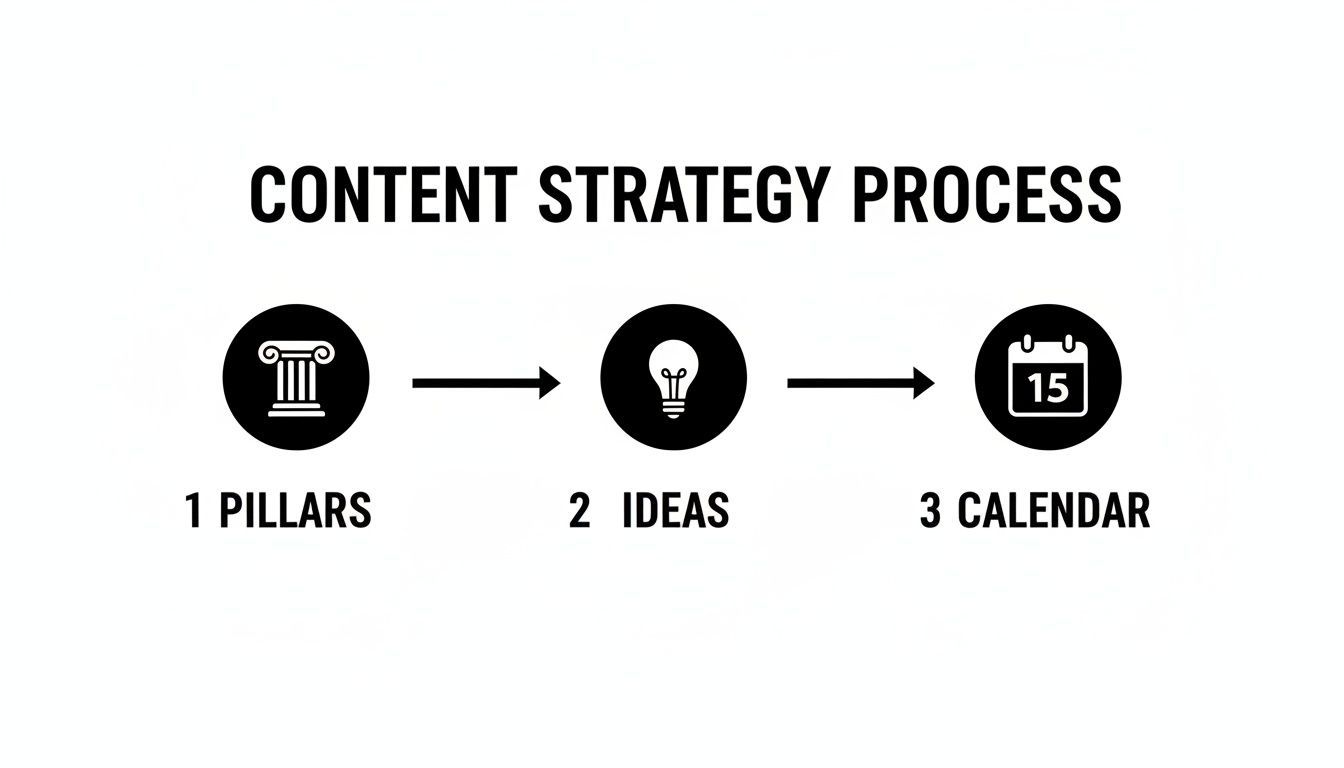
This simple flow—from pillars to ideas to a finished calendar—is exactly what AI helps you execute faster.
Editing and Distributing at Scale
Once the initial video is assembled, you can move on to editing and distribution—another area where an AI workflow is a game-changer.
The goal isn't just to make one video. It's to build a system that churns out a library of content. An AI workflow automates the repetitive stuff, freeing you to focus on high-level creative direction and strategy.
Think about the typical editing for a short-form video. You have to trim clips, add captions, and resize it for every platform. An AI video editor handles this automatically:
- Fast Trimming: Snip the beginning and end of clips to get right to the good stuff.
- Auto-Captions: Instantly generate and style subtitles. This is a must, since so many people watch videos on mute.
- One-Click Resizing: Turn a 16:9 video into a 9:16 for TikTok and Reels or a 1:1 for an Instagram feed post in a single click.
Once your videos are ready, you can organize them into a "series" in your content library. The built-in scheduler can then auto-post them across TikTok, Instagram, and YouTube according to your content calendar. And if you're running paid campaigns, an integrated AI ad generator can create and test multiple ad variations even faster.
This is how you transform content creation from a daily grind into a simple, batchable task. It's how you take a great social media strategy on paper and turn it into a high-performing content machine that actually works.
Measuring What Matters and Optimizing for Results

Having a fantastic social media strategy template is a great start, but it's only half the job. If you aren't measuring your performance, you're essentially flying blind. A truly effective strategy is a living document, and this is the stage where you build the feedback loop that makes it smarter over time.
It's all about moving beyond the "vanity metrics" that feel good but don't mean much for the business. Sure, likes and follower counts are nice, but they don’t pay the bills. The real measure of success is how your social media efforts contribute to your bigger business goals.
Tracking KPIs That Drive Business Growth
To really get a handle on what’s working, you need to monitor a handful of core metrics. Think of these KPIs as the vital signs of your strategy, telling you if your content is actually reaching the right people and getting them to act.
These are the essential metrics every marketer should have on their dashboard:
- Reach: The total number of unique people who saw your post. This answers the most basic question: Is your content getting in front of anyone?
- Engagement Rate: This bundles likes, comments, shares, and saves to show how much your content connects with your audience. A high engagement rate is a clear sign people find what you're posting genuinely interesting.
- Click-Through Rate (CTR): This is the percentage of people who actually clicked the link in your post. CTR is a direct measure of how compelling your call-to-action is.
- Conversion Rate: This is the big one. It tracks the percentage of users who took a specific, desired action after clicking your link—like signing up for your newsletter or buying a product.
These KPIs don't exist in a vacuum. Analyzing them together helps you diagnose the health of your strategy. For instance, high reach but low engagement might signal that your content isn't hitting the mark. On the other hand, high engagement with a low CTR could mean your call-to-action is weak or unclear.
Connecting Social Activity to Tangible Outcomes
To get the full picture, you’ll need to pull data from a few different places. Every social platform has its own native analytics dashboard, which is the perfect place to start for understanding reach and engagement on that specific channel.
But to track what happens after the click—like website traffic, leads, and sales—you need to connect that social data to a more robust analytics tool. This is where something like Google Analytics becomes indispensable.
A great social strategy is iterative and data-backed. Regularly review your analytics, learn what resonates, and use those insights to continually refine your content pillars and creative approach for ever-improving performance.
By using UTM parameters—which are just little tracking tags you add to your URLs—you can see exactly how many website visitors, leads, or sales came from a specific Instagram post, TikTok video, or LinkedIn article. This is how you prove the direct ROI of your social media efforts. It lets you say with confidence, "Our Instagram Reels generated $5,000 in sales last month."
The Power of A/B Testing and Optimization
Once you're consistently tracking your data, you can get to the fun part: optimization. The key here is A/B testing, also known as split testing. It’s a simple concept: create two versions of a piece of content with one small difference, and see which one performs better.
You can A/B test just about anything to dial in your results:
- Headlines: Try a straightforward headline against one that asks a question.
- Visuals: Pit a video against a static image or a carousel post to see what your audience prefers.
- Calls-to-Action (CTAs): Does "Shop Now" convert better than "Learn More"? Test it and find out.
This process of constant experimentation is what creates a powerful feedback loop. You analyze the data, learn what your audience truly responds to, and then apply those learnings to your future content. This is how you turn a static plan into a dynamic engine for growth, ensuring every post you create is more effective than the last.
A Few Common Questions We Hear
Even with a perfect template in hand, you’re going to have questions. It’s only natural. Turning a plan on paper into a real, living content machine always brings up a few sticking points.
I’ve heard these same questions from countless marketers, whether they’re a one-person shop or part of a big team. Let's clear them up so you can move forward with confidence.
How Often Should I Actually Update My Social Media Strategy?
This is a big one. Your social media strategy can't be a "set it and forget it" document—the landscape just changes too fast. Think of it more like a living guide that needs regular check-ups to make sure it’s still working hard for you.
As a general rule, give it a light review every quarter. This is your chance to pop the hood, check in on your goals, and see if your content pillars are still hitting the mark. It's the perfect time to make small tweaks based on what the data is telling you.
Beyond that, you absolutely need to plan for a deep-dive review at least once a year. This is a much heavier lift where you question everything. For this annual audit, you'll want to:
- Re-examine your audience personas. Have their needs changed?
- Do a full competitive analysis to see what others have been up to.
- Dig into the performance of each social channel.
- Decide if you need to add new platforms or ditch ones that aren't performing.
Social media algorithms and user habits are always in flux. A strategy that's reviewed quarterly and overhauled annually keeps you agile. You'll be able to jump on new features and adapt to audience shifts before your competition even knows what's happening.
This steady rhythm of review and adjustment is what separates a plan that gathers dust from one that consistently drives results.
Will This Template Work for My Small Business with a Tiny Budget?
Yes, absolutely. In fact, a solid strategy template is arguably more crucial when you have limited resources. When you can't just throw money at a problem, you have to be smart and focused. That's your superpower.
This template is all about strategy, not spending. It forces you to make deliberate choices instead of feeling like you have to be everywhere at once. By zeroing in on just 1-2 key platforms where you know your ideal customer hangs out, you can concentrate your time and energy for the biggest impact.
The idea of content pillars is another game-changer for small teams. When you focus on a few core themes, you can create high-quality, genuinely helpful content that builds trust and authority—no big production team required. This disciplined approach means every single post is pulling its weight, making your small budget go a whole lot further.
What's the Single Most Important Part of This Whole Template?
If you get only one thing right, make it this: know your audience and your goals. Everything else in your social media strategy—every post, every campaign, every creative choice—flows from these two things. They are the foundation.
If you don't have a crystal-clear picture of who you're talking to—their problems, their aspirations, what makes them tick online—your content will fall flat. You'll just be shouting into an empty room.
And without measurable goals tied to actual business outcomes (like leads, sales, or sign-ups), your social media efforts are just a hobby. You'll have no way to know if you're winning because you never defined what winning looks like.
Everything else, from your content pillars to your posting schedule, is just a tactic to serve that core strategy. Nail your audience and your goals, and even a simple plan can work wonders. Get them wrong, and the most beautifully designed content plan in the world won't deliver an ounce of real value.
Ready to stop guessing and start creating? ShortGenius turns your strategy into a high-speed content engine. Generate scripts, assemble videos with AI, and schedule posts across all your channels in a fraction of the time. Transform your workflow and start publishing content that grows your business today at https://shortgenius.com.