10 Short Form Video Trends to Watch in 2026

Explore 10 short form video trends shaping 2026, with platform examples, practical tips, and ways ShortGenius can help you create and scale.
What will earn the next scroll in 2026 probably won't be the creator who tries every trend first. It'll be the creator or team that picks a few trends they can produce repeatedly, adapts them to how each platform behaves, and keeps shipping without burning out.
That matters because short-form video now takes about 58% of social media time, according to 2026 short-form video summaries. Attention is there, but attention alone doesn't create a durable channel. Consistency, retention, and format discipline do.
I prioritize short form video trends with four filters. First, attention. Does the format stop the scroll fast enough to earn distribution? Second, repeatability. Can you make it weekly without rebuilding your process from scratch? Third, authenticity. Does it feel native to TikTok, Reels, and Shorts instead of looking like a repurposed ad? Fourth, conversion potential. Can it create comments, saves, clicks, leads, or sales instead of views that go nowhere?
The list below is ordered by production and distribution opportunity, not just by novelty. It starts with formats that make content output easier to scale, then moves into trends that build stronger audience loops, stronger community ties, and clearer monetization paths. For each one, I've paired the trend with platform context, one concrete production move, and a practical way to test and schedule it with ShortGenius.
1. AI-Generated Faceless Videos
In 2026, AI-generated faceless video has become one of the clearest production opportunities in short form. It gives creators and small teams a way to publish at higher volume, protect privacy, and keep formatting consistent across a weekly content schedule.
The format works best when the audience is showing up for utility, not personality. Finance breakdowns, software walkthroughs, motivation clips, psychology explainers, and true crime summaries all fit because the script carries the value. The editor's job is to make each scene explain the point, not just fill space.

What works and what fails
Strong faceless videos use motion with purpose. A tight first line, relevant B-roll, animated captions, visual callouts, and fast scene changes usually hold attention better than a flat voice track over generic stock clips.
Weak faceless videos break trust fast.
The usual failure point is mismatch. If the narration says “this habit ruins your focus” and the screen shows a random skyline, viewers feel the gap immediately. Talking-head content can survive a weaker visual layer because the face carries some of the attention. Faceless content cannot. Every shot has to earn its place.
Practical rule: If you remove the face, the script, pacing, and visual matching have to get sharper.
Platform context matters here. TikTok gives more room for dense text, faster pacing, and rougher visual experimentation if the idea is strong. Reels tends to reward cleaner composition, more polished captions, and brand-safe visual consistency. YouTube Shorts usually performs better when the video answers one specific question quickly, with less visual detouring.
The production move is simple. Build one core script, then create three versions of the opening and two visual packages. One version can lead with curiosity, one with a bold claim, and one with a direct how-to. Keep the middle of the script mostly stable so the test isolates the variable that matters.
ShortGenius fits this trend well because faceless production is really a modular workflow. Generate several script angles from the same topic, pair them with different voice profiles, swap caption treatments, and change the B-roll set for each platform. Then schedule the TikTok cut with heavier text framing, the Reels version with cleaner design, and the Shorts version with a tighter question-and-answer structure. That gives you a repeatable testing system without recording new footage every time.
2. Scroll-Stopping Hook Sequences
Most short videos aren't losing in the middle. They're losing in the first seconds.
That's why hook engineering sits near the top of any serious list of short form video trends. One 2026 benchmark reports that only about 30% of short-form videos exceed an 81% average watch rate, which tells you retention is still uneven even in a mature format, according to Kapwing's 2026 short-form benchmark roundup.
Build the first seconds backward
Start with the outcome, then write the opening. If the video teaches a lesson, reveals a mistake, or shows a result, the hook should preview that payoff without becoming clickbait.
Good hooks usually land in one of a few buckets:
- Curiosity hook: “I thought this edit was hurting reach. It was the caption style.”
- Pattern interrupt: sudden zoom, abrupt text card, unexpected visual cut
- Tension hook: “This looked like a strong post. Then retention collapsed.”
- Outcome-first hook: “This is the exact product shot that made people stop scrolling.”
For creators building a testing workflow on ShortGenius, the smart move isn't making one perfect opener. It's making several hook variants for the same body content. Swap the first line, first frame, caption treatment, or camera move. Keep the rest intact so you can tell what changed the result.
A lot of teams still under-test hooks. If you want a sharper organic system, studying a practical 2026 TikTok growth strategy helps because it pushes the same core idea. Format and opening beat generic “post more” advice.
The best hook is specific, native, and honest. It promises a payoff the clip can actually deliver.
3. Trend-Jacking with Real-Time Hooks
Real-time trend-jacking still works in 2026, but only when two things happen at once. The post has to ship while the trend is still active, and it has to give your audience a reason to care.
That changes the job. The goal is not to repeat a trending format faster than everyone else. The goal is to attach a relevant angle to a format that already has attention.
A SaaS creator might use a trending sound to show the onboarding mistake that causes churn. A fitness coach can turn a viral claim into a form correction. A beauty brand can respond to a cultural moment with a tutorial, comparison, or quick reaction, but only if the product connection feels native on camera.
Use short trend windows differently on each platform
TikTok is still the first stop for fast reactions because trend behavior forms there earlier and viewers tolerate rougher production if the idea is timely. Reels usually rewards the second version. Cleaner captions, tighter pacing, and a more polished visual pass help once the concept has already proven itself. Shorts tends to perform better when the trend is reframed into a takeaway, breakdown, or myth-vs-fact format that can keep getting views after the original moment cools off.
That platform order creates a practical workflow.
Record one base take fast. Then cut three versions on purpose, not one generic repost. The TikTok version can open with the trend reference immediately. The Reels cut can sharpen the visual package and reduce dead space. The Shorts version can lead with the lesson and use the trend as supporting context.
ShortGenius is useful here because speed comes from preparation, not improvisation. Keep reaction, commentary, and explainer templates ready with your caption presets, scene timing, and brand-safe layouts already built. Then the team only has to swap the source clip, rewrite the on-screen text, adjust the opener for each platform, and schedule the versions while the topic still has distribution value.
Three production rules make this trend worth repeating:
- Add context: tell viewers why this trend matters in your niche
- Add a stance: agree, disagree, test it, or translate it for a specific audience
- Add a platform edit: change the opening, pacing, and caption treatment for TikTok, Reels, and Shorts instead of posting the same file everywhere
The trade-off is simple. Fast posting helps reach the window, but rushed formatting can waste it. Teams that scale this well do not chase every trend. They keep a small filter. Relevance to the audience, ease of production, and cross-platform adaptability. If a trend fails those three checks, skip it.
4. Educational Microlearning Series & Carousel-Style Swipeable Content
Educational short-form works best when it behaves like a series, not a standalone lecture. That's especially true now that 66% of viewers finish videos under 1 minute, according to 2026 short-form viewing data.
That number matters because it rewards tightly scoped teaching. One lesson. One answer. One comparison. One visible progression.
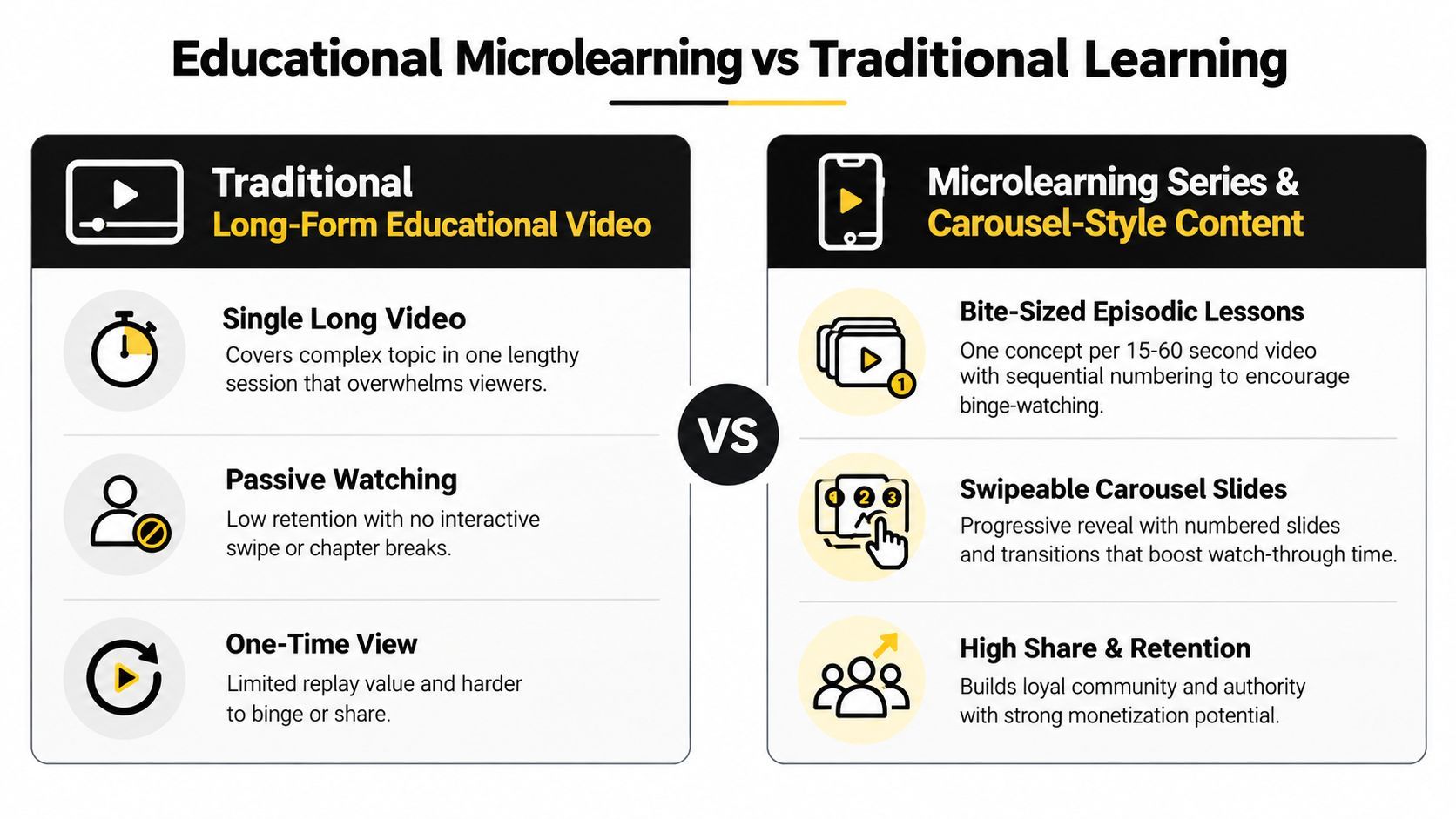
Turn lessons into episodes
Microlearning is strong on YouTube Shorts and Reels because people often save and revisit educational clips there. TikTok can work too, but the pacing needs more energy and a stronger opening pattern interrupt.
Instead of “everything about email marketing,” break it into a chain:
- Part 1: subject line mistake
- Part 2: preview text fix
- Part 3: CTA structure
- Part 4: send-time myth
Carousel-style video adds another layer. Use separate scenes like slides. Number them clearly. Give each one its own micro-payoff. That creates the feeling of progress, which keeps viewers moving.
Creators can build this cleanly with ShortGenius by outlining an entire series upfront, then turning each point into a separate scene block. That makes it easy to duplicate the format, change one lesson, and keep the same branding, pacing, and voice across a multi-post sequence.
What doesn't work is overpacking the lesson. If you need to say “there's a lot more nuance here,” that's usually a sign the clip should become a series instead of a single upload.
5. Before/After Transformation Stories
Transformation content works because it gives viewers a narrative they can measure. The setup is clear, the progress is visible, and the outcome creates emotional payoff.
That structure fits fitness, design, productivity, home organization, language learning, career skill-building, and business process content. It also performs well when the “after” isn't dramatic but the process is honest. A small but believable transformation is often stronger than a huge claim with weak proof.

Show the process, not just the reveal
The weakest transformation videos jump from before to after with no middle. That creates skepticism. The better version shows clips, habits, mistakes, tools, or decisions that explain the change.
A practical production move is to collect raw proof continuously. Screen recordings, old drafts, journal snapshots, voice memos, workout clips, and timeline markers all help. Once you have them, ShortGenius can turn the footage into a narrative sequence with split-screen comparisons, text overlays, voiceover versions, and follow-up episodes.
Show enough friction that people believe the result.
Platform context matters here. TikTok often rewards emotionally direct storytelling. Reels tends to like more polished visual reveals. Shorts usually benefits when the title frame and opening line make the transformation objective obvious. “How my thumbnails changed” works better there than a vague life-update style opener.
The best scaling angle is serialization. Don't treat the transformation as one big reveal. Turn it into chaptered updates, then repurpose the strongest clips into recap edits and platform-specific cuts.
6. UGC-Style Product Reviews
UGC-style review content keeps winning because it looks like feed-native opinion, not campaign creative. That matters in a year when 91% of businesses use video marketing, according to ReelFlood's 2026 short-form marketing roundup. If everyone's using video, polished production alone isn't an advantage.
The practical edge is credibility. Casual framing, plain language, and honest negatives often outperform glossy product scripting because viewers can classify the content faster. They know what it's trying to do, and if it feels human enough, they'll keep watching.
Native review beats ad-speak
The best UGC-style reviews sound like someone talking to a friend:
- what I bought
- why I tried it
- what surprised me
- what annoyed me
- who should use it
That format works well on TikTok and Reels. Shorts can work too, especially for software walkthroughs, gadget reviews, and quick demos, but the script usually needs to get to the practical point faster.
A scalable move with this trend is message variation. Keep the same product footage, then produce multiple scripts around different objections or use cases. One version can focus on speed. Another on ease of use. Another on one specific pain point. ShortGenius helps here because you can swap voiceovers, captions, and opening claims without rebuilding the entire edit.
If you're tying this trend to commerce, a strong guide to shoppable video ads is useful for thinking beyond “review content” and into how review footage supports buying behavior.
7. Shoppable Video & Direct Sales Integration
Short-form video now sits closer to checkout than a lot of teams admit. Deloitte points to that shift in its 2026 short-form series outlook, and the production implication is straightforward. Commerce clips need to answer buying questions while attention is still there.

A useful way to prioritize this trend is by where conversion friction happens on each platform.
On TikTok and Instagram Reels, the winning format is usually problem-first demonstration. Show the exact moment the product removes effort, confusion, or delay. On YouTube Shorts, viewers often need faster context, especially for software, gadgets, or higher-consideration products, so put the result on screen early and use captions to clarify what changed. Facebook Reels tends to reward cleaner framing and more explicit offers, particularly for broad consumer products and local businesses.
The production move is simple. Build one core product shoot around three scenes: the friction moment, the product in use, and the outcome. Then cut platform-specific versions from that same footage instead of filming separate ads for every channel. That keeps the creative consistent while letting the packaging change.
What sells is specificity.
“Here's how this organizer fits under a sink with awkward plumbing” beats generic product praise. “This keyboard shortcut removes one reporting task I was repeating every Friday” beats broad claims about productivity. Shoppable video works best when the viewer can see where the product fits into their own routine.
A repeatable workflow with ShortGenius video scheduling and versioning tools is to map edits by intent, not just by platform. Create one version for discovery, one for objection handling, and one for direct purchase intent. Change the hook, CTA timing, on-screen proof, and caption density, then schedule the right variant to TikTok, Instagram, YouTube, Facebook, or X based on how that audience buys.
Formatting still affects revenue. Tight crops can hide product details, price overlays, or the hand movement that explains the value. Teams adapting one commerce asset across channels should check vertical specs before exporting, and 1080x1920 Reel size for higher ROI is a useful reference for avoiding preventable performance loss.
8. AI Voice Cloning & Synthetic Narration Diversity
Voice selection now affects distribution, not just production speed.
A strong short form script rarely works as one universal narration track across TikTok, Reels, Shorts, and Facebook. TikTok can tolerate more personality and faster tonal shifts. YouTube Shorts often benefits from cleaner pacing and clearer explanation. Instagram usually rewards polish, especially for brand-led education or product storytelling. If teams keep one script but change the narrator, pacing, and caption rhythm, they get more testing surface without rebuilding the whole asset.
The practical trade-off is brand consistency versus audience fit. A cloned founder voice can strengthen recognition, but it can also wear out quickly if every clip sounds identical. Synthetic narration gives teams another option. Keep one recognizable voice for trust-heavy content, then use alternate voices for tutorials, recaps, multilingual cuts, or character-based series where variation helps retention.
One useful way to run this trend is by content lane:
For a tool demo, use a direct instructional voice with tighter pauses. For a customer story, use a warmer read with more space between lines. For commentary, use a faster voice with sharper emphasis in the first five seconds. Same topic. Different packaging.
That matters most for accounts producing at volume. Faceless channels, media brands, educators, and ecommerce teams often need more than one delivery style, but they do not need to re-record every script manually to get there.
Weak scripts still fail fast. Synthetic narration can save recording time, but it will not fix a vague opening, flat proof, or unclear payoff.
With ShortGenius, the scalable move is to build one approved script, generate several narration variants, and group tests by distribution goal instead of dumping every version into one batch. Schedule one voice for cold discovery clips, another for warmer audience retargeting content, and a third for localized or multilingual distribution. That creates a cleaner workflow for testing, adapting, and scheduling across platforms, and it makes results easier to interpret when one narration style outperforms another on a specific channel or topic.
9. Creator Collaboration & Duet/Stitch Repurposing
In 2026, collaboration-driven short form works best when it targets audience overlap with a clear contribution. The win is not the tag. The win is showing up inside an active conversation with a point of view strong enough to earn the follow after the borrowed reach fades.
Duets, stitches, replies, and remixes solve a real production problem too. They give teams a faster starting point than an empty timeline. That speed only matters if the added layer is useful.
Add interpretation people can keep
The strongest collaboration clips usually do one job well:
- correct a bad take
- add missing context
- apply the idea to a different niche
A fitness creator can stitch a squat tutorial and isolate one form mistake that causes knee pain. A marketer can respond to a pricing opinion and explain what changes when margins, sales cycles, or retention are weak. A personal finance creator can duet a viral money tip and flag the risk the original clip skipped.
The trade-off is simple. Recognition gets the first second. Interpretation earns the rest.
TikTok still gives this format the clearest native behavior because viewers already expect stitched commentary there. Instagram Reels usually performs better with a cleaner repost or a re-cut reaction that removes platform-native clutter. YouTube Shorts often benefits from a tighter educational frame, with the source claim summarized quickly and your response carrying the clip.
Borrowed attention becomes durable only when the added takeaway is specific.
With ShortGenius, the scalable move is to treat one source clip as a small content batch instead of a single post. Save the original under a theme, cut a native duet for TikTok, build a standalone talking-head or faceless response for Reels, then turn the same angle into a caption-led Shorts version with tighter pacing. That workflow makes testing cleaner because each platform gets the format it already rewards, and scheduling stays organized by topic, source, and response type rather than by random one-off collaborations.
10. Niche Community Building
Audience identity outperforms raw posting volume.
Short-form teams that win in a niche give viewers a reason to return beyond the individual clip. People come back for a format they recognize, a running joke, a weekly prompt, a comment series, or a shared frustration that keeps getting named clearly. That is the production opportunity here. One good idea can become a recurring asset instead of another one-off post.
Analysts at Metricool found that YouTube Shorts interactions fell nearly 50% year over year even as posting volume increased, according to Metricool's short video report. More output does not guarantee stronger response. Community formats help solve that because they give the audience a role, not just something to watch.
A practical way to build this is to create one repeatable series for each platform instead of forcing the same ritual everywhere.
On TikTok, comment-response formats and insider references usually carry better because viewers already participate in the thread culture. On Instagram Reels, recurring visual segments work better. A founder desk check, a weekly "what we shipped," or a niche meme recap with consistent styling gives followers something familiar to spot in-feed. On YouTube Shorts, community usually forms around a recurring question or problem category, since search and recommendation often reward clearer topic framing.
Useful recurring formats include:
- weekly teardown of one common mistake
- audience-submitted examples with commentary
- recurring "you only notice this if you work in X" clips
- monthly progress updates on one challenge
- jargon translation for new people entering the niche
- "what clients get wrong about this" confessionals
The trade-off is repetition fatigue. A format that is too broad turns generic fast. A format that is too narrow runs out of material in two weeks. The sweet spot is a clear container with changing inputs. "Review one bad landing page CTA each Friday" scales better than "talk about marketing advice."
ShortGenius helps at the workflow level. Save each recurring series as its own template, keep hooks and caption styles inside dedicated folders, batch three to five episodes at once, then schedule platform-specific cuts under the same series label. That makes testing easier because you can compare recurring formats by theme, not by random posts. It also cuts production drag. The team is not rebuilding the segment every time.
A healthy niche community shows up in behavior. Viewers reference prior episodes, submit material, reuse your language, and ask for the next installment. That is the signal to keep the format, adapt it per platform, and turn it into a standing part of the content calendar.
Short-Form Video Trends: 10-Point Comparison
| Item | 🔄 Implementation Complexity | ⚡ Resource Requirements & Speed | ⭐ Expected Outcomes | 📊 Ideal Use Cases | 💡 Key Advantages |
|---|---|---|---|---|---|
| AI-Generated Faceless Videos | Moderate, tool integration + scripting | Low equipment; subscription cost; fast production cycles | Scalable, consistent quality; moderate personal connection | Education, finance, narration-heavy niches, privacy-focused creators | Scales easily; low build cost; preserves creator privacy; test voices/templates |
| Scroll-Stopping Hook Sequences | Low–Moderate, creative testing & psychology know-how | Minimal equipment; rapid A/B testing; very fast iteration | High watch-through and algorithmic reach if hook is paid off | All niches on TikTok/Reels/Shorts aiming for virality | Dramatically increases views; easy to iterate; must deliver payoff |
| Trend-Jacking with Real-Time Hooks | High, requires constant monitoring and speed | Low production cost but needs rapid tools/workflow; time-critical | Potentially massive short-term reach; ephemeral longevity | News, comedy, reactive creators, trend-hunters | Early-adopter amplification; low cost; risk of saturation/short lifespan |
| Educational Microlearning Series & Carousel-Style | Moderate–High, series planning and pacing | Moderate resources for graphics/captions; efficient when batched | High retention, authority building, binge potential | Coaches, language, certifications, professional development | Predictable schedule; strong monetization; drives loyal subscribers |
| Before/After Transformation Stories | High, long-term documentation and careful editing | Moderate equipment; time-intensive production over weeks/months | Very high emotional engagement and shareability | Fitness, coaching, business growth, personal journeys | Powerful social proof; drives trust and partnerships; needs transparency |
| UGC-Style Product Reviews | Low, informal production; authenticity management | Very low equipment; requires product access; quick turnaround | High conversion and trust for commerce-focused audiences | Affiliate marketing, beauty, tech, DTC brands | Feels authentic; strong ROI; low production barrier; require disclosures |
| Shoppable Video & Direct Sales Integration | Moderate–High, e-commerce/platform integration | Requires product inventory, platform setup; moderate speed | High direct conversions and measurable ROI | E-commerce, fashion, beauty, home goods, DTC sellers | Lowest friction to purchase; supports discounts & tracking; platform-dependent |
| AI Voice Cloning & Synthetic Narration Diversity | Moderate, voice training + legal/ethics steps | Low recording hardware; subscription fees; enables instant variations | Consistent narration, large time savings; mixed authenticity perception | High-volume faceless creators, multilingual channels, tutorials | Scale narration; A/B test voices; cost-effective vs actors; disclose usage |
| Creator Collaboration & Duet/Stitch Repurposing | Low–Moderate, coordination and value-added responses | Low production needs; depends on collaborator availability; fast publish | Boosted reach via network effects; variable performance | Trend participation, comedy, music, cross-niche growth | Access new audiences quickly; low friction; fosters community ties |
| Niche Community Building (Cult of Personality) | High, long-term persona and content strategy | Moderate ongoing effort; time-intensive engagement and moderation | Very high loyalty, lifetime value, resilient engagement | Subject-matter experts, recurring-segment creators, community-first channels | Strong sponsorships and evangelism; resistant to algorithm shifts; slower initial growth |
Turn Trends Into a Repeatable System
The best way to use these short form video trends isn't to chase all ten. It's to separate experimentation from commitment.
Start by picking two trends that fit your audience and your current production reality. A solo creator might pair AI-generated faceless videos with microlearning series. A DTC brand might pair UGC-style product reviews with shoppable video. An educator might combine hook testing with transformation storytelling. The right combination depends on what you can make repeatedly without lowering quality after the first week.
Then create several variations before you decide anything. One version is content. Multiple versions become a test. Change the hook. Change the voice. Change the pacing. Change the first visual. Change the CTA. Keep the core idea stable enough that you can tell what moved retention, comments, shares, saves, or conversion signals.
This matters even more now because short-form has become a large business channel, not just a creative playground. One 2026 industry estimate places short-form video ad spending at about $1.04 trillion, and another says the global short-form video market is roughly $59.09 billion in 2026, with a projection to reach $640.9 billion by 2035 at a 30.33% CAGR, according to Vidico's 2026 short-form statistics roundup. At the same time, another 2026 compilation says 77% of marketers report that videos under 60 seconds deliver the highest ROI and that short-form represents roughly $111B of the approximately $236B global video ad spend, according to ReelFlood's 2026 video marketing statistics. The takeaway is straightforward. Teams need systems for throughput, versioning, and distribution.
That's where a platform like ShortGenius fits naturally. Once a format starts working, turn it into a branded series. Save the scene structure. Keep the winning caption style. Reuse the voice that matched the topic. Organize assets by campaign, niche, or product line. Then adapt the same creative concept across TikTok, YouTube, Instagram, Facebook, and X instead of rebuilding each post manually.
The durable advantage isn't being first to copy a trend. It's building a workflow that can test, refine, and publish relevant short-form content consistently. The creators and teams who win next year will be the ones who can do that every week.
If you want a practical way to apply these trends, ShortGenius (AI Video / AI Ad Generator) gives you one place to script, assemble, voice, edit, resize, and schedule short-form content across major platforms. It's built for exactly the kind of repeatable testing and versioning this article recommends. Explore ShortGenius (AI Video / AI Ad Generator) if you want to turn a few promising formats into a consistent publishing system.