Short Form Video Content: The Ultimate Guide for 2026

Master short form video content in 2026. Our guide covers platform specs, creative formats, scalable workflows, and measurement to drive real growth.
Video is projected to account for 82% of global internet traffic in 2025, and 78% of consumers prefer learning about products through short videos according to Teleprompter's roundup of social media video statistics. That changes the conversation. Short form video content isn't a nice extra for social teams anymore. It's core infrastructure.
The hard part isn't understanding that short video matters. The hard part is building a system that can produce it consistently without draining your team, then proving that the work contributes to something more meaningful than views.
Teams often get stuck in one of two places. They either publish sporadically because the content treadmill burns everyone out, or they publish constantly but can't connect the effort to traffic, leads, or sales. Both problems are operational problems. They need workflow discipline, format discipline, and a measurement model that reflects how short video influences buying behavior.
The Unstoppable Rise of Short Form Video
Short form video now shapes how attention is won on mobile. People open feeds dozens of times a day, often for seconds, not sessions. The formats that win in that environment get to the point fast, carry the idea visually, and give the algorithm a clear signal that viewers want more.
That shift matters because short video has moved beyond entertainment. It now plays a role in product discovery, education, trust-building, and demand generation. For marketing teams, creators, and media brands, that changes the operating model. Short video is part of the publishing system, not an add-on for social.
The practical implication is simple. Teams need a repeatable way to turn ideas into feed-ready assets at a steady pace.
A lot of teams still treat short form as a creative sprint. Someone has a strong idea, a clip performs, everyone rushes to make five more, then output drops because the process depends on individual energy. That pattern does not scale. Sustainable short-form programs rely on editorial constraints, reusable formats, and production habits that reduce decision fatigue.
Three shifts usually separate teams that post occasionally from teams that build real momentum:
- Ideas have to survive compression: If a message needs five minutes of setup, it needs a different angle before it becomes a strong short video.
- Throughput becomes an operating issue: Consistency comes from systems for scripting, filming, editing, approvals, and repurposing, not from constant creative pressure.
- Performance needs business context: Views and watch time matter, but leadership will eventually ask what the channel contributes to traffic, pipeline, or sales activity.
That is where many short-form efforts stall. One group burns out trying to feed the machine. Another publishes often but cannot show why the work matters beyond reach. The rise of short form has made both problems more visible, not less.
The teams getting results usually stop treating every post like a standalone bet. They build a series-based engine with clear content pillars, recurring hooks, and a defined next action for the viewer. Sometimes that action is a follow or profile visit. Sometimes it is a click, a signup, or a branded search that shows up later in attribution.
The opportunity is real. So are the trade-offs. More output creates more chances to learn, but it also creates review bottlenecks, creative fatigue, and noisy reporting if the system behind the content is weak. Short form works best when production discipline and measurement discipline grow together.
What Is Short Form Video Content Really
Short form video content is often described by length alone, but that misses the point. The better way to think about it is digital tapas. It's small, flavorful, easy to sample, and designed to make someone want the next bite.
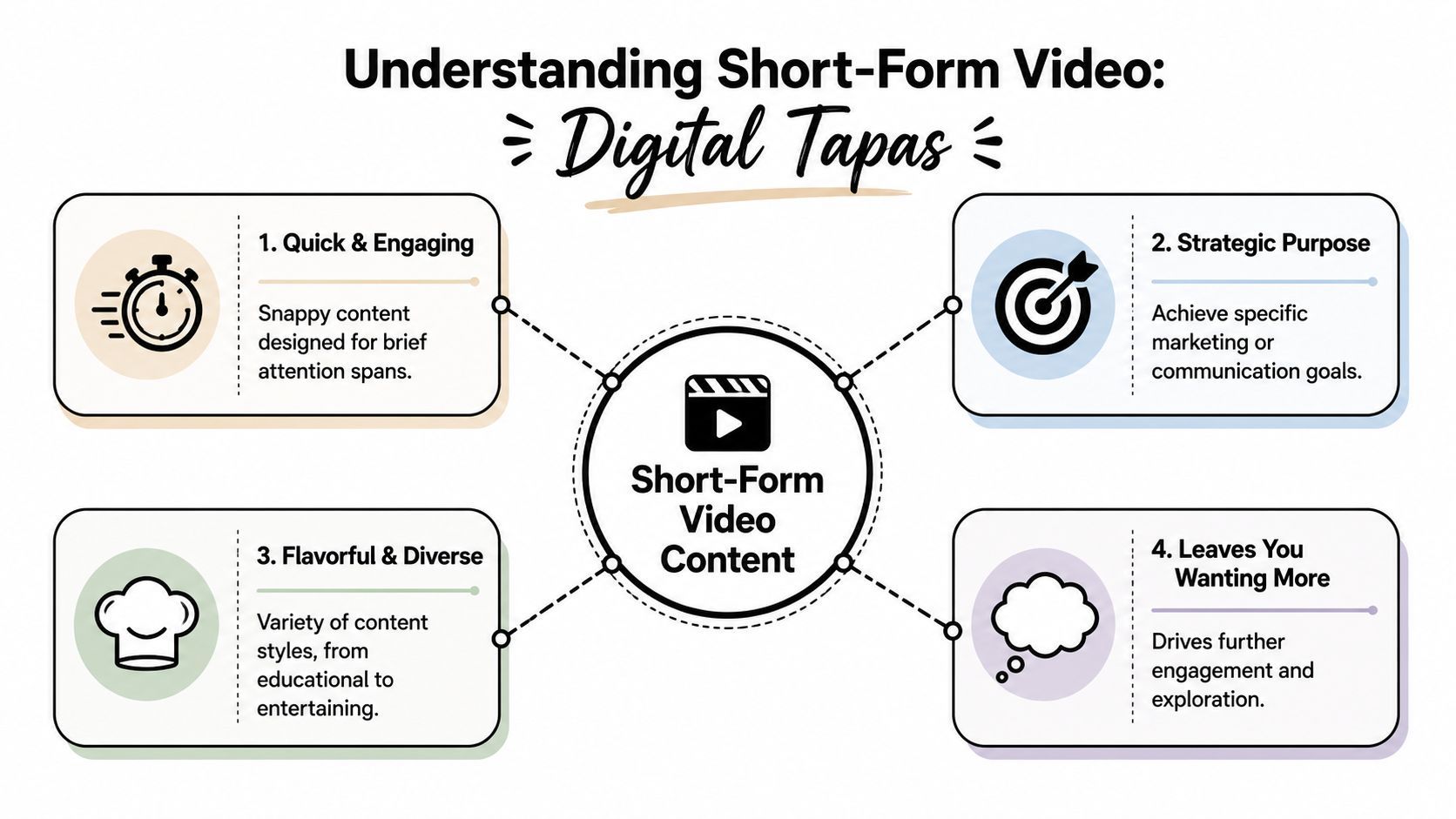
A long YouTube video, webinar, or podcast is a full meal. It can go deeper, teach more, and hold nuance. A short video does something different. It creates momentum. It earns curiosity fast and asks for very little commitment upfront.
The real job of a short video
A strong short video usually does one of four things:
- Starts discovery: Someone who has never heard of you stops scrolling.
- Sharpens a belief: You give the viewer a clearer opinion, insight, or takeaway.
- Builds familiarity: Repeated exposure makes your brand or face feel known.
- Triggers the next step: The viewer clicks, follows, searches, saves, or shares.
That's why short form video content works so well in modern content systems. It doesn't need to explain everything. It needs to do one job cleanly.
The format has its own native logic
Short videos aren't just “cut down” versions of other assets. They have different creative physics.
- Vertical framing matters: The content should feel native to a phone screen, not adapted as an afterthought.
- The opening has to carry weight: If the first moment is slow, unclear, or self-indulgent, viewers leave.
- Pacing beats polish: Many strong clips feel direct and immediate rather than overly produced.
- Loops help: A useful or satisfying ending can send viewers into a rewatch without thinking about it.
- Silent comprehension still matters: Even when audio is part of the experience, on-screen text and visual clarity do heavy lifting.
Short video succeeds when the viewer understands the premise instantly and feels rewarded before they can get bored.
A lot of teams misread the format and make tiny commercials. That usually underperforms. Native short content behaves more like a conversation starter, a demonstration, a quick lesson, a reaction, or a pattern interrupt.
The strategic mindset shift is simple. Don't ask, “How do we fit our message into a short clip?” Ask, “What is the smallest useful version of this idea that still creates desire for more?”
The Platform Landscape in 2026
TikTok, Instagram Reels, and YouTube Shorts all support short form video content, but they don't reward the same instincts in the same way. Cross-posting is still useful. Blindly cloning is not.
One principle is clear: short-form videos under 15 to 45 seconds consistently outperform longer clips, and 15 to 30 second vertical videos on TikTok and Reels achieve 60 to 80% watch-through, compared with 40 to 55% for 45 to 60 second videos according to Outbrain's analysis of short-form video performance. That same source recommends 75 to 150 words per script and a 9:16 aspect ratio for native performance.
Platform comparison
| Platform | Max Length | Optimal Length | Audience Mindset | Algorithmic Focus |
|---|---|---|---|---|
| TikTok | Varies by upload capability and platform updates | 15 to 30 seconds for most feed-native posts | Discovery first. Users expect novelty, fast payoff, and personality | Strong early retention, rewatches, shares, and content relevance |
| Instagram Reels | Varies by product format and account context | 15 to 30 seconds for broad reach | Mixed intent. Discovery, social proof, aesthetic value, and brand familiarity | Watch-through, saves, shares, and how well the post fits viewer interests |
| YouTube Shorts | Varies by current Shorts rules | 20 to 45 seconds often works well for education and commentary | Search plus feed discovery. Users often tolerate slightly more explanation | Retention, satisfaction, topic consistency, and repeat viewing behavior |
The “max length” column matters less than is commonly believed. Publishing up to the limit doesn't create an advantage by itself. In most cases, shorter wins because it reduces drop-off and forces tighter scripting.
How to choose your first platform
If you're deciding where to focus first, use the content itself as the starting point.
TikTok
TikTok is usually the best fit when the content depends on immediacy, trend fluency, informal delivery, or strong point of view. Product opinions, quick demos, hot takes, reactions, and personality-led education often travel well there.
Instagram Reels
Reels works well when brand identity, community overlap, and visual consistency matter. It's strong for creators and businesses that already have an Instagram presence and want short video to deepen familiarity rather than start from zero.
YouTube Shorts
Shorts often suits educators, commentators, reviewers, and niche experts who want short videos to feed a broader YouTube ecosystem. It's also useful when your short clips can point naturally toward longer videos.
Don't optimize for every platform at once. Optimize for the platform where your current content behavior feels most native.
One more technical note matters across all three. Keep your production baseline simple: vertical 9:16 framing, clear subtitles, readable composition, and scripts that can breathe inside a short runtime. Most weak performance comes from message bloat, not from missing advanced editing tricks.
Creative Formats and Hooks That Stop the Scroll
The fastest way to burn out is trying to invent a brand-new concept for every post. Sustainable short form video content comes from repeatable formats with fresh inputs.

Think like a showrunner, not a one-time creator. You need a handful of dependable structures that your audience can recognize and your team can execute quickly.
Four formats worth building into your mix
Problem agitate solve
This is one of the cleanest commercial formats because it mirrors how people think. Start with a specific pain point. Show why it's frustrating or costly. End with a practical fix.
A skincare brand might open with a visible issue. A B2B consultant might call out a workflow mistake. A creator selling a template might expose the clunky manual process first, then show the shortcut.
Educational quick-tip
This format works when you can teach one useful thing fast. The key is restraint. One tip. One mistake. One framework. One before-and-after.
Good quick-tip content often sounds like:
- “Do this instead of that.”
- “If you're getting this result, check this first.”
- “It's easy to overcomplicate this. The simple version is…”
Behind the scenes
Behind-the-scenes videos humanize the work. They also reduce creative pressure because they're built from real process, not from constant invention.
This can be:
- A designer walking through iterations
- A founder narrating a product decision
- An editor showing how raw footage becomes a finished clip
- A coach explaining how a lesson plan gets built
Myth busting
Myth-busting is useful because it creates tension immediately. The viewer arrives with an assumption, and the video challenges it.
Examples include:
- “You don't need more ideas. You need fewer formats.”
- “Posting more isn't your real problem.”
- “A polished intro can hurt short video performance if it delays the point.”
Hooks that earn the next three seconds
Most weak hooks fail because they're too broad. “Three tips for marketing” is generic. “Why your product videos lose viewers before the demo starts” is specific.
Use hooks like these as templates:
- A direct claim: “Most reels fail before the content even starts.”
- A pointed question: “Why are people watching but not clicking?”
- A visual contradiction: Show the result first, then explain it.
- A mistake frame: “The editing choice that makes your videos feel like ads.”
- A process reveal: “Here's how we turn one webinar into a week of short clips.”
If the first line could apply to anyone in any industry, it usually won't stop the scroll.
The best creators don't rely on inspiration every morning. They keep a swipe file of hooks, story structures, and transitions that already fit their niche. Over time, that library becomes a serious advantage.
Building a Scalable Production and Repurposing Workflow
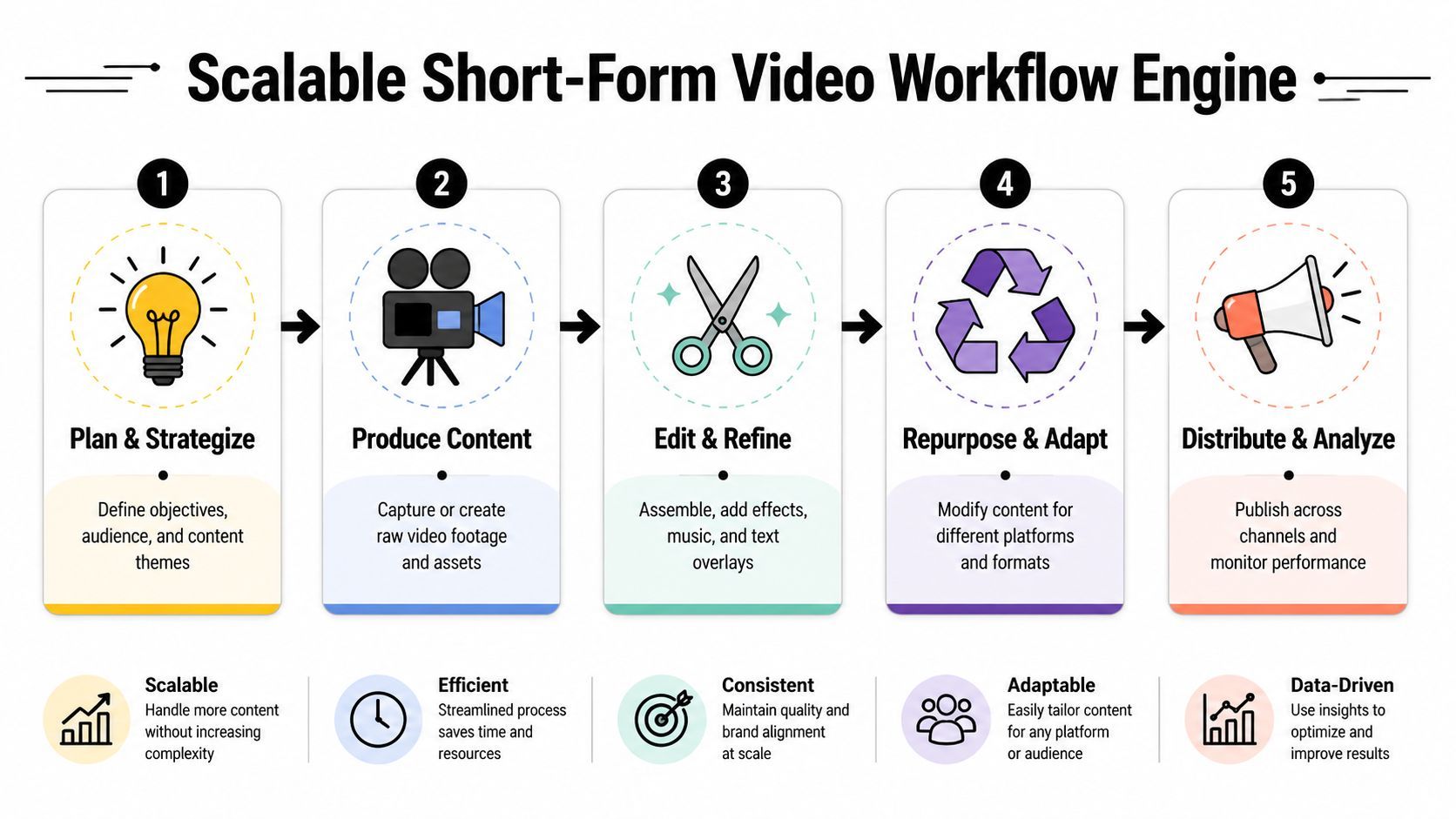
Short form breaks down at the operations layer long before it breaks down at the idea layer. Teams usually have enough topics. What they lack is a production system that can turn one recording session into a steady stream of usable clips without burning out the people making them.
That gap shows up in two places. Creative fatigue rises because every video feels custom. Measurement gets weaker because inconsistent formats make it hard to compare what is working. Analysts at the Digital Marketing Institute in their discussion of short-form video workflows note that resource constraints and repurposing challenges are common blockers for teams trying to scale.
Build a content operating system, not a posting habit
A durable workflow has five parts: planning, scripting, production, repurposing, and review. If one part stays informal, the whole system slows down. Teams start missing deadlines, editors wait on approvals, and strong source material gets used once and forgotten.
The fix is simple to describe and harder to maintain. Reduce one-off decisions.
1. Plan in repeatable series
Start with a small set of recurring themes tied to business value. Customer objections. Product use cases. Industry misconceptions. Implementation mistakes. Behind-the-scenes process. Those buckets create enough range without forcing the team to invent a new creative direction every week.
Then assign each theme a repeatable series format. For example, a founder opinion series, a weekly product teardown, or a customer-question series. Series give creators a frame to work inside, which lowers ideation time and makes output more consistent across a quarter, not just a week.
2. Script from patterns your team can repeat
Blank-page scripting wastes time and produces uneven work. Strong teams keep a small library of script structures mapped to specific goals, such as education, proof, objection handling, or conversion intent.
A simple structure often works well:
- Hook
- Core point
- Proof, example, or demonstration
- Payoff
- CTA
Write for speech, not for reading. Tight scripts usually survive editing better, and they are easier to test against retention data later because each segment has a clear job.
Teams producing at volume also benefit from a single production workflow instead of a stack of disconnected tools. An AI video workflow for scripting, editing, and publishing can reduce handoff delays and keep versioning under control. Tools such as ShortGenius can handle scriptwriting, asset generation, voiceovers, editing, resizing, and scheduling in one workflow.
Batch production before you feel behind
Batching is how teams protect quality while increasing volume.
Record multiple videos in one session while the camera setup, lighting, and talking points are already locked in. Batch B-roll on a separate day. Batch thumbnail or cover selection. Batch approvals with a reviewer who sees five clips in one pass instead of one clip five different times.
This approach lowers setup costs and reduces context switching, which is one of the biggest hidden drains in short form production. It also gives editors a cleaner queue and makes publishing more predictable.
3. Define editing rules before editing starts
Editors should not decide brand style from scratch on every asset. Set the rules once, document them, and update them only when performance or brand direction justifies a change.
Define:
- Caption rules: Font, placement, highlight style, safe margins
- Pacing rules: How quickly the main point must appear
- Visual rules: Zoom behavior, cut frequency, lower thirds, color treatment
- CTA rules: Which ask belongs to awareness, consideration, or conversion clips
These constraints do not make the work generic. They protect time for higher-value decisions, such as whether the story is clear and whether the first five seconds earn attention.
4. Repurpose source material into distinct angles
Repurposing should create variation, not copies.
One webinar, interview, customer call, or product demo can produce several short videos if the team cuts by angle instead of by transcript chunk. A single source asset might yield:
- A myth-busting clip
- A mistake-focused clip
- A product use case clip
- A founder perspective clip
- A checklist or framework clip
That method scales better because the footage does more than fill a calendar. It supports different audience intents across the funnel. If you want a practical view of the software stack many creators use for this stage, MicroPoster's content repurposing tool picks is a useful reference point.
5. Review on a fixed cadence
Publishing needs a calendar. Review needs a rhythm.
A weekly review is usually enough to catch creative problems early without overreacting to one outlier post. Look at output by format, theme, hook type, and source asset. That makes it easier to answer useful operational questions: Which series keeps generating clips worth repurposing? Which recording format creates the least editing drag? Which topics produce strong watch time but weak downstream action?
That is the goal of a scalable workflow. More output matters, but reliable output matters more. The teams that win with short form usually build a system that protects creative energy, gives editors clear rules, and produces data clean enough to improve the next batch.
How to Measure and Optimize for Real Business Impact
Views and likes are easy to report. They are weak inputs for budget decisions.
That is why short form video often gets overvalued by social teams and undervalued by revenue teams at the same time. Bambuser's article on making short-form video a commercial driver makes the core problem clear. Marketers struggle to measure impact beyond platform engagement, and last-click attribution misses how upper-funnel video influences later sales activity.
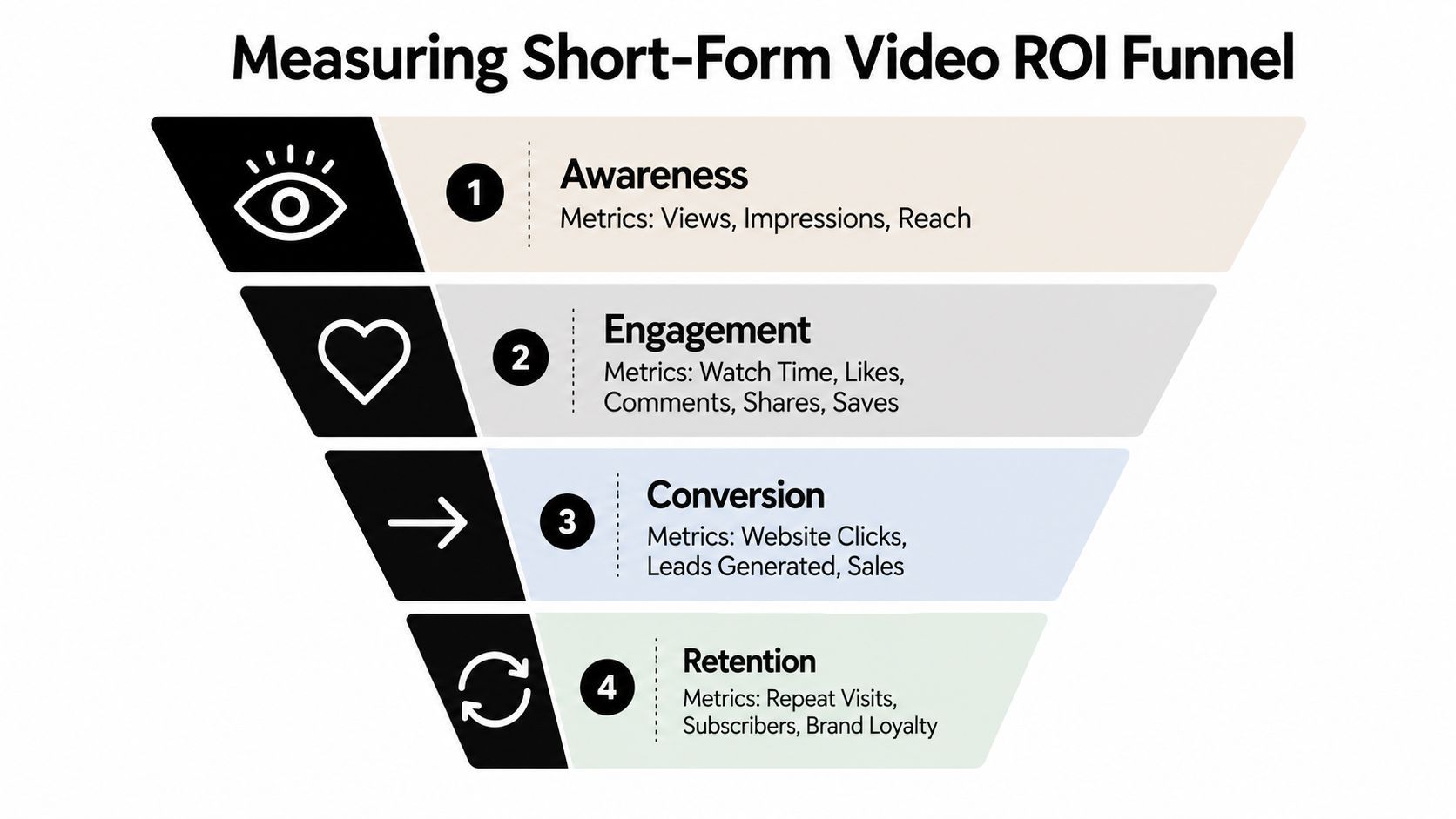
A workable system measures contribution at more than one level. That keeps teams from judging every clip by direct conversions, which is one of the fastest ways to kill a useful program.
Use a tiered measurement model
Tier one measures creative performance
Start with the signals that show whether the video itself is doing its job in-feed.
Track:
- Retention behavior: Are viewers staying long enough to hear the actual point?
- Completion rate: Does the script hold attention through the payoff?
- Shares and saves: Did the clip earn enough relevance to be kept or passed along?
- Comments: Are people asking smart follow-up questions, pushing back, or showing buying intent?
This layer improves creative decisions. It helps teams fix weak hooks, slow setups, cluttered scripting, and topics that attract curiosity without holding attention.
Tier two measures audience movement
The next question is whether attention turns into intent.
Watch for:
- Profile visits: A sign that the video created enough interest for someone to look deeper.
- Follower growth patterns: Useful when tied to a topic, series, or audience segment, not treated as a vanity score.
- Return engagement: Repeated interaction with a recurring theme or format.
- Traffic to linked destinations: Especially from bio links, pinned comments, creator profiles, or follow-up stories.
The following insight enhances reporting utility. Some clips produce average view counts but send stronger signals of consideration than bigger posts. Those are often the assets worth turning into a series.
Connect videos to off-platform behavior
Business impact usually shows up after the platform interaction, not inside the app.
Tier three measures commercial outcomes
Set up tracking so each video points to a clear destination and a clear job.
A practical setup includes:
- UTM-tagged links: Separate platform, campaign, content angle, and CTA
- Dedicated landing pages when needed: Helpful for offers, product lines, or lead magnets tied to a recurring series
- Pixel-based event tracking: Monitor sign-ups, add-to-cart actions, demo requests, and other key events where available
- Cohort review: Compare people exposed to a short form video program with other acquisition paths over time
This is the level where measurement gets messy, especially for B2B teams with longer sales cycles or brands selling through retail. That does not make the work optional. It means the reporting model needs to reflect how demand develops. A short video may create recall, shape problem awareness, and influence a later branded search or direct visit.
Optimize with operating rules
Raw metrics do not fix anything. Teams need rules that connect patterns to actions.
Use rules like these:
- If completion rate drops early, shorten the setup and place proof or payoff in the first lines.
- If views are healthy but profile visits stay weak, the topic may attract casual interest without building authority.
- If profile visits are strong but clicks are weak, the CTA, offer, or landing page promise is probably off.
- If clicks happen but conversion quality is poor, review the destination experience before changing the creative.
- If one series drives assisted conversions across multiple posts, keep funding the series even when single-post results vary.
This is also where creative burnout becomes a measurement problem. Teams burn out when they keep producing more videos without clear evidence of what is working. A tighter reporting cadence reduces wasted output. It shows which themes deserve more iterations, which CTAs need rewriting, and which formats create noise without business value.
The goal is not perfect attribution. The goal is a reporting system that gives short form video credit for the job it does, then helps the team improve that job over time.
Your First 90 Days with Short Form Video
The first three months should be simple. Complexity is what kills consistency.
In the first 30 days, pick one platform and one core format. Publish on a steady schedule you can maintain. Focus on clear hooks, tight scripting, and clean vertical presentation. Don't try to master trends, paid amplification, and multi-platform distribution all at once.
In days 31 to 60, review what's happening. Look for recurring winners by topic, hook style, and delivery method. Tighten weak openings. Rewrite vague CTAs. Start turning your better-performing ideas into variations instead of chasing new ones every time.
In days 61 to 90, maximize your impact. Expand one winning format into a series. Test a second format that serves a different goal, such as authority, community, or conversion. If your workflow is stable, start adapting selected videos for another platform rather than reposting everything blindly.
Short form video content rewards consistency more than brilliance. The teams that win usually aren't the ones with the most dramatic launch. They're the ones with a workable system, enough creative discipline to keep publishing, and enough measurement discipline to keep improving.
If you want to reduce the friction between idea, production, and publishing, ShortGenius (AI Video / AI Ad Generator) is built for that workflow. It combines scriptwriting, asset creation, video assembly, voiceovers, editing, resizing, and scheduling in one place, which can help creators and teams run a more consistent short-form operation without stitching together a large stack of separate tools.