Short Form Video Advertising: The Ultimate 2026 Guide

Learn how to master short form video advertising in 2026. Our guide covers strategy, creative, production, budgets, and measurement for TikTok, Reels & Shorts.
Short form video advertising now runs on the same constraint that shapes every paid social program. Creative throughput. Brands that can ship new concepts, test hooks quickly, and replace fatigued ads on schedule keep buying data fresh. Brands that cannot usually stall out long before media buying does.
That is the key shift. Short form video is no longer just a creative format. It is an operating system for paid acquisition, one that forces marketing teams to connect strategy, scripting, production, editing, testing, and analysis into a single workflow.
A lot of advice on this topic offers surface-level tips like hook faster, add captions, use trends, or cut tighter. Those tactics matter, but they do not solve the production bottleneck that shows up once a team needs dozens of variations across platforms, audiences, and funnel stages.
In practice, short form video advertising works when the team can do three things well. Match the message to the funnel stage. Produce enough creative volume to test real angles instead of minor edits. Use tools, including AI video workflows where they fit, to reduce turnaround time without flattening the brand voice.
That operational view is what this guide focuses on. The goal is not to collect creative tips. The goal is to build a system that turns strategy into repeatable execution and gives the team enough output to keep learning.
Why Short Form Video Is Now Essential for Growth
U.S. advertisers are putting hundreds of billions of dollars into short-form video. Budget follows attention, and attention on mobile now favors fast, vertical content that can explain, demonstrate, and persuade in seconds. For growth teams, that changes the job. Short-form video is no longer a nice add-on for social. It is a core input into customer acquisition.
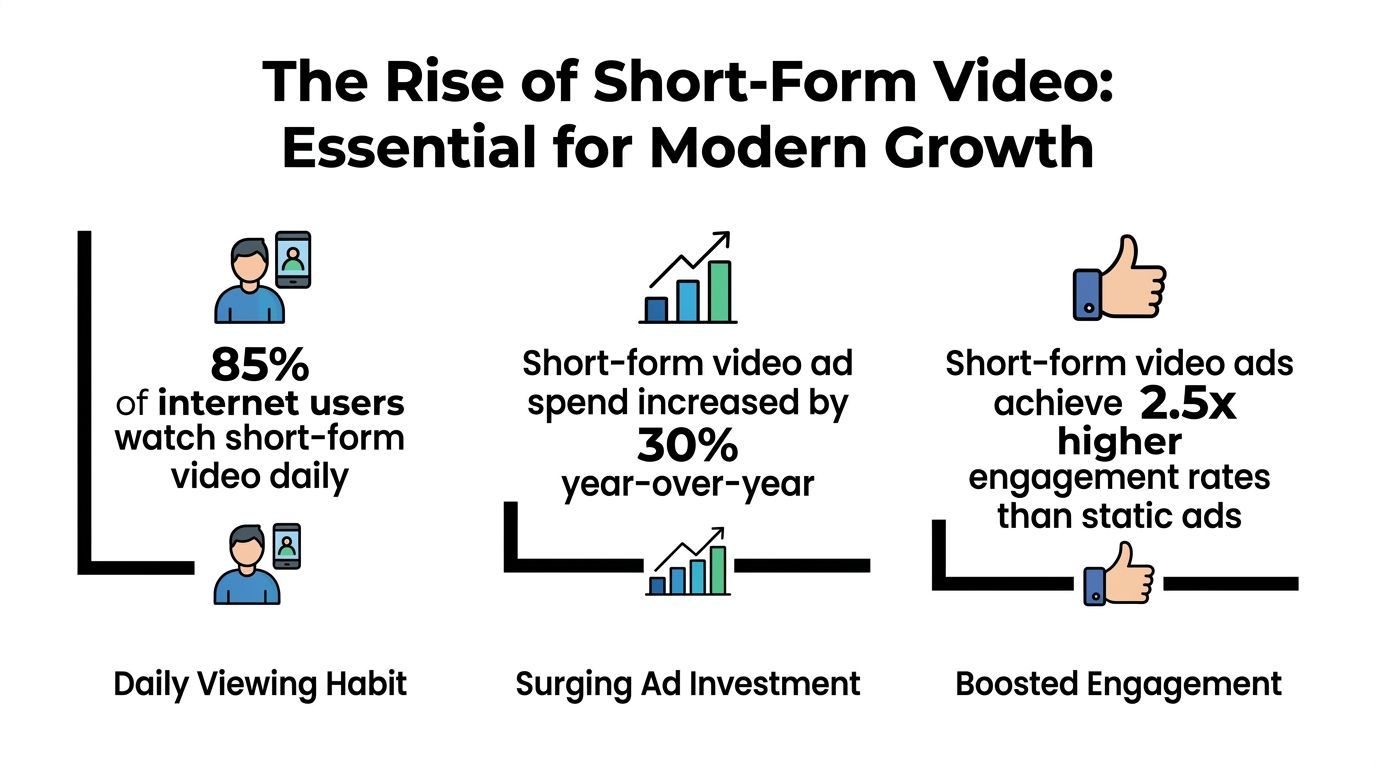
The shift shows up in operations before it shows up in reporting. Teams now compete in a market shaped by a constant stream of creator posts, UGC-style ads, product demos, testimonial cuts, offer variations, and platform-specific edits. A brand that publishes a few polished campaign films each quarter will struggle against advertisers testing fresh hooks every week and replacing fatigued creative before CPMs and CPAs drift up.
That matters because short-form video does two jobs at once. It captures attention at the top of the feed, and it produces fast feedback on messaging, offers, objections, and audience fit. In practice, that shortens the learning cycle for paid social programs. Teams can spot which problem statement gets a thumb-stop, which proof point earns watch time, and which CTA pulls through to the landing page.
The planning implication is straightforward. Short-form video affects acquisition, creative testing cadence, creator partnerships, landing page messaging, and how clearly a product team can turn benefits into visible use cases.
A few situations where it consistently pulls its weight:
- Product-led brands: Show the product in use, remove friction, and answer "how it works" before the click.
- DTC offers: Combine problem, proof, offer, and CTA in a feed-native format that can scale across many angles.
- Service businesses: Make intangible value concrete through before-and-after stories, client reactions, and short outcome-focused clips.
- B2B campaigns: Turn a complex product into a simple buying trigger that a time-starved buyer can understand fast.
Short form video advertising works best when creative is managed as a testing asset with a clear production schedule, not as a one-off brand deliverable.
This is also why the production bottleneck has become the growth constraint. Buying media is rarely the hard part once an account has budget and targeting in place. Producing enough useful creative to test distinct angles, learn from the results, and ship the next round on time is harder. That is where workflow matters. Strong teams connect strategy, scripting, filming, editing, versioning, approvals, and reporting into one operating system instead of treating content creation as an isolated task.
Platform behavior reinforces that pressure. TikTok, Reels, and Shorts reward creative that feels native to the feed and current to the moment. Teams building on TikTok can get a useful grounding from UFO agency's guide to TikTok ads, but the larger lesson applies across channels. Growth now depends less on producing one standout ad and more on maintaining a steady pipeline of new concepts that can be tested, refined, and scaled.
Decoding Short Form Video Ad Platforms
Platform choice shapes everything that follows. The same product can win on TikTok and stall on Reels, or perform on YouTube Shorts only when the creative angle shifts from trend-native to search-adjacent. The mechanics look similar from the outside because all three formats are vertical and fast. The user expectations are not the same.
Platform differences that actually matter
Here's the working comparison I use when deciding where to start.
| Platform | Primary Audience | Key Ad Formats | Best For |
|---|---|---|---|
| TikTok | Trend-driven, discovery-oriented users who respond to native creator-style content | In-Feed Ads, Spark Ads, TopView, branded effects | Fast hook testing, creator-led ads, broad discovery |
| Instagram Reels | Users already familiar with brands, creators, and social commerce behavior | Reels Ads, boosted creator content, story-connected campaigns | Visual product marketing, retargeting, brand familiarity |
| YouTube Shorts | Users in discovery mode with stronger overlap between entertainment and intent | Shorts ads, creator integrations, video action combinations | Educational hooks, product explainers, cross-channel video systems |
That table is the clean version. In live campaigns, the choice usually comes down to creative fit and downstream economics.
TikTok rewards native behavior
TikTok is still the purest environment for raw, feed-native creative. Ads that look too polished often underperform because users are trained to scroll past anything that feels imported from traditional advertising. Spark Ads are especially useful when you already have organic posts or creator posts that show traction and you want to add paid distribution behind them.
If your team needs a more detailed breakdown of setup, creative structure, and placements, UFO agency's guide to TikTok ads is a useful reference.
What tends to work on TikTok:
- Creator-led framing: A person talking to camera usually beats a faceless promo cut.
- Early tension: Start with the pain point, mistake, objection, or unexpected claim.
- Looser editing: Clean is fine. Overproduced usually isn't.
What usually fails is brand-first creative that opens like a commercial. Logos, slow intros, cinematic title cards, and generic lifestyle footage all signal “ad” too early.
Reels sits between discovery and familiarity
Instagram Reels often works best when the brand already has some visual identity or social proof to build on. It's still a short form environment, but users are often more comfortable with polished aesthetics than on TikTok, especially for beauty, fashion, home, travel, and premium consumer categories.
Reels is a strong fit when you want to combine:
- upper-funnel attention from native-looking video,
- middle-funnel product education,
- and retargeting through broader Instagram placement overlap.
The trade-off is creative tension. If you lean too polished, you lose native feel. If you go too casual without structure, the ad can feel forgettable.
Shorts is stronger for clarity
YouTube Shorts tends to reward clearer value communication. Users often tolerate slightly more direct explanation there, especially when the concept feels useful, surprising, or educational. This doesn't mean long intros work. They don't. It means a concise mini-explainer can travel better on Shorts than on TikTok if the product needs context.
Practical rule: Match the platform to the type of attention you want. TikTok for interruption and discovery. Reels for visual persuasion. Shorts for compressed explanation.
For most brands, the smartest move isn't choosing one forever. It's starting with one platform where the creative naturally fits, then porting only the winning concepts, not the exact same asset, into the others.
Aligning Ad Strategy with Your Funnel
A lot of short form campaigns underperform because every video tries to do the same job. One ad introduces the brand, explains the product, answers objections, proves credibility, and asks for the sale all at once. That's too much load for a short attention window.
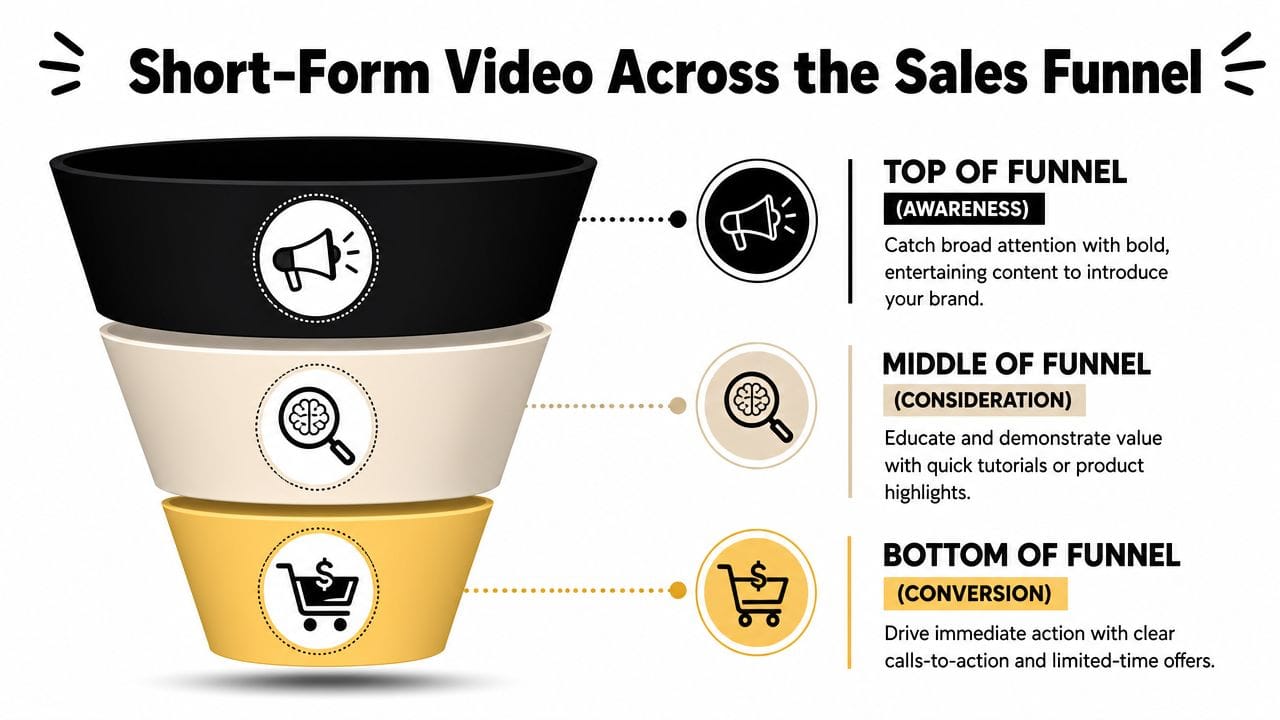
Short form video advertising works better when each asset has a single funnel job.
Top of funnel creative
Top of funnel video earns attention from people who don't know you yet. That means the ad has to win before trust exists. The job isn't to close. The job is to stop the scroll and make the audience care enough to continue.
Good top-of-funnel concepts include:
- Pattern interrupts: A surprising visual, sharp opinion, or unexpected outcome
- Problem-led hooks: “If your skin does this by noon…” or “Ad budget is often wasted here…”
- Trend-adapted concepts: Native structures that already fit how users consume content on that platform
At this stage, the creative should feel broad enough to pull people in, but specific enough that the right audience self-identifies.
Middle of funnel creative
Middle of funnel ads handle evaluation. The viewer now knows the category, the problem, or maybe even your brand. They need clarity. At this stage, concise demonstrations, feature framing, and objection handling are important.
Formats that usually perform well here:
| Funnel Stage | Creative Angle | What the Viewer Needs |
|---|---|---|
| TOFU | Entertaining hook or pain-point interruption | Relevance |
| MOFU | Demo, tutorial, comparison, use case | Understanding |
| BOFU | Testimonial, offer, proof, direct CTA | Confidence to act |
Middle-funnel ads should answer one practical question at a time. How does it work. What does it replace. Why is it easier. Why is it better for this type of user.
If the audience needs education, show the product doing the work. Don't stack claims on top of captions and expect that to land.
Bottom of funnel creative
Bottom of funnel is where many teams get timid. They keep making “nice” content when what the buyer needs is conviction. At this stage, direct response principles matter most.
Use:
- Customer proof through UGC, testimonials, or before-and-after framing.
- Offer framing that makes the next step obvious.
- Specific CTA language that matches the landing page and checkout flow.
The common mistake is using the same generic “learn more” CTA for everyone. Someone at the bottom of funnel often needs a stronger prompt. Start free. Shop now. Book a demo. Claim the offer.
The system matters more than any single ad
When the funnel is mapped properly, your media buying gets cleaner. Top-of-funnel ads build audiences. Middle-funnel ads educate the people who showed interest. Bottom-of-funnel ads convert the people who already engaged. That structure also makes creative testing easier because each video has a job, and you can judge it against the right outcome instead of asking every ad to do everything.
Creative Best Practices That Actually Convert
The format itself imposes discipline. Short form video ads usually run in a 5 to 90 second window, and the first 1 to 3 seconds are the highest-impact part of the creative because those opening moments determine whether people keep watching or scroll away, as explained in Coegi Partners' short form video marketing guide.
That one reality should change how you storyboard, script, edit, and approve ads.
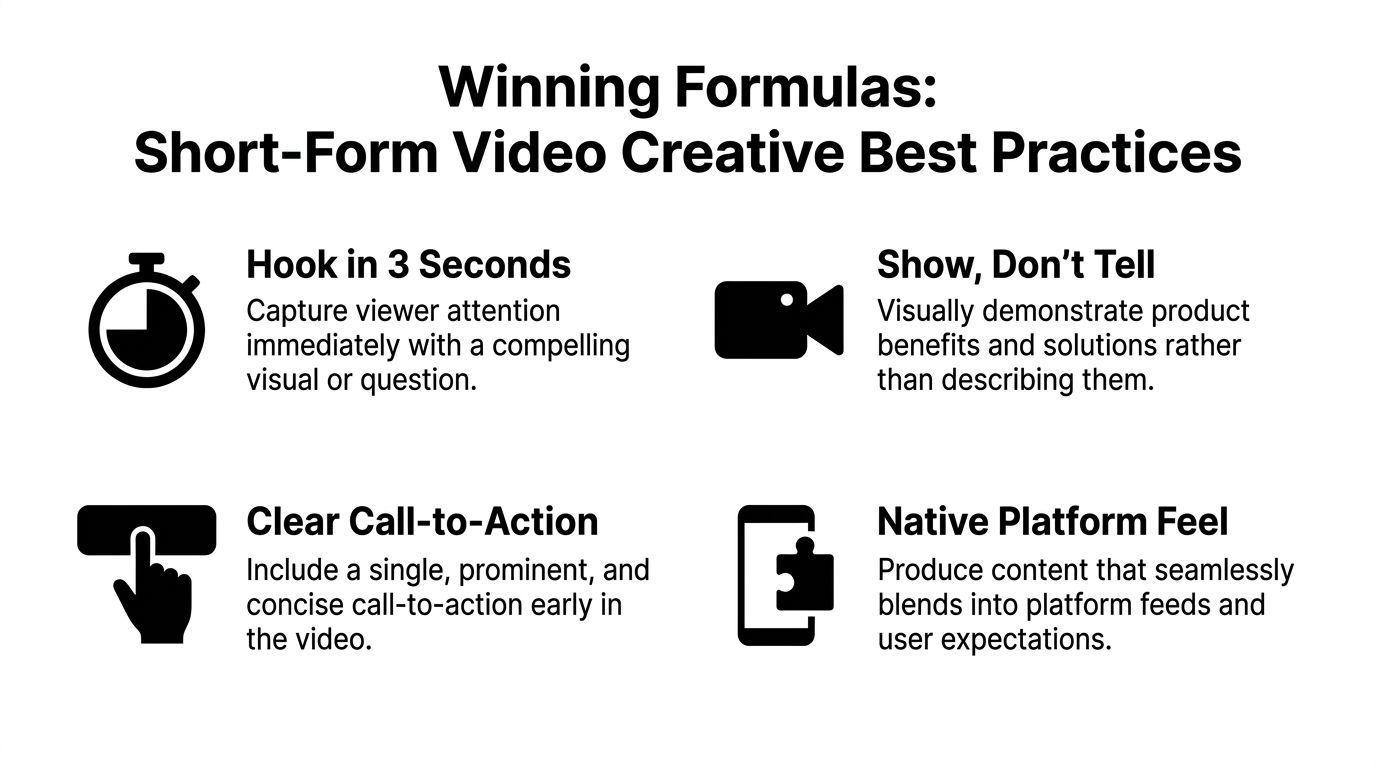
Build the opening first
Most weak ads start too late. They warm up, explain context, show a logo, or ease into the point. Feed-based video doesn't reward that.
Strong hooks usually do one of four things immediately:
- State a problem fast: “Your current CRM isn't the problem. Your follow-up speed is.”
- Show the outcome first: lead with the transformed result, then explain how it happened
- Create a curiosity gap: make the viewer want the missing piece
- Present a sharp contrast: before versus after, wrong way versus better way
The easiest production mistake is shooting a nice script and hoping the editor finds a hook later. Build the hook before the rest of the ad exists.
Design for silent viewing
A lot of paid impressions happen in environments where sound isn't guaranteed. Even when viewers do have sound on, captions help pace comprehension.
Use on-screen text to do three jobs:
- anchor the promise,
- reinforce the key proof point,
- and keep the CTA visible before the final frame.
Good captioning isn't just transcription. It's emphasis. Highlight the words that carry the selling argument.
Here's a useful reference before exporting final placements:
Native beats polished, until polished is the point
Advertisers often ask whether they should shoot UGC-style creative or branded studio content. The answer is usually both, but not for the same job.
UGC-style works well when:
- you need trust,
- the message is conversational,
- or the product benefits from lived-experience framing.
Polished creative works better when:
- the product is visually aspirational,
- the brand needs stronger visual authority,
- or motion design helps explain the value.
The mistake is confusing quality with polish. A handheld creator video can be high quality if the message is sharp, the framing is clear, and the pacing is intentional.
Most winning short form ads don't look expensive. They look relevant.
Use simple ad structures
You don't need cinematic storytelling in a feed ad. You need a repeatable structure your team can version quickly. Three reliable frameworks:
| Formula | How it Works | Best Use |
|---|---|---|
| Problem, Agitate, Solve | Call out pain, deepen it, present the fix | DTC, SaaS, service offers |
| Hook, Demo, CTA | Stop the scroll, show the product, ask for action | Product-led campaigns |
| Claim, Proof, Offer | State benefit, show evidence, give next step | Conversion-focused ads |
Make the CTA part of the ad, not an afterthought
Many teams still treat the call to action like the last line in a script. In short form video advertising, the CTA should show up earlier and more often. If someone drops before the ending, they should still know what to do next.
Practical CTA rules:
- Keep one primary action. Multiple asks weaken response.
- Match the landing page language. If the button says “Start free trial,” don't say “Get started today” in the ad if you can avoid it.
- Tie the ask to the outcome. “See the full routine” is often stronger than “Learn more.”
Creative that converts usually feels simple when you watch it. That simplicity is manufactured through hard editing choices. Cut anything that delays understanding, weakens the hook, or softens the action you want.
Production Workflows for Speed and Scale
Teams that refresh creative weekly usually outlearn teams that wait on a monthly hero asset. In short form video advertising, the constraint is rarely strategy alone. The primary limit is how fast the team can turn one idea into enough usable variations to test.
Traditional production breaks under that pressure. A workflow built around separate briefs, shoot days, edit queues, review rounds, and final exports can support a polished brand campaign. It struggles when paid social needs new hooks, offers, and audience angles every few days.
The modern workflow
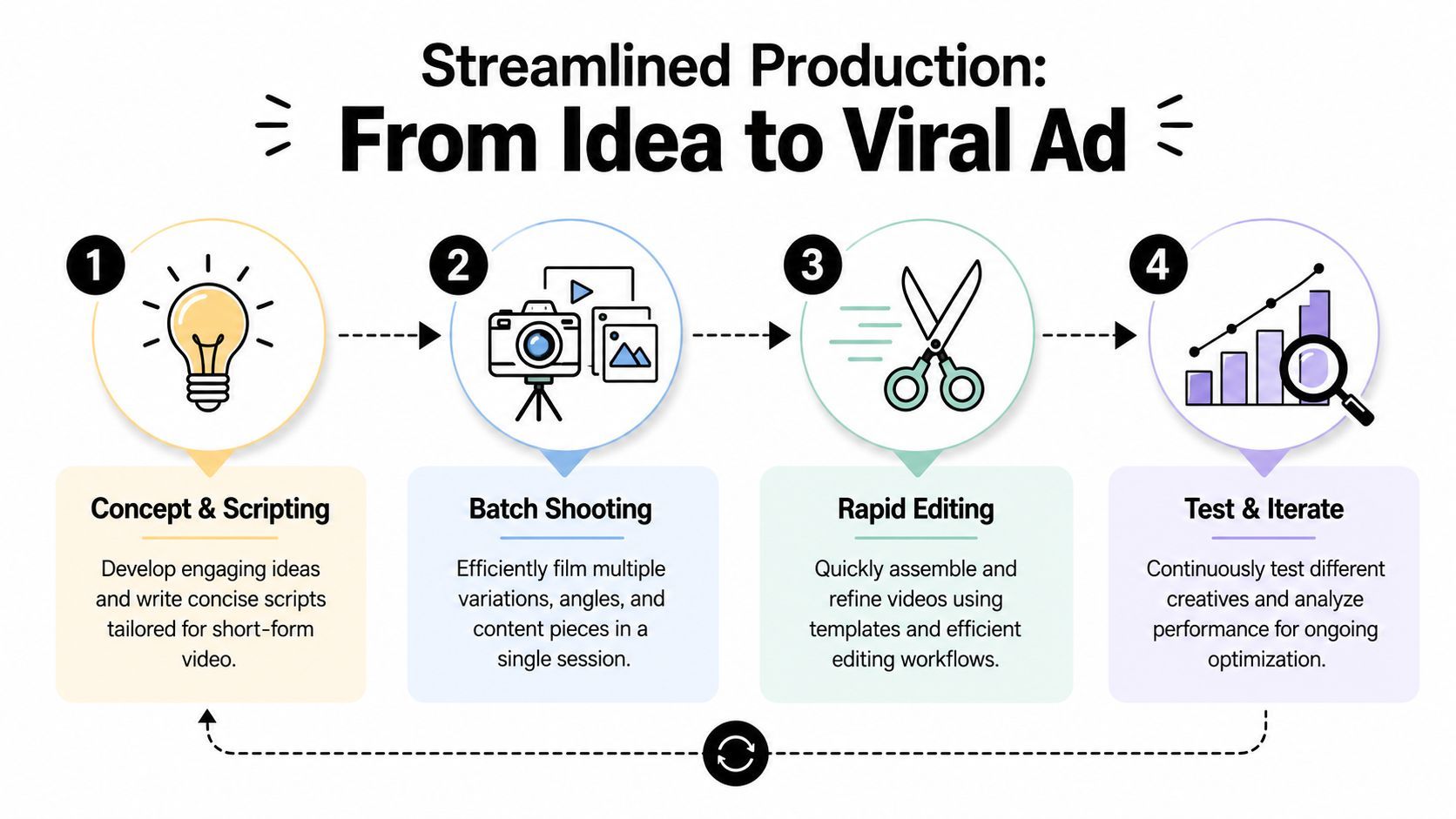
High-output teams treat production as a system, not a series of one-off projects. The goal is to create reusable inputs, faster versioning, and a review process that does not choke the testing calendar.
A practical workflow looks like this:
-
Build hook banks
Keep a live library of openings organized by audience segment, buying objection, awareness stage, and offer type. This becomes the starting point for each new test, not a blank page. -
Batch source footage
Capture founder clips, customer reactions, product demos, screen recordings, and B-roll in focused sessions. One recording block should feed several weeks of creative, not a single ad. -
Version from modules
Swap the first three seconds, change the proof element, test a different CTA, or reorder scenes without rebuilding the whole asset. These methods are how scale is attained. -
Export for placements
Resize, trim, caption, and format each variant for the placements you plan to buy. Small spec mistakes still create avoidable waste.
AI helps because it cuts repetitive production work. Teams now use it to draft scripts, generate voiceovers, clean rough cuts, produce first-pass captions, and create multiple edits from the same source material. Tools such as ShortGenius for AI video ad production workflows combine scripting, voiceovers, editing, resizing, and publishing in one environment, which reduces handoff time across the team.
Where AI solves the bottleneck
The common failure point is not idea generation. It is asset throughput.
Brands often know the angles they want to test. They get stuck because every variation requires another brief, another editor pass, another round of feedback, and another export cycle. That slows learning and leaves media buyers waiting on creative instead of replacing fatigued ads on schedule.
AI-assisted production fixes a specific operational problem. It helps teams produce more first drafts, more formatted variants, and more test-ready assets from the same raw material. The trade-off is that speed can lower quality if the team has weak inputs, unclear positioning, or no review standards. AI increases output. It does not fix bad strategy.
Production details still matter
The teams that scale well usually protect a few operating rules:
- Format discipline: Keep vertical-safe framing, readable text, clean subtitles, and motion in the first frame.
- Naming conventions: Tag every file by audience, angle, offer, hook, and CTA so winners can be traced and reused.
- Approval limits: A review process with more than two stakeholders often slows the feedback loop and softens direct-response creative.
- Export accuracy: Platform sizing mistakes still cost delivery and polish. For Instagram placements, Proven SaaS's Instagram ad size guide is a practical reference before launch.
One more rule matters. Separate performance review from creative review. If legal, brand, performance, and leadership all edit the same draft at the same time, the ad usually gets safer and weaker.
The team that ships ten coherent variants in a week usually learns faster than the team that spends a month polishing one ad. Speed matters because testing volume improves decision quality, and decision quality is what scales accounts.
Measuring Performance and Optimizing for ROI
Short form video creates a lot of seductive noise. Views, likes, shares, saves, comments. Those signals can help diagnose creative resonance, but they don't tell you enough about business impact on their own.
That distinction matters because about 3 in 8 people say they've made a purchase based on short form video content, which is why advertisers need to measure beyond engagement and focus on funnel metrics such as click-through rate and conversion attribution, as noted by Basis Technologies' analysis of short form video and advertising.
What to watch instead of vanity metrics
The best reporting setup ties creative performance to funnel movement.
Core metrics to review:
| Metric | What It Tells You | Why It Matters |
|---|---|---|
| Watch time | Whether the opening and pacing hold attention | Diagnoses hook and retention strength |
| Click-through rate | Whether the ad motivates action | Connects message to intent |
| Conversion attribution | Which creative actually assists or closes sales | Separates attention from revenue |
| Platform commerce signals | Whether users move toward product interaction | Useful for identifying buyer intent |
Views without clicks can mean the ad is entertaining but commercially weak. Clicks without conversions can mean the promise in the ad doesn't match the landing page, offer, or audience. Good optimization work starts by identifying where the leak is.
How to structure creative tests
Many teams test too many variables at once. They launch five completely different videos, each with different hooks, lengths, creators, CTAs, and offers, then can't tell what caused the result.
A cleaner approach is controlled variation.
Test in layers:
- Hook first. Keep body and CTA stable.
- Then test offer framing or proof style.
- Then test CTA language.
That sequence matters because the opening usually has the biggest effect on whether the viewer gives the ad a chance. Once a hook style works, you can optimize the middle and end more confidently.
Diagnose the failure correctly
When a short form ad underperforms, ask which stage broke:
- Low watch time early: the hook failed or the first frame looked too much like an ad.
- Good retention but weak clicks: the ad held attention, but the value proposition or CTA lacked force.
- Strong clicks but weak conversion: the post-click experience isn't aligned, or the audience quality is off.
Don't kill an ad just because engagement looks ordinary. Kill it when the metrics that matter to your funnel stay weak after a fair test.
Build the feedback loop into production
Measurement only matters if it changes the next round of creative. Winning teams document patterns. Which hooks held attention. Which creator types drove higher-intent clicks. Which offers converted cold traffic versus retargeting audiences. Then they feed those insights back into the next production batch.
This is why scaled production and measurement belong together. You need enough creative variation to learn, and you need clean enough analysis to know what to make next. Without that loop, short form video advertising turns into constant activity with very little compounding value.
Budgets Benchmarks and Real-World Examples
Budgeting for short form video advertising is less about finding an industry-average spend target and more about funding a learning cycle. Early-stage campaigns need enough room to test hooks, creators, offers, and editing styles. If the budget only covers one or two ads, the team usually ends up judging the channel before it has tested the creative.
A practical way to think about budget is by production model, not just media spend.
Where the money usually goes
Some teams spend most of the budget on production and starve testing. Others buy traffic aggressively against weak creative and burn cash proving nothing. The healthier model balances both.
Useful budget buckets:
- Creative development: scripting, raw footage capture, UGC sourcing, editing
- Variant production: new hooks, alternate cuts, fresh CTAs, placement versions
- Testing media: enough paid distribution to compare concepts
- Iteration reserve: budget held back for scaling winners and replacing fatigue
Two common operating models
A DTC brand often starts with creator-style product demos, problem-solution hooks, and testimonial cuts. The strongest ads usually become the basis for more variants, not just more spend on one file. The lesson is simple. Scale the concept, not only the original asset.
A software company usually needs a different entry point. Raw founder clips, screen recordings, objection-handling explainers, and customer proof tend to outperform generic motion graphics because they reduce abstraction. In that environment, clarity beats cleverness.
What success actually looks like
In real accounts, success rarely arrives as one breakout ad that solves everything. It usually looks like a repeatable process:
- one hook family keeps producing winners,
- one offer framing converts reliably,
- one creator persona builds trust,
- and one workflow keeps shipping new tests before fatigue sets in.
That's the outcome to aim for. Not a viral hit. A durable creative engine.
If your team needs to produce more short form ads without building a heavy production stack, ShortGenius (AI Video / AI Ad Generator) is worth evaluating. It's built for creating, editing, versioning, and publishing short form video and ad assets in one workflow, which is useful when speed and creative iteration matter as much as the original concept.