Write a Script for an Advertisement That Actually Sells

Learn how to write a script for an advertisement that captures attention and drives action. Get practical tips, frameworks, and real-world examples.
A killer script for an advertisement isn't just a document; it's the blueprint for turning a casual scroll into a sale. It’s hands down the most vital asset you have, because it controls the story, the rhythm, and the emotional punch that decides if someone sticks around or swipes away.
The Power of a Great Ad Script

Think about it: in an ocean of online content, why do some ads stick in your head while others are forgotten instantly? It's not the budget, the celebrity, or the slick production. It's the script. A solid script is the bedrock of every single ad that actually works.
And that's more true today than ever before. Global advertising spend is projected to soar past $1 trillion by 2025, and a staggering 75.2% of that is going to digital. For any business, that number represents a fierce battle for eyeballs, and your best weapon is a story that connects.
Why Your Script Matters More Than Ever
The game has completely changed with the explosion of short-form video on TikTok, Instagram Reels, and YouTube Shorts. You have less than three seconds to make an impression. If your opening line doesn't immediately hook them, you've already lost.
A truly effective ad script has three jobs:
- Stop the scroll: It has to grab someone by the collar with a sharp question, a surprising claim, or a pain point they feel deep in their bones.
- Build a real connection: It tells a story that clicks on an emotional level, making your audience feel like you get them.
- Drive action: It gives a clear, compelling reason to take the next step—whether that’s clicking a link, making a purchase, or hitting subscribe.
A script is more than just words on a page. It's a strategic sequence designed to guide a viewer from curiosity to conversion. Every line should serve a purpose in that journey.
To help you visualize this, here's a quick breakdown of how these pieces fit together.
Anatomy of a High-Converting Ad Script
This table summarizes the essential components of an effective ad script, breaking down what to include in each phase to guide your viewer from hook to action.
| Script Component | Purpose | Timing (For a 30s Ad) |
|---|---|---|
| The Hook | Grab immediate attention and stop the scroll. | 0-3 seconds |
| Problem/Agitation | Present a relatable pain point the viewer experiences. | 3-10 seconds |
| The Solution | Introduce your product/service as the answer. | 10-20 seconds |
| Call to Action (CTA) | Tell the viewer exactly what to do next. | 20-30 seconds |
Each of these elements is crucial for building momentum and leading to a conversion.
Democratizing Video Production
The good news? You no longer need a Hollywood budget to create an ad that makes an impact. Technology has leveled the playing field, making high-quality video production accessible to everyone.
AI-powered tools are a huge part of this shift. With platforms like ShortGenius, you can generate script ideas, find matching visuals, and even add a professional voiceover without ever leaving the app. This means you can pour your energy into what really moves the needle: the story.
Nailing that script is the first and most important step. For more on crafting compelling video narratives, check out this great guide on how to write a script for a YouTube video that captivates and converts.
Cracking the Code: Core Ad Scripting Frameworks

Before you ever write a single line, you have to understand the blueprint. Every great script for an advertisement is built on a solid foundation. Creativity is the secret sauce, but it needs a structure to thrive—a framework designed from the ground up to grab attention and push a viewer toward taking action.
Think of these frameworks less as rigid rules and more as psychological roadmaps. They tap into how people think and behave: our natural curiosity, our drive to solve nagging problems, and our need for clear instructions. The most battle-tested structure follows a simple, powerful sequence: Hook, Problem, Solution, and Call to Action.
Nailing the All-Important Hook
You’ve got about three seconds. That's it. Your hook is your opening shot, the one thing—a line, a visual, a sound—that stops the scroll. Its only job is to be so interesting that the viewer has to see what happens next.
Hooks that work tend to fall into a few categories:
- The Provocative Question: "Still paying for five different marketing tools?" This instantly finds your target audience by calling out a shared frustration.
- The Surprising Statement: "This isn't another skincare ad." You create intrigue by zigging where everyone else zags.
- The Relatable Scenario: Show, don't tell. An actor struggling with a tangled mess of cables under a desk says more about a common pain point than words ever could.
The goal is to be bold and direct. Your hook needs to land right in the middle of your viewer's world, making the ad feel personal and immediate.
Twisting the Knife: Agitating the Problem
Okay, you’ve got their attention. Now you have to make them feel understood. This part of the script is about more than just naming a problem; it's about agitating it. Your job is to paint a vivid picture of the frustration, the wasted time, or the real cost of leaving this issue unsolved.
If you’re a B2B software company, this might sound like: "You're burning hours every week manually updating spreadsheets, data keeps getting lost, and your team is never on the same page." See how that goes deeper than just "data entry is slow"?
For a skincare brand, the agitation is more emotional: "You've tried product after product that promised the world, only to be left with irritated skin and a shelf full of disappointments." This validates their past struggles and builds a crucial bridge of empathy.
A great script doesn't just sell a product; it sells a feeling. It makes the viewer feel seen, heard, and understood before ever mentioning a solution. This builds the trust necessary for them to believe in your offer.
The more specific and painfully relatable you make this part, the more powerful your solution will feel when you finally introduce it.
Presenting Your Product as the Hero
After setting the stage and making the viewer feel the weight of their problem, your product or service sweeps in as the obvious, essential solution. This is your moment to connect all the dots, showing exactly how you eliminate the pain you just spent time highlighting.
The key here is to talk about benefits, not just features. Nobody cares that your software has "real-time integration." They care that "your team is always on the same page, with every update syncing instantly." One is a technical detail; the other is a direct solution to their problem.
This transition from problem to solution should feel like a huge relief. The viewer, who was just nodding along to the pain points, now sees a clear way out. This narrative flow is particularly powerful in video, which is rewriting the rules of engagement. In fact, video ads are known to boost purchase intent by a massive 97% over static images, and this problem-solution flow is a big reason why. With mobile now commanding over 70% of digital ad budgets, your script absolutely has to work on a small screen. You can dig deeper into these trends by checking out the latest digital advertising statistics and insights.
The Final Push: A Crystal-Clear Call to Action
You've done the hard work. You've earned their attention, built trust, and presented a compelling solution. Don't fumble the ball now. Every script for an advertisement must end with a direct and unmistakable Call to Action (CTA). Tell them exactly what to do next.
Vague is the enemy of conversion. Your CTA needs to be simple, urgent, and focused on the benefit.
- Weak CTA: "Visit our website." (Why?)
- Strong CTA: "Tap 'Shop Now' to get your 20% discount before it's gone!"
The stronger CTA uses an action-oriented verb ("Tap"), gives a clear incentive ("20% discount"), and adds a touch of urgency ("before it's gone"). Whether it's "Swipe Up," "Download Now," or "Book Your Demo," make the next step totally effortless.
Let an AI Assistant Handle the Heavy Lifting
Okay, we've covered the theory. Now it’s time to actually get a script on paper. Knowing all the frameworks is great, but staring at a blank page and trying to pull a high-converting script out of thin air is a whole other beast. This is where an AI co-pilot becomes your secret weapon, turning that daunting blank space into a playground of ideas.
But you can't just dive in and ask the AI to "write a great ad." The process starts with you, not the machine. You need to be crystal clear on your ad's one true purpose before you write a single word. Are you just trying to get your brand name out there and build awareness? Or are you hunting for leads to fill your email list? Maybe you're going for the kill and need direct sales right now. Each goal requires a totally different scripting approach.
Once you know what you want to achieve, you have to know who you're talking to. Seriously, don't skip this part. Building out a detailed audience persona is non-negotiable. Go deeper than just age and location. What keeps them up at night? What do they secretly wish for? What kind of slang or inside jokes do they use? The AI is only as smart as the information you feed it, so a rich, detailed persona is your ticket to a script that actually connects.
Getting Your First Drafts in Seconds
This is where the fun starts. Using a tool like ShortGenius, you can take your core goal, your detailed persona, and a quick blurb about your product, and let the AI do its thing. The best part? It won’t just spit out one script. It will give you a handful of different versions, often built on those proven copywriting frameworks we talked about.
Let's imagine you're marketing a new productivity app called 'FocusFlow' for frazzled freelancers. You could prompt the AI in a few different ways to get wildly different results:
- For a PAS Script: "Give me a 30-second ad script for 'FocusFlow,' an app for freelancers. Use the Problem-Agitate-Solve framework. My audience is overwhelmed by distractions and constantly worried about missing deadlines."
- For an AIDA Script: "Write a script for 'FocusFlow' using the AIDA model. Hook them with a wild statistic about lost productivity, build interest in a distraction-free workflow, create desire for my app's unique features, and push them to start a free trial."
- For a Benefit-Focused Script: "Create a script that hammers home the top three benefits of 'FocusFlow' for freelancers: earning more billable hours, feeling less stressed, and finally getting some work-life balance."
Each prompt gives you a unique creative angle. In minutes, you’ve got multiple solid directions to explore and test.
Think of an AI assistant as your creative partner. It handles the boring structural work and initial brainstorming, which frees you up to do what a human does best: add personality, punch up the language, and make sure the final script feels real.
This completely changes the game. Scriptwriting goes from being this intimidating, artistic struggle to a clear, systematic process of generating, testing, and refining.
Adding the Human Touch
An AI's first draft is a fantastic starting point, but it's never the final word. Your job is to take that solid foundation and build on it with your brand's unique voice and a little human soul.
The first thing I always do is read the scripts out loud. Does it flow naturally, or does it sound like a robot reading a teleprompter?
Here’s a look at how simple the input process can be. You don't need to be a tech wizard.
You just describe what you want in plain English, and the AI gets to work. The real beauty is in its simplicity.
As you polish the AI's draft, zoom in on these key areas:
- Be Brutal with Word Count: Every single word has to earn its place in a short ad. If you can say something in five words instead of ten, do it. Cut the fluff.
- Translate Features into Benefits: The AI might give you a line about a feature like, "Our system uses AI-powered task prioritization." You need to translate that for a human. Change it to something like, "So you can finally focus on the work that actually pays the bills."
- Use Their Language: Ditch the corporate jargon. Swap it out for the actual words and phrases your audience uses. How would they describe their problems to a friend over coffee? Use that language.
When you thoughtfully refine the AI's output, you get the best of both worlds: the machine's speed and structural knowledge combined with the nuance and emotional gut-check of a human expert. For anyone wanting to see this workflow in action, the tools at ShortGenius are designed to help you create these high-quality ad scripts from scratch. This process doesn't just make you faster; it ultimately helps you produce a better, more effective ad.
Tweaking Your Ad Script for Each Platform
You can write the world's best ad script, but if you run it on the wrong platform, it's going to fall flat. Think about it: the fast, high-energy, trend-driven style that crushes it on TikTok would feel completely out of place and jarring in a professional LinkedIn feed.
This doesn't mean you need to start from scratch for every channel. Not at all. The key is to adapt your core message strategically. You need to tweak the hook, the pacing, the overall tone, and the call to action to fit the unique culture of each platform. Someone killing time on Instagram Reels is in a totally different headspace than someone watching a pre-roll ad before a YouTube tutorial. Your script has to respect that.
Scripts for TikTok and Instagram Reels
On platforms like TikTok and Instagram Reels, you're not just an advertiser—you're a participant in a lightning-fast cultural conversation. The ads that perform best here don't even feel like ads. They feel native to the feed.
So, how do you do that? By playing their game.
- Jump on Trends: Build your script around a trending sound or song. This is the fastest way to feel relevant and gives the algorithm a reason to show your content.
- Keep it Real: Forget the slick, high-gloss production. The stuff that works here often looks like user-generated content (UGC). A person talking directly to the camera in a relatable, conversational way builds instant trust.
- Move Fast: Your script has to be incredibly tight. We're talking a 15-30 second runtime. Every single word has to earn its spot.
Imagine a coffee brand. A great TikTok script could start with someone on camera saying, "You know that 3 PM slump? This is how I beat it in 10 seconds," before quickly whipping up the drink. It’s direct, solves a problem, and matches the platform's quick-cut rhythm.
Nailing the Hook for Skippable YouTube Ads
YouTube is a completely different beast. With those skippable pre-roll ads, you have exactly five seconds to stop someone from hitting that "Skip Ad" button. Your hook isn't just important—it's everything.
A killer YouTube hook has to spark instant curiosity or drop a value bomb right away. It needs to make the viewer think, "Wait, what happens next?" or "Whoa, that's exactly what I need." A generic brand intro will get skipped 99% of the time.
A great YouTube hook doesn't sell your product in the first five seconds. It sells the next five seconds of your ad. Your only goal is to earn their attention.
For example, an ad for a project management tool could open with a chaotic visual and the line, "This is the exact moment three different projects went completely off the rails..." That creates a story, a sense of tension, that people might actually stick around to see resolved.
Designing for a Sound-Off World: Facebook & Instagram
Video dominates the feeds on Facebook and Instagram, but here’s the catch: a massive number of users watch with the sound off. If your script relies only on its voiceover, your message is lost. You have to write for the eyes first.
Think of your script as the blueprint for a silent movie.
- Use Bold Text Overlays: Your script’s key messages need to be front and center as big, easy-to-read text on the screen.
- Tell a Visual Story: The action on screen should tell the basic story even if someone never turns the sound on.
- Captions are Non-Negotiable: For the viewers who do tap for sound, accurate captions are critical for accessibility and just plain good communication.
Adapting your ad script for each platform means understanding their unique rules of engagement, like the ones laid out in these Facebook Ads Best Practices.
This whole process of starting with a clear strategy before diving into creative is key, especially when using AI.
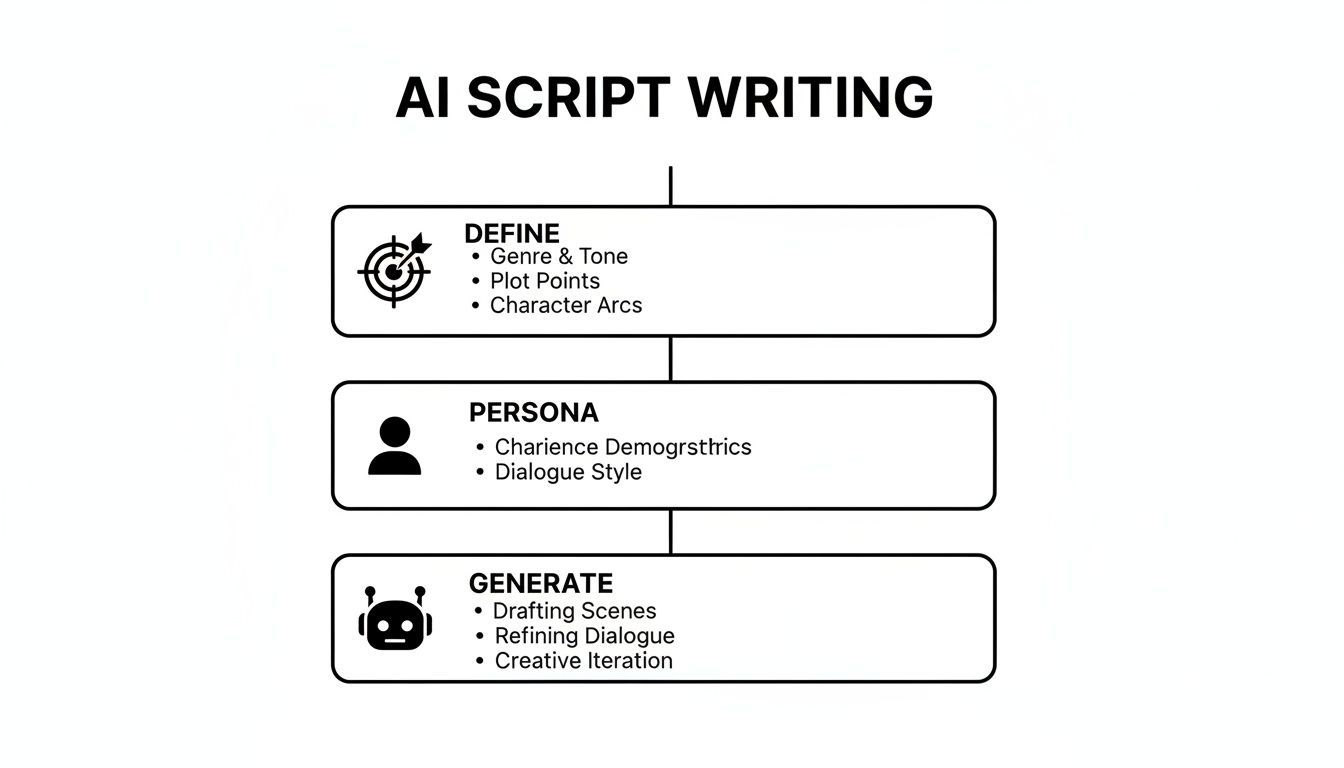
This illustrates that a successful script starts with clear strategic inputs before any creative generation begins. This is a big deal right now. Big brands are pouring resources into their creative, with 42% of CMOs planning to increase original content production as total ad spend is projected to cross the $1 trillion mark.
Changing Your Tone for LinkedIn
Finally, there's LinkedIn, which requires a complete change in personality. The audience here is in a professional mindset. They respond to value, data, and expertise—not cheap entertainment. Your LinkedIn ad script should sound more like a consultant or an industry expert.
Forget the high-energy hook. You might start with a surprising industry statistic or a common business pain point. The goal is to position your brand as a helpful authority, not just a seller. The solution you present should feel like a strategic advantage, and your call to action will likely be softer, like an invitation to download a whitepaper or book a demo instead of a hard "buy now."
Platform-Specific Scripting Playbook
Knowing where your ad will live is half the battle. Here’s a quick-glance guide to help you tailor your script's hook, tone, and call-to-action for the major platforms.
| Platform | Optimal Length | Hook Strategy | Tone of Voice | CTA Example |
|---|---|---|---|---|
| TikTok/Reels | 15-30 sec | Trend-based, problem-focused, native feel | Energetic, authentic, conversational | "Tap the link in my bio to try it!" |
| YouTube | 30-60 sec | Curiosity gap, bold claim, pattern interrupt | Story-driven, educational, direct | "Click here to learn more and get started." |
| Facebook/IG | 15-45 sec | Visually arresting, text-driven hook | Aspirational, relatable, benefit-oriented | "Shop Now" or "Learn More." |
| 30-90 sec | Statistic, question, common pain point | Professional, authoritative, consultative | "Download our free guide" or "Book a Demo." |
Ultimately, a one-size-fits-all approach just doesn't work. Taking a few extra minutes to adapt your core creative to fit the platform's context can make the difference between an ad that gets ignored and one that actually converts.
Bringing Your Script to Life (And Finding a Winner)
You’ve done the heavy lifting and now have a polished script ready to go. The blueprint is complete. Now comes the fun part: turning those words on a page into a video ad that actually gets results.
Whether you're firing up your camera or using an AI tool to generate the voiceover and visuals, the objective is the same—capture the energy of your script on screen. But here's a pro tip: creating just one version of your ad is a massive missed opportunity. The real magic happens when you start testing.
Why You Can't Afford to Guess
Guesswork is the most expensive mistake you can make in advertising. That hook you think is a stroke of genius might fall completely flat, while a simpler version could crush it. This is why A/B testing (or split testing) isn't some fancy extra—it's a non-negotiable part of the process.
The idea is straightforward: create a few variations of your ad, changing only one thing at a time. By doing this, you can figure out—with scientific certainty—what your audience actually responds to. It lets the data do the talking.
An A/B testing mindset fundamentally changes your approach. You stop asking, "Did this ad work?" and start asking, "Which part of this ad worked best, and how can we do more of that?" This is how you consistently improve performance and get the most out of every dollar you spend.
It takes your ego out of the equation and lets real user behavior guide your creative strategy. It’s the fastest path to learning what your audience truly wants.
The High-Impact Elements You Should Be Testing
You could test almost anything, but you'll get the best bang for your buck by focusing on the elements that have the biggest impact. Start with the components that make or break whether someone stops scrolling, gets your message, and actually does something about it.
Here are the top three variables I always recommend testing first:
- The Hook (First 3 Seconds): This is your biggest performance lever, hands down. Pit a question-based hook against a bold, declarative statement. Try a gritty, user-generated-style intro against a clean, animated one. A tiny tweak in these initial seconds can dramatically change your ad's entire performance.
- The Visuals: Your script builds the argument, but your visuals deliver the feeling. Test different settings, actors, or even just the color grade. If you’re using AI tools, this is incredibly easy. You could generate one version with hyper-realistic scenes and another with a more stylized, animated feel to see which one grabs more eyeballs.
- The Call to Action (CTA): How you ask for the click is crucial. Test a direct, no-nonsense CTA like "Shop Now" against a benefit-forward one like "Start Your Free Trial." You can also play with urgency by comparing a "Limited-Time Offer" against a more evergreen invitation.
When you systematically test these key pieces, you start building a playbook of what works for your brand and your audience.
Measuring What Actually Matters
Running tests is a waste of time if you're not tracking the right things. To find a clear winner, you need to focus on the key performance indicators (KPIs) tied to your campaign goal. Sure, views and likes feel nice, but they don't pay the bills.
These are the metrics that tell the real story:
- Click-Through Rate (CTR): This is the percentage of people who saw your ad and clicked. A strong CTR is your first sign that the creative is doing its job—it’s stopping the scroll and sparking curiosity.
- Conversion Rate: Of all the people who clicked, how many actually took the desired action (like making a purchase or signing up)? This metric tells you if your message is motivating people to follow through.
- Cost Per Acquisition (CPA): This is your total ad spend divided by the number of new customers or leads you acquired. The entire point of A/B testing is to find the ad variations that drive this number down as low as possible.
When you find a variation that produces a higher CTR and a lower CPA, you've struck gold. Double down on that winner, and use what you learned to inform your next script for an advertisement. This creates a powerful feedback loop that fuels continuous, data-driven improvement.
Common Questions About Ad Script Writing
As you start writing ad scripts, a few key questions always seem to surface. Don't worry, even seasoned pros get tripped up by these. Think of this section as your personal cheat sheet for navigating those common hurdles and turning a good idea into a script that’s ready to go.
We'll clear up the confusion around script length, pinpoint the mistakes that kill conversions, and look at how to get a huge creative assist from AI—even if you don't think of yourself as a writer.
How Long Should an Ad Script Be?
This is the million-dollar question, and the only honest answer is: it depends entirely on the platform. There's no magic number. The "right" length is whatever works best for a specific audience on a specific app.
The easiest way to figure this out is to work backward from where the ad will live.
- TikTok & Instagram Reels: Fast is the name of the game here. You're aiming for a 15 to 30-second spot, which works out to about 60-90 words. The goal is a quick, punchy message that feels like it belongs in the feed, not an interruption.
- YouTube Skippable Ads: Forget the total runtime; the first 5 seconds are everything. That's your entire window to hook someone before they hit "Skip Ad." If you nail the hook, the rest of the ad can run longer, even up to 60 seconds, but only if the story is compelling enough to earn that extra time.
- Facebook & Instagram Feeds: You’ve got a little more breathing room here. While short and snappy is always a safe bet, story-driven ads that run 60-90 seconds can do incredibly well if they’re genuinely engaging. I usually recommend starting with a 30-second version and then testing a longer, more narrative cut.
At the end of the day, a gripping 45-second story will always beat a boring 15-second ad. Focus on holding attention, not just hitting a word count.
What Are the Biggest Scriptwriting Mistakes to Avoid?
Most scripts don't fail because of one massive blunder. They die a death of a thousand cuts from small, avoidable mistakes. Knowing what these pitfalls are is the first step to making sure your ad actually connects with people.
Here are the missteps I see most often:
- No Hook (or a weak one): If you don't grab someone's attention in the first three seconds, you've lost. The rest of your brilliant script doesn't matter because no one will ever see it. This is the cardinal sin of modern ad scripting.
- Listing Features, Not Benefits: People don't buy a drill bit; they buy a hole in the wall. Viewers couldn't care less about your product's specs. They only care about what it does for them. Always translate features into real-world benefits that solve a problem.
- Using a One-Size-Fits-All Script: Running the exact same ad on TikTok, YouTube, and LinkedIn is a recipe for wasted money. Each platform has its own vibe, its own culture. Your script needs to respect that.
- A Vague or Missing Call to Action (CTA): You have to explicitly tell your audience what you want them to do next. "Learn more" is weak. "Tap 'Shop Now' to get 50% off your first order" is strong, clear, and gives them a reason to act.
- Too Much Information: It's tempting to cram every cool thing about your product into a 30-second ad. Don't. It just confuses people and waters down your main point. Stick to one big idea and hammer it home.
The single biggest mistake is forgetting who you're talking to. A script written for 'everyone' will ultimately resonate with no one. Ground every word in a deep understanding of your specific audience's pain points, desires, and language.
How Can AI Help If I Am Not a Creative Writer?
This is where things get really interesting. AI script generators are a massive leg up for anyone who freezes up when faced with a blank page. They're designed to give you a powerful creative starting point, not just a finished product.
You're not starting from scratch anymore. You just feed the AI some simple inputs: what your product is, who you're trying to reach, and what you want to achieve (like driving sales or getting sign-ups). The AI then spits out multiple script ideas built on proven marketing frameworks like AIDA (Attention-Interest-Desire-Action) or PAS (Problem-Agitate-Solve).
Suddenly, your job changes from "writer" to "editor" and "strategist." Your role becomes:
- Providing clear direction: The better your initial prompt, the better the scripts you'll get back.
- Picking the strongest angle: Look through the generated options and see which one feels the most powerful or interesting.
- Making it your own: Now you can step in and tweak the language to match your brand's voice, punch up the hook, or ask the AI to brainstorm a few more CTA ideas.
The AI does the heavy lifting on structure and copywriting formulas, freeing you up to focus on the nuance and personality that will make the script truly connect.
Ready to stop staring at a blank page and start generating high-converting ad scripts in minutes? With ShortGenius, you can turn your ideas into polished, platform-specific scripts with the power of AI. From the hook to the final call to action, our tool is designed to help you create ads that sell. Start creating your next winning ad script today at ShortGenius.com.