8 Prompts for Short Films to Spark Your Next Idea

Unlock your creativity with these 8 actionable prompts for short films. Find ideas for any genre, from character-driven stories to viral social media concepts.
Ever notice how the strongest short films rarely start with “a cool idea” and more often start with a built-in shape, a pressure point, or a visual rule? That's the gap most creators miss. They collect loose inspiration, then wonder why the script stalls, the shoot feels expensive, or the edit never lands. The better approach is to treat prompts for short films as compact creative systems, not vague themes, and use proven formats that already know how to carry emotion, conflict, and payoff in a small runtime. For AI-assisted workflows, that same structure matters even more, because tools work best when the prompt is specific enough to preserve tone, pacing, and scene logic. For a useful reference point on how AI video prompts are being framed in practice, see this overview of video prompts for AI tools.
The list below uses modern, battle-tested video formats as short-film prompts. Some are story-first, some are visual-first, and some are built for social platforms where attention is tight and repetition kills momentum. Each one can work for traditional filmmaking or for AI video tools like ShortGenius, which makes it easier to move from prompt to script, shots, captions, and final output without rebuilding the whole idea from scratch.
1. Genre Prompt The 60-Second Origin Story
The origin story works because it gives the viewer a reason to care before it gives them a product, brand, or persona to admire. A strong version starts with the problem, not the win, then moves through the frustration, the turning point, and the first real proof of life. That structure fits personal brands, founder content, and creator films because it compresses credibility into emotion instead of turning into a polished brag reel.
Build the pain before the breakthrough
The mistake many filmmakers make is opening with the outcome. If the film begins with success, the audience has no tension to follow. Start with the thing that hurt, the thing that felt impossible, or the moment when the creator realized the old way was broken. That is where the viewer recognizes themselves.
Real-world founder content has long used this shape, from viral startup origin stories to personal brand monologues, because it works as a trust signal. In short-film form, it becomes a miniature arc, one problem, one spark, one shift. A home office, a kitchen table, a garage, or the actual location where the idea started usually plays better than a staged studio because the setting gives the story texture.
Practical rule: Open on the friction, then earn the reveal. If the audience feels the problem, they'll stay for the solution.
For a traditional shoot, keep the camera language intimate, with natural light, handheld movement, and one or two cutaways to the original environment. For AI video workflows, prompt the tool with the setting, the emotional beat, and the visual evidence of origin, then let the narration carry the arc. In ShortGenius, that kind of structured brief maps well to voiceover pacing and scene generation, especially when you want the film to feel personal without becoming static.
2. Situational Prompt The Micro-Tutorial Film
A micro-tutorial turns a skill into a short film by making the lesson the story. It works best when the viewer gets a specific payoff fast, such as how to do one useful thing, avoid one costly mistake, or apply one clear framework. This format suits coaches, educators, product teams, and founder-led brands because it can teach and persuade at the same time.
Keep the lesson narrow enough to finish
The strongest micro-tutorials don't try to teach the whole category. They teach one move, one process, or one rule that viewers can use immediately. In short-film terms, that means a hook, three or four essential beats, and a quick application that proves the lesson wasn't just theory. A product demo, a quick-start guide, or a business tip all fit here if the content stays concrete.
This format is especially effective when the visuals do some of the teaching. Text overlays, close-ups, animated labels, and on-screen examples help viewers follow along even with the sound off. That matters in mobile viewing, where the film has to work as a silent object as much as a spoken one.
Use the outcome, not the promise. “Learn a copywriting framework” is weaker than showing the exact before-and-after of a better headline, a cleaner script, or a simpler process.
For a traditional production, shoot tight, use props that demonstrate the steps, and cut aggressively so no beat lingers past its usefulness. For AI tools, ask for scene changes that match each stage of the tutorial so the film doesn't feel like one talking head in a loop. ShortGenius's captions and scene-swap features fit this format well because they keep the lesson moving while preserving clarity.
A useful execution trick is to end with a next step that feels earned, such as a resource, a product page, or a deeper learning path. That keeps the short film from sounding like a dead end. It becomes a usable asset, not just a clip with advice.

3. Character Prompt The Transformation Story
The transformation story is built on pain, pressure, and relief. It follows the PAS shape, problem, agitation, solution, but in short-film form that means you're dramatizing the emotional cost of the problem before you introduce the answer. This is a powerful structure for DTC, SaaS, and agency work because it feels like a narrative instead of a sales pitch.
Make the pain emotional, not just practical
A weak transformation prompt says the user is inefficient. A stronger one shows embarrassment, confusion, panic, or the quiet dread of getting something wrong in front of other people. That's why this format often lands in ads that deal with email mistakes, workflow chaos, or messy workflows that affect identity, not just time.
The key is to show the before state as a lived experience. A founder staring at a broken dashboard. A freelancer missing deadlines. A parent trying to fix a problem while the child watches. The audience should feel the friction in the body language, the pacing, and the environment before you ever reveal the product or method that solves it.
Show the shift visually
This format becomes much more persuasive when the transition is obvious on screen. A cluttered workspace can become an organized one. A tense face can relax. A pile of disconnected tabs can collapse into one clean workflow. Those contrasts make the solution legible without needing to explain every feature.
- Use recognizable stakes. Pick a situation your audience has lived through, not a vague inconvenience.
- Show the agitation. Let the frustration play on the actor's face or in the edit.
- Introduce the fix as relief. The solution should feel like the answer to a real emotional problem.
- Prove the change. Before-and-after visuals or a customer testimonial make the transformation believable.
For AI video tools, scene swaps are especially useful because they can dramatize the shift from chaos to order without requiring a full live-action setup. If you're moving fast, pair the prompt with a clear before/after note so the tool understands the narrative turn. The more precise the emotional contrast, the more useful the output becomes.
4. Observational Prompt A Day in the Life
A day-in-the-life short film works because people are drawn to access. They want to see how someone works, how a business runs, or how a creative mind moves through ordinary time. The format builds trust by showing rhythm instead of just claims, which is why it's so useful for personal brands, agencies, and lifestyle-led creators.
Choose moments that reveal a point of view
The day doesn't need to be special. It needs to be specific. A few well-chosen moments often tell you more than a full schedule, especially if the film includes one challenge, one transition, or one unexpected interruption. The goal is not to document everything, it's to reveal what matters.
Real creator workflows often thrive on a few repeatable beats, such as a morning setup, a problem-solving moment, and a final reflection. That's enough to imply discipline, taste, or momentum without turning the film into a literal diary. If the subject is a founder or team lead, include one decision point that shows how they think under pressure.

Make the workflow easy to repeat
A day-in-the-life film only becomes valuable when you can capture it regularly. Film vertically when possible, build a simple kit with a phone tripod and wireless mic, and collect multiple clips in short bursts instead of waiting for one perfect day. Batch shooting also helps you turn one session into several short films later.
Music can help, but it shouldn't flatten the sound of the day. Let keyboards, street noise, room tone, and natural pauses breathe where they matter. Use music to bridge transitions or compress time, not to hide the life of the footage.
For AI-assisted production, this format benefits from flexible resizing and versioning because the same material often needs to live across vertical and horizontal placements. ShortGenius is useful here because it can adapt output for different formats and help you turn a single sequence into multiple deliverables without rebuilding the structure each time.
5. Constraint Prompt The Viral Trend Remix
A trend remix is less about copying a trend and more about hijacking its structure for a more useful purpose. That could mean taking a meme format, an audio trend, or a viral challenge and applying it to your niche in a way that feels surprising but still native. It's one of the fastest ways to make a short film feel current without abandoning your point of view.
Use the trend as the shell, not the substance
The trend itself should be a delivery system. Your niche, your expertise, or your worldview should be the actual content. That's why the best versions feel like a clever mismatch, such as a business concept inside a playful audio format or a professional insight delivered through a familiar internet meme.
The trade-off is speed versus originality. Trends decay quickly, so the process needs to be tight. Many creators monitor what's moving, pick a format that fits their niche, and produce a response before the joke gets stale. That doesn't mean rushing carelessly. It means being prepared to move while the format still has cultural energy.
A trend remix only works if the twist feels inevitable after the reveal. If the niche angle feels bolted on, the audience will see the strain immediately.
For a traditional shoot, keep the production simple and let the concept do the lifting. For AI tools, rapid script drafting and fast editing matter more than elaborate generation because the timing window is short. ShortGenius is useful when you need to test multiple trend flips quickly and keep the output consistent enough to publish without a full post-production bottleneck.
6. Documentary Prompt The Authentic Testimonial
The testimonial film is one of the most useful prompts for short films because it turns proof into story. Instead of asking a customer to repeat a slogan, you ask them to describe the problem, the shift, and the result in their own words. That gives the film emotional weight and social proof at the same time.
Capture the before, after, and surprise
A good testimonial is not just praise. It's a mini-narrative about what changed. Ask people what was hard before, what felt different after, and what surprised them along the way. Those three angles often produce more useful footage than a generic “I love this” comment ever will.
The visual proof matters too. Screenshots, before-and-after images, product usage, or a real environment where the change happened can all help the story feel grounded. A film about improved workflow, fitness progress, or business growth becomes stronger when the viewer can see evidence of the transformation, not just hear about it.
Turn one shoot into many assets
Testimonial filming is most efficient when you plan for multiple cuts from the start. A short version can work as social proof in an ad. A longer cut can live on a landing page. A caption-heavy version can support a feed post. The story stays the same, but the runtime and packaging change.
- Ask specific questions. “What was the biggest struggle before?” usually beats “How do you feel now?”
- Film in batches. A few customers in one session is more efficient than one-off shoots.
- Capture proof. Screenshots and visual evidence make the claims feel real.
- Keep the tone human. The best testimonial sounds like someone talking, not reading a script.
For AI-assisted workflows, this format is ideal for repurposing. You can take one strong customer story and turn it into multiple edits, quote graphics, and caption-led variations. That makes the testimonial film one of the easiest prompts to scale without making it feel fake.
7. Speculative Prompt The Future Forecast
A future forecast short film turns expertise into anticipation. It works because viewers want someone to connect the dots, name what's changing, and explain what to do next. That makes the creator look less like a commentator and more like an analyst, strategist, or informed observer.
Ground the prediction in signals
Speculation becomes credible when it's tied to visible behavior, industry movement, or operational pressure. The film shouldn't sound like a random guess. It should sound like someone noticing patterns and making a disciplined call. That means fewer absolute statements and more grounded observations that lead into a plausible direction.
The best future forecast films usually make two or three distinct predictions rather than one giant proclamation. That gives the viewer room to agree with part of it even if they push back on the rest. Contrarian points can work well here, but only if the reasoning is clear and the stakes are concrete.
Make the audience do something with the forecast
This format gets stronger when it ends with a practical implication. If the trend is coming, what should the audience test, change, or prepare for now? That turns the film from commentary into strategy.
For filming, use overlays, data cards, or simple visual proof to keep the argument legible. For AI video tools, text emphasis and background changes can help separate each prediction so the viewer doesn't lose the thread. The point isn't to overwhelm people with certainty. It's to give them a useful frame for attention.
You can also revisit a forecast later, which is one reason this format is so effective for recurring content. A follow-up film about what happened can perform well because it closes the loop and rewards the creator's earlier judgment.
8. Visual Prompt The Juxtaposition Film
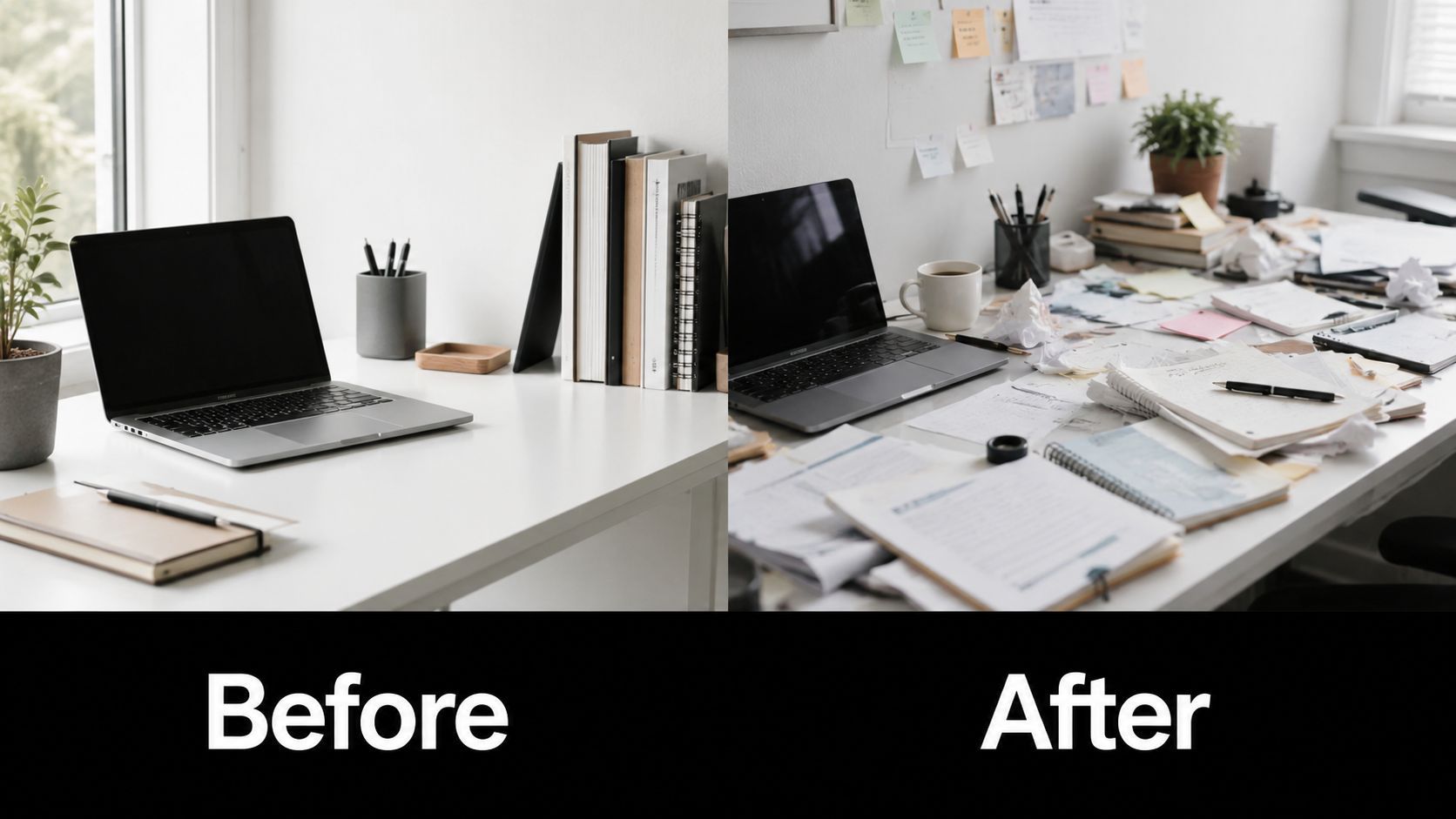
The juxtaposition film is one of the most efficient short-film prompts because it relies on contrast instead of exposition. Before and after, wrong and right, then and now, expected and reality. The viewer understands the point almost instantly, which is why this format works so well for lifestyle, fitness, productivity, and personal growth content.
Make the contrast impossible to miss
Subtlety usually weakens this format. The audience should feel the shift immediately, whether it's a messy desk becoming a clean workspace or a chaotic routine turning into a disciplined one. If the difference is too small, the reveal loses its emotional and visual payoff.
The transition matters just as much as the state change. A swipe, a rotation, a match cut, or a physical movement can make the reveal feel satisfying. Trend-friendly audio often helps because the sound can crest at the exact moment the new state appears. When the reveal lands cleanly, viewers tend to understand the point without needing much explanation.
Give the contrast a believable frame
A timeframe or context line makes the transformation easier to trust. “One morning,” “after three weeks,” or “day one versus day 365” helps the audience read the shift as earned, not arbitrary. Text overlays can also carry the comparison clearly, especially when the video needs to work in silence.
Best use case: When the visual evidence alone tells the story, you don't need much narration. The edit becomes the argument.
For AI video production, this is one of the easiest formats to prototype because the prompt can explicitly describe both states and the transition between them. ShortGenius is useful here because its scene swaps and transition options can help you build a polished reveal without a heavy live-action setup. If you want a format that's fast, legible, and highly reusable, this is often the one.
8-Point Comparison of Short Film Prompts
| Format | 🔄 Implementation Complexity | ⚡ Resources & Speed | 📊 Expected Outcomes | 💡 Ideal Use Cases | ⭐ Key Advantages |
|---|---|---|---|---|---|
| Genre Prompt: The 60-Second Origin Story | 🔄 Moderate, three-act script + authentic delivery | ⚡ Low production, quick turnaround; needs vulnerable storytelling | 📊 Strong emotional connection, high shareability, founder credibility | 💡 Personal brands, DTC founders, thought leaders | ⭐ Authenticity, easy repurposing, algorithm-friendly |
| Situational Prompt: The Micro-Tutorial Film | 🔄 Moderate–High, requires clear pedagogy and tight pacing | ⚡ Medium resources (demo setups, editing); batch-producible | 📊 High engagement & watch-through; drives traffic/conversions | 💡 Coaches, educators, e‑commerce product demos | ⭐ Establishes authority; directly monetizable |
| Character Prompt: The Transformation Story (PAS) | 🔄 Moderate, customer-focused narrative & emotional agitation | ⚡ Medium resources; often longer (2–3 min) and requires testing | 📊 Elevated conversion rates; stronger purchase intent | 💡 DTC brands, SaaS, agencies selling solutions | ⭐ Higher conversion via emotional investment |
| Observational Prompt: A Day in the Life | 🔄 Low–Moderate, documentary habit + selective editing | ⚡ Low production cost but needs consistent filming routine | 📊 Deep audience loyalty; increased long-term engagement | 💡 Creators, agency showcases, lifestyle/entrepreneur content | ⭐ Builds trust and parasocial connection; evergreen clips |
| Constraint Prompt: The Viral Trend Remix | 🔄 Low, creative adaptation of existing trend formats | ⚡ Very fast production; time-sensitive (48–96h optimal) | 📊 Burst reach and high engagement if timely and relevant | 💡 Educators, brands, thought leaders leveraging trends | ⭐ Leverages algorithm momentum while adding novelty |
| Documentary Prompt: The Authentic Testimonial | 🔄 Moderate, customer coordination, legal/consent steps | ⚡ Variable resources; UGC lowers cost but needs process | 📊 Very high credibility; significant lift in CTR/conversions | 💡 DTC, SaaS, coaches, agencies seeking social proof | ⭐ Strongest trust signal; scalable social proof |
| Speculative Prompt: The Future Forecast | 🔄 High, requires research, evidence, and clear reasoning | ⚡ Low production cost (talking head) but prep-heavy | 📊 Positions creator as authority; drives debate & subscriptions | 💡 Thought leaders, analysts, consultants | ⭐ Long-lived content that builds intellectual authority |
| Visual Prompt: The Juxtaposition Film | 🔄 Low, simple before/after visual storytelling | ⚡ Low resources; quick edits; high replay value | 📊 High replay/share rates; language-agnostic reach | 💡 Fitness, productivity, style, home, skill transformations | ⭐ Universally understandable, sound-off friendly, satisfying reveal |
Turn Your Prompt into a Masterpiece
An idea is only the starting point. What separates a forgettable clip from a real short film is the decision-making after the prompt, what you leave in, what you cut, and how clearly the film earns each beat. The best prompts for short films give you structure, but they don't replace taste. You still have to choose the strongest angle, stage the most revealing visual, and make the runtime feel intentional instead of compressed.
The most useful prompt is the one that fits your actual production reality. If you have one location and one performer, choose a format that rewards constraint. If you're working with customers, let the testimonial shape the story. If your audience lives on trend-driven platforms, use the remix or juxtaposition formats to make the idea feel native to the feed. That's where short-film prompting becomes practical rather than theoretical.
Traditional filmmaking still benefits from the same discipline. A short film with a clear origin story, a focused tutorial, or a tight before-and-after structure is easier to shoot, easier to edit, and easier to pitch. AI tools add another layer of speed, but they don't change the core challenge. You still need a premise with enough shape to survive compression, whether you're building it by hand or with a generator.
Tools like ShortGenius can help when the prompt is already doing real creative work. Its script, visual, and assembly workflow fits projects that need fast iteration, especially when you're turning one idea into multiple scenes, versions, or platform-specific outputs. That kind of support is useful if you're trying to move from concept to publishable film without losing the original shape of the idea.
Take one prompt from this list and make it this week. Don't wait for the perfect concept to arrive fully formed. The discipline of finishing one short film will teach you more than collecting ten more ideas ever will.
A CTA for ShortGenius (AI Video / AI Ad Generator).