A Practical Guide to Measuring Content Marketing ROI

Master measuring content marketing ROI with our practical guide. Learn to connect content to revenue using proven frameworks, KPIs, and real-world examples.
Let's get straight to the point.Let's get straight to the point. When we talk about measuring content marketing ROI, we’re talking about a simple, powerful calculation: (Return - Investment) / Investment * 100. This formula is what transforms your content from a line item on the expense sheet into a quantifiable revenue-generating engine.
Why Measuring Content Marketing ROI Is Non-Negotiable

In today's marketing world, simply creating great content isn't enough to keep your budget secure. Leadership wants to see numbers. They need a clear, undeniable line connecting your team's creative efforts to the company's financial health.
Despite this pressure, a staggering 65% of marketers admit they struggle to quantitatively prove the impact of their work. This guide is designed to fix that. We're moving past the theory and into a practical, field-tested framework for measuring your content marketing ROI.
Connecting Creativity to Business Outcomes
The real challenge for any content marketer is translating engagement metrics—like views, shares, and clicks—into tangible business results. Every piece of content you produce has to serve a bigger purpose, whether that's generating qualified leads, improving customer loyalty, or driving direct sales.
Operating without a data-backed system is like navigating without a map; you’re just guessing. This leaves your content strategy vulnerable to budget cuts, especially as production costs climb and new channels add complexity. For instance, measuring the impact of a viral short-form video requires a completely different lens than analyzing a long-form blog post.
To prove value, you must build a system that connects every piece of content back to the bottom line. It’s the only way to validate your work and make informed decisions about where to invest next.
The Modern Toolkit for ROI Measurement
Thankfully, we have more sophisticated tools than ever to help us connect these dots. While platforms like Google Analytics and HubSpot are foundational for tracking the customer journey, a major evolution is happening on the content creation side.
Take AI video generators like ShortGenius, for example. These tools do more than just make production faster; they fundamentally alter the ROI equation itself.
By enabling you to generate dozens of video variations for A/B testing in minutes, you can:
- Standardize your investment: The cost per asset becomes predictable and fixed, which cleans up your ROI calculations significantly.
- Optimize your return: You can rapidly pinpoint which creative elements resonate most with your audience and drive conversions, then double down on what works.
- Link efficiency to results: The correlation between faster, more efficient production and improved financial outcomes becomes direct and measurable.
This guide will walk you through building a bulletproof measurement system, from the initial goal-setting all the way to using these powerful new tools. It’s time to ensure your content is not just seen, but truly valued.
Building Your Measurement Foundation
Before you can even think about calculating ROI, you need to lay the groundwork. This isn't about getting lost in complex spreadsheets; it's about drawing a straight line from your content efforts to what your business actually cares about. It all starts with translating those big company ambitions into specific, tangible content goals.
Taking this first step is crucial because it gives every article, video, and social post a clear job to do. For example, a B2B SaaS company might have a top-level goal of booking more enterprise-level demos. The content team's goal, then, becomes generating Marketing Qualified Leads (MQLs) from decision-makers. That goal immediately points toward creating things like in-depth whitepapers or industry reports.
From Business Objectives to Content KPIs
Once you know your goals, you have to pick Key Performance Indicators (KPIs) that genuinely show progress. A classic mistake I see all the time is getting distracted by vanity metrics like social media likes. They feel good, but they rarely have any real connection to revenue. Instead, you need to zero in on KPIs that track the specific actions you want your audience to take.
If your goal is generating MQLs, for instance, your main KPIs should be things like form submission rates on your landing pages and the total number of MQLs each piece of content brings in. On the other hand, an e-commerce brand trying to cut down on customer support costs would be watching a completely different set of numbers:
- Reduction in support ticket volume for topics you've covered in new tutorial videos.
- Time spent on "how-to" pages, which tells you people are finding answers on their own.
- Positive ratings on your help-center articles or videos.
This disciplined approach forces you to justify every piece of content by tying it to a real-world outcome. It makes measuring your content marketing ROI down the line so much simpler.
Calculating Your Total Content Investment
Now for the "I" in ROI: your total content investment. Getting this number right is non-negotiable for an accurate calculation. This isn't just about the cost of a stock photo or a freelance writer's invoice. It’s the sum of every single cost involved in taking a piece of content from a spark of an idea to your audience's screen.
Think of your investment as the total "all-in" cost. This includes not just direct expenses but also the value of your team's time. If you don't track this properly, you'll always end up with an inflated and inaccurate ROI figure.
To get the full picture, make sure you're tracking all of these components:
- Creation Costs: This is the most obvious bucket. It includes payments to freelance writers, designers, and video editors. It also covers subscriptions for any tools you use, like AI video generators. For example, you could see how a text-to-video AI platform can make your content creation more efficient.
- Internal Team Time: You must put a dollar value on the hours your own team spends on content. This means tracking time for brainstorming, writing, editing, project management, and even uploading. A simple way to do this is to calculate a blended hourly rate for your content team.
- Distribution and Promotion Spend: Never forget the cost to get eyeballs on your content. This includes any money spent on social media ads, search engine marketing (SEM), influencer partnerships, or email marketing platform fees tied to a specific campaign.
By tracking these elements, you get a real, defensible number for your investment. That clarity is priceless, especially when you're in a room discussing budgets. And it's worth the effort—recent stats from marketing leaders show that B2B content marketing generates a 3:1 ROI on average, which handily beats paid ads. You can discover more insights about these content marketing ROI stats to help set realistic expectations for your own campaigns.
Connecting Your Content to Actual Conversions
This is often where the wheels fall off for marketers trying to measure ROI. It feels complicated, but it doesn't have to be. To get a real sense of your return, you need a way to connect the dots between the content people are consuming and the moment they decide to buy. That bridge is what we call content attribution.
Without a solid attribution strategy, you're essentially flying blind. You might see a blog post pulling in thousands of views and a separate demo page getting sign-ups, but you'll have no idea if the blog post had anything to do with those conversions. Attribution models are simply the rules you set to connect those touchpoints and assign credit where it's due.
Before you can even think about which model to use, though, you need a solid foundation. This is about making sure your measurement efforts are actually tied to what the business cares about.
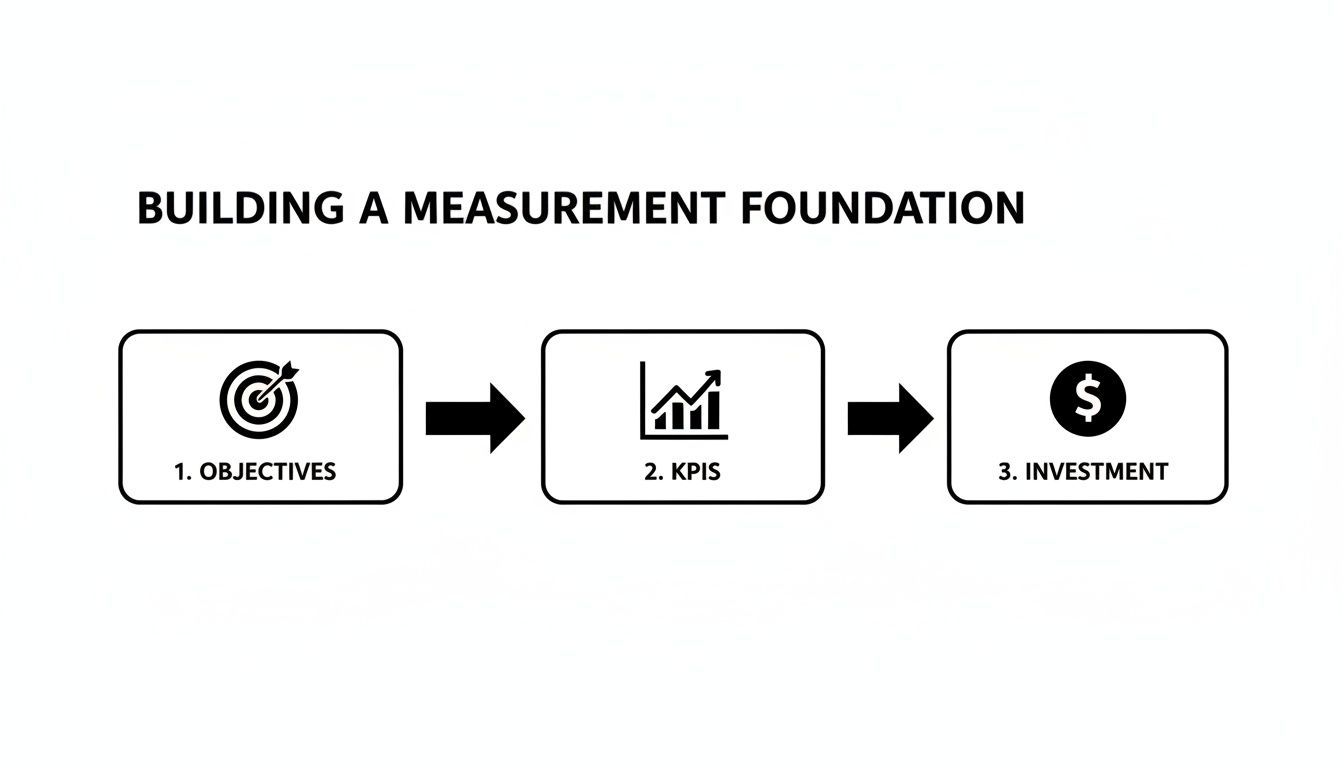
As you can see, everything flows from your core business objectives. Getting this right is the prerequisite for any attribution model to give you meaningful data. It ensures you're tracking outcomes that justify your team's time and budget.
The Different Flavors of Attribution
Think of a customer's journey like a soccer game. A midfielder might steal the ball, pass it to a winger, who then crosses it to a striker for the goal. Who gets the credit? Just the scorer? The player who made the final assist? Or everyone who touched the ball along the way? Attribution models are how you answer that question for your marketing.
There are a few common ways to slice this:
- First-Touch Attribution: This model gives 100% of the credit to the very first piece of content a customer ever saw. It’s simple, but it only tells a sliver of the story—the very beginning.
- Last-Touch Attribution: The polar opposite. This gives 100% of the credit to the final touchpoint right before conversion. It’s the most common model because it's the default in many analytics tools, but it's famously shortsighted.
- Multi-Touch Attribution: This is where things get more interesting. These models spread the credit across multiple interactions. A Linear model gives every touchpoint equal credit, while a Time-Decay model gives more weight to the interactions that happened closer to the conversion.
For a truly complete picture of your marketing impact, especially if you're running campaigns across different platforms, you'll eventually want to explore more sophisticated methods like cross-channel attribution.
Choosing Your Content Attribution Model
Picking the right attribution model isn't about finding the "best" one—it's about finding the one that's right for your business right now. The table below breaks down the most common models to help you decide.
| Attribution Model | How It Works | Best For | Potential Drawback |
|---|---|---|---|
| First-Touch | 100% credit to the first interaction. | Teams focused heavily on demand generation and brand awareness. | Completely ignores how content nurtures leads down the funnel. |
| Last-Touch | 100% credit to the final interaction before conversion. | Short sales cycles; teams new to attribution needing simplicity. | Devalues top- and middle-funnel content that builds trust. |
| Linear | Credit is split evenly among all touchpoints. | Teams wanting a balanced view of the entire customer journey. | Can treat all interactions as equal, even if one was pivotal. |
| Time-Decay | More credit to touchpoints closer to the conversion. | Longer sales cycles; teams wanting to know what closes deals. | Still undervalues the initial awareness-building content. |
While simplicity is tempting, be careful. Relying only on Last-Touch is a classic mistake. It consistently undervalues awareness content, which can lead you to slash budgets for the very things that fill your funnel in the first place.
My Two Cents: If you have the data, a Linear Multi-Touch model is a fantastic starting point for a more balanced view. It acknowledges that blogs, social posts, and videos all play a part in nurturing a lead. You might discover that generating AI UGC ads is critical for initial discovery—an insight a Last-Touch model would totally miss.
The Nuts and Bolts: Putting Attribution to Work with UTMs
So, how do you actually track all these touchpoints? The secret weapon is the humble UTM parameter. These are just little snippets of text you add to the end of a URL to tell your analytics platform where a click came from. They are the absolute foundation of good attribution.
A UTM link can have five parameters, but you'll mostly rely on these three:
- utm_source: The specific platform, like
tiktok,google, oractive-campaign. - utm_medium: The marketing channel, such as
social,cpc, oremail. - utm_campaign: The name of your specific effort, like
q4-black-fridayornew-feature-video.
Let's say you just created a great new product tutorial video with ShortGenius and want to share it on TikTok and YouTube for your "Summer Launch" campaign. You'd use two different links:
- For TikTok:
yourwebsite.com/tutorial?utm_source=tiktok&utm_medium=social&utm_campaign=summer-launch - For YouTube:
yourwebsite.com/tutorial?utm_source=youtube&utm_medium=video&utm_campaign=summer-launch
Now, when someone clicks the link in your TikTok bio and later becomes a customer, your analytics will properly credit tiktok as part of their journey. This simple habit is what makes any attribution model work, giving you the clean, organized data you need to prove your content's worth.
How to Calculate and Benchmark Your Content ROI
Alright, you've set your goals and you know what you're spending. Now for the fun part: running the numbers. The foundation for measuring content marketing ROI is a simple but powerful formula. Honestly, this is something every marketer should have in their back pocket. It's how you translate all your hard work into a language that executives and finance teams actually understand.
The classic formula is: (Return - Investment) / Investment * 100% = ROI
This gives you a straightforward percentage that shows exactly how much you earned for every dollar spent. For instance, a 400% ROI means you made $4 in profit for every $1 you invested. We've already talked about the "Investment" side of this equation, but the "Return" part is where things get interesting—and where many marketers get tripped up.
Defining and Quantifying Your Return
Your return isn't always just the cash from a direct sale. Content adds value in so many different ways, and a truly accurate ROI calculation has to account for all of them. To get the full picture, you need to look past simple last-click sales and consider both direct revenue and the money you've saved.
One of the biggest, yet most overlooked, returns comes from cost savings from organic traffic. Just think about it for a second. Every single person who lands on your blog from a Google search is a visitor you didn't have to pay for with ads. That’s real money you've kept in your pocket.
Here’s how you can put a real number on that value:
- First, pinpoint the main keywords your best content is ranking for.
- Next, use an SEO tool to find the average Cost-Per-Click (CPC) for those keywords in a Google Ads campaign.
- Finally, multiply your monthly organic traffic for that piece of content by the average CPC.
What you're left with is the equivalent media value—basically, what it would have cost to get that same traffic using paid search. For any company with a decent SEO game, this figure can be a huge part of your total return.
A common benchmark you'll hear is that a good content marketing ROI is around 500%. But I see that as more of a starting line. I've personally seen well-executed SEO and content strategies deliver well over 1,000% ROI over a two-to-three-year timeline as that content gains authority and just keeps working for you.
Industry Benchmarks and Performance Data
While 500% is a solid goal, the sky's the limit when content is done right. For example, some research into top-tier content programs found they were pulling in an average yearly ROI of $984,000. In one industry, companies saw an average of $1.1 million in new revenue over three years, which works out to an incredible 844% ROI.
Of course, tracking all this requires solid reporting. Effective Modern Search Engine Marketing Reporting is what helps you connect the dots between clicks, impressions, and real business results. It’s the bridge between raw data and actionable insights.
A Tangible Scenario Calculating Video ROI
Let's walk through a realistic example. Imagine your team used an AI video platform like ShortGenius to create a series of five short-form videos to promote a new software feature.
The Investment:
First, let's tally up the costs.
- Creator Time: 10 hours for planning, scripting, and review @ $50/hour = $500
- Tool Subscription: Monthly fee for ShortGenius = $99
- Promotion Budget: Ad spend to boost the best-performing video = $1,000
- Total Investment = $1,599
The Return:
Now, let's see what happened over the next 30 days.
- Generated Leads: The campaign brought in 40 demo requests.
- Lead-to-Customer Rate: Your sales team knows from experience they convert 15% of these leads.
- Customers Acquired: 40 leads * 0.15 = 6 new customers.
- Customer Lifetime Value (LTV): Each new customer is worth $1,200 to the business.
- Total Return = 6 customers * $1,200/customer = $7,200
Calculating the ROI:
Time to plug it all into our formula.
($7,200 Return - $1,599 Investment) / $1,599 Investment * 100% = 350% ROI
This is the kind of number that proves the campaign was a success. It completely changes the conversation from "the videos got a lot of views" to "the video campaign generated a 350% return on our investment." That’s how you get bigger budgets and prove your strategy is working.
Using Tools and Automation to Simplify Measurement

Let's be honest: trying to manually track every view, click, and conversion is a recipe for disaster. You’ll burn out fast, and your data will be riddled with errors. The smarter approach is to build a tech stack that does the heavy lifting for you, delivering clean data without drowning you in spreadsheets. This is what makes measuring content marketing ROI not just possible, but actually manageable.
The absolute foundation of any solid measurement stack is getting your core platforms to communicate. At a minimum, this means connecting your analytics and your customer relationship management (CRM) system.
For example, when you link Google Analytics 4 (GA4) with a CRM like HubSpot, you can finally see the whole picture. You can trace a user's entire journey, from the first blog post they read all the way through to becoming a paying customer. This integration is what brings multi-touch attribution to life, showing you every piece of content that nudged them along the way.
Building Your Core Measurement Stack
Your tech stack doesn’t need to be overwhelmingly complex, but it must cover the essentials of tracking and analysis. Think of it as the engine powering your ROI calculations, pulling data from all corners into one cohesive view.
A typical, effective stack usually includes:
- Analytics Platform: This is your source of truth for website traffic and user behavior. GA4 is the industry standard for a reason, offering robust event-based tracking that's perfect for monitoring how people engage with your content.
- CRM System: Your CRM—whether it's HubSpot, Salesforce, or another—is where your customer data lives. It tracks leads, deals, and revenue, making it essential for calculating the "Return" side of the ROI equation.
- Content & Management Tools: This includes your CMS (like WordPress) and any specialized creation platforms. This is where your "Investment" originates.
The magic happens when these tools talk to each other. When your analytics platform sends traffic data to your CRM, which then ties that traffic to a closed deal, you get a complete, end-to-end view of your content’s real-world performance.
How AI Creation Tools Directly Impact ROI
A new breed of tool is changing the ROI formula itself: AI-powered creation platforms. These don't just help you measure ROI; they actively improve it by influencing both the "Investment" and "Return" sides of the equation.
Think about it: a primary challenge in ROI calculation is nailing down your investment. When production is unpredictable, your costs fluctuate. AI standardizes this, giving you a predictable cost-per-asset that cleans up your data and simplifies your entire measurement process.
This shift is a huge reason why 68% of firms report a boosted ROI from using AI, pointing to faster production and better personalization. The global content marketing industry is projected to grow by 33% to over $107 billion by 2026, and AI is a massive accelerator of that growth.
Optimize Your Return with Rapid Experimentation
Beyond just keeping costs in check, AI platforms give you a powerful lever for maximizing your return. A platform like ShortGenius, for instance, lets you generate multiple video variations in minutes. This ability to test creatives at speed is a game-changer for ROI.
Instead of just guessing which video hook or call-to-action will resonate, you can create ten different versions and run a quick, small-scale A/B test. By dedicating a small budget, you can let real-world engagement and conversion data tell you which video is the top performer.
This process creates a direct line between creative efficiency and financial outcomes. You’re no longer just creating content; you’re systematically identifying the most profitable version of that content. Then, you can confidently put your main budget behind the proven winner, ensuring your investment is channeled for maximum impact. This is how modern tools turn creative work into a predictable, revenue-driving machine. If you're curious how this works, see how an AI ad generator can streamline this entire workflow.
Common Questions About Measuring Content ROI
After laying out the framework for measuring content marketing ROI, you're bound to have some questions. It's only natural. The path from creating a piece of content to calculating a clean ROI figure is rarely a straight line—it’s full of "what-ifs" and "how-to's." Let's tackle some of the most common hurdles I see people face, so you can move forward with confidence.
How Soon Can I Expect to See a Positive ROI From My Content Marketing?
Patience is a genuine virtue in content marketing, especially when organic growth is your main goal. Unlike the almost immediate feedback you get from paid ads, content is a long-term investment that builds momentum over time.
Generally, you can start to see meaningful results within 3 to 6 months. This initial period is when you're busy building topical authority, earning backlinks, and slowly climbing the search engine rankings. But the real magic happens later. The returns are evergreen—a single, well-optimized video or blog post can keep generating leads and traffic for years with very little ongoing effort.
I’ve consistently seen B2B firms experience the most significant compounding effects in years two and three of a sustained SEO strategy. The initial grind gives way to exponential growth as your content library becomes a powerful asset.
If you want to speed things up, the best advice is to focus on creating high-quality, deeply-researched content right from the start. Then, be proactive about promoting it across all your relevant channels to get that initial traffic boost.
What If My Goal Is Brand Awareness and Not Direct Sales?
Measuring the ROI of "softer" goals like brand awareness is totally possible. You just need to change how you define "Return." Instead of looking at direct revenue, you'll measure your return using valuable proxy metrics that show your brand's presence is growing.
Look for trends in metrics like these:
- Growth in direct traffic: This happens when people type your URL directly into their browser, which is a great sign of strong brand recall.
- Increase in branded search volume: Keep an eye on how many people are specifically searching for your brand name in Google.
- Share of voice: Track how often your brand is mentioned online compared to your competitors.
To put a dollar figure on this, you can calculate the earned media value. This is simply what you would have had to spend on paid advertising to get the same level of reach, impressions, and engagement. That value becomes the "Return" in your ROI formula, giving you a solid number to show stakeholders when you're measuring content marketing ROI.
What Is the Biggest Mistake to Avoid When Measuring Content ROI?
The single most common—and costly—mistake I see is relying only on last-touch attribution. This model gives 100% of the credit for a conversion to the very last thing a person clicked before taking action, like hitting the "Buy Now" button from a product page.
While it's simple to track, this method is dangerously shortsighted. It completely ignores the top-of-funnel blog post that first introduced the user to a solution, the mid-funnel case study that built their trust, or the social media video that kept your brand on their radar.
This flawed view inevitably leads to undervaluing all your awareness-building content and making poor decisions about where to put your budget. You risk cutting the very content that fills your pipeline, all because it doesn't get the final "assist." Even adopting a basic linear multi-touch model will give you a much more accurate and holistic picture of what's truly driving your business forward.
How Do AI Tools Actually Improve ROI, Not Just Help Measure It?
This is a great question. AI creation tools are so powerful because they directly impact both sides of the ROI equation, which improves your final return.
First, they dramatically lower the "Investment". A tool like ShortGenius can slash video production time from days to just a few minutes, which significantly cuts down on costs for creator time, editing, and finding assets. This makes your initial investment much, much smaller.
Second, they help you optimize the "Return" side of the equation through quick, data-driven experiments.
Imagine you want to launch a new video ad campaign. Instead of just guessing which hook or message will land with your audience, you can:
- Use AI to generate ten variations of the ad in minutes, each with a different hook, visual, or call-to-action.
- Run a small-budget A/B test with these variations across your social media channels.
- Quickly identify the top-performing creative based on real engagement and conversion data.
This process lets you confidently put your main ad spend behind a proven winner. You're no longer guessing; you're maximizing the financial return from your content because you know what works.
Ready to stop guessing and start measuring? ShortGenius gives you the tools to not only create high-quality video content at scale but also to test and optimize it for maximum financial return. Transform your content strategy from a cost center into a revenue driver. Start creating with ShortGenius today.