How to Write Product Descriptions That Sell in 2026

Learn how to write product descriptions that convert. Our guide covers audience research, SEO, copywriting formulas, and examples for web and video.
You've got the product. The photos are live. Traffic is coming in. And then you open the product page and realize the description says almost nothing useful.
That's where a lot of stores lose sales.
Most weak product descriptions fail for one of two reasons. They either read like a spec sheet, or they try so hard to sound “brand-y” that they forget to answer the buyer's actual question: why should I care? Good product copy closes that gap. It helps a shopper understand the product fast, trust it, and picture it in their life.
If you want to learn how to write product descriptions that sell, start with the buyer, translate features into outcomes, structure the page for scanning, and then adapt the copy to the platform where it appears. That last part matters more now than most guides admit. A Shopify page, an Amazon listing, and a TikTok caption do different jobs.
Before You Write a Word Know Your Customer
Great product copy doesn't start in a document. It starts in customer language.
If you don't know what your buyer is worried about, what they want, and what words they use to describe both, you'll write copy that sounds polished but misses the sale. Clever writing can't rescue weak customer understanding.

Build a buyer profile from real language
Skip the fictional persona with a made-up name and hobby list. What you need is a working profile built from evidence.
Start pulling phrases from places like:
- Customer reviews: Look for repeated pain points, praise, and objections.
- Support tickets and live chat: These show what blocks a purchase.
- Social comments: Buyers say things casually there that they won't say in surveys.
- Sales calls or founder DMs: Especially useful for higher-consideration products.
- Competitor reviews: Not to copy, but to spot what customers love or hate in the category.
A good swipe file doesn't need to be fancy. A spreadsheet works. Create columns for “problem,” “desired outcome,” “exact phrase used,” and “objection.”
Buyers rarely describe what they want in marketing language. They describe it in relief language. “I need this to stop leaking.” “I want it to fit under an airplane seat.” “I don't want to look overdressed.”
That language is gold because it gives you both message and priority.
Find the pain, not just the demographic
Age range and income bracket can help with positioning, but they won't write the description for you. What writes the description is tension.
Ask:
- What problem pushed this person to look for a solution?
- What outcome are they hoping for?
- What are they afraid might go wrong?
- What would make them feel smart, safe, stylish, efficient, or relieved after buying?
For example, if you sell a travel backpack, “men 25 to 40” tells you very little. “Frequent travelers who hate checking a bag, need fast laptop access at security, and don't want a pack that looks overly technical” gives you usable copy direction.
Write to one buyer, not to everyone
The fastest way to flatten a description is to make it universal. When brands try to appeal to everyone, they stop sounding specific enough for anyone.
A sharper approach looks like this:
- Weak: “A versatile backpack for all your daily needs.”
- Better: “A carry-on backpack built for people who move straight from airport security to meetings.”
The second version creates a scene. The shopper can place themselves inside it.
What to collect before drafting
Before writing a single line, gather:
- Top customer problem
- Main desired result
- Most important objection
- Three exact phrases customers use
- One use case you can vividly describe
- The practical details they need before buying
That prep work saves time because it keeps you from filling the page with generic claims.
The Core Formula From Features to Benefits
Most product descriptions fail at the same point. They stop at the feature.
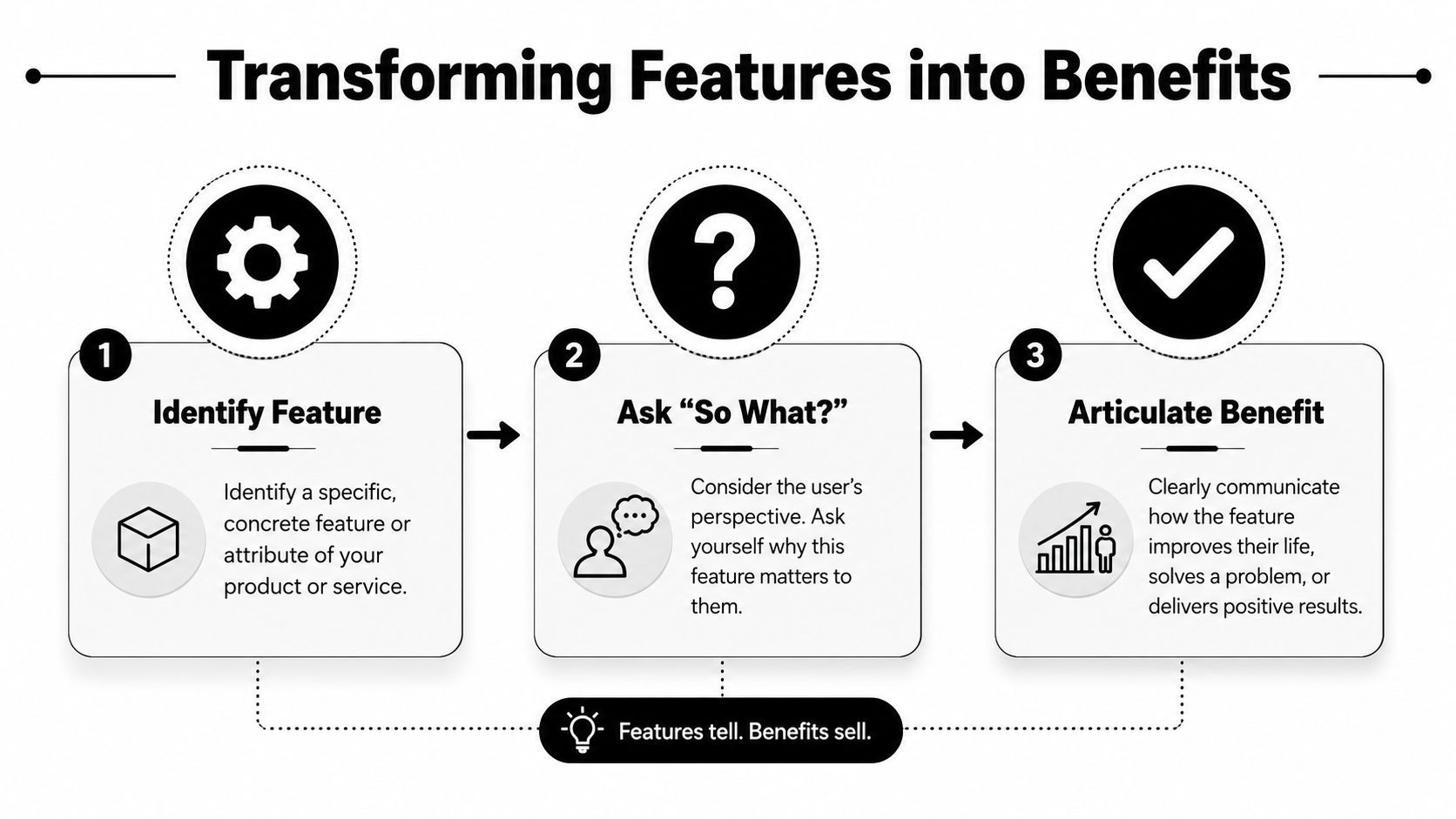
A feature matters, but only after the customer understands what it does for them. Shopify notes that 70% of online shoppers say they abandon purchases when product information is unclear or lacks tangible value, and that benefit-led phrasing outperforms bare specs. In the same guidance, Shopify gives a useful contrast: describing a camera as “capturing crystal-clear memories” converts 45% better than saying “12MP sensor with 4K video” in the cited example from Shopify's product description guidance.
Use the So What bridge
Here's the simplest copywriting habit I know for turning flat specs into persuasive copy. For every feature, ask: so what?
Take a backpack:
- Feature: water-resistant fabric
- So what: your gear stays protected in rain
- Benefit: you can commute or travel without worrying about your laptop and clothes getting soaked
Take a skincare product:
- Feature: fragrance-free formula
- So what: it's less likely to feel overwhelming during use
- Benefit: your routine feels comfortable, especially if you dislike heavily scented products
Take software:
- Feature: auto-caption generation
- So what: you don't have to type captions manually
- Benefit: you publish faster and spend less time on repetitive editing work
The customer doesn't buy the feature itself. They buy the easier day, the better result, or the avoided frustration.
A simple transformation example
Here's what weak copy looks like:
Backpack with 20L capacity, YKK zippers, padded straps, and a laptop sleeve.
Nothing there is false. It's just incomplete.
Now rewrite it with outcomes:
Built for short trips and daily carry, this 20L backpack keeps your essentials organized without turning bulky. The laptop sleeve protects your computer in transit, padded straps stay comfortable on long days out, and durable zippers hold up to constant packing and unpacking.
Same product. Better selling job.
What features deserve the spotlight
Not every feature belongs in the lead copy. Put the most meaningful ones first.
Lead with features that do one of these jobs:
- Solve a common objection: “dishwasher-safe,” “machine-washable,” “fits under most airline seats”
- Reduce risk: “locking lid,” “scratch-resistant finish,” “non-slip base”
- Improve daily use: “one-handed open,” “quick-dry fabric,” “easy-refill design”
- Support identity: “precision fit,” “minimal silhouette,” “studio-grade finish”
Technical details still matter. They just shouldn't carry the whole message.
A helpful additional reference is this guide for omnichannel product descriptions, which is useful when you need the same core message to hold up across product pages, marketplaces, and social placements.
Give the product a second to move before asking the reader to absorb specifications.
Before and after examples
Tech accessory
- Before: 10,000mAh power bank with dual USB-C output.
- After: Keep your phone alive through travel days, commutes, and late nights without hunting for an outlet. Dual USB-C output lets you charge more than one device when time is tight.
Apparel
- Before: Mid-weight cotton crewneck with ribbed cuffs.
- After: Soft enough for everyday wear and structured enough to look put-together, this crewneck gives you that clean, easy layer you'll reach for on repeat.
Home product
- Before: Stoneware mug, matte glaze, 14 oz capacity.
- After: A sturdy everyday mug that feels substantial in your hand and holds enough coffee to get you through a real morning.
Practical rule: If a sentence could appear on a wholesale inventory sheet, it probably isn't finished copy yet.
Proven Copywriting Frameworks and SEO
Once the message is clear, structure matters. Good product descriptions don't ramble. They guide attention.
Two frameworks show up again and again because they match how buyers think: AIDA and PAS. Neither is magic. Both are useful when applied to the right product and buying context.
AIDA versus PAS
| Framework | Best For | Example Structure |
|---|---|---|
| AIDA | Lifestyle products, visually driven products, products with emotional pull | Attention with a strong opening, Interest with context, Desire with benefits and proof, Action with a clear next step |
| PAS | Problem-aware shoppers, practical products, pain-point-led categories | Problem the buyer recognizes, Agitate the frustration or cost of that problem, Solution that resolves it |
AIDA works well when the product benefits from aspiration. Think apparel, beauty, décor, premium accessories, or gifting. You start with the appealing result, then support it.
PAS works better when the buyer already feels friction. Think storage products, organization tools, ergonomic items, cleaning tools, or software that removes repetitive work. You start with the annoyance because that's what triggered the search.
What AIDA looks like in product copy
A linen shirt description might open with the outcome:
Attention
A lightweight linen shirt that keeps its shape and still feels easy in warm weather.
Interest
Cut for everyday wear, it layers cleanly under jackets and works just as well untucked on weekends.
Desire Breathable fabric helps you stay comfortable, while the fitted silhouette avoids the oversized, sloppy look linen can sometimes get.
Action
Choose your regular size for a relaxed fit, or size down for a cleaner silhouette.
When PAS does the better job
An under-desk cable tray is not selling aspiration first. It's selling relief.
Problem
Loose cables make a workspace look messy fast.
Agitate
They collect dust, snag your feet, and turn simple adjustments into a chore.
Solution
This under-desk tray keeps power strips and charging cables off the floor and out of sight, so the desk stays cleaner and easier to use.
That's not more “creative.” It's just better matched to the buyer's mindset.
Bring in proof without sounding forced
Trust is part of copy, not decoration. ProductLed notes that adding social proof like customer quotes or metrics such as “loved by 100,000+ creators” can boost trust and increase sales by up to 34%, and that 88% of consumers trust online reviews as much as personal recommendations in the cited summary from ProductLed's article on product descriptions.
Use proof where skepticism naturally appears:
- After a bold outcome claim
- Near a quality objection
- Before the add-to-cart area
- Inside bullets where credibility matters
Examples:
- “Loved by 100,000+ creators”
- “Customers mention the fit, storage, and all-day comfort most often”
- “A favorite for weekend travel and daily commuting”
You don't need to overdo it. One strong proof cue beats five weak ones.
The cleanest descriptions sound confident because they answer doubt before the buyer has to ask.
SEO that still sounds human
SEO copy fails when people write for a crawler first and a customer second. The better approach is to choose a primary phrase, then place it where it helps both search visibility and comprehension.
CXL recommends an inverted pyramid structure, placing key outcome-based information early, linking the primary keyword to the H1, and keeping copy scannable with bulleted specs in CXL's product description framework. That's a smart standard because it forces clarity.
Practical placement:
- Title: Use the product name plus the main category phrase
- Opening lines: State what it is and why it matters
- Subheads: Include natural variations if they help the reader
- Bullets: Add specs where shoppers expect them, not stuffed into prose
- Meta language and alt copy: Keep it descriptive, not repetitive
If you're doing marketplace or catalog work, this Online Brand Growth's keyword guide is a practical resource for finding terms customers use, especially when search behavior differs from your internal product naming.
A good rule is simple. If the keyword makes the sentence worse, rewrite the sentence.
Adapting Your Copy for Different Platforms
A product description isn't a fixed asset anymore. It's a modular message that changes shape depending on where the customer sees it.
That matters because the page, feed, or marketplace changes what the buyer needs from the copy. On a product page, the description often has to close the sale. On social, it often has to earn the next tap.
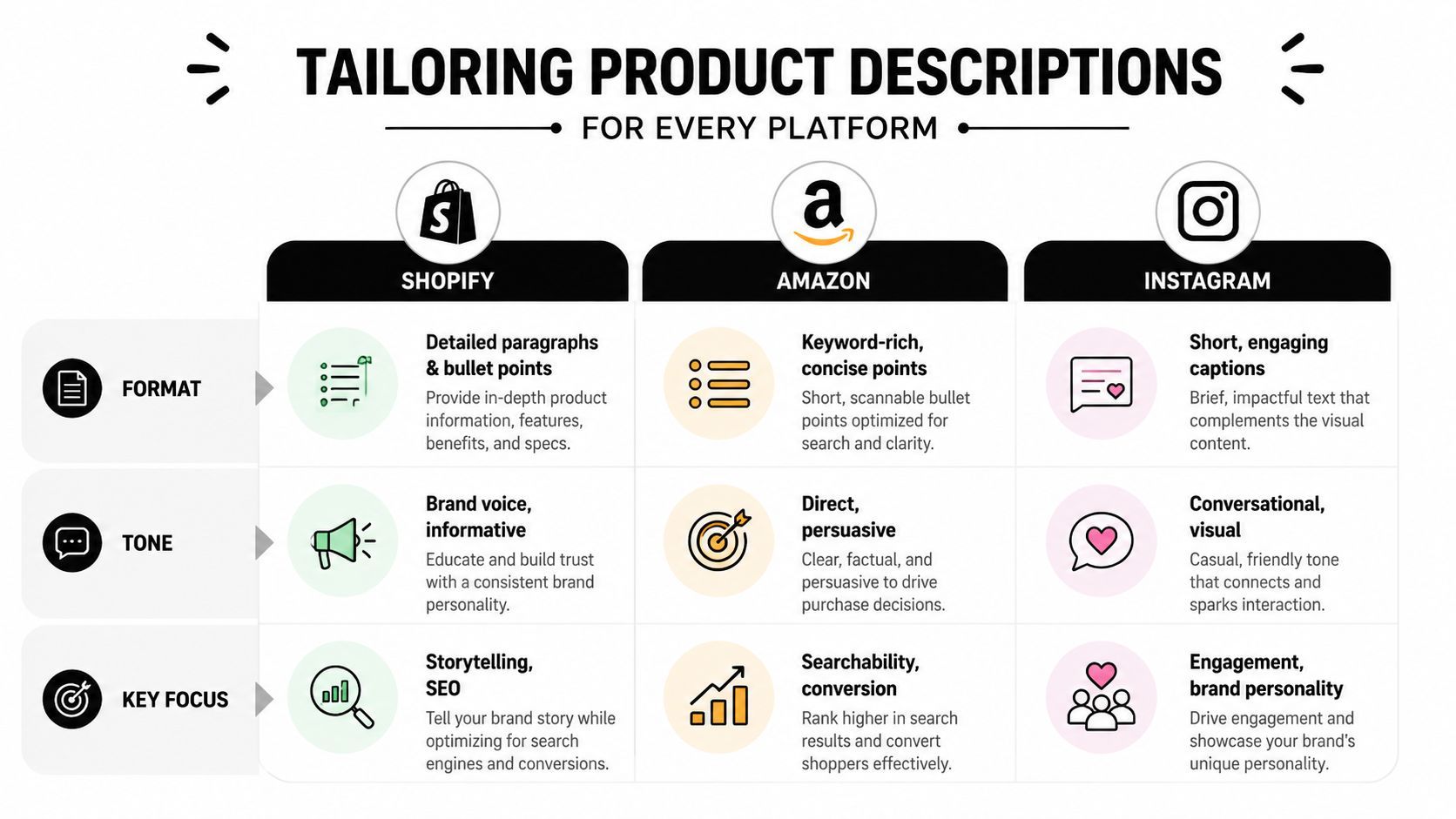
Jasper highlights a gap most ecommerce teams can already feel in practice. It cites 2025 data showing that 74% of e-commerce traffic originates from mobile social apps, while 89% of product description tutorials still focus on desktop webpage optimization in Jasper's article about product descriptions. That's why brands need a real approach to micro-descriptions for short-form video.
What changes from platform to platform
A strong Shopify description can carry story, reassurance, use cases, care details, and specs. It has room to do the full job.
An Amazon listing usually needs tighter language, clearer keyword alignment, sharper bullets, and less room for brand flourish. Shoppers there are often comparing options fast.
Instagram shopping copy sits somewhere in between. It needs tone, pace, and enough context to spark interest without trying to answer every question.
Short-form video is different again. The description may be a caption, on-screen text, a voiceover line, or all three working together. The copy's first job isn't to inform fully. It's to stop the scroll.
The micro-description playbook
A micro-description is a compressed product pitch designed for a viewer who's moving fast.
The format I use most often is:
- Hook the friction or desire
- Show the payoff
- Add one concrete detail
- Prompt the next action
Examples:
- “Your weekender bag shouldn't fight you at the airport. This one slides under the seat, opens wide, and keeps shoes separate.”
- “If your serum pills under sunscreen, try this. Lightweight, quick-absorbing, and easy to layer.”
- “Messy cables, gone. Mount it under the desk and clear the floor in minutes.”
These aren't mini web descriptions. They're attention devices tied directly to a product outcome.
Long page versus short video
Here's the practical difference.
Shopify product page opening:
A structured carry-on backpack designed for short trips, daily commuting, and work travel. It keeps tech, clothing, and quick-access essentials organized without the bulk of a full-size travel pack.
TikTok caption or opening voiceover: Carry-on backpack that keeps your work stuff separate from your clothes.
The second one is blunter because it has to be. The shopper hasn't committed attention yet.
A useful platform checklist
- Shopify or DTC page: Lead with the main outcome, then support with use case, objections, and specs.
- Amazon: Front-load search language and practical buying details.
- Instagram post: Keep it conversational and visual. Let the image do some work.
- TikTok and Reels: Use short spoken language, strong nouns, fast contrast, and one sharp promise.
If a viewer can't understand the benefit in a glance or a short spoken line, the copy is too slow for short-form video.
Refining and Optimizing Your Descriptions
First drafts usually contain the right ingredients in the wrong order. Refining is where the description starts pulling its weight.
The easiest upgrade is scannability. CXL's guidance recommends an inverted pyramid approach that puts the most important information first and uses bullets for specs because that structure reduces cognitive load and supports add-to-cart behavior in CXL's product description playbook. That matches what strong ecommerce teams do in practice.
Tighten the reading experience
Look at the page on a phone, not just on desktop. That's where weak formatting shows up immediately.
Clean it up with:
- Short opening paragraph: State product, buyer, and payoff fast.
- Bullet points for specs: Don't hide practical details inside dense prose.
- Micro-heads: Labels like “Why it works” or “Fit and feel” help scanning.
- Short paragraphs: Two or three sentences is usually enough.
Dense copy can still be good writing. It's just bad ecommerce writing.
Improve the small words around the description
Microcopy affects confidence more than many teams think. Button text, shipping reassurance, returns language, and fit notes all influence whether a buyer moves forward.
Examples of stronger supporting copy:
- Button language: “Choose your size” can work better than a generic purchase command when selection matters.
- Risk reduction: “Free 30-day returns” removes hesitation.
- Use guidance: “Best for weekend trips and overnight travel” helps self-qualification.
- Expectation setting: “Runs relaxed through the body” cuts return risk.
For brands producing a lot of creative variations, landing pages, and product-led content, tools like ShortGenius can help teams generate, edit, and repurpose supporting assets faster, especially when the product description has to feed multiple content formats.
What to test first
Don't test everything at once. Pick the parts most likely to change buyer behavior:
- Opening line: Outcome-led versus feature-led
- Primary benefit: Convenience, quality, status, comfort, or speed
- Bullet order: Put the most persuasive point first
- CTA copy: Match the buying stage
- Proof placement: Near the top versus near the cart area
A good optimization rhythm is simple. Keep the product the same. Change one message variable. Watch how buyers respond.
Common Questions About Product Descriptions
How long should a product description be
Use the product's complexity as the guide. CXL recommends 150 to 300 words for simple products and 300 to 600+ words for high-consideration items in its framework on writing product descriptions. In practice, low-cost, obvious products need less explanation. Technical, wearable, or expensive products usually need more.
Is it okay to use AI to write product descriptions
Yes, if you use it as a draft partner, not as the final voice. AI is useful for brainstorming angles, organizing specs, and generating variations. It's less reliable when you feed it thin inputs and publish the first output untouched. The quality still depends on your customer insight, claim discipline, and editing.
How do you write descriptions for boring or technical products
Treat “boring” as a signal that the copy is stuck in feature language. Technical products usually become persuasive once you translate the spec into reduced friction, saved time, easier maintenance, cleaner results, or lower risk. Cable organizers, drill bits, storage bins, and accounting software all sell when the buyer can feel the improvement in daily use.
Should every product use the same tone of voice
The brand should feel consistent, but the product's job should shape the tone. A luxury candle can carry more atmosphere. A water filter should sound clearer and more practical. Consistency matters, but usefulness matters more.
If you remember one thing, remember this: the best product descriptions don't try to impress readers. They remove doubt, make the benefit obvious, and help the right buyer say yes.
If you're turning product descriptions into short-form ads, social videos, or multi-platform creative, ShortGenius (AI Video / AI Ad Generator) helps you go from idea to publish-ready content fast. It brings scriptwriting, visuals, voiceover, editing, and scheduling into one workflow, which is useful when one product message needs to become a product page, a Reel hook, a TikTok ad, and a full campaign without starting from scratch every time.