How to Make Video Ads for Dropshipping That Convert

Learn how to make video ads for dropshipping that actually sell. Our guide covers hooks, scripting, quick editing, and optimization for TikTok & Reels.
You've found a product with promising margins, built a store, and watched competitors sell the same type of item through ads that look almost impossible to match. Then you open your phone's camera roll and find a few supplier photos, no usable footage, and no clear idea how to turn a product into a convincing story.
That's the central challenge with dropshipping ads. The product is only one part of the offer. Your creative has to stop the scroll, demonstrate the benefit, build enough trust, and give the viewer a reason to click before attention disappears. The practical answer is a repeatable process for producing multiple useful variations without paying an agency for every edit.
Why Winning Dropshipping Brands Run on Video Ads
New dropshippers often treat video as a branding project. They wait for a product sample, search for the perfect creator, and imagine they need polished studio footage before launching anything. That approach delays learning. A simple phone recording, a clear demonstration, and a strong opening can teach you more about buyer demand than a beautifully edited video that never reaches the right audience.
Short-form video matters because it can influence more than awareness. In a controlled study covered by Marketing Dive's video advertising benchmark summary, 6-second video ads increased brand preference by 9% and purchase intent by 5%, while 15-second ads produced similar outcomes at 10% and 4%. Both lengths generated the same recall, which supports an important point for direct-response commerce: a short ad can still move someone toward a purchase.
A dropshipping product usually needs a fast explanation. The viewer might need to see how a cleaning tool removes a problem, how a kitchen gadget saves effort, or how an accessory changes the way an everyday item is used. Static images can show the object, but motion can show the transformation.
Practical rule: If the product has to be seen in use before its value becomes obvious, start with video.
The format also matches where ecommerce advertisers already compete. Independent reporting attributes more than 45% of total digital video ad spending to social video, while 65% of consumers engage with short-form video multiple times a day, according to the same industry benchmark report. That doesn't mean every product needs a video for every campaign. It does mean you should treat video creation as a core acquisition skill, not an optional upgrade.
The profitable mindset is simple: don't try to make one perfect ad. Build a system that produces several focused variations, then let audience response show you which message deserves more attention.
Deconstructing a Profitable Dropshipping Video Ad
A profitable dropshipping ad follows a clear sequence. The viewer needs a reason to stop, a problem they recognize, proof that the product works, and one obvious next step. For solo sellers, the practical goal is not one polished video. It is a low-cost system for producing several variations and learning which angle earns attention and action.

1. Hook
The hook is the opening visual, spoken line, or text overlay that earns the next moment of attention. Show the product in motion, an obvious frustration, a surprising result, or a genuine reaction. A logo animation usually delays the reason to care, especially with a cold audience.
The first 3 seconds are the critical scroll-stopping window. Treat a 25% or higher 3-second view rate as a strong directional hook benchmark, and aim for completion above 40% for videos under 30 seconds, based on ecommerce video ad guidance from VidAU.
2. Problem
Show the situation your buyer recognizes. A reusable lint remover can open on clothing covered in pet hair. A posture support product can show someone adjusting their chair after a long work session. Make the problem visible early rather than hiding it in narration.
3. Solution
Demonstrate the product doing the job. Use close-ups, before-and-after footage, and a simple sequence that makes the change easy to understand. If viewers must guess what improved, the demonstration needs another shot or a clearer angle.
4. Proof
Proof may come from a creator using the product, a customer reaction, product details, or on-screen context explaining its usefulness. Do not invent reviews or imply results the footage cannot support. Match every claim to a realistic use case and show enough detail for viewers to judge the result.
5. CTA
End with one action. “See how it works,” “Shop the product,” and “Get yours today” are clearer than several competing instructions. Keep the CTA readable, then reinforce it with text or voiceover when appropriate instead of relying only on the final frame.
The format can also support stronger interaction than image-only creative when demonstration affects purchase confidence. ZIK Analytics reports that dropshipping stores using video ads can receive up to 3x more clicks than stores relying only on images. Treat that as a directional benchmark, not a promise. Product-market fit, landing-page quality, price, shipping, and audience determine whether a creative converts.
Produce the first batch with simple footage, captions, and reusable editing templates. Change one main variable at a time, such as the opening problem, demonstration, proof, or CTA. That approach gives a small budget more useful learning than spending the entire budget on one elaborate ad.
How to Plan and Script a Scroll-Stopping Ad
Don't open your editor before deciding what the ad needs to communicate. Start by collecting language from product reviews, customer questions, competitor comments, and your own product page. Look for repeated frustrations and specific moments of use. “This solves clutter” is broad. “My charging cable keeps falling behind the desk” gives you a scene, a hook, and a problem.

Create a small idea bank with three columns:
- Audience situation: What is the buyer trying to do?
- Visible frustration: What keeps going wrong?
- Product outcome: What changes after using the item?
This keeps the script grounded in buyer reality. If you need a broader process for organizing research, messaging, and production, planning editorial workflows from scratch can help you structure the work before you start creating assets.
The one-hook script
Use one central hook per ad. Don't combine a price offer, a product feature, a testimonial, and a lifestyle message in the opening. One variable should have a fair chance to work.
A practical script template looks like this:
- Hook: “Still dealing with [specific frustration]?”
- Agitation: “It gets worse when [recognizable situation].”
- Reveal: “This [product category] helps by [plain-language mechanism].”
- Demonstration: Show the item solving the problem in real time.
- Proof: Show the result, the texture, the fit, the speed, or a believable use moment.
- CTA: “Tap to see how it works.”
For a portable fabric shaver, the finished version could sound like this:
“Still pulling fuzz off your favorite sweater by hand? One wash can leave fabric looking tired and rough. This compact fabric shaver glides across the surface and collects the loose fibers as you go. Watch the fabric change in one pass. Tap to see the product in action.”
The words support the footage. They don't replace it. Film the problem first, cut immediately to the product, and use captions so the viewer can follow without sound.
A useful production target is a short-form ad under 30 seconds, with the first 3-second hook treated as its own testable asset. The VidAU ecommerce ad guide identifies 15 to 20 seconds as a common sweet spot for short-form ecommerce ads, alongside the view-rate benchmarks above. Treat duration as a testing variable rather than a fixed rule. A simple product may need less explanation, while a product with unfamiliar use requires a clearer demonstration.
Before filming, write three versions of the hook around different buyer situations. Keep the problem, product, and CTA consistent. That gives you a clean way to learn whether the audience responds to the frustration, the result, or the identity of the person using the product.
Producing and Editing Your Ad on a Budget
A profitable dropshipping ad can start with a phone, a window, and a clear shot list. The production goal is enough usable footage to explain the product, then enough editing flexibility to create several openings and angles.
If you have the product, film near a window. Capture a wide shot for context, a close-up of the mechanism, a hand demonstrating the key action, and the final result. Keep the camera stable, simplify the background, and record more raw material than you expect to use. A five-second action can become several edits when you change the opening, caption, or voiceover.
Without the product, request original footage from your supplier and confirm that advertising use is permitted. Licensed stock clips can establish the problem, but they should not appear to demonstrate your exact item. AI-generated scenes can support concept variations, provided the finished ad represents the product accurately.
Build a low-cost creative pipeline
Organize your assets into three groups:
- Product evidence: Demonstrations, close-ups, packaging, and real results.
- Human context: A creator, AI actor, hands, voiceover, or reaction that clarifies the use case.
- Message layers: Captions, benefits, price or offer details, and the CTA.
Editors such as CapCut, Canva, and InShot cover trimming, captions, overlays, music, and resizing. Build the first cut around the footage, then add text. Heavy transitions, animated logos, and decorative effects can make an ad feel less native while pulling attention away from the product.
AI helps when creative variation is the bottleneck. The global short-form video advertising market was valued at $14.7 billion in 2025, with in-feed ads representing 42.5% of revenue, according to MarketIntelo's short-form video advertising report. For a solo seller, the practical takeaway is production speed. One concept rarely provides enough learning, so a low-cost workflow should make multiple hooks and edits affordable.
A tool like ShortGenius can turn a product brief into a vertical ad concept with a script, AI actors, voiceover, assembly, captions, and export. Use it to produce different hooks, avatars, pacing choices, and benefit angles. Review every version before publishing. Check product details, remove unsupported claims, fix unnatural narration, and confirm that the visuals match the voiceover.
The strongest budget workflow combines both sources. Use real footage when trust depends on physical evidence, then use AI for scripts, voice swaps, scene variations, and faster editing. This creates enough creative volume to test without making generic visuals carry the entire ad.
Optimizing Your Video for TikTok Reels and YouTube Shorts
A strong ad can lose performance if platform controls cover the product or viewers miss the message with sound off. Export one clean vertical master, then inspect each placement in its native preview before spending on traffic.
Use 9:16 vertical framing for TikTok, Instagram Reels, and YouTube Shorts. Keep faces, product demonstrations, captions, and the main benefit clear of interface areas at the top and bottom. Place important text near the center, choose a large readable font, and burn in captions instead of relying on audio.
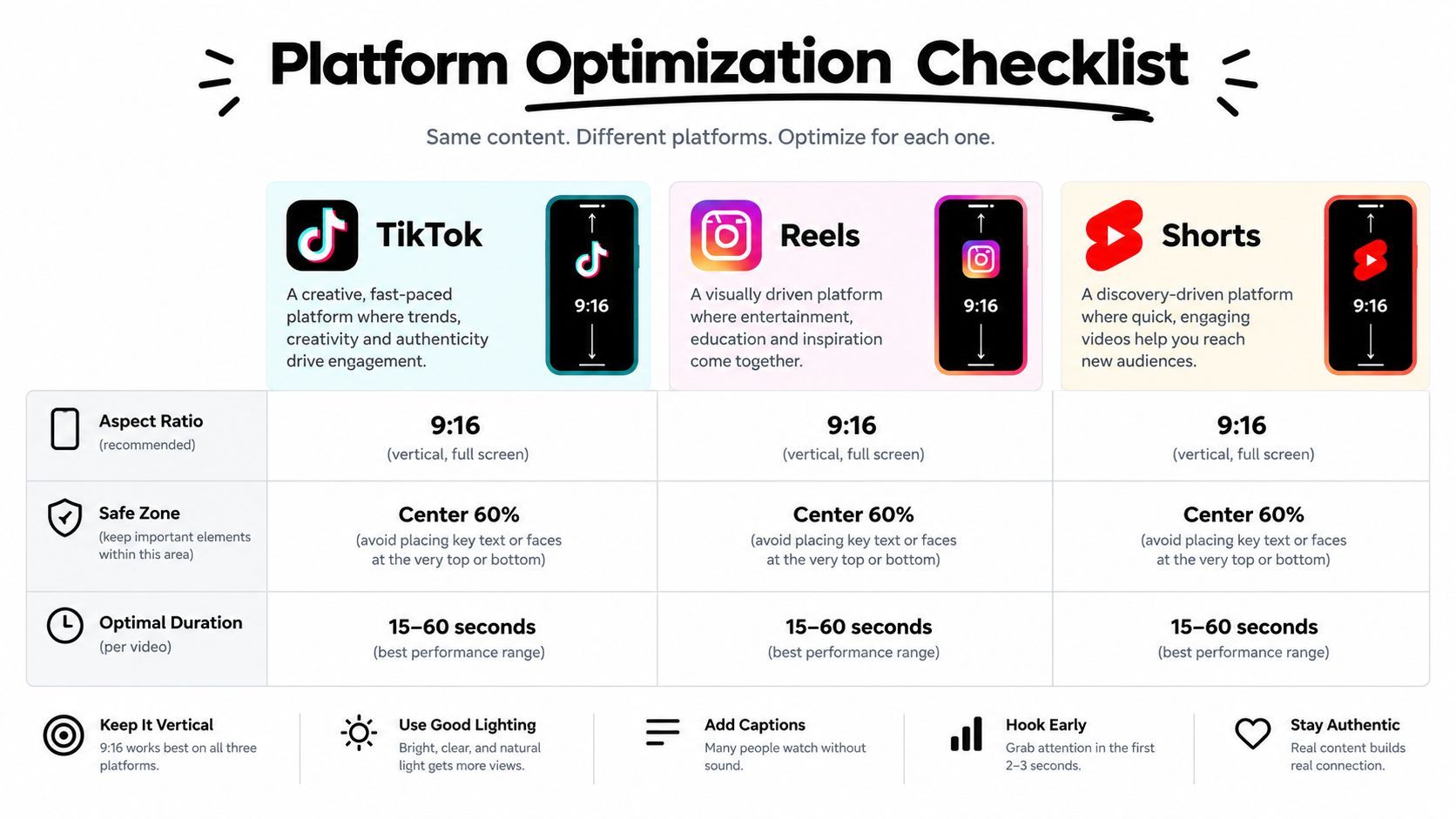
Ad Specs for Top Short-Form Video Platforms
| Specification | TikTok In-Feed Ads | Instagram Reels Ads | YouTube Shorts Ads |
|---|---|---|---|
| Recommended aspect ratio | 9:16 vertical | 9:16 vertical | 9:16 vertical |
| Safe zone | Keep key text and product action away from interface overlays | Keep captions and CTA clear of top and bottom controls | Keep the main visual and message in the central viewing area |
| Duration approach | Open with the product or problem immediately | Use fast visual progression and native-looking captions | Make the premise understandable without relying on a long setup |
| Audio and text | Use cleared audio and readable burnt-in captions | Match audio to the brand and verify commercial usage rights | Keep narration and captions aligned for sound-off viewing |
Audio licensing requires attention. A trending sound may suit an organic post but still lack clearance for paid advertising. Choose platform-approved or properly licensed music, keep it below the voiceover, and prevent sound effects from masking the product benefit.
Keep separate versions for testing. A clean master without platform UI, watermarks, or edge-positioned captions can support quick edits across channels. Create a preview for each platform and check it on a phone. Desktop review often hides small text that disappears on a mobile screen, while a low-budget workflow benefits from catching layout problems before launching multiple variations.
Testing Creatives to Find Your Winning Ad
Your first ad gives you a starting point, not a verdict. Build a testing system around the same product and offer, then change one meaningful element per variation. For a solo dropshipper, this keeps production manageable while creating enough creative volume to find a winner. Start with the hook, then test the speaker or avatar, demonstration order, benefit, and CTA.
Use performance signals to choose the next edit:
- Weak early retention: Replace the opening visual or first spoken line. The problem may not be clear quickly enough.
- Strong viewing but weak clicks: Rework the product explanation, offer, or CTA. Attention is not becoming intent.
- Clicks without purchases: Check the product page, price, shipping message, checkout, and trust elements before blaming the video.
- Sales from one angle: Create more versions around that buyer problem. Keep the winning premise and vary the execution.
The hook benchmark in the earlier ecommerce video guidance can help diagnose the opening, but profitability depends on more than one metric. Review click quality, add-to-cart behavior, purchases, and contribution margin alongside retention and CTR. A video can attract attention while the landing page or unit economics prevent profitable sales.
UGC-style ads suit discovery, but keep other formats in the test plan. AliDrop's creative guidance notes that static and carousel ads remain useful for retargeting and faster early testing. Use a carousel to explain details to returning visitors, or a static image to refresh a fatigued audience without producing another full video.
A tool that turns product briefs into scripts, AI actors, voiceovers, captions, edits, and platform-ready variations can reduce the production bottleneck. Generate several hooks and product demonstrations, then let results determine which concept receives more budget. Record each variation, audience, spend, and outcome in one sheet. This practical paid social playbook provides a useful reference for campaign structure, measurement, and iteration.
ShortGenius can help you turn a product URL or brief into short-form ad variations. Create product demos and hook tests at shortgenius.com, then use performance data to choose the next batch.