How to Make Reels for Instagram: A 2026 Pro Guide

Learn how to make Reels for Instagram that get views. Our step-by-step 2026 guide covers planning, filming, editing, and strategy, streamlined with AI tools.
Instagram users now spend a huge share of their time watching Reels, and short-form video reaches farther than static posts. For anyone publishing on Instagram, the critical question is no longer whether Reels matter. It is how to produce them consistently without turning content into a daily time drain.
A lot of advice on how to make reels for instagram still treats each post like a one-off task inside the app. Come up with an idea. Film it. Edit it by hand. Write a caption. Start over tomorrow. That workflow can work for a casual creator. It breaks quickly for brands, agencies, and social teams that need volume, consistency, and clear performance signals.
A stronger approach is to build a repeatable production system.
That means planning in batches, scripting faster, filming with clear constraints, editing from reusable templates, and scheduling across platforms instead of posting one Reel at a time under pressure. Tools like ShortGenius help turn that process into something operational. You can generate ideas, shape scripts, produce videos faster, queue content, and review what actually held attention. The result is simpler to manage and much easier to scale.
Why Reels Are Essential for Instagram Growth in 2026
More than half of the time people spend on Instagram now goes to Reels, and short-form video reaches farther than single-image posts, as noted earlier. If growth is the goal, Reels are the format Instagram rewards with the most discovery.
That shift changes the job. Instagram no longer limits distribution to the people who already follow you. Strong Reels can get placed in front of new viewers at scale, which makes video one of the few formats that can still expand reach without paid support. Static posts and carousels still do useful work, especially for education and saves, but Reels carry more of the discovery load.
The challenge is not understanding that Reels matter. The challenge is producing them often enough to benefit from that distribution.
A lot of creators, brand teams, and agency operators hit the same wall. They can come up with a decent Reel occasionally. They cannot maintain the pace with a manual, inside-the-app workflow.
- Ideas slow down: Content planning happens post by post, so every publishing day starts from zero.
- Filming takes too long: Retakes, script changes, and setup decisions stretch a short video into a long task.
- Editing piles up: Cutting clips, adding captions, formatting covers, and resizing create a backlog fast.
- Publishing stays reactive: Teams post what they finished today instead of working from a scheduled content pipeline.
Here's the practical reality. The Reel itself is rarely the bottleneck. The bottleneck is switching between ideation, scripting, filming, editing, posting, and review with no system connecting them.
That is why experienced teams stop treating Reels as isolated pieces of content. They build a workflow. Ideas come from repeatable content themes. Scripts follow proven structures. Recording happens in batches. Edits use reusable formats. Publishing and analysis happen on a calendar, not in a rush.
ShortGenius helps turn that workflow into something a team can run week after week. Instead of handling every step manually in Instagram, you can use AI to generate concepts, shape scripts, produce videos faster, schedule across platforms, and review which Reels held attention. That saves time, but the bigger win is consistency. Consistency is what gives Instagram enough volume to learn who responds to your content and keep distributing it.
Planning Your Reel for Viral Potential
Most weak Reels fail before filming starts. The problem isn't camera quality. It's that the idea is vague, the angle is generic, and the message has no structure.
High-retention Reels usually begin with a tighter planning method. One of the most useful guidelines is to brainstorm around three to five content pillars and finalize with a caption, 3 to 5 relevant hashtags, and a clear CTA, as outlined in Templify's Instagram Reels best practices. That keeps your content consistent without making every post look the same.
Build around content pillars
Content pillars stop the blank-page problem. Instead of asking “What should I post?” you ask “Which pillar deserves the next Reel?”
A practical setup looks like this:
- Education: Teach one tactic, one mistake, or one framework.
- Proof: Show process, before-and-after thinking, teardown, or results qualitatively.
- Opinion: Take a stance on what's overrated, outdated, or misunderstood.
- Behind the scenes: Show workflow, setup, editing choices, or daily operations.
- Conversion: Answer objections, explain offers, or direct viewers to the next step.
If you're a creator, coach, brand, or agency, that mix gives you enough range to stay fresh while staying recognizable.
Use a simple script, not a full monologue
You don't need a long script for a Reel. You need a clear sequence. The strongest format for most business and creator content is:
| Part | What it does | Example |
|---|---|---|
| Hook | Stops the scroll fast | “Most Reels fail before the first cut.” |
| Value | Delivers one useful idea | “If your opening shot doesn't create tension, viewers leave.” |
| CTA | Tells people what to do next | “Save this before your next filming day.” |
That structure works because viewers can follow it immediately. One Reel should carry one idea. When creators try to pack in five lessons, retention usually gets worse because the video feels crowded.
A good Reel script reads like a headline, a proof point, and a next step.
Plan from audience pain, not just trends
Trending audio can help, but trends aren't a strategy by themselves. If you only chase what's popular, your content starts to look interchangeable.
A better planning prompt is:
- What does my audience keep getting wrong?
- What question do I answer repeatedly?
- What part of my process would save someone time if they saw it?
- What belief in my niche needs correcting?
That gives you angles with built-in relevance. Then, if a trend fits naturally, use it.
For anyone learning how to make Reels for Instagram at scale, scripting from a keyword or pain point is much faster than improvising on camera. That's especially true when you're batching multiple Reels in one sitting.
Filming Fundamentals for High-Quality Reels
You can fix many things in editing. You can't fix bad framing, weak lighting, and unclear audio as easily as people think. Reels don't need cinema production, but they do need basic technical discipline.
The first essential element is format. To maximize performance, Reels should use a 9:16 vertical aspect ratio at 1080 x 1920 pixels, and your hook needs to appear within the first 3 seconds for organic content according to Quso's Reels best practices. If you film horizontally and hope to crop later, you create extra work and usually lose visual impact.
What matters most on shoot day
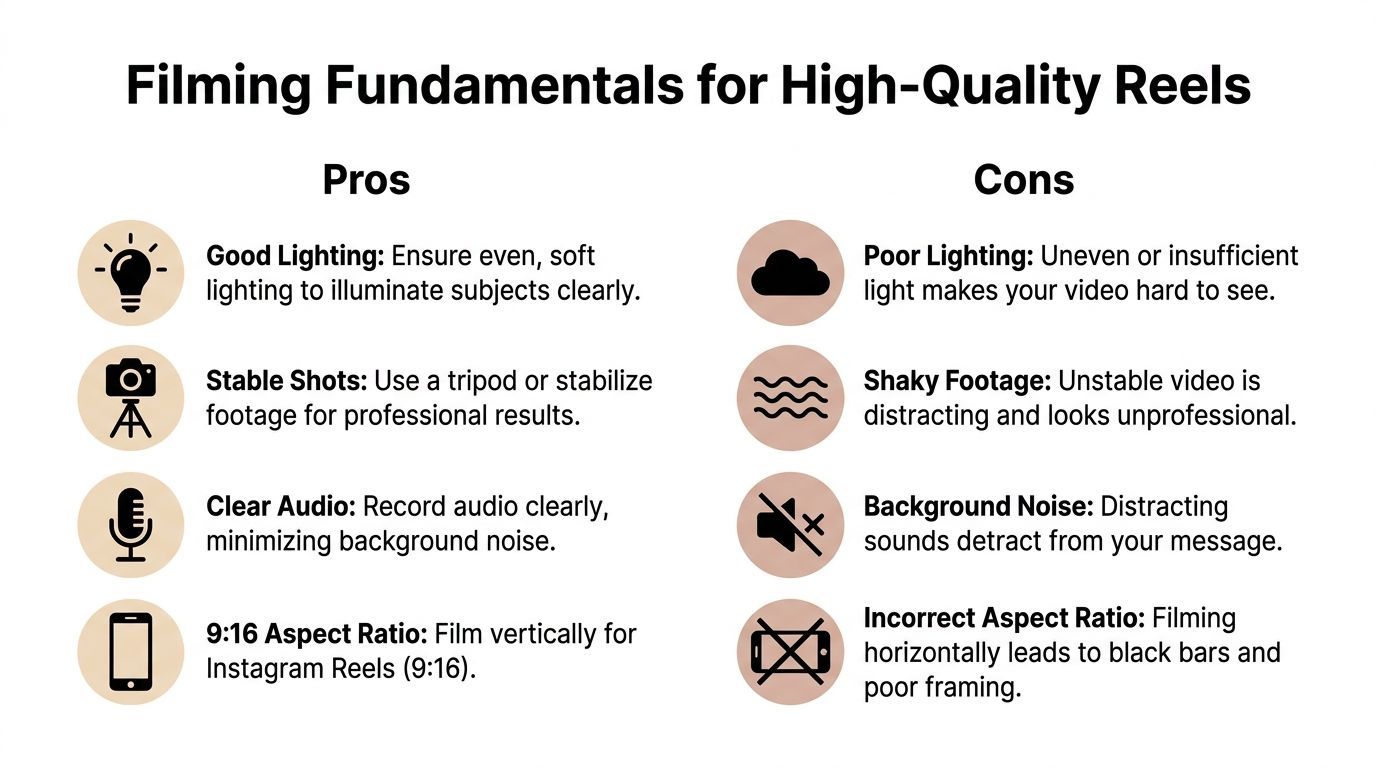
The three production choices that change quality fastest are simple.
- Lighting first: Face a window when possible. If you use artificial light, keep it soft and even. Harsh overhead light makes skin look flat and products look dull.
- Audio second: Viewers will tolerate a phone camera. They won't tolerate muddy sound. A small external mic helps, but even a quiet room and close speaking distance improve results.
- Framing third: Lock the phone at eye level or slightly above. Shaky handheld footage can work for energy, but accidental shake looks careless.
Design the first shot to stop the scroll
Most creators think the hook is only verbal. It isn't. The opening visual matters just as much.
A strong first shot usually does one of these things:
- Shows the result before the explanation
- Uses movement immediately
- Starts in an unusual crop or close-up
- Puts bold text on screen that creates tension
- Opens with a problem viewers recognize instantly
What usually fails is a slow warm-up. If your Reel starts with adjusting the camera, smiling at the lens, or walking into frame with no payoff, people leave before the point arrives.
Don't introduce the topic slowly. Start where the viewer's curiosity begins.
Keep your safe zones clean
Another avoidable mistake is text placement. Interface elements cover part of the screen, especially near the bottom. If your headline, subtitles, or CTA sit too low, viewers miss the message.
A clean filming checklist is short:
- Shoot vertical from the start.
- Leave room around your face or subject for captions.
- Record a few versions of the opening line.
- Get one wide shot and one tighter crop if possible.
That alone solves a surprising amount of “my Reels look amateur” feedback.
Editing Your Reel Like a Pro with AI
Editing is where casual posting turns into a repeatable content system.
Instagram's native editor handles quick trims, simple text, and basic audio sync. That works for a one-off Reel. It breaks down once you publish regularly, because you keep rebuilding captions, pacing, layouts, and brand styling from scratch. The better workflow is to treat editing like production infrastructure, not a last-minute cleanup step.
Manual editing versus system editing
The trade-off is simple.
| Workflow | What you gain | What you give up |
|---|---|---|
| Edit inside Instagram | Fast publishing, native tools, low setup | Repetitive caption work, weaker template reuse, limited control across multiple posts |
| Edit in a dedicated AI workflow | Reusable templates, faster captions, easier resizing, stronger consistency | Initial setup time and a bit of process discipline |
For creators, agencies, and in-house teams publishing every week, setup time pays back quickly. One strong template can carry dozens of Reels. Brand fonts, caption styles, intro patterns, CTA screens, and shot structures stop being separate decisions every time.
For creators who want a more advanced breakdown of cuts, pacing, and caption choices, these effective Instagram Reels techniques are worth reviewing alongside your own workflow.
The hard part is not trimming clips
The primary bottleneck is turning raw footage into platform-ready assets at scale.
That usually means converting long videos into short vertical edits, cleaning dead space, generating readable captions, and keeping every post visually consistent across Instagram, TikTok, and YouTube Shorts. Manual editors can do all of that. They just spend too much time on production chores that do not improve the idea itself.
A tool built for AI Reel creation and multi-platform scheduling changes that workflow. Instead of editing line by line, you review scripts, scene choices, captions, framing, and publishing in one system. That is the difference between making content occasionally and running a content engine.
Horizontal footage is still the common editing problem
A large share of usable source material starts in 16:9. Podcasts, webinars, interviews, event footage, demos, and client recordings all need reframing before they feel native in Reels.
The fix depends on the footage quality and the goal of the post.
What works:
- Punch into the speaker: Tight crops often perform better on mobile because the face carries more visual weight.
- Use keyframe panning: Reframe movement so the subject stays centered instead of drifting out of view.
- Build split-screen layouts: Put the speaker in one zone and supporting text, screenshots, or product visuals in another.
- Add a designed vertical canvas: If a crop cuts too much context, use background color, blur, or brand framing to hold the composition together.
What fails fast:
- Leaving a horizontal video tiny in the center of the screen
- Placing captions over the mouth, product, or key visual
- Cropping so tightly that gestures and context disappear
- Reposting watermarked clips that make the content look recycled
Good editing solves those problems before publishing, not after weak performance.
A walkthrough helps more than theory here, especially if you're moving from manual editing to automation:
Polish choices that raise perceived quality
Small editing decisions change how professional a Reel feels.
- Captions stay readable: High contrast, short lines, and timing that matches natural speech.
- Cuts remove drag: Every trim should tighten attention, not just shorten runtime.
- B-roll carries a job: It should clarify the point, show proof, or reset attention.
- Branding stays consistent: Fonts, colors, hooks, and cover styling should look related across posts.
- Pacing matches intent: Fast cuts help energy. Slower cuts help credibility. Use both on purpose.
That is why AI editing matters. It does not replace judgment. It removes repetitive labor so you can spend more time on hooks, clarity, and testing creative angles that improve reach.
Optimizing and Posting for Maximum Reach
A solid Reel can still underperform if the packaging is weak. Posting isn't just the final click. It's where discovery, context, and conversion get decided.
That matters because Instagram isn't only a view platform. In 2026, 48% of marketers said Instagram delivers the highest ROI of any social platform, and the average Reel generates more than 90 shares and 18 comments according to Sprout Social's Instagram stats roundup. Shares and comments tell you something important: good Reels don't just get watched. They travel.
Build a better posting checklist
The best publishing workflow is boring in the right way. It uses the same checklist every time.
- Caption with a job: Write for response, not filler. A strong caption can expand on the Reel, clarify a point, or invite a specific action such as saving, commenting, or checking your profile.
- Hashtags with intent: Stick to relevant tags tied to the topic, niche, or audience. Random broad tags rarely improve targeting.
- Cover image that scans fast: Use a short promise, a strong facial expression or product visual, and consistent style across your grid.
- Audio choice with context: Trending sounds can help if they fit the message. Original audio is often better for education, commentary, and branded explainers.
Consistency comes from scheduling, not motivation
Missing posts often isn't due to a lack of ideas. Instead, it's because publishing depends on real-time energy.
Batching solves that. Create several Reels in one production block, prepare captions and covers together, then schedule them. That gives you continuity without forcing you into daily editing.
Schedule while your brain is still in production mode. Don't make future-you rebuild context every morning.
If you're posting for a brand, your account setup also affects what tools and analytics you'll have access to. This guide on Instagram Business vs Personal in 2026 is a useful reference before you lock in your workflow.
Small choices that hurt reach
A few mistakes repeatedly weaken otherwise good Reels:
- Weak cover text: If your grid doesn't communicate the point, profile visitors won't tap.
- Generic CTA: “Thoughts?” is weaker than asking one concrete question.
- Overstuffed captions: Long isn't bad, but unfocused is.
- Inconsistent publishing: Random gaps make it harder to learn from patterns over time.
If you want to know how to make Reels for Instagram that support growth, treat posting like distribution strategy, not admin.
Measuring Success and Refining Your Strategy
Strong Reel performance comes from review loops, not guesswork. A single post can spike for reasons you cannot repeat. A pattern across ten posts gives you something you can use.
Check analytics with one goal. Make the next batch better.
Start with the metrics that explain behavior: reach, plays, saves, shares, comments, profile actions, and retention. Reach shows whether Instagram gave the Reel distribution. Saves and shares show whether the idea had enough value to keep or send to someone else. Retention shows whether the structure earned attention past the hook.
Ask better questions of your data
Review analytics like a content operator, not a spectator.
Use questions that lead to clear production decisions:
- Which hook format held attention longer?
- Did direct-to-camera openings beat B-roll intros?
- Which topics produced saves instead of passive views?
- Which CTA drove profile visits or comments?
- Did concise scripts hold better than dense explanations?
Those questions matter because high reach alone can be misleading. A Reel might get broad distribution but weak retention, which usually points to a strong premise and a weak structure. Another might pull moderate reach and high saves, which often signals a format worth repeating, expanding, or turning into a series.
Look for patterns you can repeat, not one-off wins.
Compare by content series, not isolated posts
One Reel is a data point. A series is a test.
Group related posts by format or intent, then compare performance over several publishing cycles.
| Series | What you're testing |
|---|---|
| Myth-busting | Opinion-led hooks |
| Tutorials | Step-by-step education |
| Behind the scenes | Process and credibility |
| Offer-focused | Conversion messaging |
This makes trade-offs easier to see. Tutorials often drive saves. Opinion Reels often drive comments. Behind-the-scenes content may not spike on day one, but it can improve profile conversion and trust over time. That matters if the goal is leads or sales, not just views.
For teams producing at volume, an AI-assisted workflow begins to pay dividends. Instead of reviewing posts one by one, track which hook types, script structures, and content pillars keep working across batches. Then feed those lessons back into ideation, scripting, editing, and scheduling. The process gets faster because each round starts with evidence, not a blank page.
What to change after each batch
Keep the review process simple and repeatable:
- Keep the hook styles that consistently hold attention.
- Cut weak intros earlier in the edit.
- Commit to one or two content pillars that keep producing saves, shares, or profile actions.
- Rewrite CTAs that fail to trigger a next step.
- Rework strong ideas from a new angle instead of abandoning them.
The fastest-growing accounts rarely reinvent the wheel every week. They refine winning formats, tighten weak steps, and build a system that improves with every batch.