How to Make a Viral Video That Actually Spreads

Learn how to make a viral video with proven hooks, story frameworks, editing tactics, and cross-platform distribution strategies that drive real shares.
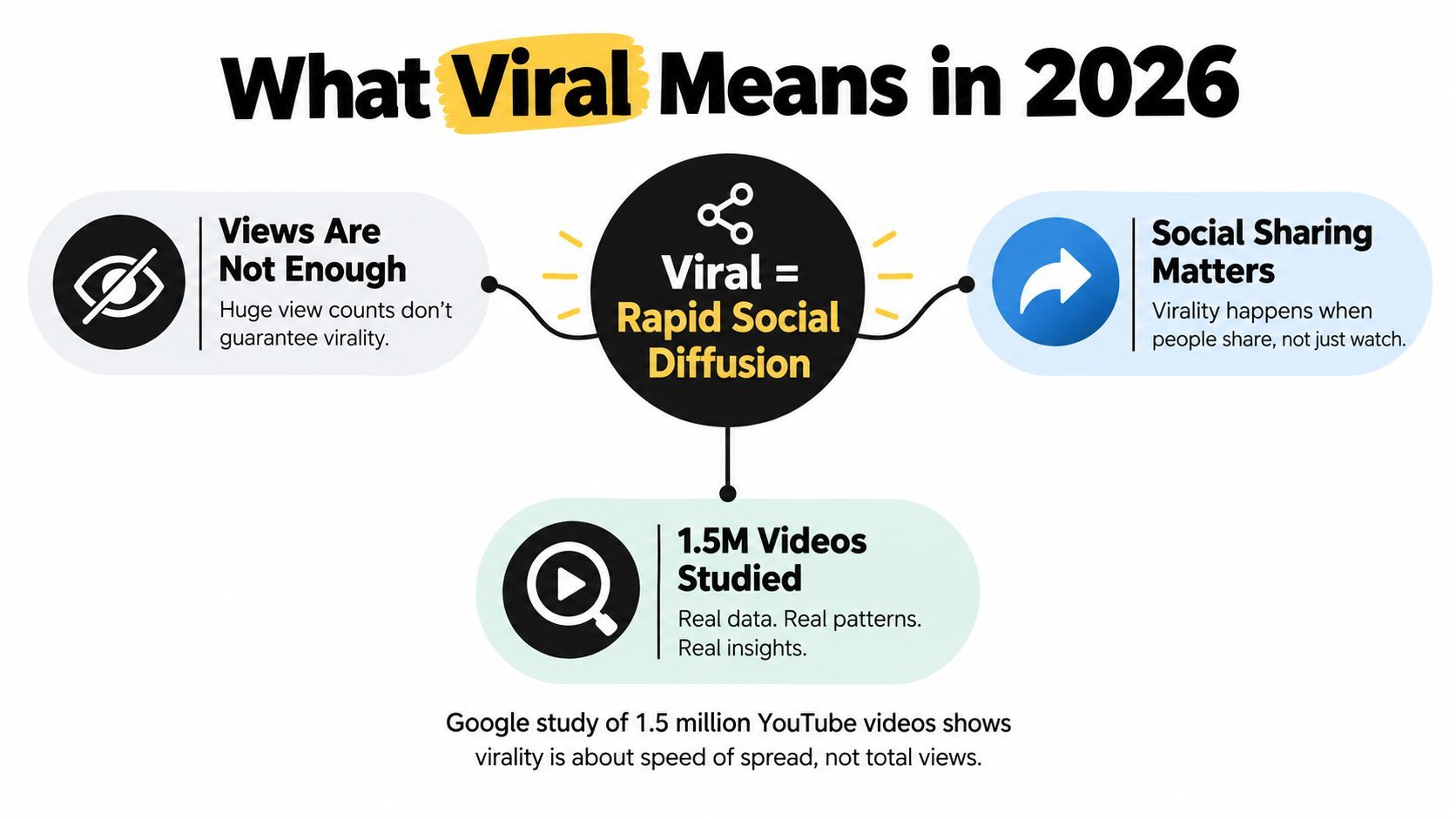
Only 21% of the most popular videos qualified as viral when researchers measured spread instead of raw views, according to the Google Research analysis of 1.5 million YouTube videos. That single fact should change how you make a viral video. You're not chasing a view counter. You're engineering a reason for one viewer to pass the video to the next person, then designing the format, platform, and follow up releases so that transmission keeps happening.
Most creators do the opposite. They copy a trending sound, post the identical file everywhere, and call a recommendation spike virality. Stop doing that. Build for sharing behavior first, retention second, and platform fit third. In that order.
What Viral Actually Means in 2026
Viral means rapid social diffusion. It doesn't mean a lot of people happened to watch. A video pushed hard by recommendations can collect huge views while almost nobody sends it to a friend, embeds it, or posts it elsewhere. Another video can move fast through a tight community and still never reach mass scale. Those are different outcomes, and they need different fixes.
That's why the Google finding matters. If only a minority of top viewed videos qualify under a social diffusion definition, your dashboard is lying to you when you sort by views alone. You need to separate passive exposure from active transmission.
Read Your Analytics Like a Diffusion Report
Check where views came from. Look at the share of traffic from shares, messages, embeds, and external referrals alongside total views. If recommendations did all the work, you made a watchable video, not a viral one. If social sources spiked early and the video rose and fell fast, you likely triggered real person to person spread.
Use this quick diagnostic after every post:
- High views, low shares: The platform distributed it. Your hook worked, your share trigger didn't.
- Modest views, high share rate: The idea transmits. It needs better seeding, not a new concept.
- High shares, weak completion: People forwarded the premise before the payoff. Tighten the middle.
- Strong completion, no comments or shares: It's satisfying but socially inert. Add identity, utility, or a conversation prompt.
That last distinction matters on every network, and the threshold for calling something viral shifts by platform. If you publish professionally, it's worth understanding what is considered viral on linkedin because a professional network rewards a different kind of forwarding than an entertainment feed does. A save and send to a colleague is transmission, even if the public view count looks modest.
If nobody is sending it to a specific person for a specific reason, you don't have virality. You have distribution.
Set your primary metric now, before you script anything. For most short videos I recommend shares per 1,000 qualified views as the headline number, with completion rate as the guardrail. Views tell you how far the platform carried you. Shares tell you whether viewers carried you further.
Designing for Emotion and a Share Trigger
People don't share topics. They share reactions. In the analysis of 800 videos with recorded daily sharing, emotional arousal was the primary driver of sharing, while whether the emotion was positive or negative mattered less strongly. Awe and affection in particular encouraged sharing through emotional connection and generosity.
Translation for your brief: pick intensity first, pleasantness second. A mildly nice video loses to a video that makes someone laugh hard, gasp, feel seen, or urgently warn a friend.

The Five Step Creative Brief
Fill this in before you shoot or generate a single frame:
- One dominant reaction: Choose surprise, awe, humor, inspiration, or anger. One. Stacking three emotions blurs all of them.
- Payoff stated up front: Tell viewers what they'll get in the opening line or opening frame. Don't hide the premise behind a logo sting or context.
- Escalation: Raise the stakes, the weirdness, or the usefulness with each beat.
- Memorable reveal: Land one moment people can describe to a friend in one sentence.
- Natural share trigger: End with a prompt tied to a person, such as send this to someone who still does it the old way. That's more specific than like and follow, and specificity is what moves thumbs.
Watch how a strong opening promise and a clean reveal carry a short video in this example, then map the same beats onto your own script.
Give the Share a Social Job
Every share does work for the sender. It signals identity, helps a friend, starts an argument, or proves a point. Name that job in your brief. Educational creators usually win with useful information a viewer can gift to someone else. Brands often win when a satisfied customer becomes the messenger, which is why the thinking behind turning customer recommendations into revenue applies directly here. A testimonial clip that a happy buyer wants to forward beats a polished ad nobody would send unprompted.
Test at least three versions of the same core idea. Vary the emotional framing, the first visual, and when the payoff lands. Keep the concept constant so you learn which feeling transmits.
Avoid shock or outrage with no credible resolution. It can spike attention, but it erodes trust and makes brand safe distribution and repeat viewing harder. High arousal with a clean payoff is the combination you want.
The Retention Engineering Production Loop
A share trigger gets you forwarded. Retention gets you watched long enough for the trigger to fire. Treat the opening seconds as a hypothesis you're testing, not a creative instinct you're defending.
The analysis of 46,605 TikTok hooks found that curiosity gaps and urgency generally outperformed direct address and instructional phrasing, while ideal hook length varied sharply by category, from about nine words in news to roughly 90 in entertainment. That kills the universal three word hook advice. Your niche sets the length. Your testing sets the winner.

Build Three Hooks, Not One
For every core idea, write these variants:
- Curiosity gap: Name the outcome, hide the mechanism. The viewer stays to close the loop.
- Urgent consequence: State what goes wrong if they keep doing it the current way.
- Immediate result: Put the finished result or strongest claim in frame one, then show how it happened.
Put the strongest visual first. Cut logo animations, greetings, and throat clearing. Nobody shares your intro. Then build a tight sequence: problem, one escalating step, payoff, and a final beat that loops cleanly or invites a reply.
Captions and Pacing Rules
Use readable captions on every cut because many short form views happen without dependable audio. Keep lines short, contrast high, and timing matched to speech. Dense caption blocks are a retention leak, not an accessibility win. Change something visual or informational often enough that a viewer who looks away for a moment still feels forward motion when they look back.
If your team produces at volume, systematize this loop instead of relying on memory. A documented content workflow guide for marketers is useful here because hook variants, caption checks, and review gates need to happen in the same order on every video, not only when someone remembers.
Judge With the Right Metrics
Don't declare a winner from likes. Likes are cheap and they don't transmit. Read this stack instead:
- 3 second hold rate: Did frame one and the first line stop the scroll?
- Midpoint retention: Where exactly do viewers leave?
- Completion rate and rewatches: Did the payoff land and invite a second pass?
- Comments and shares: Did viewers react socially, not just watch?
Change one major variable at a time between versions. Hook wording, opening frame, pacing, or payoff timing. If you change all four, you've learned nothing you can reuse. When a beat loses viewers, re edit that beat. Posting more often on top of a broken middle just scales the leak.
Picking the Right Platform Before You Press Publish
Platform choice isn't a distribution detail. It's a creative decision, and habit is a bad way to make it. The 2025 analysis of more than 5 million videos from 582,456 accounts found Instagram had the highest average engagement rate at 8.24%, followed by TikTok at 6.1%, YouTube Shorts at 2.99%, and Facebook at 2.13%, while Facebook led on average views per video at 15,334.
Read that divergence carefully. The platform with the most views isn't the platform where people interact most. If you optimize for the wrong one, you'll call a campaign a failure when it did its job, or celebrate reach that produced no followers, clicks, or sales.
Platform Fit at a Glance
| Platform | Avg Engagement Rate | Avg Views per Video | Best Campaign Objective | Watch Out For |
|---|---|---|---|---|
| 8.24% | 14,422 | Community response, saves, shares to close networks | Polished creative that feels like an ad gets skipped | |
| TikTok | 6.1% | 11,447 | Discovery, comments, cultural momentum | Rising volume competing for the same attention |
| YouTube Shorts | 2.99% | 9,921 | Search adjacent discovery, channel growth | Viewers may watch without engaging socially |
| 2.13% | 15,334 | Broad reach, older and community audiences | High views with comparatively low interaction |
That same analysis found TikTok content volume up 156.32% while reach fell 47.19%, even as engagement rose 35.61%. More posting into a crowded feed doesn't guarantee more reach. A smaller exposed audience can interact more intensely, which is valuable if your goal is comments, loyalty, or conversion rather than raw impressions.
Start From the Objective, Then Pick the Network
Work backwards with these questions:
- Do you need buyers or viewers: If you need clicks and sales, prioritize the platform where your audience already responds to offers, and judge by downstream actions, not views.
- Do you need community: Favor the network where your niche comments, saves, and sends to friends. Engagement rate matters more than reach here.
- Do you need discovery: Accept lower interaction in exchange for new audience exposure, but give new viewers an obvious next video or follow reason.
- Do you need authority: Choose the format that supports context and credibility, even if the view ceiling looks lower.
Practical rule: One primary platform gets the native, best version. Every other platform gets an adaptation. Nobody gets a lazy repost with another app's watermark and the wrong caption style.
Decide your success metric per platform before publishing. Write it down. If Facebook delivers views and Instagram delivers shares, that's not a contradiction to average away. It's information about what each network is doing for you, and it should shape where the next idea launches first.
Cross Platform Seeding That Builds Momentum
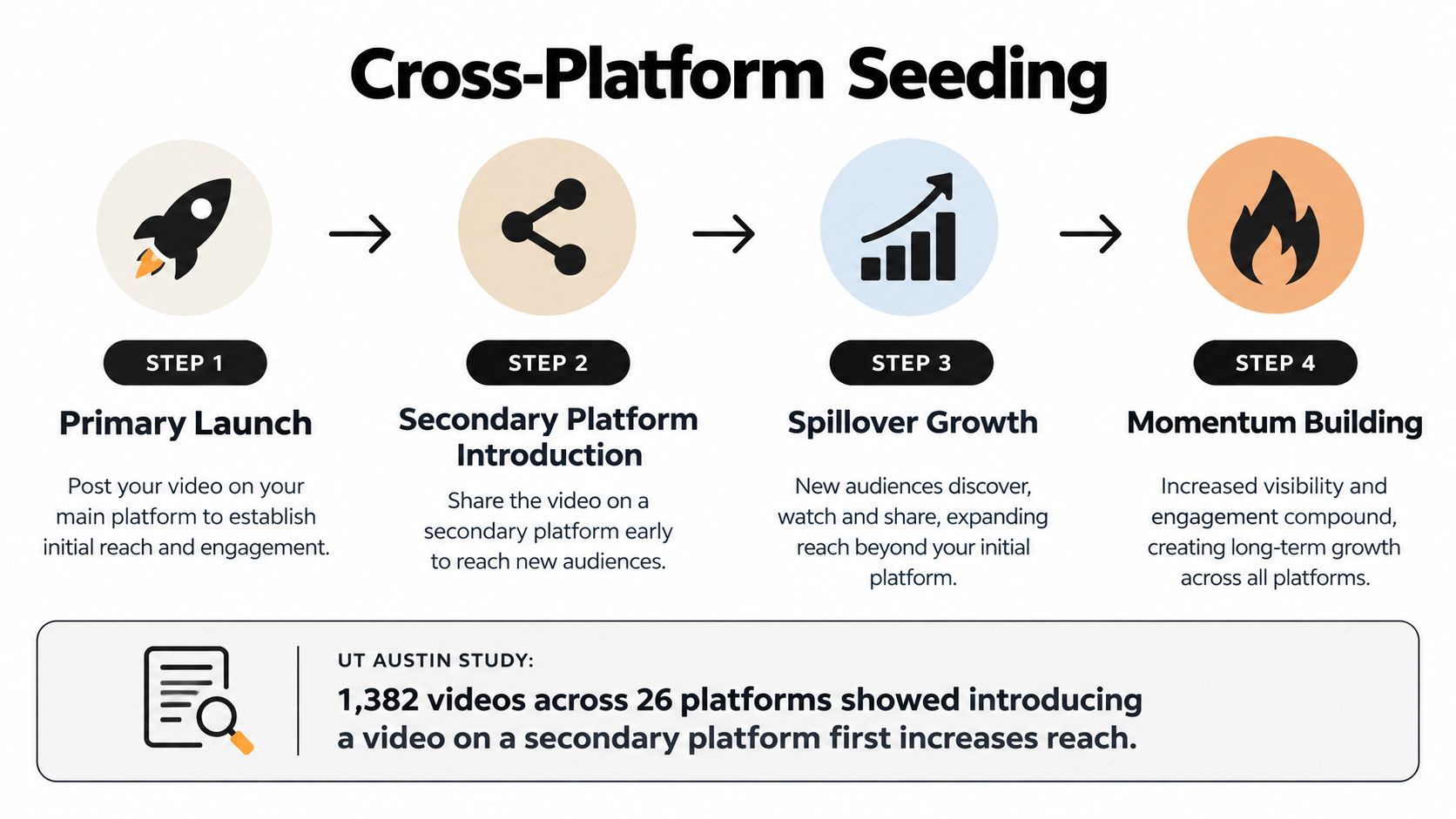
Once you've picked the launch platform, seeding the idea into a second community isn't splitting your attention. Done properly, it feeds the original post. The University of Texas at Austin analysis of 1,382 videos across 26 platforms found that introducing a video on a secondary platform approximately doubled subsequent views on the primary platform.
The mechanism is straightforward. Exposure in one community creates awareness, searches, links, and recommendations that carry people into another community. Your job is to make that carryover easy to recognize and easy to act on.
Adapt the Idea, Don't Mirror the File
Build a small family of cuts from one core concept:
- Vertical short: The tightest version, strongest hook, fastest payoff, native captions.
- Captioned square or feed cut: Slightly more context, text that works with sound off, same opening claim.
- Longer context version: Room for proof, demonstration, or story for audiences who want depth.
- Consistent anchors across all cuts: The same recognizable hook line, visual cue, and call to action, so a viewer who sees two versions connects them instantly.
Identical files dumped everywhere ignore audience expectations and formatting norms. Adapted versions preserve recognition while respecting each feed. That's the difference between seeding and spamming.
Run the Release as a Sequence
Launch on your primary platform first and watch the earliest retention and share signals. Then introduce the adapted cut on the secondary platform while the idea is still fresh, and measure incremental views and shares after each release, not just combined totals. If the second release lifts the first, you've found a spillover pairing worth repeating for your niche.
Organized workflows pay for themselves here. ShortGenius (AI Video / AI Ad Generator) is one option that combines script generation, video assembly, captions, resizing, and scheduling to TikTok, YouTube, Instagram, Facebook, and X in a single workspace. Whether you use that or a manual stack, the requirement is the same: versioning, resizing, and scheduling can't be an afterthought you improvise at midnight.
Keep a simple seeding log with the platform, format, hook variant, publish order, and share rate for each cut. After a few cycles you'll know which secondary platform reliably amplifies your primary one, and you'll stop guessing about distribution the way most creators do.
Using AI Without Killing Trust
AI makes you faster. It also makes you generic if you let it finish your thinking. Interchangeable, implausibly polished videos trigger quiet resistance, and perceived inauthenticity can drag down the exact likes and shares you're trying to earn. Speed that costs you trust is expensive.
Qualitative research with short-video creators describes invisible authenticity labor as verifying AI generated claims, naturalizing language, restructuring narratives, and adding embodied or human signals so content feels credible. That labor isn't overhead. It's the work that makes AI output publishable.
Draw the Human Line Explicitly
Let AI handle volume tasks. Let a person own judgment:
- AI drafts: Hook variants, script options, storyboards, b roll concepts, caption drafts, and format versions.
- Human verifies: Every factual claim, number, and product statement. No exceptions for content that sounds plausible.
- Human decides: Emotional framing, cultural context, point of view, and what you'd say out loud.
- Human performs or evidences: Firsthand demonstration, original commentary, recognizable voice, or real customer proof where credibility matters most.
If a script could belong to any creator in your niche, it isn't ready. Add a specific opinion, a real example from your work, or a detail only someone with experience would know. Specificity is the fastest authenticity signal you control.
Treat Disclosure as a Calibrated Choice
Don't hide AI involvement where transparency is expected, and don't assume a label fixes weak content. Disclosure interacts with how authentic the video already feels. A clearly human, accurate, distinctive video can carry a disclosure comfortably. A synthetic sounding video with a label still reads as synthetic. Fix the content first, then be transparent about the process where your audience and platform expect it.
Authenticity isn't a brand value you state. It's a production variable you test.
So test it. Publish AI assisted variants with different levels of human presence, such as on camera delivery versus voiceover, or original commentary versus straight generated script. Compare shares and comments, not just output volume. If the more human version transmits better, you've learned something worth more than the time AI saved you.
Your 30 Day Viral Video Action Plan
Run this as a calendar, not a wish list. Each week has one job.
Weeks One and Two
- Week one, decide: Pick one audience problem, one dominant emotion, and one primary platform based on your objective. Set shares per 1,000 qualified views as your headline metric.
- Week two, build variants: Create three hook versions per core idea. Shoot or generate the strongest visual for frame one, caption everything, and keep one variable different per version.
Weeks Three and Four
- Week three, publish and seed: Launch on the primary platform, then release adapted cuts on your secondary platform. Log format, order, and share rate for every version.
- Week four, measure and revise: Rank videos by share rate and completion, find the exact beat where retention drops, and re edit that beat for the next batch.
Fix the Three Most Common Stalls
- Flat at the opening: Your first frame or first line is weak. Lead with the result or the consequence.
- Views without shares: The platform likes it, people don't transmit it. Strengthen the emotional payoff and name who should receive it.
- Rising impressions, falling engagement: You're reaching a broader, colder audience. Tighten relevance or shift effort to the platform where your viewers respond.
Thirty days of this loop teaches you more about how to make a viral video for your audience than a year of copying trends. You'll end the month with tested hooks, a proven seeding pair, and a metric you trust.
Stop hoping a repost catches fire and start running the loop above with tooling built for it. ShortGenius (AI Video / AI Ad Generator) lets you generate hook variants, assemble captioned short form videos in native formats, and schedule adapted cuts across TikTok, YouTube, Instagram, Facebook, and X from one workspace. Visit ShortGenius today, build your first three hook test, and judge it by shares, not vibes.