How to Create Facebook Ads That Convert in 2026

Learn how to create Facebook ads that convert. This 2026 step-by-step guide covers planning, AI tools, targeting, budgeting, launch, testing & measurement.
You're staring at Ads Manager, the budget is set, the product page is ready, and the hardest part still feels unresolved, what the ad should say, show, and target? That's the core challenge behind how to create Facebook ads that don't just go live, but keep producing useful signals. The process works best when you treat it like an optimization loop, not a one-time build, and that means starting with a clear goal, a specific audience, strong creative, and a tracking stack that can tell you what happened after the click, not just what happened in the feed. Meta's workflow is structured around exactly that sequence, from objective to audience to budget to placement to creative to performance monitoring, with metrics like CTR, CPC, CPM, and conversion rate guiding the next move (Meta Ads Manager workflow overview).
Introduction to Creating Facebook Ads
Most first campaigns fail for a boring reason. The advertiser spends hours polishing the image, but the ad never had a clear business goal, a clean testing structure, or a way to measure whether the traffic mattered.
That's why the practical answer to how to create Facebook ads is less about “making an ad” and more about building a system. Meta's Ads Manager is designed as a workflow, not a single upload screen, and that workflow is easier to manage when the creative is built from the start to support testing, tracking, and iteration.
AI tools fit naturally here because they shorten the most time-consuming part, turning one offer into multiple hooks, formats, and versions fast enough to test properly. A tool like ShortGenius (AI Video / AI Ad Generator) can help unify scriptwriting, image generation, and video assembly in one place, which matters when you need several ad variants instead of one polished asset. The point isn't speed for its own sake, it's faster learning.
Use a simple angle-selection framework before you build anything. Start with the audience pain point, then choose whether the ad should lead with a direct benefit, an objection response, a timing argument, or the exact language buyers already use. That keeps creative choices grounded in the campaign goal instead of whatever looks strongest in a vacuum.
Practical rule: build the campaign so the creative can fail quickly, and the budget can then move toward what resonates.
Define Goals and Audience for Facebook Ads
A Facebook ad that starts with “let's get some traffic” usually wastes budget. Start with the outcome, then match the audience to that outcome so the creative has a clear job. If the goal is leads, the ad should qualify interest. If the goal is sales, the ad should push toward purchase behavior, not just visibility.
Use one objective and one audience hypothesis at a time
Set one objective, then write one audience hypothesis around it. That keeps the campaign readable in Ads Manager and gives you a clean way to judge whether the problem is the message, the audience, or the offer. Meta's workflow is built around that kind of controlled setup, where you define the campaign first and then test the pieces underneath it (Meta Ads Manager workflow overview).
A practical way to frame the work is to sort your ad goal into one of three buckets, awareness, lead generation, or sales, then write the angle from the buyer's current state. A pain point angle speaks to frustration, an objection angle addresses doubt, a timing angle explains why this matters now, and an audience-language angle mirrors the words customers already use. Those are different jobs, and each one changes what the ad should promise.
A simple worksheet keeps the setup from drifting into guesswork:
- Goal: pick one outcome, such as leads or purchases.
- Primary audience: define who the ad is for in plain language.
- Main pain: describe what is making the buyer hesitate.
- Objection: write the likely reason they will delay or ignore it.
- Angle to test first: choose the most believable promise, not the cleverest one.
That angle-first approach matters because many tutorials focus on the mechanics of launching ads and skip the decision about which message deserves the first test. A practical angle-selection framework maps benefits, objections, timing, and audience language before the creative is built, which gives you a better starting point than guessing at a hook in isolation (angle-selection framework discussion).

Use AI to speed up the first draft, not to decide the strategy. A tool like ShortGenius can help turn one offer into multiple hooks and variations quickly, which is useful when you need enough creative to test a few angles without spending all day on copy.
Keep the audience stable while you test angles
The biggest mistake at this stage is changing too many variables at once. If you change the audience, the creative, and the placement together, you will not know what drove the result. Hold the audience steady, then compare the angle against a single objective so the readout stays useful.
Meta also teaches advertisers to test audiences and creatives in a controlled way, including narrow audiences, broader audiences, and lookalikes when there is enough customer data to work from (Meta's ad creation lesson on testing audiences and creatives). That approach is especially useful when you are trying to separate a weak message from a weak audience fit.
Keep the audience controlled, then let the message earn the win.
That is also where a clear angle matrix helps. Group ideas by segment, emotion, and format, then launch the three strongest candidates first. If you start with ten, the readout gets muddy fast. If you start with three, you can see which promise is getting attention and which one needs a rewrite.
One more practical test belongs here. If your audience research shows a real engagement habit, you can optimize agency content with Facebook polls before you scale the paid version. Polls will not replace a conversion campaign, but they can give you a cleaner read on which message people respond to.
Create AI-Powered Facebook Ad Creative
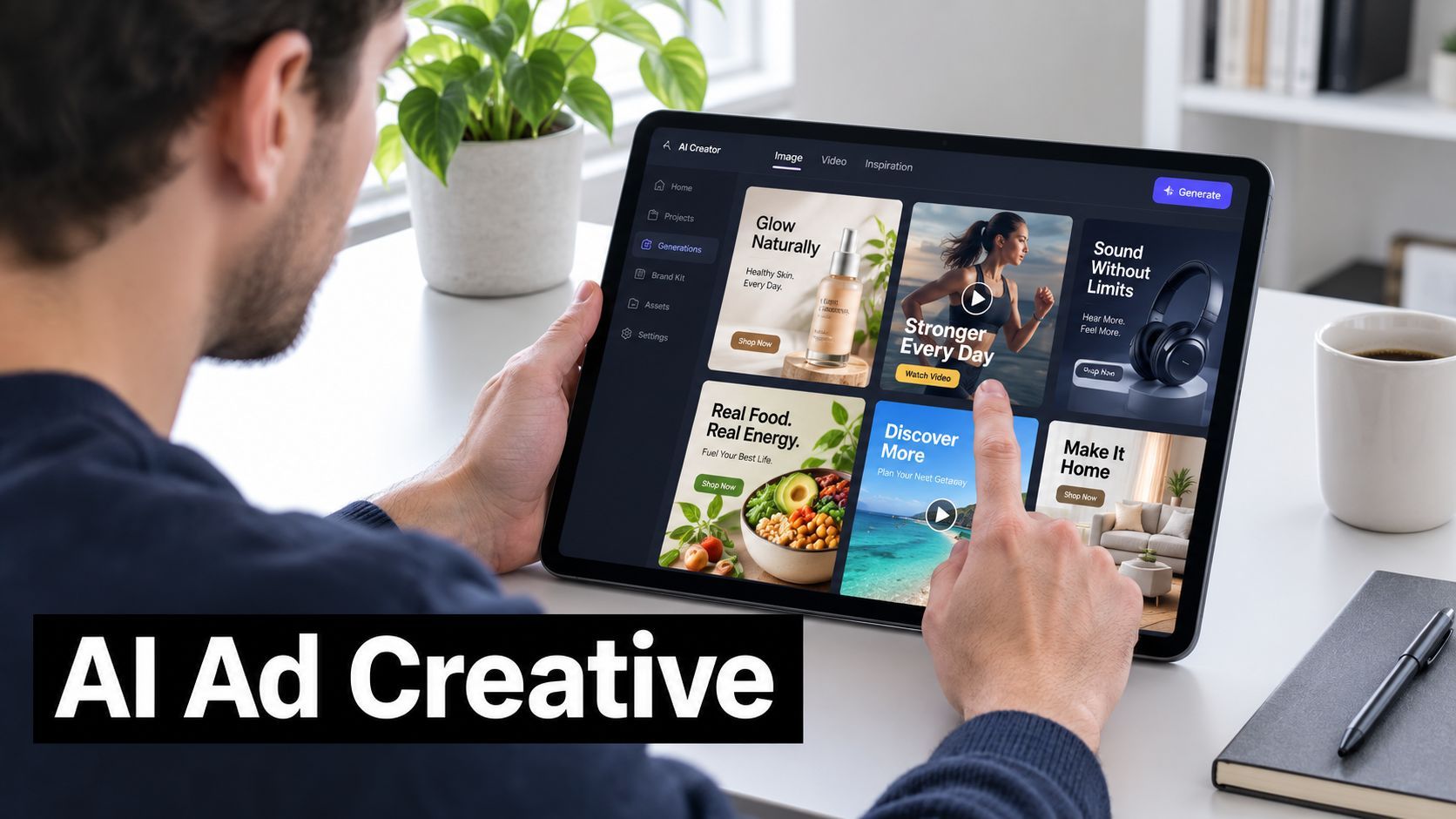
The quickest way to waste budget is to build one ad, export it, and treat it as finished. Strong Facebook creative usually comes from a batch process, because the platform gives you useful signal only when you test enough variants to see what resonates.
Build one message into multiple executions
Start with one core promise, then break it into three or four angles. From there, turn each angle into a short video, a still image, and a carousel concept. That gives you several ways to reach the same buyer, while keeping the message close enough to compare performance with real confidence.
For video, keep the pacing tight. Social Media Examiner recommends keeping videos under 1 minute, and compressing simple product demos or explainers to 15–30 seconds for better in-feed consumption (Social Media Examiner's Facebook ads guide). That benchmark matters because Facebook users do not owe you attention. If the opening frames miss, the rest of the edit usually does not recover it.
A practical AI workflow looks like this:
- Draft three hooks from the same angle.
- Turn each hook into a short script.
- Generate a still image and a carousel concept from the same message.
- Apply brand colors, type, and voice consistency.
- Export every variant in the same testing batch.
Batching improves the quality of the readout. Experienced marketers favor several creatives in one campaign because you can compare them more cleanly when the audience stays steady and only the message changes.
Use readable, human creative, not overdesigned noise
The ads that hold up in feed usually look native to the environment. Short lines, a clear visual hierarchy, and one obvious action usually work better than creative that tries to explain every feature at once. People stop only when the ad feels specific enough to deserve attention.
AI helps most when the workflow stays narrow. Use one brief, one brand kit, and one set of hooks, then generate multiple outputs from that foundation. If you want to produce video, image, and copy assets in one place, ShortGenius is one tool that keeps those steps together without making the process complicated.
Before you spend on production, use audience language to shape the message. Social polls can reveal objections and preferences quickly, and this guide on optimize agency content with Facebook polls is useful when you want real responses to guide the angle, the proof point, or the offer framing.
The practical takeaway is simple. Build a message family, then let the test show which execution earns the click.
Set Campaign Structure and Budget for Facebook Ads
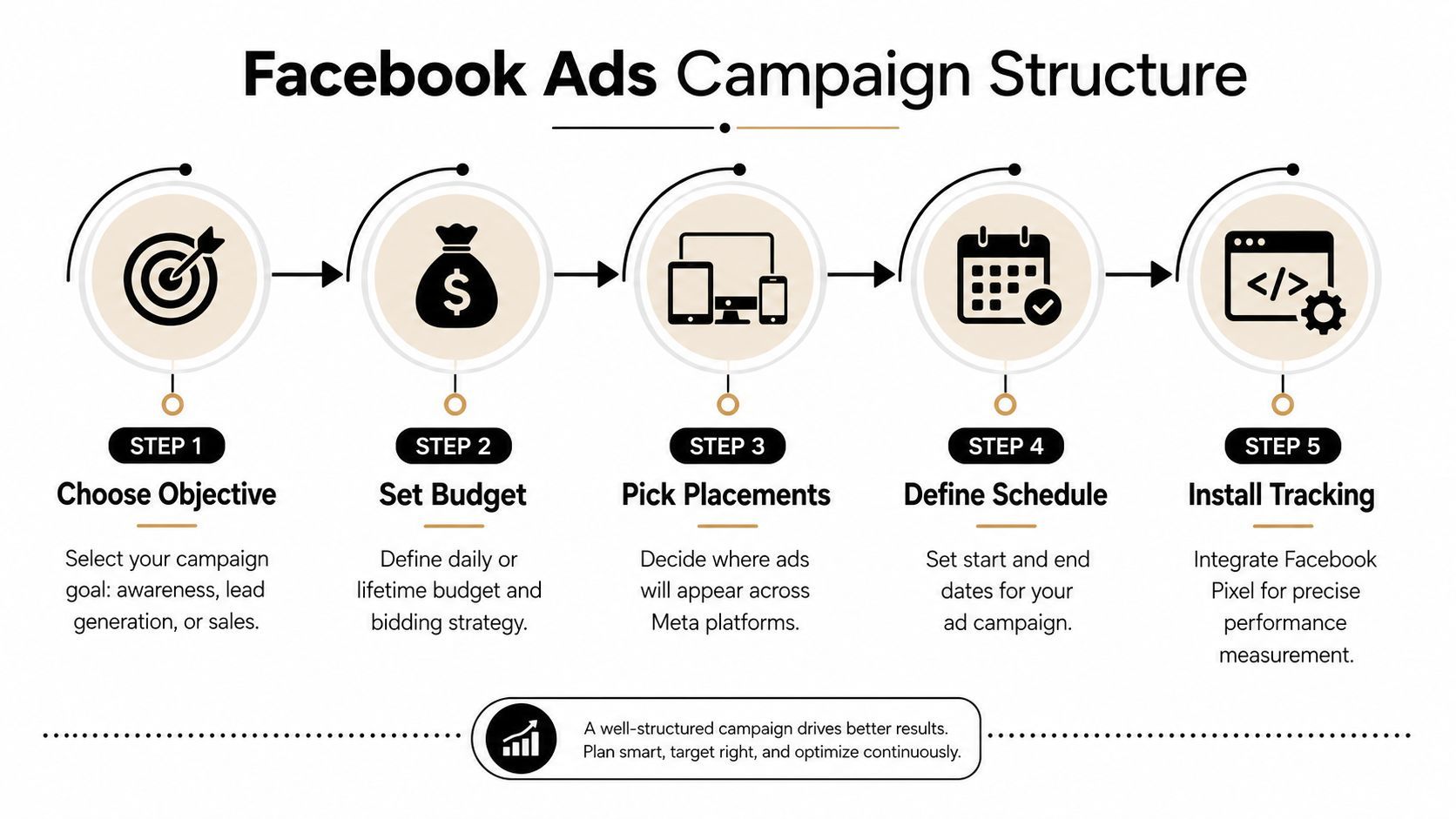
A clean Meta setup makes decisions easier to read. Start with the objective, then set the audience, budget, placement, schedule, create the ad, and review results through the metrics that matter for the goal, including CTR, CPC, CPM, and conversion rate. The workflow is laid out in Meta Ads Manager workflow overview.
Build the campaign in the same order Meta expects
Open Ads Manager and choose one objective first. Keep every later setting aligned to that choice. If the goal is sales, a structure that mainly rewards clicks will send the wrong signal. If the goal is leads, the campaign should optimize for the action you want, not for a cheaper but less useful metric.
Budget and schedule deserve the same discipline. Change them too early and you blur the test, which makes it harder to tell whether the creative, audience, or delivery caused the result. I usually start controlled, then adjust only after the campaign shows enough signal to justify the move. Placement matters too. Meta can spread delivery across several surfaces, but manual placement choices make sense when the asset clearly fits one environment better than the others.
Tracking needs to be live before the first impression. A beginner setup usually includes a Facebook Pixel or Conversions API, plus custom conversion events so the campaign can be measured beyond the platform itself. A practical setup pairs those tools with the action that matters most, such as purchases, leads, or demo bookings. The infographic showing the campaign structure, including objective, budget, placement, schedule, and tracking, reinforces that order from setup through measurement. A five-step infographic showing the Facebook Ads campaign structure, including objective, budget, placement, schedule, and tracking.
Use tracking to optimize toward outcomes, not vanity traffic
If the pixel is missing, broken, or firing on the wrong event, the campaign can still collect clicks while the business result stays unclear. That is the trap. The dashboard looks active, but the funnel underneath is incomplete, so you end up optimizing for the wrong signal.
Structure the account around the business goal, then let tracking confirm whether the click turned into something useful. That approach also makes AI-driven creative work easier to manage. When I build variants with AI, I keep the campaign structure tight so I can see whether a new angle, hook, or offer is improving outcomes instead of just adding more activity. Angle selection helps here too. One message may speak to speed, another to trust, another to price, and each one belongs in the same test only if the budget can support a fair read.
A simple structure is usually the most usable one. It keeps the objective clear, keeps the tracking stack honest, and gives you a clean read on which creative angle deserves more spend.
Launch Test and Optimize Facebook Ads
A good launch starts small enough to read. The goal is not to prove the campaign is perfect, it is to find which creative, hook, and angle deserves more budget.
Test a controlled ad set before you scale anything
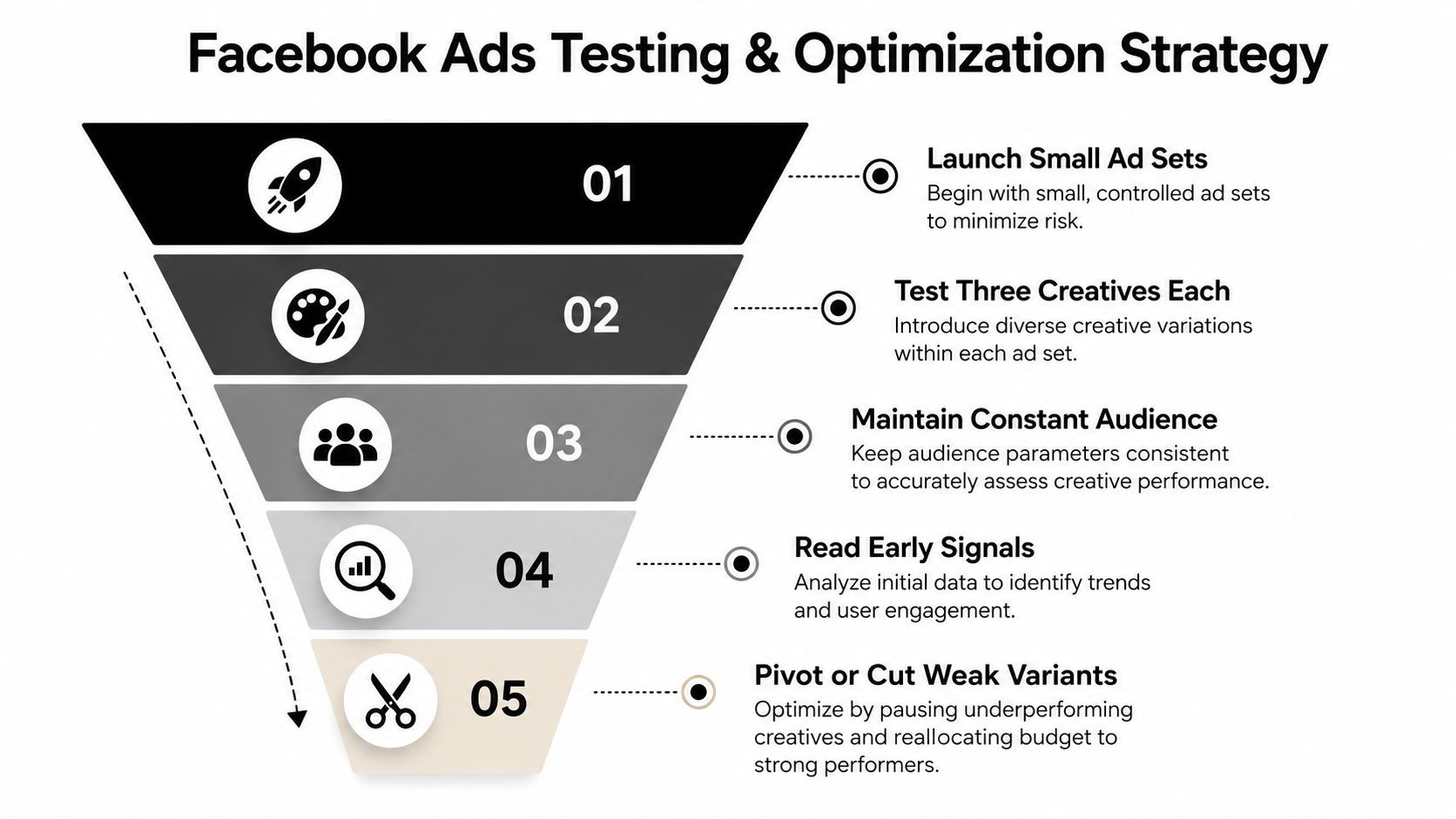
Meta recommends running at least three creatives per campaign so you can separate performance signals before you scale, and it also recommends testing one narrow audience against a broader one, plus lookalikes when you have enough data. That gives the delivery system enough variation to work with while keeping the test readable.
In practice, the launch should feel boring. Keep the audience stable, limit the number of ads, stick to one objective, and give delivery enough time to concentrate impressions. If one creative falls behind after a few days, cut it. Do not keep weak variants alive because you like the design.
Read the signal the right way
Early optimization should start with the clearest metric for the campaign goal. If the ad is meant to generate interest, CTR can show whether the creative is pulling attention. If the goal is to drive qualified action, watch the downstream result, not just the click.
That makes a simple decision rule useful:
- Strong CTR, weak conversions: the ad is interesting, but the landing path or offer may be mismatched.
- Weak CTR, decent conversions: the message may be too soft for the audience, but the offer is working.
- Both weak: the angle probably needs a rewrite.
- One ad clearly ahead: keep the audience stable and build new variations from that winner.
Changing one thing at a time pays off here. Meta's guidance favors comparing creatives under stable targeting conditions, and that makes the next move much easier to read than a test where every variable changes together.
Pivot from angle, not just from format
The strongest optimization work usually happens at the angle level. If a product demo underperforms but a problem-first message wins, the answer is to keep the winning angle and build new executions around it, not just make another video.
I use testing as a funnel. Start with a broad message, then narrow the angle, then refine the format, then expand budget. AI helps here when it is used for variation, not guesswork. I can generate multiple hooks or visual directions quickly, then keep the campaign structure tight enough to see which angle is doing the work. That matters more than chasing more activity.
Best Practices and Troubleshooting for Facebook Ads
The biggest Facebook ad problems usually come from the same handful of mistakes: over-narrow targeting, overloaded creative tests, and measuring the wrong endpoint. The fix is less glamorous than desired, but it works.
Recent guidance emphasizes measuring qualified leads and revenue impact instead of just CTR, and using the Meta Ad Library to pull angles from ads that have run for a long time (Leadenforce on creative angles and downstream measurement). That's a useful corrective because clicks can look healthy while the business result stays flat.
Do this and avoid that
- Do keep testing angles. A hook that wins for one segment can fail for another, so treat angle selection as an ongoing test, not a one-time brainstorm.
- Do hold audience stable during creative tests. If targeting keeps changing, the data gets noisy and the winner is harder to trust.
- Do use the Meta Ad Library for pattern recognition. Long-running ads often reveal the core angle faster than fresh campaigns do.
- Don't mix static and video inside the same test when you need clean signal. It muddies the read because format can mask the message.
- Don't over-narrow before you have evidence. A tiny audience may feel precise, but precision without proof can choke delivery.
Troubleshoot by symptom, not by guesswork
Low click-through usually points to a weak hook, a bland visual, or an angle that doesn't match the audience's current pain. High click costs often mean the ad is competing for attention without giving people enough reason to stop. Ad fatigue is usually a sign that the winner has been shown too long without a fresh execution.
A practical repair sequence looks like this. Refresh the opening hook first, then swap in a new visual execution, then test a different angle only if the message family has clearly dried up. That keeps you from throwing away a usable concept too early.
The best Facebook campaigns don't stay “creative” in the abstract, they stay testable, readable, and tied to a business outcome.
Conclusion and Next Steps for Facebook Ads
The campaigns that hold up over time usually follow the same pattern. The goal is clear, the audience is defined, the creative is built in batches, the structure is clean, and the test is designed to produce a decision instead of a pile of mixed signals. That's the fundamental answer to how to create Facebook ads that keep improving rather than drifting.
A practical 30-day rhythm works well. In week one, document the goal, audience, and angle matrix. In week two, launch three creatives with stable targeting. In week three, cut the weak variant and generate new executions from the winner. In week four, audit the downstream results, not just the clicks, and prepare the next test cycle.
If you keep that loop moving, the ad account becomes easier to manage, not harder. AI just makes the loop faster, because the hard part is no longer asset production, it's deciding which idea deserves the next round of spend. That's where disciplined creative testing and real measurement can turn Facebook ads from a cost center into a repeatable growth channel.
If you want to speed up the creative side of this process, start a new campaign brief in ShortGenius (AI Video / AI Ad Generator) and build your first set of scripts, images, and short videos from the same angle.