How Much Are Commercials? a 2026 Cost Guide

Wondering how much are commercials in 2026? Get a full breakdown of production and airtime costs for TV, streaming, and social media, plus tips to save.
Commercials can cost as little as $500 for a local TV spot or roughly $8 million for a Super Bowl placement. The reason the range is so wide is simple: you're usually paying for two different things, the ad itself and the audience that sees it.
That's the part many business owners miss when they ask, how much are commercials. They treat it like one price tag, as if a commercial were a fixed product sitting on a shelf. It isn't. A commercial has one economy for making it and another for showing it, and those two budgets behave very differently.
For years, the media buy often overshadowed everything else. You could produce something lean and still spend heavily to place it. What's changed is the production side. AI tools have pushed the cost of creating usable ad creative down dramatically, which means smaller brands can now redirect more of their budget toward distribution, testing, and iteration instead of burning it all on a single polished shoot.
That shift matters whether you're buying a local TV placement, running Hulu or YouTube inventory, or building TikTok creative for paid social. If you understand where the money really goes, you stop asking “What does a commercial cost?” and start asking the better question: “What mix of production and distribution gives me the best return?”
The Two Halves of a Commercial's Cost
About half the confusion around commercial pricing comes from treating one budget like one invoice. In practice, you are paying for two separate things. You pay to make the ad, and you pay to show it to people.
Those two costs behave differently, scale differently, and should be managed differently.
Making the ad
Production is the cost of creating the asset itself: strategy, concept, script, filming, editing, motion graphics, voiceover, music, versions, and final delivery. This side used to have a stubborn floor. Even a simple spot needed a crew, equipment, scheduling, and post-production time, so smaller advertisers often assumed quality creative was out of reach.
That assumption is weaker now.
AI tools, template-based editing, creator-style production, remote voiceover, and faster revision workflows have pushed down the entry cost for usable ad creative. A local business can now build testable video without committing to a full traditional shoot. A larger brand can also use those same tools to produce more variations, faster, instead of putting the whole budget into one polished master.
The trade-off is straightforward. Lower-cost production gets you speed, volume, and room to test. Higher-cost production gets you more control over brand presentation, locations, casting, lighting, and finish. Neither is automatically better. The right choice depends on how proven your offer is and where the ad will run.
A practical rule I use is simple: if the message is still being tested, keep the production budget flexible.
Showing the ad
The media buy is a separate cost center. It covers the money paid to a network, platform, station, streamer, or publisher for access to an audience. That includes local TV, national TV, connected TV, YouTube, Hulu, TikTok, Meta, and other paid channels.
This number often becomes the larger one.
I have seen brands overspend on production and leave too little room for frequency, audience testing, or geographic coverage. I have also seen rough creative outperform expensive work because the placement, targeting, and repetition were right. Good media can carry average creative farther than many owners expect. Bad media placement wastes even excellent creative.
That is why smart planning starts with two columns instead of one total. One column answers, "What is the cheapest creative that can still do the job?" The other answers, "Where does this creative have the best chance to convert?" If you need a framework for budgeting for TV commercials, that resource does a good job separating production decisions from airtime decisions.
Why this split matters more now
The commercial market used to squeeze smaller advertisers on both sides. Production was expensive, and premium distribution was expensive. The production side has changed faster than the media side.
That shift creates an opening.
Smaller brands can now spend less on the making and preserve more cash for the showing. In plain terms, that means more room for testing hooks, rotating new edits, trying multiple audience segments, and replacing weak creative quickly. The winners in 2026 will not always be the brands with the most polished single ad. They will often be the brands that can produce enough good creative at low cost and put media behind the versions that earn attention and sales.
Deconstructing Commercial Production Costs
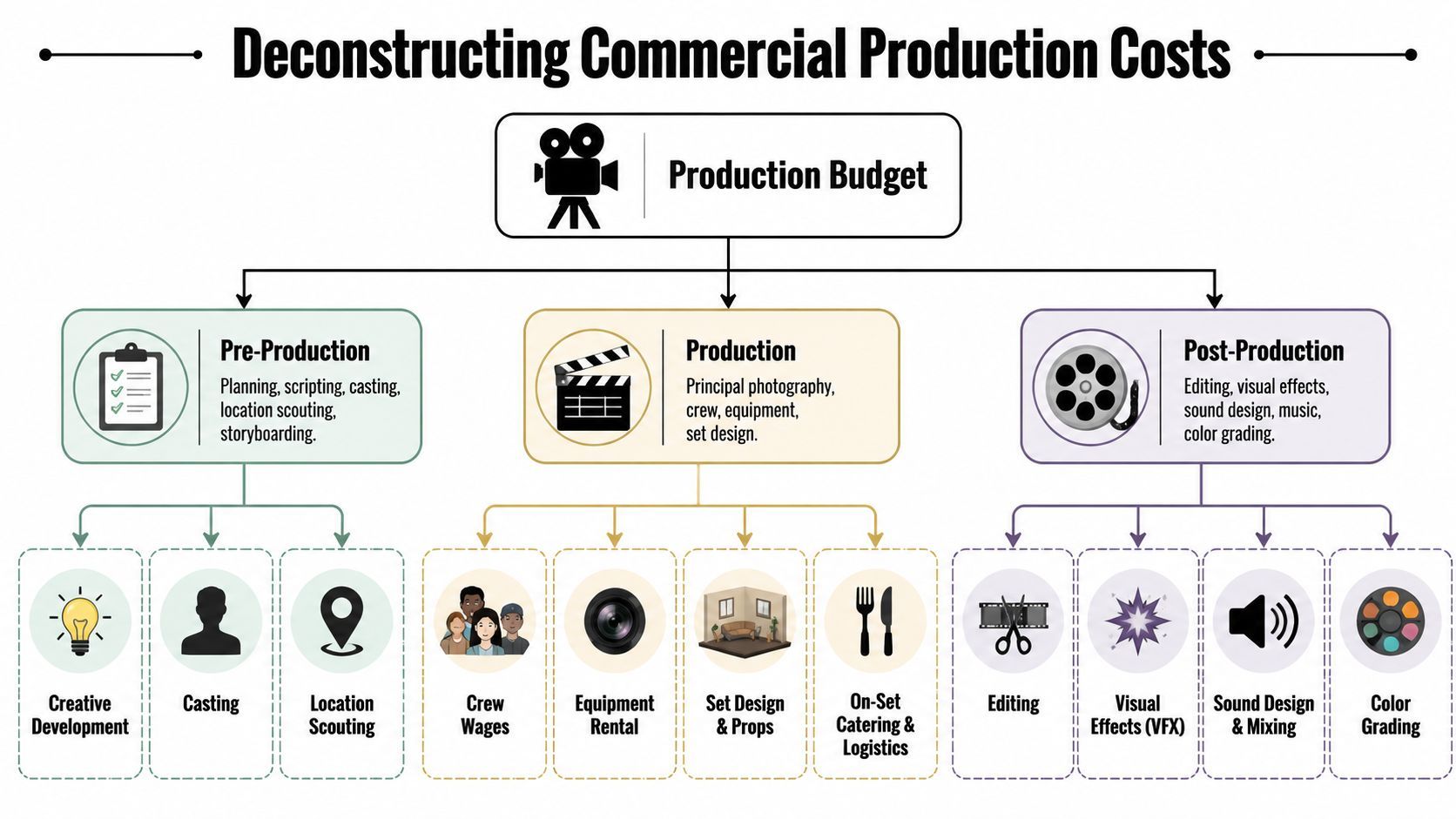
Production costs feel mysterious until you break them into stages. Most quotes are built around three buckets: pre-production, production, and post-production. If you know what lives inside each bucket, you can spot where your money is going and where you can cut without hurting the final ad.
Pre-production
Here, expensive mistakes are either prevented or scheduled.
Pre-production includes the brief, concept, script, storyboard, shot list, casting decisions, location planning, wardrobe notes, approvals, and logistics. Even if you're making a simple ad, somebody has to decide what the ad says, what the viewer sees, and how the whole thing gets made on time.
If your message is unclear here, the rest of the budget gets wasted. Businesses often underfund this part because there's nothing flashy to show for it. That's a mistake. A weak script costs more than a strong one because every downstream department has to compensate for it.
Common pre-production line items include:
- Creative development: The concept, angle, offer framing, and campaign hook.
- Scriptwriting: The spoken lines, pacing, CTA, and variations for different placements.
- Casting and talent selection: Choosing actors, presenters, creators, or voice talent.
- Location scouting: Finding places that look right and won't create operational headaches.
Production
This is the shoot itself. It's where the budget can climb quickly because time becomes expensive all at once.
A traditional production day may involve a director, producer, camera team, lighting, audio, art direction, hair and makeup, client services, transport, meals, and equipment rental. If you add multiple locations or specialty setups, complexity multiplies. Even a one-day shoot can become a full logistical operation.
What works well for smaller brands is stripping the shoot down to the actual selling job. If a product demo, founder message, customer testimonial, or simple lifestyle setup will do the work, don't finance cinema for a problem that only needs clarity.
The cheapest production is the one that captures a sharp message in a format your audience already trusts.
Post-production
Post is where the ad becomes usable. Raw footage rarely sells on its own.
Editing shapes pacing and narrative. Sound design and music make the piece feel intentional. Color correction helps everything match. Captions matter because many viewers watch with sound off, especially on social and mobile placements. Versioning also lives here, and that's where smart teams gain an advantage. One core asset can become multiple cuts for TV, CTV, YouTube, TikTok, Instagram Reels, and product landing pages.
Here's the production reality most quotes are hiding in plain sight:
| Production phase | What you're really paying for | Where overspending often happens |
|---|---|---|
| Pre-production | Strategic clarity and coordination | Too many approval layers |
| Production | Time, people, gear, and logistics | Fancy setups that don't improve the message |
| Post-production | Usability, polish, and variants | Endless revision rounds |
Where AI changes the equation
The low end of production has changed because software now handles work that used to require several vendors. Script drafts, voiceovers, rough cuts, synthetic visuals, resizing, captions, and adaptation for different channels can all happen faster than before.
That doesn't mean every brand should abandon live action. It means you should stop assuming custom filming is the default. If your goal is testing offers, validating hooks, or generating multiple ad variants, AI-assisted production often makes more business sense than a traditional shoot.
The smartest move isn't always “spend less.” It's to spend on the parts that create persuasion and remove cost from the parts that don't.
Understanding Media Buy and Airtime Prices
Media cost is the other half of the equation, and in large campaigns it often becomes the bigger half. A business might spend $15,000 to make a strong spot, then spend five or ten times that amount to put it in front of the right audience.
That split matters. Production buys the asset. Media buying buys the attention.
Simulmedia's TV ad pricing guide gives a useful range for how wide airtime pricing can be: small local markets can run around $200 to $1,500 per placement, mid-sized markets around $500 to $3,000, and top markets such as New York or Los Angeles can reach $5,000 to $50,000+ for a single spot. At the top end of the market, premium event inventory gets much more expensive. Statista reported an average price of $7 million for a 30-second Super Bowl ad in 2024.
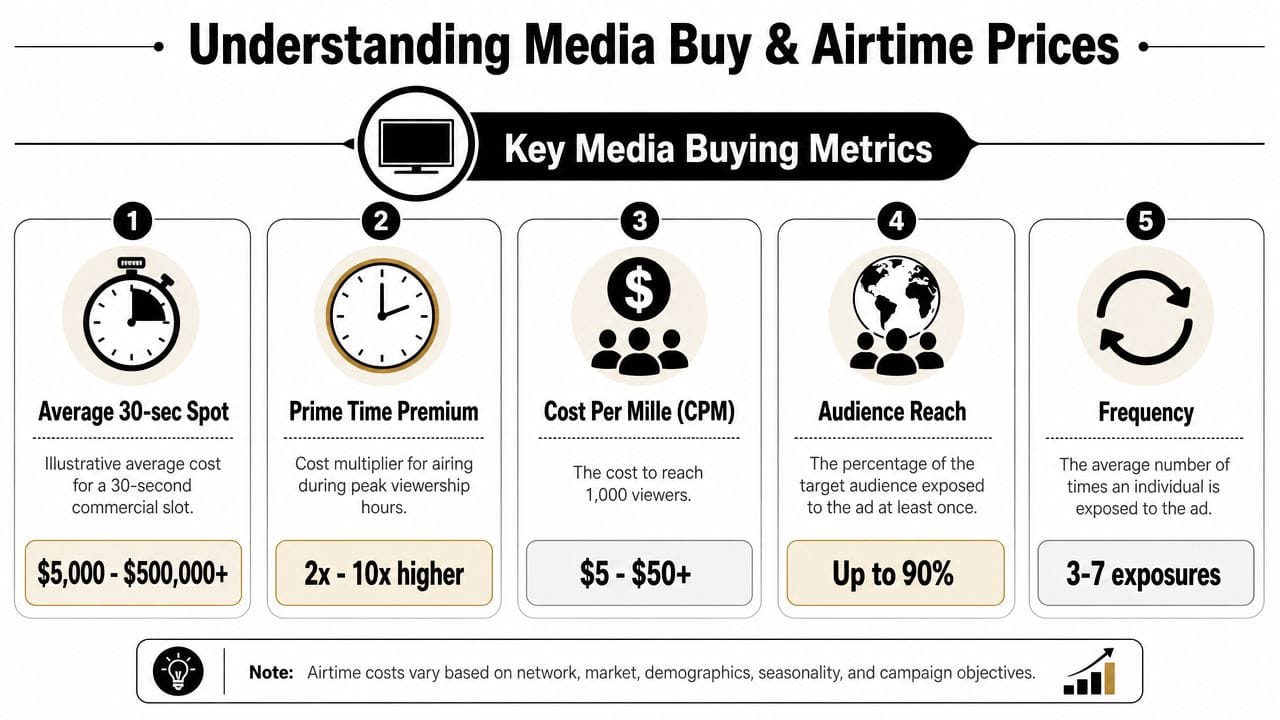
Airtime is priced on demand for the audience, not on the effort it took to make the ad. Two 30-second commercials can cost exactly the same to produce and have completely different media bills because one reaches local cable viewers at noon and the other reaches a national live-event audience.
Three factors drive that price.
First is audience volume. More reach usually costs more. Second is audience quality. Adults with high household income, in-market shoppers, or viewers inside a specific service area can be worth more than a broader crowd. Third is scarcity. Live sports, award shows, season finales, and other limited inventory events get expensive because there are only so many slots to sell.
Daypart and market selection decide whether a campaign is efficient or wasteful. Morning news, daytime, early fringe, prime, and late night all attract different viewers and different rates. For a local law firm, home services company, dealership, or regional healthcare group, the best buy is often the audience that can respond now, in the right geography, at a frequency the budget can support. A bigger program with weaker local relevance can look impressive and still produce worse results.
That is where inexperienced advertisers lose money. They focus on spot price or prestige instead of cost per useful impression.
Buyers use CPM and CPP to judge value. CPM is cost per thousand impressions. It lets you compare TV, CTV, YouTube, and social video on common ground. CPP is cost per rating point. In broadcast planning, buyers also estimate rates from the cost of one rating point multiplied by the expected audience rating, as noted earlier.
The practical question is simple: what did each dollar buy? A $4,000 placement that reaches the right households at a fair CPM can be a better buy than a cheaper spot in the wrong program. The reverse is also true. Low sticker prices hide a lot of bad inventory.
AI changes this part of the conversation indirectly. It does not make premium airtime cheap, but it does lower the cost of making enough creative versions to match the buy. Smaller advertisers can now afford multiple offers, regional edits, platform-specific cuts, and faster testing cycles. That matters because media efficiency improves when creative matches the audience, and that match used to be too expensive for many smaller brands to produce.
Common buying mistakes are predictable:
- Too little frequency: A few isolated spots rarely create enough recall to move results.
- Too much market spread: Brands buy coverage in places they cannot sell or fulfill well.
- Audience mismatch: The program looks strong, but the viewers are wrong for the offer.
- Creative mismatch: One generic ad gets forced into every placement instead of adapting to channel and audience.
- No test plan: Spend scales before the team knows which message, offer, or call to action works.
Good media buying is disciplined allocation. The production budget gets you in the game. The media budget determines whether anyone who matters sees the ad.
Commercial Costs Compared Across Channels
A commercial can cost less to make than to show, or far more to make than the media ever justifies. That split matters. Production and distribution run on different economics, and channel choice determines whether your budget goes toward attention, precision, scale, or testing speed.
The useful comparison is not just "what does a spot cost?" It is "what does this channel demand from the creative, and what does it return for the spend?" Broadcast TV, CTV, YouTube, Hulu, TikTok, and Instagram all price inventory differently, but the bigger mistake is treating them like interchangeable shelves for the same video.
A practical comparison table
| Channel | Typical Buy Structure | Relative Cost Level | Best For |
|---|---|---|---|
| Local TV | Spot-based, market by market | Mid to high, depending on market and daypart | Local awareness, retail events, service businesses, political windows |
| National or cable TV | Network or program-based buys | High in premium inventory, more manageable in cable niches | Broad reach, older audiences, mass-market credibility |
| YouTube | Auction or reservation, usually impression or view-based | Low to mid | Efficient reach, search-adjacent demand capture, testing hooks and offers |
| Hulu | Premium streaming inventory | Mid to high | Brand-safe streaming, household targeting, TV-like viewing context |
| CTV | Platform, publisher, or DSP-based buying | Mid to high, often above open-web video | Living-room viewing, audience targeting, geographic control |
| TikTok and Instagram Reels | Auction-based short-form video | Low to mid, but creative fatigue can raise real costs fast | Fast testing, creator-style ads, lower-cost iteration, impulse response |
What changes from channel to channel
Local TV still works when the sale happens inside a clear geography. A roofing company, hospital group, dealership, casino, or regional retailer can get solid value from concentrated schedules in the right programs. The catch is waste. If the footprint is tight and the station coverage is broad, a meaningful slice of spend reaches people who cannot buy.
National and cable TV buy status as much as reach. That can matter for major launches or brands trying to signal scale, but it is usually the least forgiving channel for smaller advertisers. Mistakes get expensive fast, and weak creative gets exposed immediately.
YouTube is usually the most practical place to test message-market fit on video. It is cheaper to put multiple hooks, offers, and lengths into market there than on television. That matters because the "making" side of the budget has changed. AI-assisted editing, script variation, voiceover, and versioning let smaller brands produce more viable tests without booking another shoot day.
Hulu and broader CTV sit closer to television in viewing behavior, but they behave more like digital in targeting and reporting. That combination is valuable if the offer needs household precision and a premium screen. It also means the creative has to hold up on a big TV. Sloppy social-first footage can still work, but it has to feel intentional.
TikTok and Instagram serve a different job. They are less useful as direct substitutes for TV and more useful as low-cost creative proving grounds. A brand can test founder reads, UGC-style testimonials, hard offers, product demos, and opening hooks quickly. Then the winning angle can be rebuilt for CTV, Hulu, YouTube, or local TV.
The smart way to compare channels
CPM matters, but only as a starting metric. A low CPM with weak attention, poor audience fit, or the wrong context can lose money. A higher CPM can still be the better buy if the audience is tighter, the viewing environment is stronger, and the conversion path matches the platform.
I usually compare channels on four practical questions:
- How expensive is it to get enough data?
- How much creative adaptation does the channel require?
- How well does the audience match the actual buyer?
- Can the business support the demand the channel creates?
That framework keeps the two cost economies separate. Some channels are cheap to enter on media but expensive to feed with enough creative variation. Others require pricier media, but one strong concept can run for months with only minor edits.
Where AI changes the math
AI lowers the cost of making channel-specific versions. It does not make premium airtime cheap, but it does make adaptation cheaper. A small brand can now cut 6-second, 15-second, and 30-second versions, swap intros by audience, test different offers, and localize calls to action without rebuilding the whole production process from scratch.
That shift is a real advantage for smaller advertisers. Five years ago, many brands could afford one polished spot and had to force it everywhere. Now they can make one core asset, then build native executions for YouTube, CTV, and short-form social at a fraction of the old post-production cost.
The wrong comparison
The wrong question is which channel has the cheapest inventory.
The right question is which channel gives the business the best return after both costs are counted. The cost to produce effective creative for that placement, and the cost to buy enough distribution for the message to matter.
That is why a founder-shot TikTok ad can outperform a polished TV-style edit on social, while the reverse can be true in CTV. Same product. Same offer. Different viewing conditions, different attention patterns, different economics.
Putting It All Together with Example Budgets
Budget conversations get easier when you stop asking what a commercial should cost in theory and start mapping what a campaign can accomplish in practice.

A lean local campaign
A small local business with a modest budget usually can't afford waste, so the production has to be simple and the media has to stay tight. Think founder-led messaging, product closeups, customer testimonials, or lightly edited before-and-after visuals. The goal isn't cinematic polish. It's credibility and clarity.
In that setup, I'd keep production lean and preserve enough budget to run the ad more than once. A single polished asset with no repetition usually underperforms a simpler asset with a sensible local schedule.
A growing regional brand
A regional DTC or service brand has a different job. It needs creative that can travel across channels. That usually means building one core concept and then turning it into multiple edits for streaming, YouTube, and short-form social.
Here, the budget split often becomes more balanced. The brand may justify a stronger production process because the same shoot can feed more placements and more months of testing. That's when versioning starts to carry real financial value.
A useful way to think about this middle tier is not “one commercial,” but “one production cycle that yields a family of ads.”
For a closer look at how teams think through campaign trade-offs, this walkthrough is worth watching:
A larger national push
A national campaign with a serious media plan changes the stakes. The brand can support broader reach, more rigorous pre-production, and multiple delivery formats. It may need TV-safe masters, CTV versions, social cutdowns, and compliance review.
At that level, media discipline matters even more than production ambition. A company can spend heavily on the creative and still lose if the rollout is too fragmented. Strong campaigns usually narrow the message, commit to key markets or audiences, and keep enough flexibility to replace weak creative quickly.
Here's the practical summary:
- Small budget: Keep production minimal. Protect enough spend for repetition.
- Mid budget: Build one adaptable concept and version it aggressively.
- Large budget: Treat production as a system, not a one-off asset, and guard against bloated media plans.
The budget size changes. The logic doesn't. The winner is usually the advertiser that keeps creation efficient and distribution intentional.
How to Reduce Commercial Costs in 2026
A commercial usually gets expensive in one of two places: making it, or showing it. In 2026, the biggest savings come from controlling both separately instead of treating “the ad” as one lump cost.
Start with production, because that is where smaller brands now have real room to compete. If the concept is simple, the product is clear, and the offer is strong, you can skip a surprising amount of traditional overhead. Fewer shoot days, smaller crews, lighter post-production, and more template-based editing all cut cost before you spend a dollar on distribution.
AI has pushed that shift further. A business that once needed a full studio workflow can now script, build visuals, create voiceover, assemble cuts, resize formats, and publish variants from one system. That changes the math. The goal is no longer one expensive hero spot. The goal is enough usable creative to test hooks, offers, and formats before media spend scales. Tools for AI video ad creation and versioning fit that workflow when speed and output volume matter as much as polish.
That same principle applies to product visuals. Brands that need affordable product imagery for furniture often reduce shoot costs with virtual staging and rendered assets instead of organizing repeated physical setups.
Then protect the media side.
A cheap ad can still lose money if it runs in the wrong places. Keep targeting tight, especially early. Use lower-cost channels to find response patterns, then put more budget behind the combinations that convert. For many advertisers, that means testing on paid social, YouTube, or smaller CTV flights before committing to broader local TV or premium national inventory.
The practical move is to shift money out of unnecessary production extras and into useful repetition, faster iteration, and disciplined placement. Brands that win in 2026 usually do three things well: they shorten the production cycle, produce more variations, and scale media only after the message proves itself.