How Are AI Voices Made: A Practical 2026 Guide

How Are AI Voices Made. Learn how are AI voices are made in 2026, from data collection and TTS architectures to voice cloning, quality metrics, and the ethical
You've got an ad script, a timeline of product shots, and a voiceover that sounds convincing until it says your brand name wrong. You fix the spelling, render again, and suddenly the opening sounds more excited while the closing line runs past the final scene. The voice is believable, but directing it feels unpredictable.
That's the practical question behind how are AI voices made. Understanding the machinery helps you distinguish a pronunciation problem from a pacing problem, choose the right voice for the job, and stop treating every disappointing render as a reason to change models.
What an AI Voice Really Is Before You Build One
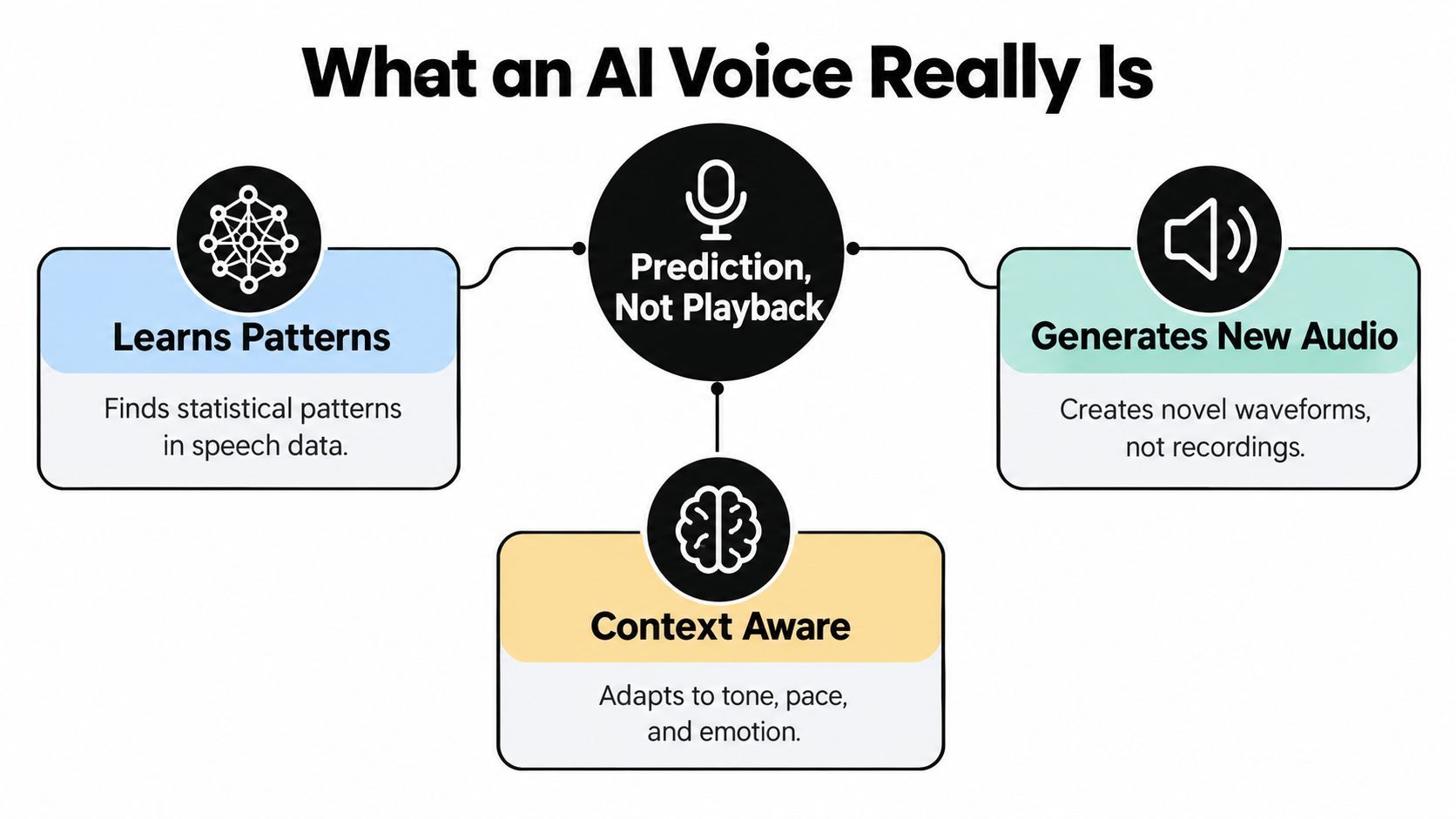
An AI voice is prediction, not playback. In the modern neural approach, developers train a model on paired transcripts and speech recordings. The model learns relationships between written language and acoustic patterns, then generates speech for sentences that weren't individually recorded during training.
Think of it as learning a performer's habits rather than collecting their lines. A recording library contains finished performances. A trained speech model contains learned relationships that help it produce a new performance.
That distinction matters when you change an ad's offer, rewrite a hook, or add a product name. You don't need a matching recording of the entire sentence. You need a system that can infer an appropriate delivery.
A sound plan, then a performance
Prosody means the rhythm, stress, pitch, and pauses of speech. A mel-spectrogram is a compact visual representation of how sound energy should develop over time. A vocoder turns that representation into the audio waveform you can play.
The production chain becomes easier to follow when you separate its jobs:
- Prepare the words. Resolve pronunciation, abbreviations, and ambiguous text.
- Direct the delivery. Supply the voice identity and intended speaking style.
- Generate the audio. Predict acoustic features and turn them into sound.
- Finish the take. Review pacing, loudness, breaths, and artifacts against the edit.
The distinction between learned patterns and stored recordings is illustrated below.
In its 2017 evaluation, Tacotron 2 received a naturalness mean opinion score of 4.53 on a 1–5 scale, compared with 4.58 for professionally recorded human speech, a difference of 0.05 points, as documented in the Tacotron 2 publication and audio demonstrations. That result describes a particular evaluation, not a guarantee that every generated sentence will sound human.
For an adjacent perspective on recognizing vocal identity, Isolate Audio's resource on speaker identification techniques is useful context. Recognizing a speaker and generating their voice are different tasks, but both prompt you to separate who is speaking from how they're delivering a particular line.
Collecting the Data That Trains a Voice
The training material is best understood as a cookbook of paired examples: written instructions alongside the sound of someone performing them. If the transcript and recording disagree, the example becomes harder to interpret. If every recording uses the same delivery, there's little evidence of how that speaker behaves outside it.
For a creator preparing recordings, my advice is to treat the session like a production shoot. Decide what you want the voice to do before recording whatever happens to be convenient.
A controlled recording setup gives you a practical starting point.
Record examples you can actually trust
Start with accurate transcripts and intelligible performances. Keep the microphone position and recording environment consistent, and review takes for clipped syllables, background distractions, or words the speaker skipped.
Variety should be intentional rather than accidental. A calm explanation and an enthusiastic invitation are useful different performances. A clean recording and a muffled recording aren't useful different styles.
For dataset preparation, I'd organize the material around these checks:
- Transcript agreement. Preserve what the speaker said, including corrections to the written script.
- Speaker identity. Keep each person's recordings clearly associated with that person.
- Delivery notes. Label intended styles such as restrained narration or energetic promotion when the training workflow supports them.
- Recording consistency. Separate technical problems from deliberate changes in performance.
During training, speech alignment can establish where sound units occur in the recording. That timing information helps support duration learning. The FastSpeech 2 example discussed below uses alignment-derived duration labels alongside pitch and energy extracted from recordings.
Coverage matters more than a stopwatch
Don't assume a longer session automatically produces a more useful voice. Ask whether the recordings cover the kinds of language and delivery your content needs: product descriptions, questions, calls to action, unfamiliar names, and transitions between ideas.
The comparative vocoder evaluation discussed later also found weaker results for multi-speaker synthesis than for single-speaker models. Its practical warning is relevant at the recording stage: speaker diversity, recording consistency, and conditioning quality deserve attention.
Recording rule: Capture variation in performance, not variation in technical quality.
Before commissioning a brand-specific corpus, ask the provider what its training process requires. A reference clip, a cloning session, and a dataset for training aren't interchangeable deliverables.
The Acoustic Model That Turns Text Into Sound Plans
Consider the script fragment “Dr. Vale ships to St. James.” Before a model plans the performance, the system needs to resolve what those abbreviations mean in context. The punctuation on the page isn't enough to establish the intended spoken wording.
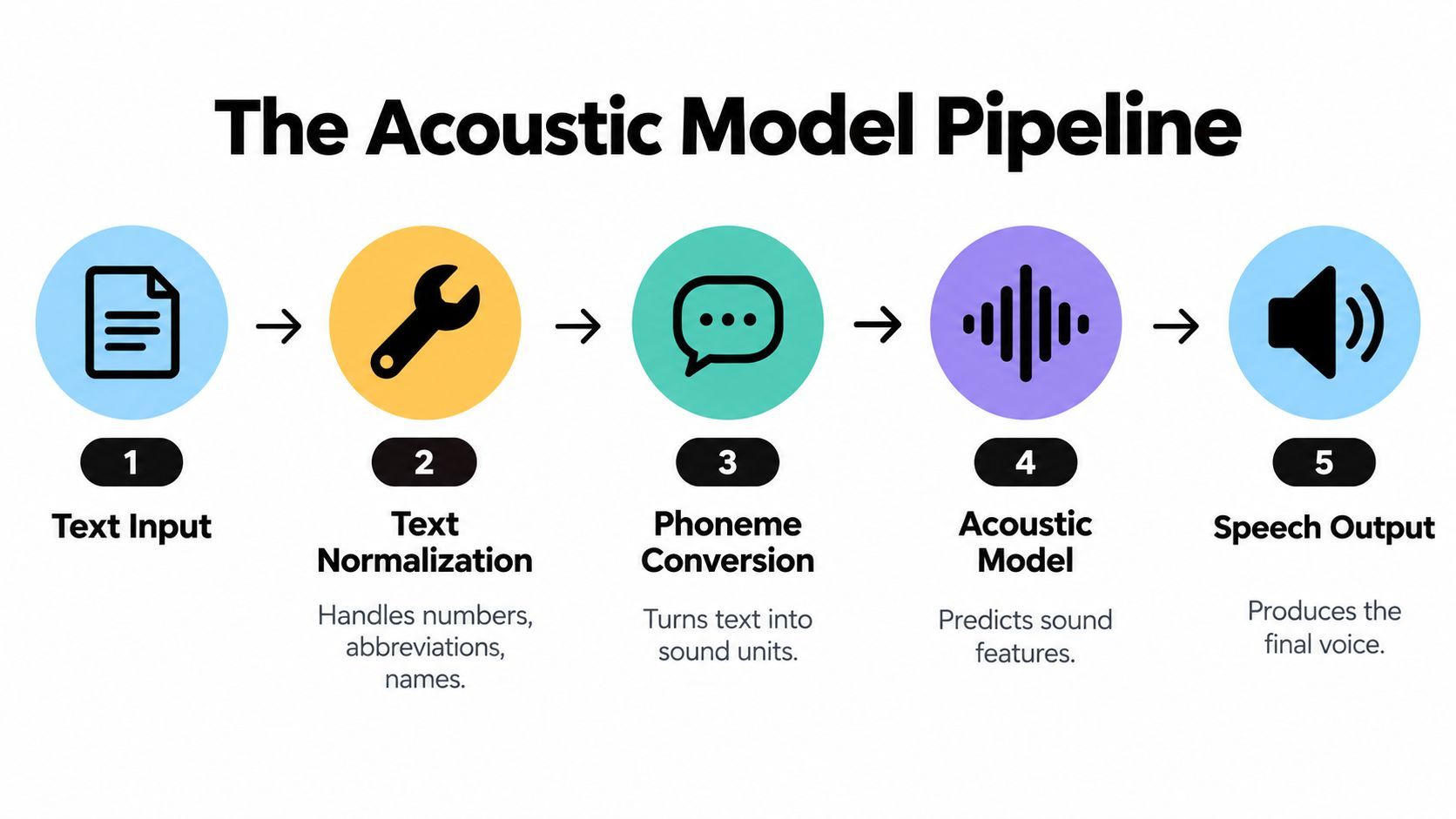
Text normalization handles that preparation. Names, quantities, abbreviations, and punctuation may need explicit treatment before the system converts the text into phonemes or other model-ready tokens.
This diagram places that preparation in the broader generation flow.
Turning language into an acoustic score
The acoustic model is closer to a musical arranger than a loudspeaker. It specifies how the performance should unfold before the vocoder produces playable sound.
FastSpeech 2 makes important parts of that process explicit. Its encoder creates internal representations, and a variance adaptor predicts phoneme duration, fundamental frequency, and frame-level energy before a decoder generates mel-spectrogram features; its published experiments also report a 3× training-speed improvement over FastSpeech while improving voice quality, according to Microsoft's explanation of FastSpeech 2.
For a producer, those variables correspond to recognizable directing choices:
- Duration. How long should a syllable last, and where should the phrase leave space?
- Pitch. Should the delivery rise like a question, settle like a conclusion, or stress a particular word?
- Energy. Where should the performance feel forceful or restrained?
The model's training process uses duration information derived from alignment, with pitch and energy extracted from recordings. At generation time, it predicts those variables rather than receiving a fresh human performance.
Why identical words can need different deliveries
The phrase “You found it” could express relief, surprise, or a matter-of-fact confirmation. This is the one-to-many problem in speech synthesis: the text doesn't uniquely determine the performance.
For an ad, I'd resolve that ambiguity in the script and direction before repeatedly rendering. Specify the intended emphasis, make the sentence structure clear, and use supported style controls rather than expecting punctuation to carry every instruction.
The embedded video provides an additional viewing resource alongside this explanation.
A pronunciation mistake and an emphasis mistake require different interventions. Correct the word representation for the former; adjust delivery guidance for the latter. Stretching the finished audio won't reliably fix either.
The Neural Vocoder That Actually Makes the Sound
A spectrogram isn't a recording you can drop into an editing timeline. The neural vocoder must reconstruct a time-domain waveform from those spectral features, including fine acoustic structure that contributes to consonant sharpness, timbre, and breathiness.
Think of the acoustic model as supplying a performance score and the vocoder as realizing that score in sound. A sensible score can still result in an unsatisfactory recording if the realization introduces roughness or loses detail.
Different routes to the waveform
WaveNet established an influential approach by modeling the raw waveform sample by sample. That approach delivered important quality gains, but direct sequential generation was computationally expensive compared with later accelerated vocoders.
WaveGlow and HiFi-GAN belong to the later production stage. You shouldn't select among these names as though each guarantees a fixed sound or turnaround time. The implementation and deployment environment still need testing.
Neural Vocoders Compared for Short-Form Production
| Vocoder | Generation Approach | Typical Strength | Production Trade-Off |
|---|---|---|---|
| WaveNet | Direct sample-by-sample waveform modeling | Detailed waveform prediction | Sequential generation can impose substantial computational cost |
| WaveGlow | Neural conversion of spectral features into audio | An alternative to direct sequential waveform generation | Benchmark the actual implementation rather than assuming a speed advantage |
| HiFi-GAN | Neural reconstruction from mel-spectrogram features | Strong quality and speed in the cited comparison | Test with the intended speakers and production hardware |
A comparative evaluation of HiFi-GAN, Multiband WaveRNN, and LPCNet reported real-time synthesis for all tested systems on a single CPU core, with HiFi-GAN offering the strongest combination of quality and synthesis speed among the evaluated models. The same evaluation reported generally lower scores for multi-speaker synthesis than for single-speaker models.
Measure throughput, then finish the take
Real-time factor, or RTF, is synthesis time divided by generated-audio duration. An RTF below 1.0 means faster-than-real-time generation. That's useful for estimating rendering throughput, but it doesn't describe every delay in a complete video workflow.
For production, time the service you'll use. Include its preparation, generation, download, and review stages rather than treating a model benchmark as an editing schedule.
Post-processing is the other overlooked job. I'd check loudness against the music bed, inspect pauses around scene changes, and listen for distracting breaths or artifacts before approving the take.
A fast render isn't a finished voiceover. Approve the audio in the edit, not just in the generation preview.
The separation between acoustic prediction and waveform generation also provides architectural flexibility. It can support changes to speaker or prosody conditioning without redesigning the entire waveform generator, provided the components remain compatible.
Voice Cloning From a Few Samples or a Full Session
Choosing a voice and cloning a voice aren't the same decision. A selectable narrator may already satisfy the creative brief. Cloning becomes relevant when the identity of a particular consenting speaker matters to the content.
Speaker conditioning gives a synthesis system information about the intended speaker, accent, or vocal style. The creator-facing question is whether that identity comes from an established voice, reference material, or a dedicated adaptation process.
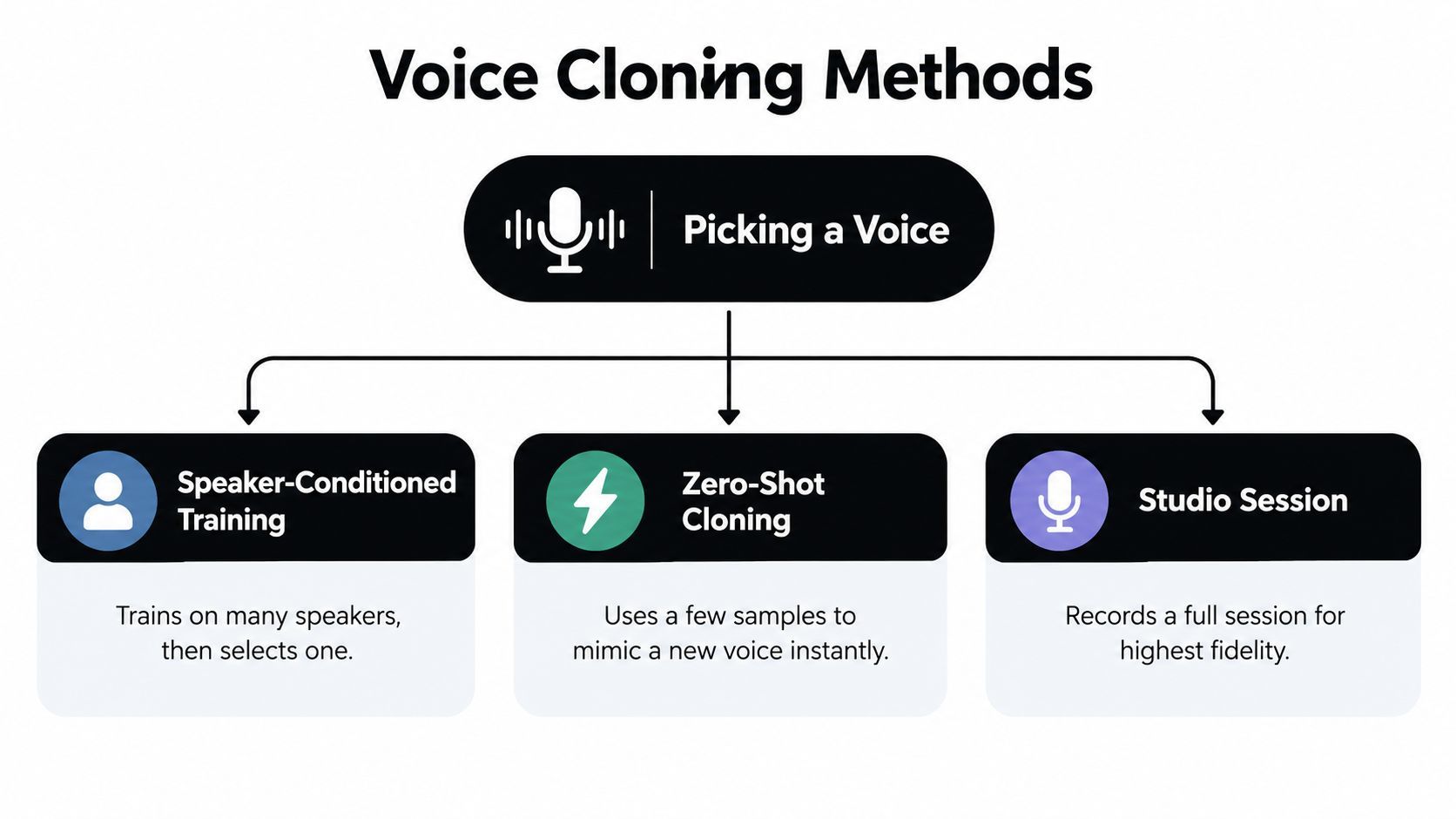
The diagram distinguishes the main routes without treating them as interchangeable.
Reference-based cloning versus dedicated adaptation
In common technical usage, zero-shot cloning means synthesizing a new speaker from reference material without speaker-specific retraining. Few-shot adaptation refers to using a limited set of target examples to adapt the system. A dedicated studio workflow gives the team more opportunity to collect controlled material and evaluate the resulting voice.
These labels aren't reliable quality rankings. Ask the provider what happens after upload: reference conditioning, model adaptation, or something else. Then ask how you can evaluate the result before committing to production.
A short reference may be convenient, but convenience doesn't establish reliable pronunciation, accent preservation, or emotional control across your scripts. Conversely, commissioning a recording session doesn't automatically solve those problems.
Choose the scope by the job
For a recurring educational series, I'd prioritize identity preservation and dependable delivery. For an isolated promotional clip, I'd assess whether a licensed selectable voice already provides the required performance.
Use these decision criteria rather than a promised minimum clip length:
- Identity requirement. Does the audience need to recognize this particular speaker?
- Script coverage. Can the result handle your names, terminology, and intended languages?
- Revision behavior. Does the voice remain recognizable when you change the copy?
- Rights scope. Does permission cover the planned channels, advertising uses, and future revisions?
If you're evaluating services, VideoTour.ai's resource to compare voice cloning software can provide a starting point for your shortlist. Keep your own audition script separate from vendor demonstrations so you can compare the same material.
My recommendation is to approve a clone against the intended use, not against a flattering resemblance demo. A familiar timbre is only part of a usable production voice.
Measuring Quality Beyond How Real It Sounds
A voice can sound pleasant while delivering the wrong word. Another can preserve a speaker's identity but miss the scene timing. Naturalness, intelligibility, identity, and speed are separate evaluation questions.
Mean opinion score, or MOS, summarizes subjective listener ratings. In North American English tests, WaveNet achieved 4.21, compared with 3.86 for a concatenative system and 3.67 for an LSTM-RNN parametric system, improvements of 0.35 and 0.54 points, respectively, in the WaveNet paper.
Those scores provide a concrete historical comparison. They aren't a portable ranking you can apply to unrelated products, scripts, or listening conditions.
Evaluate the line you need to publish
Build an audition script around likely failures rather than easy sentences. Include your brand name, a question, a restrained explanation, an emphatic hook, and the closing call to action.
Word error rate, or WER, compares a transcript with the intended words through substitutions, deletions, and insertions. It can help organize an intelligibility check, but a speech recognizer's transcript shouldn't be your only judge. Listen directly for names that a recognizer might normalize or misunderstand.
For speaker similarity, compare generated lines with an authorized reference. For timing, place the narration against the actual visual sequence. A sentence that sounds comfortable alone may feel rushed when the product demonstration needs breathing room.
Producer's test: Judge the voice on the difficult line, not the polished demo.
A compact approval checklist
Keep separate notes so one appealing quality doesn't conceal another failure.
- Naturalness. Does the phrasing sound intentional, with appropriate stress and pauses? Use listener ratings consistently if you collect them.
- Intelligibility. Are the intended words audible and correctly pronounced? Track transcription errors and manually review critical terms.
- Speaker similarity. Does the identity remain recognizable across different scripts and deliveries?
- Production speed. Record RTF and end-to-end turnaround on the workflow you'll deploy.
I'd treat pronunciation of the offer and brand name as approval requirements, not qualities to average against a pleasant tone. The viewer needs to understand what you're selling.
Choosing a Voice Profile for Ads and Short Videos
More expressive isn't automatically more useful. My production recommendation is to match vocal variation to the purpose of the clip, rather than pushing every control toward maximum emotion.
A recurring narrator benefits from familiarity. A hook may need a deliberate change of energy. A dialogue scene needs distinguishable speakers, but not necessarily exaggerated performances from everyone.
Start with a role, not a realism slider
| Voice Profile | Creative Job | Suggested Direction |
|---|---|---|
| Narrator | Explain products or maintain a recurring series | Keep identity, baseline pace, and emphasis restrained and consistent |
| Hook | Introduce surprise, urgency, or an emotional beat | Use a targeted expressive style and protect the key phrase |
| Character | Separate participants in a scene | Assign distinct identities and keep each character's delivery coherent |
For a narrator, preserve approved pronunciation choices and reuse the same baseline settings when the tool allows it. Judge revised lines beside earlier clips so you can hear whether the series still feels connected.
For a hook, direct a specific intention. “Confident invitation” is a more useful creative instruction than “more human.” If the line is too long for the opening shot, shorten the copy before forcing a faster delivery.
Reserve room for the edit
Character separation should help the audience follow the scene. If every speaker uses the same intensity, changing identities alone may not establish clear conversational roles.
For broader advertising context, Adwave's guide for small business TV ads is a useful companion when considering voice character alongside the rest of the creative.
Before generating, make the decisions explicit:
- Identity. Who is speaking, and should that identity recur?
- Delivery. Which words need emphasis, and which should remain neutral?
- Timing. Where must the viewer have time to absorb a visual?
- Finish. What loudness and pause adjustments will the edit require?
My default is a stable base voice with deliberate exceptions. That gives you a repeatable series without making every clip sound emotionally identical.
Ethics, Consent, and How to Verify Before You Publish
Technical access to someone's audio isn't permission to reproduce their identity. Treat consent and verification as production requirements, alongside script approval and audio review.
Consumer Reports found that researchers could create clones from public audio in four of six tested products, while several services relied mainly on users' self-attestation of legal rights, according to its assessment of AI voice-cloning products. That finding makes public availability a poor substitute for authorization.
Build a publish gate
Before releasing a cloned performance, establish who authorized it, what uses they approved, and who can generate further audio. Don't leave those answers scattered across messages or assume a provider's upload checkbox settles them.
Use a practical approval checklist:
- Written consent. Document permission for the intended content, distribution channels, and advertising use.
- Identity verification. Confirm that the person granting permission is the speaker or an authorized representative.
- Access controls. Restrict who can use the voice and review the provider's deletion and revocation options.
- Disclosure and provenance. Apply synthetic-audio disclosure or watermarking where required, and retain records of origin and approval.
- Misrepresentation review. Avoid making an identifiable person appear to endorse a product or say something they haven't authorized.
Prefer services that let you inspect these safeguards rather than merely asserting that cloning is responsible. Don't assume watermarking, verification, or deletion controls exist without checking.
An approved voice can still produce an unapproved message. Review the final script and rendered performance together, because consent to create a voice shouldn't be treated as blanket consent to every future use.
ShortGenius (AI Video / AI Ad Generator) brings scriptwriting, visual generation, video assembly, and natural voiceovers into one workflow. Visit to build a short ad or video, then audition the narration against your scenes and refine the voice, captions, and timing before publishing.