Facebook AI Ads: Your Complete 2026 Performance Guide

Master Facebook AI ads in 2026. This guide covers Advantage+, AI creative, and optimization tips to boost ROI and build high-performing video ads.
A lot of advertisers still talk about Facebook AI ads as if they're an optional layer on top of the old playbook. They're not. In 2024, campaigns using AI optimization for ad targeting and creative generation showed a 23% improvement in cost per acquisition compared with manual management, according to Madgicx's analysis of 15,000+ campaigns. That number changes the conversation.
The practical question isn't whether to use AI. It's how to work with it without letting your account turn into a pile of generic creative, weak messaging, and black-box decision making. The teams getting durable results aren't handing everything to automation. They're giving Meta's systems stronger inputs, clearer objectives, and more varied creative to test.
That's the shift. The machine handles more of the distribution logic. The human handles the judgment. If you still approach Facebook like a manual media buyer from a few years ago, you'll spend too much time adjusting knobs that matter less and too little time improving the inputs that matter more.
The Age of the AI Co-Pilot in Advertising
Meta's ad system has moved from assistant to operator. It now handles much of the execution that used to absorb a buyer's week: delivery decisions, bid adjustments, audience expansion, creative matching, and cross-placement distribution.
That doesn't mean human skill matters less. It means the job changed.
The old model rewarded people who could segment audiences obsessively, spin up endless manual tests, and force control over placements and bids. The current model rewards people who can define a sharp offer, package it into multiple creative expressions, and let the system learn from enough variation to find performance.
What changed in practice
The account manager is no longer the person pulling every lever by hand. The stronger operator now does three things well:
- Sets the right objective: If the campaign goal is muddy, the system learns in the wrong direction.
- Feeds the system strong creative inputs: AI can distribute and recombine, but it can't rescue a weak hook.
- Holds the line on brand truth: Automated variation helps. Automated blandness hurts.
Practical rule: Use AI for execution scale, not for strategic substitution.
This is why “co-pilot” is the right frame. Meta's AI can process more signals than any human buyer can manage manually. But it still needs direction. When advertisers fight the algorithm by over-constraining it, performance often stalls. When they surrender all judgment to automation, the ads often become interchangeable.
What success looks like now
A good Facebook AI ads workflow is simpler on the media-buying side and more demanding on the creative side.
The system wants room to explore. You want to supply better material for that exploration. That means broader inputs on delivery, cleaner campaign structures, and a consistent stream of fresh angles grounded in actual customer language.
The advertisers who adapt to that split usually stop asking, “Which hidden setting should I tweak?” and start asking, “What better signal can I give the machine tomorrow?”
What Exactly Are Facebook AI Ads
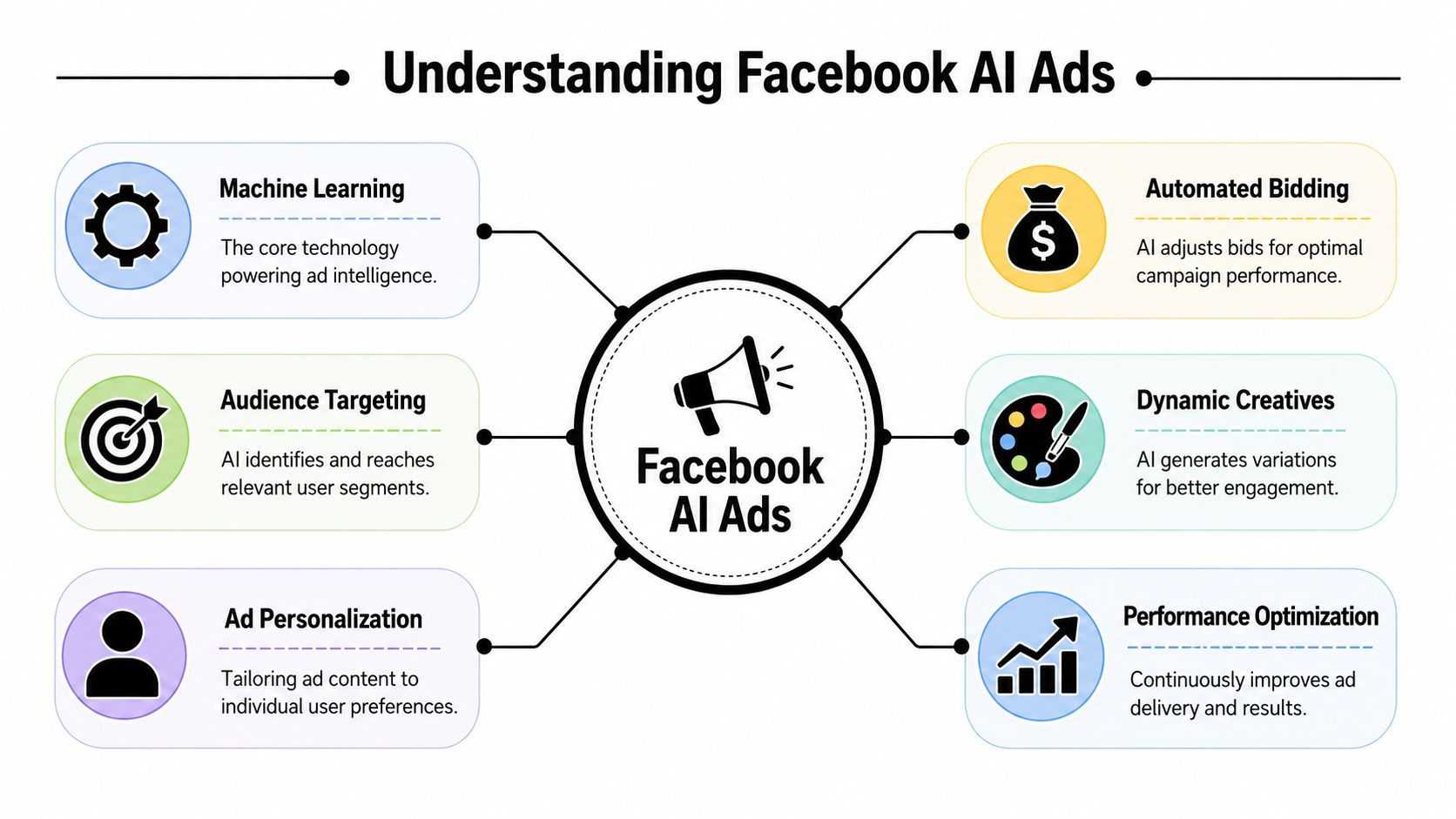
Facebook AI ads aren't one feature. They're a stack of machine learning systems working together inside campaign setup, delivery, bidding, placement, and creative assembly.
A useful way to think about it is an orchestra conductor. You don't see every instrument separately during the performance, but the conductor is coordinating timing, emphasis, and balance across the whole group. Meta's AI does something similar across two big jobs: delivery and creative.
Delivery AI
Delivery AI decides where budget is most likely to create the result you asked for. That includes who sees the ad, when they see it, which placement gets priority, and how aggressively the system bids in the auction.
You don't control each of those micro-decisions anymore, at least not in the old manual sense. Instead, you give the system boundaries:
| Input you control | What the system does with it |
|---|---|
| Objective | Prioritizes the outcome you want, such as leads or purchases |
| Budget | Allocates spend across likely opportunities |
| Creative set | Matches different assets to different viewers and placements |
| Conversion data | Learns which users and contexts tend to produce the target action |
This is why setup discipline matters. If your event tracking is sloppy or your campaign objective doesn't match the business outcome, the AI isn't “wrong.” It's just optimizing against a bad instruction.
Creative AI
Creative AI handles a different layer. It helps decide which version of the message should appear in front of which person and in which format. In some workflows, it can also generate or adapt pieces of that creative.
That includes tasks like:
- Testing combinations of assets
- Adjusting presentation across placements
- Expanding or adapting visual formats
- Generating text variants for hooks or descriptions
The promise is speed. The risk is sameness.
The system can generate variation fast. It can't tell you whether the variation still sounds like your brand.
The mental model that matters
If you want Facebook AI ads to work, stop thinking in terms of “targeting settings plus ad copy.” Start thinking in terms of inputs and outputs.
Your inputs are strategy, assets, offer, objective, and signal quality. The outputs are leads, sales, and downstream efficiency. The AI sits between those two. It interprets the inputs at scale, then makes thousands of delivery and matching decisions you'll never see individually.
That's why better media buying now starts earlier. It starts at the brief.
How AI Automates Ad Delivery with Advantage+
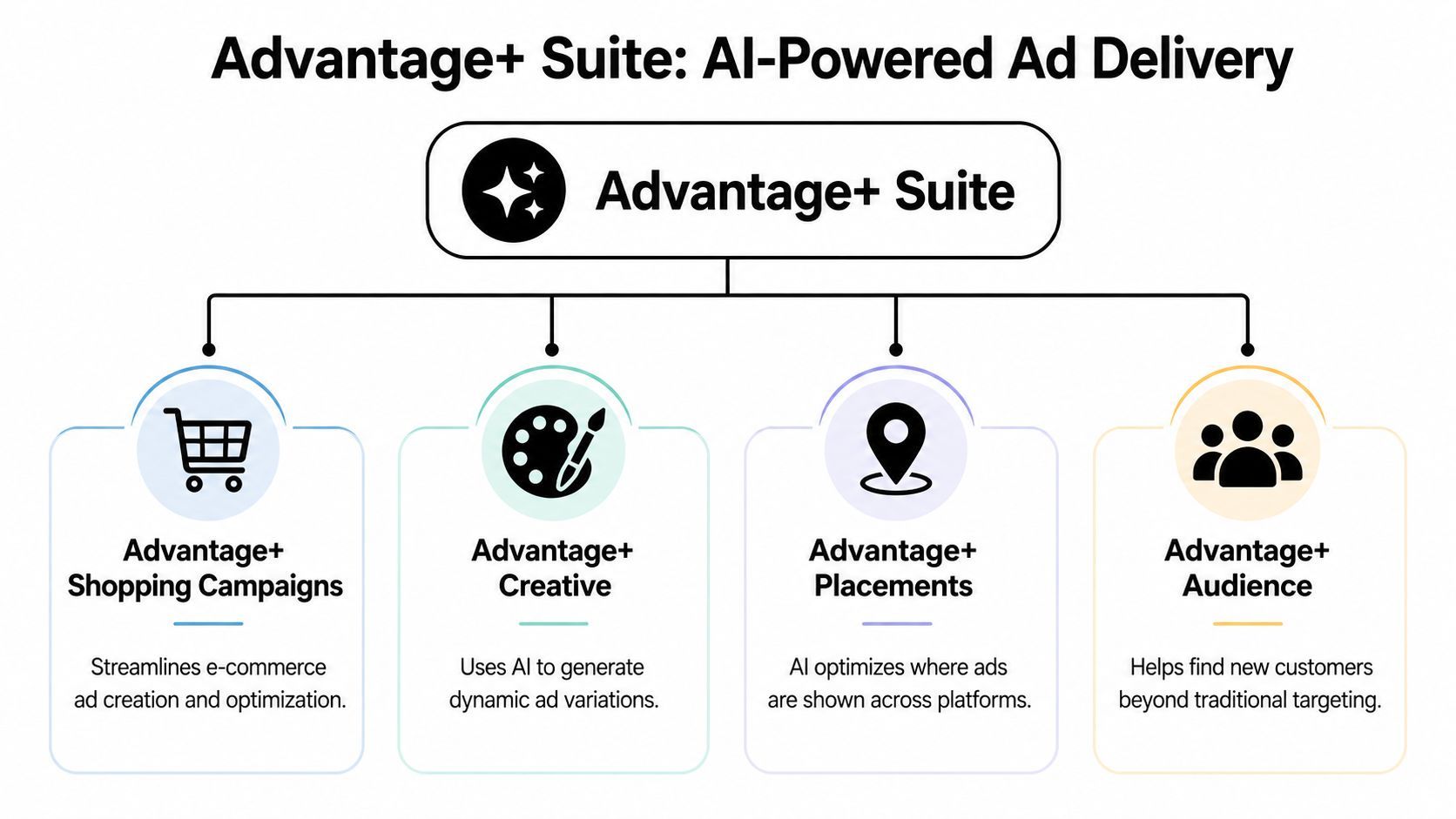
Advantage+ is Meta's clearest expression of the new delivery model. Instead of asking the buyer to dictate every tactical choice, it asks for cleaner strategic intent and then automates the distribution work around that intent.
That shift has become financially meaningful at platform scale. Facebook's advertising revenue reached a projected $122 billion in 2024, alongside a 31% increase in ad impressions in 2023 and a 6% drop in average cost per ad, according to Quso.ai's Facebook marketing stats. The point for advertisers is simple: Meta has strong incentives to make AI-driven delivery more efficient for both the platform and the buyer.
Advantage+ Audience
Many advertisers still hesitate. They want tighter manual targeting because it feels safer. In practice, rigid audience definitions often choke off learning.
Advantage+ Audience lets the system move beyond a narrow seed and find people you might not have selected manually. That matters because good prospects often don't fit the obvious demographic box. They show up through behavior, context, and patterns that aren't visible in a simple interest stack.
Use it when your account has decent signal quality and your offer is broad enough to travel. Be more cautious when the offer is highly regulated, geographically constrained, or requires very narrow qualification.
Advantage+ Placements and bidding
Placement selection used to be a control lever that buyers touched constantly. Now it's usually better treated as a learning surface. Advantage+ Placements distributes across Facebook, Instagram, Stories, Reels, Feed, and other available inventory based on where the system predicts the best result.
Bidding works the same way. Instead of setting static assumptions about what traffic is worth, the system evaluates likely action value in real time.
A practical way to judge whether to loosen control is to ask one question: is your manual rule based on current evidence, or on habit?
Many manual exclusions survive in ad accounts long after the reason for them disappeared.
Advantage+ Shopping Campaigns and account structure
For ecommerce teams, Advantage+ Shopping Campaigns push this automation further by consolidating decision making across audience, placements, and optimization. The main gain isn't magic targeting. It's reduced fragmentation.
A fragmented account structure creates weak learning pockets. Too many ad sets, too many micro-audiences, too many isolated tests. The machine learns less because the data is split across too many containers.
A leaner structure often works better because it gives the system more signal concentration. That doesn't mean every business should flatten everything into one campaign. It means complexity now needs stronger justification than “that's how we've always organized tests.”
Where advertisers still need to intervene
Automation works best when the buyer stops micromanaging logistics and starts guarding business logic.
That means checking:
- Objective alignment: Is the campaign optimizing for the result the business values?
- Offer fit: Does the landing page, angle, and audience promise line up?
- Signal integrity: Are conversion events clean enough for the system to learn from?
Advantage+ can automate delivery. It can't fix a bad offer, a confused funnel, or misleading creative.
The New Era of AI-Powered Ad Creative
Creative used to be the slow side of Facebook advertising. Media buyers could launch tests quickly, but making new ads meant wrangling copywriters, designers, editors, and approval loops. AI changed that. Now the bottleneck isn't production capacity alone. It's judgment.
Two systems matter here: dynamic creative optimization and generative creative tools. They sound similar, but they solve different problems.
Dynamic creative versus old-school A/B testing
Traditional A/B testing was rigid. You'd build separate ads, isolate variables imperfectly, wait for enough spend, then decide what to keep. It worked, but it was slow and often underpowered.
Dynamic creative is more fluid. You provide multiple assets, and the platform tests combinations across headlines, primary text, visuals, and calls to action. Instead of one winner for everyone, it can surface different combinations for different contexts.
That changes the creative workflow in a useful way:
| Older workflow | AI-assisted workflow |
|---|---|
| Build a few polished ads | Build a wider set of modular assets |
| Test in separate lanes | Let the platform mix combinations |
| Wait for a clean winner | Watch which themes keep earning delivery |
| Refresh after fatigue appears | Keep feeding new angles before fatigue hardens |
The mistake is assuming this means quality matters less. It matters more. Poor components create poor combinations faster.
Generative tools are accelerators, not replacements
Meta's newer AI features can help with copy variants, format adaptation, and visual adjustments. That's useful, especially when you need many versions of one idea across placements.
It's also where weak advertisers get lazy. They accept the first clean-looking output, even when it sounds generic or detached from the product. That's a fast route to forgettable ads.
A stronger approach is to use AI to multiply options, then let a human editor decide which ones still carry conviction. That's especially true for product-led creative. If you need realistic visuals anchored to the item you're selling, a tool like product to model ai can help create product-focused assets that are more usable than generic stock-style outputs.
Good AI creative starts with a real angle. It doesn't start with “write me five ad variations.”
The trust problem most advertisers ignore
There's another trade-off here. AI makes volume easier, but audiences are getting better at spotting content that feels synthetic, over-smoothed, or empty. When that happens, the ad may technically render well and still fail the trust test.
That's why human review is no longer optional in creative operations. Someone has to protect specificity, tone, proof, and realism. If the ad sounds like it was assembled from recycled marketing language, the platform may still deliver it, but the buyer won't feel persuaded.
The practical win isn't “AI makes creative for us.” It's “AI helps us produce, test, and adapt more creative without lowering the standard.”
How to Optimize Your Campaigns for Facebooks AI
Advertisers get better results from Meta's AI when they stop treating optimization as a post-launch settings exercise and start treating it as an input problem. Budget, bids, and audience controls still matter. The bigger swing usually comes from the quality of the signals you give the system before it spends the first dollar.
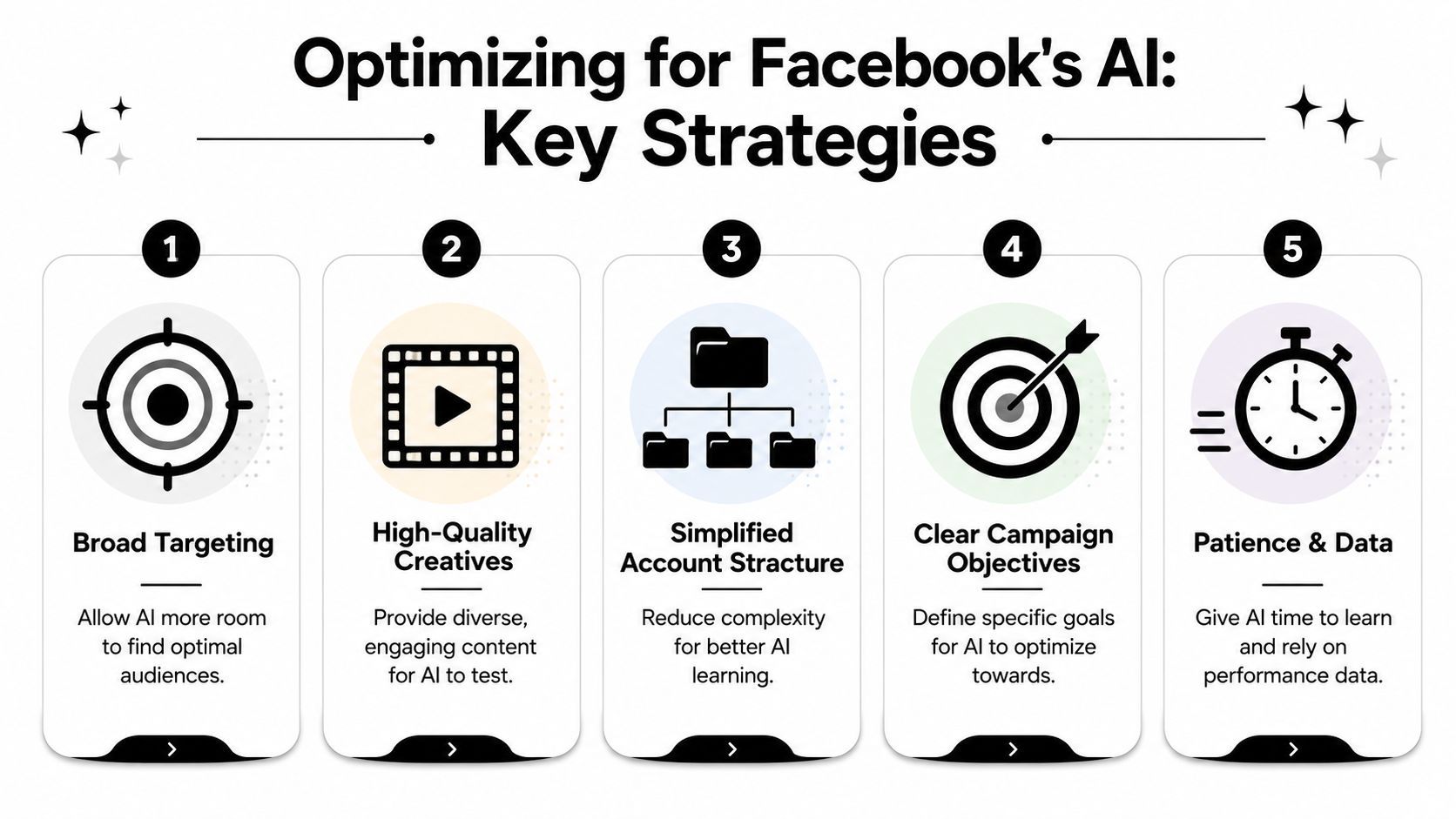
The teams that adapt fastest usually make two changes at once. They simplify account structure so delivery has room to work, and they put more effort into producing clearer creative inputs. That trade-off is easy to miss because platform interfaces pull attention toward campaign settings. Meta's AI gets stronger when the account is less fragmented and the creative library is more intentional.
A useful setup looks like this:
- Give delivery room to explore. Over-segmented audiences and too many small ad sets slow learning and hide winning pockets of demand.
- Choose the conversion event carefully. Optimize for the action that maps to real business value, not the easiest event to inflate.
- Refresh creative on a schedule. New concepts should enter testing before performance decays, not after.
- Judge patterns, not only individual ads. Winning messages often repeat across different executions.
- Keep the account clean. Redundant campaigns, overlapping tests, and inconsistent naming make it harder to read what the system is learning.
Creative is where the human plus machine model becomes practical.
Meta can match the right impression to the right user better than most media buyers can do manually at scale. It cannot pull sharp customer insight out of a vague brief. If the inputs are generic, the system will still optimize delivery, but it will optimize around mediocre persuasion.
That is why voice of customer work matters more now, not less. Pull phrases from reviews, comments, support tickets, return reasons, and sales calls. Then build ads around the actual buying motivation or objection in those phrases.
A skincare brand is a good example. The internal team may brief around "glow" or "radiance." Customers may care more about "doesn't sting," "works under makeup," or "fixes dry patches by noon." Those lines usually produce stronger hooks because they sound like a buyer, not a brainstorm.
Here is the workflow I see hold up in real accounts:
- Collect raw customer language from places buyers speak plainly.
- Group that language by problem, desired outcome, and objection.
- Write one brief per angle with a clear promise, proof point, and audience context.
- Produce multiple variations in different formats so Meta has real options to test.
- Review results by theme so you know which message is working, not just which ad ID happened to win.
That fifth step is where many teams still lose the plot. They pause losers and scale winners without extracting the lesson. A better read is: which claim got attention, which proof reduced skepticism, and which framing pulled in qualified clicks? Those answers improve the next batch of creative and give the algorithm better material to work with.
If your team struggles to maintain that output, a creative workflow built for ad variation testing can help keep the process consistent. The value is not automation for its own sake. The value is getting more usable inputs into Meta's system without flooding the account with random assets.
Human judgment still decides the angle. The machine helps distribute, test, and find the pockets of demand you would not spot by hand.
Building High-Performing Facebook Video Ads with ShortGenius
Video creates the clearest split between what Meta's AI can optimize and what the advertiser still has to decide. The platform can test delivery patterns at a scale no team can manage by hand. It still depends on the inputs you give it, especially the first three seconds, the message angle, and the format choices that determine whether people keep watching.
A practical workflow starts with one product and a small set of distinct angles. For a Reels campaign, I would usually build at least three:
- Problem-aware angle: name the friction the buyer already feels
- Outcome angle: show the result fast and in plain language
- Objection-handling angle: answer the reason someone hesitates before clicking
That structure matters because Meta needs real creative variation, not cosmetic edits. Swapping one caption line while keeping the same underlying message usually does not teach you much. Changing the promise, proof, or opening scene does.
That is where a video ad creation workflow for testing multiple angles earns its keep. ShortGenius combines scriptwriting, asset generation, voiceover, video assembly, resizing, and publishing in one system. The value is operational. You can turn one strategy brief into several usable ad variants without losing message discipline across the batch.
Format decisions should happen before production, not after. Short-form Facebook video works best when the message appears quickly, the frame is composed for mobile, and the product is visible early. Teams that build a polished horizontal video first and try to trim it into Reels later usually end up with weaker hooks, crowded captions, and awkward crops.
A better approach is to set the production rules up front:
| Creative decision | Practical implication |
|---|---|
| Video length | Build for short retention windows so the core claim lands fast |
| Frame design | Compose for vertical or mobile-first viewing from the first edit |
| Hook placement | Put the main promise, problem, or visual proof at the start |
| Variant production | Create multiple opens from the same core script and footage |
Once the format is right, the next job is scale with control. One script can become a useful test set if you vary the elements that change buyer response:
- Hook swaps for different awareness levels
- Scene swaps to emphasize product use, lifestyle, or proof
- Voice swaps to match tone and audience fit
- Caption edits to sharpen the first-screen message
- Resize passes for Feed, Stories, and Reels
That is precisely the human plus machine workflow. Software handles the repetitive production work. The marketer still decides what claim is credible, what proof belongs on screen, and which variations are different enough to justify spend.
Here's a quick product walkthrough that fits this kind of workflow:
Reviewing the outputs also changes. Do not judge the batch like an editor polishing a single hero ad. Judge it like a performance marketer trying to find signal. Which opening gets attention without sounding inflated? Which version shows the product soon enough? Which angle attracts clicks from people who are likely to convert, not just curious viewers?
That review loop is where many advertisers still waste the benefit of AI production. They get more assets, but not more learning. The point is to produce faster, test cleaner, and feed the next round with better judgments. That is how Facebook AI ads improve over time. The machine gets more to test. The human keeps raising the quality of what goes into the system.
The Future of AI Advertising and Your Next Steps
Facebook AI ads are heading toward more automation, not less. Delivery will keep getting more abstracted. Creative adaptation will keep getting faster. Privacy constraints will keep pushing platforms toward broader signal interpretation instead of the old style of hyper-manual targeting.
That doesn't reduce the advertiser's role. It sharpens it.
The teams that keep winning will do a few things consistently. They'll simplify account structures where complexity no longer helps. They'll treat creative production as a continuous system, not an occasional project. They'll build angles from customer language instead of relying on generic AI output. And they'll judge automation by business results, not by how impressive the feature list sounds.
A good next-step checklist is short:
- Audit your current workflow and identify where you're still over-managing delivery.
- Review your creative process and ask whether you can produce more distinct concepts each month.
- Pull Voice of Customer data before writing your next round of ads.
- Build for format early so your assets are usable across Feed, Stories, and Reels.
- Use AI where it increases speed, but keep human review where trust and specificity matter.
The practical edge in 2026 won't come from using more automation than everyone else. It'll come from giving the automation better material to work with.
If you want a cleaner way to turn product inputs, scripts, visuals, voiceovers, and ad-ready edits into usable video variations, ShortGenius is built for that workflow. It helps teams produce Facebook ad creative faster while keeping the human role focused on message, offer, and quality control.