Ecommerce Product Videos: Boost Conversions in 2026

Learn how ecommerce product videos boost conversions, the best formats, technical specs, and AI workflows to scale production fast.
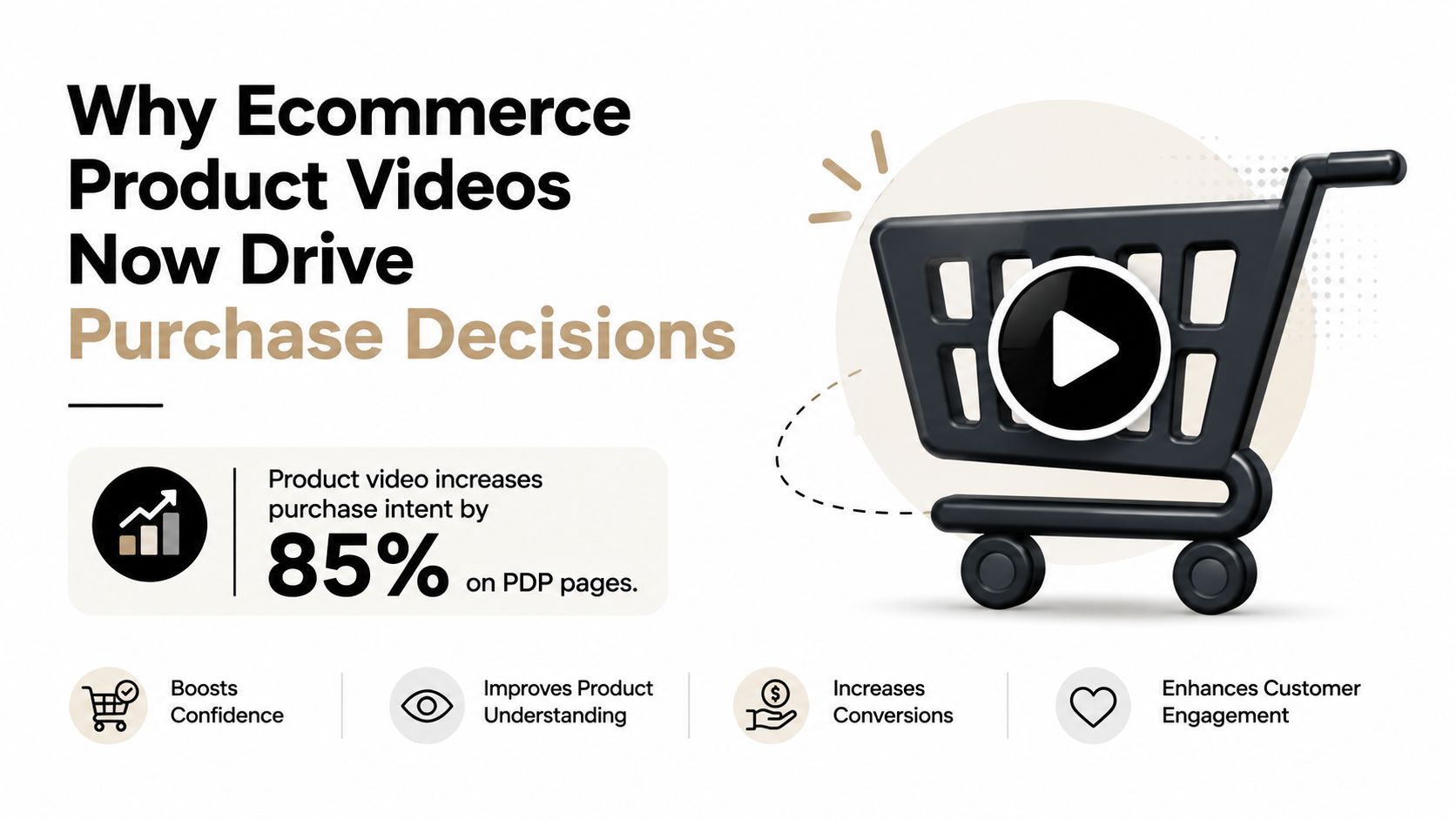
Product pages with video convert up to 80% better than pages without video, and shoppers who watch a product video are up to 144% more likely to add the item to their cart BusinessDasher. This is the key reason ecommerce product videos matter. They don't just make a page look better, they answer the buyer's question faster, reduce hesitation, and move people closer to purchase.
In practice, the best product videos are less about polish and more about proof. A shopper doesn't need a cinematic opener when they're wondering if a jacket fits loosely, if a blender sounds unbearably loud, or if a chair looks right in a small apartment. They need the video to be diagnostic, not decorative.
That's why video has become a core merchandising format, not a side experiment. Industry benchmarks cited in ecommerce video analyses show pages with embedded video average 4.8% conversion versus 2.9% without video, a 65% lift, while 75% of shoppers prefer video over text or images and 82% have bought something after watching a video WebTonic. The same body of research ties video use to 49% faster year-over-year revenue growth for companies that use it BusinessDasher.
Practical rule: if the video doesn't answer the top objection, it's probably not doing its job.
The rest of this guide focuses on what works. That means choosing the right format for the buyer's intent, making the first seconds pull weight, distributing one core asset across channels without wrecking consistency, and measuring whether the video changed behavior, not just views.
Why Ecommerce Product Videos Now Drive Purchase Decisions
The strongest reason to invest in ecommerce product videos is simple, they change what happens at the point of decision. A product detail page is where uncertainty turns into action, and video helps close that gap better than still images or paragraphs of copy. Industry benchmarks show pages with video convert up to 80% better than pages without video, which is a direct signal that video belongs in the buying path, not just the brand story.
The behavior shift is also visible in shopper preference. Research cited in ecommerce video analyses says 75% of shoppers prefer video over text or images to learn about a product, and 82% have bought something after watching a video WebTonic. That preference matters because it shows what buyers trust when they are trying to judge fit, function, and feel from a distance.
Video changes the cart decision, not just the mood
A strong product video does two jobs at once. It increases the chance that a shopper engages with the page, and it increases the chance that they keep moving toward checkout. One benchmark says shoppers who watch a product video are up to 144% more likely to add the item to their cart, while another commonly cited figure is a 37% increase in add-to-cart conversions on pages with video.
Those numbers matter because they show the effect sits upstream of the sale. Video does not just support branding. It changes the odds that a person will decide the product is worth buying. Companies using video also report 49% faster year-over-year revenue growth than companies that do not BusinessDasher, which is why serious ecommerce teams treat video like merchandising infrastructure.
The shift from text-heavy selling to visual demonstration is now built into ecommerce behavior. Industry research cited in 2026 analyses says 91% of businesses use video as a marketing tool. That does not mean every brand needs a studio, but it does mean buyers now expect richer proof before they commit.
If a PDP is where doubt gets resolved, video is the format that resolves doubt fastest. The next issue is which type of video answers which hesitation.
The Main Product Video Formats and When Each One Works
A product video earns its place by answering the buyer's top objection. If the shopper needs proof of function, a glossy brand clip is wasted effort. If they need to understand what arrives in the box, a polished lifestyle edit misses the point. The format should do diagnostic work, not decoration work.
Match the format to the hesitation
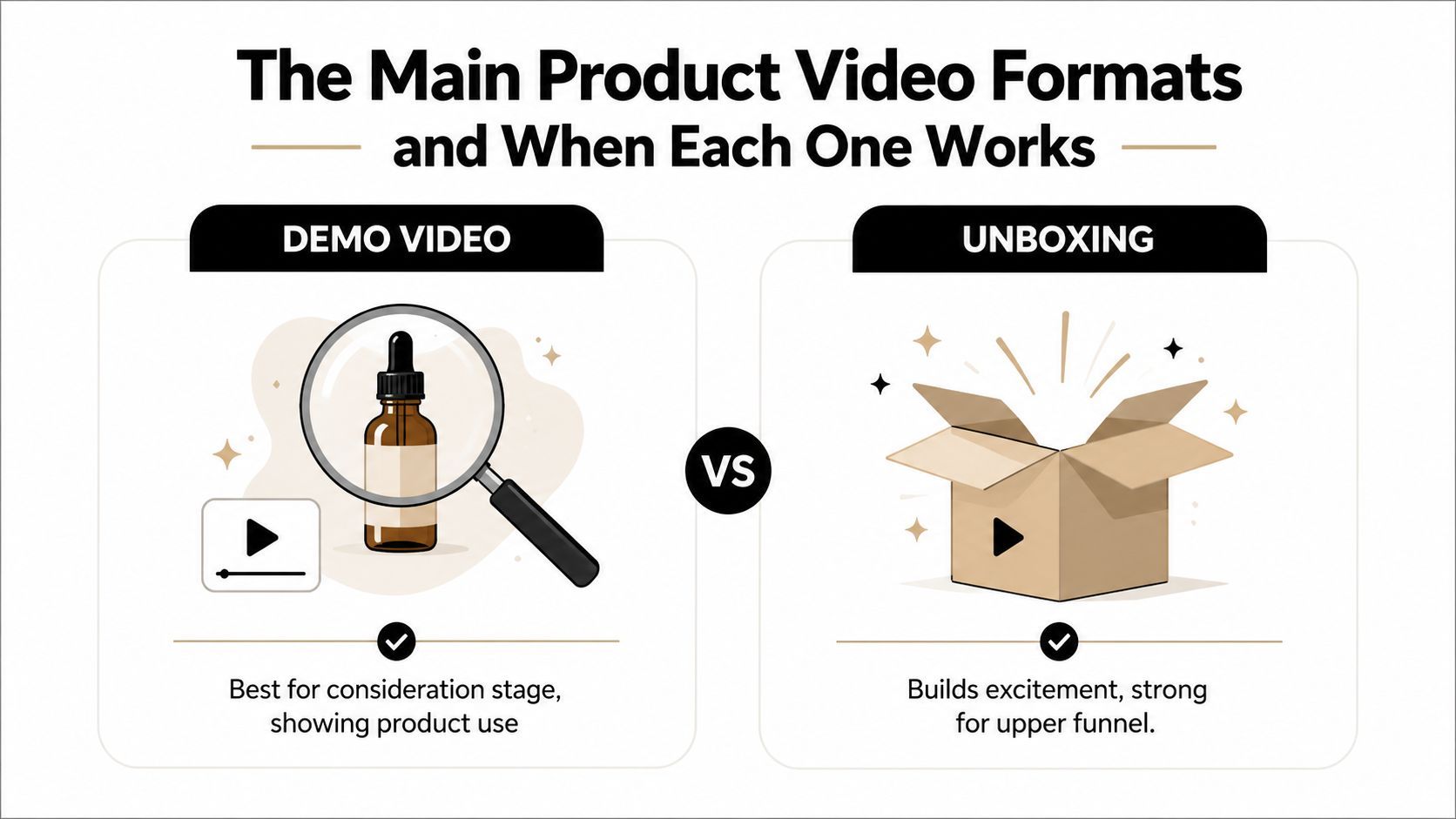
Demo videos work best when the shopper already wants the product but still needs proof that it performs. They show the item in use and make the mechanics clear. For a skincare tool, a coffee machine, or a foldable stroller, the demo supplies the missing context that static images cannot deliver. That is the right format when the objection is, "Will this do what I need?"
Unboxing videos are stronger at the top of the funnel and in gifting categories. They create anticipation, show packaging, and make the purchase feel concrete before the box is opened. They matter when presentation is part of the value, such as premium accessories, collectibles, or any product where the delivery experience shapes the buyer's expectation. For teams that sell products where packaging and first impressions carry weight, Clickstera Solutions LLC Amazon photography sits in the same family of proof, because the buyer is still judging what the item feels like before using it.
Lifestyle videos serve aspiration. Apparel, beauty, and home goods often benefit when the product is shown in motion, in context, or inside a room that feels lived in. These clips help the shopper picture ownership, which is different from understanding the mechanics. A lifestyle video can make the product feel right for the buyer's world even before the feature list does its job.
Trust clips and explainers close different gaps
UGC and testimonial clips are strongest near checkout because they reduce skepticism. A real person using the product in a real setting usually feels more credible than a polished brand cut. That matters when the shopper is asking whether the product will work for someone like them, or whether the claim holds up outside a studio setup.
Short explainers fit more technical products or anything with setup friction. If the product has parts, modes, compatibility issues, or a learning curve, the explainer should remove confusion quickly. Guides on ecommerce product video consistently point to demos, testimonials, unboxings, how-tos, and comparison formats as the core toolkit Syncle, but the useful way to think about them is by objection, not by genre.
Decision rule: if the buyer's biggest worry is understanding, use a demo. If the worry is trust, use proof from another person. If the worry is excitement, use unboxing or lifestyle framing.
The strongest teams start with the purchase barrier on the page. Once that barrier is clear, the format choice gets simpler, and the video does the job it was hired to do.
Creative and Technical Best Practices That Drive Results
A product video works hardest when it answers the buyer's main objection fast. If the opening seconds only deliver polish, the page loses attention before the product has done any useful work. A logo animation, a slow pan, or a generic mood shot may look clean, but they do not tell the shopper whether the item fits their needs.
Make the first seconds diagnostic
Strong ecommerce product videos show scale, texture, motion, and setup early because those details resolve uncertainty. A jacket should show drape and fit in motion. A lamp should show its size next to real furniture. A beauty product should show texture and application. A kitchen tool should show the actual use case, not only the finished result.
That is the practical shift many teams miss. A prettier video often does less for conversion than a clearer one. If the buyer is still unsure, extra atmosphere does not help much.
Show the thing that would matter if they had the product in their hands.
Keep the technical path clean
Performance still matters because a slow or cluttered player interrupts the momentum the video is supposed to create. For ecommerce product videos, the working baseline is clear, keep load time under 3 seconds, use a player without ads or suggested videos, choose the right aspect ratio, and turn captions on Swarmify. A useful implementation pattern is to test one product page video first, measure conversion lift over 30 days, then expand after it proves itself.
The aspect ratio choice matters too. 16:9 works for desktop, while 9:16 is the mobile-friendly option. If your audience watches mostly on phones, a desktop-first frame makes the product harder to read and the action harder to follow.
For marketplace execution, Amazon has its own constraints. The practical benchmark is MP4 or MOV, a maximum file size of 5 GB, 16:9 ratio, minimum 1280 x 720 resolution with 1920 x 1080 recommended, and a typical duration of 30 seconds to 2 minutes, with 30 to 90 seconds described as the attention-retention sweet spot Keevx. If you are exporting once and distributing widely, those limits should shape the master cut.
For teams that want a useful production reference, Clickstera Solutions LLC Amazon photography reinforces the same principle, show the product clearly, without clutter, and with enough visual detail to reduce hesitation.
Adapting and Distributing Product Videos Across Channels
A single product video should not stay locked to one page. Buyers meet that asset in different places, and each placement changes what the video needs to do. A PDP, Amazon listing, TikTok post, and YouTube placement all call for different framing, pacing, and length, even if they come from the same shoot.
Build one master cut, then derive the rest
Start with a master version that shows the product quickly and clearly. From there, create platform-specific versions instead of rebuilding the story for every channel. That keeps the message consistent and avoids the brand drift that happens when separate teams edit in isolation.
On site product pages, muted autoplay above the fold usually does the job. The video should help the page explain itself without relying on sound or extra clicks. That fits the shopper's job in that moment, which is to decide whether the product solves the problem they came to solve.
Amazon needs tighter discipline. The common upload shape is still MP4 or MOV, 16:9, up to 5 GB, and short enough to hold attention in the marketplace environment. Keep the master flexible enough to export a clean marketplace version without re-editing the entire piece.
Let each channel keep its native behavior
TikTok and Instagram Reels want 9:16, captions burned in, and the hook visible in frame one. If the opening beat takes too long to reveal the product, the feed has already moved on. YouTube can handle a longer explainer or a Short cut from the same source footage. Facebook still tends to reward more compact, square-friendly execution for broader audience consumption.
The operational point is simple. Distribution is not about multiplying effort, it is about multiplying fit. The same footage can support several placements if the team thinks in layers, master cut, aspect-ratio cut, short-hook cut, and marketplace cut. That lets a small team publish across channels without creating a separate production cycle for each one.
A distribution plan that does not include variant creation is usually just a publishing wish. A usable plan starts with the master asset and ends with the right file in the right format for the right feed.
Measuring Product Video Performance the Right Way
A product video can get watched and still fail to move a buyer. Views are easy to report, which is exactly why teams overrate them. The metrics that matter sit deeper in the funnel, where engagement turns into product interest and product interest turns into revenue.
Track behavior in funnel order
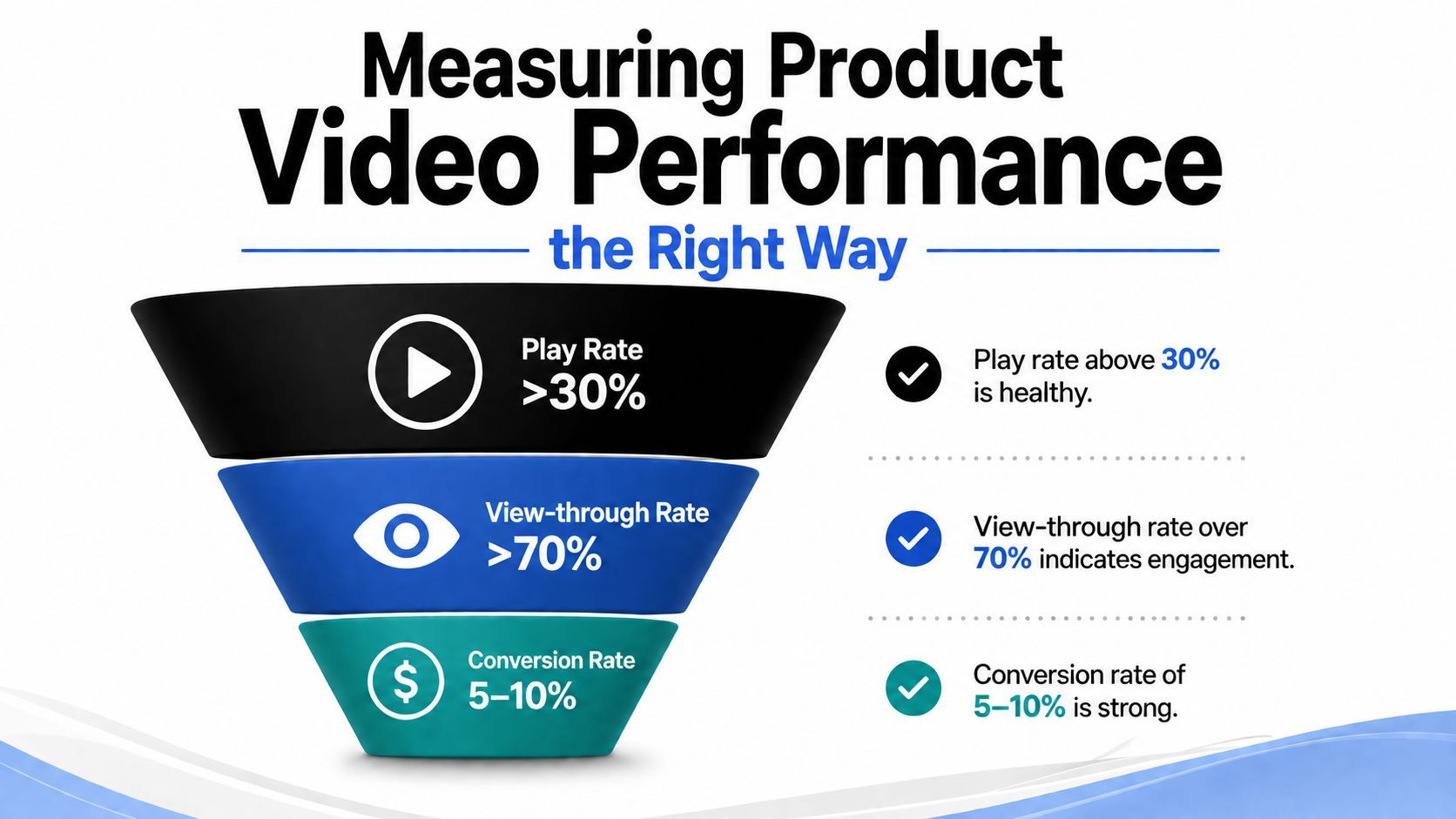
Start with play rate, because it shows whether the placement and thumbnail are earning attention. Then look at hold rate, which shows whether the first moments are persuasive enough to keep the shopper watching. After that, watch click-through to add to cart, then add-to-cart lift, then revenue impact.
Practical rule: if play rate is weak, fix placement or thumbnail. If hold rate is weak, fix the opening seconds. If add-to-cart does not move, the video is not answering the buying question.
The benchmark reality matters too. A 4.8% conversion rate on pages with video is an average, not a promise, and categories, traffic sources, and price points all change the result. That is why a finance partner will not accept “the video got views” as proof. They want to see behavior change on the page.
For a clean test, use one video per PDP, run it for a 30-day window, and compare against a holdout or a before-and-after baseline. That gives you a fairer read on whether the asset added value. If you are measuring paid placements, ROAS belongs in the same conversation as conversion, not in a separate slide deck.
The most useful dashboard is the one that tells a simple story. Did the video get seen, did people keep watching, did they move closer to purchase, and did that movement show up in revenue? If the answer is yes, you have a merchandising asset. If not, you have content that needs a clearer job. Teams that need to produce more testable variants can speed that learning cycle with ShortGenius, since volume only helps when it is tied to a specific objection and a specific metric.
Video:
Scaling Production With AI Workflows Like ShortGenius
Production speed is the bottleneck for most ecommerce teams now, not creative taste. A brand may need several variants to test hooks, CTAs, and angles across channels, but a traditional shoot-and-edit process often produces only one or two. That gap is why AI-assisted workflows are becoming operationally relevant instead of experimental.
Versioning beats one perfect cut
The practical advantage of AI video workflows is that they let a small team generate more usable variants from the same product inputs. ShortGenius can assemble product-focused videos from scripts, images, scene structures, captions, voiceovers, and format-specific exports in one workflow, which makes it easier to create the variations needed for testing and distribution. Used well, that means a marketer can move from a static product page asset to social-ready cuts without rebuilding everything manually.
The test burden is real. Different hooks, different openings, different CTAs, and different aspect ratios all need to be tried against actual audience behavior. If production takes too long, the team defaults to a single generic video and never learns which version really reduces friction.
Human review still has to stay in the loop
AI doesn't remove the need for judgment. Product accuracy, compliance, and claim verification still need human review before anything goes live. That's especially true for categories where fit, ingredients, or performance expectations can create customer service issues if the video overpromises.
The useful way to think about AI here is as a throughput tool, not an authority. It helps the team ship more variants, faster, while keeping the final call with the marketer or creative lead who understands the product and the audience. Practical Ecommerce has noted the normalization of generative AI tools for ecommerce production, which is a sign that speed is becoming a real strategic constraint in the category Volusion.
If you're evaluating workflow options, ShortGenius is one example of a platform that combines script generation, visual assembly, voice, captions, resizing, and brand kit application in one place. That kind of setup matters less because it looks advanced and more because it reduces the number of handoffs between idea and publishable asset.
Real-World Examples of Product Videos That Worked
A beauty brand doesn't need a glamorous spot if the core objection is texture. In practice, a short diagnostic clip that shows shade, application, and finish often does more work than a polished lifestyle reel because it answers the question the shopper has. The lesson is simple: when the category has high uncertainty, clarity beats atmosphere.
An apparel DTC team can also win by cutting multiple vertical variants from one studio master. That approach keeps the brand consistent while giving TikTok and Instagram the native pacing they expect. It also lets the team test different openings without reshooting the product every time, which is where many small brands lose momentum.
A home goods seller using an Amazon explainer can get a different kind of lift by showing scale, assembly, and use in a compact format that matches marketplace behavior. The useful pattern is not “make it cinematic,” it's “make the product easier to buy.” That's the thread across categories, the video that sells is usually the one that removes the most doubt the fastest.
Your 30-60-90 Day Product Video Action Plan
Start with one hero SKU and build one core product video for the PDP. Track baseline performance, then compare the page with and without the video so you can see whether it changes behavior.
In days 31 to 60, cut that master into TikTok, Reels, and YouTube Shorts versions, then test two hook variations. Watch hold rate and add-to-cart lift, not just views.
By days 61 to 90, add a second SKU, create a reusable template in an AI workflow, and document a brand kit so future videos stay consistent. If play rate is low, fix the thumbnail or placement first. If add-to-cart lift is flat, the video probably isn't answering the buyer's top objection.
A CTA for ShortGenius (AI Video / AI Ad Generator).