Create Video Ads With AI That Actually Convert

Learn how to create video ads with AI that drive real results. This guide offers proven strategies for planning, generating, and optimizing AI video ads.
Creating video ads with AI isn't about just swapping one tool for another. It’s a complete overhaul of the old, linear production line into a nimble, agile workflow. Think of it less like a long march and more like a series of quick sprints.
You're using AI to generate scripts, piece together scenes, and produce voiceovers almost instantly. This allows you to create and test ads at a speed that was once unthinkable. The core idea is to shift from spending months chasing perfection to spending minutes on iteration and letting the data tell you what works.
The New Reality of Video Advertising
Let's be real—the traditional way of making video ads is broken. The painfully long timelines, eye-watering budgets, and creative gridlock just don't cut it anymore. In a world that demands a constant stream of fresh content for platforms like TikTok and Instagram, sticking to the old model isn't just inefficient; it's a threat to your business.
This is why everyone from solo creators to massive global brands is turning to AI video tools. It's become a necessity. The pressure is on to produce, test, and tweak ads faster than ever before, especially when a trend can be born and die in the span of a weekend.
Speed and Cost Are the Game-Changers
We all know how slow and expensive traditional video production is. A single, polished 60-second ad can easily take weeks and cost thousands of dollars when you factor in scriptwriters, actors, film crews, and editors. This has always made it incredibly difficult for smaller businesses to compete or for bigger brands to test more than one or two creative ideas at a time.
AI flips the entire economic model on its head. I've seen teams go from spending $4,500 per minute of video to just $400. The creation time for a 60-second ad plummets from 13 days to a mere 27 minutes. This isn't a future-state fantasy; this is what AI makes possible right now.
This incredible leap in efficiency is exactly why the market is exploding. The global AI video generator market is on a rocket ship, projected to hit $946 million by 2026 and then soar toward $3.35 billion by 2034. You can dig into these AI video generation statistics yourself, but the trend is undeniable. Businesses are scrambling to adopt these tools to keep up.
A Level Playing Field
What this really means is that the game is changing for everyone. AI empowers the little guys, giving them the tools to create high-impact ads that can go toe-to-toe with big-budget productions. When you can brainstorm and generate a dozen different ad concepts in the time it used to take just to schedule a kickoff meeting, you’ve got a serious competitive advantage.
The strategy shifts from pouring all your resources into one "perfect" ad to launching multiple versions and letting real-world performance data pick the winner.
To really see the difference, it helps to put the two approaches side-by-side.
Traditional vs AI Video Ad Production At a Glance
The table below breaks down just how stark the contrast is between the old way of doing things and the new AI-powered workflow.
| Metric | Traditional Process | AI-Powered Process |
|---|---|---|
| Time | Weeks or Months | Minutes or Hours |
| Cost | High ($1,000s+) | Low ($10s-$100s) |
| Complexity | High (Requires a full team) | Low (Manageable by one person) |
| Iteration | Difficult and Expensive | Fast and Affordable |
| Scalability | Limited by budget and team | Nearly unlimited |
Looking at this, it's easy to see why the old model is failing. It's too slow, too rigid, and far too expensive for today's advertising demands. When you start creating video ads with AI, you’re embracing a workflow built for speed, agility, and constant improvement. It’s a practical shift that’s already well underway.
Building Your AI Video Ad Blueprint
I see it all the time: people get excited about a new AI tool and dive right in, expecting magic. The result? Generic, forgettable ads that fall completely flat. Before you even dream of writing a prompt, you need a solid plan. This blueprint is what separates a winning campaign from a pile of wasted effort, and it’s the foundation for every decision you’ll make.
Think of it as giving your AI co-pilot a destination and a map. Without them, you’re just driving in circles.
So, let's start with the destination. Vague goals like "more sales" won't cut it. You need something sharp and measurable. Are you trying to get 500 sign-ups for a new webinar? Or maybe your focus is selling out a new product in its first week? A precise goal like that sets the tone for the entire ad.
Know Who You Are Talking To
Once you know what you want to achieve, you have to figure out who you're talking to. This is where a clear audience persona comes in, and it's way more than just age and location. You need to get inside their head. What keeps them up at night? What are they secretly hoping for? What slang or jargon do they use?
An ad for a 22-year-old student passionate about sustainable fashion needs to feel completely different than one for a 45-year-old executive searching for productivity software.
This persona shapes everything:
- The Script's Vibe: Is it funny and casual, or is it buttoned-up and authoritative?
- The Visuals: Are you going for bright, fast-paced user-generated content (UGC) or sleek, cinematic shots?
- The Problem You Solve: What specific headache does your product cure for this person?
If your ad tries to speak to everyone, it will end up connecting with no one. A great exercise I recommend is to write a quick, one-paragraph description of your ideal customer. Write it as if you're describing a real person you know.
Brainstorming Concepts for AI
Okay, now you’re ready to brainstorm concepts that actually play to AI's strengths. The trick isn't to just ask the AI to "make a cool ad." Instead, you feed it the core ingredients of a killer short-form video. Your job is to build a reliable structure, and the AI's job is to generate compelling variations you can test.
In my experience, every strong ad concept has three non-negotiable parts:
- A Thumb-Stopping Hook: You have three seconds. That's it. Your hook has to be an absolute showstopper that grabs them by the collar.
- A Punchy Value Prop: Get to the point. What does your product do, and why should they care? Be clear and be quick.
- A Crystal-Clear CTA: Don't be shy. Tell them exactly what to do next—"Shop Now," "Learn More," or "Sign Up Today."
This whole process of planning and then generating with AI completely flips the old, slow workflow on its head. It’s a much faster, more iterative cycle.
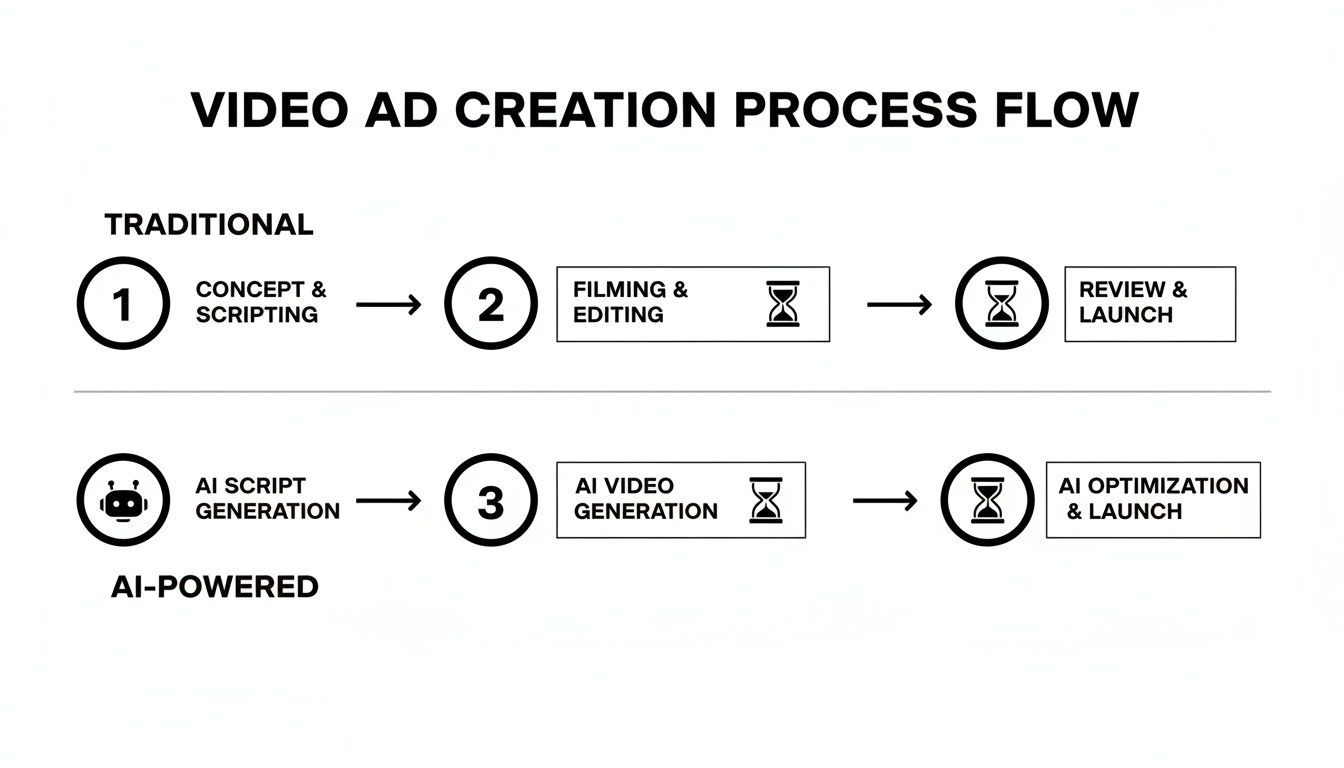
As you can see, planning is what fuels the AI engine. To pick the right engine for the job, you might want to look into some dedicated AI Video Tools that have the specific features you’ll need to bring your blueprint to life.
Key Takeaway: A detailed blueprint doesn't kill creativity—it focuses it. When you give AI a clear goal, a specific audience, and a proven structure, you're guiding it to create ads that aren't just clever, but strategically designed to work.
Let's imagine a direct-to-consumer (DTC) brand launching a new skincare serum. Their blueprint might set a goal of 500 sales in the first week, targeting women aged 25-35 who are already following beauty influencers. With that plan, they could test three different hooks: one using a dramatic "before and after," another highlighting a rare, natural ingredient, and a third featuring an AI-generated testimonial. This is how you make A/B testing truly powerful.
If you're interested in that last idea, our guide on how to create AI UGC ads is a great next step for that specific strategy.
Bringing Your Ad to Life With AI
Alright, you've got your strategy mapped out. Now for the fun part: actually making the ad. This is where your planning meets AI-powered production, and you get to generate the scripts, visuals, and voiceovers that will define your campaign.
Don't think of this as just hitting "generate" and crossing your fingers. It’s more of a creative dance. You lead with the strategy, and the AI follows with rapid-fire execution, giving you the raw materials to build with.
The sheer speed is what makes this process so powerful. What used to take a whole team of people—writers, voice talent, videographers—can now be done in a matter of minutes on one platform. This efficiency is why experts are predicting that by 2026, almost 40% of all video ads will be created or touched by generative AI. That's a huge leap from just 22% in 2024, and it's all driven by the growing demand for more personalized content. If you want to go deeper into the numbers, the IAB has some great insights on eMarketer.com.
Crafting Prompts That Get Results
I can't stress this enough: the single biggest factor in your AI ad's success is the quality of your prompt. Garbage in, garbage out. If you give the AI a vague request, you'll get a generic, forgettable ad.
A lazy prompt looks like this: "Create an ad for my new running shoes."
A great prompt pulls directly from your strategic blueprint, feeding the AI everything it needs to know about your audience, hook, value proposition, and call to action.
Let's say you're an e-commerce brand selling eco-friendly yoga mats. Here's a prompt designed to get a fantastic result:
"Generate a 30-second video script for TikTok. The target audience is Gen Z and eco-conscious consumers. The hook should be a question: 'Is your yoga mat poisoning your practice?' The ad needs to highlight the mat's non-toxic, sustainable cork material. Keep the tone calm and inspiring. End with a strong CTA: 'Flow cleanly. Shop our new mat now.'"
See the difference? This prompt gives the AI specific, actionable instructions:
- Target Platform: TikTok
- Audience: Gen Z, eco-conscious
- Hook: A pointed, curiosity-driving question
- Value Prop: Non-toxic, sustainable cork
- Tone: Calm and inspiring
- CTA: A clear, direct command
When you use a unified tool like ShortGenius, you can feed it a prompt like this and get several script variations in seconds. This is a game-changer for A/B testing down the line, as you can try out different angles without any real extra work.
From Text To Compelling Visuals
With a winning script in hand, it's time to create the visuals. The best AI tools can take your script and generate corresponding video clips or images scene by scene. Your job is to act as the director, making sure the visuals tell a story that feels cohesive and on-brand.
For that yoga mat ad, you could prompt the AI for specific shots:
- A macro close-up showing the natural texture of the cork yoga mat.
- A wide shot of a woman in a sun-drenched studio, holding a peaceful yoga pose on the mat.
- A satisfying slow-motion shot of the mat unrolling smoothly.
Think like a filmmaker. Instead of just "woman doing yoga," be descriptive. "Serene woman in athletic wear performing a warrior pose at sunrise." The more vivid your description, the better the visual output. This is where advanced text-to-video models really flex their muscles, turning your written direction into dynamic motion.
Finding The Right Voice And Music
Video is an audio-visual medium, and sound is easily half the battle. The right voiceover and music can instantly set the mood and make your ad stick in the viewer's mind.
AI voice generation has gotten incredibly realistic. You can browse huge libraries of voices to find the perfect match for your brand.
- Energetic and Upbeat: Great for a product launch or a flash sale.
- Calm and Trustworthy: A perfect fit for wellness, finance, or B2B brands.
- Friendly and Relatable: Works wonders for user-generated content (UGC) style ads or product tutorials.
Our yoga mat ad would pair perfectly with a calm, reassuring female voice. Add in some gentle, ambient music, and you've built an entire audio-visual experience that reinforces the core message of sustainability and peace.
Pro Tip: Always generate your video with a few different voiceovers and music tracks. Listen back to each version. You'll often be surprised by how a simple audio swap can completely change the ad's vibe and overall impact.
The real magic of using AI here is the ability to iterate. If a scene feels off, regenerate it. If a line of dialogue sounds clunky, get a new one instantly. This frictionless workflow lets you experiment and polish your ad until it’s just right, all without the massive time and budget sinks of traditional production.
Once your AI ad is ready, knowing how to use a full video link in bio is a smart move. It helps drive traffic directly from your social profiles, making it easier for engaged viewers to take the next step.
Refining Your AI-Generated Video
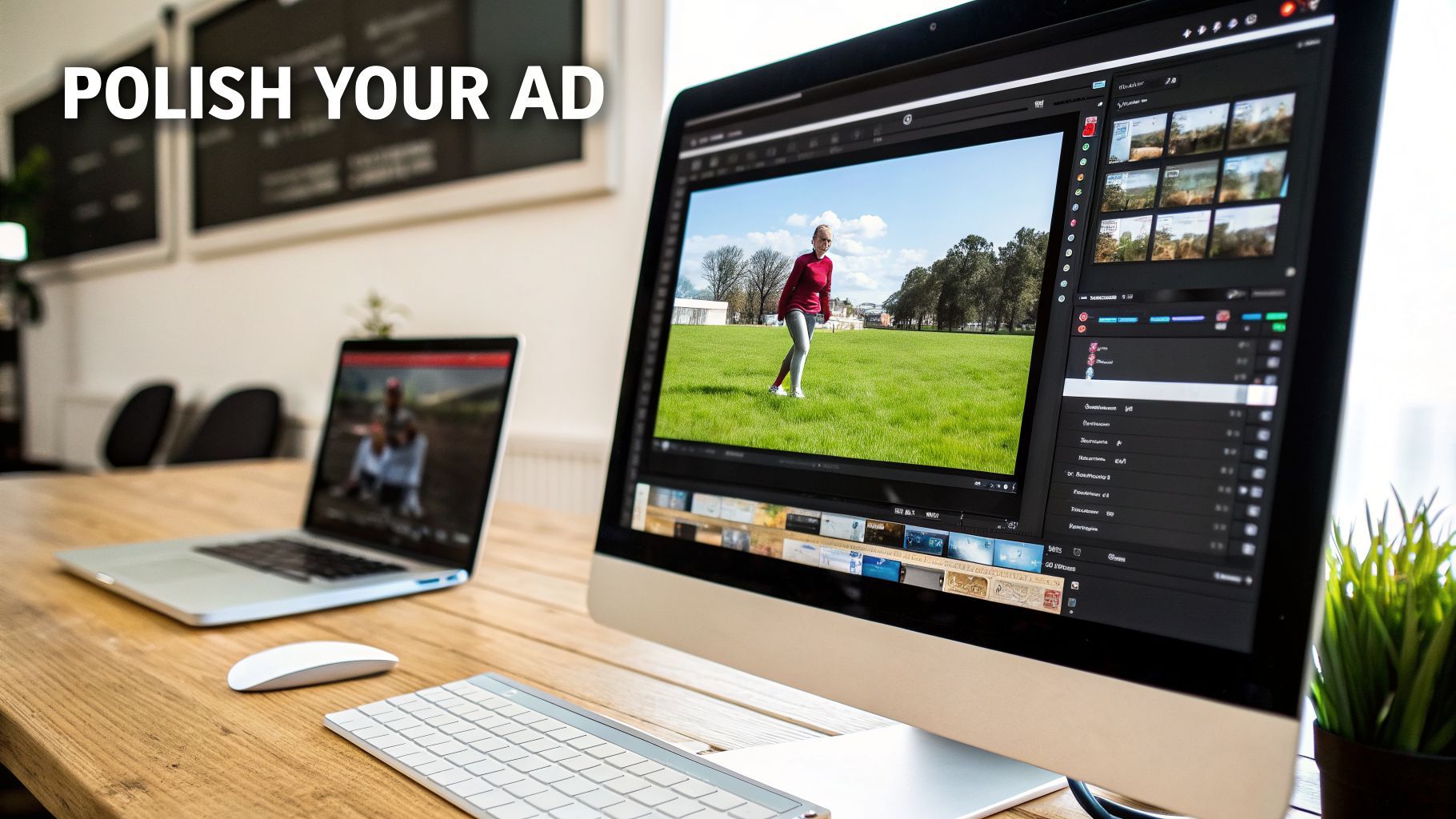
So, you've got the raw footage from the AI. Great. But we're not done yet—not even close. The clips an AI generates are the clay, not the finished sculpture. This next step, the human touch, is what separates a decent ad from one that actually stops the scroll and gets results.
This is where your expertise comes in. You’ll be trimming the fat, polishing the visuals, and shaping the narrative to connect with your audience. It's the most critical part of the process when you create video ads with AI.
Mastering the Pace and Flow
Pacing is everything in a social media ad. If it’s too slow, you’ll lose viewers to the next video in their feed. Too fast, and the message gets lost in a frantic blur. Your first job is to find that perfect rhythm.
Jump into your editor and start snipping. Almost every AI video tool has a basic trim function. Get ruthless with it. Cut out any awkward pauses, slow moments, or frames that don't add value. The goal for social ads is to maintain high energy and deliver your message crisply.
For instance, if the AI gave you a five-second scene but all the important action happens in the first three, chop off the last two seconds without a second thought. Every single moment on screen has to earn its keep.
The Power of Dynamic Captions
Let’s be real: adding captions isn't a "nice-to-have" anymore. With so many people watching videos on mute, bold and engaging captions are non-negotiable if you want your message to land.
But don’t just slap on the default text and call it a day. Your captions should be a key part of the visual experience.
- Emphasize Keywords: Make important words pop with a flash of color or bold text.
- Use Emojis: A few well-placed emojis can inject personality and catch the eye.
- Animate Text: Sync words to the voiceover by having them appear one by one.
Think about it this way: your ad’s main hook might be read, not heard. By designing captions that grab attention, you make sure your message hits home even in a sound-off world. This one step can have a huge impact on comprehension and recall.
Tools like ShortGenius let you customize captions with ease, helping them stand out in a crowded feed. It’s a small effort for a massive potential return.
Resizing for Every Platform
An ad formatted for a wide YouTube screen will look awful cropped into a vertical TikTok video. You absolutely have to optimize the aspect ratio for every platform you’re running on. Thankfully, this isn’t the headache it used to be.
With a few clicks in most modern editors, you can reformat your video for all the essential sizes.
- 9:16 (Vertical): The standard for Instagram Reels, TikTok, and YouTube Shorts.
- 1:1 (Square): A solid choice for Instagram and Facebook feed posts.
- 16:9 (Horizontal): Best for traditional YouTube videos and website embeds.
This is about more than just getting rid of ugly black bars. Proper resizing ensures your product, logo, and call to action are perfectly framed and visible, no matter where or how someone is watching.
Applying Your Brand's Signature Style
Brand recognition hinges on consistency. Even if the core visuals are from an AI, the final ad must feel like it came from you. This is where a brand kit is your best friend.
A brand kit typically stores your logo, brand colors, and official fonts. Applying these elements is the final layer of polish that makes the ad unmistakably yours. For anyone creating content at scale, having a simple way to apply these assets is a must. You can see how modern tools are making this easier in our look at advanced image editing features.
Subtle camera movements, like a slow zoom-in on the product or a gentle pan across a scene, can also add a professional, dynamic quality. Use these effects strategically to create a powerful "scroll-stopper" in the first 3 seconds. This is where your human creativity adds a layer of polish that AI simply can't replicate on its own.
Launching and Analyzing Your AI Ad Campaign
So you've created a brilliant, polished video. That's a huge win, but it's only half the battle. An ad that nobody sees—or one that doesn't actually get people to click—is just a well-made file sitting on a server. This last phase is all about getting your AI-generated ad in front of the right people and figuring out what works so you can do more of it.
This is where your AI-powered workflow becomes a serious competitive advantage. Because you can churn out variations so quickly, you can finally stop guessing and let real data drive your creative strategy. It's what separates campaigns that scale from the ones that just sputter out.
Scheduling and Publishing Your Ads
Let’s be honest, manually uploading videos to every social platform is a soul-crushing task. Thankfully, those days are pretty much over. Modern tools, especially ones built for creating content at scale, integrate scheduling right into the platform.
A great example is ShortGenius, which lets you connect your TikTok, Instagram, and YouTube accounts to push your finished ads live on a set schedule. This isn't just about saving time; it's about being strategic. You can map out an entire week or month of content, which guarantees a consistent brand presence without the daily scramble to post something.
The Smart Way to A/B Test Your AI Ads
A/B testing is where using AI to make your video ads truly pays off. Forget spending weeks and a small fortune to produce two versions of an ad. Now, you can spin up five or ten variations in a single afternoon. This allows you to test specific elements to find out what actually grabs your audience.
Here’s a simple framework for running A/B tests that deliver real answers:
- Test Your Hooks: The first three seconds are everything. Create three versions of your ad that are identical except for the opening scene or first line. One could be a question, another a bold claim, and the third a visually jarring shot.
- Vary Your Calls-to-Action (CTAs): How you ask for the sale matters. Test different closing lines to see what works. Does a straightforward "Shop Now" beat "Learn More"? What about adding urgency like, "Shop the Sale Before It's Gone"?
- Compare Entire Concepts: Pit two totally different ideas against each other. If you're a coffee brand, one ad might focus on the "get-up-and-go energy boost" while another sells the "cozy morning ritual" vibe. With AI, you don't have to choose—you can test both.
I always tell people to start with the hooks. From my experience, a killer hook can improve an ad's performance more than any other single tweak. If you can't stop the scroll in the first three seconds, the rest of your ad doesn't matter.
Once your variations are ready, run them at the same time to small, similar audience segments. Let them run long enough to get solid data, then divert your ad budget to the winner.
Demystifying Your Ad Performance Metrics
Drowning in data is a real risk, but you only need to focus on a few key numbers to know if your ad is actually working. Don't get distracted by vanity metrics; zero in on what directly impacts your business goals.
This focus is more important than ever in what some are calling the "attention crash." Recent analysis showed that while ad impressions shot up 53% between 2024 and 2025, actual clicks fell off a cliff. This is exactly why video is so critical—it's one of the few things that can still capture a user's fleeting focus. Video ads consistently pull 20-30% higher click-through rates than static images, making them essential. You can dig deeper into these trends with some valuable advertising insights on TheBrief.ai.
Here are the core metrics you should obsess over:
| Metric | What It Measures | Why It Matters |
|---|---|---|
| Click-Through Rate (CTR) | The percentage of people who see your ad and click on it. | This tells you if your creative is compelling. A low CTR is a huge red flag that your hook or offer isn't connecting. |
| Cost Per Conversion (CPC) | The average cost you pay for a specific action, like a sale or lead. | This is all about efficiency. The goal is to drive this number as low as possible without sacrificing the quality of the customer you're acquiring. |
| Return On Ad Spend (ROAS) | The total revenue you earn for every dollar you spend on ads. | This is the bottom line. It's the ultimate measure of profitability. A 3:1 ROAS means you’re making $3 for every $1 spent. |
Watching these numbers closely lets you make smart, informed decisions. If your CTR is amazing but conversions are low, the problem probably isn't your ad—it’s your landing page. If your ROAS is in the gutter, it’s time to test a new creative angle or audience. This loop of creating, testing, analyzing, and iterating is the engine of modern advertising success.
Common Questions About AI Video Ad Creation
Whenever I talk to people about using AI for video ads, the same few questions always come up. It's a new field for most, so it's natural to have some healthy skepticism. Let's clear the air on some of the biggest concerns I hear from creators and brands.
First off, the big one: "Will AI replace human creativity?" Honestly? No. That was never the point. The best way to think about AI is as a creative co-pilot, not an autopilot. You're still the director.
Your strategy, your deep understanding of the brand, and your gut feeling for what makes your audience tick—that's what you bring to the table. AI just handles the technical grunt work, but the soul of the ad comes directly from you.
How Do I Keep AI Ads From Looking Generic?
This is probably the most common fear, and it’s a fair one. We’ve all seen those soulless, cookie-cutter AI videos. The secret to avoiding that trap is getting incredibly specific with your prompts. Vague instructions will always give you bland results.
- Go deep on context. Don’t just ask for “an ad for a coffee brand.” Get into the specifics. Try something like, “Generate visuals for a rustic, small-batch coffee brand that celebrates quiet morning rituals and craftsmanship.”
- Iterate on your visuals. Never settle for the first thing the AI spits out. Keep refining your prompts until it nails the aesthetic. Push it further with prompts like, “a cinematic close-up of steam rising from a handmade ceramic mug at sunrise.”
- Use your brand kit. This is non-negotiable. Applying your brand's unique fonts, colors, and logo is the fastest way to make an AI-generated ad feel like it truly belongs to you.
The biggest mistake you can make is just accepting the default settings. The real magic happens when you treat AI as a collaborator. It’s a dialogue between your specific vision and the tool's ability to generate—not just a one-way command.
Ensuring Your Ads Are Brand-Safe and Original
That brings us to another big worry: brand safety and originality. How do you know the AI isn't ripping off copyrighted material or creating something that goes against your brand's values? This is where the human element is absolutely critical.
An AI has no concept of your company's mission or the subtle nuances of your brand voice. You are the final gatekeeper, and it's a role you can't delegate. Before any ad goes live, you have to review every frame, every word of the script, and the overall tone. Most high-quality platforms are built to create entirely new assets, but you're the one hitting "publish," so the final responsibility is always yours.
Ready to stop wondering and start creating? With ShortGenius, you can turn your ideas into high-performing video ads in minutes. Our platform gives you the tools to generate scripts, visuals, and voiceovers, then edit and schedule them all in one place. Join over 100,000 creators and teams today!