Behinde the Scene Videos: A Step-by-Step Guide

Learn how to create engaging 'behinde the scene' videos with our step-by-step guide. Covers planning, shooting, AI editing with ShortGenius, and repurposing.
You record a polished main video, export it, post it, and then the pressure starts again. The next idea needs scripting. The next shoot needs setup. The next edit needs hours you probably don't have. For most creators, the problem isn't a lack of ideas. It's that every video feels like starting from zero.
That's why behinde the scene content works so well when you treat it as a system instead of an afterthought. The footage already exists around your real work. The challenge is capturing it cleanly, shaping it into a story, and turning one recording session into multiple useful assets without creating more chaos.
The creators who stay consistent usually don't work harder on every post. They build a repeatable loop. Plan the moments worth capturing. Shoot them in a way that feels natural. Edit fast. Repurpose aggressively. Then review what performed and refine the next batch.
Why Behind the Scene Content Is Your Secret Weapon
Most creators think BTS content is the “extra” post. It isn't. It's often the most efficient content in the whole pipeline because it shows the work you're already doing, with less pressure to manufacture a perfectly polished concept every time.
When someone watches behinde the scene footage, they're not just consuming information. They're watching decisions, mistakes, revisions, tools, and process. That lowers the distance between creator and audience. A tutorial can teach. A polished ad can persuade. BTS does something different. It gives people context for how the work gets made, and context builds trust.
BTS removes the blank page problem
A lot of burnout comes from treating every post as a standalone production. BTS changes that. One long-form recording session, product shoot, client project, podcast, or design sprint can generate an entire layer of support content.
That's where back-of-the-envelope estimation becomes useful. A practical way to size your production capacity is to start with one pillar video per week, then estimate 5 to 7 BTS short-form clips from that same effort, as described in ByteByteGo's explanation of back-of-the-envelope estimation. The same source notes that 80% of system design candidates fail BOTE because they chase precision instead of useful approximations. Creators make the same mistake when they over-plan content calendars down to the minute instead of building a workable output range.
Practical rule: Don't ask, “Can I create daily BTS content?” Ask, “How many usable moments usually come from one real work session?”
That shift matters. It turns content from a creativity problem into an operations problem you can manage.
What works better than polished filler
BTS performs best when it reveals a real moment with a clear angle. Good examples include:
- A decision point where you explain why you chose one hook, frame, or product shot over another
- A friction moment like bad lighting, messy audio, or an edit that didn't work
- A tiny win such as landing the shot, fixing the color, or getting the pacing right
- A repeatable method your audience can copy in their own workflow
What usually doesn't work is random studio footage with no point. A coffee pour, keyboard clicks, lens changes, and timeline clips aren't enough on their own. They need a story function.
The long-term advantage
Behinde the scene content also gives your brand texture. Over time, your audience starts recognizing your process, your environment, and your standards. That familiarity makes future posts easier to trust because people have seen the work behind them.
BTS is rarely about spectacle. It's about proof.
For solo creators and small teams, that makes it one of the most effective formats available. You're not adding a second creative job. You're documenting the first one in a smarter way.
The Blueprint for Planning and Scripting Your BTS Narrative
A useful BTS video starts before the camera is on. If you wait until you're halfway through a shoot to decide what the “behind the scenes” angle is, you'll end up with scattered clips and no story.
The easiest way to plan behinde the scene content is to pick one narrative lane per piece. Not five. One.
Pick the angle before you pick the shots
The strongest BTS clips usually fall into one of these buckets:
-
The process
Show how something gets made from rough start to near-finished result. -
The struggle
Capture the friction. Retakes, setup issues, bad framing, missed cues, creative indecision. -
The tools
Focus on the phone rig, editing timeline, lighting choice, mic setup, or software stack. -
The judgment call
Explain why one version won over another. -
The environment Show the actual working context. Desk, studio corner, whiteboard, product table, location prep.
Once you choose the lane, the script becomes much easier. You don't need a formal screenplay. You need a short narrative arc that gives the viewer a reason to stay.
A simple structure works:
- Opening beat: what you're making
- Middle beat: what got in the way or what mattered most
- Ending beat: what changed, what worked, or what you'd do differently
Use prompts that force clarity
If you freeze when scripting short videos, use prompts that generate movement:
- What am I trying to make right now?
- What nearly went wrong?
- What detail would another creator miss?
- What decision certainly improved the result?
- What clip proves that?
This is also where angle selection matters. Commercially, shot choice isn't just style. It changes outcomes. A TubeBuddy analysis referenced here found that behind-object shots increased click-through rates by 18% and low-angle shots boosted add-to-cart rates by 12% in a set of DTC YouTube Shorts. For creators making product-driven BTS, that's a reminder to stop treating shot variety as decoration. It affects how people respond.
If the story is “watch me making this,” the shots should prove access. If the story is “watch me solving this,” the shots should prove tension.
Essential Behind-the-Scenes Shot List
| Shot Type | Description | Purpose in the Story |
|---|---|---|
| Wide establishing shot | A full view of your workspace, studio corner, desk, or location | Gives context and sets the scene quickly |
| Over-the-shoulder shot | Camera behind you while you edit, draw, type, or review footage | Makes the viewer feel involved in the process |
| Close-up of tools | Tight shot of a keyboard, lens, mic, sketchbook, timeline, or product | Adds texture and specificity |
| Screen detail | A close shot of the monitor, preview window, script, or waveform | Shows actual work, not generic activity |
| Hand action shot | Hands adjusting lights, moving props, cutting clips, or arranging gear | Adds motion and rhythm |
| Behind-object shot | Frame the scene through a mug, monitor edge, light stand, or product | Creates depth and a more immersive feel |
| Low-angle shot | Camera placed lower than eye level during setup or action | Adds energy and visual emphasis |
| Reaction shot | Your face during a mistake, review, or moment of satisfaction | Humanizes the process |
| Mess shot | Cables, retakes, scattered props, rough drafts, failed takes | Builds authenticity |
| Result shot | The final frame, exported clip, product reveal, or before-and-after | Delivers payoff |
Keep the script tight
A BTS short doesn't need heavy narration. In most cases, one or two lines are enough if the visuals carry the rest.
Try formulas like these:
- “This is what it took to film this shot in a tiny room.”
- “I changed one thing in the setup, and the footage got cleaner.”
- “This angle looked better, but this one sold the product more clearly.”
- “The final clip took less time to edit because the setup was planned right.”
That's the blueprint. Pick a lane, build a tiny arc, and capture enough visual contrast to support it. The point isn't to document everything. It's to collect the right proof.
A Practical Guide to Shooting Authentic BTS Footage
Most BTS footage falls apart for one simple reason. The creator tries to shoot it like a commercial. That usually makes the process slower, stiffer, and less believable.
For solo creators, the better target is controlled realism. You want the footage to feel alive, but not messy enough that people can't follow it.
Use the room you already have
A smartphone is enough for strong behinde the scene video if you work with the room instead of fighting it. Put your setup near a window if possible. Turn off ugly overhead lights if they create mixed color. Face the light for explanations, and side-light your hands when you want texture on tools or products.
An artist filming a canvas process doesn't need a huge setup. A window on one side, a chair as a phone stand, and a few locked angles can cover most of the sequence. A coder filming a build session can use a wide desk shot, a keyboard close-up, and a monitor reflection shot to make a static workspace feel active.
Many creators overestimate the stabilization required for their work. Evidence suggests a more relaxed approach is effective. According to Twirl's BTS angle discussion and the related creator data cited there, 68% of solo creators say rigging compelling BTS angles without an assistant is a major pain point, and subtle handheld BTS angles boost engagement 22% more than polished shots. That lines up with what feels believable in short-form content.
Cheap rigs beat no rigs
You don't need a full support kit. You need a few repeatable hacks.
- Backpack strap over-the-shoulder setup keeps the phone close to eye line and works well for desk tasks or walking commentary.
- Suction cup placement helps with low ground peeks on smooth surfaces.
- Shelf, mug, or stacked books can create stable framing faster than hunting for a tripod.
- The human tripod method works when you lock elbows into your ribs and control your breathing for short static clips.
A stable imperfect shot is more useful than a perfect angle you never manage to capture.
For creators who want a broader foundation on sound, framing, and consistency, this guide on improving video quality for creators is worth keeping bookmarked.
Shoot in passes, not constantly
One mistake I see all the time is trying to record BTS continuously while also doing the actual work. That usually ruins both tasks.
Instead, shoot in passes:
- Pass one: capture the work uninterrupted
- Pass two: recreate the key actions in tighter angles
- Pass three: record reaction shots, voice notes, and environment details
This keeps your primary work intact and gives you cleaner edit points later. It also makes audio easier to manage. If you're speaking, move closer to the phone or use a simple lav mic. If the room is noisy, skip live dialogue and record a voiceover after the fact.
What feels authentic on camera
Authentic doesn't mean sloppy. It means the footage contains signs of actual effort.
Good BTS footage often includes:
- Micro-pauses before a take
- Hands correcting mistakes
- Visible setup adjustments
- Short spoken observations instead of polished monologues
What usually reads as fake is overacting the process. Repeatedly moving the same object for the camera, pretending to work, or forcing exaggerated reactions makes BTS feel like staged filler.
The best footage has one job. It should help the viewer understand what happened, what mattered, and why it was worth watching.
AI-Powered Editing from Raw Clips to Polished Video
Editing is where BTS content usually stalls. Planning is manageable. Shooting is manageable. Then the clips pile up. You've got wide shots, close-ups, half-finished voice notes, a few usable reactions, and no time to stitch it all into something coherent.
That's why the edit needs a system, not just software.
A practical workflow starts like this:
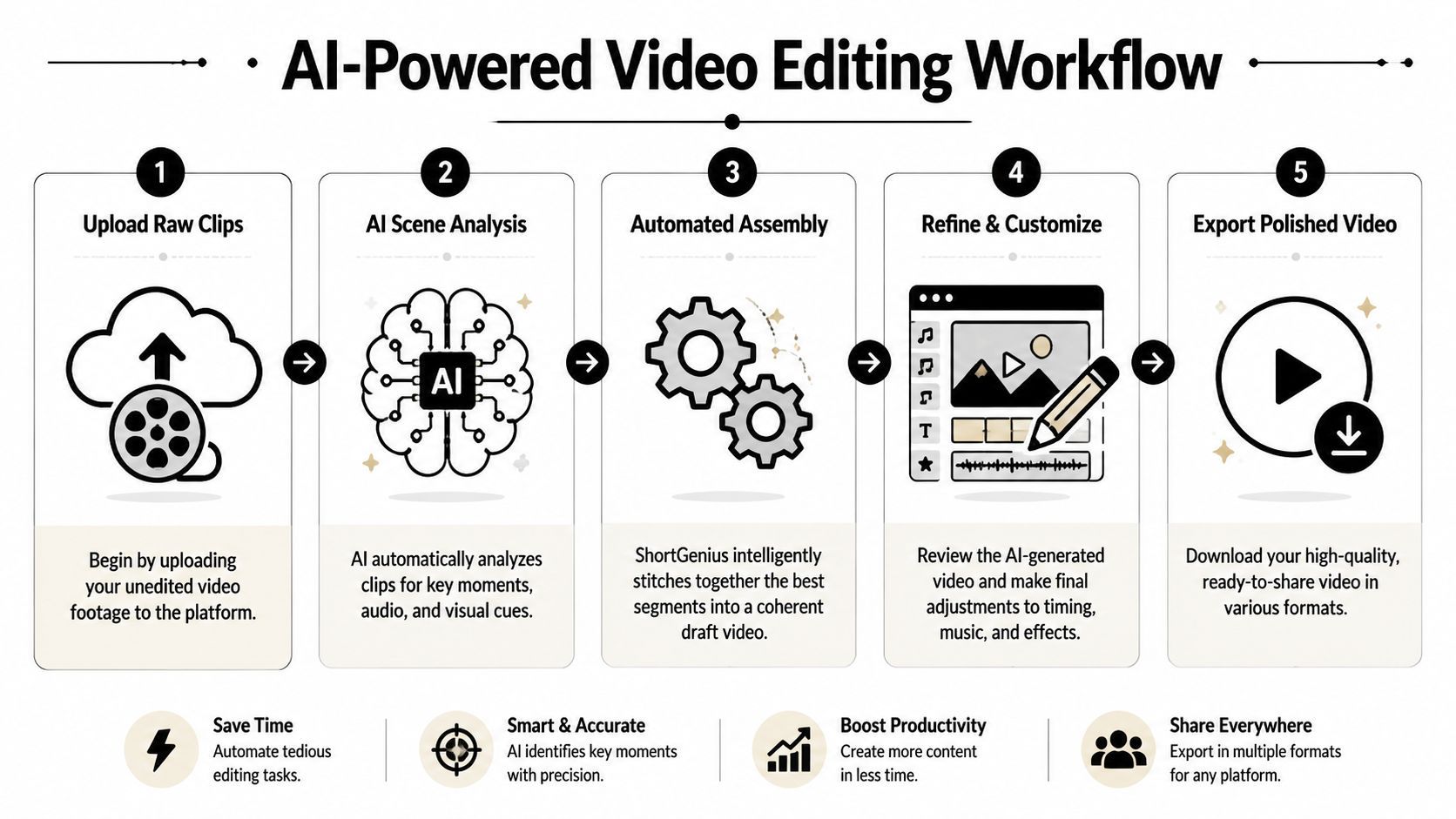
Start with assembly, not perfection
When you edit BTS manually from scratch every time, you waste energy deciding basic structure over and over. The first pass should answer only three questions:
- What is the opening hook?
- Which clips prove the process?
- What ending gives payoff?
An AI-first workflow helps in this capacity. Upload raw clips, let the platform analyze scenes, identify usable moments, and build a rough cut around your chosen angle. That doesn't replace judgment. It removes the most repetitive sorting work.
A good first draft should already identify likely openers, trim dead space, and align visual beats with whatever narration or on-camera speech exists. From there, your role shifts from assembler to editor. That's a far better use of your attention.
To see the general style of this workflow in motion, this walkthrough is useful:
Treat your content like a catalog
One reason teams slow down is content sprawl. Files live in random folders. Version names become useless. Campaign variants disappear. BTS clips that should become a series end up buried under exports.
A better model is to organize projects as connected assets. The same logic used in Backstage's entity-and-relation system for software catalogs translates well to content operations. As described in Roadie's explanation of the Backstage system model, a structured setup helps high-volume users prevent sprawl and can reduce project onboarding time by up to 60%. For creators, that means one BTS video can be linked to a campaign, a product launch, a platform format, and future variations instead of living as an isolated file.
That structure matters even more once you're working across multiple channels. A desktop folder can hold files. It can't hold relationships well.
What AI should handle and what you should keep
There's a clean split between tasks AI should do first and tasks a creator should still own.
Best use for AI in BTS editing
- Rough sequencing so clips land in a workable order
- Fast trim suggestions to remove obvious pauses and filler
- Caption generation for speed and accessibility
- Voiceover drafting when you need a clear first pass
- Resize and format adaptation for different platforms
- Brand kit application so recurring series look consistent
What still needs your eye
- The story angle and whether the draft supports it
- Pacing choices around suspense, humor, or clarity
- Clip selection when a mistake is more compelling than the polished take
- Taste-level decisions about transitions, scene swaps, and how raw the final cut should feel
AI is strongest at narrowing the field. Creators are strongest at deciding what deserves emphasis.
If you're comparing workflows before choosing one, this roundup of best AI tools for content creators is a useful reference point.
Build one editing template and reuse it
The fastest BTS editors don't reinvent style. They establish a default format and tweak from there.
A practical template might include:
- First second with a clear visual hook
- Early text overlay naming the situation
- Mid-sequence pattern break such as a low-angle shot or reaction insert
- Caption styling that stays consistent across the series
- End screen that points to the finished result, lesson, or next part
If you're building that system in one place, ShortGenius is designed around exactly this kind of workflow. It combines scripting, video assembly, voiceovers, captions, scene swaps, brand kits, and publishing into one environment, which is what makes repeatable BTS production realistic for solo operators and lean teams.
The gain isn't just speed. It's continuity. When your tools support a repeatable sequence from raw clip to final export, behinde the scene content stops feeling like another edit on the pile. It becomes a production stream you can maintain.
A Framework for Repurposing and Distributing Your Content
A good BTS video shouldn't be posted once and forgotten. If the footage captured a real process, then it usually contains more than one asset. The smart move is to cut for intent, not just for length.
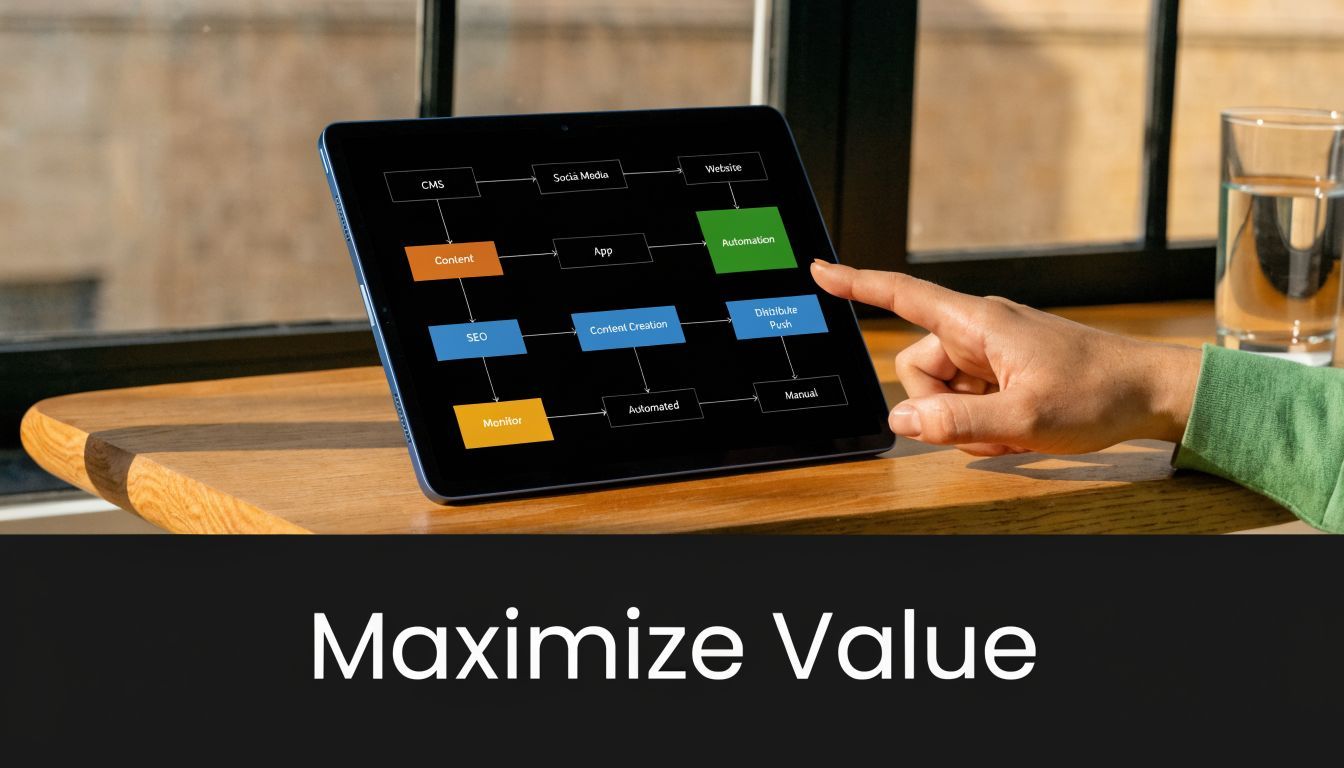
Turn one recording block into a content pack
A single BTS session can support several outputs if you package it deliberately:
- Primary short video for TikTok, Reels, or Shorts with the full mini-story
- Teaser cut that isolates the tension, mistake, or reveal
- Still frame post pulled from a clean setup moment with a short caption about the lesson
- Looping clip or GIF built from a satisfying repeated action
- Story sequence broken into quick frames for casual daily posting
The key is that each version should do a different job. Don't just crop the same asset five ways and call it repurposing. One version should hook. Another should explain. Another should reinforce brand familiarity.
For creators trying to build a system around this, this guide on scaling engagement through content reuse offers a helpful strategic lens.
Match the format to the platform behavior
Different platforms reward different viewing patterns. A short vertical cut with captions and immediate motion works well for discovery. A more reflective BTS clip with context can work better where your audience already knows your work. Stories support rougher updates. Feed posts can carry a stronger takeaway.
Resizing and scheduling tools eliminate significant friction. Instead of exporting separate projects from scratch, build one master edit and create variants with adjusted framing, titles, and pacing. Keep the core idea intact. Adapt the wrapper.
Distribution gets easier when each asset already belongs to a family instead of acting like a standalone post.
Measure rates, not vanity totals
Raw views feel good, but they're a weak decision tool on their own. A large view count can hide weak response. A smaller post can outperform if the people who saw it clicked, watched through, replied, or converted.
That's why rates matter more than raw numbers. A 2.5% click-through rate tells you more about effectiveness than a view total without context, and Sycamore's discussion of statistical thinking notes that data-driven companies that prioritize rate-based metrics are 58% more likely to exceed revenue goals. For creators, the practical takeaway is simple. Judge BTS by the behavior it produces, not the size of the top-line impression count.
A clean review loop looks like this:
| What to review | Why it matters |
|---|---|
| Conversion rate | Shows whether the content moved viewers to act |
| Click-through rate | Reveals whether the packaging and angle created enough curiosity |
| Watch-through patterns | Helps identify weak openings or dull middle sections |
| Saves, replies, or shares | Indicates whether the BTS clip delivered practical value or emotional connection |
| Performance by angle | Shows whether process, struggle, tools, or result-driven BTS works best for your audience |
Build your distribution rhythm
The best repurposing systems use a simple rhythm:
- Publish the strongest version first
- Cut secondary versions from the same source
- Schedule platform-native variants
- Review rate-based outcomes
- Keep the angle, replace the execution if the rates are weak
That loop makes behinde the scene content scalable. You're no longer posting whatever extra clip happened to survive the edit. You're building a repeatable campaign from one working session.
Your System for Effortless Content Creation
Consistency doesn't come from waiting for better ideas. It comes from reducing the number of decisions you have to remake every week.
That is the primary value of a behind the scene workflow. You choose the narrative angle before filming. You capture a repeatable set of shots. You edit with a template instead of improvising structure from scratch. Then you repurpose the result across channels and judge performance by the rates that truly matter.
The workflow that holds up
When this works well, the process is simple:
- Plan one clear BTS angle
- Shoot the proof, not every possible moment
- Edit around story beats, not clip order
- Repurpose by platform role
- Review what drove action and keep only what earns its place
The creativity is still yours. The taste is still yours. The judgment is still yours. What changes is that the repetitive production work stops eating the time you need for the part only you can do.
The goal isn't to make more content for the sake of volume. It's to build a system that lets good content happen without draining the rest of your work.
Solo creators and small teams usually don't need a bigger production. They need less friction between idea, capture, edit, and distribution. Once you build that loop, BTS stops feeling like bonus content and starts acting like one of the most dependable assets in your entire media engine.
If you want a faster way to build that loop, ShortGenius (AI Video / AI Ad Generator) helps turn raw ideas, clips, and scripts into finished videos you can edit, brand, resize, and publish from one place. It's a practical fit for creators and teams who want behinde the scene content to become a repeatable system instead of another task sitting in the backlog.