AI Voice Actors: How to Choose and Use Them

Learn how to choose and use AI voice actors for short-form video. Get tips on quality, cost, and integration in 2026.
You're on a deadline, the edit is already late, and the client still wants the voiceover “by end of day.” Maybe the talent canceled, maybe the budget got cut, or maybe you just need five versions of the same script for TikTok, Reels, and Shorts without booking a studio. That's exactly where AI voice actors have moved from novelty to real production utility.
They're not magic, and they're not a one-for-one replacement for human performance. They're a fast way to turn text into speech, test pacing, localize a draft, or build a publishable narration when the usual recording path would slow the whole campaign down. In short-form video, that difference matters because timing, iteration, and volume usually decide whether a project ships or stalls.
What AI Voice Actors Are
A finished script and no booked talent used to mean a long wait, a reschedule, or a scramble to record scratch audio on a phone mic. Now the same script can go into a voice tool, a voice gets selected, tone gets adjusted, and the first usable take can come back in minutes. For creators, that is the basic promise of AI voice actors, speech generation that reads written text aloud with a synthetic voice designed to sound natural enough for media work.
At the practical level, the workflow is simple. You paste text, pick a voice, set pacing or emphasis, and generate a read. Better tools add controls for emotion, pronunciation, pauses, and sometimes cloning, so the output is not just spoken, but shaped for a specific use case.
What the creator hears
The biggest shift is control. Instead of hiring talent, sending notes, waiting for a pickup, and then asking for another pickup, teams can test line variations instantly and hear which version fits the cut. That is why AI voices have become common in draft narration, placeholder reads, explainer videos, and fast-turn ad testing.
Practical rule: use AI voices when the project needs speed, iteration, or scale. Use a human when the delivery has to carry trust, intimacy, or emotional nuance.
That split also explains why these systems are more than text-to-speech. Modern voice models are built to convert language into speech patterns that feel closer to a performed read, not a flat machine rendering. Quality still varies, and the hidden constraints show up fast in production. Latency matters when a creator needs to generate, audition, and swap reads inside a short-form edit. Audio engineering matters when the voice has to sit under music, sound effects, or a fast hook without sounding pasted on. Partial substitution matters too, because a team may use AI for the first pass, then bring in a human for the final line or the section that needs real emotional weight.
For short-form teams, that matters because the voiceover is rarely the only asset. It has to lock to scenes, captions, hooks, and platform pacing. In tools like ShortGenius, the value is not just that a voice can read a script, it is that the narration can move from concept to publishable cut without waiting on a studio slot or a freelance schedule.
Types of AI Voices and How Quality Compares
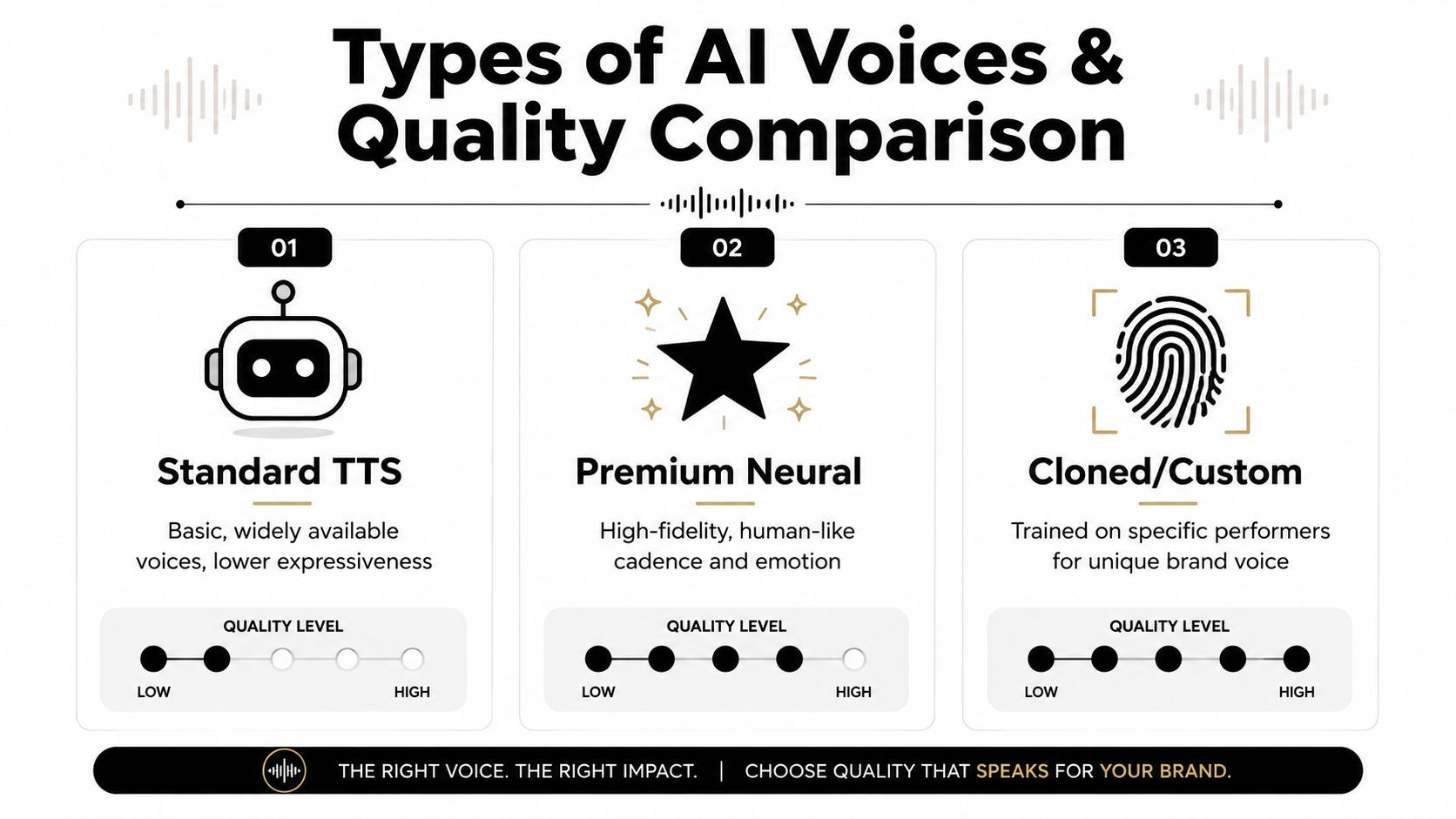
A lot of people talk about AI voices as if they're one thing. They're not. The difference between a basic read and a convincing performance can be obvious after the first sentence, especially when the script has rhythm, attitude, or a sales angle.
Standard voices, premium neural voices, and cloned voices
Standard TTS is the easiest to spot. It gets the words out cleanly, but the pacing and emphasis can feel generic, which is fine for utility content and rough internal drafts. It's the voice equivalent of a plain stock photo, useful, but rarely brand-defining.
Premium neural voices are where most creators feel the jump in quality. These voices usually have better cadence, more natural pauses, and a stronger sense of phrasing, so they're more believable for ads, explainers, and recurring branded content. If you're voicing a 30-second TikTok ad, this is usually the first category that feels production-ready.
Cloned or custom voices go further by training on a specific performer or voice sample. That gives you brand consistency and a distinct vocal identity, but it also raises the stakes around consent, usage rights, and quality control. If the clone is imperfect, the flaws tend to become more noticeable, not less.
Matching the voice to the format
A short-form ad wants urgency. An educational series wants clarity and consistency. A long storytelling series wants enough tonal range that the listener doesn't feel trapped inside one note for minutes at a time. That's why the “best” voice depends on the format, not just the demo reel.
- For quick ads: pick a voice with crisp consonants and fast comprehension, because the hook has to land immediately.
- For tutorials or explainers: prioritize clarity, stable pacing, and easy pronunciation of industry terms.
- For branded series: custom voices can help, but only if the script, style, and approvals are already locked down.
A convincing AI read usually has three things working together. It sounds stable, but not stiff. It changes pace when the copy changes. And it doesn't force drama where the script doesn't need it.
A polished synthetic voice can still feel wrong if the script is overloaded with jargon, awkward punctuation, or sentences that are too long to breathe through naturally.
That's why quality isn't just about the model. It's also about the copy, the edit, and the use case. The better you match those three things, the less the voice sounds like software and the more it sounds like a real production choice.
Benefits and Technical Limits of AI Voiceovers
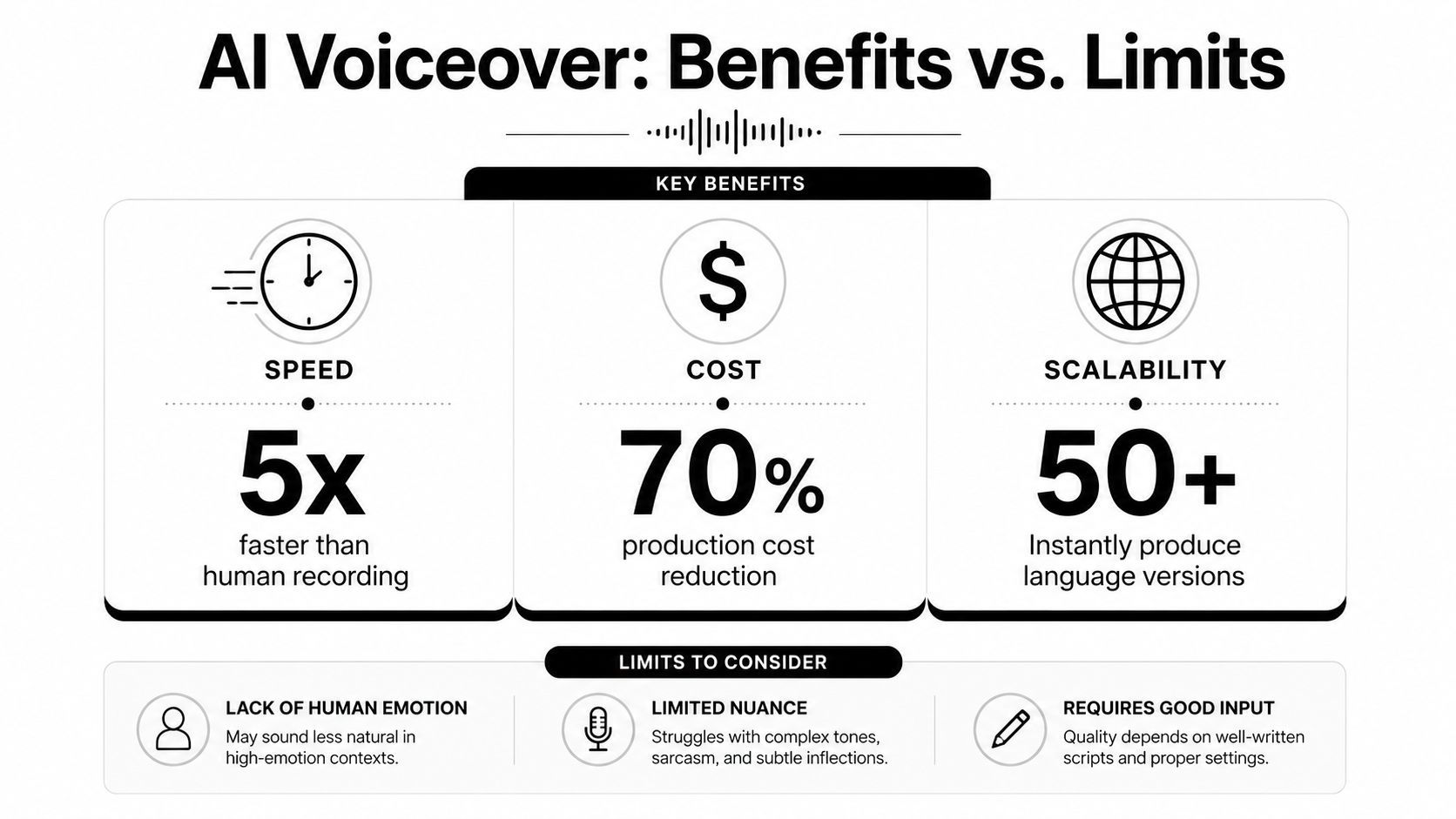
A short-form team feels the benefit of AI voiceovers as soon as the edit tightens up. You can generate reads quickly, test alternate hooks without booking another studio session, and keep the cut moving when a client changes the CTA after the timeline is already locked. That speed is one reason the AI-generated voice acting market was valued at $4.8 billion in 2025 and is projected to reach $28.6 billion by 2034, with a 22.1% CAGR over the forecast period, according to the cited market data in the brief (market report).
Where the gains are real
The practical gains show up in production, not in the pitch deck. Teams can iterate faster, produce more versions of the same concept, and localize content without rebuilding the whole recording chain. Software also accounted for 63.4% of that market in 2025, which matches how voice capability is typically purchased, as a tool layer inside a larger content system.
For short-form video, that matters because one script often becomes several cuts. A creator can keep the structure, swap the voice, and adapt the message for a different platform tone without starting from zero. The value is throughput, especially in workflows like ShortGenius where the same core idea needs to move through multiple ad variations, hooks, and versions fast.
The hard limits production teams run into
Latency is the first constraint that shows up in live or interactive workflows. Guidance in the brief says the practical bar for 2026 is under 800 ms end-to-end, with conversational gaps of 300 to 500 ms becoming noticeable and latency above 1.5 s feeling broken to users (latency guidance). A voice that sounds clean in a rendered file can still fall apart in a live ad workflow or a conversational agent if the turn-taking feels slow.
Audio engineering sets the next boundary. Professional pipelines often keep 48 kHz or higher during processing, use 24-bit audio, and rely on 128-sample or lower monitoring buffers for low-latency handling, according to the technical guidance in the brief. That same guidance notes 16 GB RAM as a common baseline, with 32 GB recommended for more complex work, plus 8 GB+ VRAM for better performance and 16 GB VRAM as a production target (technical requirements).
- Latency: strong for rendered narration, risky for live turn-taking.
- Audio quality: output depends on clean processing settings, not just the model.
- Hardware: GPU acceleration matters because the cited guidance says it can cut processing time by roughly 10x versus CPU-only.
The trade-off is straightforward. AI voiceovers save time and scale output, but they do not remove the need for audio judgment. If the script is sloppy, the pacing is awkward, or the edit leaves no room to breathe, the model will not fix it. It will just produce the problem faster.
Legal and Ethical Concerns Around AI Voices
A short-form team can cut a clean voice track in minutes, then hit a legal wall when the client asks who owns the result, whether the voice was licensed for this use, and whether the performer ever agreed to training at all. Those questions show up fast when AI voices move from experiment to paid campaign, especially in workflows that mix human reads with synthetic pickups.
The practical split is substitution, not full replacement. Industry commentary in the brief says AI is already handling repetitive, low-stakes work like pickup lines and draft localization, while human actors still carry high-emotion, high-stakes performance work. That matches what many production teams see day to day. A synthetic voice can save a deadline. It usually does not replace a person when the message has to carry trust or emotional weight (voice actor commentary).
Consent and usage rights matter first
The legal question is not only whether a voice can be cloned. It is who approved the use, what the voice can be used for, and whether training rights were ever granted in the first place. The IAPP notes that voice actors are being urged to negotiate contracts that control how their voices are used, and to support legislation and advocacy around those rights.
That matters because a voice is tied to identity and reputation. If a client wants to reuse a voice across future campaigns, the contract needs to say that plainly. If the voice is only licensed for one project, the usage limits need to be just as clear.
Compensation is the part many teams skip
Compensation becomes harder to ignore when a voice helps train a model or shape a reusable asset. The brief points to academic work on the AI data economy that treats fair financial or non-financial reward as an open question, not something settled. That is a more useful frame than abstract arguments about whether voice cloning is allowed.
If a project depends on a performer's identity, the contract should define who can use the model, how long they can use it, and what happens if the campaign expands. That is where rights drift happens in real production, especially when a campaign starts as one short and then gets repurposed across more cuts, more variants, and more channels.
The ethical side follows the same pattern. Clients should be clear when a voice is synthetic, cloned, or partly generated from a real performer. Audiences may not care about the toolchain, but they do notice when a brand hides how the voice was made. The safest approach is to treat voice rights like any other creative right, with permissions in writing before the asset goes live.
Integrating AI Voices into Short Form Video Workflows
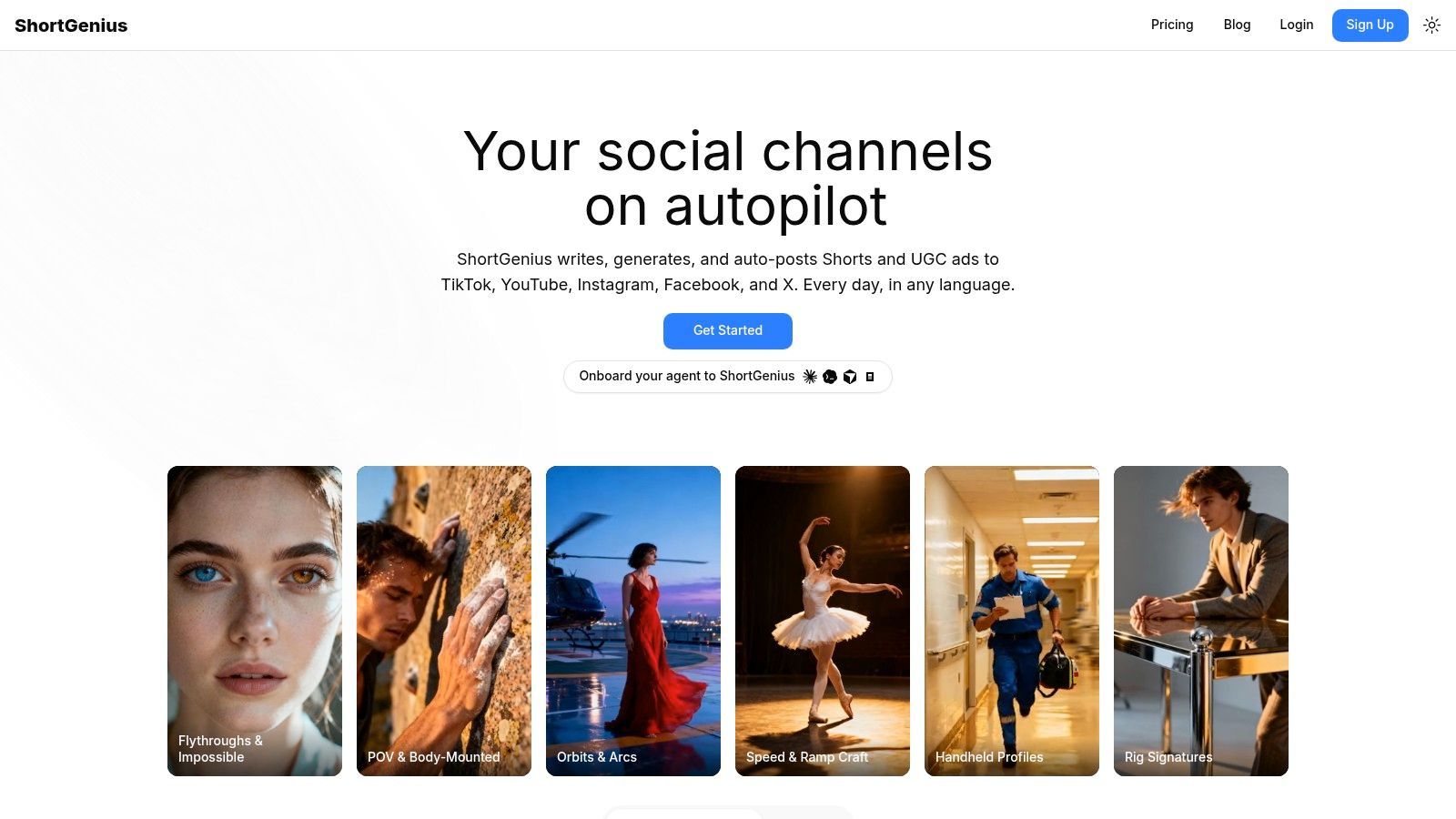
The fastest way to make AI voices useful is to stop thinking about them as a standalone asset. In a short-form workflow, the voice has to work with the hook, the cut timing, the captions, and the platform's attention pattern. If it doesn't, the whole edit feels off even if the pronunciation is clean.
A practical workflow starts with the script. Write for breath, not for essays. Short sentences are easier to pace, and punctuation gives the voice engine clues about where to slow down, lift emphasis, or pause. That matters more than people think, because many bad AI reads are really bad scripts in disguise.
The next step is voice selection. Match the tone to the platform and the campaign goal. TikTok ads usually need faster comprehension and a sharper opening, while educational shorts need calmer pacing and cleaner articulation. If you're using a platform like ShortGenius, the value is that the voice choice sits inside the same toolchain as script generation, scenes, captions, and publishing, so you're not exporting between five separate apps.
A clean sequence for production
- Draft the script first. Keep the hook tight, then trim anything that doesn't help the voice land the message.
- Generate a test read. Listen for pacing, weird emphasis, and words that need spelling fixes or pronunciation tweaks.
- Cut the scene timing to the voice. Don't force the voice to chase the edit if the line reads naturally one way and the visuals need another.
- Add captions after the voice is locked. That prevents caption drift when you change the narration later.
- Swap voice or scene only when the narrative needs it. Constant tinkering usually makes the final result less coherent.
The screenshot above is the right mental model for this kind of production, because voice, scenes, and publishing all belong in the same workflow. A standalone voice tool can work, but a connected workflow saves more time when the same ad needs multiple versions for different channels.
The edit gets easier when the voice is treated like one modular part of the timeline. That means you can tighten the hook, swap a scene, or change the narration without rebuilding the whole asset. In short-form campaigns, that flexibility is often the difference between shipping one version and shipping ten.
Sample Scripts and Best Practices for AI Narration
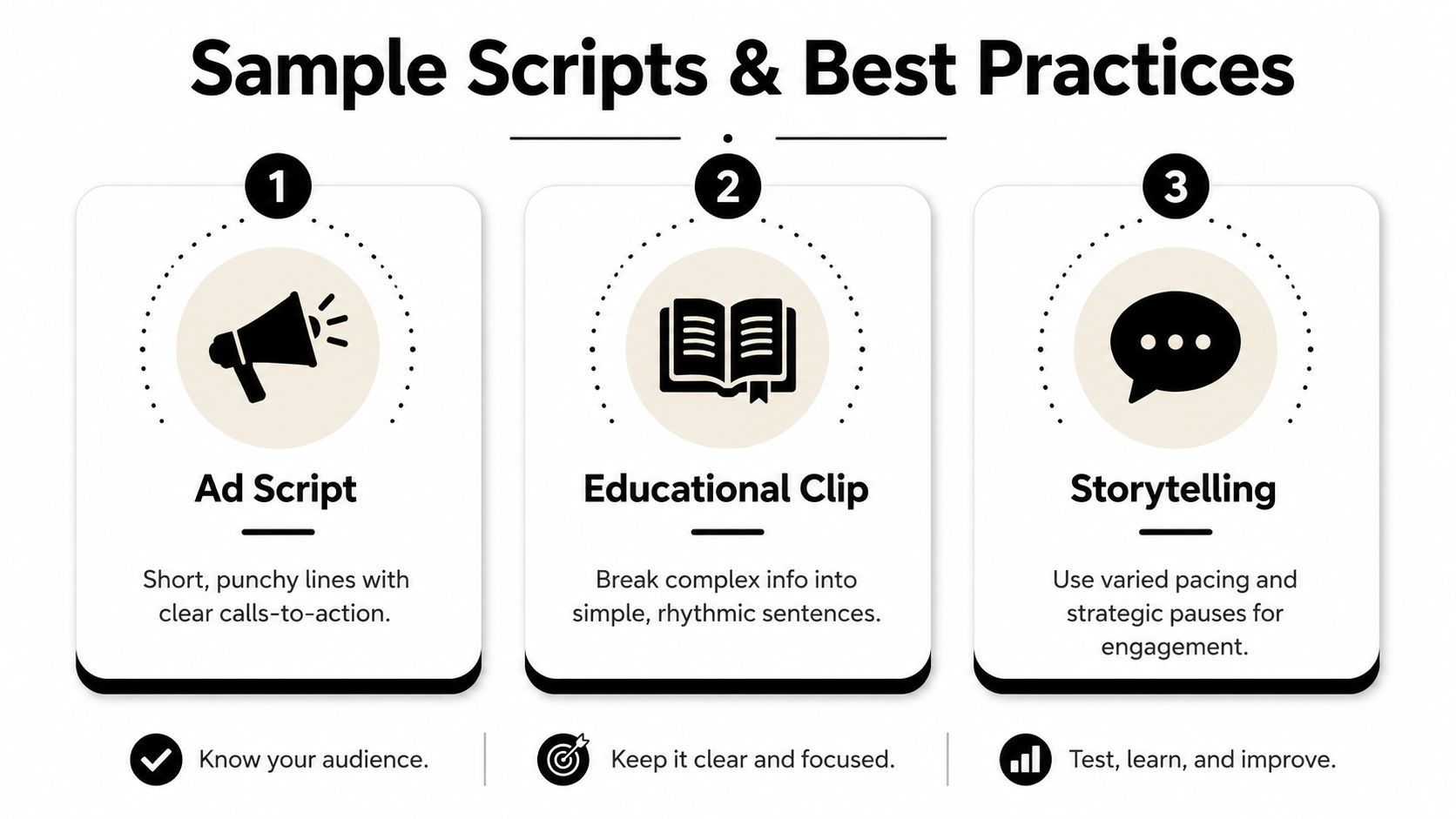
The script is where most voice quality gets won or lost. A good synthetic voice can still sound awkward if the copy is too dense, too formal, or packed with phrases that make the rhythm collapse. The fix usually isn't a new model. It's a better script.
Three script styles that work
Ad Script
Short, direct, and built around one action. Keep the lines punchy, because the voice needs room to sell the offer without tripping over extra words.
Example. “Need more edits done today. Generate your video, add your voice, and publish before the trend cools.”
Educational Clip
Clear beats, simple clauses, and enough spacing for the listener to follow along. Break difficult ideas into small units so the voice can land each point cleanly.
Example. “AI voices can speed up narration. They work best when the script is short, the pacing is controlled, and the vocabulary is easy to pronounce.”
Storytelling
More variation, more pauses, and a little room for tension. The goal is to keep the voice from sounding monotonous while still making the story easy to follow.
Example. “The first version sounded flat. The second version had pause control, and suddenly the scene felt like a real cut.”
What changes the read fast
Punctuation changes delivery. Commas create breathing room. Periods force a stop. Short lines create momentum. Long sentences can work, but only if the voice engine and the narrator structure can carry the pacing without smearing the point.
Remove anything the speaker wouldn't naturally say out loud. Awkward filler, stacked nouns, and overly polished marketing language usually make AI narration sound worse, not better.
Platform fit matters too. TikTok usually rewards a faster hook and less setup. YouTube Shorts often tolerates slightly more explanation if the voice stays clean and the visual rhythm keeps moving. The same core script can work across both, but only if you tighten the opening and keep the CTA specific.
The best practice is to write for the ear first. Read the line out loud before you hand it to the voice model. If you have to fight the sentence, the audience probably will too.
When to Use AI Voices and When to Hire Humans
Use AI when the work needs scale, speed, or a draft that can be revised quickly. That includes high-volume ad variations, localized versions, internal explainers, placeholder reads, and evergreen content that doesn't depend on a highly emotional performance. In those jobs, the synthetic voice does the job well enough to keep production moving.
Hire humans when the voice has to carry trust, conflict, warmth, or brand identity at the highest level. Hero campaigns, emotional storytelling, flagship launches, and premium brand spots still benefit from a performer who can interpret the line, not just read it. The brief's research points to that same divide, where AI is already handling lower-stakes work while human actors remain essential for the parts that need real emotional judgment (voice actor commentary).
The smartest teams blend both. They use AI voices for iteration and volume, then bring in human talent for the pieces that define the brand. That keeps costs and turnaround under control without flattening the work that needs a human voice.
If you're building short-form campaigns and want voiceover, editing, captions, and publishing in one workflow, ShortGenius (AI Video / AI Ad Generator) gives you a practical place to test AI voices inside the full production process. It's useful when you need to move from script to finished cut without jumping between separate tools for voice, scenes, and scheduling.