Master AI Video Creation Tool in 2026

Revolutionize content with an AI video creation tool. Learn how they work, their uses, & choose the best for your 2026 goals.
Think of an AI video creation tool as your personal, on-demand production studio that lives right in your web browser. In the past, creating a single video meant juggling a scriptwriter, a designer, a voice actor, and an editor. These tools bundle all those roles into one automated platform, transforming video creation from a slow, expensive headache into a fast, scalable workflow.
The New Engine for Modern Content
If you've ever tried to keep up with the relentless demand for video on TikTok, Reels, and YouTube Shorts, you know the grind. It's an exhausting cycle of filming, editing, and publishing that can easily lead to burnout. This is exactly the problem AI video creation tools were built to solve. They completely reframe video production, moving it from a manual, time-consuming chore to a simple, prompt-based process.
Instead of coordinating a whole team of specialists, you now get to act as the creative director. You guide a powerful AI that handles all the heavy lifting. This shift makes producing high-quality video content possible for everyone, not just those with huge budgets or deep technical skills.
From Idea to Published Video in Minutes
The real magic is how these platforms blend multiple AI capabilities into one smooth workflow. A single idea can become a finished video in a surprisingly short amount of time.
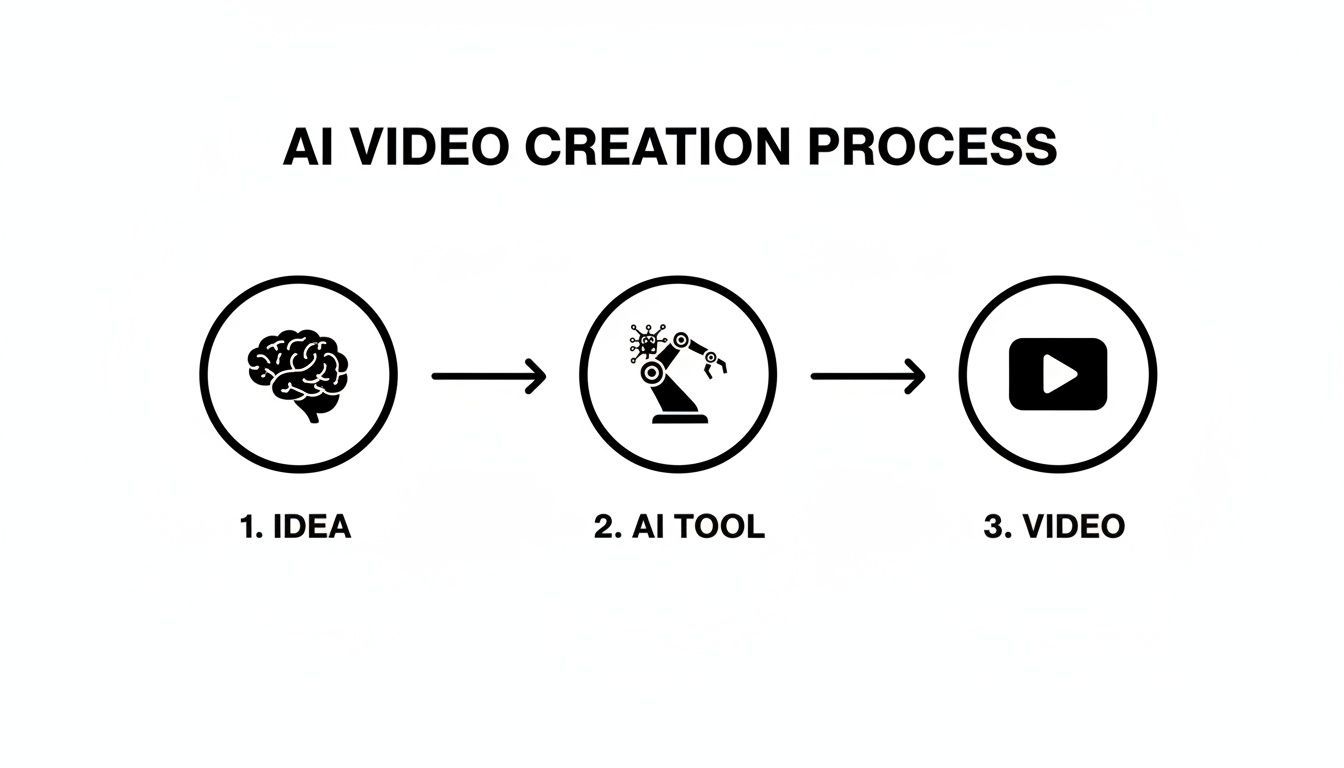
As you can see, the creator’s job is no longer about manual labor; it’s about creative vision. You're the one steering the ship, and the AI is the crew making it happen. This new efficiency is why the market is seeing such explosive growth, rocketing from $534.4 million in 2024 to a projected $2,562.9 million by 2032. The demand for faster, more affordable content is fueling the fire.
This growth is all thanks to a handful of core AI features working in concert:
- AI Scripting: Turns a simple idea or prompt into a well-structured video script.
- Asset Generation: Creates custom video clips, images, and backgrounds tailored to your script.
- AI Voiceovers: Produces realistic narration in dozens of languages and accents.
- Automated Editing: Takes care of the tedious bits, like adding captions, trimming clips, and resizing videos for different platforms.
Tools like the Vivideo AI Video Generator are great examples, showing just how powerful this tech can be by turning simple text and images into complete videos.
These platforms don't just speed up the old process—they introduce a fundamentally new way to create. It's about turning your best ideas into polished, multi-platform video campaigns in minutes, not weeks.
By integrating these functions, an AI video creation tool empowers you to produce a high volume of engaging videos consistently. You can see how we put these components to work at ShortGenius by reading our guide on AI-powered text-to-video technology. We're entering a new era where the only real limit is your own creative vision.
How AI Turns Your Ideas Into Videos

Watching an AI video creation tool spin a simple prompt into a finished video can feel a bit like magic. But what's really happening under the hood is a beautifully coordinated process where different AI models work together, almost like a digital production crew.
Think of the tool as your creative co-pilot. It handles the tedious, technical heavy lifting, freeing you up to focus on the story you want to tell.
Let's say you want to make a short video about "the benefits of remote work." Instead of staring at a blank screen, you just feed that idea to the AI. From there, a fascinating chain of events unfolds, starting with the script.
AI Scriptwriting: The Story's Blueprint
First things first, your concept needs a narrative. The AI scriptwriter gets to work, analyzing your prompt and generating a complete script with a clear beginning, middle, and end. It will often include scene suggestions, key talking points, and a solid call to action.
The AI is trained on storytelling principles, so it understands how to build a narrative that flows well and keeps viewers engaged. A prompt for a "short video ad for a new energy drink," for instance, will likely result in a script with a hook, a quick rundown of benefits, and a final shot of the product. This script becomes the blueprint for the entire project.
AI Media Generation: Bringing The Script To Life
With a script locked in, the platform starts creating the visuals. This is where the real "wow" factor kicks in, powered by text-to-video and text-to-image models. The AI reads the script scene by scene and generates custom video clips and images to match the descriptions.
You can get incredibly specific. Prompts like "a person working from a scenic mountain cabin" or "a dynamic shot of a team collaborating on a video call" are translated into unique visuals in moments. This completely changes the game—no more endless scrolling through stock footage libraries or coordinating expensive shoots. To get a better sense of how this works, you can learn more about AI-powered text-to-image models and the tech behind them.
This is a massive shift in content creation. You no longer have to find the perfect clip; you just describe it, and the AI builds it for you. Every visual is tailor-made for your story.
To give you a clearer picture, here’s a breakdown of the core capabilities you’ll find in most modern AI video tools.
Core AI Video Generation Capabilities
| Core Capability | How It Works | Primary User Benefit |
|---|---|---|
| AI Scriptwriting | Uses natural language processing (NLP) to turn a simple prompt into a structured video script. | Overcomes writer's block and creates a solid narrative foundation in seconds. |
| Media Generation | Converts text descriptions from the script into original video clips and images. | Eliminates the need for stock footage, providing perfectly matched, custom visuals. |
| AI Voiceover | Synthesizes text from the script into human-like speech using a library of voices and languages. | Produces professional-sounding narration without hiring voice actors or recording audio. |
| Automated Editing | Assembles video clips, voiceover, music, and captions into a final, synchronized video. | Automates the most time-consuming part of video production, saving hours of work. |
These features work in concert to take your project from a basic idea to a fully realized video.
AI Voiceovers And Final Assembly
Once the visuals are in place, an AI voiceover engine reads the script. You can browse a huge library of realistic voices, accents, and languages until you find the perfect one for your brand. The AI then generates the narration, syncing it flawlessly with the on-screen action. With more than 75% of marketers already using AI for tasks like this, it's quickly becoming a standard.
Finally, the AI editor acts as the director, putting all the pieces together. It stitches the clips and narration, adds suitable background music, and even generates captions for accessibility. It also handles the nitty-gritty details like trimming dead air and formatting the video for different platforms like TikTok, YouTube Shorts, or Instagram Reels.
This automated assembly line turns what used to be days or weeks of work into a process that takes just a few minutes. The result is a polished, cohesive video ready for you to share with the world.
Real-World Uses for AI Video Creation
 The tech behind an ai video creation tool is one thing, but seeing what it actually does in the real world is where its value truly clicks. It’s time to move past the hype and look at how these tools are solving genuine problems for creators and businesses today.
It's easy to dismiss these as novelty gadgets, but in practice, they’re becoming workhorses that deliver concrete results. From solo entrepreneurs to large agencies, people are finding that AI opens up new possibilities for video content, hitting new benchmarks for speed, scale, and creativity.
The adoption numbers tell the story. A recent ViVideo.ai report shows that 78% of marketing teams are already using AI-generated videos, with 70% aiming for full integration by 2029. This shift is all about efficiency—companies are publishing video campaigns 68% faster and saving an average of 34 hours per project. You can dive deeper into the trends with these AI video statistics from ViVideo.ai.
For The Solo Creator
We all know the story of the solo creator grinding it out on TikTok and YouTube Shorts. They spend an entire weekend just to film and edit a handful of videos, always feeling like they're falling behind the algorithm. It's a textbook recipe for creator burnout.
When an AI video creation tool enters the picture, that workflow is turned on its head. In just one afternoon, that same creator can brainstorm ideas, generate scripts, and produce a full month's worth of short-form content. With the repetitive tasks handled, they can finally focus on the bigger picture—strategy, community, and growth.
This is how creators finally achieve consistency. They can schedule posts weeks out, sidestep algorithm fatigue, and maintain a strong presence without burning the candle at both ends.
For The E-Commerce Brand
For social media managers at e-commerce brands, the main objective is running video ad campaigns that actually drive sales. But testing different ad concepts has always been a slow, expensive bottleneck. Producing a single variation took serious time and budget.
An AI video creation tool completely changes the A/B testing game. A manager can take one core product idea and instantly spin up twenty different video ads. The AI can swap out hooks, try new visuals, test different calls-to-action, and even experiment with various voiceovers to see what clicks. You can get a closer look at how this works in our deep dive on the ShortGenius AI ad generator.
This data-first approach takes the guesswork out of creative. Brands can quickly pinpoint their winning ads and pour their budget into what's proven to work, directly boosting their return on investment.
For The Creative Agency
Creative agencies constantly juggle the challenge of scaling video production for multiple clients without letting quality or profitability slip. Traditionally, each new project meant either stretching their team thin or starting a lengthy onboarding process for freelancers.
By building an AI video creation tool into their process, an agency can produce entire branded video series far more efficiently. They use AI for the heavy lifting—like scripting and assembling first cuts—freeing up their human editors to focus on high-value creative polishing and client strategy. This lets them take on more clients, improve their margins, and deliver finished work faster, which keeps everyone happy.
How to Choose the Right AI Video Creation Tool
 With a flood of options on the market, picking the right AI video creation tool can feel a bit like a guessing game. So many platforms promise the world, but the actual experience can be wildly different from one to the next. To cut through the noise, you have to look beyond the flashy marketing and focus on what really matters for your work.
It helps to think of it like choosing a camera. A simple point-and-shoot is perfect for casual photos, but a professional DSLR gives you the control and image quality you need for serious projects. The best tool always depends on what you're trying to create.
Evaluate the Core AI Models
This is, without a doubt, the most important thing to get right. A tool is only as good as the AI engine running under the hood. If the platform is built on a weak text-to-video model, you'll end up with generic, strange, or just plain wrong visuals, no matter how slick the interface is.
Before you even think about committing to a subscription, you need to scrutinize the output. Does the AI actually generate crisp, relevant video clips? Or do you get uncanny valley weirdness? Do the AI voices sound natural, or are they obviously robotic?
- Video and Image Quality: Look for tools that consistently produce high-resolution, contextually accurate visuals. Test it with your own specific, tricky prompts to see how well it understands nuance.
- Voice Realism: Don't just trust the marketing copy; listen to the voice samples. A great AI voice should be almost indistinguishable from a human, with options for different tones, pacing, and accents.
- Scriptwriting Intelligence: Does the script generator just spit out a dry list of facts, or can it weave a compelling narrative?
The quality of these core models directly determines the ceiling of your creative potential. A powerful AI engine gives you the freedom to bring complex ideas to life, while a weak one will constantly hold you back.
Prioritize a Seamless Workflow and User Experience
Let's be honest—a powerful AI doesn't mean much if the tool is a nightmare to use. The best platforms are designed to feel intuitive from the second you log in. The whole point is to spend your time creating, not wrestling with confusing menus and a laggy interface.
A smooth workflow means the tool guides you logically from one step to the next. It should feel like a natural process, moving from script to visuals, then voiceover and final edits. Small things make a huge difference here. Being able to swap a scene, regenerate a voiceover line, or apply your brand colors in one click are all signs of a well-designed tool.
Look for Customization and Control
While we use these tools for their automation, you should never feel trapped by the AI's first draft. The best AI video creation tool always gives you the final say. You absolutely need the ability to fine-tune every element until it perfectly matches your vision.
Look for these non-negotiable customization features:
- Brand Kit Integration: Can you upload your brand's logos, fonts, and specific color palettes? This is essential for keeping every video on-brand.
- Editing Flexibility: Does the tool let you trim clips, reorder scenes, and adjust the timing of different elements? You need that granular control.
- AI Fine-Tuning: Can you ask the AI to regenerate just one bad scene or rewrite a single line of the script without having to start the whole project over?
To see how different tools stack up, you might want to check out a guide on the Best AI Video Generators currently available. Seeing a side-by-side comparison can help you weigh these features against what's on the market. In the end, the right platform finds that perfect balance between powerful automation and deep creative control.
The Future of AI-Powered Content Creation
As we've seen, an AI video creation tool isn't some far-off concept—it's a practical partner for anyone making content today. Think of it less as a replacement for your creativity and more as a super-efficient assistant. It’s the tool that handles the grunt work, freeing you up to focus on the one thing that truly matters: your message.
It all boils down to three things: speed, scale, and consistency. We've all felt that pressure to produce more video than is humanly possible, a cycle that often leads to burnout. Now, you can take a single idea and watch it branch into a complete video campaign for multiple platforms, and you can do it in minutes.
A New Era for Creators
What would you do if production hurdles simply disappeared? Imagine testing twenty different ad concepts before your morning coffee is cold. Or mapping out an entire month's worth of YouTube Shorts in a single afternoon, all while knowing your brand's look and feel will remain perfectly consistent.
This isn't science fiction anymore. It's what AI-powered creation makes possible. Even massive platforms like YouTube are weaving AI directly into their creator tools, letting you generate video clips and background music from nothing more than a few words. The walls that once stood between a great idea and a great video are crumbling.
This shift gives you back your most valuable resources: time and mental bandwidth. Instead of getting lost in editing timelines or endlessly searching for the right stock clip, you can pour that energy into better strategy, sharper storytelling, and actually connecting with your community.
The Opportunity Is Now
These tools aren't just for tech giants or massive studios. They're here, they work, and they’re incredibly accessible. Platforms like ShortGenius are putting the power of a professional production house into the hands of individual creators, marketers, and teams of all sizes. It’s a genuine chance to get off the content treadmill and start building a real asset.
The door is wide open to build a stronger brand, connect with a bigger audience, and tell stories that truly resonate. Your audience is hungry for great content. With an AI video tool in your corner, you finally have a sustainable way to deliver it.
A Few Common Questions
Diving into any new technology brings up a few questions. As AI video creation tools become a go-to for creators and brands, it’s smart to get a handle on what they can really do. Let's clear up some of the most common points of confusion.
Can I Use My Own Footage And Voice?
Yes, and you absolutely should! The best platforms aren't a black box where you just type and pray. Think of them more like a super-powered editing assistant.
You can—and should—upload your own video clips, product shots, logos, and voice recordings. The AI then helps you weave those personal assets together with generated scenes or captions. This lets you keep your brand’s unique feel while still getting all the speed benefits of AI.
Is The Content The AI Creates Actually Unique?
This is a huge one, especially for anyone worried about copyright strikes. The short answer is yes, the content is unique. Reputable tools are built on massive, ethically sourced libraries of licensed content.
When you give it a prompt, the AI isn’t just grabbing a stock clip; it’s generating a new image or video based on what it’s learned. Top-tier platforms like ShortGenius are designed from the ground up to produce commercially-safe content, so you can post and promote without looking over your shoulder. Of course, it’s always a good idea to check the terms of service of any tool you’re considering.
How Much Technical Skill Do I Need?
Basically, none. The whole point of an AI video creation tool is to open up video to everyone, not just people with a film degree or years of editing experience.
The idea is to finally make video production accessible. If you can write an email or use a simple drag-and-drop tool, you have all the technical skill you need to get started.
These tools are designed to tear down the walls—both technical and financial—that have kept so many people from making great video content consistently.
Can AI Really Do The Job Of A Human Editor?
This question needs a little context. For a Hollywood blockbuster? No, you'll still want a team of seasoned professionals. But for the vast majority of videos we see every day—social media content, ads, tutorials, internal training—the answer is a resounding yes.
AI can often produce this type of content at a quality and speed that a human editor simply can't match. It’s not about replacing human creativity, but about augmenting it. The AI handles the tedious, time-sucking tasks, which frees you up to focus on the bigger picture: your message, your story, and your strategy.
Ready to see it in action? ShortGenius puts a complete production studio at your fingertips. Turn your ideas into polished, multi-platform video campaigns in minutes, not weeks. Start creating with ShortGenius today.