12 Best AI Tools for Influencer Marketing in 2026

Discover the 12 best AI tools for influencer marketing in 2026. This guide covers platforms for discovery, content creation, and campaign management.
Influencer marketing has evolved beyond manual searches and spreadsheet tracking. Today, the most successful brands and creators are using artificial intelligence to discover partners, create compelling content, analyze performance, and scale their impact. But with hundreds of platforms claiming to use AI, how do you choose the right ones? This guide cuts through the noise.
We will explore the essential AI tools for influencer marketing, categorized by their primary function, from end-to-end management suites to specialized content creation engines like ShortGenius. To gain a comprehensive understanding of how AI fits into this landscape, it's useful to consider the distinctions between influencer marketing vs. affiliate marketing, as many tools support both models. This resource is designed to help you find the best platforms for your specific needs, whether you're a solo creator, a marketing team, or an agency.
Inside this deep dive, you will find a detailed breakdown of 12 leading platforms. Each entry includes:
- Core AI Features: What the AI actually does.
- Practical Use Cases: How to apply the tool in a real-world workflow.
- Honest Limitations: An assessment of potential drawbacks or areas for improvement.
- Direct Links & Screenshots: See the platform for yourself.
We'll analyze everything from CreatorIQ and GRIN to HypeAuditor and Affable AI, providing a clear, actionable comparison. Our goal is to help you build a smarter, more efficient influencer marketing stack for 2026 and beyond. Let's get started.
1. ShortGenius (AI Video / AI Ad Generator)
ShortGenius earns its place as our featured choice by providing a genuinely complete, end-to-end solution for video content creation. It stands out among other ai tools for influencer marketing by unifying every step of the production process into a single, cohesive workflow. Instead of juggling separate tools for scripting, asset generation, voiceovers, and editing, influencers can manage the entire lifecycle of a video within one platform. This integrated approach is a significant advantage for creators focused on maintaining a consistent and high-volume output across multiple social channels.
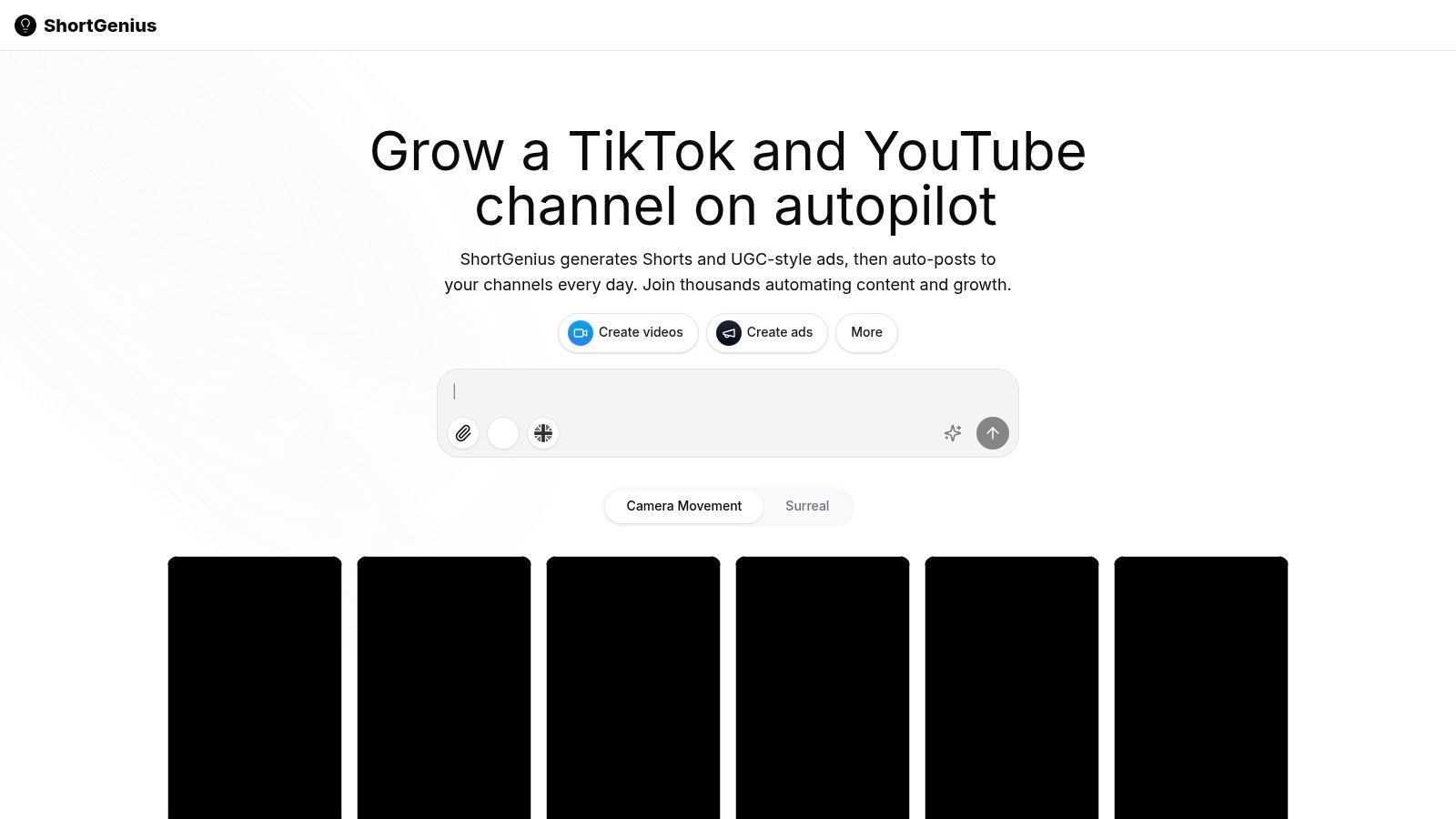
The platform connects best-in-class AI models for text, image, video, and voice, ensuring that the final output doesn't feel generic. For example, the voiceovers use ElevenLabs-quality synthesis, and the script generation pulls from top-tier LLMs like those powering Grok and ChatGPT. This focus on quality at each stage results in more polished, professional-grade content.
A key differentiator is its automation capability. Influencers can create and schedule entire "series" of themed videos to be posted automatically to TikTok, YouTube, Instagram, and more. This removes the manual burden of daily posting, allowing creators to build a content library and maintain an active presence with minimal ongoing effort. Brands can also use this feature to scale their campaigns, especially for generating and testing user-generated content (UGC) style ads. For those looking to explore this specific application, ShortGenius provides excellent resources on how to create AI UGC ads that perform well.
Key Strengths & Use Cases
- End-to-End Workflow: From a simple idea, you can generate a script, create accompanying visuals and video clips, add a premium voiceover, and assemble the final video without leaving the editor.
- Automated Multi-Platform Distribution: The "series" feature is a standout. You can set a posting cadence for different platforms, ensuring consistent audience engagement.
- Creative Accelerators: A rich library of presets for camera movements, scroll-stopping effects, and surreal visuals allows for rapid experimentation and creative variation without deep technical skill.
- Model Diversity and Quality: By integrating multiple leading AI engines, ShortGenius delivers higher-quality and more varied outputs compared to single-model platforms.
| Feature Comparison | ShortGenius | Typical AI Video Tool |
|---|---|---|
| Workflow | Unified: Script, Video, Voice, Edit, Schedule | Often siloed; requires multiple tools |
| Distribution | Automated series scheduling to 5+ platforms | Manual export and upload |
| AI Models | Integrates multiple best-in-class engines | Usually relies on a single proprietary model |
| Creative Assets | Large preset library for effects & motion | Basic templates or limited creative options |
Best for: Influencers and social media teams needing to scale short-form video production efficiently. The platform is also an excellent fit for agencies and DTC brands looking to produce a high volume of ad creatives for testing.
Pricing: Specific plan details are available on the product's website, and you may need to sign up to view the full pricing structure.
Website: shortgenius.com
2. CreatorIQ
CreatorIQ is a powerful, enterprise-grade creator marketing platform designed for large brands and agencies managing complex campaigns. It's one of the most mature AI tools for influencer marketing, built on a massive dataset called the Creator Graph. This AI foundation drives everything from content-first creator discovery to predictive performance analytics, making it a go-to for organizations that need robust data and governance.
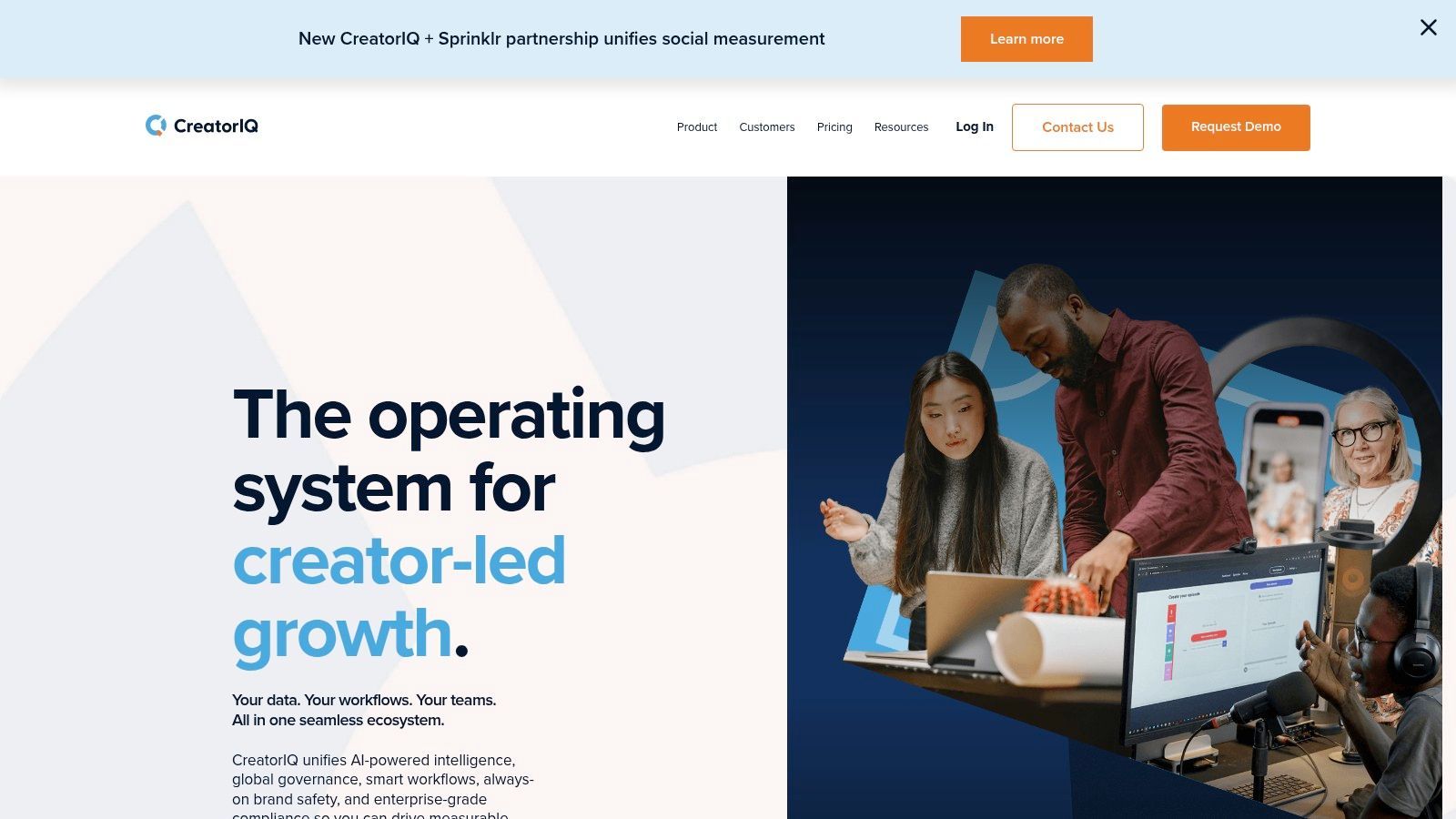
Unlike smaller tools, CreatorIQ's strength is its end-to-end management capabilities. For example, its SafeIQ feature uses multimodal AI to analyze text, images, video, and audio for brand safety, which is a critical function for brands in regulated industries like finance or healthcare. The platform also offers integrated creator payments and deep integrations with Shopify, major affiliate networks, and business intelligence tools.
Key Features & User Focus
- Best For: Large brands and agencies needing an all-in-one solution for discovery, management, measurement, and payments.
- Standout AI Feature: The AI-powered "similar creator" recommendations and multimodal brand-safety analysis (SafeIQ) provide a level of data-driven confidence that is hard to find elsewhere.
- Pricing: Access is quote-based and tailored to mid-market and enterprise budgets. Expect a sales-led process and a significant investment.
- Implementation Tip: Because of its depth, CreatorIQ has a steeper learning curve. Dedicate time for team onboarding and explore its integrations with your existing tech stack (like BI or e-commerce platforms) to get the most value.
| Pros | Cons |
|---|---|
| Deep data and governance for regulated industries. | Pricing is not accessible for small businesses. |
| Strong enterprise integrations (Shopify, affiliate, BI). | Requires a more involved implementation process. |
| End-to-end workflow management from discovery to payment. | Can be overkill for simple, one-off campaigns. |
Website: https://www.creatoriq.com
3. GRIN (Gia AI)
GRIN is a creator management platform built specifically for e-commerce and direct-to-consumer (DTC) brands, with a strong focus on revenue attribution. It positions itself as one of the key AI tools for influencer marketing by integrating its AI copilot, Gia, directly into the workflow. Gia is trained on over a decade of transaction and creator performance data, allowing it to automate and optimize the entire creator lifecycle for Shopify-based businesses.
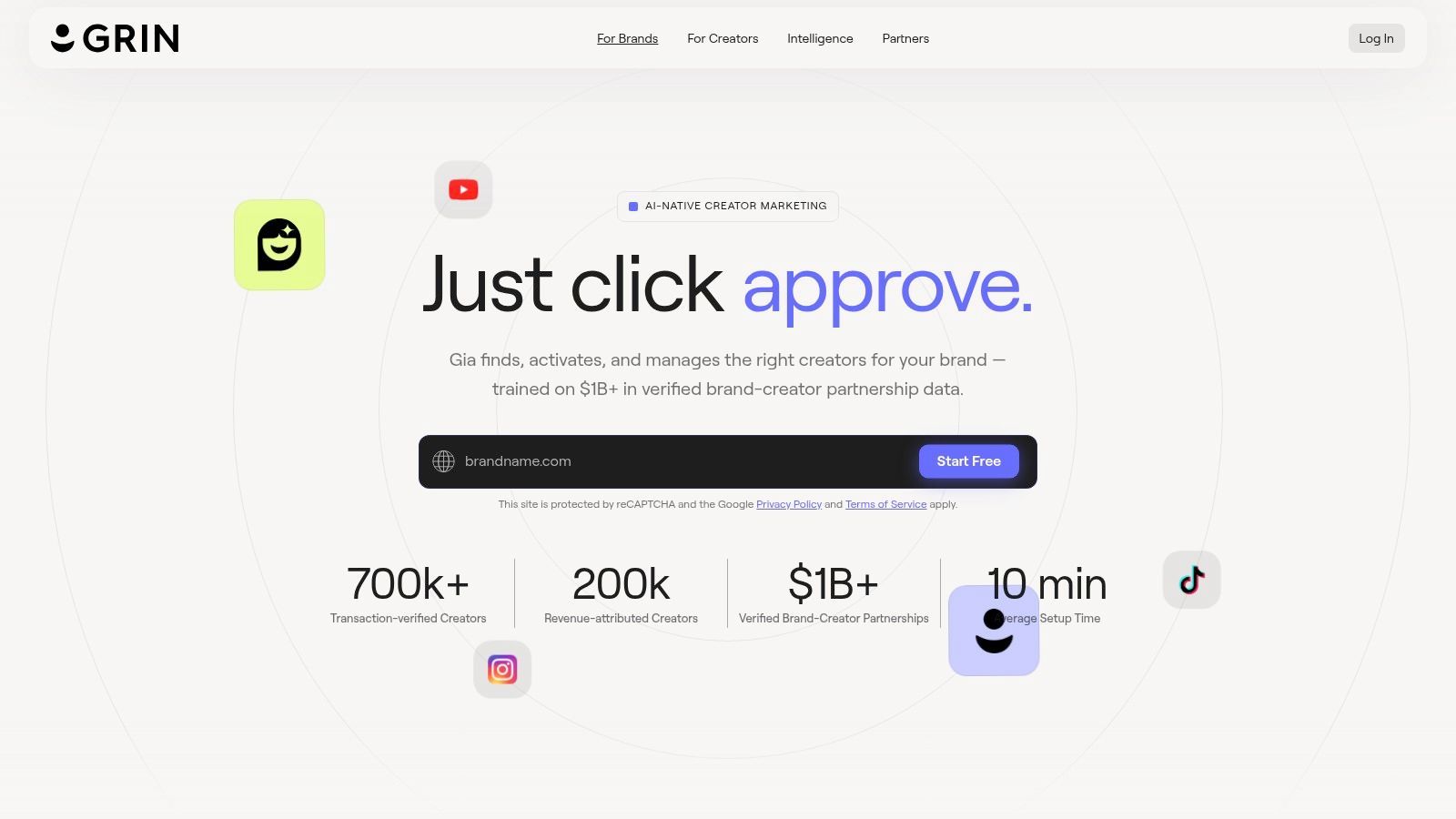
Unlike platforms that rely only on public social media data, GRIN’s strength comes from its deep integration with e-commerce systems. This connection enables Gia to recommend creators based on their actual ability to drive sales, not just engagement metrics. The platform automates everything from outreach and onboarding to product gifting, affiliate code generation, and performance reporting, making it a powerful engine for DTC teams focused on ROI.
Key Features & User Focus
- Best For: DTC and e-commerce brands on Shopify that need to scale their creator programs with a clear line to revenue.
- Standout AI Feature: Gia's AI-powered creator recommendations are based on a network of transaction-verified influencers, providing a much stronger signal for sales potential. The creator retention scoring and automated workflows are also significant time-savers.
- Pricing: Pricing is not publicly listed and is quote-based, typically suited for established brands with dedicated creator marketing budgets.
- Implementation Tip: To get the full benefit of GRIN, your primary goal should be tying creator activity to sales. Start by integrating your Shopify store and use the automated gifting and affiliate features to build a performance-based program from day one.
| Pros | Cons |
|---|---|
| Built around revenue and transaction data for better ROI. | Shopify is the primary, most deeply supported integration. |
| Strong automation for outreach, gifting, and onboarding. | Pricing is not public and can be a barrier for new programs. |
| Fast implementation for teams already on Shopify. | Less focused on top-of-funnel brand awareness campaigns. |
Website: https://grin.ai
4. Upfluence (with Jaice AI)
Upfluence is an end-to-end influencer and affiliate platform with a strong focus on e-commerce and direct-to-consumer brands. What makes it a standout among AI tools for influencer marketing is Jaice, its AI campaign copilot. Jaice assists with critical tasks like identifying the best-fit creators from its database of millions and generating personalized outreach sequences, which helps teams activate campaigns faster.
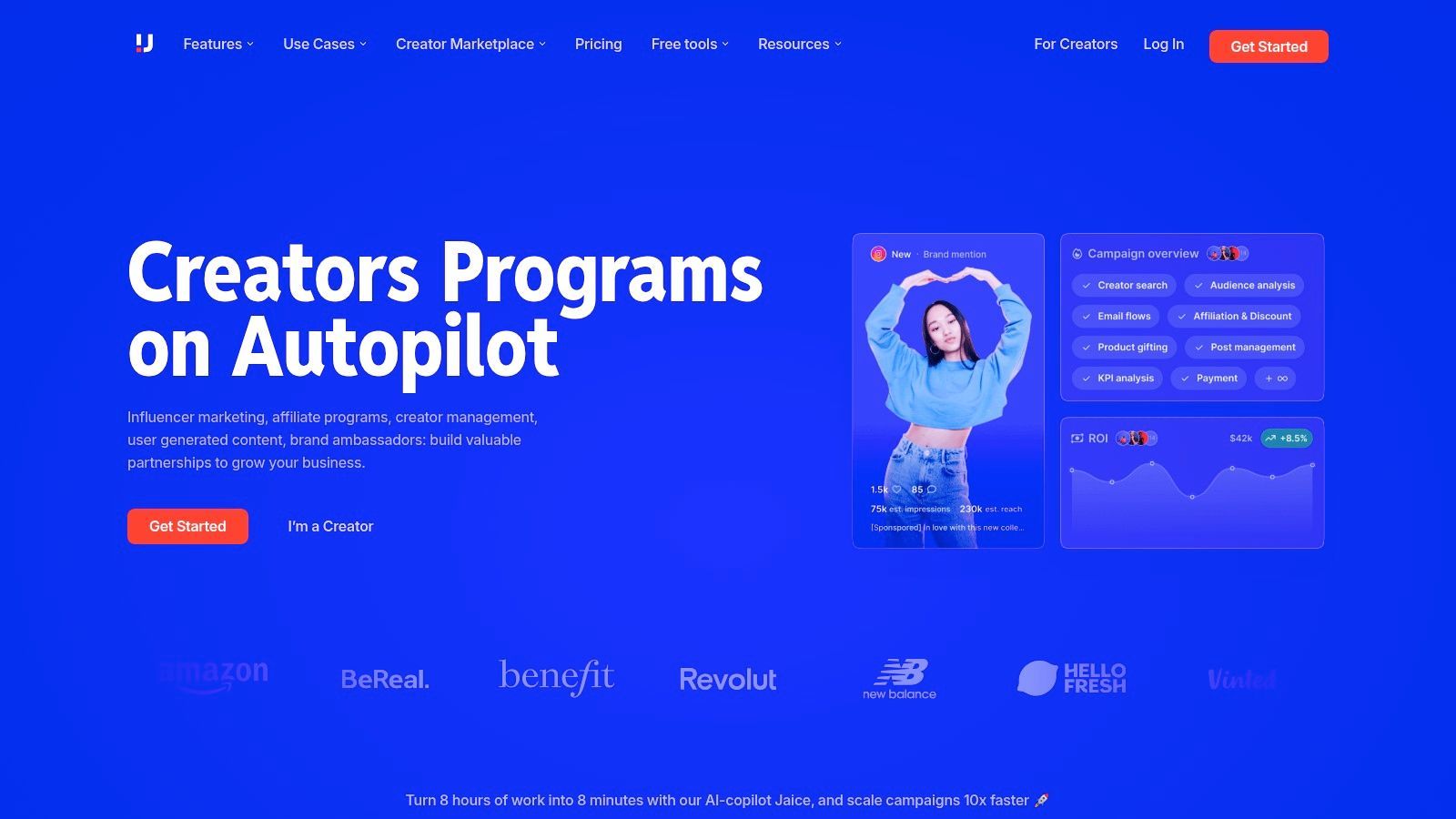
The platform is especially powerful for brands selling on Shopify or Amazon. It provides deep integration for tracking affiliate links, generating promo codes, and attributing sales directly back to specific creator posts. This commerce-first approach is also supported by its creator marketplace, where influencers can apply to campaigns, and its integrated workflows for managing product gifting and global payments.
Key Features & User Focus
- Best For: DTC brands and Amazon sellers who need a unified platform for managing both influencer marketing and affiliate programs with a clear focus on sales attribution.
- Standout AI Feature: Jaice, the AI copilot, excels at matching creators to specific campaign goals and automating the initial, time-consuming outreach process with personalized communication.
- Pricing: Pricing is quote-based and generally aimed at mid-market and enterprise clients. A sales consultation is required to get a specific price.
- Implementation Tip: Get the most out of Upfluence by connecting your e-commerce store (Shopify, WooCommerce) and Amazon Attribution account early. This unlocks its full sales tracking and ROI measurement capabilities.
| Pros | Cons |
|---|---|
| Strong e-commerce orientation (Shopify, Amazon). | Pricing is not accessible for small businesses. |
| Marketplace feature accelerates creator recruitment. | Advanced features may require dedicated onboarding. |
| Integrated gifting, payments, and affiliate management. | Can be complex for simple brand awareness campaigns. |
Website: https://www.upfluence.com
5. Aspire
Aspire bridges the gap between a full-suite influencer marketing platform and a dynamic creator marketplace. It's a versatile tool that uses data to help brands manage everything from influencer discovery and product seeding to affiliate programs and user-generated content (UGC) campaigns. While not purely an AI-first platform, Aspire incorporates machine learning to streamline workflows, making it one of the more accessible yet powerful AI tools for influencer marketing available to growing brands.
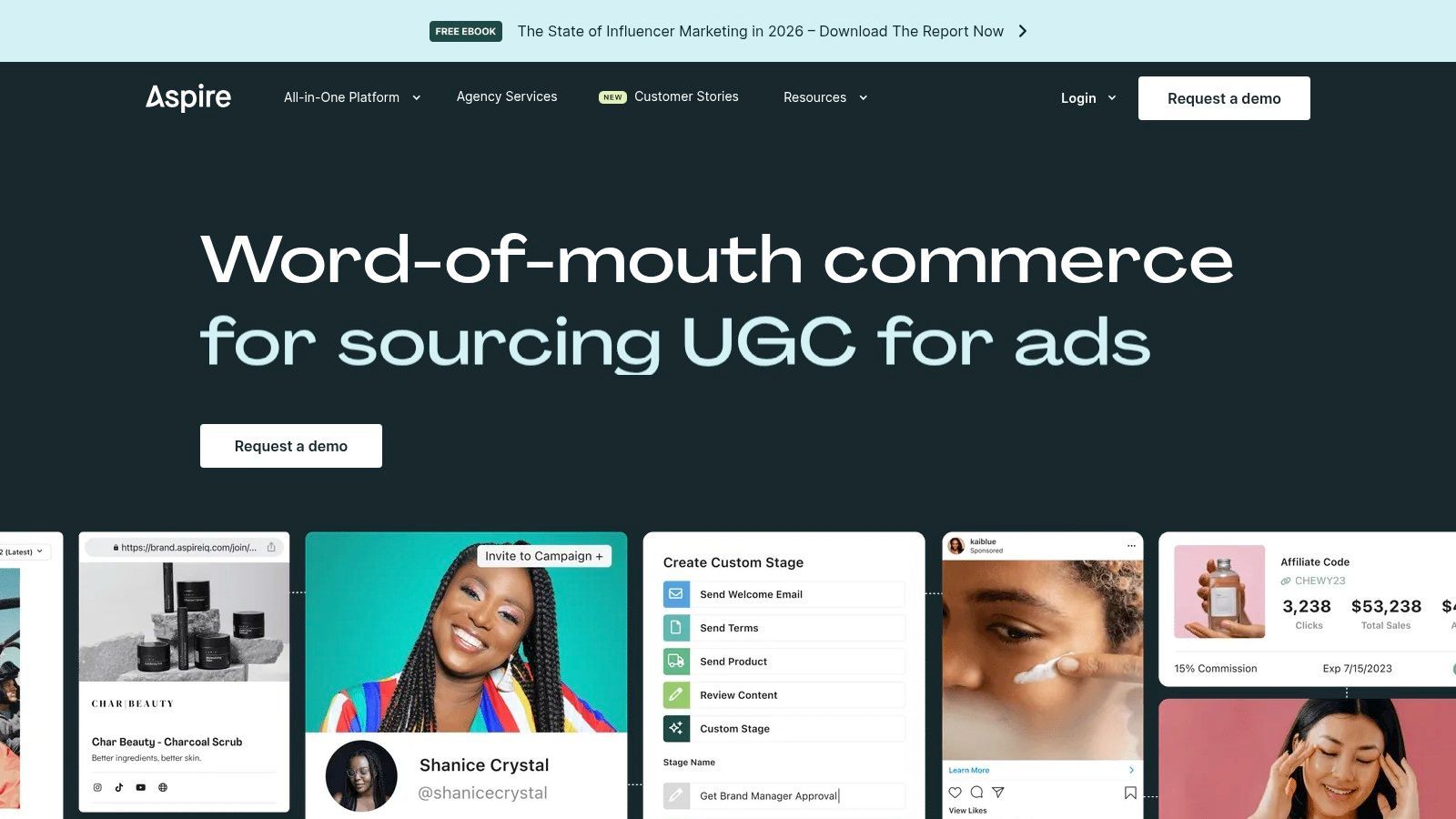
The platform's dual approach is its main differentiator; brands can proactively search a database of over 20 million creators or post campaign briefs to its Creator Marketplace and receive inbound applications. This flexibility supports both targeted outreach and scalable recruitment. Its native Shopify integration simplifies product seeding and sales tracking, and the ability to boost creator content directly into paid ads from the platform offers a connected path from organic content to paid media.
Key Features & User Focus
- Best For: E-commerce and DTC brands that need a flexible tool for managing diverse creator programs, including affiliates, ambassadors, and UGC generation.
- Standout AI Feature: The AI-assisted image search and creator lookalike recommendations help brands quickly find new influencers who match the aesthetic and performance of their top partners.
- Pricing: Pricing is quote-based and requires a sales call. It is generally positioned for established small businesses to mid-market companies.
- Implementation Tip: Start by using the Creator Marketplace for a single campaign to understand the quality of inbound applicants. At the same time, connect your Shopify store early on to automate product seeding and unlock affiliate sales tracking capabilities.
| Pros | Cons |
|---|---|
| Combines a creator marketplace with a search database. | Pricing is not transparent and requires a sales demo. |
| Supports diverse use cases like UGC, ads, and affiliates. | Feature depth can be more than what very small teams need. |
| Excellent Shopify integration for e-commerce brands. | Managed services are an additional cost. |
Website: https://www.aspire.io
6. Traackr
Traackr is a creator intelligence platform built for sophisticated strategy, benchmarking, and program governance. It's one of the more established AI tools for influencer marketing, focusing on deep audience quality analytics, brand-safety, and spend optimization. The platform is particularly popular in enterprise categories like beauty and fashion, where historical performance data and multi-market reporting are essential for making strategic decisions.
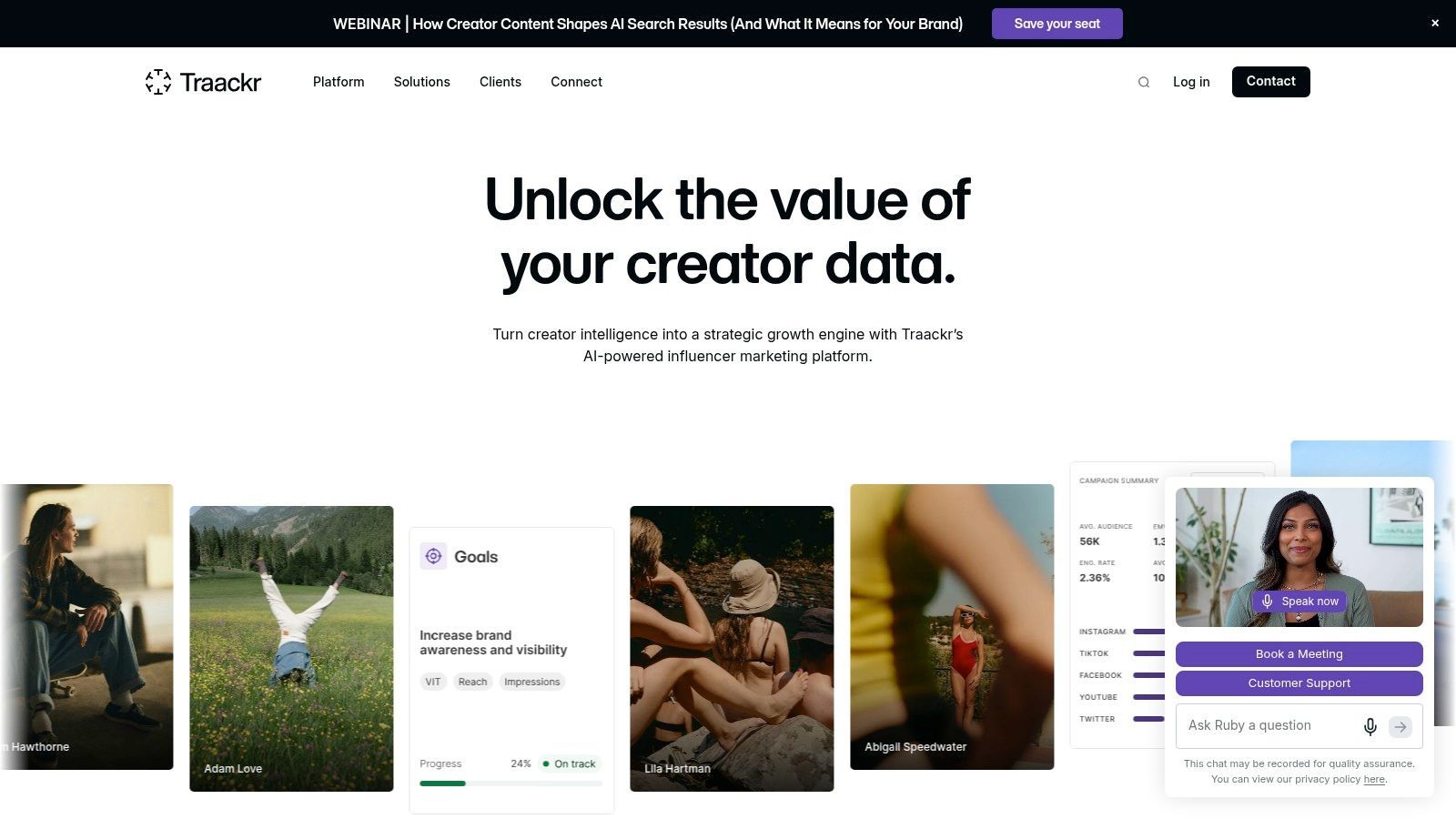
The platform’s AI is geared toward vetting and discovery, providing brand-safety scores and insights into a creator's audience demographics and authenticity. This allows large brands to manage risk and ensure alignment at a global scale. Traackr’s value lies less in lightweight outreach and more in its ability to deliver competitive benchmarking and program measurement tied directly to budget optimization and business outcomes.
Key Features & User Focus
- Best For: Global enterprise brands, especially in beauty and CPG, that need strong governance and data-driven strategic planning tools.
- Standout AI Feature: The AI-powered creator vetting, which includes brand-safety scoring and audience quality analysis, helps large organizations confidently select partners who align with their brand values across different markets.
- Pricing: Pricing is custom and targets mid-market and enterprise clients. A sales-led consultation is required to get a quote.
- Implementation Tip: Use Traackr’s historical trend analysis to benchmark your brand against competitors before launching a new campaign. This provides a data baseline to measure your program’s unique impact on share of voice and audience engagement.
| Pros | Cons |
|---|---|
| Deep analytics and compliance for enterprise scale. | Custom pricing is inaccessible for small businesses. |
| Strong governance for multi-market, multi-team programs. | Not designed as a simple outreach or CRM tool. |
| Competitive benchmarking and historical data analysis. | The interface can be complex for users new to data tools. |
Website: https://www.traackr.com
7. Tagger by Sprout Social
Tagger, now part of the Sprout Social suite, brings together a dedicated influencer marketing platform with a broad social media management ecosystem. This integration makes it one of the more interesting AI tools for influencer marketing for businesses already invested in Sprout's platform. Tagger’s core AI assists with creator discovery by analyzing audience data, content performance, and engagement metrics to suggest relevant partners for your brand.
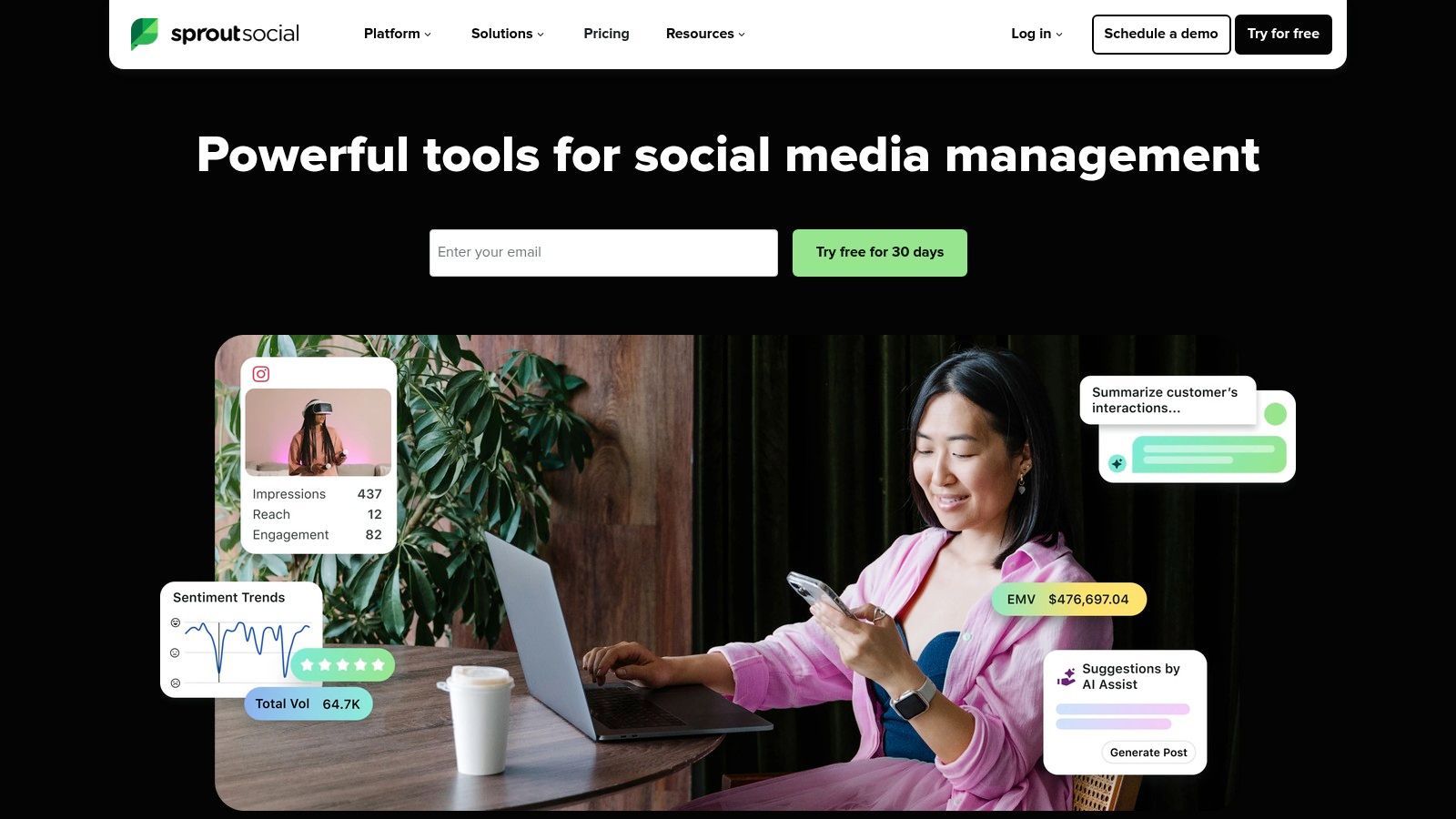
The primary advantage is creating a unified workflow where influencer campaigns are managed alongside organic social publishing, paid media, and customer care. This single-vendor approach simplifies reporting and team collaboration. The platform uses APIs to pull rich creator data, providing detailed profiles and content previews to help vet potential collaborators without leaving the tool.
Key Features & User Focus
- Best For: Mid-to-large companies that use or plan to use Sprout Social for their wider social media management and want an integrated influencer marketing solution.
- Standout AI Feature: The AI-driven creator search combined with its alignment to Sprout’s social listening capabilities allows you to discover influencers who are already talking about your brand or industry.
- Pricing: Enterprise-focused, quote-based pricing. It's most cost-effective when bundled with other Sprout Social products and may not fit smaller business budgets.
- Implementation Tip: To get the full benefit, focus on integrating your influencer marketing workflows with your broader social media strategy within Sprout. Use its unified reporting to show how influencer activities impact overall social ROI.
| Pros | Cons |
|---|---|
| Single vendor for social media and influencer management. | Enterprise pricing can be a barrier for smaller teams. |
| Continuous product evolution after the Sprout acquisition. | Best value is realized when standardizing on the full Sprout suite. |
| Integrates influencer data with social listening tools. | May offer more features than needed for simple campaigns. |
Website: https://sproutsocial.com
8. Captiv8
Captiv8 is a comprehensive, end-to-end platform that excels in connecting influencer marketing directly to commerce and performance metrics. It positions itself as one of the key AI tools for influencer marketing by integrating powerful discovery and workflow automation with robust payment and affiliate systems. The platform is built to manage the entire lifecycle of a campaign, from finding the right talent to measuring their direct impact on sales.
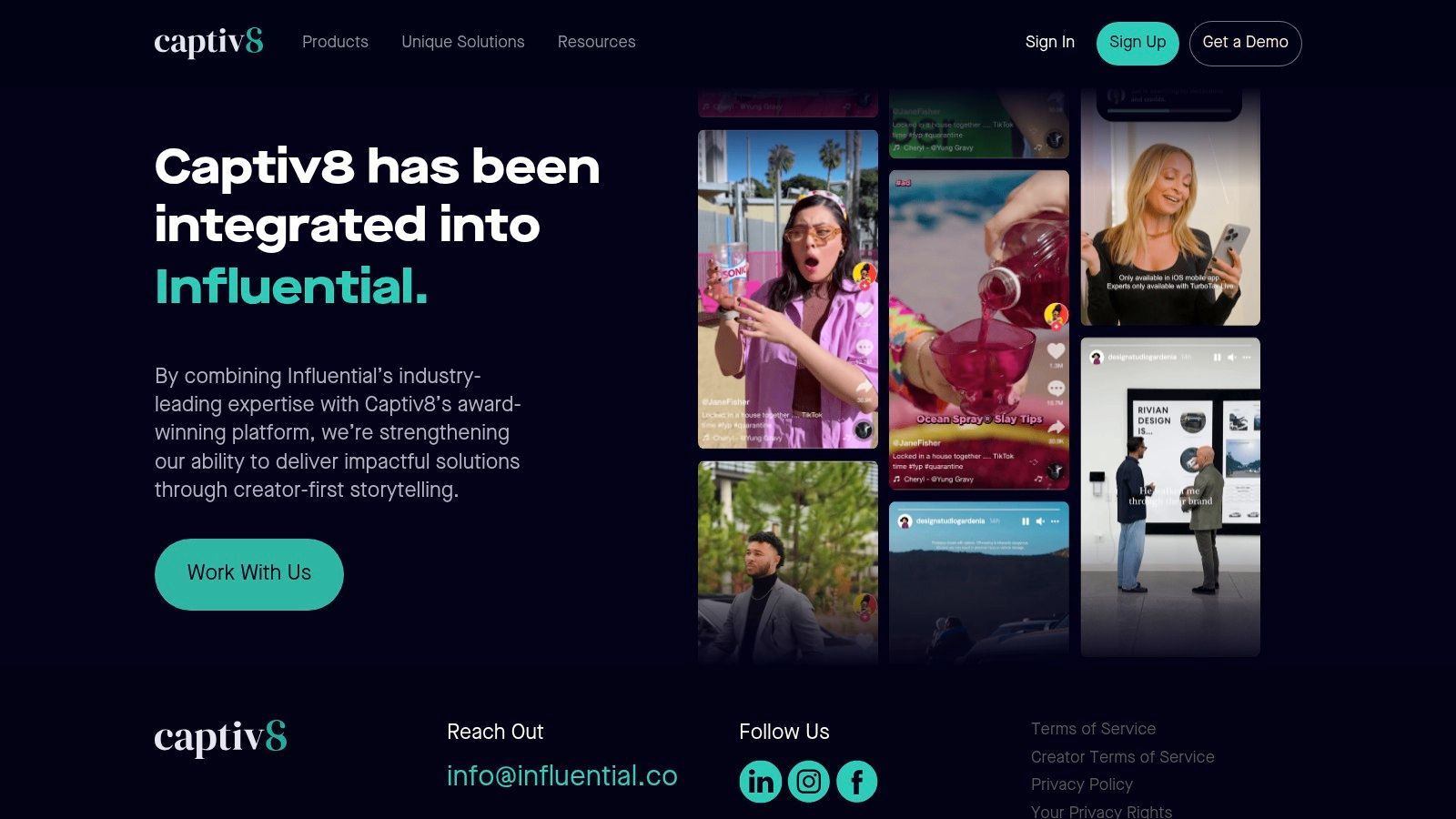
A notable aspect of Captiv8 is its focus on measurable results. Its AI-assisted discovery goes beyond simple follower counts, incorporating a proprietary "Influencer Velocity" signal to identify rising stars and brand-fit signals to ensure alignment. Furthermore, its deep integrations with Shopify, affiliate networks, and global payment processors make it a strong choice for brands that need to prove ROI through direct attribution, gifting, and affiliate link management.
Key Features & User Focus
- Best For: Mid-to-large-sized e-commerce brands and agencies that need to manage complex, multi-creator campaigns with a strong focus on sales attribution and affiliate marketing.
- Standout AI Feature: The AI-powered "Influencer Velocity" signal helps marketers spot up-and-coming creators before they become saturated, offering a competitive advantage in talent discovery.
- Pricing: Pricing is quote-based and requires a conversation with their sales team. It's designed for businesses with established influencer marketing budgets.
- Implementation Tip: To get the most from Captiv8, lean into its commerce features early. Connect your Shopify store and set up affiliate links during the initial campaign setup to ensure all performance data is tracked from day one.
| Pros | Cons |
|---|---|
| Broad feature coverage from discovery to payment. | Pricing is sales-led and not suited for small teams. |
| Strong commerce and affiliate capabilities (Shopify, etc.). | Some users have noted occasional payment timing issues. |
| AI discovery includes unique "velocity" and brand-fit signals. | Can feel complex for simple awareness campaigns. |
Website: https://captiv8.io
9. HypeAuditor
HypeAuditor is an analytics-first platform centered on vetting creators and combating influencer fraud. It uses AI to score audience authenticity, detect bots, and analyze engagement quality, making it one of the most trusted AI tools for influencer marketing when it comes to due diligence. Its core value is providing the data needed to avoid wasting budget on influencers with fake followers or inflated metrics across Instagram, TikTok, and YouTube.
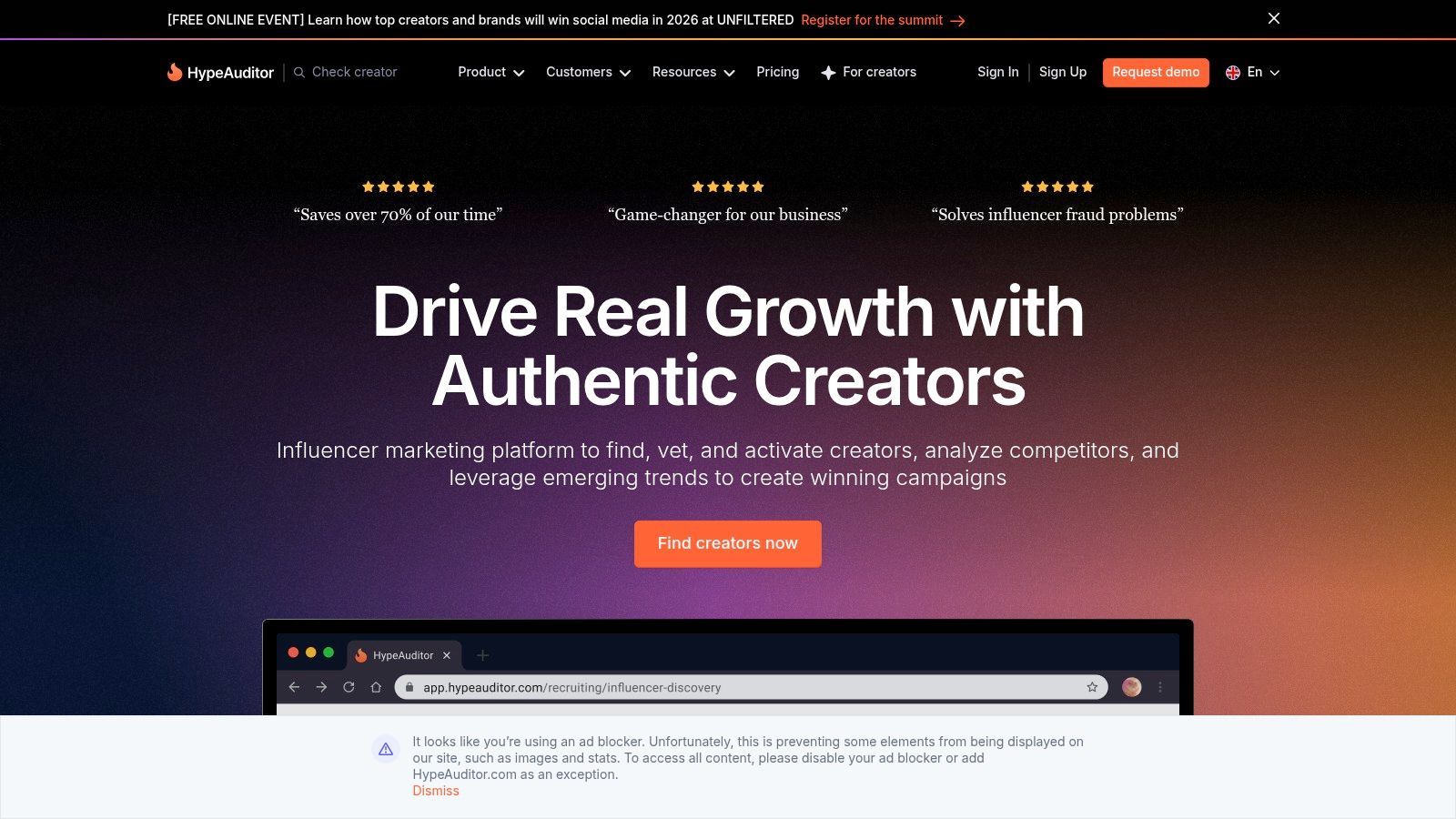
While it offers campaign management and discovery features, its main distinction is the depth of its analytical tools. The platform’s Audience Quality Score (AQS) is an industry benchmark for evaluating an influencer’s audience health. For larger programs, HypeAuditor provides API access and robust reporting capabilities, allowing teams to integrate its powerful fraud detection data into their existing workflows or business intelligence dashboards.
Key Features & User Focus
- Best For: Marketers and agencies who prioritize data integrity and want to verify creator authenticity before committing budget.
- Standout AI Feature: The AI-powered fraud and bot detection, encapsulated in its Audience Quality Score (AQS), provides a clear, actionable metric for vetting creators at scale.
- Pricing: Pricing is custom and quote-based, varying by data volume, the number of reports needed, and feature access.
- Implementation Tip: Use HypeAuditor as your primary vetting tool before adding creators to a campaign management platform. Run potential candidates through its analysis to build a pre-approved roster, saving time and reducing risk during campaign execution.
| Pros | Cons |
|---|---|
| Strong vetting and authenticity checks reduce wasted spend. | Pricing is custom and can vary by data consumption. |
| Robust reporting and API support for larger programs. | Discovery and outreach tools are less CRM-like than some suites. |
| In-depth audience quality and sentiment analysis. | Focus is more on analytics than end-to-end campaign management. |
Website: https://hypeauditor.com
10. Modash
Modash is a modern influencer marketing platform that stands out for its transparent pricing and focus on serving SMBs, startups, and agencies. It provides a full suite of tools for discovery, CRM, and content tracking, making it one of the most accessible and scalable AI tools for influencer marketing. Its AI is primarily focused on its massive creator database search and endpoint capabilities, allowing for precise and flexible creator discovery.
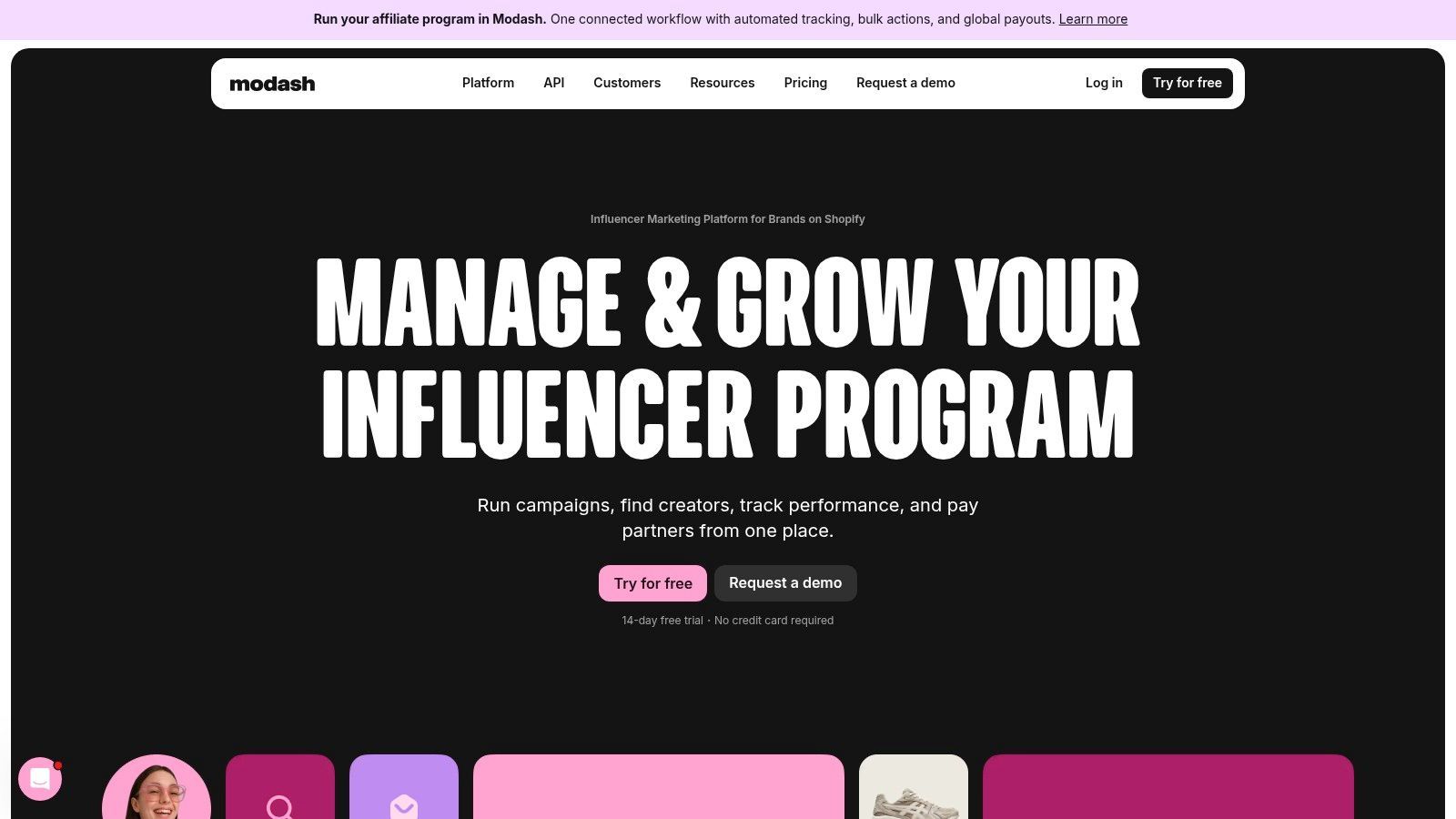
The platform is built for speed and efficiency, appealing to lean teams that need to get campaigns running without a lengthy sales or onboarding process. Modash offers a clear balance of powerful discovery features across 350M+ profiles on Instagram, TikTok, and YouTube, alongside practical tools like a creator CRM, automated content monitoring, and integrated payments. For developers, its API and AI search endpoints offer a foundation for building custom internal tools.
Key Features & User Focus
- Best For: SMBs, startups, and agencies needing a powerful yet straightforward platform with predictable costs and quick implementation.
- Standout AI Feature: The database search is a key function. Its AI-driven search endpoints allow for highly specific filtering (e.g., finding creators with a certain percentage of their audience in a specific city), providing granular control for targeted campaigns.
- Pricing: Offers a free trial and has transparent, publicly listed pricing tiers starting from a monthly subscription, which is rare in this space.
- Implementation Tip: Take advantage of the free trial to test your core use cases. Its Shopify and email integrations are easy to set up and can quickly connect influencer marketing efforts to your existing sales and communication workflows.
| Pros | Cons |
|---|---|
| Clear, transparent pricing with a free trial. | Lacks the deep enterprise governance of top-tier suites. |
| Excellent balance of discovery, CRM, and tracking. | Advanced paid-media and complex permission settings are limited. |
| API access allows for custom workflow development. | May not be robust enough for massive, globally regulated brands. |
Website: https://www.modash.io
11. Influencity
Influencity offers a flexible and accessible platform for brands and agencies looking to scale their influencer marketing efforts without the enterprise-level commitment. It stands out by balancing powerful AI tools for influencer marketing with modular, subscription-based pricing. This approach allows growing teams to start with essential features like AI-assisted discovery and analytics and add more capabilities as their programs mature.
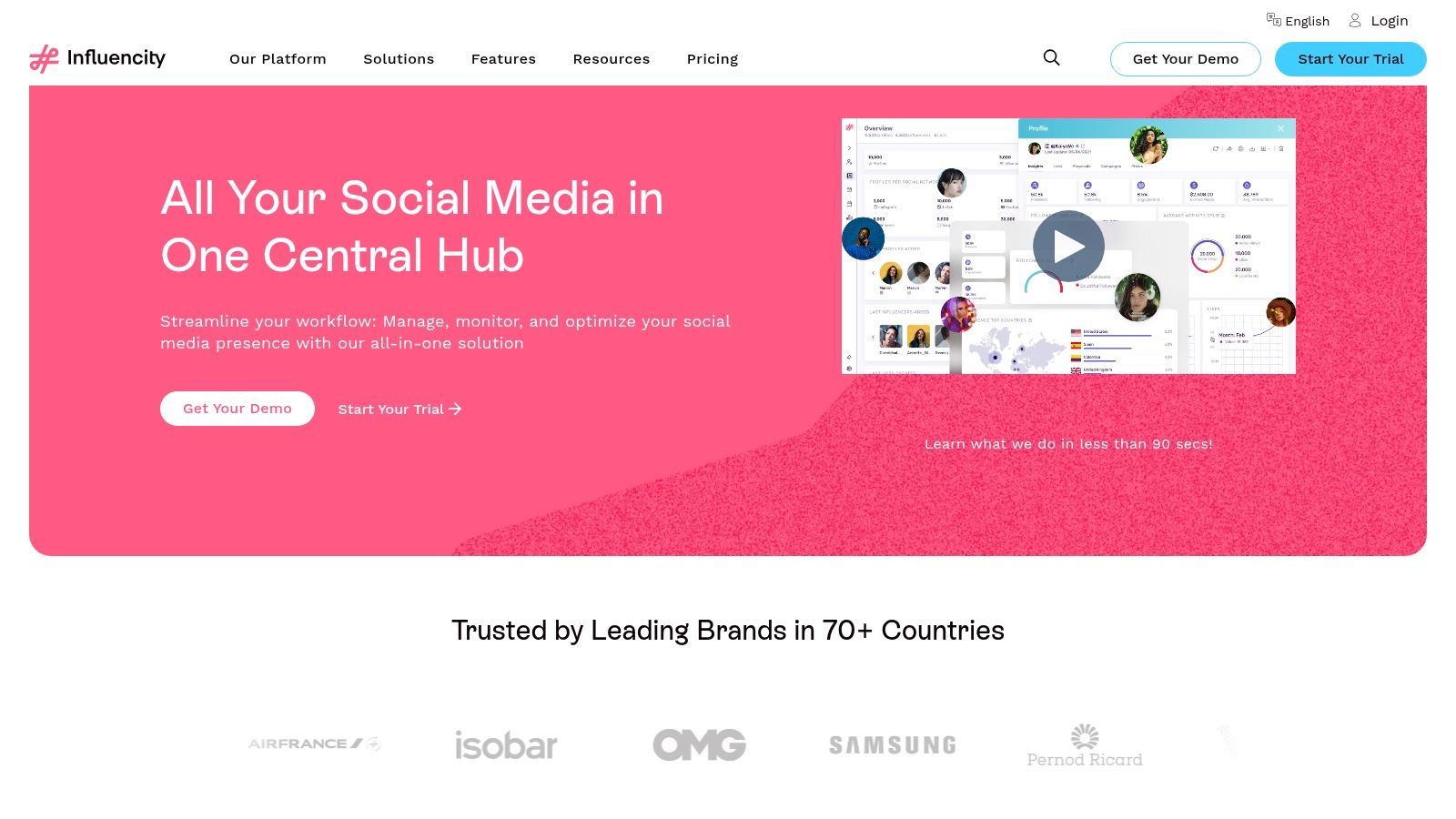
The platform’s core strength is its AI-driven search engine, which lets you filter a massive database of influencers by audience demographics, lookalikes, performance metrics, and more. Beyond discovery, Influencity provides an influencer CRM for managing relationships and detailed campaign reporting. Optional modules for social listening and content planning mean you can build a custom stack that fits your specific workflow and budget.
Key Features & User Focus
- Best For: Small to mid-sized brands and agencies needing a scalable, cost-effective platform with strong analytics and workflow management.
- Standout AI Feature: The AI-powered discovery engine is a highlight, offering granular filters for audience quality, interests, and lookalike creators to find the perfect fit for any niche campaign.
- Pricing: Offers several tiered plans with monthly billing options, making it more approachable than enterprise-only platforms. The exact feature sets and quotas are best clarified during a demo.
- Implementation Tip: Start with the core discovery and campaign management features. As you scale, evaluate the Social Hub modules (like social listening) to see if they can replace other standalone tools in your marketing stack.
| Pros | Cons |
|---|---|
| Flexible, modular stack with approachable monthly costs. | The on-site pricing grid is simplified; full details require a demo. |
| Good balance of analytics and workflow for growing teams. | Fewer direct marketplace or affiliate options than some competitors. |
| AI-assisted discovery provides deep audience insights. | Can feel less 'all-in-one' if you don't purchase add-on modules. |
Website: https://influencity.com
12. Affable AI (by Bazaarvoice)
Acquired by the e-commerce content giant Bazaarvoice, Affable AI has evolved from a standalone platform into an integrated solution connecting creator marketing directly to commerce. It stands out as one of the key AI tools for influencer marketing that now bridges the gap between influencer-generated content and shoppable user experiences. The platform's AI engine excels at data-rich creator discovery, campaign management, and performance measurement, all within the larger Bazaarvoice ecosystem.
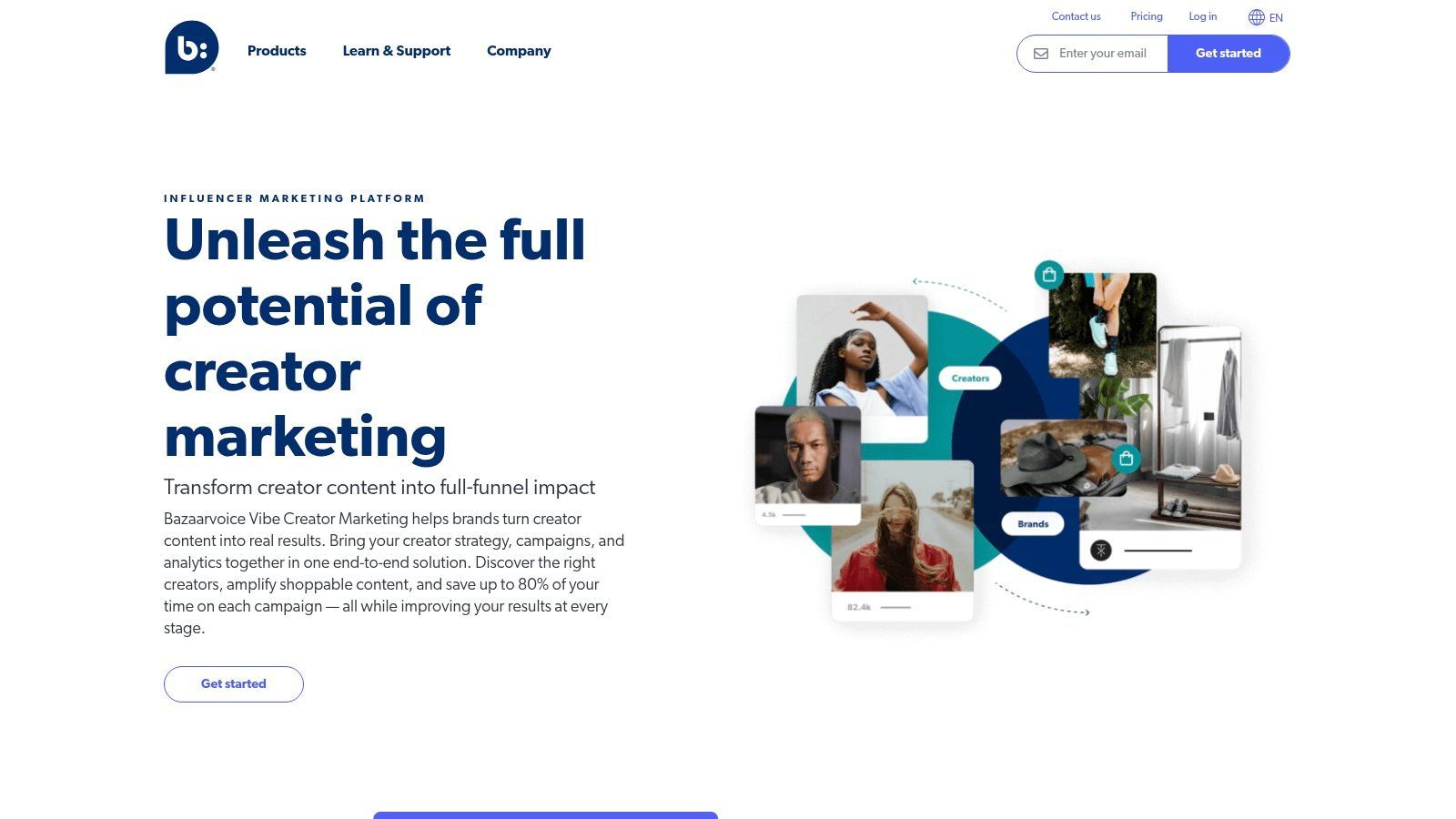
This connection is its main differentiator. Brands using Bazaarvoice for ratings and reviews can now use Affable AI to identify influencers, run campaigns, and then amplify that creator content as shoppable social proof across their websites. Its AI-assisted discovery provides deep audience analytics, while campaign workflows are built for scalable team collaboration, complete with reporting that ties back to e-commerce results.
Key Features & User Focus
- Best For: E-commerce brands, particularly those already invested in the Bazaarvoice suite, who want to integrate influencer marketing with their on-site UGC and commerce strategy.
- Standout AI Feature: AI-powered creator and content discovery that is now deeply integrated with Bazaarvoice's commerce and shoppable media capabilities, making creator content directly transactional.
- Pricing: Pricing is quote-based and not public. It is designed for mid-market and enterprise clients, requiring a sales-led engagement.
- Implementation Tip: To see the full benefit, plan to use Affable AI in conjunction with other Bazaarvoice products. Focus on workflows that turn influencer content into shoppable galleries on your product pages.
| Pros | Cons |
|---|---|
| Backed by a major commerce platform (Bazaarvoice). | Pricing details are not publicly available. |
| Strong analytics orientation and scalable for teams. | Best fit when also using other Bazaarvoice services. |
| Directly connects influencer content to shoppable experiences. | Might be too focused on e-commerce for non-retail brands. |
Website: https://www.bazaarvoice.com/products/bazaarvoice-affable-ai/
Top 12 AI Influencer Marketing Tools Comparison
| Product | Core Features ✨ | Experience ★ | Value 💰 | Target Audience 👥 | Unique Strengths 🏆 |
|---|---|---|---|---|---|
| ShortGenius (AI Video / AI Ad Generator) 🏆 | ✨ End‑to‑end AI: script → image/video → voice → edit → schedule | ★★★★★ Fast, polished short‑form output | 💰 Tiered; sign‑up for plans | 👥 Influencers, social teams, agencies, DTC, educators | 🏆 Unified workflow + rich presets, API & automated multi‑platform distribution |
| CreatorIQ | ✨ AI discovery, SafeIQ brand‑safety, program mgmt, payments | ★★★★★ Enterprise‑grade insights & governance | 💰 Sales‑led (enterprise) | 👥 Large brands & agencies | ✨ Deep data governance and broad integrations |
| GRIN (Gia AI) | ✨ Transaction‑trained AI, discovery, gifting, Shopify execution | ★★★★ Revenue‑focused, fast time‑to‑live | 💰 Sales‑led; fits established DTC | 👥 DTC brands, Shopify teams | ✨ Revenue/transaction‑driven creator recommendations |
| Upfluence (with Jaice AI) | ✨ Jaice AI matching, affiliate/Amazon tracking, marketplace, payments | ★★★★ Strong commerce & marketplace UX | 💰 Sales‑led (mid‑market+) | 👥 DTC/Amazon sellers, agencies | ✨ Amazon + affiliate attribution & creator marketplace |
| Aspire | ✨ Discovery + Creator Marketplace, campaign mgmt, Shopify | ★★★★ Marketplace scale with campaign controls | 💰 Sales‑led | 👥 Brands needing marketplace + SaaS controls | ✨ Large sponsorship marketplace for rapid recruiting |
| Traackr | ✨ Discovery, audience vetting, benchmarking, global reporting | ★★★★★ Deep analytics for enterprise programs | 💰 Custom enterprise pricing | 👥 Enterprise beauty, fashion, global teams | ✨ Best‑in‑class benchmarking, compliance & governance |
| Tagger (by Sprout Social) | ✨ AI discovery, creator profiles, paid‑media integrations | ★★★★ Integrated with Sprout Social stack | 💰 Enterprise pricing; best value with Sprout | 👥 Teams standardizing on Sprout Social | ✨ Unified social publishing + influencer workflows |
| Captiv8 | ✨ Velocity discovery, workflow, affiliate & payments, attribution | ★★★★ Broad feature coverage for commerce | 💰 Sales‑led (larger programs) | 👥 Mid→large brands with commerce focus | ✨ Velocity signals + global payments tooling |
| HypeAuditor | ✨ Fraud/bot detection, Audience Quality Score, campaign analytics | ★★★★ Strong vetting and reporting accuracy | 💰 Custom pricing (data volumes) | 👥 Teams focused on vetting & audit | ✨ Industry‑leading fraud & authenticity checks |
| Modash | ✨ Large database (350M+), CRM, content tracking, API | ★★★★ Transparent, fast onboarding | 💰 Transparent plans; SMB‑friendly | 👥 SMBs, agencies, builders | ✨ Predictable pricing + developer API & integrations |
| Influencity | ✨ Discovery, CRM, campaign reporting, optional social modules | ★★★ Flexible, modular UX | 💰 Tiered monthly plans available | 👥 Growing programs and cost‑sensitive teams | ✨ Modular stack with monthly billing and social add‑ons |
| Affable AI (by Bazaarvoice) | ✨ AI discovery, campaign mgmt, shoppable content integration | ★★★★ Scalable analytics tied to commerce | 💰 Sales‑led; integrated with Bazaarvoice | 👥 Brands leveraging Bazaarvoice & commerce teams | ✨ Shoppable creator content within Bazaarvoice ecosystem |
Putting It All Together: Building Your AI-Powered Workflow
Navigating the extensive list of AI tools for influencer marketing can feel overwhelming, but the goal isn't to adopt every platform. Instead, the real power comes from strategically selecting a few key tools to build a custom, efficient workflow that directly supports your specific objectives. We've explored a dozen platforms, from all-in-one management suites like CreatorIQ and GRIN to specialized analytics engines like HypeAuditor. The common thread is that AI is no longer a futuristic concept; it's a practical, accessible assistant ready to automate the most time-consuming parts of your job.
Your journey begins with a clear understanding of your primary bottleneck. Are you spending countless hours searching for the right creators? A discovery-focused tool like Upfluence or Modash should be your starting point. Is your main challenge managing relationships, contracts, and payments for a growing roster of influencers? A platform like Aspire or GRIN would be a more logical first investment. The key is to identify your biggest pain point and choose a "core" platform to solve it.
Designing Your Influencer Marketing Tech Stack
Once you have a foundational tool, you can build a more powerful system by integrating specialized solutions. This "hub-and-spoke" model is where true efficiency is born. Think of your core influencer relationship management (IRM) platform as the hub. The spokes are the specialized tools that handle specific, high-impact tasks.
Consider this practical workflow for a direct-to-consumer brand:
- Discovery & Vetting (The Hub): You use Tagger by Sprout Social to identify creators whose audience demographics precisely match your target customer profile. Its AI analyzes audience authenticity and engagement patterns, saving you from manual vetting.
- Outreach & Management (The Hub): You manage the entire campaign within Tagger, from initial outreach emails to contract signing and product shipment tracking.
- Content Amplification (The Spoke): Once your influencer partners create and post their content, the work isn't over. You can now use a tool like ShortGenius to ingest that user-generated content. Its AI can analyze the best moments, write new scripts for different ad angles, generate a professional voiceover, and create a dozen variations of high-performing video ads for TikTok, Instagram Reels, and YouTube Shorts.
In this scenario, you've seamlessly connected relationship management with scalable content creation. The initial influencer post generates awareness, while the AI-generated ads drive performance-focused conversions, maximizing the return on your initial investment.
Key Considerations Before You Commit
Before you subscribe to any service, it's vital to think through the implementation process. Here are a few final points to guide your decision-making:
- Start Small and Measure: Don't try to build your entire dream stack overnight. Select one primary tool, integrate it into your current process, and establish clear key performance indicators (KPIs). Are you saving time? Is your creator response rate improving? Is the content quality better? Let the data guide your next move.
- Focus on Integration: The best AI tools for influencer marketing work well with others. Before committing, check for native integrations or API access that allows platforms to share data. A tool that operates in a silo will eventually create more manual work.
- Balance Automation with Authenticity: AI is here to handle repetitive, data-heavy tasks so you can focus on what matters most: building genuine human relationships. Let the AI find the influencers, but you should be the one building the connection. Let the AI generate video ad variations, but you provide the strategic direction and creative spark.
Ultimately, these tools are powerful force multipliers. They give small teams the capabilities of a large agency and empower solo creators to operate like a full-fledged business. By thoughtfully combining discovery, management, and content creation tools, you can build an influencer marketing engine that is not only efficient but also incredibly effective.
Ready to turn your successful influencer collaborations into scalable ad campaigns? ShortGenius (AI Video / AI Ad Generator) is the perfect tool to amplify your content, letting you create dozens of high-quality video ads from a single piece of influencer content in minutes. Stop letting great content go to waste and start driving real results by visiting ShortGenius (AI Video / AI Ad Generator) to see how it works.