AI Image Generation API Guide for Production

Compare AI image generation API categories, endpoints, SDKs, pricing, limits, reliability, rights, and integration patterns for production workflows.
Your campaign is ready for review, except the hero image needs a wider background, the social thumbnail needs room for captions, and the product must look identical in every version. The first generated image looked convincing. Turning it into reusable campaign assets is where the engineering work starts.
An AI image generation API should support that entire production process, not just return pixels. The useful question isn't which model produces the most impressive sample. It's which integration can deliver approved assets predictably, with clear costs, recoverable failures, and records your team can audit.
Why Production Image APIs Are Different
A successful demo ends when an image appears. A production workflow ends when a reviewer approves the asset and the publishing system can use it.
Consider a campaign for a skincare product. The creative team needs a portrait composition for a social placement, a horizontal background for an advertisement, and a thumbnail with clear space for a headline. A late packaging revision shouldn't require someone to rebuild the entire campaign manually.
These are related creative jobs, but they aren't interchangeable API calls. Generating a fresh composition, preserving an existing product, and extending a background require different controls and acceptance criteria.
Practical rule: Choose the integration around the asset's destination, not the attractiveness of its preview.
The architectural distinction is asset production versus image generation. Your application needs to know which campaign requested the image, which operation produced it, whether it passed review, and which downstream outputs depend on it.
Define success before choosing a model
Write an acceptance contract before evaluating providers:
- Creative requirements: Specify the subject, composition, protected visual elements, and intended placement.
- Technical requirements: Define accepted dimensions, formats, transparency needs, and downstream compatibility.
- Operational requirements: Decide how users submit work, receive progress updates, approve results, and recover failed jobs.
- Governance requirements: Identify the permissions and origin records required before publication.
This contract prevents a common procurement mistake: selecting a model for visual quality and discovering afterward that its execution model doesn't fit the application.
For creators, agencies, and commerce teams, generated images are often intermediate assets. They become scenes, advertisements, thumbnails, or inputs to video assembly. The API should fit those dependencies rather than leave every surrounding task to manual recovery.
Understanding the Core API Layers
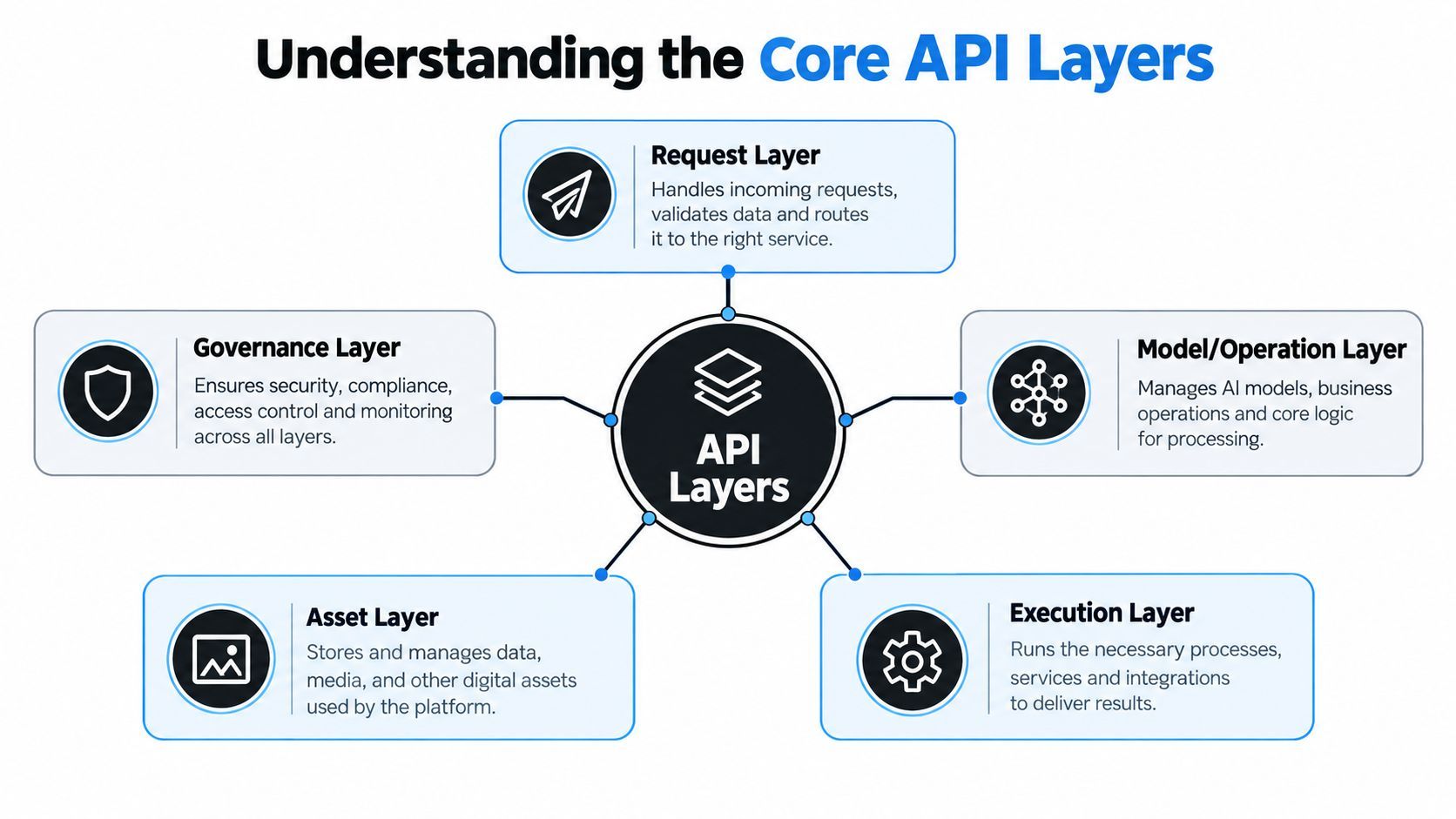
Separate the integration into request, model, execution, asset, and governance layers. This makes provider comparisons more precise and keeps a model change from becoming an application rewrite.
The map below shows the boundaries worth preserving in your implementation.
Give each layer a clear responsibility
- Request layer: Accepts the creative brief and validates application inputs. An endpoint is the addressable operation; a parameter is a setting supplied to it.
- Model or operation layer: Selects the generation or editing capability and its supported controls. A model version identifies the implementation you evaluated.
- Execution layer: Manages submission and completion. Synchronous execution holds the request open; asynchronous execution separates submission from result retrieval.
- Asset layer: Tracks the actual file, its application identifier, and its storage location.
- Governance layer: Associates permissions, review status, and provenance with the asset.
An SDK method is a programming-language interface to some portion of this process. It isn't the model itself, and its response object isn't necessarily a finished asset. That response might contain image bytes, a provider-hosted location, or a job identifier requiring further processing.
Keep application records separate
Design distinct records for the user's request, provider execution, stored asset, and provenance. A provider-hosted image location is a delivery mechanism, while durable application storage is an ownership and retention decision.
For broader architectural context, NZ Apps' API integration insights for platform builders provide a useful companion resource when planning service boundaries.
API access also differs from a finished creative tool. Your team still needs to decide who approves output, how revisions work, and when a result becomes publishable. Those decisions belong in the application, not in assumptions about an SDK.
Comparing API Categories and Image Operations
Choose an operation before choosing a provider. A text-to-image endpoint is a poor substitute for a controlled edit when the product packaging must remain unchanged.
AI image API categories compared
| API category | Execution pattern | Core image operation | Key controls | Best-fit workflow |
|---|---|---|---|---|
| Synchronous generation | Submit and await result | Text to image | Prompt, supported dimensions, quality | Interactive concept creation |
| Asynchronous generation | Submit, track, retrieve | Text to image or longer-running work | Job settings, completion handling | Queued campaign production |
| Editing and inpainting | Upload, instruct, retrieve | Change existing pixels | Source image, mask where supported | Localized thumbnail revisions |
| Outpainting or extension | Upload and expand | Generate beyond existing boundaries | Canvas dimensions, placement | Wider advertisement backgrounds |
| Variation and reference workflows | Supply source or references | Produce related alternatives | Reference role, supported influence controls | Concept exploration with constraints |
| Multi-model platforms | Route through an application interface | Multiple supported operations | Model selection, capability mapping | Mixed creative workloads |
Execution pattern and image operation are separate dimensions. An editing service can be synchronous or asynchronous; a platform can expose several operations without making their behavior identical.
Historical image generation, editing, and variation documentation illustrates why these distinctions matter: supported output sizes, orientations, and output counts differed by model. Treat those examples as historical behavior, not a current capability matrix.
Match the workflow to the constraint
For a new campaign concept, text-to-image gives the model broad compositional freedom. For an approved photograph needing a background change, prefer an editing workflow and explicitly test what remains untouched.
Reference-guided generation occupies a different position. A reference can communicate appearance or composition, but you shouldn't assume it guarantees pixel preservation. Verify the provider's documented interpretation and test the protected details.
A domain-specific product such as OutdoorBrite's ai garden design generator is a useful planning example: design concepts call for different input constraints and review criteria than product advertisements.
Resolution and orientation are workflow controls, not cosmetic options. Ask whether the service generates the requested composition directly or requires a subsequent crop, resize, or extension. Each path changes what your reviewers must inspect.
Making a Text-to-Image API Request
Start with a small application-level request contract. Don't copy a provider's complete parameter list into your public interface unless you intend to support every field indefinitely.
The request flow below separates creative intent from the provider-specific translation.
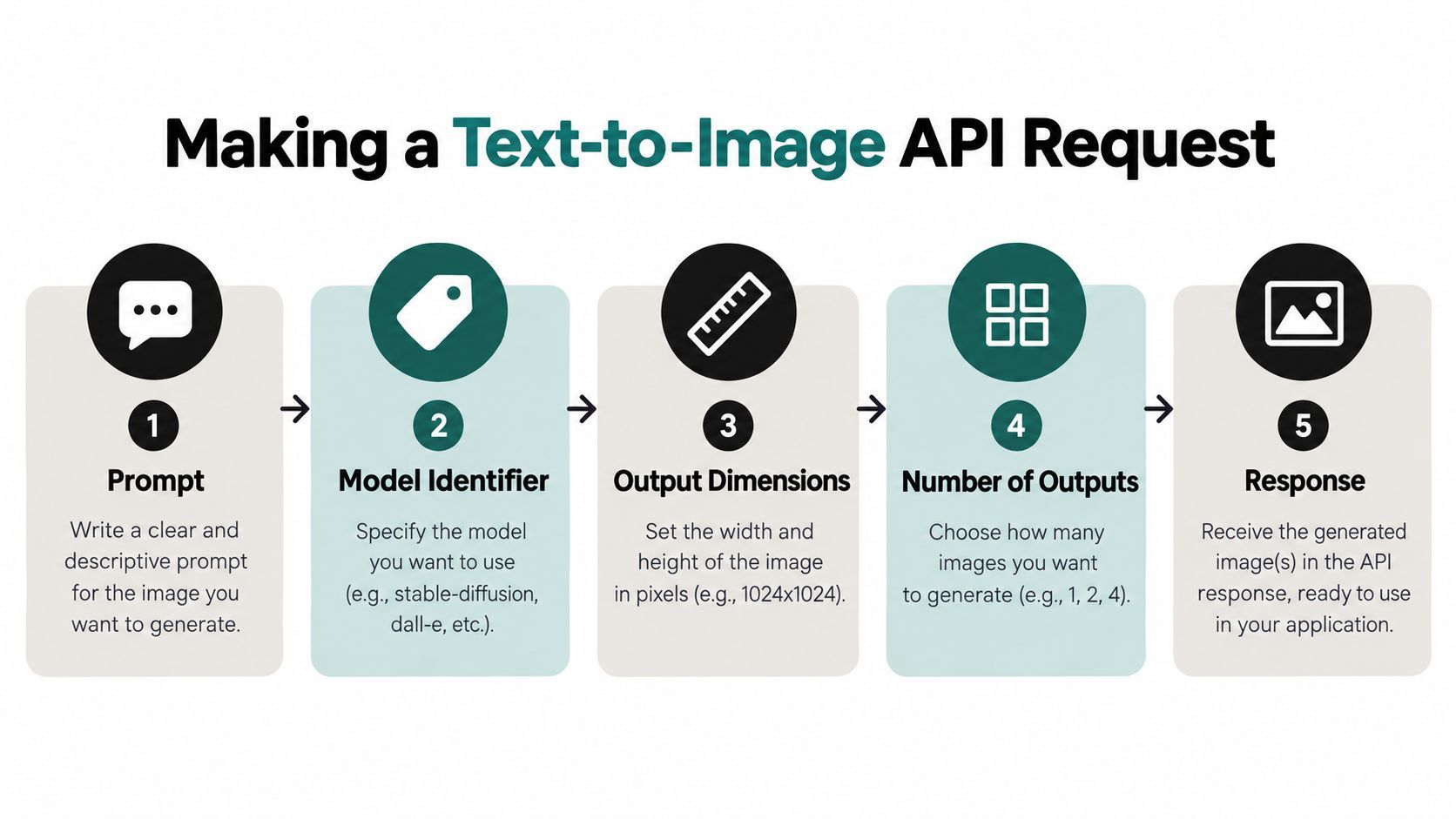
A vendor-neutral request might contain prompt, model_identifier, output_dimensions, output_count, and optional_controls. These are application field names, not a claim that any provider accepts this exact payload.
For campaign concepts, the prompt should describe the subject, desired composition, lighting, and reserved caption space. Keep placement requirements in structured fields where possible so your adapter can validate them independently.
Minimal submission and processing flow
Use this conceptual sequence as pseudocode:
- Load credentials: Read the provider secret from a server-side environment variable or secret manager. Never expose it in browser code.
- Validate the request: Confirm that the selected model supports the requested operation, dimensions, output count, and optional controls.
- Submit through an adapter: Translate the application request into the provider's documented SDK call.
- Classify the response: Distinguish completed output, accepted work, rejected input, and execution failure.
- Ingest the result: Validate the returned media and copy accepted output into application-controlled storage.
- Record context: Associate the asset with the prompt, model identifier, supported settings, request identifier, and evaluation status.
Set explicit connection and execution timeouts. Configure retries deliberately rather than accepting an SDK's defaults without inspection; the recovery policy belongs to the reliability design.
The companion video can be viewed alongside this request pattern.
Validate the image, not just the HTTP response. A successful status doesn't establish that the downloaded file decodes correctly or matches the requested dimensions. Inspect the media type, decode the file, and compare its properties with your acceptance contract before marking the asset ready.
Treat returned download locations as untrusted input. Restrict where the ingestion worker may fetch files, limit downloads, and avoid logging signed locations or credentials. A useful integration remains small, but it shouldn't skip the boundary checks surrounding the model call.
Adapting the Integration for Edits and Variations
A thumbnail revision starts with an approved asset, not an empty canvas. That changes both the request structure and the definition of success.
Editing changes existing content. Inpainting targets a selected region, while outpainting generates content beyond an existing boundary. A variation requests an alternative rendition; reference-guided generation uses supplied material to influence a new result. Providers may group these capabilities differently, so map documented behavior rather than relying on endpoint names.
Build an explicit source-aware payload
Keep the following concepts separate in your internal representation:
- Source assets: Identify the original image and any additional references by application asset identifiers.
- Mask: Supply a region selection only when supported, with the provider's required interpretation and format.
- Instructions: Describe what should change and what must remain unchanged.
- Canvas and output settings: Record the intended dimensions, source placement, format, and supported generation controls.
- Reference roles: Distinguish a product reference from a style reference instead of sending an unexplained collection of files.
Preserve the original file as an immutable source. Store edited output as a new asset with a relationship to that source, rather than overwriting the file a reviewer previously approved.
Validate uploads before submission
Check decoded content as well as declared content type. Enforce upload-size and image-dimension limits, and verify whether the service accepts multipart files, uploaded asset identifiers, or another documented transport.
For a social thumbnail, request a localized background revision while protecting the subject. For an advertisement extension, specify the expanded canvas and where the original sits within it. For a controlled variation set, record which attributes may change, such as lighting, and which must remain stable, such as packaging.
Don't treat a visually plausible edit as proof of preservation. Compare protected regions and inspect product text, logos, and edges after the transformation. Use the quality gates described below, and retain the source relationships needed for the provenance record.
Choosing SDKs and HTTP Integrations
The integration choice affects more than request syntax. It determines who owns provider changes, how asynchronous jobs are tracked, and how much detail reaches your logs when a generation fails. Match the client to your team's operational requirements and the provider's documented behavior.
An official SDK can reduce setup work when its types and examples fit your runtime. Before adopting it, check whether it exposes request identifiers, cancellation, polling, and raw error details. A method called “stream” may stream job events rather than image bytes, so confirm what the response contains.
Direct HTTP gives your team control over connection pools, tracing, deadlines, and dependency policy. That control comes with maintenance work: authentication, serialization, response parsing, and compatibility tests become your responsibility. It can also make provenance easier to preserve if your adapter records the provider request ID and the exact settings used for each asset.
| Integration path | Useful advantage | Trade-off to inspect |
|---|---|---|
| Official SDK | Language-oriented methods and response types | Retry behavior, dependency weight, release compatibility |
| Direct HTTP | Explicit transport and error handling | More serialization, parsing, and lifecycle code |
| Multi-provider adapter | Shared application contract | Capability mismatches and abstraction maintenance |
For a provider-neutral direct request, keep the transport boundary explicit:
- Prepare: Read the documented endpoint and authentication settings from server-side configuration.
- Send: Serialize the request body and apply a deadline to the HTTP call.
- Inspect: Record the status, provider request identifier, and relevant rate-limit or retry guidance.
- Normalize: Map the result to an application state such as completed, pending, rejected, or failed.
This is an integration sequence, not a runnable provider request. Use current documentation for authentication, HTTP methods, content types, and field names.
A multi-provider adapter should standardize stable concepts, including requests, job states, assets, and errors. Keep provider-specific controls available through scoped extensions. Forcing unlike models into identical parameters can hide differences that affect output quality, commercial rights, or cost per usable asset.
Test adapters against recorded response fixtures, including malformed responses, not only successful live calls. Pin dependencies and run contract tests before upgrades. Portability means switching providers deliberately, with their output behavior and terms still checked individually.
Evaluating Image Quality and Prompt Adherence
A polished sample is evidence that a model can produce that image. It isn't evidence that the API fits your campaign workload.
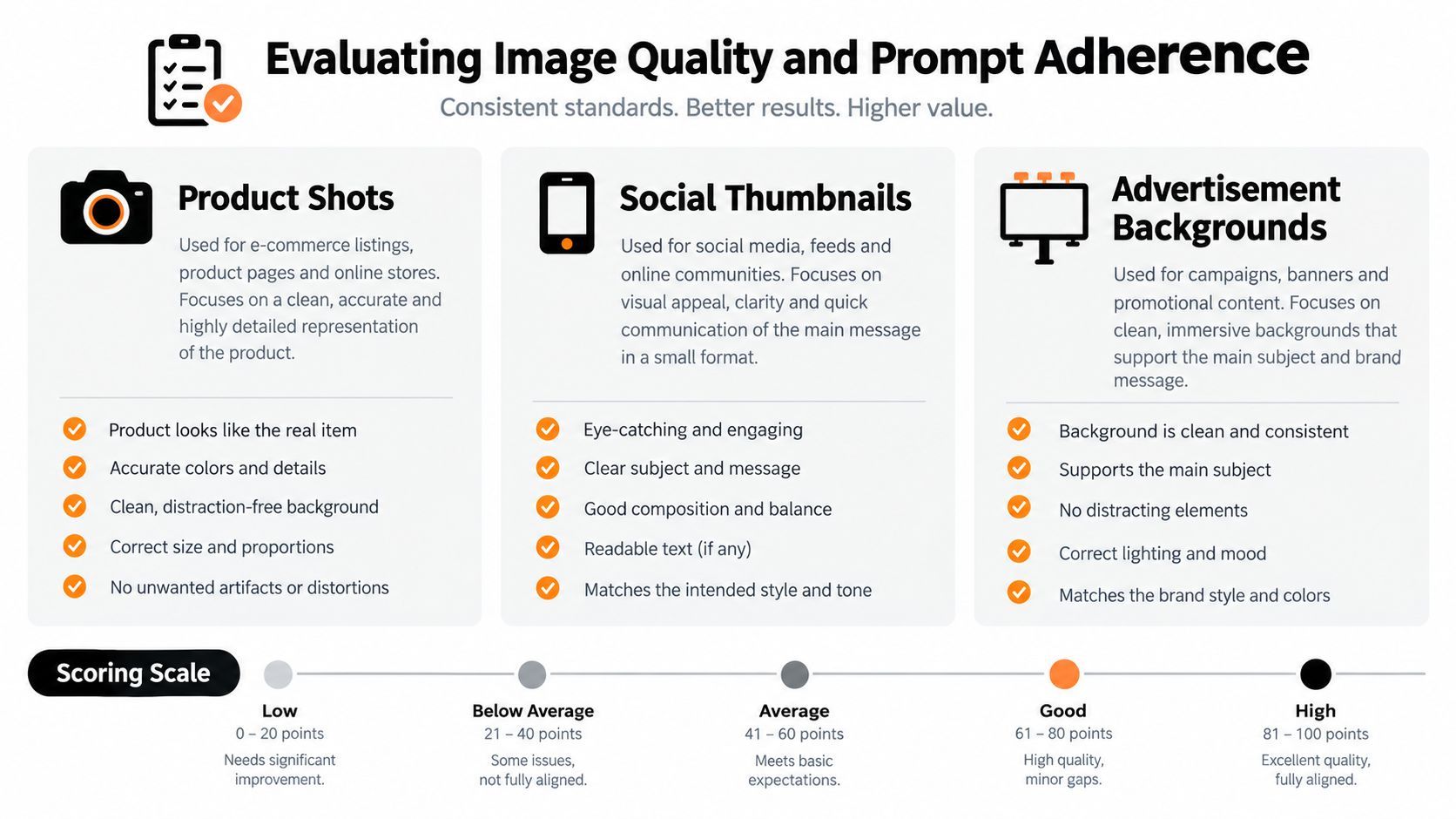
Build a fixed evaluation set covering product shots, social thumbnails, advertisement backgrounds, presenters, text-heavy designs, and reference-guided edits. Include difficult prompts from actual production requirements, not just favorable showcase prompts.
The scorecard below organizes review around creative use cases.
Use metrics for specific questions
A multimodal benchmarking framework combines CLIP Score for prompt-image alignment, CLIP cosine similarity for reference comparison, LPIPS for perceptual similarity, FID for distribution-level comparison, mean reciprocal rank for retrieval ordering, and Recall@3 for top-three matching accuracy.
These measures answer different questions. A high semantic alignment score doesn't establish correct typography, anatomy, brand compliance, or composition. Distribution-level measures also shouldn't be treated as approval scores for individual advertisements.
Run repeated generations and retain model versions, request settings, and seeds where supported. Record latency distributions, failures, moderation outcomes, and cost alongside visual scores so a quality comparison doesn't hide operational differences.
Add blinded human review
Give reviewers explicit criteria and conceal provider identity where practical. Ask them to judge prompt adherence, visual defects, brand compliance, and whether the result is usable without substantial repair.
Prompt specificity should reflect the profession. TattoosAI's guidance for tattoo artists seeking client concepts is a relevant companion resource when designing a domain-specific prompt set rather than a generic aesthetic benchmark.
For campaign assets, make the final acceptance gate workflow-based:
- Content integrity: Required products and logos remain correct.
- Placement readiness: The composition works at the target aspect ratio.
- Production compatibility: Captions, resizing, and video compositing don't make the image unusable.
- Review completeness: Required approvals and provenance records accompany the file.
Keep rejected outputs in the evaluation dataset with rejection reasons. Otherwise, teams can accidentally compare only their favorite results and overlook recurring failure modes. The useful outcome is a measured approval process, not a leaderboard disconnected from the work.
Designing Reliable API Operations
A generation job may finish after your client times out. If you retry without checking, you can pay for duplicate work; if you mark the request as failed, the completed image may go unnoticed.
A published image-generation reliability benchmark reports that high-quality generation commonly takes 30–60 seconds, with timeout risk around 180 seconds. These are benchmark-specific observations, not service guarantees or universal timeout settings. Set client timeouts and recovery behavior according to the provider's documented limits and your workflow's tolerance for delay.
Start by creating an application job before calling the provider. Track submission, provider acceptance, generation, ingestion, validation, and completion as distinct states. This gives workers a reliable record to reconcile after a crash or ambiguous response.
Use provider-supported idempotency keys where available, backed by application-level duplicate protection. Store the provider's job identifier as soon as it is returned. If submission has an unclear outcome, check for an existing operation before resubmitting when the provider supports reconciliation.
Polling should follow documented guidance and use backoff. For webhooks, verify signatures when supported, and make handlers safe for duplicate or out-of-order events. Set retry budgets that distinguish transient transport errors from invalid inputs, moderation decisions, and exhausted quotas. Separate batch queues from interactive revisions so campaign volume does not delay time-sensitive work.
Before selecting a provider, test its recovery behavior:
| Reliability criterion | Evidence to request or test |
|---|---|
| Latency | Distribution by operation, quality setting, and load |
| Availability | Published history and contractual commitments |
| Concurrency | Limits, queue behavior, and throttling responses |
| Result retention | Expiration terms and retrieval recovery |
| Errors | Stable classifications and actionable diagnostics |
| Recovery | Cancellation, reconciliation, and support procedures |
Show users only progress states the system can confirm, such as queued, generating, processing, or requiring review. If the provider exposes no progress estimate, avoid invented completion percentages.
Fallbacks need explicit policy. Use only alternatives that meet the required quality and rights criteria, and record each substitution. A fallback must never bypass a moderation rejection.
Operational checkpoint: Test worker crashes and expired result locations before testing peak throughput.
In a campaign pipeline, downstream rendering should wait for an approved asset. If a background fails, mark the job as blocked and provide an actionable reason rather than producing an incomplete video.
Comparing Pricing Tiers and Unit Economics
The listed generation fee is only part of the purchasing decision. Compare the cost of producing an approved creative, not merely the cost of submitting a request.
Broader inference economics have changed substantially: Stanford's AI Index reports that querying a model at a specified language-benchmark performance level fell from $20 to $0.07 per million tokens between November 2022 and October 2024. That's language-model inference evidence, not an image-generation price forecast.
Provider pricing questions
| Pricing dimension | What to verify | Unit to calculate | Operational trade-off |
|---|---|---|---|
| Generation | Billing trigger and failed-job treatment | Cost per requested image | Low fees can hide unsuccessful work |
| Resolution or quality | Which settings change charges | Cost per accepted asset | Higher quality may change latency |
| Editing | Input and output billing rules | Cost per approved revision | Repeated repair can exceed fresh generation |
| Compute time | Queue and execution billing | Cost per completed operation | Slow jobs may affect expenditure |
| Storage and delivery | Retention, transfer, and retrieval charges | Cost per retained asset | Durable delivery adds infrastructure cost |
| Commitments | Minimum spend and usage conditions | Cost per completed campaign variant | Discounts can reduce flexibility |
Calculate with approval outcomes
Define cost per successful asset as attributable production spend divided by technically accepted assets. Define cost per approved creative using reviewer-approved outputs instead. For campaign economics, include the assembly and processing costs attributable to the completed variant.
Keep provider charges, storage, orchestration, and human review visible as separate categories. That makes it easier to distinguish an expensive model from an inefficient workflow.
Verify included capabilities, quotas, spending controls, and overage terms in current documentation. Don't infer them from a consumer subscription or an unrelated API tier.
A cheaper request can still be the wrong purchase if reviewers reject its output or engineers repeatedly recover its jobs. Use the quality and reliability results to explain the denominator in your cost calculation.
Managing Rights and Content Provenance
A campaign can have permission to use an image without owning exclusive rights to it. Commercial-use terms, copyright protection, and exclusivity are separate questions, so an API subscription alone does not settle them.
For U.S.-focused context, guidance on AI-generated content and copyright explains that purely generated material generally cannot be registered, while qualifying human selection, arrangement, or substantial modification may receive protection. Outcomes depend on the work and jurisdiction. For high-stakes campaigns, get legal review before relying on an output's copyright status.
Build rights evidence into the asset record. At generation time, retain the applicable provider terms and model restrictions. Check license scope, indemnity conditions, input ownership, and procedures for takedowns. Record decisions about recognizable people, trademarks, and artwork as part of publication review.
For each asset, keep evidence of:
- Input permissions: Confirm uploaded photographs, references, and brand materials may be used for the intended processing.
- Human contribution: Retain records of meaningful selection, arrangement, and editing where relevant.
- Publication review: Document applicable jurisdiction-specific restrictions and approvals.
- Exclusivity expectations: Promise uniqueness only when the contract and legal analysis support it.
Provenance records help establish where an asset came from and how it changed. They do not grant permission to use its inputs.
NIST's guidance on synthetic-content transparency describes C2PA as an interoperable specification that binds provenance assertions to media with cryptographic signatures. Its credentials can be embedded or stored externally and include origin and edit-history information. Unlike ordinary editable metadata fields, signed credentials are tamper-evident.
Where available, retain a manifest or Content Credential with the asset. Record the generating provider or model, creation time, permitted references, transformations, and signature status. During resizing, format conversion, or video assembly, check whether credentials survive. Keep upstream assertions distinct from transformations your system records and signs.
A valid signature supports the integrity of recorded assertions. It does not establish that inputs were licensed, a depicted person consented, or the output qualifies for copyright protection. Keep provenance validation and legal approval as separate controls.
Quick Reference for Production Integration
Use a release checklist tied to observable behavior. “The API works” isn't a sufficient shipping criterion.
Request skeleton
Represent the request internally as creative_brief + operation + model_identifier + output_specification + source_references + execution_policy. This is an application schema, not a provider payload; the adapter translates it into documented fields.
Before submission, confirm:
- Capability mapping: The endpoint supports the operation, parameters, dimensions, and output settings.
- Authentication: Credentials stay server-side and follow your rotation policy.
- Client choice: SDK or HTTP behavior is tested, including retries and error visibility.
- Execution handling: Synchronous deadlines or asynchronous completion paths match the workflow.
- Usage controls: Rate limits, concurrency, spending controls, and billing units are understood.
- Release evidence: Quality benchmarks, rights review, provenance handling, and fallback qualification are complete.
Response-processing checklist
Separate transport success from asset readiness:
- Classify: Identify completed, pending, rejected, failed, and ambiguous outcomes.
- Associate: Save provider identifiers against the application job.
- Ingest: Retrieve and validate media using the storage controls described earlier.
- Evaluate: Apply the relevant generation or editing acceptance gate.
- Govern: Attach provenance, permissions, and review records.
- Publish: Release only approved assets to dependent workflows.
Assign an owner to every failure state. A rejected request needs different handling from an expired download or a visually incorrect result.
Use the operation comparison for endpoint selection, the quality benchmark for acceptance, the reliability scorecard for recovery, and the pricing framework for purchasing. Together, these checks turn an attractive generation demo into a production integration your team can operate.
ShortGenius brings scriptwriting, image generation, video assembly, voiceovers, and editing into a shared workflow for video and ad production. Visit ShortGenius (AI Video / AI Ad Generator) to explore how generated scenes and thumbnails can become publishable campaign assets, then evaluate that workflow against your quality, reliability, and governance requirements.