AI Deep Dream: From Google's Experiment to Viral Art
What is AI Deep Dream? Explore the history of Google's surreal AI art generator and learn how to create similar psychedelic visuals for modern video content.
In 2015, my social feeds filled with photos of buildings, trees, and clouds that looked like they were melting into dogs' faces and extra eyes. Many viewers called it weird AI art. What they were observing was one of the first times the public watched a neural network reveal how it “saw” an image.
What Is AI Deep Dream and Why Does It Matter
AI Deep Dream matters because it sits at a turning point in creative technology. It gave the public a vivid, unsettling, unforgettable look inside a neural network at a time when few had directly interacted with machine learning.
The first thing to clear up is the biggest misconception. DeepDream did not create images from scratch the way many modern AI tools do. It started with an existing image, then exaggerated patterns already inside it until the result looked psychedelic, crowded, and dreamlike.
That distinction still trips people up. In one Reddit discussion, 78% of users asking “How do I make my own deepdream images?” showed confusion about whether the tool generated original content or distorted an input image, according to this Reddit thread about what DeepDream images are.
What DeepDream actually does
When you stare at clouds, you might start seeing animals, faces, or symbols. DeepDream does something similar, but instead of casually noticing shapes, it aggressively amplifies them.
Practical rule: If there's no source image, there's no classic DeepDream result.
That's why it's better to call DeepDream a visualization tool than a general image generator. It shows the kinds of patterns a trained neural network has learned to notice, then pushes those patterns until they become impossible to ignore.
Why creators should still care
For creators working today, DeepDream is more than an old internet curiosity. It introduced a visual language that still shows up everywhere: recursive textures, organic distortions, repeated eyes, animal-like forms, and a sense that reality is slipping sideways.
You can see its influence in:
- Music visuals that turn scenes into pulsing hallucinations
- Fashion edits that blend beauty imagery with pattern overload
- Short-form videos that use surreal transitions to stop a viewer's scroll
- Educational explainers that visualize perception, memory, or altered states
DeepDream's real legacy isn't the original code. It's the aesthetic and the idea behind it. Machines don't just label images. They can reshape them based on what they've learned to detect. Once you understand that, modern AI video effects make a lot more sense.
The Viral Phenomenon of Google's AI Experiment
In 2015, the internet suddenly looked like it had started hallucinating. Photos of dogs, buildings, and city streets came back covered in extra eyes, curling textures, and animal forms that seemed to grow out of the image itself. For many people, DeepDream was the first time AI stopped feeling like background infrastructure and became something you could see, share, and react to instantly.
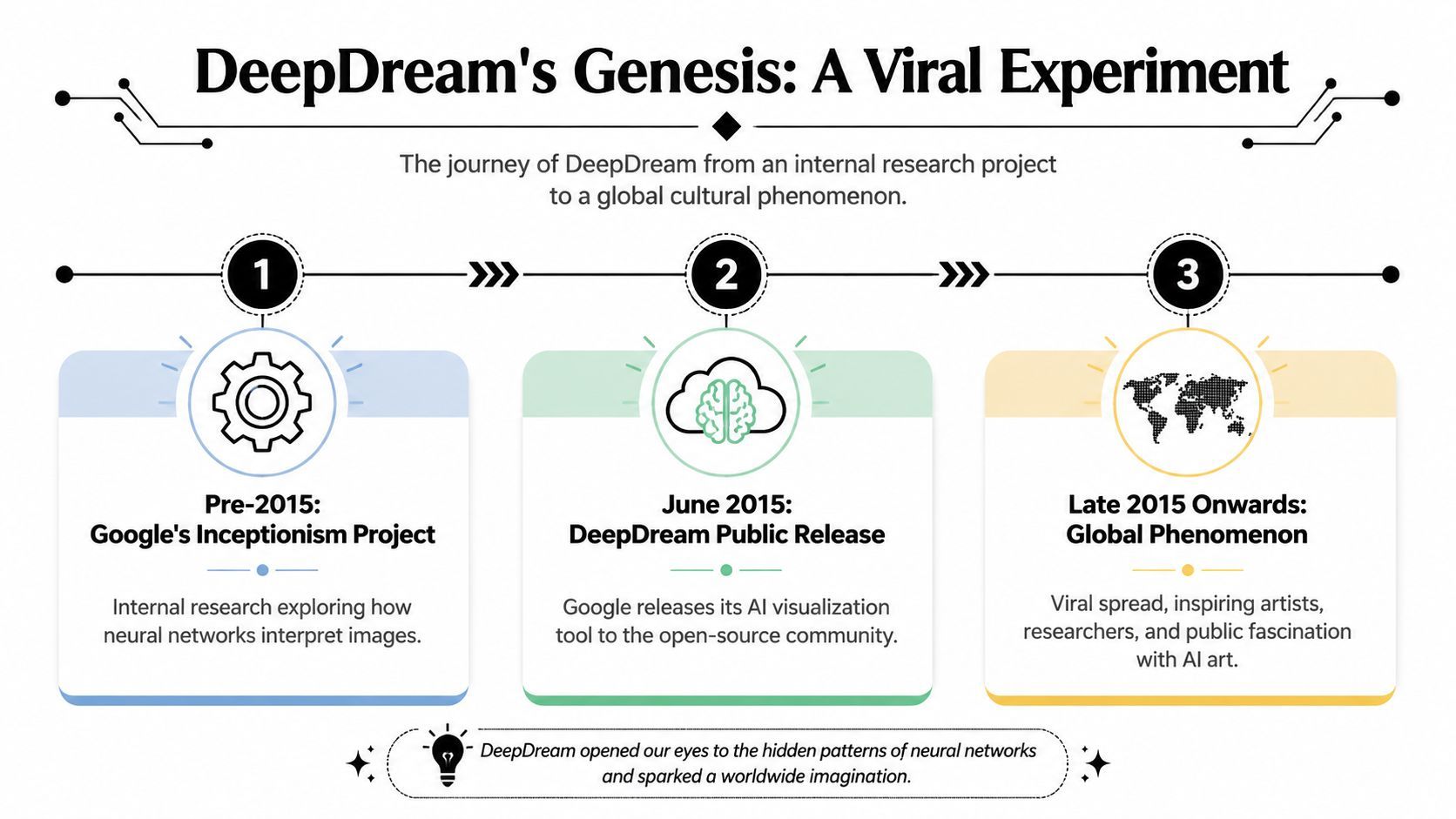
DeepDream began inside Google as a research project led by Alexander Mordvintsev, Mike Tyka, and Christopher Olah. Early on, the process was called Inceptionism, a name that made sense to researchers but did little to explain the feeling of the images. DeepDream stuck because it matched the result. The pictures looked less like software output and more like machine-made visions.
Google published the project on its research blog in June 2015 and released the code soon after, as noted earlier. That sequence mattered. A lab experiment became a public tool, and once people could run it on their own photos, the style spread far beyond AI research circles.
Why the release spread so fast
DeepDream arrived at exactly the kind of internet moment that rewards visual shock. Social feeds already favored remix culture, strange humor, and images that made people stop scrolling for a second just to ask, “What am I looking at?”
A few factors helped it travel:
- Anyone could try it: Open-sourcing turned spectators into participants.
- The output was instantly readable: You did not need a machine learning background to respond to a skyline sprouting eyes and snouts.
- It mixed beauty with unease: The images were playful, creepy, and oddly mesmerizing at the same time.
That combination made DeepDream easy to meme, easy to remix, and easy to remember.
One sentence explains its cultural force. DeepDream gave ordinary internet users a way to experience machine perception as an image style.
From internet curiosity to art-world material
Virality was only the first chapter. Soon, artists began using DeepDream as more than a novelty filter. Galleries and creative institutions started treating neural-network imagery as a real artistic medium, not just a technical stunt.
That shift matters because it changed the conversation around AI visuals. Before DeepDream, computer vision mostly sounded administrative. It tagged photos, detected objects, and sorted information. DeepDream turned that hidden process outward. It made the system's pattern-seeking behavior visible, strange, and emotionally charged.
For creators today, this is the historical lesson worth keeping. DeepDream was rough, slow, and hard to control by current standards, but it introduced a surreal visual language that still works. Modern tools such as ShortGenius let you produce that same dreamlike instability in short-form video with far more speed and control, whether you want a warped transition, a creeping texture shift, or a full AI hallucination sequence built for social platforms.
DeepDream now reads like a historical artifact from the early public era of AI art. Its influence is still alive. The difference is that creators no longer have to accept the original tool's limits to use the aesthetic.
How DeepDream Turns Images into Dreams
A good way to grasp DeepDream is to start with a photograph of something ordinary. Maybe it is a tree line, a building facade, or a cloudy sky. The system studies that image, starts favoring certain visual signals, and then keeps pushing those signals back into the picture until the scene begins to hallucinate itself.
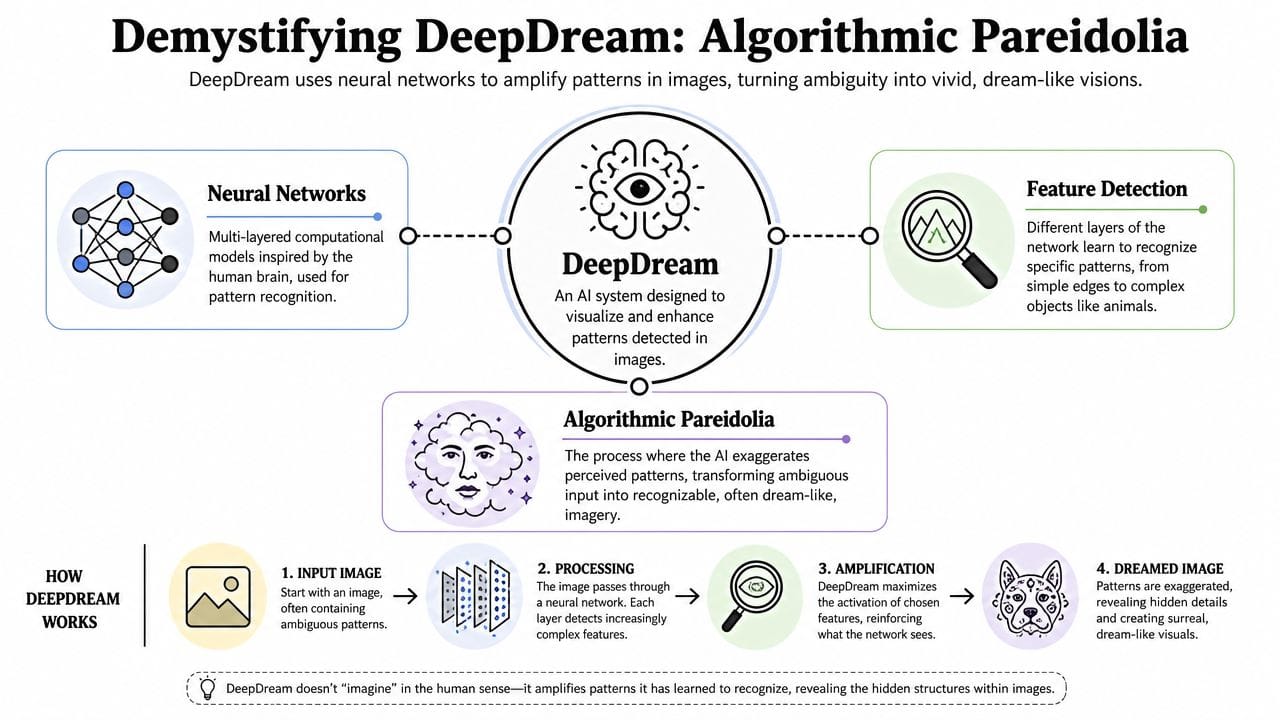
At a technical level, DeepDream edits an input image by measuring which pixels would increase activity in a selected layer of a trained neural network, then nudging the image in that direction again and again. TensorFlow's DeepDream tutorial explains this gradient-based process and shows why shallow layers tend to produce simpler textures while deeper layers pull out more complex forms.
That sounds abstract until you view it as a feedback loop.
- Start with a real image.
- Choose a layer in the network.
- Measure what visual changes would make that layer react more strongly.
- Apply those changes to the image.
- Repeat.
Each pass is small. The accumulation is what matters.
A patch of leaves can start to sprout feathers. A cloud bank can grow eyes. A stone wall can develop animal faces that were never there, but now feel impossible to ignore.
Why some outputs look subtle and others look feral
Different parts of the network pay attention to different visual ingredients. Early layers respond to edges, contrast shifts, and texture. Middle layers begin grouping those fragments into motifs. Deeper layers react to larger, more object-like patterns.
| Layer choice | What you tend to see |
|---|---|
| Lower layers | Ripples, lines, textures, repeated strokes |
| Middle layers | Curves, motifs, clustered forms |
| Deeper layers | Faces, eyes, animals, object-like structures |
This is why DeepDream images can feel so different even when the starting photos are equally plain. The chosen layer changes the type of visual exaggeration, almost like turning different knobs on a distortion pedal.
If you want a clearer foundation for how neural networks represent visual features, this practical AI image model explainer gives helpful context.
A moving example helps more than a definition. This walkthrough shows the effect in action:
The role of algorithmic pareidolia
Humans already do something similar. We spot faces in windows, creatures in smoke, and patterns in carpet. DeepDream turns that impulse into a machine process.
The dream effect comes from the machine overcommitting to patterns it half-recognizes.
That is why the output feels eerie rather than random. The network keeps making a visual guess, then painting that guess back onto the image until the suggestion hardens into structure.
For creators, that idea still matters. The strongest surreal visuals usually keep one foot in reality. They bend a recognizable scene instead of replacing it completely. In 2015, DeepDream did that through slow image iteration. Today, short-form video tools such as ShortGenius let creators apply the same principle to motion, transitions, and evolving textures with much tighter control. The aesthetic survives, but the workflow fits modern content creation.
DeepDream Versus Modern Generative AI
DeepDream still matters, but it helps to place it correctly. It's a historical artifact, not a modern production workflow. According to a documented retrospective, ten years after its 2015 release, DeepDream remains foundational in AI image history, predating Stable Diffusion by 7 years and Google Veo 3 by 10 years, and it worked by iteratively enhancing images inside a VGG16 network rather than generating from newer model families, as described in this DeepDream retrospective video.
That “historical artifact” framing is important because many creators discover DeepDream backwards. They encounter modern AI image and video tools first, then look up older systems and assume they were early versions of the same thing. They weren't.
The central difference
DeepDream is about enhancement. Modern generative AI is often about creation.
DeepDream starts with an image and transforms it by exaggerating learned features. Modern systems can often begin with a text prompt, generate a scene from scratch, revise it, animate it, expand it, and adapt it for different outputs in one workflow.
That changes everything for creators. It affects speed, control, repeatability, and how easily you can work in video.
DeepDream vs modern AI tools
| Feature | AI DeepDream (2015) | Modern AI Tools (e.g., ShortGenius) |
|---|---|---|
| Starting point | Existing image required | Can start from prompts, assets, or mixed inputs |
| Core function | Enhances patterns already present | Generates, edits, assembles, and adapts content |
| Creative control | Layer-based and indirect | More direct control through prompts, scenes, effects, and edits |
| Output style | Psychedelic distortion and recursive motifs | Wide range, from photoreal to abstract and surreal |
| Speed | Older workflow, slower by current standards | Faster and built for production use |
| Video readiness | Not designed as a modern short-form workflow | Better suited to reels, shorts, ads, and multi-scene editing |
Why this matters in practice
If you want the exact DeepDream process for historical or artistic reasons, the old method is still interesting. But most working creators don't need historical fidelity. They need a result they can shape and ship.
That means today's question usually isn't, “How do I run classic DeepDream?” It's closer to, “How do I get that eerie, over-interpreted, dreamlike feel in a vertical video without losing control?”
Modern tools are better at:
- Maintaining subject consistency
- Handling social formats
- Integrating captions, pacing, and voiceover
- Letting you iterate without rebuilding everything manually
If you want a broader map of how image systems differ, this practical AI image model explainer is useful because it separates older approaches from newer model categories in plain language.
Then versus now for surreal aesthetics
DeepDream gave us a look into machine perception. Modern AI tools let you direct that perception toward a creative goal. That's the key shift.
Working rule: Treat DeepDream as inspiration, not as your production stack.
For short-form creators, the opportunity is bigger now. You can borrow the original aesthetic logic, repeated motifs, warped texture, unstable realism, visual recursion, and apply it with much tighter control than the 2015 workflow ever allowed.
Recreating Surreal Visuals for Modern Content
A creator in 2015 might have fed a still image into DeepDream, waited, and watched the software turn fur, clouds, and stone into a feverish pile of eyes and animal faces. A creator making Shorts now needs something different. The image still has to feel uncanny, but it also has to fit 9:16 framing, hold attention in the first second, and stay readable enough to support a message.
That shift matters because DeepDream is now less useful as a production method than as a visual reference point. It showed what machine perception looked like when a model over-read an image. Modern short-form creators can recreate that same tension, ordinary reality tipping into pattern obsession, with far more control over pacing, subject focus, and final format.

Start with footage that can mutate well
DeepDream always favored images with surfaces, edges, and repeated forms. The same principle holds for modern video. Dense visuals give the system more opportunities to exaggerate, echo, and distort.
Useful starting points include:
- Architecture: windows, tiles, railings, carved surfaces
- Nature footage: clouds, branches, flowers, water, smoke
- Portrait closeups: hair, eyelashes, jewelry, makeup textures
- Detailed products: glass, stitching, chrome, labels, packaging
Sparse scenes rarely work. A blank wall gives you very little to transform. A frame full of texture gives you material to bend.
Build the surreal effect in stages
The easiest mistake is applying maximum distortion from the first frame. Old DeepDream outputs often looked compelling because the viewer could still recognize the original image underneath the hallucination. Good short-form video uses that same push and pull.
A practical sequence looks like this:
-
Start with a stable shot
Use a clip with clear composition and limited camera shake. Slow movement gives the audience time to notice the change. -
Increase texture and edge detail
Bring out small patterns, lines, and surface contrast. This recreates the old DeepDream habit of turning hidden detail into visual noise. -
Repeat one motif
Choose a recurring form such as eyes, petals, liquid reflections, branching veins, or folded geometry. Repetition makes the effect feel dreamlike instead of random. -
Shift the color logic
Acid greens, infrared reds, electric blues, or faded pastel haze can change the emotional reading of the scene before the viewer even notices the distortion itself. -
Disturb the motion slightly
Gentle morphing, pulsing zooms, and looped instability often feel more unsettling than aggressive movement.
This process works like increasing feedback on an audio mixer. A small amount adds character. Too much turns the whole signal into noise.
Shape the clip like a dream, not a filter demo
Strong surreal edits usually have a simple arc. The scene begins in reality, slips into misrecognition, reaches overload, then returns to clarity or lands on a reveal.
That structure is useful because the audience needs contrast to feel the transformation. If everything is strange from frame one, nothing feels like it changed.
A simple four-part progression works well:
- Open with normal reality
- Let one detail mutate
- Spread that logic across the frame
- Resolve with a clean image, product shot, or key line
This is one of the clearest ways to borrow from DeepDream without copying its original workflow.
Compose for vertical screens
Vertical video changes where surreal energy should live. In a gallery image, the eye can wander sideways. In a phone screen, attention tends to stay near the center and travel up or down.
For 9:16 edits:
- Keep the main subject centered
- Leave room for captions and interface elements
- Let drips, vines, smoke, eyes, or repeating forms climb vertically
- Avoid stuffing the side edges with detail
If you want references before designing a sequence, browsing a visual category like surreal tattoo style can help because tattoo artists often compress bizarre dream imagery into bold, readable compositions. That is a useful constraint for social video too.
A modern workflow for short-form creators
A modern AI video workflow gives you the DeepDream mood without the old friction. Tools built for short-form production let you generate the surreal layer, time it to a beat, and keep the subject readable across scenes. If you want a current example, ShortGenius for AI short-form video creation fits this approach.
Use a simple production logic:
- Choose one anchor subject: one face, object, or environment
- Set a mutation rule: floral growth, machine eyes, liquid metal, cosmic fog, insect symmetry
- Increase intensity over time: subtle first, heavy later
- Cut on a beat, lyric, or script turn: the effect feels intentional when visual change matches meaning
- End on clarity: the audience should remember the point, not only the distortion
Direction matters more than chaos.
That is the core lesson to carry forward from DeepDream. The memorable images were not just weird. They gave the viewer one stable thing to hold onto while the rest of the frame slipped into machine fantasy.
Where this aesthetic works best
Surreal visuals can support far more than art experiments. They work especially well when the distortion expresses an idea.
| Content type | Surreal visual use |
|---|---|
| Product ads | Show craving, transformation, obsession, or sensory overload |
| Music promos | Build looping dream states around the track's mood |
| Fashion content | Distort fabric, accessories, makeup, and silhouette details |
| Education | Show perception errors, memory drift, dreams, or AI pattern recognition |
| Personal branding | Turn a face or repeated setting into a recognizable visual signature |
The goal is not historical reenactment. The goal is to take a visual language born in the DeepDream era and remake it for the speed, framing, and storytelling demands of short-form video.
Creative and Ethical Uses for Creators
DeepDream left creators with a useful warning label. AI does not only generate style. It also reveals what a system has been trained to notice, repeat, and overstate.
A famous DeepDream quirk made that easy to see. Because the model had strong exposure to dog imagery, it kept pulling dog-like eyes, snouts, and fur patterns out of unrelated subjects. A cloud became a kennel of hidden faces. A building facade started to sprout muzzles. The image looked surreal, but the bias was concrete.
That same lesson applies to current video tools. If your prompt asks for “dreamlike transformation” and the output keeps drifting toward glossy female faces, cyberpunk neon, or melting luxury textures, the tool is showing you its habits. Those habits come from training data, model tuning, and product defaults. Treat them as signals to direct, not as final answers to accept.
Creative ways to use the aesthetic
Surrealism works best when the distortion says something specific.
A skincare creator, for example, can let pores turn into cracked desert soil, then restore smooth skin when the product appears. A music promo can make streetlights bloom into watchful eyes on the beat, turning anxiety into a visual motif instead of random weirdness. An educator explaining pattern recognition can show a neutral hallway gradually filling with repeated faces or animal forms, so viewers feel how an AI system starts forcing meaning onto noise.
Useful applications include:
- Hypnotic B-roll: transform rooms, streets, or natural scenes into metaphors for stress, craving, memory, or overload
- Product transitions: let a product texture, such as bubbles, chrome, petals, or smoke, spread across the frame before snapping back to the item
- Educational storytelling: visualize bias, false pattern detection, unstable perception, or machine vision errors
- Artist promos: start with a real sketch, outfit, mask, or face, then let one feature replicate and mutate with purpose
- Campaign hooks: open with one impossible visual event that earns attention fast, then return to a clear message
For short-form video, restraint matters. One mutation carried through three fast cuts usually lands harder than ten unrelated effects in ten seconds.
A practical ethical test
Use two questions before you publish.
First, what is this tool pushing me toward visually? Answer it with specifics. If every “beautiful portrait” prompt keeps returning lighter skin, symmetrical features, and expensive-looking editorial makeup, the bias is no longer abstract. If every “surreal city” prompt becomes neon Tokyo at night, the model is collapsing a broad idea into one familiar internet image set.
Second, what belongs to me in this piece? Your subject choice, edit timing, script, camera reference, and selection logic should still be visible. If the result depends mostly on a model's default taste, the work will look interchangeable. If it reflects your direction, the surrealism becomes part of authorship.
Responsible AI art starts when creators notice repetition, trace it back to the system, and choose whether to keep, redirect, or reject it.
Keep the human part visible
DeepDream matters today because it exposed both the magic trick and the flaw. The machine could generate startling images, but it also kept showing its habits in public. Modern tools are faster, cleaner, and far more useful for video, especially for creators making short-form content on tight timelines. The responsibility has not changed.
The creator still decides what the dream means.
That is where good taste, editing judgment, and ethical judgment meet. Use surreal aesthetics to express obsession, memory drift, sensory overload, or transformation. Do not use them to flatten people into stereotypes, imitate another artist too closely, or let a model's favorite motifs stand in for your own point of view.
As noted earlier, newer video workflows make it much easier to build this kind of controlled surreal sequence for Reels, Shorts, ads, and creator content. The historical lesson from DeepDream still holds. Strange images become memorable when a human chooses what should stay real, what should mutate, and why.