AI Ad Copy Generator: A 5-Step Workflow for Results

Learn a complete workflow for the modern ai ad copy generator. Go from prompt to published ad with steps for visuals, voiceovers, A/B testing, and optimization.
You're probably dealing with the same bottleneck most paid teams hit sooner or later. The media budget is ready, the offer is solid, the landing page is live, and then the whole campaign slows down because nobody has enough fresh ad copy. One headline works for Meta but feels flat on LinkedIn. Search needs tighter language. Short-form video needs a hook, on-screen text, a voiceover script, and a CTA that doesn't sound recycled.
That's why the ai ad copy generator category took off so quickly. It solves a real production problem. Not a hypothetical one.
Used well, it gives you speed, more angles to test, and less blank-page friction. Used badly, it gives you generic ads at scale. The difference is workflow. The teams getting results don't treat AI like an autopilot. They use it as a co-pilot inside a process that starts with strategy, moves through structured prompting, and ends with testing, editing, and policy review.
Why Your Ad Creative Process Is Crying Out for AI
A typical campaign doesn't need one ad. It needs a system of ads.
You need variants for cold audiences and retargeting. You need different hooks for different pain points. You need creative adapted for feed, story, reels, search, and maybe display. Then a winning angle starts to fatigue, and the whole cycle begins again.
That's where the workflow breaks. Not on ideas, but on throughput.
Salesforce's 2025 generative AI statistics report shows that marketers are already using generative AI heavily for basic content creation (76%) and writing copy (76%), with additional use for creative inspiration and market analysis, according to Salesforce's generative AI statistics report. That lines up with what's happening in real ad accounts. Copy generation became mainstream because marketers already had strong pressure to produce more assets, faster, across more channels.
The real problem isn't writing one ad
The actual problem is feeding the machine without lowering quality.
An ad account wants:
- More variants: Different hooks, CTA styles, and message angles
- Faster turnaround: New creative before fatigue drags performance
- Channel fit: Copy that matches platform behavior instead of repeating one generic message everywhere
- Brand control: Variations that still sound like your company
AI works best when it removes production drag, not when it replaces judgment.
That's also why AI ad copy doesn't live in a vacuum anymore. Teams increasingly pair it with visual generation, scripting, and repurposing workflows. If you're building campaigns across content and ads, the RepurposeMyWebinar B2B automation guide is a useful reference because it shows how AI fits into broader marketing operations, not just one isolated writing task.
The shift that matters is simple. Stop asking AI to “write the ad.” Start using it to generate structured options inside a repeatable system.
Define Your Ad Strategy Before Generating Copy
Most weak AI ads come from weak inputs, not weak models.
If your prompt is vague, the output will be vague. If your strategy is fuzzy, the copy will sound polished but directionless. Before you open any ai ad copy generator, lock down three decisions: the action you want, the audience you're speaking to, and the offer that makes the click worth it.
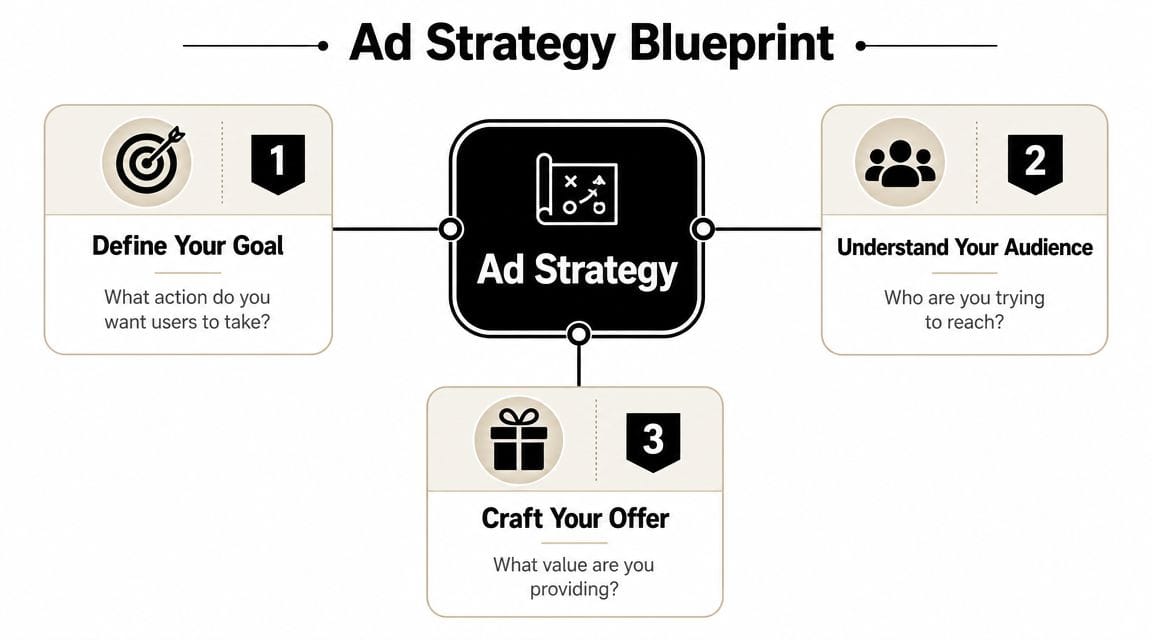
Start with the action
Ads fail when the desired action is unclear.
A brand awareness ad needs curiosity and memorability. A lead gen ad needs clarity, trust, and low friction. A product page click ad needs a direct connection between pain point and solution. If you don't define the conversion step first, the AI will blend all three into generic marketing language.
Use this quick filter:
| Goal | What the copy should do | What usually hurts performance |
|---|---|---|
| Brand awareness | Create interest and recognition | Asking for too much too early |
| Lead generation | Reduce hesitation and explain value fast | Overloaded copy and weak offer framing |
| Direct response | Push immediate action with a clear reason | Generic CTA with no urgency or specificity |
Define the audience like a buyer, not a demographic
“Small business owners” is not enough. Neither is “women 25 to 44.”
The AI needs buying context. What are they trying to fix? What have they already tried? What would make them distrust the ad? What language do they use when they describe the problem?
A useful audience brief usually includes:
- Stage of awareness: Problem-aware, solution-aware, or already comparing options
- Primary frustration: The thing they want solved now
- Desired outcome: What better looks like from their point of view
- Objection: Price, complexity, time, trust, or fit
- Platform mindset: Why they're on that platform in the first place
The model can generate phrases. It can't invent positioning you never gave it.
Craft the offer before you craft the words
Many teams spend too much time refining tone and too little time sharpening the offer.
The offer is the reason to act now. That might be a trial, a demo, a discount, a bundle, a lead magnet, or a faster path to a desired outcome. If the offer is weak, cleaner copy won't save it.
A strong prep doc for AI ad generation should answer:
- What exactly are we promoting
- Why should this audience care
- Why should they act now
- What proof or specifics can we responsibly include
- What must the ad avoid saying
That last part matters more than many advertisers realize. If you're in a sensitive category, or if you advertise on strict platforms, your input should already include compliance boundaries and claim restrictions. It's much easier to generate safe copy from a good brief than to clean up reckless copy after the fact.
Master Prompts for High-Converting Ad Copy
Most prompting advice is too abstract to help in an ad account. You don't need a clever trick. You need a prompt structure that consistently produces usable variants.
The simplest framework I've found is P-A-I-N. That stands for Platform, Audience, Intent, Negative Constraints.
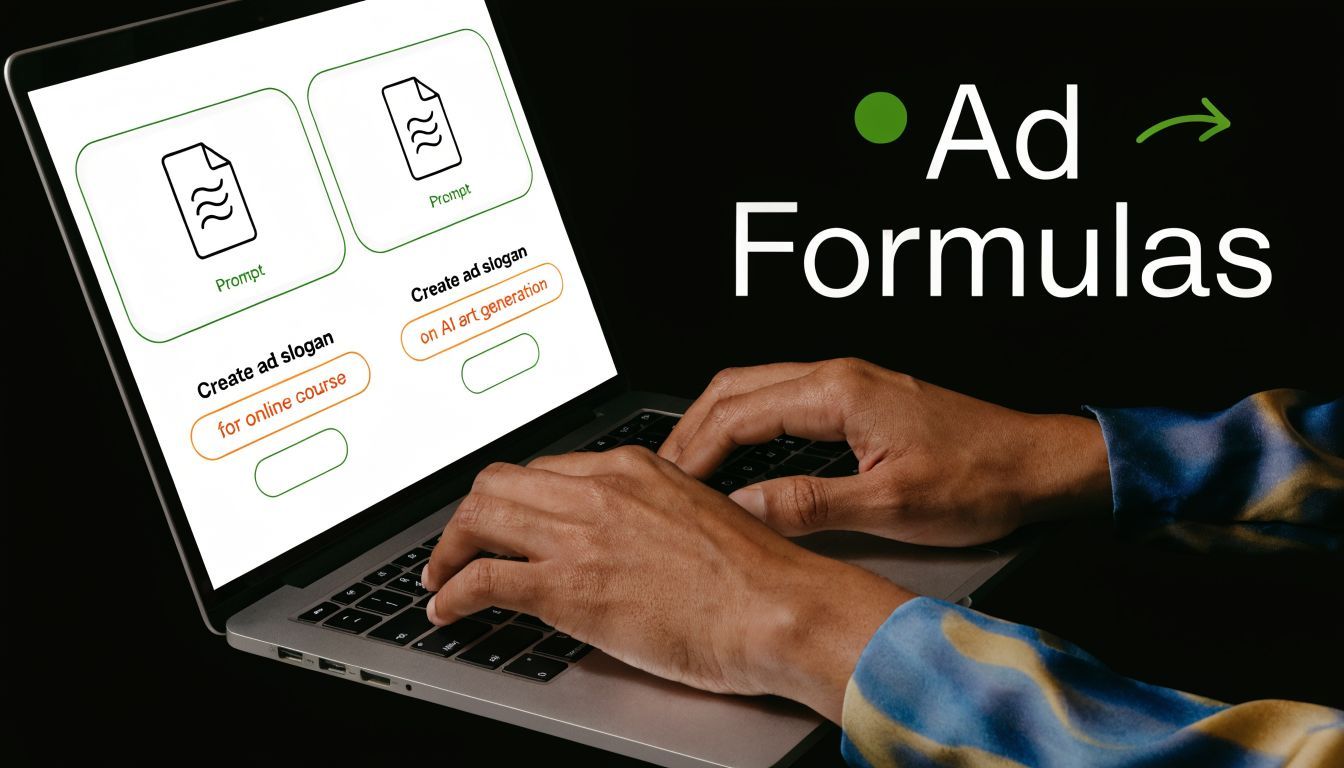
Use the P-A-I-N framework
Platform
Every platform has different copy behavior.
Google Search rewards tight, functional language. Meta often needs a stronger scroll-stopping opener. LinkedIn usually benefits from more explicit business context. X tends to reward sharper, punchier phrasing. If you don't specify platform, AI often writes for no platform at all.
Audience
Give the model a buyer snapshot, not a label.
Bad input: “fitness audience.”
Better input: “busy professionals who want short home workouts and are frustrated by plans that require equipment or long sessions.”
Intent
Say what the ad is trying to do.
You're not just asking for copy. You're asking for a cold traffic hook, a retargeting reminder, a lead capture ad, a product launch script, or a branded search ad variant. Intent changes everything from tone to CTA.
Negative Constraints
Good prompts become production-ready here.
Tell the AI what to avoid:
- No exaggerated claims
- No reference to personal attributes
- No fear-heavy language
- No clickbait phrasing
- No mention of restricted topics
- Stay within brand voice
Weak prompt versus usable prompt
A weak prompt looks like this:
Write an ad for my software product.
That gives you fluff because the model has to guess the audience, the offer, the platform, and the CTA.
A better prompt looks like this:
Write 10 Meta ad variations for a project management tool aimed at agency owners who struggle to keep client work organized. Goal is demo bookings. Emphasize visibility, team coordination, and easier handoffs. Keep tone confident and direct. Avoid hype, exaggerated claims, and personal-attribute phrasing. Include headline, primary text, and CTA options.
That's the difference between output you skim and output you can test.
Copy this prompt template
Create [number] ad copy variations for [platform] promoting [product or offer].
Audience is [specific buyer description].
Their main problem is [pain point].
Desired outcome is [result they want].
Campaign intent is [clicks, leads, demos, purchases, retargeting, awareness].
Use this tone [tone description].
Include [headline / body copy / CTA / script / hooks].
Emphasize [offer, differentiator, proof, urgency].
Avoid [claims, phrases, topics, tone issues, compliance risks].
Keep each version [length guidance].
Here's a useful breakdown of prompting and ad scripting in practice:
Three practical examples
For an ecommerce skincare product
Ask for multiple hooks based on routine simplicity, ingredient focus, and texture experience. Exclude medical-style claims unless your approved copy allows them.
For a B2B SaaS trial campaign
Prompt for variants by role. One set for founders, one for ops leads, one for marketers. Their pain points are different, so the ads should be too.
For a coaching or course offer
Request short-form video hooks, on-screen text, and CTA lines separately. Long-form sales language often collapses in feed environments, so modular outputs work better.
Write prompts like briefs to a media buyer and copywriter in the same room. That's usually the quality level you'll get back.
Assemble Your Full Ad with AI Visuals and Voice
Copy rarely wins alone anymore. It has to work with the visual, the pacing, the first frame, the voice, and the CTA screen.
That's why treating an ai ad copy generator as a text-only tool leaves performance on the table. Modern ads are multimedia assets. If the headline promises one thing and the visual signals something else, the ad feels stitched together. If the script is sharp but the voiceover sounds wrong for the brand, the ad loses trust before the offer lands.
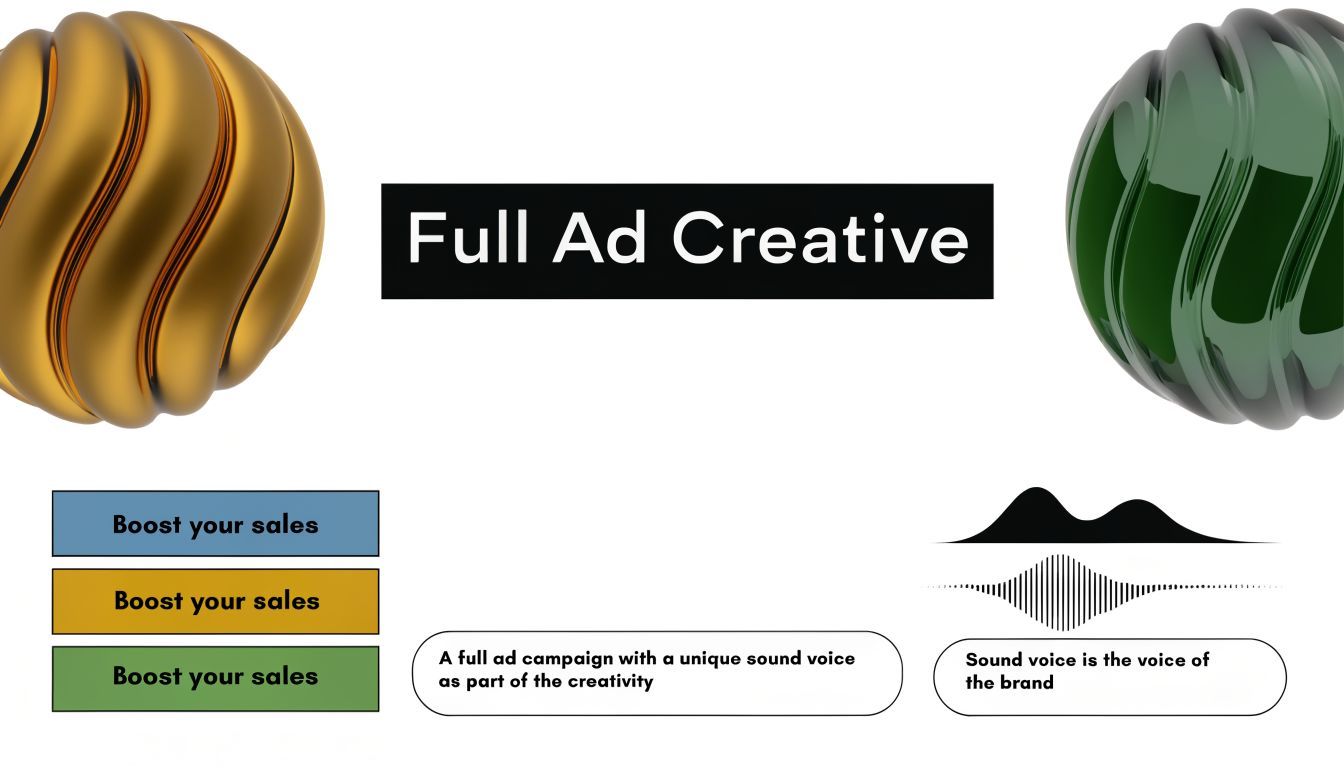
Build the ad as one creative system
A useful production workflow looks like this:
-
Choose the winning message angle
Don't move every draft into production. Pick the strongest hook family first. Usually that means one pain-led angle, one outcome-led angle, and one offer-led angle. -
Match the visual to the promise
If the copy is about speed, the visual should show speed. If the copy is about simplicity, the scene should feel clean and direct. Too many AI-generated ads fail because the visual is generic while the text tries to carry the whole load. -
Write voice for the ear, not the eye
Good ad copy on screen isn't always good narration. Voiceover needs shorter lines, cleaner rhythm, and fewer stacked claims. -
Align CTA timing
The call to action should feel earned. If it shows up too early, it feels pushy. Too late, and viewers drift.
Where an integrated workflow helps
Using separate tools for copy, images, editing, and voice can work. It also creates friction fast. Assets get versioned in different places, script edits don't match visuals, and teams lose time moving files around.
One option is ShortGenius, which combines scriptwriting, image generation, video assembly, natural voiceovers, editing, brand kit controls, and publishing in one workflow. In practice, that matters because the ad can be built as a unified asset instead of a chain of disconnected handoffs.
A simple assembly pass usually includes:
- Hook scene: First visual and opening line built for feed interruption
- Body sequence: Supporting scenes that reinforce the core claim or offer
- Voice and captions: Tight sync between spoken line and on-screen text
- End card: Clear CTA with the right destination and framing
Keep the creative coherent
The strongest AI-assisted ads usually feel like one person made them, even when AI generated half the pieces.
Use the same tone rules across script, captions, visuals, and voice. If the brand is calm and premium, don't pair polished copy with hyperactive transitions. If the brand is punchy and creator-led, don't choose stiff narration.
A good ad isn't copy plus design plus audio. It's one argument delivered through multiple signals at once.
That's the true upgrade. AI doesn't just help you write faster. It helps you assemble complete ad units faster, which is what the platform sees and what the audience experiences.
Refine, Review, and Ensure Ad Policy Compliance
The fastest way to waste AI output is to publish it without editing.
Raw AI copy often sounds smooth on first read. Then you look closer and find vague promises, flat phrasing, compliance risk, or language that technically says the right thing but doesn't sound like your brand. That's normal. Draft quality is not launch quality.
A controlled experiment reported by The Drum found that AI-generated copy lightly edited by humans produced a 26% higher click-through rate than human copy alone, as covered in The Drum's report on AI-assisted copywriting. That result matches what many practitioners see in live work. The useful pattern is hybrid. AI gives you speed and variation. Human review adds judgment.
Edit for specificity and voice
The first pass should remove generic language.
Watch for phrases like “transform your business,” “reveal your potential,” or “take your results to the next level.” They sound polished and say almost nothing. Replace them with approved specifics, product truth, or sharper customer language.
A strong edit usually does three things:
- Tightens the promise: Say exactly what the user gets
- Adds texture: Use language your market would use
- Protects brand voice: Keep the ad sounding like your company, not a model trained on everyone else
Run a real compliance check
Most “ai ad copy generator” advice falls short.
Platform-safe copy isn't just persuasive copy. It also has to avoid restricted claims, unsafe targeting language, and wording that triggers unnecessary reviews. That matters on Google, Meta, LinkedIn, and X, especially in categories involving health, money, employment, housing, or sensitive personal traits.
Use a final review checklist:
- Claim review
Remove anything your team can't substantiate. - Personal attribute review
Avoid wording that directly calls out sensitive user traits. - Category review
Check regulated industries, restricted products, and local ad rules. - Landing page alignment
Make sure the ad and destination page say the same thing. - Brand safety pass
Remove language that creates unnecessary legal or reputation risk.
If the ad is persuasive but non-compliant, it isn't ready. It's just expensive draft copy.
Polish for delivery
The last pass is rhythm.
Read it out loud. Watch where the sentence drags. Cut where the thought repeats. If it's video, check how the copy lands with captions and pacing. If it's search or social, check whether the CTA fits the actual commitment level of the click.
This is the part AI still struggles to own. It can generate options fast. It can't fully replace editorial taste, legal caution, or platform-specific judgment.
Launch, Test, and Optimize with Performance Data
No one can predict the winner with perfect accuracy. Not the human copywriter. Not the model. Not the creative director.
That's why testing is essential.
In a direct comparison reported by Search Engine Journal, human-written ads achieved 60% more clicks, with a 4.98% CTR versus the AI's 3.65% CTR, according to Search Engine Journal's humans versus machines ad copy test. The reported results also included a gap in impressions and average CPC. The useful takeaway isn't that AI can't write ads. It's that performance has to be earned in-market, and strategic oversight still matters.
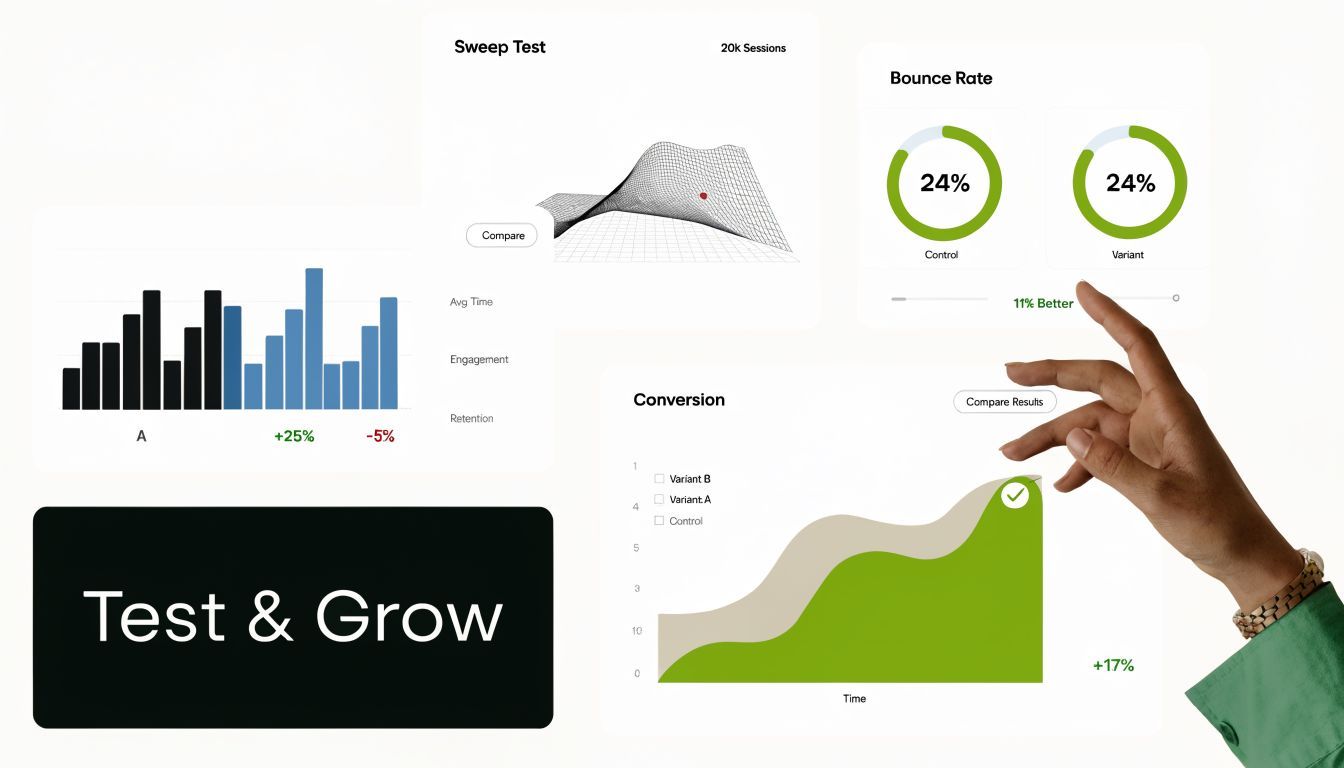
Test one variable at a time when possible
If you change the hook, visual, CTA, and audience all at once, you won't know what caused the result.
A cleaner structure is to hold most variables steady and rotate one meaningful difference:
- Hook test: Pain-first versus outcome-first
- CTA test: “Learn more” versus “Get started”
- Offer framing: Free trial versus demo versus bundle
- Proof angle: Product feature versus use case versus ease of use
This matters even more when using AI because generation is cheap. You can produce endless variants. That doesn't mean you should test a chaotic pile of unrelated ideas.
Use the data to improve the next prompt
A majority of teams stop at “winner” and move on. Better teams treat results like prompt feedback.
If one angle draws stronger clicks, feed that insight back into the next generation round. If shorter hooks win on one platform, request tighter variants there. If a direct CTA lifts response for retargeting but feels too aggressive for cold traffic, split your prompt by funnel stage next time.
A practical loop looks like this:
| Performance signal | What it often means | Next prompt adjustment |
|---|---|---|
| High CTR, weak post-click quality | Hook is strong, expectation match is weak | Make the value proposition more precise |
| Low CTR, good conversion quality | Message is qualified but not compelling enough | Ask for stronger hooks and first lines |
| Strong performance from one angle family | Market is responding to that promise | Generate deeper variants around that angle |
| One platform lags | Copy may not fit user intent there | Rewrite specifically for that platform behavior |
Treat every campaign result as training data for your next prompt, even if you're not training the model itself.
Don't hand AI the final decision
AI is excellent at generating more doors to open. It isn't the person who decides which room is worth entering.
That decision still comes from media buying context, product knowledge, funnel understanding, and clean test design. The practical value of an ai ad copy generator is speed to iteration. The practical value of the marketer is knowing what deserves to be iterated.
Your New AI-Powered Ad Creation Workflow
Monday morning looks the same in a lot of ad accounts. The team needs fresh concepts, the designer is waiting on approved messaging, legal wants cleaner claims, and media buyers need new variants before fatigue hits. An ai ad copy generator helps only if it fits that real production flow.
The workable version is straightforward. Start with strategy. Generate copy from a tight brief. Build the full asset with matching visuals, captions, and voiceover. Review for claim risk, brand fit, and platform policy. Then launch, read results, and send those findings back into the next prompt cycle.
That process matters because copy is only one piece of a sale. A strong headline can still fail if the visual sets the wrong expectation. A solid script can still get rejected if the claim language is too aggressive. Teams that scale creative well treat AI as a co-pilot inside an operating system, not a button that spits out finished ads.
A practical workflow usually looks like this:
- Brief the ad before you generate it: define audience, offer, awareness stage, channel, and the one action you want
- Prompt for usable outputs: request multiple hooks, body variants, CTAs, and clear exclusions so the first draft is closer to usable
- Build the ad as one unit: pair the copy with visuals, captions, voice, and timing so the message stays consistent
- Run a human review: check claims, tone, compliance, and whether the ad matches the landing page
- Launch controlled tests: compare angles, hooks, and formats, then use performance patterns to guide the next round
That is the difference between AI content and a production-ready ad workflow.
If you want to run that workflow in one place, ShortGenius combines copy generation, visuals, voiceovers, editing, and publishing in a single system. It is useful for teams that need more than text output and want a practical path from prompt to launch-ready creative.