Ad Creative AI: Accelerate Campaigns with ad creative ai Insights

Discover how ad creative ai transforms marketing, delivering faster, higher-converting video and image ads while simplifying workflows.
Think of ad creative AI as your team's new creative co-pilot. It’s a powerful set of tools that automates the grunt work of making ad content—everything from writing scripts and finding visuals to producing complete, ready-to-run video ads. The goal isn't to replace human creativity, but to supercharge it.
What Is Ad Creative AI and Why Does It Matter Now?
Imagine having an assistant who can brainstorm and build hundreds of ad variations for you on demand. That's pretty much what ad creative AI does. It takes on the repetitive, time-sucking tasks, freeing up your team to focus on bigger-picture strategy and the truly innovative ideas that AI can't replicate.
At its core, ad creative AI is a system that ingests and learns from your data. It looks at your brand assets, your product details, and—most importantly—your past campaign performance to generate fresh, optimized ads. This directly tackles one of the biggest headaches in advertising today: creative fatigue.
The Problem of Creative Burnout
Audiences on platforms like TikTok, Instagram, and YouTube have an insatiable appetite for new content. Trying to manually produce enough ads to keep them engaged is a massive bottleneck for marketing teams, no matter their size. Creatives get burned out, and campaigns start to tank as people see the same ads over and over again.
Ad creative AI is the solution. It allows for rapid, scalable ad production that keeps your content library full and your campaigns fresh.
Ad creative AI isn’t just about making ads faster. It’s about making data-driven creative decisions at a scale that was simply out of reach before, letting smaller teams punch well above their weight.
This tech fundamentally changes how you test ideas. Instead of just guessing which hook, visual, or call-to-action will land, you can generate dozens of variations and let real-world data tell you what works. This constant loop of testing and learning leads to much more effective campaigns and a better return on your ad spend.
How It Empowers Marketers
The benefits go way beyond just churning out more ads. Ad creative AI gives marketing teams some serious advantages:
- Get to Market Faster: You can launch new campaigns in a fraction of the time it takes with a traditional production workflow.
- Supercharge Your A/B Testing: Easily create countless versions of your hooks, scripts, and visuals to pinpoint the winning combinations.
- Slash Production Costs: Cut back on the need for expensive photoshoots, video crews, and long, drawn-out editing cycles.
- Create with Confidence: Use real performance data from past ads to guide the AI, ensuring new content is already primed to connect with your audience.
This technology is central to where modern marketing is headed, exploring how to start unleashing the power of AI ad creative to build campaigns that truly perform. By automating the heavy lifting, these tools make high-quality ad production accessible to everyone, from solo entrepreneurs to massive enterprise teams.
How Ad Creative AI Actually Works
You don't need a computer science degree to get how ad creative AI works. The best way to think about it is as a smart, three-step process—kind of like how an expert creative team would brainstorm, produce, and then refine a campaign. It all boils down to what you give the system to work with.
Step 1: Input and Analysis (The Brief)
This first step is all about giving the AI a solid brief. Just like you would with a human team, you provide the core components that define your brand and what you’re trying to achieve. Think of the AI as your new creative strategist, gathering all the essential ingredients for the campaign.
This goes way beyond just uploading a logo. The more context you provide, the better and more relevant the ads will be.
Here’s what a typical "brief" for an AI looks like:
- Brand Assets: Your logos, brand colors, and specific fonts that keep everything looking like you.
- Product Information: The nitty-gritty on what you’re selling—key features, customer benefits, and what makes it special.
- Audience Profiles: A clear picture of who you're talking to. What are their pain points? What gets them excited?
- Performance Data: Hard numbers from past campaigns. This tells the AI what’s worked before and, just as importantly, what hasn’t.
The Three Pillars of Ad Creative AI Technology
Under the hood, these platforms are powered by a few key technologies working together. Here’s a simple breakdown of what they are and what they do in a tool like ShortGenius.
| Technology Pillar | What It Does (Simplified) | Example Application in ShortGenius |
|---|---|---|
| Generative Models (GPT, DALL-E, etc.) | Creates brand new content—text, images, video scenes, or audio—based on prompts and existing data. | Writing a dozen different ad scripts or generating unique UGC-style video clips from just a text description. |
| Computer Vision | Analyzes and understands the content of images and videos, identifying objects, people, and scenes. | Scanning your product photos to automatically create visually compelling B-roll or dynamic product showcases. |
| Predictive Analytics | Uses historical data to forecast which creative elements (hooks, visuals, CTAs) are most likely to perform well. | Suggesting that a "question-based" hook is likely to get more views based on past campaign data from your industry. |
These technologies aren't working in isolation; they’re all interconnected to turn your initial brief into a finished ad.
Step 2: Generation and Synthesis (The Creative Production)
Once the AI has all its ingredients, it moves into the production phase. This is where the magic really happens. The AI models act like an entire production studio, combining all the different elements to build complete, ready-to-launch ads.
This isn't just one action but a whole symphony of processes happening at once.
A text model might spit out 10 different hooks and calls-to-action based on your product info. At the same time, an image model could be creating custom visuals or product mockups. Another model might even generate a natural-sounding voiceover to go with the script.
This is where AI really delivers on its core promises of speed, scale, and data-backed insights.
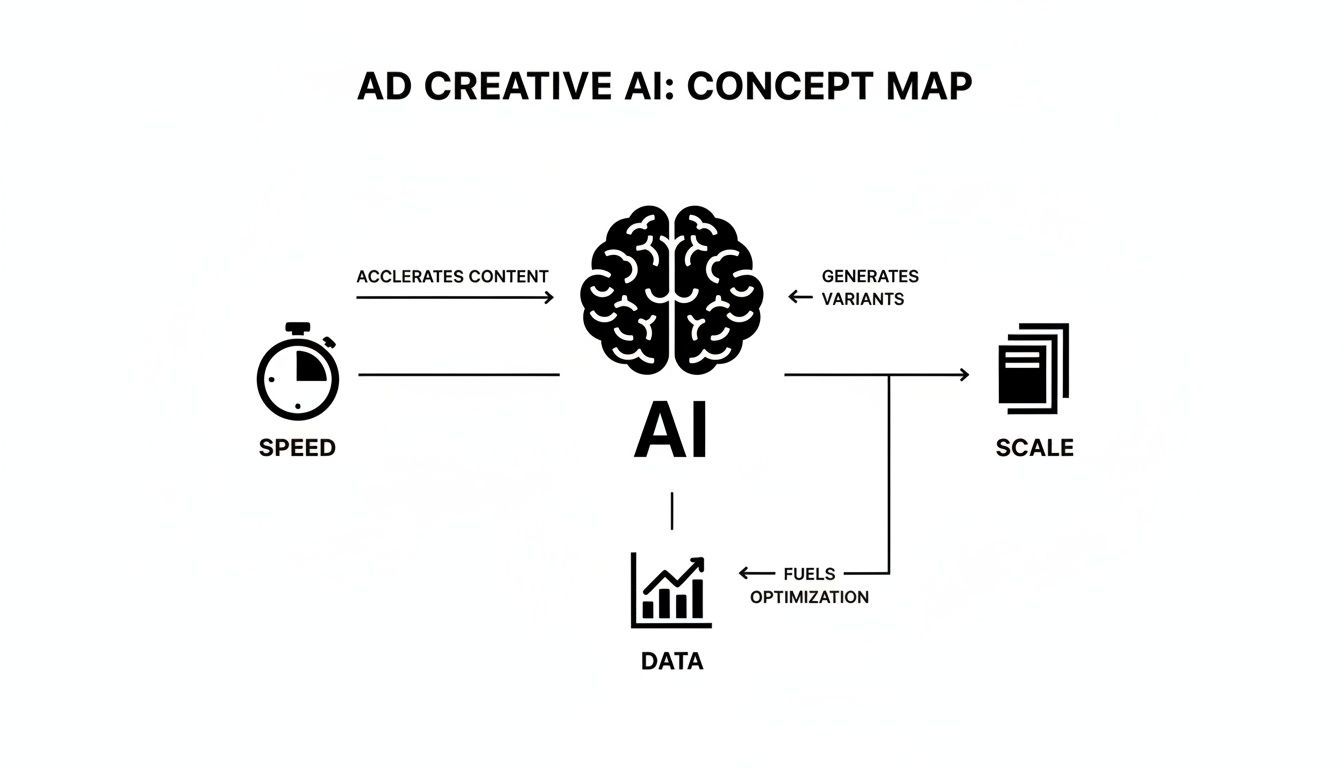
As you can see, the AI engine is the central hub that drives everything. It helps you generate content faster (speed), produce a lot more of it (scale), and then fine-tune it based on what the numbers say (data).
Step 3: Optimization and Learning (The Feedback Loop)
This final step is what truly sets AI apart. After you launch the ads, the system doesn’t just clock out. It starts watching the real-world performance data to figure out what’s actually connecting with your audience.
This continuous feedback loop is the secret sauce. Ad creative AI isn't just a content factory; it’s a learning engine that gets smarter with every single campaign you run.
The AI keeps an eye on key metrics like click-through rates, hook rates (how many people watch past the first 3 seconds), and of course, conversions. It hunts for patterns in the winning ads. For example, it might find that ads using a question in the hook get a 25% higher engagement rate.
That insight is then fed right back into the system. The next time you go to generate ads, the AI will know to lean into that successful formula. This cycle ensures your creative doesn't just look good on day one—it actively gets better and drives more results over time.
Unlocking Performance with AI-Generated Ads
The ideas behind ad creative AI are exciting, but what really matters is whether it delivers real, measurable results for marketers in the trenches. When we move past the theory, the true story is how these tools directly boost key performance indicators (KPIs) and completely change the financial side of digital advertising.
It’s not just a small bump, either. It’s a major shift. In a digital world where everyone is fighting for attention, AI-optimized creatives have been shown to deliver up to two times higher click-through rates (CTR) than ads designed the old-fashioned way. This huge leap in performance comes from the AI's ability to test and learn on a scale humans simply can't match. You can dig deeper into how AI impacts ad statistics to see the full picture.
This jump in CTR is all about rapid, data-driven iteration. An AI can spin up hundreds of ad variations—messing with different hooks, visuals, calls-to-action, and tones—to quickly figure out what clicks with a specific audience. This unlocks a level of hyper-personalization that used to require massive teams and even bigger budgets.
Beyond Click-Through Rates
A higher CTR is fantastic, but the benefits of using an ad creative AI platform go much deeper. These tools tackle some of the biggest headaches in modern marketing, helping you build a more sustainable and effective ad strategy.
The first win you'll notice is the huge reduction in creative fatigue. We all know that audiences on platforms like TikTok and Instagram get bored seeing the same ad over and over. AI lets you constantly refresh your campaigns with new visuals and messages, keeping your content fresh and engaging for way longer.
That leads right into another major win: getting campaigns live faster. A lot faster. What used to take weeks of back-and-forth between copywriters, designers, and video editors can now be knocked out in a single afternoon.
Think about an e-commerce brand launching a new product line. Instead of a month-long production cycle, they can use an ad creative AI tool to generate 20 unique UGC-style video ads in just a few hours. They're ready to test and launch that same day.
This speed completely changes how marketing teams operate, allowing them to jump on trends and react to the market in real-time.
The New Economics of Ad Production
One of the most powerful arguments for bringing in ad creative AI is its impact on your budget. By automating so many of the manual steps in production, it drastically cuts the cost of creating high-quality ads.
Just think about the traditional costs of producing one video ad:
- Talent: Hiring actors or finding the right content creators.
- Production Crew: Videographers, sound engineers, directors.
- Location Scouting: Finding and paying for a place to shoot.
- Post-Production: Endless hours of editing, color grading, and adding effects.
An ad creative AI platform like ShortGenius makes most of these costs disappear. It generates realistic scenes, voiceovers, and dynamic effects from a few lines of text. This doesn't just save money—it makes high-quality ad production accessible to everyone, letting smaller businesses and solo entrepreneurs create professional-grade ads without breaking the bank.
A Flywheel of Continuous Improvement
The real magic of ad creative AI is how it creates a self-improving marketing engine. The work isn't over when you publish an ad; that's actually when the learning starts.
- Generate & Launch: The AI creates a whole range of creative variations based on your initial ideas and brand guidelines.
- Analyze Performance Data: As the ads run, the platform vacuums up real-time data on which versions are killing it across metrics like hook rate, watch time, and conversions.
- Identify Winning Traits: The system sifts through the top-performing ads to spot patterns. It might find that ads with a certain color scheme or a question-based hook are getting all the engagement.
- Inform Future Generations: These data-backed insights are fed right back into the AI. It then uses what it learned to generate the next batch of creatives, making each new ad smarter than the last.
This continuous loop turns advertising from a guessing game into a system of constant optimization. It gets your team away from relying on gut feelings and moves you toward a smarter process where every ad dollar works harder, driving sustainable growth and a much better return on ad spend (ROAS).
How Ad Creative AI Works in the Real World
The true value of ad creative AI really clicks when you see how it solves tangible, day-to-day problems for different people in the marketing world. This isn't just a high-tech toy for mega-corporations; it's a remarkably flexible tool that adapts to whatever you throw at it, whether that's scaling up content or fine-tuning a performance campaign.
Let's move past the theory and look at some real-world scenarios. It’s here you see how the technology goes from a buzzword to a practical, results-driving asset. From a one-person show to a global agency, the core challenges—keeping up with content demands, constant creative testing, and tight budgets—are pretty much universal. Ad creative AI has a direct answer for each.
For the Solo Content Creator
The Problem: A solo creator with a popular TikTok or YouTube series is on a constant content treadmill. The pressure to keep up a demanding schedule is immense, and burnout is a real threat. If production slows down, they risk losing the audience momentum they worked so hard to build. They need a way to produce great episodes consistently without being chained to their editing software.
The Solution: Ad creative AI becomes a virtual production assistant. The creator can feed it a core video or even a simple script, and the platform can instantly spit out multiple versions for different channels. Imagine turning one long-form YouTube video into three punchy TikTok clips and an Instagram Reel, all from a single piece of source material. This hands-off approach frees up the creator to do what they're best at: coming up with killer ideas and connecting with their community.
By automating the grunt work—resizing, captioning, and creating variations—a solo creator can realistically triple their output without hiring a team. Their content pipeline never has to run dry again.
For the Performance Marketing Team
The Problem: A performance marketing team's life revolves around A/B testing ad hooks. They have to churn through variations constantly to find what works and stamp out ad fatigue. But manually creating dozens of versions of a single ad, each with a different first three seconds, is a soul-crushing time-sink. It means they can only test a few ideas at once, leaving potential performance gains on the table.
The Solution: An ad creative AI platform was practically built for this job. The team can upload their main video and tell the AI to generate 20 different hooks on the spot. It can try out all sorts of angles—hooks that ask a question, hit you with a surprising stat, or lead with the customer's problem. Marketers can also get a huge lift by using specialized tools for AI-generated images for marketing campaigns to create an endless supply of visual assets for testing.
This lets them launch a massive multivariate test in minutes, not days. They get real data on what actually grabs attention, helping them drive down customer acquisition costs.
For the Small Business Owner
The Problem: The owner of a small e-commerce shop needs a slick product demo video for their new gadget. But hiring a production crew, renting a studio, and paying for post-production? That's way out of budget. Without a quality video, they're left struggling to compete with the big brands on social media.
The Solution: Ad creative AI makes professional video production accessible to everyone. With a tool like ShortGenius, the owner can just upload a few product photos. The AI then gets to work, generating a complete, dynamic product demo—complete with realistic scenes, an energetic voiceover, and perfectly synced background music. It can even create authentic-looking user-generated clips, a tactic we dive into in our guide to UGC AI, to build social proof without having to hire influencers.
Suddenly, a small business can produce top-tier video ads for a tiny fraction of the traditional cost. The playing field just got a little more level.
For the Marketing Agency
The Problem: An agency is juggling ad accounts for ten different clients, each with its own brand guidelines and campaign goals. The creative team is stretched to its limit trying to refresh ads across all those accounts to keep them from going stale. This manual overload slows everything down and makes it tough for the agency to take on more clients.
The Solution: Using an ad creative AI platform, the agency can set up a unique "Brand Kit" for every single client, locking in their logos, fonts, and color palettes. The moment a client's ads start to dip in performance, the account manager can generate a whole new batch of perfectly on-brand creatives in seconds. This makes it possible to manage dozens of accounts efficiently, deliver consistently great results, and free up the team to focus on high-level strategy instead of repetitive design tasks.
A Step-by-Step Guide to Implementing Ad Creative AI
Jumping into ad creative AI might feel like a huge technical hurdle, but it’s really more about your process than your programming skills. The path from a simple idea to a live, AI-powered ad campaign is actually a pretty straightforward workflow. This guide breaks it all down into five clear steps to get you started.
Think of this less like a rigid rulebook and more like a flexible framework. Each step logically builds on the one before it, making sure your final ad is not only effective but also feels true to your brand.

Step 1: Establish Your Brand Kit
Before the AI even thinks about writing a single word or generating an image, you have to teach it your brand’s language. This is where your Brand Kit comes in. It’s the foundational piece that ensures every ad you create feels consistent and professional.
You’ll start by uploading your core brand assets right into the AI platform. This isn't just about making things look pretty; it's about giving the AI a digital identity to work with on all future creatives.
This usually involves:
- Logos: Upload high-resolution versions of your main logo and any variations.
- Color Palettes: Plug in the exact hex codes for your brand’s primary and accent colors.
- Fonts: Add your specific brand typefaces so all the text looks just right.
Setting these guardrails first means the AI works within your brand’s visual world. This prevents any off-brand weirdness and saves you tons of time on manual fixes down the line.
Step 2: Generate Initial Concepts and Scripts
With your brand foundation in place, it’s time for the fun part: coming up with ideas. This is where you team up with the AI to brainstorm compelling angles, hooks, and scripts for your ads. You don't need to be a pro copywriter—you just need to give the AI some good context.
Kick things off with a simple prompt that covers your product, target audience, and what makes you special. For instance, you could try something like: "Generate five short ad scripts for a new eco-friendly coffee subscription box targeting busy professionals who value sustainability."
The AI will instantly spit back multiple script variations, each with a slightly different tone or angle. You go from a blank page to a set of testable concepts in seconds, which massively speeds up the whole creative process.
Step 3: Produce Your Scenes
Once you've picked a script you like, the next step is bringing it to life with visuals. An ad creative AI platform like ShortGenius automates this by generating the scenes for you. It can create just about anything, from authentic-looking UGC clips to polished product shots or dynamic animations.
This completely bypasses the need for expensive, time-sucking video shoots. The AI looks at your script and product details to create relevant, high-quality scenes that fit the story. For example, if your script mentions a specific feature, the AI can generate a visual that highlights it perfectly.
This is a huge deal for small businesses without a design team, a topic we dive into deeper in our guide on AI ad tools for small businesses. It really levels the playing field, making professional video production accessible to everyone.
Step 4: Assemble and Refine the Final Ad
With your script and scenes good to go, the AI stitches them together into a cohesive ad. But it doesn't just stop there. The last stage is all about refinement—adding those pro touches that make an ad truly stand out and stop the scroll.
This is where you can add elements like:
- AI Voiceovers: Pick from a library of natural-sounding voices to narrate your script.
- Dynamic Captions: Add animated, easy-to-read captions to hook viewers watching with the sound off.
- Music and Effects: Find the right background music and apply effects to make your ad more engaging.
You always have the final say. You can tweak timings, swap out scenes, and adjust effects until the final ad is exactly what you had in mind.
Step 5: Publish, Test, and Iterate
Launching your ad is really just the beginning. The real magic of an ad creative AI workflow is how quickly you can test and iterate. That first batch of AI-generated ads gives you the raw data you need to figure out what your audience actually responds to.
Once your ads are live, keep a close eye on key metrics like hook rate, click-through rate, and conversions. The insights you get are pure gold. If you see that ads with a question-based hook are crushing it, you can feed that info right back to the AI.
Just tell it to "generate more hooks based on this winning script," and it will produce a fresh batch of variations built on a proven formula. This creates an awesome feedback loop where every ad you run makes the next one smarter. Your campaigns just keep getting better over time.
Measuring Success and Optimizing Your AI Ads
Getting your first AI-generated ad live is a great first step, but the real work starts now. Think of it as the starting pistol, not the finish line. The true power of an ad creative AI platform is what happens after the launch—it’s all about building a continuous cycle of measuring, learning, and refining.
This turns your AI from a simple creation tool into a smart engine that keeps getting better. When you dig into the performance data, you're not just looking at numbers. You’re gathering crucial intel to feed back into the system for the next round of creatives.
Key Metrics Beyond the Click
To really get a grip on what's working, you have to look past the obvious metrics. A high click-through rate (CTR) is nice, but a few other key performance indicators (KPIs) give you a much richer story about how your ad creative AI outputs are actually performing.
These are the metrics that truly matter:
- Hook Rate: What percentage of people stick around for the first 3 seconds of your video ad? This tells you, flat out, if your creative is strong enough to stop someone mid-scroll.
- Cost Per Acquisition (CPA): How much does it cost to land a new customer? A low CPA shows that your ads aren't just getting attention; they're driving profitable action.
- Return on Ad Spend (ROAS): This is the bottom line. For every dollar you spend, how much revenue comes back? A healthy ROAS is the ultimate proof that your creative is connecting with the right people.
The Feedback Loop in Action
Once you have data flowing in on these metrics, you can start spotting patterns in your best ads. This is where the magic of optimization really kicks in.
The goal isn't just to find one "winning" ad. It's to understand the elements that make an ad a winner and replicate that success at scale.
Let's say your data shows that ads starting with a question have a 25% higher hook rate than those that open with a simple statement. Boom. That's a solid insight. You can then go back to the AI and ask it to generate ten new variations, all built around that successful question-based formula. This data-driven approach takes the guesswork out of the creative process.
This back-and-forth is the key to maximizing your ad spend. To learn more about setting up these kinds of tests, check out our guide on the best way to test multiple ad creatives with AI. By constantly feeding performance data back into the AI, you train it to make each new batch of ads smarter and more effective than the last.
Got Questions About Ad Creative AI? We've Got Answers.
As AI tools for ad creation start showing up everywhere, it's totally normal to have a few questions. Let's tackle some of the most common ones so you can see exactly where this technology fits and how to use it with confidence.
Will Ad Creative AI Replace Human Creativity?
Not a chance. A better way to think about it is as a creative co-pilot. This kind of AI is fantastic at handling the grunt work—churning out hundreds of variations, A/B testing different hooks, and resizing assets for every social platform imaginable.
This frees up marketers and creative teams to do what they do best: dream up the big-picture strategy, nail down the core campaign concept, and inject the human emotion that actually makes people connect with a brand. You bring the vision; the AI gives you the scale and speed to execute it flawlessly. It’s a powerful partnership.
Is This Kind of AI Only for Big Companies?
Definitely not. In fact, you could argue that ad creative AI is an even bigger deal for smaller businesses, scrappy startups, and even one-person marketing teams. It gives them the production power that, until recently, was only available to companies with massive budgets and dedicated creative agencies.
This technology really levels the playing field. It lets smaller brands create a high volume of professional-looking ads without breaking the bank, helping them compete head-to-head with the big players.
How Do I Keep AI-Generated Ads On-Brand?
This is a huge—and valid—concern, and modern platforms are built to solve it from the ground up. Most good tools include a feature often called a “Brand Kit.” It’s the first thing you set up. You upload your logos, specific color hex codes, brand fonts, and any other design rules you live by.
The AI then treats this kit as its non-negotiable rulebook. Every single piece of content it generates is built on that foundation, ensuring everything looks and feels like your brand. And, of course, nothing goes live until you give it a final look and make any tweaks you see fit. You're always in the driver's seat.
Ready to create video ads that actually perform, without spending weeks on production? With ShortGenius, you can put your entire creative workflow on autopilot, from writing the script to editing the final cut. Stop the guesswork and start generating ads that drive results. See how it works at https://shortgenius.com.