Ugc ai Blueprint: Using ugc ai for Authentic Content at Scale

Explore how ugc ai reshapes content creation, with a clear guide on what it is, how it works, and how to use it to scale authentic, high-performance content.
So, what exactly is UGC AI?
At its core, UGC AI is technology that creates content designed to look and feel like it was made by a real person, not a brand. It takes the genuine, trustworthy vibe of user-generated content (UGC) and mashes it up with the incredible speed and scale of artificial intelligence. This allows brands to churn out authentic-style ads, videos, and social posts in a fraction of the time it would normally take.
The New Wave of Authentic Content Creation
Think about the difference between a slick, professional studio ad and a candid video your friend posts on TikTok. The studio ad is polished, perfect, and expensive. But the friend's video? That feels real, relatable, and trustworthy. For a long time, marketing was all about that perfect studio ad. But today's audiences are tired of being sold to—they crave the authenticity of that candid shot.
This is why User-Generated Content (UGC) became such a powerhouse for marketers. It’s raw, it's honest, and it builds a genuine connection. The problem? Finding a steady stream of high-quality UGC from actual customers is a massive headache and almost impossible to scale up.
UGC AI is the bridge over that gap. It’s not about replacing human creators. Instead, it’s about learning from them. The AI analyzes thousands of real UGC posts to pick up on all the little things that make them work—the selfie-style camera angles, the casual slang, the not-so-perfect lighting, and the unscripted, off-the-cuff feel.
Why Authenticity Matters More Than Ever
The hunger for genuine brand interactions is off the charts. The UGC marketing space is expected to become a USD 9.4 billion global industry by 2025, with projections showing it could explode to USD 46.5 billion by 2034. That growth is fueled by a simple fact: people trust recommendations from their peers way more than they trust a traditional advertisement.
UGC AI plugs directly into this trend, generating content that mirrors the trusted, peer-to-peer style that audiences actually want to see. It all starts with understanding what makes UGC, well, UGC.
This is the foundation. The AI learns to replicate this exact style—content made by end-users, for end-users, and shared online.
The Creator and AI Partnership
What we're seeing is a new kind of partnership forming between human creativity and machine efficiency. In this new era of content creation, creators are always on the lookout for ways to do more, faster, without sacrificing quality. This is where tools come into play, and you can explore some of the best tools for content creators that are changing how we all work.
The end goal is to make content that not only feels authentic but also drives real results. By getting a grip on these fundamentals, you can start rethinking your own creative workflow. You can even learn how to squeeze more value out of what you already have, like finding the https://shortgenius.com/blog-to-video and turning your existing articles into engaging videos.
How AI Learns the Art of Authenticity
So, how does an AI learn to sound… well, human? Think of it like a comedian learning to perfect their craft. They don't just memorize one joke; they spend years watching other stand-ups, studying timing, tone, and audience reactions. They absorb what makes a story land, what makes a punchline funny, and what feels real.
UGC AI works in a strikingly similar way. It’s not just programmed with rules; it's trained by binge-watching the internet's massive library of authentic user content. We're talking millions of TikTok videos, Instagram Reels, candid customer reviews, and unboxing clips.
By analyzing this firehose of data, the AI starts to see the patterns—the unwritten rules of what makes something feel genuine and trustworthy. It learns to spot the difference between something that screams "real person" and something that whispers "corporate brand."
Decoding What Makes Content Feel "Real"
The AI goes beyond just the words in a script. It’s learning the entire language of user-created content, including all the subtle quirks we barely notice but instantly recognize.
Here are a few of the key signals it picks up on:
- Visual Cues: The AI learns to replicate the classic selfie camera angle, the slight shake from a handheld phone, and the kind of lighting you'd find in a living room, not a professional studio.
- Auditory Patterns: It recognizes the natural cadence of how people actually talk—the "ums" and "likes," the occasional pause to think, and the genuine excitement in someone's voice when they love a product.
- Pacing and Editing: It also masters the editing style that defines the genre, like the quick cuts, simple text on screen, and the use of trending audio that’s all over short-form video.
Once the AI masters these elements, it can generate brand new content that follows all the unspoken "rules" of authenticity. The end result is something that feels like it came from a friend, not a faceless company.
This chart really drives home how we've moved from old-school ads to the AI-powered content we're seeing now.
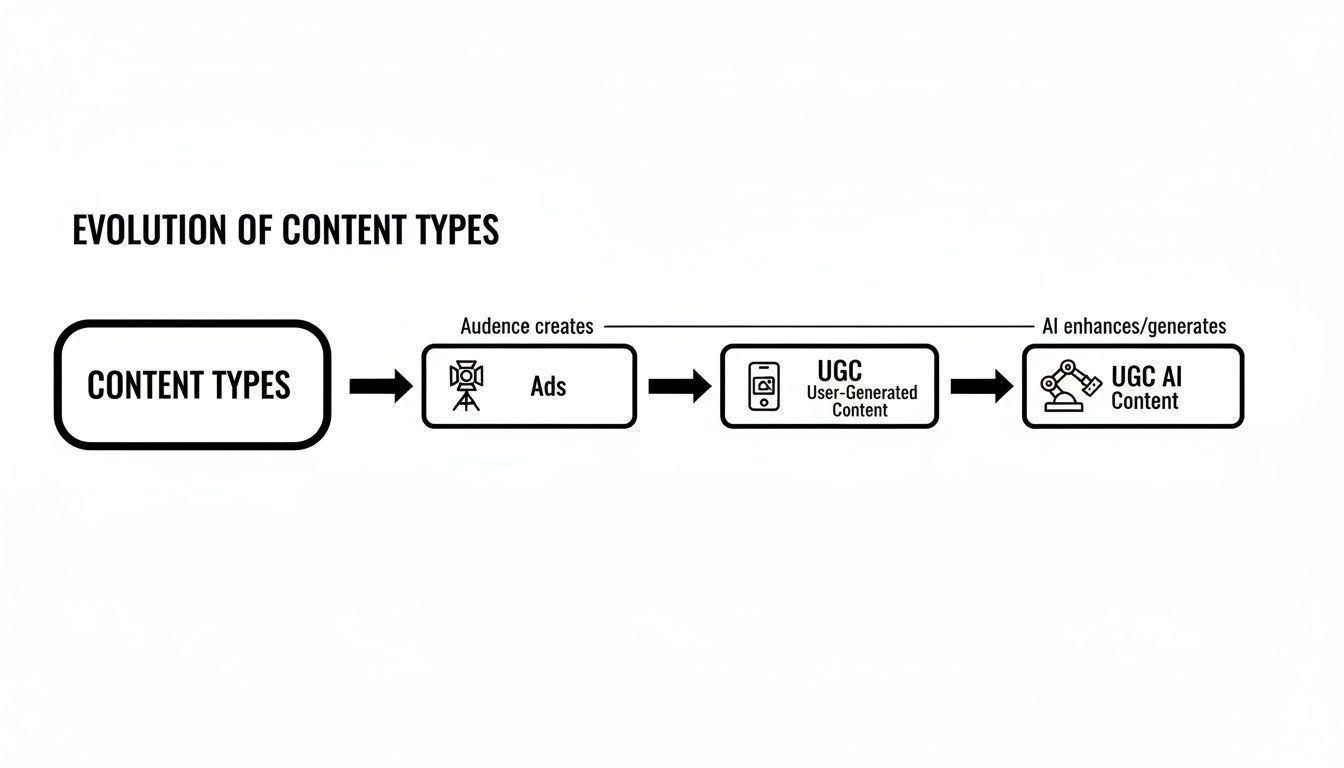
It's a clear visual journey, showing the shift away from tightly controlled brand messaging toward more authentic—and now, incredibly scalable—ways of connecting with people.
A Tale of Three Content Styles
The true power of this approach really clicks when you put it side-by-side with other types of content. Traditional ads are slick and polished. Real, organic UGC is raw and unpredictable. UGC AI sits right in the middle, trying to give you the best of both.
The real difference isn't just about how it's made; it's about how the audience feels. Polished ads are great for making people aware of your brand, but content that feels authentic is what builds trust and actually gets them to take action.
To make this crystal clear, let's break down the key differences between these three approaches. The table below shows exactly where UGC AI fits into a modern marketing strategy.
Content Style Comparison: Traditional Brand Content vs UGC AI
This table compares the key characteristics of traditional branded advertising, authentic user-generated content (UGC), and AI-generated UGC to highlight their differences in style, audience perception, and production.
| Characteristic | Traditional Brand Content | Authentic Human UGC | UGC AI Content |
|---|---|---|---|
| Tone & Style | Polished, professional, and scripted | Raw, candid, and conversational | Replicates a candid, conversational style |
| Production Value | High, often using studio equipment | Low, typically shot on a smartphone | Low to medium, designed to mimic smartphone quality |
| Credibility | Lower, perceived as a sales pitch | Highest, seen as a trusted peer review | High, when executed well to feel genuine |
| Scalability | Low, expensive and time-consuming | Very low and unpredictable | Very high, can generate variations instantly |
| Cost | Very high per asset | Low to medium (if incentivized) | Low and highly efficient at scale |
As you can see, UGC AI carves out a unique space by offering the trust-building style of real user content but with the control and scalability that brands have always needed.
Why Top Brands Are Jumping on the UGC AI Bandwagon
The move towards UGC AI isn't just another fleeting trend. It's a smart, strategic pivot driven by some serious gains in efficiency, scale, and raw performance. Brands are sidestepping the steep costs and snail-like pace of traditional content creation because they’ve realized AI can deliver that authentic, audience-loved style for a tiny fraction of the time and money.
Honestly, this is about more than just saving a few bucks. It's about gaining a massive competitive advantage.
Think about it: instead of juggling dozens of individual creators—a process that's both a logistical nightmare and a budget-eater—marketers can now fire up a single platform and generate hundreds of content variations. This completely changes the game for marketing campaigns, offering a level of speed and flexibility that was pure fantasy just a few years ago.

Unlocking Ridiculously Fast Ad Testing
One of the biggest wins with UGC AI is how it puts A/B testing on steroids. In the old days, testing even a handful of ad variations was a major project. With AI, a marketing team can create and test hundreds of ad versions almost overnight.
Let's say a skincare brand wants to reach different customer groups. Using UGC AI, they could whip up dozens of video testimonials with a diverse cast of AI avatars. Each one could have a slightly tweaked script that speaks directly to a specific audience's pain points.
This lets them test an incredible number of combinations on the fly:
- Scripts and Messaging: Trying out different hooks, value props, and emotional angles.
- Calls-to-Action: Seeing which CTA actually gets people to click.
- Visuals: Swapping out backgrounds, text overlays, and even the look of the AI avatar.
By testing and tweaking this quickly, brands can pinpoint their winning ad creative in days, not months. This puts them on the fast track to maximizing their return on ad spend. Exploring tools for creating AI UGC ads can give you a clear playbook for putting this into action.
How This Plays Out in the Real World
The practical uses here are already changing how e-commerce and direct-to-consumer brands do business. An online fashion retailer, for instance, could create unique "unboxing" videos for every single item in their inventory without ever setting up a camera. Just like that, their product pages are filled with engaging content built to convert.
The real magic is how UGC AI blends that feeling of authenticity with hard data. It produces content that feels real, which is precisely why it works so well in the first place.
The numbers don't lie. Ads featuring UGC see four times higher click-through rates (CTR) and a 50% drop in cost-per-click compared to ads that don't. When you take that proven power and add AI's ability to scale it infinitely, the value is impossible to ignore. For a deeper dive into these stats, you can discover more insights about UGC performance on marketingltb.com.
Navigating the Risks and Ethical Lines
While UGC AI brings some incredible efficiency to the table, that power comes with some serious responsibilities. If you dive in without a solid ethical game plan, you can quickly destroy the very trust you're trying to build with your audience.
The most immediate pitfall is the uncanny valley. This is that weird, unsettling feeling you get when something looks almost human, but something is just… off. It’s creepy, not convincing.
An AI avatar with jerky movements or a voice that sounds just a bit too perfect doesn't come across as genuine. It feels fake, and for a brand, that’s a credibility killer. Your audience doesn't just see a clumsy video; they feel like you're trying to pull one over on them.
The only way to sidestep this disaster is through absolute transparency. Your audience is sharp—they can sniff out a fake. Trying to pass off a synthetic video as a real person's review is a recipe for backlash. The goal isn't to trick anyone; it's to scale the style of user-generated content, not to fake the user.
The Critical Role of Transparency and Disclosure
In an era of deepfakes and digital smoke and mirrors, trust is everything. And trust is built on honesty. People are more skeptical than ever, so being upfront about your use of AI isn't just a good idea, it's a necessity.
The best UGC AI content finds that sweet spot between automation and real human creativity. It keeps the emotional connection alive. Deception shatters that balance, poisoning the well of trust that makes this content style so powerful in the first place.
Clearly labeling your content is non-negotiable for your brand's long-term health. Look to guidelines from organizations like the Federal Trade Commission (FTC) for a solid foundation on disclosures. Often, a simple hashtag like #AIgenerated or a quick disclaimer is all it takes to keep things on the level.
Addressing Bias and Inauthenticity
Beyond just being transparent, there's another challenge hiding inside the AI models themselves. These tools learn from the massive amounts of data they're trained on—basically, a huge chunk of the internet. That means they can accidentally pick up and reproduce all sorts of human biases related to race, gender, and culture.
Without a watchful eye, a UGC AI tool could easily spit out content that reinforces negative stereotypes, which can do serious damage to your brand and alienate a huge part of your potential audience.
Using this technology responsibly means you have to be the human in the loop. You need to constantly check the AI's output and make sure the content you create is inclusive and fair. At the end of the day, success with UGC AI is about pairing its amazing technical ability with a strong ethical compass. It's about building relationships based on honesty, not illusion.
Your First UGC AI Video Creation Workflow
Alright, let's move from theory to action. This is where you can really see the magic of UGC AI come to life. I’m going to walk you through a simple, step-by-step workflow to create your first UGC-style video ad. We'll go from a basic idea to a ready-to-post video in just a few minutes, focusing on the speed and authenticity that makes this whole approach so powerful.
The timing couldn’t be better. The demand for authentic, user-centric content is absolutely exploding. In 2024, the market for User-Generated Content platforms hit USD 7.8 billion, and it's projected to climb to an almost unbelievable USD 109.19 billion by 2034. A huge chunk of that growth is coming from AI making it easier for everyone to jump in. You can see more on this market's explosive growth on zionmarketresearch.com.
Step 1: Define Your Campaign Goal
First things first: what do you actually want this video to do? Before you even think about a script, you need a crystal-clear objective. A fuzzy goal will always lead to a weak, ineffective video.
So, what’s the one action you want viewers to take?
- Driving downloads for a new mobile app?
- Getting sign-ups for a free trial?
- Making a sale on a specific product?
Let's run with an example. Our goal is to drive downloads for a new productivity app. Having this North Star will shape every other decision we make, from the script's hook to the final call-to-action.
Step 2: Craft a Script with an AI Prompt
Now for the fun part—the script. The trick here is to prompt the AI to write like a real person, not a marketing bot. You want a casual, conversational tone, like someone genuinely sharing a great find with a friend. Ditch the corporate speak and zero in on the feeling and the benefits.
A great prompt looks something like this:
"Write a 30-second, energetic script for a TikTok ad. The speaker is a user who is genuinely excited about how our new productivity app, 'FocusFlow,' has helped them stop procrastinating and get more done. Keep the language simple, relatable, and enthusiastic."
The AI will spin up a script that feels natural and unscripted—the perfect foundation for our video. If you really want to nail this, it helps to build a better content creation workflow that keeps quality high while saving you a ton of time.
Step 3: Choose Your Avatar and Voice
With the script locked in, it’s time to pick your digital presenter. Think about your target audience. You'll want to choose an AI avatar that looks like someone they'd trust or relate to. The same goes for the voice—find one that sounds natural and engaging, not robotic.
Most modern platforms give you a ton of options to play with. Don't be afraid to test out a few different combinations to see what feels right.
This is basically what the setup looks like. You're piecing together the different AI elements to build your final video.
 It's a simple interface where you can mix and match avatars, voices, and scripts to generate content on the fly.
Step 4: Generate and Refine the Video
Okay, hit that "generate" button. The AI will stitch together your script, avatar, and voice into a first draft. Now it’s time to polish it up.
- Add Text Overlays: Slap some text on screen to emphasize your key points or benefits.
- Customize the Background: Swap in a simple, realistic background. A home office or a cozy living room works great.
- Export for Social: Make sure the video is formatted for the platform you’re targeting. For TikTok, Reels, or Shorts, that’s almost always a 9:16 aspect ratio.
These little finishing touches are what make the video feel polished without losing its authentic, creator-style vibe. If you want to get more advanced with this part of the process, our guide on the best AI video editing software is a great place to see which tools give you the most creative control.
Common Questions About UGC AI
Whenever a powerful new technology like this comes along, it’s natural for questions to bubble up. It's smart to be curious and even a little skeptical. Let's dig into some of the most common questions and clear the air so you can see exactly how this fits into today's content world.
Is UGC AI Going to Replace Human Creators?
This is the big one, and I'll give you the short answer right away: no.
Think of UGC AI as a powerful co-pilot, not a replacement for the pilot. It’s a tool built to handle the tedious, time-consuming tasks that bog creators down. This frees you up to focus on what humans do best: strategy, creative ideation, and building real, lasting connections with your community.
Human creators bring that irreplaceable spark—the nuance, the lived experiences, and the ability to build genuine trust. AI can't fake that. What it can do is scale up content production and run A/B tests at a speed that would be impossible for a person. For instance, a creator could use AI to generate ten different video hooks for one core idea, then spend their time actually filming the version that’s most likely to resonate.
It’s not a zero-sum game of humans vs. machines. This is about a partnership where AI handles the speed and scale, while creators provide the vision, emotion, and strategic thinking that makes content truly connect.
How Can I Make My AI Content Feel Genuinely Authentic?
Making AI-generated content feel real and trustworthy all comes down to a few core ideas. Authenticity isn't about trying to fool your audience; it's about adopting a style that feels familiar, human, and relatable. If you get the fundamentals right, the AI elements will blend in naturally.
Here’s how you can nail that authentic vibe:
- It Starts With the Script: A natural, conversational script is everything. Write like you talk, complete with casual language, pauses, and real emotion.
- Pick a Natural-Sounding Voice: Choose an AI voice that has a realistic rhythm and cadence. Anything that sounds perfectly polished or robotic is an instant red flag for viewers.
- Keep Your Backgrounds Simple: Use backdrops that look like real places—a home office, a kitchen, a living room. A sterile, flawless background screams "corporate video," not "creator."
- Don't Overproduce It: Authentic UGC is rarely slick. Stick to simple cuts, basic text overlays, and minimal effects to keep that raw, off-the-cuff feel.
What Are the Legal Rules for Using UGC AI in Ads?
Navigating the legal side of things is absolutely critical for maintaining trust and staying out of hot water. The single most important rule here is transparency. Regulators like the FTC have clear guidelines on advertising disclosures, and those same principles apply directly to AI-generated content.
Your top priority should be to clearly label any content that is AI-generated, especially when it's a sponsored post or an ad. A simple, visible disclaimer like #Ad or #AIgenerated is usually all you need. The goal is to make sure any reasonable person knows they're looking at an ad and that AI was used to create it. This kind of honesty protects your brand’s reputation and builds a much stronger, more trusting relationship with your audience in the long run.
Which Industries Benefit Most From UGC AI?
While almost any brand can find a smart way to use it, some industries are perfectly positioned to see massive returns from UGC AI right out of the gate. These are typically fast-moving, digital-first sectors that rely on a high volume of content for their performance marketing.
The biggest early adopters we're seeing include:
- E-commerce and D2C Brands: These businesses need a constant flow of fresh ad creatives for platforms like TikTok and Instagram to fight ad fatigue and keep sales coming.
- Mobile Apps: For companies trying to drive installs, UGC AI lets them test hundreds of ad variations to pinpoint the creative that dramatically lowers their cost-per-acquisition.
- SaaS Companies: Software businesses can use AI to create testimonial videos, product explainers, and targeted ads for different user personas at scale.
Ready to create high-performing, authentic-style content at scale? With ShortGenius, you can generate unique videos and ads in minutes, not days. From AI scripting to natural voiceovers and one-click publishing, it's the end-to-end platform built to make your content creation faster and more effective. Explore ShortGenius today!