What are ai ugc ads and How They Build Authentic Campaigns

Learn what are ai ugc ads and how blending user content with AI boosts authentic, high-converting campaigns. Get tips to start.
So, what exactly are AI UGC ads?
Think of them as advertisements that capture the raw, authentic vibe of user-generated content (UGC) but are created with the incredible speed and scale that only artificial intelligence can provide. Instead of spending a fortune on polished, high-production brand campaigns, marketers are now using AI to craft, edit, and multiply ads that genuinely look and feel like they came from real customers.
This creates a powerful mix: the trustworthiness of a peer recommendation combined with the efficiency of modern technology.
The New Wave of Authentic Advertising
Picture this: an expert chef (that’s the AI) takes a basket of fresh, organic ingredients from a local farm (your authentic UGC) and instantly whips up thousands of unique, delicious meals (your high-performing ads), each tailored to a different person's taste. That’s the magic of AI UGC ads in a nutshell.
This whole approach marks a huge shift in advertising. We're moving away from the old-school, overly polished commercials and toward content that feels more genuine, relatable, and human.
At its heart, the process involves using AI tools to work with raw materials you already have—like customer photos, short video clips, online reviews, or even social media comments. To really get it, you need to understand the core concept of AI UGC. These smart systems can automatically sift through content to find the best clips, edit them for different platforms like TikTok or Instagram, add realistic voiceovers, and even create entirely new visuals to produce a nearly infinite number of ad variations.
Why This Matters for Marketers
This method tackles two of the biggest headaches in modern advertising: the sky-high cost of creating new ads and the fact that today’s consumers are practically allergic to anything that feels fake.
Instead of coordinating expensive video shoots or hiring big production crews, brands can now tap into a never-ending stream of customer content. They use AI to quickly turn that raw material into professional, campaign-ready ads. This is exactly where platforms like ShortGenius shine, giving teams the ability to generate fresh ad concepts and UGC-style scenes in just seconds.
The industry is catching on fast. A recent survey found that 60% of marketers expect to use AI tools every single day in 2025—a massive jump from just 37% in 2024. This trend shows just how vital AI has become for turning authentic UGC into a scalable and effective advertising strategy.
By fusing the credibility of real users with the power of automation, AI UGC ads allow brands to connect with audiences on a more human level, but at an unprecedented scale. It's the best of both worlds—authenticity amplified by technology.
To make the difference crystal clear, let's break down how AI UGC ads stack up against the traditional ads we're all used to seeing.
AI UGC Ads vs Traditional Ads At a Glance
The table below offers a quick comparison, highlighting the fundamental differences between AI-powered UGC advertising and conventional, brand-produced ad creative.
| Attribute | Traditional Brand Ads | AI UGC Ads |
|---|---|---|
| Creator | Professional agencies, in-house teams | AI algorithms, often using customer content |
| Look & Feel | Polished, high-production, cinematic | Raw, authentic, "shot on a phone" style |
| Production Time | Weeks or months | Minutes or hours |
| Cost | High (shoots, talent, editing) | Low (software subscription, existing assets) |
| Scalability | Difficult and expensive to create variations | Easy to create hundreds of variations |
| Authenticity | Low; often perceived as corporate | High; feels like a peer recommendation |
| Performance | Can be effective, but prone to ad fatigue | Often higher engagement and conversion rates |
As you can see, the shift isn't just about a new type of ad—it's a completely different way of thinking about creative production, speed, and how brands connect with their audience.
How AI Turns User Content into Powerful Ads
So, how does this all actually work? At its core, artificial intelligence is the engine that takes raw, authentic user content and turns it into a high-performance advertising machine. It essentially acts as your super-intelligent assistant at every single step, from digging up the best user videos to delivering a perfectly personalized ad to the right person.
Think of AI as an entire production crew rolled into one. First, it’s your scout, automatically scanning social media feeds, review sites, and your own content libraries to spot user posts with the most potential. It’s not just looking for pretty pictures; it analyzes engagement, video quality, and even the sentiment of the post to flag the most compelling stuff for your ad campaigns.
This diagram really nails the core concept, showing how genuine user content and AI processing power come together to create something new.
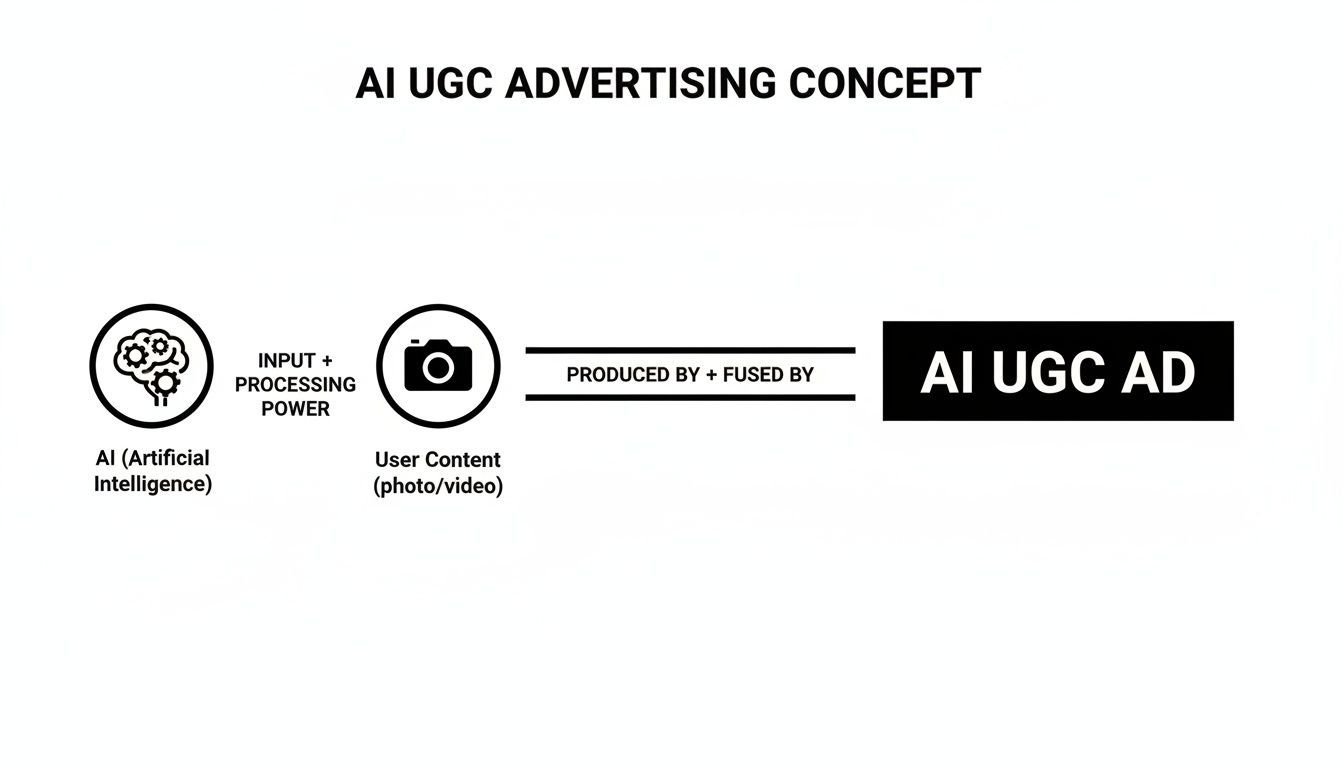
The key takeaway is that AI is the bridge. It transforms a static piece of customer content into a dynamic ad asset that’s ready to perform.
Automating the Creative Workflow
Once you’ve got the right content, AI steps in as your automated editor and creative director. All those tedious tasks that used to eat up hours—manually resizing videos for different platforms, adding captions, creating multiple versions—can now be done in seconds.
- Smart Resizing: It can take a horizontal video and instantly reframe it for vertical formats like TikTok or Reels, automatically keeping the important action centered. No more awkward crops.
- Automated Captions: Since so many people watch videos on mute, captions are non-negotiable. AI generates and syncs them perfectly, saving a ton of manual effort.
- Effortless Variations: This is a huge one. AI can spit out hundreds of ad variations by swapping out hooks, changing the background music, or testing different calls-to-action. This makes A/B testing incredibly fast and simple.
This level of automation is what makes creating AI UGC ads so ridiculously efficient. If you want to get into the weeds on the tools behind this, exploring what AI short video generators are capable of is a great place to start.
Synthesizing New Media Elements
But it gets even more interesting. AI isn't just about editing what's already there; it can create entirely new elements to make the UGC even better. This is where you can blend that authentic user footage with AI-generated components for a seamless, professional final ad.
A popular and incredibly useful application here is AI-powered voiceovers. Instead of hiring voice actors for every ad variation, an AI can either clone a real human voice or generate a brand-new, realistic one to narrate a video. This is perfect for adding context or a clear call-to-action to user footage that was originally silent.
You can even take it a step further with AI actors or avatars. These digital people can introduce a user clip, deliver a testimonial, or demo a product feature. It adds a polished human touch without the time and cost of a full-blown video shoot.
The real magic of AI here isn't just managing content—it's about multiplying its impact. A single great customer video can become 50 unique, platform-specific ads in a matter of minutes, not weeks.
Enabling Hyper-Personalization at Scale
When you put all of these capabilities together, you get the holy grail of modern advertising: hyper-personalization at scale. AI can dynamically pull together different pieces of UGC, voiceovers, and captions based on very specific audience data.
Imagine this: a skincare brand could automatically show a viewer an ad featuring a user with a similar skin type. A travel company could serve up an ad showcasing customer photos from a destination that specific viewer was just researching. This makes the ad feel less like an interruption and more like a helpful recommendation, which does wonders for conversion rates.
The Real-World Impact of AI UGC Ads
It's one thing to understand how AI can create UGC-style ads, but the real question is: why should you care? The answer comes down to the measurable, data-backed results this approach brings to the table. This isn't just about making ads faster; it's about making them fundamentally better.
The magic is in the authenticity. When an ad looks and feels like something a real person shared, it immediately builds a level of trust that a polished, corporate video just can't replicate. That genuine connection is what drives higher engagement—viewers see it less as a sales pitch and more as a genuine recommendation from someone they can relate to.
This trust isn't just a feeling; it translates directly into hard numbers. Industry studies consistently show that UGC-style ads pull in roughly four times higher click-through rates and can slash cost-per-click by 50% compared to typical brand creative. On top of that, campaigns that weave in UGC often see a 50% lift in overall engagement.
Radically Lower Production Costs and Timelines
Beyond performance, the operational benefits are massive. Just think about the old way of making a video ad: weeks of back-and-forth planning, expensive shoots, hiring actors, and a long, drawn-out post-production process. A single polished ad can easily cost thousands of dollars and take a month or more to get out the door.
AI UGC turns that entire model upside down.
- Slash Your Budget: You can forget about expensive camera crews, location scouting, and talent fees. Your main cost shifts from unpredictable production expenses to a simple software subscription. This is a huge win, especially when you consider how much creator rates can fluctuate. (If you're curious about the traditional creator economy, our guide on how much YouTube pays breaks it down).
- Launch at Lightning Speed: Instead of waiting weeks, an AI platform can pump out dozens of ad variations in minutes. This agility lets you jump on market trends, launch reactive campaigns, and keep your creative fresh without missing a beat.
The takeaway is clear: AI UGC lets you create more ads, more often, for a fraction of the cost, all while delivering the authentic feel that actually drives conversions.
A Clear Path to Higher ROAS and Scalability
At the end of the day, all these perks funnel down to the metric that matters most: Return on Ad Spend (ROAS). When you’re lowering your CPC and boosting your CTR, your campaign’s financial performance naturally gets better.
This newfound efficiency also opens the door to incredible scale. With AI, you can test hundreds of different ad variations—tweaking hooks, swapping visuals, and changing calls-to-action—without blowing your entire budget on testing.
You can find the winning combinations faster than ever, allowing you to confidently pour resources into what’s actually working. The result is a more nimble, data-driven, and ultimately more profitable advertising strategy.
Real-World Examples of AI UGC Ads in Action
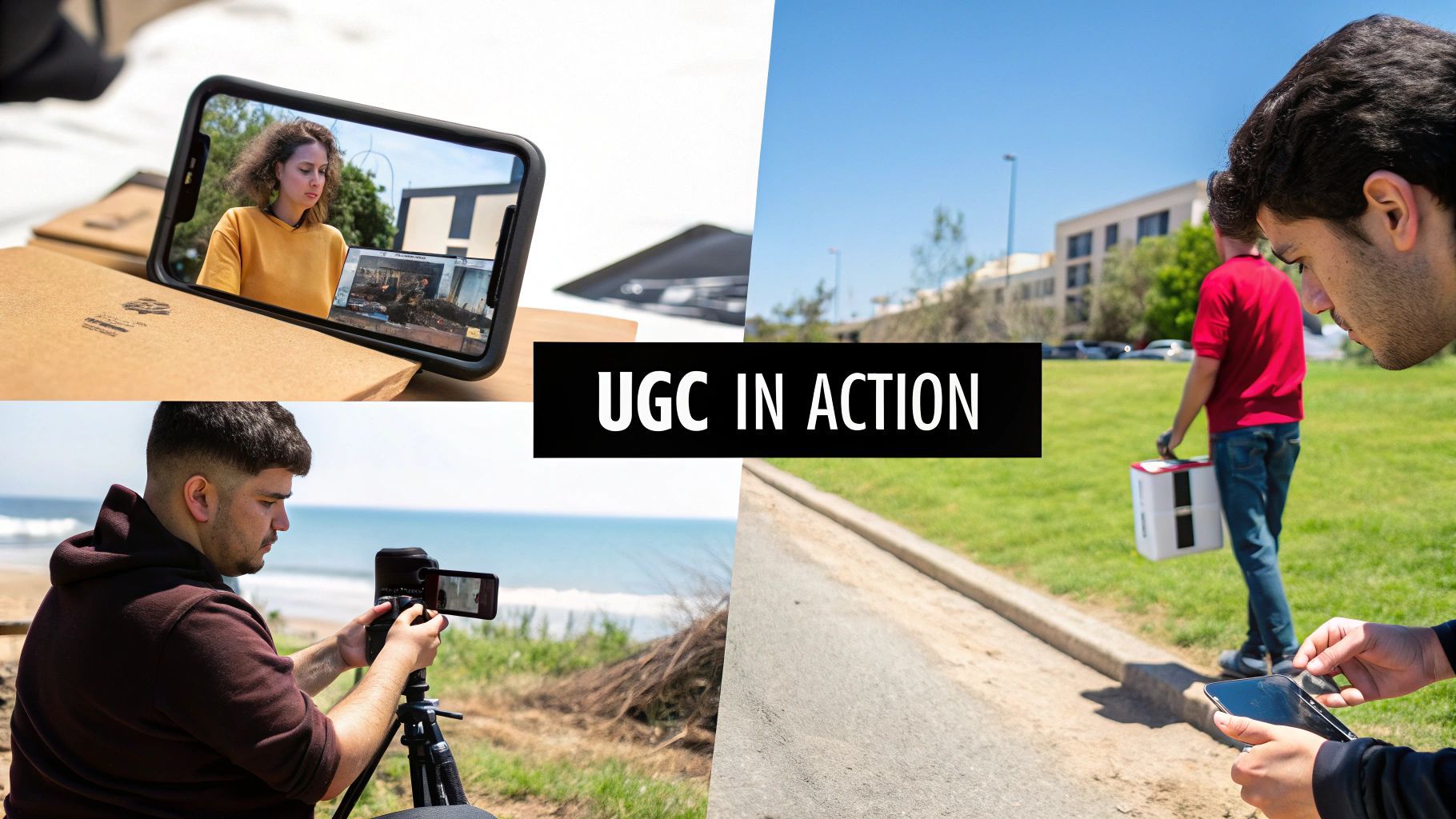
Theory is one thing, but seeing AI UGC ads out in the wild is what really makes the concept click. Let's move past the abstract and look at a few concrete examples of how this approach is already driving results for businesses.
From Hashtags to High-Converting Ads
Imagine an e-commerce fashion brand launching a new clothing line. They want to show how the clothes look on real people with different body types, not just professional models. Instead of a massive, expensive photoshoot, they launch a simple campaign: share your unboxing video with a specific hashtag.
This is where the AI kicks in. It scours social media for that hashtag, automatically analyzing which videos have the best lighting, clearest audio, and highest engagement. The top clips are instantly flagged. From that handful of authentic customer videos, the AI can spin up dozens of ad variations.
- Version A: It snags a 15-second clip of a customer gushing about her new dress, pairs it with some trending background music, and slaps on a text hook like, "Finally found the perfect summer dress!"
- Version B: The AI stitches together three different clips from three different customers, adds a super-realistic AI voiceover that summarizes their positive comments, and finishes with a strong "Shop The Look" call-to-action.
- Version C: It even pulls still frames from the best videos to create a dynamic carousel ad. Each frame features a different customer and a direct link to the exact product they’re showing off.
Scaling Authenticity Across the Globe
Now, think about a travel company selling vacation packages. Their entire business is built on inspiring people by showing them incredible, authentic travel moments. They can use AI to pull in customer photos and videos from specific destinations, like Bali or Paris.
The AI then gets to work, assembling these clips into beautiful video montages. But it doesn't stop there. It can generate localized AI voiceovers in Spanish, French, or Japanese, creating perfectly tailored ads for international markets without hiring a single new production team. Someone in Madrid researching a trip to Bali could see an ad made entirely from recent traveler footage from that exact spot, making the dream trip feel real and within reach.
The big idea here is to let AI do all the tedious production work. This frees up brands to focus on the high-level strategy, turning one great piece of customer content into a goldmine of personalized, high-performing ads.
One last example: a mobile gaming app. They can use AI to find glowing user reviews online and dynamically overlay them onto actual gameplay footage. An AI-powered system can create thousands of these micro-targeted ad variations almost instantly. It can match a user's known gaming preferences (say, puzzle games) with a review that specifically says, "Best puzzle game I've played all year!" This kind of granular personalization is basically impossible to do manually, but it's a piece of cake for AI.
Kicking Off Your First AI UGC Ad Strategy
Alright, let's move from theory to practice. Getting your first AI UGC ad campaign off the ground isn't as daunting as it might seem. With a clear, step-by-step workflow, you can confidently go from a raw idea to a live campaign that actually gets results.
It all starts with your most valuable resource: genuine content from your users.

This first step is everything. You need a solid system for finding and organizing the raw material that will feed your AI tools. Think about where your best user content is hiding. Is it on social media under specific hashtags? Buried in product reviews? Or maybe in direct submissions from your biggest fans?
Just as crucial is getting the legal stuff right. Always, always get explicit permission before you use a customer's photo or video in an ad. A simple, clear process for requesting and tracking content rights will save you from massive legal headaches later on.
Choosing Your Tools and Setting Goals
Once you have a steady stream of content, it’s time to pick the right AI platform. The market for AI-powered UGC tools is absolutely exploding. One forecast suggests the UGC market could leap from $5.36 billion to a staggering $32.6 billion by 2030. That’s a huge indicator of the opportunity for tools that can automate ad creation. You can dig into more of these stats over at amraandelma.com.
When you're looking at different tools, think about what you really need:
- Creative Automation: Can it handle the grunt work, like automatically resizing videos, adding captions, and creating different versions?
- Media Synthesis: Does it offer features like realistic voiceovers or even AI actors to fill in the gaps in your UGC?
- Performance Focus: Is the tool actually built for making ads that convert, or is it just a fancy video editor?
This is where a dedicated AI ad generator becomes a game-changer, letting you rapidly turn that raw footage into dozens of polished ads ready for launch.
Before you even think about creating an ad, you need to define what a "win" looks like. Setting clear Key Performance Indicators (KPIs) from the start is absolutely non-negotiable if you want to measure the real impact.
Are you trying to drive down your Cost-Per-Click (CPC)? Push up your Click-Through Rate (CTR)? Or are you focused on the big picture with Return on Ad Spend (ROAS)? Your goals will shape everything that follows, from the creative hooks you test to the audiences you target. This data-first mindset ensures you’re not just making ads faster—you’re making them smarter.
Common Pitfalls and How to Avoid Them
AI-powered UGC ads can be a game-changer, but like any powerful tool, you can't just press a button and hope for the best. Jumping in without a solid game plan is how you end up with campaigns that fall flat or, even worse, backfire. Let's walk through some of the most common traps I've seen brands fall into and how you can steer clear of them.
The biggest mistake? Forgetting the "U" in UGC. The whole point is to capture that raw, human element, and it's surprisingly easy to sterilize it with too much automation. The goal isn't to create perfectly polished, robotic ads; it's to scale the feeling of authenticity.
Then there's the legal and ethical tightrope. Grabbing a customer's content without their explicit say-so is a one-way ticket to legal headaches and a fast way to torch your brand's reputation. Getting clear consent isn't just a good idea—it's non-negotiable.
Losing the Authentic Vibe
What makes UGC so powerful is its genuine, unscripted feel. But if you lean too hard on AI, you can end up with ads that feel just a little...off. They become generic, losing the very magic you were trying to capture.
Think of AI as a turbocharger for your creative team, not a replacement.
- Keep a Human in the Loop: Always have a real person review the AI-generated scripts, voiceovers, and final cuts. Their gut check is crucial to make sure the ad feels relatable and doesn't wander into the uncanny valley.
- Start with Real Stories: The best AI UGC ads are built on a foundation of real user reviews or video clips. Use AI to handle the grunt work—adding slick captions, resizing for different platforms, or spinning up variations—not to invent the core message out of thin air.
- Mix and Match: Some of the most compelling ads I've seen blend AI-generated scenes with actual customer footage. This hybrid approach often strikes the perfect balance between polished and believable.
Navigating Content Rights and Brand Safety
Protecting your brand means being proactive about both legal permissions and the quality of the content you're associating with. The last thing you want is your brand name attached to something inappropriate or just plain shoddy.
Before a single piece of user content is used in an ad, a clear and documented trail of permission must exist. This isn't just a best practice; it's a fundamental requirement for ethical marketing.
Your workflow should be airtight on this front:
- Get Explicit Consent: Set up a dead-simple form or process where users officially give you the green light to use their content for advertising. No ambiguity.
- Have a Vetting Process: Whether it's a person on your team or a smart AI moderation tool, every piece of potential UGC needs to be reviewed. You're checking for brand alignment—no off-color language, no blurry videos, nothing that doesn't feel like you.
- Credit When Possible: It's not always practical, but giving a shout-out to the original creator can build a ton of goodwill. It shows you value your community and encourages more people to share their experiences.
To wrap this up, here’s a quick-glance table to keep these points top of mind as you build out your campaigns.
Best Practices for Effective AI UGC Campaigns
This table summarizes the key dos and don'ts that can help guide you toward creating AI UGC ad campaigns that are not only successful but also ethical and respectful of your audience.
| Best Practice (Do) | Common Pitfall (Don't) |
|---|---|
| Prioritize authenticity by starting with genuine user content and stories. | Don't over-automate to the point where ads feel robotic or generic. |
| Get explicit, documented consent from users before using their content in any ad. | Don't assume you can use publicly posted content without permission. |
| Use AI as an enhancer for tasks like editing, captioning, and creating variations. | Don't rely on AI to generate the core creative message from scratch without human oversight. |
| Implement a human-in-the-loop review process to ensure brand alignment and quality. | Don't skip the final human gut-check for tone, relatability, and authenticity. |
| Credit original creators when it's feasible to build community and encourage more UGC. | Don't ignore the person behind the content; treat them as a valued partner. |
Ultimately, the most successful brands will be those that strike a smart balance—using AI to achieve scale while keeping human creativity and ethical standards right at the core of their strategy.
Got Questions About AI UGC Ads? Let's Get Them Answered.
As you start to explore how AI UGC ads could fit into your marketing mix, a few practical questions are bound to pop up. Let's tackle the most common ones so you can move forward with confidence.
Is It Ethical to Use AI Actors in Ads?
Yes, as long as you're transparent about it. The golden rule here is to avoid deceiving your audience.
Most reputable AI platforms build their digital avatars from real human actors who have given full consent for their likeness to be used. This creates a solid ethical foundation from the start. Your focus should be on creating an ad that feels authentic in its messaging, not on trying to pass off an AI actor as a real, unpaid customer. The goal is to use AI to present information in a clear and relatable way, not to fake a personal story.
The point of AI UGC ads isn't deception; it's about scaling the style of authentic content. Being upfront with your audience is always the best policy and the surest way to build long-term trust.
Do I Still Need to Work With Real UGC Creators?
Absolutely. You should think of AI-generated content as a powerful tool that works alongside your real creator content, not as a replacement for it. There's a certain spark—a genuine emotion and unpredictability—that real creators bring to the table that AI is still working to master.
The smartest ad strategies use a mix of both:
- Real Creators: These are your go-to for building deep trust, capturing truly authentic moments, and leading your big, "hero" campaigns.
- AI UGC Ads: This is your engine for scaling. Use AI to create dozens of ad variations for testing, fill creative gaps on the fly, and keep your ad accounts fresh when you're short on real content.
It’s not an either/or situation. It's about having more options in your creative toolkit.
How Can I Get Started if I'm on a Small Budget?
This is where AI UGC ads really shine. One of their biggest perks is just how cost-effective they are. A traditional UGC campaign can easily run you hundreds, if not thousands, of dollars per creator. AI tools, on the other hand, typically run on a simple subscription model.
You can often get started for less than what it would cost to hire a single creator. For a predictable monthly fee, you can produce a high volume of ad variations, which makes this approach perfect for smaller brands or any team that wants to test a new creative strategy without a huge upfront investment.
Ready to create high-performing ads with the power of AI? ShortGenius helps you generate ad concepts, UGC-style scenes, scripts, and voiceovers in seconds. Stop guessing and start creating what converts. Try ShortGenius today!