How Much Does YouTube Pay Creators A Definitive Guide

Curious how much does YouTube pay? This guide breaks down creator earnings, from ad revenue and CPM to memberships, revealing how to maximize your income.
So, you want to know how much YouTubers actually make? It’s the million-dollar question, and the answer isn't as straightforward as you might think.
On average, a creator can expect to earn somewhere between $2,000 to $5,000 for every one million video views. But that’s a huge range, right? This figure isn't a fixed salary; it's a dynamic number that can swing wildly based on your content, where your audience lives, and the types of ads that run on your videos.
The Big Question: How Much Does YouTube Pay?
Asking "how much does YouTube pay" is a lot like asking how much a small business owner makes. The honest answer is always, "it depends." There's no simple paycheck. Instead, your income is a blend of several moving parts, which makes every creator's financial journey unique.
For some channels, a million views might bring in a modest sum. For others in high-value niches like finance or tech, those same million views could generate a seriously significant income. It all comes down to the specifics of your channel.
What's clear is that YouTube has become a massive economic engine for its community. In just the last three years, the platform has paid out a staggering $70 billion to creators, artists, and media companies. That's a huge testament to the power of the creator economy.
While the top-tier channels with billions of views are certainly earning millions, the average creator's income is a more complex calculation. It’s a mix of ad rates, audience engagement, and the monetization strategies they use.

It's About More Than Just Views
Think of your YouTube channel not as a single job, but as a business with multiple income streams. Relying solely on ad revenue is a common starting point, but it’s just one piece of a much larger puzzle. The most successful creators build a diversified income portfolio directly on the platform.
To give you a clearer picture, let's break down the primary ways you can earn on YouTube.
YouTube Earnings at a Glance: Potential Payouts per Revenue Stream
This table provides a high-level summary of the main ways creators earn money on YouTube and the typical potential for each.
| Revenue Stream | How It Works | Typical Earning Potential |
|---|---|---|
| Ad Revenue | Earn a share of the money advertisers pay to run ads on your videos. | $1 - $10+ RPM (Revenue Per Mille, or per 1,000 views). Varies wildly by niche. |
| YouTube Premium | Receive a portion of a viewer's subscription fee when they watch your content. | Varies based on watch time from Premium subscribers. Adds a steady, secondary income. |
| Channel Memberships | Fans pay a recurring monthly fee for exclusive perks like badges and custom emojis. | $0.99 - $99.99 per member per month. Depends on the value you offer. |
| Super Chat & Thanks | Viewers can pay to highlight their messages in live chats or to show appreciation on videos. | Can be a significant boost during live streams. Tips range from $1 to $500. |
| Sponsorships | Brands pay you directly to feature their product or service in your videos. | Highly variable, from $500 to $50,000+ per video, based on your influence. |
This table shows that relying only on ad revenue means you're leaving a lot of money on the table. A smart strategy involves layering several of these options to create a more stable and predictable income.
Building Your Monetization Strategy
To really understand the financial landscape, it helps to zoom out and look at broader trends. Getting a sense of how much influencers really make across all platforms—not just YouTube—is crucial for setting realistic expectations. This wider context helps you plan your own monetization strategy much more effectively.
YouTube itself has built a whole ecosystem to help creators turn their passion into a career. It's all about moving beyond simple ad payouts and building a real business around your content.
Understanding Your Core Revenue Streams
So, you want to know how much YouTube really pays? The first step is to get a handle on where the money actually comes from. Don't think of it as one big paycheck; see your channel as a business with several pipelines filling up your bank account.
The two main pipelines, managed directly through the YouTube Partner Program (YPP), are Ad Revenue and YouTube Premium. For most creators, these are the first and most important income sources. While things like Super Chats and brand deals can eventually become huge, mastering these two is your first real step toward a stable income from your content.
The Lifeblood of YouTube: Ad Revenue
Ad revenue is the classic YouTube money-maker, and for many, it’s still the biggest piece of the pie. Once you're in the YPP, you're essentially giving YouTube permission to run ads on your videos. In exchange, you get a slice of what advertisers pay to be there.
It's not just one kind of ad, though. You’ll see a few different types pop up, and knowing what they are can help you plan your videos to make more money.
There are three main types of video ads to know:
- Pre-Roll Ads: These are the ads everyone knows—they play right before your video starts. They're a reliable source of income, even if the individual payout isn't massive.
- Mid-Roll Ads: This is where things get interesting. For any video longer than eight minutes, you can insert ads during your content. You get to choose where they go, so you can place them at natural pauses to make them less annoying for viewers and maximize your earnings.
- Post-Roll Ads: Just like it sounds, these ads run after your video ends. Honestly, their impact can be a bit hit-or-miss since many people click away as soon as the content they came for is over.
The ability to place mid-roll ads is a huge milestone. A creator with a 10-minute video can potentially earn more than double what a creator with a 7-minute video earns, even with the same number of views, simply by having more ad slots available.
Unlocking a Second Stream with YouTube Premium
Ads are great, but what about viewers who pay for YouTube Premium to avoid them? You still get paid, and this revenue stream is often overlooked.
It’s actually pretty straightforward. YouTube pools a portion of all the money it makes from Premium subscriptions and divides it among creators. Your cut is based on one simple metric: how much watch time you get from Premium members.
The more a Premium subscriber watches your videos, the bigger your slice of that revenue pie. This creates a fantastic incentive to not just get clicks, but to create content that keeps people hooked from start to finish.
Broadening Your Horizons
These YPP streams are just the beginning. The creator economy is massive, and it’s smart to understand how influencers get paid across different platforms and through all sorts of deals. Thinking bigger helps you see how your YouTube channel can be the core of a much larger personal brand and business.
At the end of the day, getting a grip on both ad revenue and Premium payouts is fundamental. They complement each other perfectly: ads generate income from the vast majority of your audience, while Premium offers a steady, watch-time-based income from your most dedicated viewers. By building your strategy around both, you create a much more resilient financial foundation for your channel.
Don't Just Rely on Ad Revenue
Putting all your eggs in the ad revenue basket is a risky game. It's a great place to start, sure, but the creators who really build sustainable careers know that true financial stability comes from having multiple streams of income. Luckily, YouTube has built some fantastic tools that let your most loyal fans support you directly, turning them from passive viewers into a real community that’s invested in what you do.
This is where you shift from just being a content creator to running a genuine business. Instead of earning tiny fractions of a cent from each ad view, you're opening up a direct line to the people who appreciate your work the most. It's not just about earning more money; it’s about creating a more predictable and stable income that isn't entirely at the mercy of ad algorithms.
Let Your Biggest Fans Support You
YouTube has a whole category of features often called "Fan Funding." Each tool works a little differently, but they all give your community a way to show their appreciation with more than just a thumbs-up.
Here’s a quick look at the heavy hitters:
- Channel Memberships: Think of this as your channel's own VIP club. For a small monthly fee, your biggest fans get access to exclusive perks that you design—things like custom emojis, special badges, members-only videos, or a sneak peek at new content. It's a fantastic way to build a recurring revenue stream.
- Super Chat & Super Stickers: These are game-changers for live streams and Premieres. Viewers can pay to make their comments stand out in the live chat feed. The more they contribute, the longer their message stays pinned and highlighted. It's a fun, interactive way to engage with your audience in real-time while also monetizing the event.
- Super Thanks: This is basically a digital tip jar for your regular, on-demand videos. If someone really loved a video you posted, they can buy a colorful, animated "Super Thanks" to show their support. It’s a simple, one-off way for fans to say "job well done."
These aren't just fancy features; they represent a totally different way of thinking about how YouTube pays. The most successful creators don't just upload videos—they build a business. In fact, a recent analysis found that creators who actively focus on monetization as a business reported an average annual income of over $132,000. That's more than double what creators who only chase audience growth reported. You can dig into the numbers yourself by checking out the full creator earnings report.
How Money Works on YouTube Shorts
Short-form video is a whole different beast, and it has its own unique way of paying creators. With YouTube Shorts, ad revenue isn't tied to the ads on your specific videos. Instead, all the money is pooled together and then shared among eligible creators.
Here's the simple version of how it works:
- All the revenue from ads that run between Shorts in the main feed gets collected into a single pot.
- A slice of that money is first taken out to cover music licensing fees.
- What's left is called the "Creator Pool," and this is the money that gets distributed to creators.
How big of a slice you get is based on your channel's share of total Shorts views. So, if your Shorts get 1% of all the eligible views in your country for the month, you get 1% of the money from the Creator Pool. From that amount, creators keep 45%.
This system really rewards creators who can consistently pump out popular Shorts. A single viral hit might not make you rich, but a channel that consistently gets good viewership can build a pretty significant income from this separate revenue stream.
At the end of the day, diversifying is the secret to maximizing how much you can really earn on YouTube. When you combine your ad revenue with direct fan support from Memberships and Supers, and then add in the growing potential of the Shorts ecosystem, you're not just making videos anymore. You're building a resilient financial foundation for a real, long-term business built around your passion.
Decoding Your Earnings With CPM and RPM
Diving into your YouTube analytics for the first time can feel like trying to crack a code, especially when you’re looking at the money side of things. To get a real grip on how YouTube pays creators, you need to understand two little acronyms that are the lifeblood of your channel’s finances: CPM and RPM.
It’s super common for new creators to get these two mixed up, but knowing the difference is absolutely crucial. Here’s a simple way to think about it: CPM is like the sticker price of a product, while RPM is the actual cash you put in your pocket after all the costs and cuts are taken out.
CPM: The Advertiser's Perspective
CPM stands for Cost Per Mille—"mille" is just Latin for a thousand. This number tells you how much advertisers are willing to pay for every 1,000 times an ad is shown on your videos. This is a measure of the advertiser's cost, not what lands in your bank account.
An "ad impression" is counted every single time an ad appears. So, if a viewer watches a pre-roll ad and then a mid-roll ad in the same video, that's two separate impressions. CPM is all about what brands think your audience is worth.
This is exactly why a channel focused on personal finance might pull a CPM of $25 or higher, while a gaming channel might see something closer to $5. Advertisers are happy to pay a premium to get their products—like investment apps or new credit cards—in front of an audience that's ready to buy.
RPM: Your True Take-Home Pay
While CPM is interesting to know, the metric that should really have your attention is RPM, which means Revenue Per Mille. It’s your revenue per 1,000 views. This is your number. RPM gives you the bottom-line figure of what you earned from all sources for every 1,000 views your videos received.
Unlike CPM, which is strictly about ad costs, RPM takes a much bigger-picture view.
RPM calculates your total revenue—from ads, YouTube Premium, Channel Memberships, Super Chat, and Super Thanks—and then divides it by your total number of video views. It's the most honest look you can get at how well your channel is actually turning views into income.
This is where features like direct fan funding come into play, which can give your RPM a serious boost beyond just ad money.
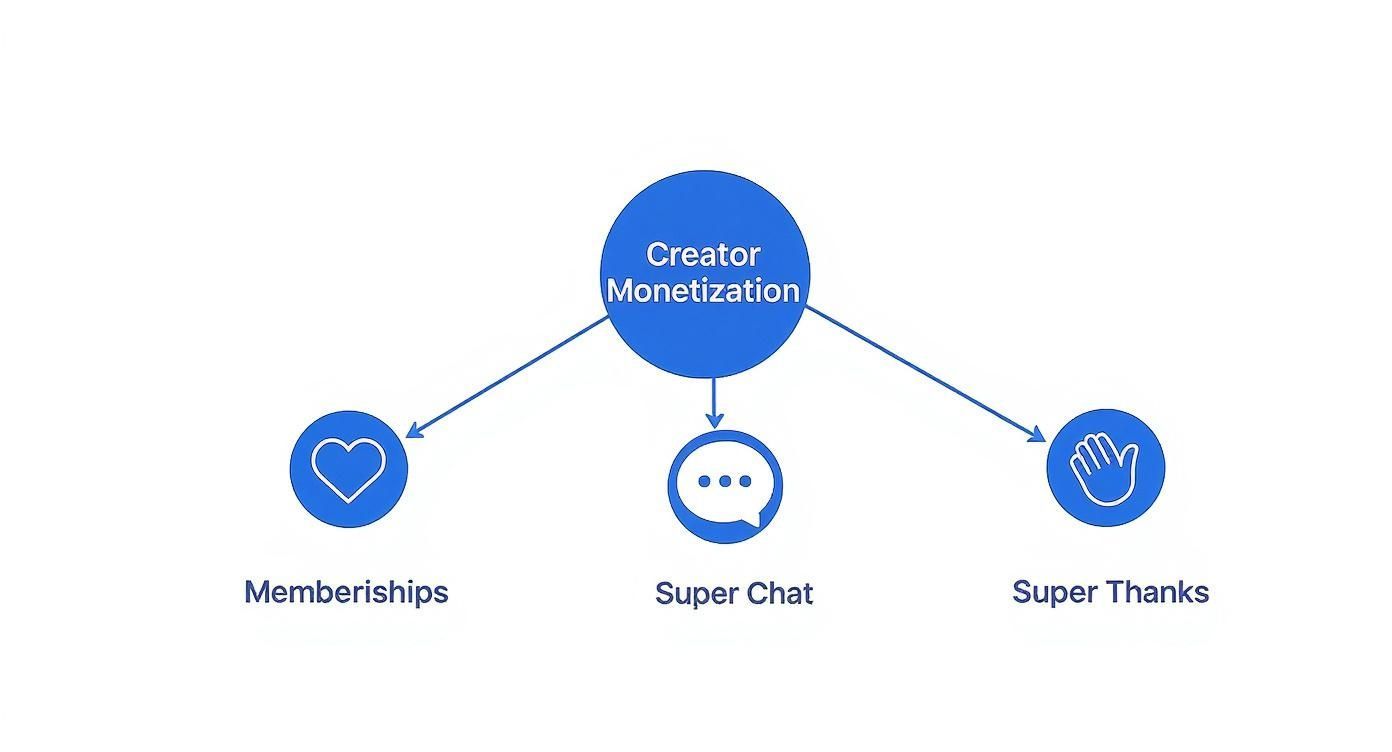
As you can see, things like Memberships and Super Chats are direct contributions from your most loyal viewers. They are powerful ways to increase your earnings that have nothing to do with advertisers.
CPM vs RPM: Understanding Your Earnings
To make sense of your channel's financial performance, you really need to know how these two metrics work together. Here's a straightforward comparison to clear things up.
| Metric | What It Measures | Who It's For | Why It Matters to You |
|---|---|---|---|
| CPM | The amount advertisers pay for 1,000 ad impressions. | Advertiser | Shows you the commercial value of your niche and audience to brands. |
| RPM | Your total revenue from all sources per 1,000 video views. | Creator | Gives you the real, unfiltered picture of your channel's financial health. |
Don't panic if your RPM is always lower than your CPM. That’s totally normal and expected.
The reason is simple: not every single person who watches your video is going to see an ad. Some people use ad blockers, some watch on devices that don't serve ads for that format, and sometimes YouTube just doesn't have an ad to show. Your RPM accounts for all those ad-free views, giving you a realistic average.
At the end of the day, keeping your eye on RPM is what will help you make smarter decisions. If you see your RPM going up, it’s a great sign that your strategies—like promoting channel memberships or shouting out Super Thanks—are paying off. It tells the complete story of how much YouTube is really paying you, so you can focus on building a more profitable channel.
What Actually Determines Your YouTube Pay Rate?
Ever wondered why two channels with similar views and subscribers can have wildly different bank balances? You see one creator upgrading their gear and the next still struggling to make ends meet. It’s not just luck—it’s a deep understanding of the forces that control YouTube ad rates.
Thinking you get paid just for views is a common mistake. The reality is far more nuanced. A handful of key factors work together to determine how much money actually lands in your pocket. Getting a handle on these is like a sailor learning to read the winds and the tides. You can set sail without this knowledge, but you won't get far, fast.
Let's break down the "big four" that dictate your earnings: your niche, your audience's location, the time of year, and how captivated your viewers are.
Content Niche: The Foundation of Your Ad Value
Your niche is, without a doubt, the heaviest hitter when it comes to your earning potential. Put yourself in an advertiser's shoes for a moment. If you're selling expensive project management software, would you rather your ad run on a prank channel or a channel that teaches business owners how to scale? You’d pay a hefty premium for the second option, because every single viewer is a potential customer.
That’s exactly why some niches are absolute goldmines compared to others.
- High-RPM Niches: Think personal finance, real estate, technology reviews, and business strategy. These topics pull in advertisers with deep pockets. A video breaking down investment apps could easily pull an RPM of $15 - $30, and sometimes much more.
- Lower-RPM Niches: Broad entertainment categories like gaming, daily vlogs, or comedy sketches tend to have lower RPMs, often falling in the $2 - $6 range. They can get enormous view counts, but the ads are usually for mass-market products, which just don't command the same high ad rates.
The income potential in the right niche is staggering. It's not uncommon for finance or business channels with around one million subscribers to clear $10,000 a month from AdSense alone. Some specialized videos can even hit CPMs over £40 per 1,000 views. It's all made possible by YouTube's surprisingly favorable creator revenue splits.
Audience Geography: Where Your Viewers Are Matters. A Lot.
Next up is geography. A view isn't just a view; it’s a person in a specific place with a certain amount of purchasing power. Advertisers know this, and they pay accordingly. A viewer from the United States, the UK, or Canada is simply more valuable to most global brands than a viewer from a country with a less-developed consumer market.
Why? Because brands are willing to bid more to reach people in markets with higher average disposable income.
If 70% of your audience is in the US, your RPM will be dramatically higher than a creator with the exact same number of views, but whose audience is 70% based in South Asia. This is a crucial piece of the puzzle to remember as you build your content strategy.
Seasonality: Riding the Wave of Ad Spending
Advertiser spending isn't a flat line—it's a rollercoaster that follows the calendar. The last three months of the year, known as Q4 (October-December), are a gold rush for creators. Brands pour money into ads to capture the holiday shopping frenzy, from Black Friday right through to Christmas.
During Q4, it’s completely normal to see your RPMs spike by 30-50%, sometimes even more. On the flip side, Q1 (January-March) is usually the slowest period. Holiday bills have come due, consumer spending cools off, and marketing departments are working with fresh, and often tighter, new budgets.
Audience Engagement: The Power of Watch Time
Finally, YouTube is a business built on attention. The longer you can keep someone on the platform, the more YouTube rewards you. Key engagement metrics like watch time, likes, comments, and shares send powerful signals to the algorithm that your content is high-quality.
This has a direct and immediate impact on your wallet. Videos that hold attention for longer can serve more ads—especially those valuable mid-roll ads that you can place in videos longer than eight minutes. This immediately juices your RPM. Plus, a truly engaged audience is the one that will stick around to support you in other ways, like through Super Thanks and Channel Memberships, pushing your total earnings even higher.
Actionable Strategies to Boost Your YouTube Income
Knowing how YouTube pays you is one half of the puzzle. The other half is actually doing something with that knowledge to make more money. It’s all about shifting your mindset from just making videos to building a smart, revenue-generating channel.
You don't need to overhaul everything overnight. Often, it's the small, strategic tweaks that lead to the biggest jumps in your earnings. The idea is to optimize every video for its maximum revenue potential without ever sacrificing the quality your audience expects. It's time to think like a creator and an entrepreneur.
Master Your Content and Ad Strategy
Believe it or not, the most powerful tool you have for increasing your income is the content itself. When you start creating videos with both your audience and advertisers in mind, you can directly influence how much ad revenue lands in your pocket.
First off, aim to make your videos longer than eight minutes. This is the golden ticket that lets you place mid-roll ads—those little ad breaks in the middle of a video. A single 15-minute video with a couple of well-placed mid-rolls can easily earn twice as much from ads as a 7-minute video, even with the exact same view count.
Next, start thinking about high-CPM keywords. What are the topics in your niche that advertisers are willing to pay top dollar for? Use tools like vidIQ or just poke around on YouTube to see what successful creators are talking about. Videos on "best personal finance apps" or "how to invest in real estate" will almost always attract higher-paying ads than general vlogs.
Key Takeaway: Stop just making videos and start designing them for profitability. Being intentional about your video length and topic is a game-changer for becoming a top earner.
Diversify with Direct Fan Support
Ad revenue is great, but it can swing wildly from month to month. To build a more stable and predictable income, you need to lean into direct support from your biggest fans. This isn't just about flipping a switch in your settings; it’s about making these features part of your channel’s DNA.
Here are a few simple ways to get started:
- Ask for Super Thanks: During your video, drop in a casual reminder. Something like, "If this video helped you out, hitting that Super Thanks button is a huge way to support the channel." A gentle nudge goes a long way.
- Offer Real Membership Perks: Don't just turn on Channel Memberships and cross your fingers. Give people a reason to join! Offer things like exclusive behind-the-scenes content, members-only Q&As, or a private Discord server where they can connect with you and other fans.
- Shout Out Your Supporters: When you're live-streaming, make a big deal out of every Super Chat. Read the message, say their name, and thank them personally. It makes that person feel amazing and shows everyone else that their support is seen and valued.
Embrace Shorts for Growth and Revenue
YouTube Shorts aren't just for getting discovered anymore—they're a real revenue stream. While the RPM for a Short is definitely lower than for a long-form video, the sheer number of views you can rack up makes them an essential part of your strategy.
A great approach is to use Shorts as trailers or highlight reels for your main videos. This creates a powerful funnel: the massive reach of Shorts drives new viewers to your long-form content, where your RPM is much higher.
By consistently pumping out fun, engaging Shorts, you get to tap into the Shorts Creator Pool while simultaneously growing your main channel. For creators who want to scale up their short-form production without burning out, tools offering AI video generation can be a huge help in keeping a steady flow of content going.
Got Questions? Let's Clear Up Some YouTube Pay Myths
Even with all the numbers and metrics laid out, there are always a few lingering questions that creators get stuck on. It’s totally normal. Getting these common points cleared up is the final piece of the puzzle to really grasp how this whole YouTube money thing works.
Let's dive into the questions I hear most often from creators trying to connect the dots between their stats and their bank account.
How Many Subscribers Do You Need to Get Paid?
This is probably the most common question, and the answer surprises a lot of people: you don't get paid for subscribers directly. Instead, they’re a key to unlock the door to monetization.
To get into the YouTube Partner Program (YPP) and start earning, you need to hit two specific goals: at least 1,000 subscribers AND either 4,000 public watch hours in the last year or 10 million Shorts views in the last 90 days. Once you cross those lines, you can apply to turn on the money-making features. Think of subscribers as your ticket to the game, not the prize itself.
Does YouTube Pay for Likes or Comments?
Nope, YouTube doesn't send you a check for likes or comments. But don't discount them—they are incredibly valuable for your channel's health and, by extension, your wallet.
High engagement—likes, comments, shares—is a massive signal to the YouTube algorithm that people are enjoying your video. The algorithm then shows it to more potential viewers. More views mean more ad impressions, which means more revenue. So, while a single "like" isn't worth a penny, a thousand of them can absolutely lead to more dollars down the road.
Can You Really Make a Living from YouTube?
Absolutely, yes. Thousands of people treat YouTube as their full-time job. But let's be real: it's a business, not a get-rich-quick scheme. Making a real living from it comes down to consistently creating great content, finding a profitable niche, and—this is the big one—not relying on just one source of income.
The creators who thrive aren't just living off ad revenue. They've built a multi-faceted business around their channel.
- Sponsorships: They partner with brands they believe in for paid promotions.
- Merchandise: They sell their own branded gear to their loyal fans.
- Affiliate Marketing: They earn commissions for recommending products they use and love.
- Memberships & Supers: They use YouTube's built-in tools to get direct support from their community.
When you start weaving these different streams together, you stop asking "how much does YouTube pay?" and start building your own answer. A channel can go from a side hustle to a sustainable career if you treat it like one.
Ready to scale your content production and grow your channel faster? With ShortGenius, you can turn ideas into high-quality videos in minutes. Create, schedule, and publish Shorts, Reels, and TikToks effortlessly. Start creating with ShortGenius today