Faceless youtube channel: Launch, Grow, and Monetize Without Showing Your Face

Discover how to run a faceless youtube channel and monetize without showing your face. Get niche ideas, content strategies, and steps to grow fast.
You've probably heard that to make it big on YouTube, you need to be a charismatic, on-camera personality. I'm here to tell you that’s a myth. A faceless YouTube channel is a strategy where you, the creator, stay completely behind the scenes. Instead of filming yourself, you rely on voiceovers, animations, stock clips, or screen recordings to tell your story.
This isn't just about being camera-shy. It’s a business model that lets you build a huge audience and a serious income by focusing 100% on the quality of your content, not on your on-screen presence.
The Untapped Potential of Anonymous YouTube Content

Let's get one thing straight: building a YouTube empire doesn't mean you have to become an influencer. For a growing number of creators, the faceless model is a massive strategic advantage. When you take the pressure of performing for the camera off the table, you can pour all that energy into what actually grows a channel: creating valuable, engaging, and polished content.
The benefits are immediate. You get a level of privacy that's almost impossible for traditional YouTubers, keeping your personal life completely separate from your brand. But the real game-changer is scalability. Without the bottleneck of filming yourself for every single video, you can build a production assembly line. You can hire writers, editors, and voice actors to create content far faster than you ever could alone.
Proof of Faceless Profitability
Still skeptical? The numbers don't lie. Faceless channels aren't just a niche hobby; they are absolute media powerhouses, dominating some of the most profitable categories on all of YouTube. They're concrete proof that a great idea and solid execution will always beat a charismatic host who puts out mediocre content.
Take a look at BRIGHT SIDE, a behemoth in the space with an incredible 44.7 million subscribers. Their animated videos cover everything from brain teasers to weird science, and they reportedly rake in anywhere from $23,000 to $75,000 every single month just from ads.
Then there's WatchMojo.com. They've built a whole empire on "Top 10" list videos, grabbing 25.9 million subscribers and earning an estimated $120,000 to $334,000 per month. You can dive deeper into the success stories of channels like these and check out their earnings on Awisee.com.
The key takeaway is simple: Audiences subscribe for value and entertainment. When your content consistently delivers on that promise, the absence of a face becomes completely irrelevant to your channel's success.
Why This Model Thrives
So, why does the faceless approach work so well? It gets right to the heart of what viewers actually want: information, entertainment, or a solution to a nagging problem. This opens up a world of possibilities.
You can build a massive channel around almost any interest imaginable—guided meditations, deep-dive financial explainers, gaming compilations, true crime documentaries, you name it. This versatility lets you tap into incredibly lucrative markets without the stress of personal branding.
The beauty of it is you're not selling yourself; you're selling the content. And that is the fundamental power behind building a video business without ever stepping in front of a camera.
Here’s a quick look at some of the most profitable niches that are perfect for the faceless model, giving you an idea of the sheer breadth of opportunity out there.
Top Faceless Channel Niches and Their Earning Potential
| Niche Category | Content Style Example | Estimated Monthly Earnings |
|---|---|---|
| Finance & Investing | Whiteboard animations explaining stock market concepts | $5,000 - $50,000+ |
| Health & Wellness | Guided meditations with calming stock footage | $2,000 - $20,000 |
| History & Education | Documentary-style voiceovers with archival footage | $3,000 - $35,000 |
| Gaming Montages | "Funniest Moments" or "Epic Wins" compilations | $1,500 - $25,000 |
| True Crime & Mysteries | Storytelling over stock clips and text on screen | $4,000 - $40,000 |
| Tech & Software Tutorials | Screen recordings walking through software features | $1,000 - $15,000 |
As you can see, the earning potential is significant across a wide range of topics. The key is to pick a niche you understand and deliver value that keeps people coming back for more.
Finding Your Profitable Niche Without Guesswork
Picking a niche for your faceless YouTube channel is, without a doubt, the most critical decision you'll make. Forget the old advice to just "follow your passion." While passion is great for fuel, it's a terrible compass for business. Profitable channels are built on what an audience wants, not just what you feel like making.
We're looking for that sweet spot where real audience interest, solid monetization potential, and manageable competition all overlap.
I've seen too many creators burn out after months of making videos that barely crack 100 views. Why? Because they skipped the homework. They built something for an audience that simply didn't exist. Let's make sure that's not you by using data from day one.
Using Data to Find Your Goldmine
Think of yourself as a digital detective. Your first stop should be a tool like Google Trends. It's a fantastic way to see the bigger picture. You can plug in a few ideas and see if interest is trending up, down, or just flatlining. For instance, you might find that searches for "AI productivity tools" are spiking, while "life hacks" have been slowly declining for years. That’s your first clue.
Next, head straight to the source: YouTube's own search bar. Start typing in your general ideas and watch the autocomplete suggestions. These aren't guesses; they're the exact phrases real people are searching for. Typing "historical mysteries" might bring up "historical mysteries solved" or "historical mysteries documentaries." That's YouTube literally handing you proven video ideas.
Of course, a big part of finding a profitable niche is deeply understanding who you're even talking to. You have to know how to identify your target audience if you want to create content that actually connects with them.
Matching Content Style to Your Niche
Once you have a shortlist of promising niches, you need to think about how you'll actually make the videos. The content style you pick has a huge impact on your workflow, your budget, and the entire vibe of your channel. Not every format works for every topic.
Here are a few combinations that consistently do well:
- Animated Explainers: Absolutely perfect for breaking down complex topics. Think finance, science, or psychology. Channels like Kurzgesagt are masters of this, making heavy subjects feel light and engaging.
- Stock Footage Compilations: This is your go-to for niches built on emotion or atmosphere—meditation, motivation, or luxury travel. The right clips paired with a great voiceover can be incredibly powerful.
- Screen Recordings & Tutorials: The bread and butter for any "how-to" channel. If you're teaching software, coding, or even Excel tricks, this is the most direct and effective way to do it.
- AI-Generated Visuals: This is a game-changer for storytelling niches. True crime, historical deep dives, and sci-fi lore channels can use AI to create unique, atmospheric scenes you just can't find in a stock library.
For example, a channel diving into ancient history could blend maps, archival photos, and AI-generated scenes of Roman life to create an immersive documentary feel. On the other hand, a channel teaching Photoshop would be almost 100% screen recordings.
Key Insight: The best faceless channel ideas live at the intersection of a high-demand topic and a content style that communicates that information perfectly without ever needing to show a face.
Sizing Up the Competition
The final piece of the puzzle is a little friendly recon. Search your top niche ideas on YouTube and see who's already there. Your goal isn't to find a niche with zero competition—that's usually a red flag that nobody cares about it. You're looking for a niche where you can bring a fresh angle.
Scrutinize the top videos. Look for their weak spots. Is the audio quality terrible? Are the visuals dated and boring? Is the script rambling and hard to follow? Every weakness is an opportunity for you to do better.
Maybe every video on "beginner stock investing" is a dry, 20-minute lecture. You could come in with a series of punchy, 5-minute animated videos, each laser-focused on one concept. That's how you carve out your own space and build a faceless YouTube channel that stands out.
Building Your Content Production Machine
With your niche locked in, it's time to roll up your sleeves and get to work. This is the fun part—where you shift from planning to producing. The goal here isn't just to make one good video, but to build a repeatable system, a content assembly line, that turns your ideas into polished videos consistently.
For a faceless channel, your script and voiceover are doing all the heavy lifting. They have to paint a picture, stir emotion, and guide your viewer through the story without the help of a human face. That means your scripts have to be incredibly clear, punchy, and sound like a real person talking.
Crafting Scripts Meant to Be Heard
Writing for a voiceover is a whole different beast than writing a blog post. You have to use simpler words, shorter sentences, and find a natural rhythm that's easy on the ears.
The first 15 seconds are everything. You absolutely must have a killer hook that grabs attention and makes a clear promise about what the viewer will get out of sticking around.
Think about it. Instead of a bland start like, "In this video, we will discuss the history of ancient Rome," kick it off with some intrigue: "What if everything you thought you knew about the Roman Empire was wrong? Three forgotten facts reveal a much darker story." See the difference? One informs, the other hooks.
Choosing Your Visual Style
Once you have a solid script, you need to decide how to bring it to life visually. Each method has its own vibe and workflow, so pick the one that fits your niche, your budget, and your skills.
- Stock Footage: Platforms like Pexels, Pixabay, and Storyblocks are goldmines of high-quality video clips. This is the go-to for niches like motivation, history, or luxury, where you can layer a powerful voiceover onto beautiful, evocative scenes.
- Screen Recordings: This is non-negotiable for any channel focused on tech, software tutorials, or gaming. A free tool like OBS Studio is all you need to capture your screen in high definition. Pro tip: keep it clean. Hide your desktop icons, use a plain background, and make sure to zoom in on the important stuff so people can actually see what you're doing.
- AI-Generated Visuals: This is the new frontier, and it's a game-changer for faceless creators. AI tools can create completely unique images or even video clips from a simple text prompt. This is perfect for storytelling niches like true crime, sci-fi, or unsolved mysteries, letting you create custom visuals that perfectly match your narrative.
This whole process is about finding the right fit. You analyze what works, find your sweet spot, and then match your visual style to what that specific audience expects.
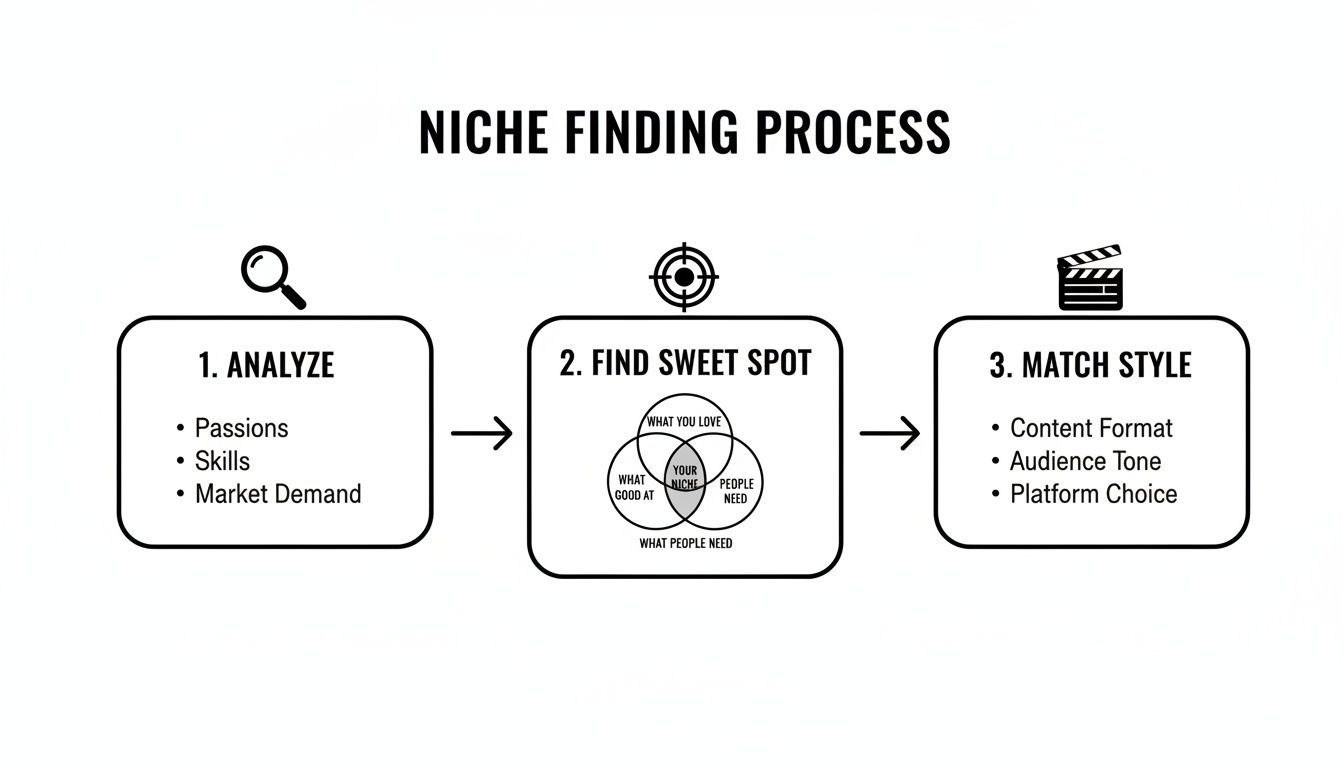
This chart really drives home a core principle: after you've figured out a topic has potential, you have to align your visual style with audience expectations. It’s a crucial step that many people skip.
Your Audio Can Make or Break You
If visuals are the body of your video, audio is the soul. I can't stress this enough: bad audio will make viewers click away faster than anything else. You really have two main paths to go down here: a human voiceover or an AI-generated one.
Here’s a hard truth: 99% of faceless channels never earn a single dollar. It’s often because they get into a saturated niche too late or their execution is just sloppy. The top 1%, on the other hand, figured out how to use automation to their advantage. AI-driven tools for scripting, voiceovers, and video creation let savvy creators churn out polished content at an incredible pace, scaling their output across YouTube, TikTok, and beyond.
Key Insight: Don't let the term "faceless" fool you. Your voice becomes the face of your channel. Whether it's human or AI, it has to be clear, engaging, and professional to build any kind of trust with your audience.
Comparing Human vs. AI Voiceover Options
Deciding between a real person and an AI narrator is a big decision that impacts your workflow, budget, and final product. Here's a quick breakdown to help you weigh the pros and cons.
| Feature | Human Voiceover | AI Voiceover (e.g., ShortGenius) |
|---|---|---|
| Cost | Higher, often per-word or per-hour rates | Lower, usually a flat subscription fee |
| Turnaround Time | Slower (hours to days) | Instant (seconds to minutes) |
| Consistency | Can vary between recordings and artists | Perfectly consistent tone and pacing every time |
| Revisions | Can be slow and may incur extra costs | Instant and unlimited revisions |
| Emotional Nuance | Excellent, capable of genuine emotion | Rapidly improving, with controls for tone and inflection |
So, what's the verdict? If you have the budget and want that unique human touch, hiring a voice actor from a site like Fiverr can be a great investment.
But for creators who are all about speed, volume, and efficiency, modern AI voices are scarily realistic and offer unmatched convenience. You can see how this kind of automation helps create engaging AI-powered user-generated style ads at ShortGenius, and the same principle applies to faceless videos. The ultimate goal is to build a production machine that works for you, freeing you up to focus on what really matters: creating great content, consistently.
Mastering YouTube SEO to Get Discovered
 Making a great video is only half the job. Honestly, it's the easier half. All that effort goes down the drain if your videos are buried by the YouTube algorithm, never to be seen.
Getting your faceless YouTube channel discovered isn't about luck—it's about understanding how to speak the algorithm's language. This is YouTube Search Engine Optimization (SEO), and it involves tweaking every part of your video to signal exactly what it's about and who needs to see it.
Remember, YouTube is the world's second-biggest search engine. People are actively searching for answers, entertainment, and tutorials. Your mission is to make sure your video is the best possible answer they find. This process starts way before you ever click "publish."
Crafting Titles That Drive Clicks
Your video title is your digital handshake. It has to do two things at once: tell the algorithm what your video is about using keywords, and make a human being desperately want to click.
So, a title like "History of Rome" is dead on arrival. It’s boring and generic. Instead, get inside your viewer's head and add a hook. Something like "The Brutal Gladiator Secret Rome Tried to Hide" is worlds better. It still has the keyword "Rome," but it also creates an immediate sense of intrigue.
Here are a few title formulas I've seen work incredibly well for a faceless YouTube channel:
- The "How-To" Title: "How to Animate a Whiteboard Video in 10 Minutes"
- The "Listicle" Title: "7 AI Tools That Will Change How You Work Forever"
- The "Curiosity Gap" Title: "Why Most Investors Fail (And How You Can Avoid It)"
Writing Descriptions That Feed the Algorithm
Think of your video description as your secret SEO weapon. Most people won't read it all, but the YouTube algorithm reads every single word. This is your prime real estate to add context and hammer home your keywords.
The first couple of sentences are critical because they show up in search results. Write a quick, punchy summary of the video that includes your main keyword. Then, below that, flesh it out. Write a more detailed overview, sprinkling in related keywords and phrases someone might be searching for.
Pro Tip: Don't just stuff a bunch of keywords in there. Write a genuinely helpful summary. I like to think of it as a mini-blog post that supports the video, giving viewers extra value and signaling to the algorithm that my content has real depth.
To truly get ahead, you need to understand where search is going, especially with AI changing the game. Learning how platforms like YouTube are evolving their search functions gives you a massive advantage. I'd highly recommend digging into resources like Everything YouTube Taught Me About AI Search. This will help you optimize for today and tomorrow.
The Art of the Faceless Thumbnail
On a faceless channel, your thumbnail is the face of your video. Since you can't rely on a human expression to create a connection, your design has to work overtime to stop the scroll.
High-contrast colors are a must. Think bold yellows, electric blues, or bright reds against a dark background. Your text needs to be huge and easy to read—stick to 3 or 4 words max. It should either state the video's core promise or ask a question that makes people curious.
Instead of a face, pick one powerful visual that screams what your video is about. For a finance channel, maybe it's a glowing green stock chart arrow pointing up. For a history channel, a mysterious-looking artifact. The goal is a clean, powerful image that people understand in a split second.
Consistency: The Unspoken SEO Factor
Finally, let's talk about the most underrated signal you can send to YouTube: consistency.
Publishing on a predictable schedule—whether it’s once a week or three times—builds serious momentum. The algorithm starts to see your channel as a reliable source in your niche, and it will be more likely to promote your videos in search and suggestions.
This also builds incredible trust with your audience. When they know a new video drops every Tuesday, they come back. That loyal, repeat viewership is a huge signal to YouTube that your channel is worth promoting. It's the key to long-term growth.
Scaling Your Channel Into a Real Business
Watching those first few videos take off is a huge rush. But once you've got some traction, the real game begins: turning your channel from a hobby into a genuine, scalable business. Just relying on YouTube AdSense is a bit like building a house with only one support beam—it's a good start, but you need more pillars for real stability.
This is the moment you shift your mindset from creator to media business owner. It's all about building multiple streams of income around the awesome content you're already making.
Moving Beyond AdSense Revenue
The YouTube Partner Program is a fantastic milestone, but it should never be your end-all, be-all. Ad revenue can be a rollercoaster, swinging with seasonal trends and the whims of the algorithm. To build a business that can weather any storm, you need to layer in revenue streams you actually control.
Faceless channels have a unique advantage here. Your brand is built on solid information and value, not your personal fame. This makes it much easier—and more authentic—to promote products and services that truly fit your niche. Your audience trusts you for your expertise, not just your personality.
Think of it like building a financial portfolio for your channel. Here are the core assets you'll want to develop:
- Affiliate Marketing: This is the easiest win right out of the gate. You simply recommend products you believe in and get a cut when someone buys through your link.
- Brand Sponsorships: As you grow, brands will start knocking. They’ll pay you to feature their products, often bringing in far more cash than AdSense.
- Digital Products: This is the ultimate goal. You create your own ebooks, templates, or courses and keep 100% of the profit.
- Memberships & Donations: Your biggest fans can support you directly through platforms like Patreon or YouTube's own Channel Memberships in exchange for some perks.
Integrating Affiliate Marketing Seamlessly
The best affiliate marketing doesn't even feel like marketing. It should feel like a natural, helpful part of your content.
For instance, if your channel is all about software tutorials, becoming an affiliate for that software is a no-brainer. Drop your links in the description and give them a quick, genuine shout-out in the voiceover. A channel creating animated book summaries can pop affiliate links to Amazon or Audible for every book they cover. It helps your viewers and earns you a commission. The golden rule is authenticity—only push products that you know will benefit your audience.
Key Insight: True scale isn't about pumping out more videos; it's about making each video work harder. A single video can generate AdSense revenue, affiliate commissions, and sales for your digital products all at once.
Securing Brand Deals and Selling Digital Products
Once your subscriber count and monthly views start hitting impressive numbers, you'll notice brands sliding into your DMs. For faceless channels, sponsorships are usually about weaving the product into the content itself. A history channel might get a deal with a documentary streaming service, or a meditation channel could team up with a wellness app. To get a handle on what you could earn and how to price your sponsored slots, it's worth learning more about how much YouTube pays at different channel sizes.
But the real power move is creating your own product. If your channel demystifies personal finance, sell a killer budget spreadsheet. If you create "study with me" videos, a digital planner or productivity guide is a perfect fit. This is how you transform your channel from a platform that runs ads into a direct sales engine for a business you completely own.
Don't mistake faceless channels for a passing trend; they are absolute revenue machines. Just look at a titan like 5-Minute Crafts, with its 81 million subscribers and an estimated $38 million in annual revenue. These channels work so well because they put the content front and center, which hooks viewers and opens up massive opportunities for ads, sponsorships, and merchandise. You can discover more insights about these profitable channels on beatoven.ai.
Automating and Scaling Your Operations
With your revenue systems in place, the final piece of the puzzle is scaling your production without burning yourself out. This is where you bring in the robots—automation tools are your new best friend.
A platform like ShortGenius can be a game-changer, helping you crank out high-quality content by handling the heavy lifting of scripting, finding visuals, and generating voiceovers. This lets you batch-create videos weeks or even months ahead of schedule.
Even better, it frees up your time to think like a CEO. Instead of being stuck in the content grind, you can focus on the big picture: testing new video formats, diving deep into your analytics, and maybe even mapping out your next faceless channel in a completely different niche. This is how you go from running one successful channel to owning a whole portfolio of media assets.
Common Questions About Faceless YouTube Channels
Jumping into faceless YouTube channels is exciting, but let's be real—it also brings up a ton of questions. It's totally normal to wonder about how long it all takes, what could go wrong, and if you can actually build a following without showing your face.
Let's cut through the noise and tackle these common concerns head-on. Getting these answers straight will help you build a solid plan from the get-go, so you can avoid the guesswork that trips up so many new creators.
How Long Does It Take to Get Monetized?
This is the million-dollar question, isn't it? The truth is, the road to 1,000 subscribers and 4,000 watch hours is different for everyone. A realistic timeframe, assuming you're putting in consistent work, is somewhere between 6 to 12 months.
Of course, some channels blow up much faster. If you hit a hot niche with killer content, you could see monetization in just 3 to 6 months. The biggest factor? Creating videos people actually stick around to watch. Dive into your analytics, see what’s resonating with your audience, and then make more of that. It's the fastest way to accelerate your growth.
Can I Just Use AI for Everything?
AI is a game-changer for scripting, voiceovers, and even creating visuals. But going 100% AI is a risky move. YouTube wants to see your creative touch—some real human effort behind the content.
Think of AI as the world's best assistant, not a replacement for you. The channels that really succeed are AI-assisted, not AI-generated.
Use AI to get your first draft done, but then it's your job to go in and inject your personality. Let it create the visuals, but you need to be the one curating them to build a brand that feels unique and helps you stand out.
What Are the Biggest Mistakes I Should Avoid?
I see new creators make the same few mistakes over and over. If you can sidestep these, you’ll be way ahead of the pack.
- Vague Niche Choice: This is the big one. Choosing a niche that’s way too broad (“Health”) or has no specific audience is a recipe for failure.
- Sporadic Uploads: The YouTube algorithm loves consistency. A predictable schedule tells it your channel is active and reliable.
- Bad Audio: You can get away with so-so visuals, but bad audio is an instant dealbreaker. People will click off in a second. A clear voiceover is non-negotiable.
- Weak Thumbnails & Titles: These are your video's billboard. If they don't grab attention, even an amazing video will get lost in the noise.
Is It Really Possible to Build a Community?
Absolutely. With a faceless channel, your voice, your editing style, and the value you provide is the personality. You're building a connection around a shared passion, not your physical appearance.
Here’s how you can make it happen:
- Engage with comments. Show people you’re actually there and listening.
- Use the community tab. Run polls and ask questions to get your audience involved.
- Start a Discord server. Give your biggest fans a place to connect with each other.
- Ask for feedback. Let your viewers know their ideas can shape future videos.
Your community connects with the brand you build, whether it's educational, funny, or inspirational. This model works, and it's a huge part of the creator economy. In fact, seeing how creators get paid on other platforms can offer great perspective, which is why we break down how much TikTok pays creators in another post.
Ready to stop planning and start creating? ShortGenius gives you an all-in-one platform to write, produce, and publish professional-quality videos in minutes. Turn your faceless channel idea into a reality today at https://shortgenius.com.