Unlock youtube video scripts: Create Compelling Content That Hooks Viewers

Master youtube video scripts with proven frameworks to hook viewers and boost retention.
A great YouTube video rarely happens by accident. Behind the scenes, there's almost always a solid script acting as the blueprint. Think of it as the strategic foundation for your entire video—it maps out the dialogue, visual cues, and key moments that will keep your audience hooked from start to finish. Winging it can lead to rambling, lost viewers, and a video that just doesn't hit the mark.
The Blueprint for a High-Performing YouTube Script

Before you even think about writing, you need to understand the fundamental structure that all successful videos share. It’s not just about what you say, but the order and timing of how you say it. The most powerful YouTube scripts are built on a simple but incredibly effective three-part framework: the Hook, the Value, and the Call-to-Action (CTA).
This structure isn’t just a creative guideline; it’s engineered to align with viewer psychology and the YouTube algorithm itself. A killer opening snags attention, the main content delivers on your video's promise, and a clear ending tells your audience what to do next. Getting this sequence right is your first major step toward creating content that doesn't just get views, but actively grows your channel.
The Foundational Hook-Value-CTA Structure
Every great video has a skeleton, and this framework is it. Each piece has a specific job, and when they work together, they create a seamless and rewarding experience for your viewers.
To make this crystal clear, here’s a quick-reference table that breaks down these essential components.
The Three Pillars of an Engaging Video Script
| Script Component | Primary Goal | Pro Tip for Success |
|---|---|---|
| The Hook | Grab viewer attention in the first 5-15 seconds. | Start with a bold claim, a relatable problem, or a sneak peek of the final outcome. |
| The Value | Deliver on the promise of your title and hook. | Focus on being helpful, entertaining, or inspiring. This is where you build trust. |
| The CTA | Guide the viewer on what to do next. | Make it specific and singular. Ask for a subscription, a comment, or a click on another video. |
By keeping these three pillars in mind, you ensure your video has a clear direction and purpose from the very beginning.
A common mistake I see creators make is trying to reinvent the wheel. They overcomplicate things. Just stick to the Hook-Value-CTA model. It gives your audience a clear and satisfying journey, which sends all the right signals to the YouTube algorithm about your content's quality.
Why This Framework Is So Effective
This structure is powerful because it directly targets the two metrics YouTube cares about most: Click-Through Rate (CTR) and Audience Retention.
A magnetic hook, combined with a great thumbnail and title, is your formula for a high CTR. Then, by delivering genuine value in the middle, you keep people watching longer, which boosts your audience retention and average view duration.
For example, imagine a DIY channel. The hook could be a shot of a beautiful, finished piece of furniture with the line, "I built this entire desk for under $50." The value is the step-by-step tutorial showing how it's done. The CTA? "If you want more budget-friendly projects like this, hit that subscribe button." It's a simple, predictable, and incredibly effective flow.
If you really want to go deep on the fundamentals, this guide on how to write a script for YouTube videos that gets views is a fantastic resource. The ultimate goal is to make the viewing experience feel so effortless and valuable that hitting "subscribe" becomes a no-brainer for your audience.
Mastering the First Five Seconds to Hook Viewers
The battle for attention on YouTube is won or lost in the first few seconds. You have a tiny, brutal window—often just five seconds—to convince someone your video is worth their time. A weak start is a death sentence; viewers will click away without a second thought, telling the YouTube algorithm your content isn't engaging.
Think of your hook as a strategic promise. It's not just a clever opening line; it’s a direct signal to the viewer about the value they’re about to receive, creating an immediate need to see what comes next. Honestly, getting this right is the single most important thing you can do to boost your audience retention.
Proven Hook Formulas That Actually Work
Forget those vague, sleepy intros like, "Hey guys, in this video, we're going to talk about..." They are retention killers. You need to jolt the viewer with something that grabs them by the collar. Your hook has to hit a nerve, challenge a deeply held belief, or open up an irresistible curiosity gap.
Here are a few formulas I've seen work time and time again:
- The Belief-Breaker: Start by shattering a common misconception in your niche. This instantly frames you as an expert who has something new and valuable to say.
- The Open Loop: Kick off a story or present a problem but deliberately leave it unresolved. Our brains are hardwired to crave closure, making viewers stick around to find out what happens.
- The "End Result First" Teaser: Show the incredible final outcome right at the start. If you're teaching a skill, flash the masterpiece. If it's a personal transformation, lead with the "after" shot.
Let's make this real. For a video about cooking pasta, a weak hook is, "Today, I'm going to show you how to make spaghetti." A much better, belief-breaking hook would be, "Everything you know about cooking pasta is wrong, and I'm going to prove it." Feel the difference? One is passive, the other is a challenge.
The Data Doesn't Lie
The power of a great hook isn't just theory; the numbers back it up. I’ve seen creators spend two full months perfecting a single 10-minute script, only to have it fizzle out with a measly 10,000 views in two weeks. That's what happens when the opening fails.
In contrast, one team started embedding belief-breaking points every two minutes in their scripts across 17 videos and saw their retention jump by a massive 34%. In another case, a channel's video completion rates shot up from 39% to 58% just by focusing on stronger hooks. You can find a ton of other deep-dive insights on these retention tactics in this detailed video breakdown.
The goal of a hook isn’t to trick someone into watching. It's to accurately signal the immense value they are about to receive, creating a pact between you and the viewer that you will honor throughout the video.
This is especially true for paid advertising. When you're scripting compelling user-generated content ads, the hook is everything. It's what stops the scroll and pushes for the conversion.
Tailor Your Hook to Your Audience
The very best hooks are never one-size-fits-all. They have to be custom-fit to the video's topic and, more importantly, to the specific person you're trying to reach. What hooks a gamer is worlds apart from what will intrigue a financial analyst.
To get your hook right, ask yourself these three questions:
- What's my viewer's single biggest pain point on this topic? Address it head-on.
- What's a surprising or counterintuitive fact they don't know? Lead with the shock value.
- What is the ultimate outcome they're dreaming of? Show them you can get them there.
Let's take a script idea for a video on "how to wake up early." The hook needs to change based on who you're talking to.
- For Students: "Stop failing your 8 AM classes. This one trick will make you a morning person overnight." (This hits a specific pain point).
- For Entrepreneurs: "The world's most successful CEOs don't use an alarm clock. Here's what they do instead." (This challenges a belief and hints at a desirable outcome).
Your opening words are the most valuable real estate in your entire script. Treat those first five seconds with the strategic importance they deserve, and you'll dramatically increase the chances that viewers will stick around for the whole ride.
How to Script for Different YouTube Video Formats
You can’t use a one-size-fits-all script for your YouTube videos. A script designed for a high-energy, personality-driven vlog would feel completely out of place for a detailed, step-by-step software tutorial. It just wouldn't work. The real key to effective scripting is matching the structure, pacing, and tone to the specific format of your video.
This goes way beyond just changing the topic. You have to think about the fundamental narrative framework for each video type. A product review needs to build trust and deliver a clear verdict, while an educational video is all about making complex information easy to digest. Nail these distinctions, and you’ll write scripts that actually connect with your audience.
Before we dive into specific formats, think about your hook. No matter the video type, you need to grab attention immediately.
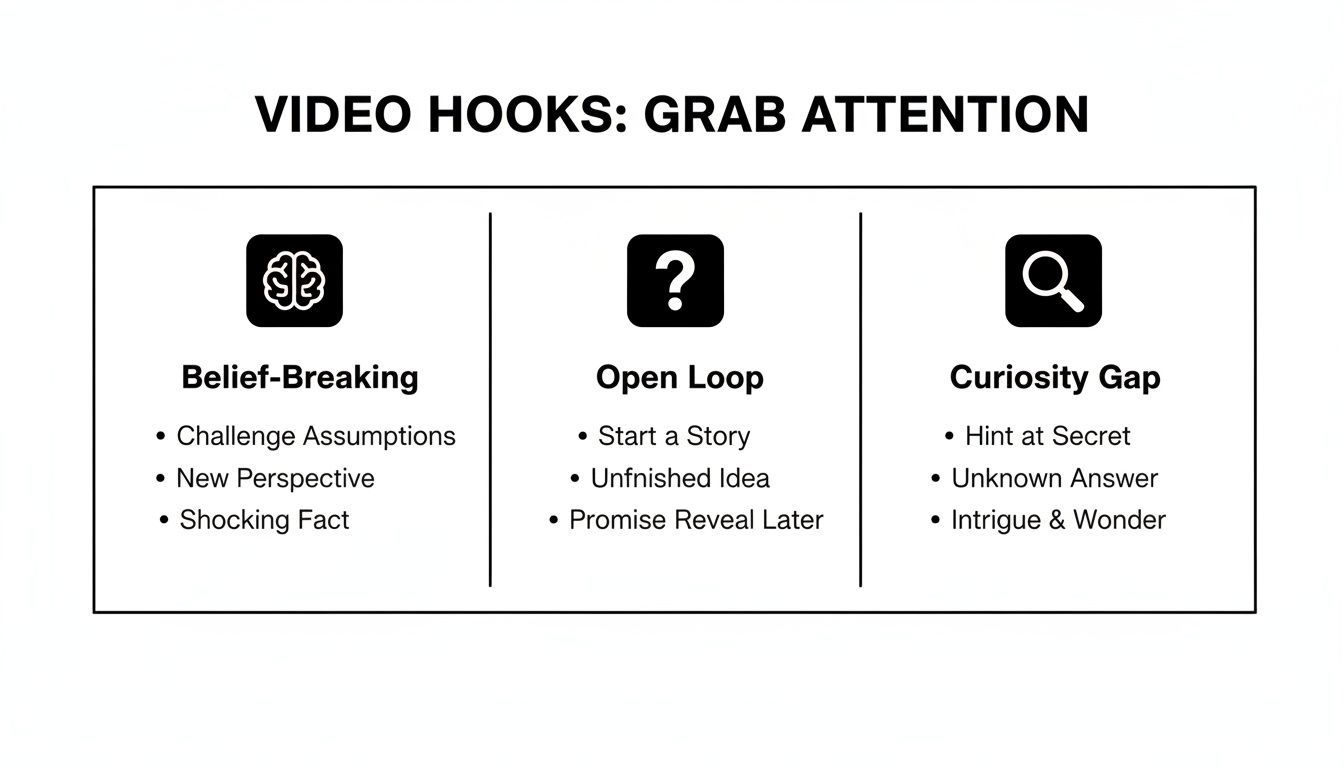
As the graphic shows, challenging a common belief, creating an open loop, or sparking a bit of curiosity are all fantastic ways to stop someone from scrolling.
Scripting for Tutorials and How-To Videos
When it comes to tutorials, clarity is everything. Your script’s main job is to take a viewer from a problem to a solution as painlessly as possible. This means the pacing needs to be deliberate and easy to follow, so avoid getting bogged down in technical jargon unless you absolutely have to.
Think of your script as a roadmap for the viewer.
- State the Problem, Promise the Solution: Open by hitting on their pain point. Something like, "Tired of your photos looking flat and boring? In the next five minutes, I'll show you a simple editing trick to make them pop."
- Outline the Steps: Briefly tell them what you're going to cover. This sets expectations and gives them a clear path to follow.
- Walk Through Each Step: This is the meat of your video. Break down each action into a clear, separate part of your script. It helps to write in visual cues for yourself, like
(Show close-up of the 'contrast' slider). - Show the Final Result: End by revealing the finished product and quickly recapping the most important steps. This really helps the information stick.
Your tone should be that of a patient, confident teacher. You're there to help them succeed.
Crafting a Compelling Product Review Script
A product review lives and dies on trust. Your audience has to believe you’re giving them an honest, unbiased take—whether you loved the product or hated it. Your script needs to be built from the ground up to establish that credibility.
Start by setting the scene. Why are you reviewing this product, and who is it for? This helps the right people know they're in the right place. From there, your script should logically answer every question a potential buyer might have.
The best review scripts aren’t just a dry list of features. They tell the story of what it’s like to actually use the product, focusing on how it solves a real-world problem or fits into a certain lifestyle.
Here’s a framework that works wonders:
- Unboxing and First Impressions: Script out your genuine initial thoughts as you open it. This raw, relatable moment is gold for building authenticity.
- Key Features in Action: Forget the spec sheet. Pick the 3-4 most important features and script out how you’ll demonstrate them and explain their real-world value.
- The Good and The Bad: Give the pros and cons their own dedicated sections. Being balanced is crucial for building trust, so don't be afraid to point out flaws.
- The Final Verdict: Wrap up with a clear, decisive recommendation. Who should buy this? And just as importantly, who shouldn't?
Structuring a Vlog or Storytelling Script
Unlike a tutorial, a vlog is all about personality and narrative. And while the best ones feel spontaneous and off-the-cuff, they’re almost always guided by a pre-planned story arc. The goal is to take your audience on a mini-journey with a clear beginning, middle, and end.
Instead of a rigid, word-for-word script, you might opt for a "beat sheet" that just outlines the key story points. This gives you structure without killing the vibe.
Your vlog script or beat sheet should focus on these elements:
- The Setup: Introduce the goal or the challenge for the day. What are you setting out to do?
- The Conflict: What gets in your way? What unexpected things happen? This is the heart of any good story.
- The Climax: This is the peak moment of the video—the most exciting, emotional, or dramatic part of your story.
- The Resolution: How does it all end? What did you learn or accomplish?
Your tone should be conversational and completely authentic to who you are. If you're looking for ways to turn written concepts into powerful on-screen stories, you can explore how to transform text into engaging video content using specialized tools.
The table below breaks down these different approaches in a nutshell, comparing how the structure, pacing, and calls-to-action shift depending on the video format you're creating.
Scripting Frameworks by Video Type
| Video Type | Core Structure Focus | Pacing & Tone | Primary CTA |
|---|---|---|---|
| Tutorial / How-To | Problem -> Steps -> Solution | Deliberate, clear, helpful | "Try this yourself," Subscribe for more tips |
| Product Review | Unboxing -> Features -> Pros/Cons -> Verdict | Honest, thorough, balanced | "Check the price here," Affiliate link, "Let me know your thoughts" |
| Vlog / Storytelling | Setup -> Conflict -> Climax -> Resolution | Conversational, authentic, personal | "Like if you enjoyed," "Comment your experience," Subscribe |
| Educational Explainer | Hook -> Core Concept -> Examples -> Summary | Engaging, informative, simplified | Subscribe, Watch the next video in the series |
Understanding these frameworks is your starting point. The real magic happens when you inject your own personality and expertise into these proven structures.
Weaving SEO into Your Script to Get Found on YouTube
You can write the most brilliant script in the world, but it won't matter if nobody ever finds the video. This is where the creative art of storytelling bumps up against the hard science of YouTube SEO.
The goal isn't to awkwardly stuff keywords into every other sentence. It's about strategically signaling to the YouTube algorithm what your video is all about, making sure it gets in front of the right people. This whole process starts way before you even think about hitting the record button—it begins with solid keyword research.
Once you know what terms people are actually searching for, that primary keyword becomes your North Star, guiding everything from the title you choose to the exact words you use in your opening hook.
Speaking Your Keywords: How the Algorithm Listens
Think of YouTube as a search engine with ears. When you say your target keywords out loud, especially within the first 15-30 seconds, you’re giving the algorithm a massive audio clue. It helps YouTube instantly categorize your content and serve it up to the right viewers.
Let's say your target keyword is "beginner sourdough recipe." A weak hook would be, "Today, we're going to bake some bread." A much stronger, SEO-friendly hook would be, "If you're looking for an easy beginner sourdough recipe that actually works, you've come to the right place." See the difference? You've immediately confirmed the topic for both the viewer and the algorithm.
Your YouTube video script is more than just dialogue—it's metadata. Every single word you speak can be transcribed and analyzed by the platform. Speaking your keywords naturally is one of the most powerful, and often overlooked, SEO tactics you have.
This verbal reinforcement gets even stronger when you pair it with on-screen text. Displaying your main keyword or related phrases as a text overlay provides another powerful signal. This combination—a keyword-rich title, a verbal mention early on, and on-screen text—creates an SEO trifecta that can seriously boost your video's relevance score.
Beyond the Spoken Word: Your Title and Description
Your script’s SEO power doesn't stop once you've said the words. Your title, description, and tags are all critical pieces of the puzzle, and they need to be in perfect harmony with the script you've just written. The script is the core of your content; these other elements are the packaging that helps people find it.
- Video Title: This is arguably the single most important piece of your video’s SEO. It has to include your primary keyword, preferably near the start, but it also has to be compelling enough to make someone want to click.
- Video Description: The first couple of lines are what count most. Use this space to summarize the video's value and naturally work in your main keyword along with a few secondary ones. For a deeper dive into making your content more discoverable, it’s worth learning how to optimize content for SEO for better rankings.
- Thumbnail Text: While the algorithm doesn't "read" the text on your thumbnail for ranking, it works hand-in-glove with your title to boost your Click-Through Rate (CTR). A higher CTR is a huge signal to YouTube that your video is a good match for a search query, which often leads to better rankings.
Using Your End Screen to Fuel Channel Growth
Those final seconds of your script are prime real estate. Don't waste them with a generic "thanks for watching!" Your script needs to intentionally guide viewers to their next action. This increases session watch time, a metric the YouTube algorithm absolutely loves.
A killer formula for end screens is the 'Pattern Interrupt + Question + Action' combo. I've seen this take click-through rates on end screens from a dismal 5% all the way up to an impressive 15%. That's a massive difference, funneling viewers who stick around right back into your other content.
Let's apply this to our sourdough video example:
- (Pattern Interrupt): "But before you click away..."
- (Question): "Ready to tackle our advanced whole wheat recipe next?"
- (Action): "Click the video right here on the screen to get started."
By scripting these last few moments with a clear purpose, you turn a one-time viewer into an engaged subscriber who binges your content. That's how you build a real audience on YouTube.
Using AI to Accelerate Your Scripting Workflow
Let's be honest, the blank page is a creator's worst enemy. Staring at that blinking cursor, trying to pull the perfect words out of thin air, can kill hours of your day. It’s the single biggest reason so many channels fizzle out. The issue usually isn't a lack of ideas—it's the sheer time and grind it takes to turn those ideas into polished YouTube video scripts.
This is where AI tools have completely changed the game. Think of them not as a replacement for your creativity, but as a powerful co-pilot. Imagine getting a complete, high-retention script drafted in just a few minutes, already structured with the hooks and frameworks that actually work. It’s not about cutting corners; it’s about winning back your time to focus on your delivery, the edit, and actually growing your channel.
From Idea to Full Script in Minutes
Modern AI tools like ShortGenius are built to understand what makes a great video tick. You don't just get a wall of text. Instead, you can prompt the AI to bake in the elements we’ve been talking about, like compelling hooks, belief-busting arguments, and curiosity-building open loops.
You could feed it a simple idea, like "Write a 5-minute script about the top 3 mistakes new photographers make," and it gets to work. It builds a logical flow, adopts a conversational tone, and makes sure your core message doesn't get lost in the weeds.
This frees you from the grunt work of structuring and lets you jump straight to refining and adding your personal touch.
The Real-World Impact for Creators
The shift to AI-assisted scripting is already making a huge difference. I’ve seen educational creators who used to burn a full day on a single script—only to see it flop—now slash their writing time down to just 12 minutes. That efficiency has helped them generate a collective 50 million views and counting.
And the data backs this up. A recent study showed 71% of marketers see short-form video (30 seconds to 2 minutes) as their highest-performing content. That’s a format practically made for rapid, AI-driven creation. When you can move this fast, you can test more ideas, jump on trends, and build a massive content library without burning out.
AI isn't here to make you a lazy creator. It’s here to make you a prolific one. It handles the heavy lifting of the first draft, freeing you up to do what only you can do: add your unique personality, stories, and expertise.
A Unified Workflow That Goes Beyond the Script
The real magic happens when an AI platform helps you with what comes after the script is done. A great tool won't just spit out a document and leave you hanging; it helps you turn that script into a finished video.
Platforms like ShortGenius are designed to streamline the entire production pipeline:
- Instant Voiceovers: You can generate a natural-sounding voiceover directly from your script in seconds. This is huge for hearing the pacing and flow before you ever hit record.
- Automated Video Assembly: The system can suggest relevant stock footage, b-roll, and visuals that match your script's content, giving you a solid first draft of the video to start editing.
- Effortless Scheduling: Once your video is ready, you can schedule it to post directly across your channels, from YouTube to TikTok and Instagram.
This all-in-one approach turns content creation from a chaotic series of separate tasks into a single, efficient process. If you’re focused on monetization, an AI ad generator can even apply these same principles to help you pump out high-converting promotional videos at scale.
By embracing these tools, you're not just writing YouTube video scripts faster. You're building a content engine that lets you create more, experiment without fear, and ultimately grow your audience without hitting a wall.
Got Questions About Scriptwriting? Let's Clear Things Up.
Even after you've nailed down the basic structure, a few lingering questions always seem to pop up right when you're about to start writing. Trust me, I've been there. Getting stuck on these details can kill your momentum.
So, let's tackle some of the most common questions I hear from creators. Think of this as a quick-reference guide to help you push past those roadblocks and get your script finished with confidence.
How Long Should My Script Actually Be?
This is the million-dollar question, isn't it? The truth is, there's no single magic number. It all comes down to your video's intended length and your natural speaking pace.
A great rule of thumb is to aim for around 150 words for every minute of video you want to produce. This gives you room for a comfortable, unhurried delivery with natural pauses.
Here's what that looks like in practice:
- A 1-minute YouTube Short: You'll want a tight script, somewhere between 150-180 words. Every single word has to count.
- A standard 8-10 minute video: You're looking at a script in the ballpark of 1200-1500 words.
- A 20-minute deep dive: This is where you get into longer territory, easily 3,000 words or more.
But here's a pro tip: don't get obsessed with the word count. Focus on covering your topic well without any fluff. Your script should be as long as it needs to be to deliver incredible value, and not a word longer. The best clue is often right in front of you—check out the top-performing videos in your niche. How long are they? That’s what your audience has already proven they'll watch.
What's the Best Way to Format a Script?
For my money, the best and most practical format is the classic two-column AV (Audio/Visual) script. It’s the standard in the production world for a simple reason: it forces you to think about what people will see and what they will hear at the same time.
It's super simple to set up. You just create two columns.
| Visuals (What They See) | Audio (What They Hear) |
|---|---|
| Here, you'll describe the action on screen. Think: "Close-up shot of the product," or "B-roll of me walking through the park," or "On-screen text: Don't Forget This!" | This is for everything audible. Write out your voiceover, dialogue, or sound cues like, "The secret is to always start with...," or "(Upbeat, inspiring music fades in)." |
Using this format is a game-changer, especially when it comes time to film and edit. It becomes your roadmap, making sure your visuals perfectly match what you're saying, which prevents those awkward moments where your B-roll has nothing to do with your voiceover.
A good AV script is more than just a document for you—it’s a communication tool. If you ever work with an editor or a camera operator, this format provides a crystal-clear blueprint that gets everyone on the same page, saving you countless hours in post-production.
How Do I Stop My Script from Sounding So Robotic?
This is a big one. The secret is to write for the ear, not the eye. You want to sound like a real person, not like you're reading an academic paper.
Here are a few tricks I use to make my own scripts sound more conversational:
- Read it aloud. Seriously, this is the most important step. Your ears will instantly catch clunky phrases and sentences that are a mouthful to say. If you trip over a line when you're reading it alone, you're definitely going to struggle on camera.
- Use contractions. Nobody says "it is" or "you are" in a normal conversation. Use "it's," "you're," and "don't." It immediately makes your delivery feel more relaxed and natural.
- Use short sentences. Long, winding sentences are hard to follow. Break your thoughts down into shorter, punchier lines. It adds energy and makes your points much clearer.
Don't be afraid to throw in a personal story or a relatable example. It's those little touches of your personality that turn a generic script into something uniquely you.
Can I Just Wing It and Make a Good Video Without a Script?
Look, some incredibly charismatic vloggers can pull it off with just a few bullet points. But for the vast majority of us? Trying to "wing it" is a recipe for disaster. It usually leads to rambling, forgetting crucial information, and a nightmare of an editing process trying to piece it all together.
A script isn't a prison; it's a foundation. It’s your safety net that guarantees your video is tight, focused, and delivers its message without wasting your viewer's time. Even if you just start with a detailed outline, having that structure is essential to keep your video on track and professional.
Ready to stop staring at a blank page and start generating high-retention scripts in minutes? ShortGenius uses AI to build proven narrative structures directly into your first draft, complete with hooks, voiceovers, and visuals. Transform your workflow and scale your content production by visiting https://shortgenius.com today.