What Is Performance Marketing A Guide to Boosting Your ROI

What is performance marketing? Discover a results-driven strategy where you only pay for actions like sales or leads. Learn key channels and tactics to grow.
Think of it this way: you'd never hire a salesperson and pay them just for showing up to meetings. You pay them when they actually close a deal. That's the essence of performance marketing. It’s a straightforward deal where you only pay for tangible results—not just the chance that someone might see your ad.
Beyond Paying for Potential
Traditional advertising can feel a bit like shouting into the void. You buy a billboard or a TV commercial and cross your fingers, hoping the right people see it and decide to take action.
Performance marketing flips that entire model on its head. It strips away the guesswork. Instead of paying for impressions or eyeballs, you only open your wallet when someone completes a specific, desired action. This could be anything from a click or a lead to a completed sale.
This results-first approach is all about accountability and minimizing risk. Every single dollar you spend is tied directly to a concrete outcome, which is why it has become such a reliable growth engine for businesses of all sizes. It’s a true form of pay-on-performance marketing.
Let's quickly compare the two approaches side-by-side to make the distinction crystal clear.
Performance Marketing vs Traditional Marketing At a Glance
This table breaks down the core differences in payment, measurement, and goals between the two advertising philosophies.
| Attribute | Performance Marketing | Traditional Marketing |
|---|---|---|
| Payment Model | Pay for specific actions (clicks, leads, sales) | Pay for ad placement (impressions, airtime) |
| Measurement | Based on direct, trackable results (CPA, CPL) | Based on estimates (reach, frequency, GRPs) |
| Risk | Lower for the advertiser | Higher for the advertiser |
| Focus | Generating immediate, measurable ROI | Building long-term brand awareness and reach |
| Optimization | Data-driven and continuous, based on performance | Slower, often based on periodic campaign reviews |
As you can see, the focus shifts from hoping for results to paying for them.
The Key Players in Performance Marketing
To really understand how this works, you need to know who's involved. The whole system relies on a few key groups working together seamlessly.
- Advertisers (or Merchants): These are the brands—think of an e-commerce store or a software company—that want to sell something. They set the goals and decide which actions are valuable enough to pay for.
- Publishers (or Affiliates): These are your marketing partners. They could be bloggers, influencers, coupon sites, or major media outlets that promote the advertiser's offer on their own channels to earn a commission.
- Networks and Platforms: These are the crucial intermediaries. They provide the technology that connects advertisers and publishers, tracks all the actions, handles reporting, and makes sure everyone gets paid correctly.
This collaborative structure is incredibly effective. In fact, performance-based strategies now make up a huge chunk of global marketing spend. A recent Adobe report found that 23% of marketers boosted their performance budgets last year, all chasing that clear, measurable ROI.
The fundamental promise of performance marketing is simple yet profound: You only pay for what works. This direct link between cost and outcome provides unparalleled clarity and control over your advertising budget, turning marketing from a cost center into a predictable revenue driver.
Exploring the Core Performance Marketing Channels
Performance marketing isn’t just one thing; it’s a whole approach that comes to life across different digital channels. Each channel gives you a unique way to reach people and drive real, measurable results. Think of them as different tools in your toolbox, each one perfect for a specific job.
To build a smart, effective strategy, you have to understand how these channels work. By picking the right mix, you can connect with customers at every step of their journey, from the moment they hear about you to the moment they click "buy." Let's break down the heavy hitters.
Affiliate Marketing
At its core, affiliate marketing is all about partnerships. You team up with creators, bloggers, or publishers (your "affiliates") who promote your products to their own loyal audience. The best part? You don't pay for exposure; you pay a commission for each specific action they drive, like a sale or a sign-up.
This model is incredibly efficient. It’s like having a dedicated sales team that you only compensate when they deliver results.
- How it works: An affiliate shares a unique tracking link on their website, social media, or in an email. When someone from their audience clicks that link and completes the desired action, the affiliate gets paid a pre-agreed commission.
- Real-world example: A popular tech YouTuber reviews a new piece of software and puts their affiliate link in the video description. For every viewer who clicks that link and subscribes, the YouTuber earns a cut of the sale.
This channel is booming. In the U.S. alone, affiliate marketing spend jumped by nearly 50% from $9.1 billion to $13.62 billion, which in turn drove an incredible $113 billion in e-commerce sales. These numbers, highlighted in the PMA Performance Marketing Industry Study, show just how powerful this channel has become.
Social Media Advertising
Platforms like TikTok, Instagram, and Facebook have evolved far beyond just brand-building. They're now powerhouse performance channels where you can target users with surgical precision based on their interests, online behaviors, and demographics. The goal isn't just to get likes; it's to get clicks, leads, and sales.
Performance campaigns on social media are built to convert. They use eye-catching creative and clear calls-to-action to get users to buy a product, sign up for a newsletter, or download an app—all without ever leaving their feed.
Social media has transformed from a town square into a highly efficient marketplace. Performance advertisers use its rich data to find not just any audience, but the right audience, and serve them ads that feel less like interruptions and more like solutions.
Search Engine Marketing
Search Engine Marketing (SEM) is all about capturing intent in the moment. When someone types "best running shoes for flat feet" into Google, they have a problem and are actively searching for a solution. SEM lets you put your brand right at the top of those search results through a pay-per-click (PPC) model.
With PPC, you only pay when someone actually clicks on your ad. This makes it one of the most direct and accountable forms of marketing out there. You are literally paying for a highly motivated person to visit your website. That direct line from intent to action is why SEM is a cornerstone of so many successful performance campaigns.
Native Advertising
Ever read an article on a news site that felt like part of the regular content, only to notice a small "Sponsored" label? That’s native advertising. This channel focuses on creating ads that blend in perfectly with the look, feel, and function of the platform they're on.
Instead of a flashy banner ad that screams "I'm an ad!", native content provides value in a format that feels natural to the user experience. Because it’s less disruptive, people are often more willing to engage with it. The performance goal here is typically a click that leads to a landing page or an educational blog post, making it a subtle but powerful way to drive traffic and warm up potential customers.
Tracking the Metrics That Actually Matter
In performance marketing, you don't just throw money at a campaign and hope for the best. You measure everything. Obsessively. It’s easy to get distracted by flashy numbers like impressions or follower counts, but those are often just "vanity metrics"—they look good on a report but don't actually pay the bills.
The real story of a campaign's success is told through a handful of key performance indicators (KPIs). These are the numbers that track meaningful actions and, ultimately, tell you if you're profitable. Think of these metrics as the language of performance marketing. Mastering them is what separates guessing from growing, helping you understand exactly what’s working, what isn’t, and where to invest your next dollar for the best possible return.
Cost-Based Metrics: The Building Blocks
At the very foundation of performance measurement are the metrics that connect your ad spend to specific user actions. They tell you precisely how much it costs to nudge someone one step closer to becoming a customer.
-
Cost Per Click (CPC): This is the most fundamental performance metric. It’s the price you pay every single time someone clicks on your ad. Put simply, it’s the cost of getting one person to visit your website or landing page.
-
Cost Per Lead (CPL): Going a little deeper down the funnel, CPL tracks the cost of getting a potential customer's information. This "lead" could be someone who filled out a form, downloaded a guide, or signed up for a webinar. CPL answers the question, "How much did I have to spend to get that person's email address?"
-
Cost Per Acquisition (CPA): Often called Cost Per Action, this is usually the most critical cost metric. It measures the total cost to acquire one paying customer. CPA draws a straight line from your ad budget to actual revenue, showing you exactly what it cost to make a sale.
These three metrics don't live in isolation; they tell a story together. A low CPC is great, but if those clicks never convert into leads (a high CPL) or sales (a high CPA), then you're just buying cheap traffic, not building a business.
In performance marketing, every click and every lead has a price tag. The goal isn't just to get these costs as low as possible, but to understand the relationship between them. A higher CPL might be perfectly fine if those leads consistently turn into high-value customers.
ROAS: The Ultimate Measure of Profitability
While cost metrics are essential for gauging efficiency, one KPI stands above the rest. It answers the single most important question: "Is my advertising actually making me money?" That metric is Return on Ad Spend (ROAS).
ROAS measures how much revenue you earn for every dollar you spend on ads. It's the ultimate litmus test for profitability and the North Star that guides every successful performance marketing campaign. If you spend $1 on ads and get $5 back in sales, your ROAS is 5x.
The formula couldn't be simpler:
ROAS = (Total Revenue from Ad Campaign / Total Cost of Ad Campaign)
For example, if you spend $1,000 on a social media campaign and it drives $4,000 in sales, your ROAS is 4x (or 400%). This single number proves your campaign isn't just an expense—it's a profitable investment. By focusing on ROAS, you ensure your marketing efforts contribute directly to the bottom line, turning your ad budget into a predictable engine for growth.
To help you keep these straight, here's a quick rundown of the essential performance marketing KPIs that every marketer should have on their dashboard.
Essential Performance Marketing KPIs Explained
| KPI | What It Measures | Typical Use Case |
|---|---|---|
| CPC (Cost Per Click) | The average cost for each click on your ad. | Assessing the cost-efficiency of driving traffic from platforms like Google Ads or Facebook. |
| CPL (Cost Per Lead) | The average cost to generate one new lead. | Evaluating lead generation campaigns where the goal is capturing contact info (e.g., webinar sign-ups). |
| CPA (Cost Per Acquisition) | The total cost to acquire a single paying customer. | Measuring the true cost of a sale for e-commerce or SaaS subscription campaigns. |
| ROAS (Return on Ad Spend) | The total revenue generated for every dollar spent on ads. | Determining the overall profitability and financial success of an advertising campaign. |
| Conversion Rate (CVR) | The percentage of users who complete a desired action. | Understanding how effectively your landing page or ad creative persuades users to act. |
| CTR (Click-Through Rate) | The percentage of people who see your ad and then click it. | Gauging how compelling and relevant your ad creative and copy are to your target audience. |
| Customer Lifetime Value (CLV) | The total revenue a business can expect from a single customer account. | Informing how much you can afford to spend on CPA while remaining profitable long-term. |
Understanding these metrics is the first step. The real magic happens when you start analyzing the relationships between them to make smarter, data-backed decisions for your campaigns.
How to Build Your First Winning Campaign
Jumping into your first performance marketing campaign might feel like a big leap, but it’s really just a series of logical steps. Success here isn’t about getting lucky; it’s about having a solid process for setting goals, knowing your audience, and letting the data guide you. Think of this as your playbook for turning a good idea into real, measurable results.
Every great campaign starts with a simple question: What, exactly, are we trying to accomplish? A fuzzy goal like "get more sales" won't cut it. You need something sharp and measurable, like "generate 500 qualified leads from Facebook Ads this quarter with a Cost Per Lead under $25."
Getting that specific from the start gives your campaign a north star. It informs every single decision you’ll make, from the platforms you choose to the words you write in your ads.
Define Your Audience and Channels
Once you know where you're going, you need to figure out who you’re talking to. Who is your perfect customer? Don't just stop at demographics. Dig deeper. What keeps them up at night? What are their biggest frustrations? Where do they hang out online? Truly understanding your audience is the single best way to avoid throwing your budget away on people who will never become customers.
This customer insight makes choosing your channels a whole lot easier.
- Selling B2B Software? You’ll likely find your people on LinkedIn Ads and Google Search, targeting them by job title or the specific problems they’re trying to solve.
- Running an E-commerce Fashion Brand? Your audience is scrolling through visual platforms like TikTok, Instagram, and Pinterest for inspiration. That’s where you need to be.
- A Local Plumber or Electrician? Hyper-local Google Ads, focused on a tight geographic radius, will capture people searching for help right now. A broad social media campaign just can't compete with that level of intent.
The trick is to meet your audience where they already are. Don't try to bend a platform to your will; follow the customer's lead.
Set a Smart Budget and Bidding Strategy
Your budget is the fuel for your campaign, so you need to be smart about how you use it. When you're just starting out, set aside a test budget you're comfortable losing. Think of it as the cost of learning. From there, your bidding strategy dictates how you actually spend that money.
Are you paying for clicks (CPC), impressions (CPM), or actual conversions (CPA)? For most beginners, CPC is the safest bet because you’re only paying when someone shows tangible interest by clicking your ad. Once you have a steady stream of conversion data, you can move up to more sophisticated strategies like Target CPA, where you tell the ad platform your ideal cost per sale and let its algorithm work its magic to hit that number.
This flow is at the very heart of how performance campaigns operate—it’s a constant loop of launching, tracking, and fine-tuning.
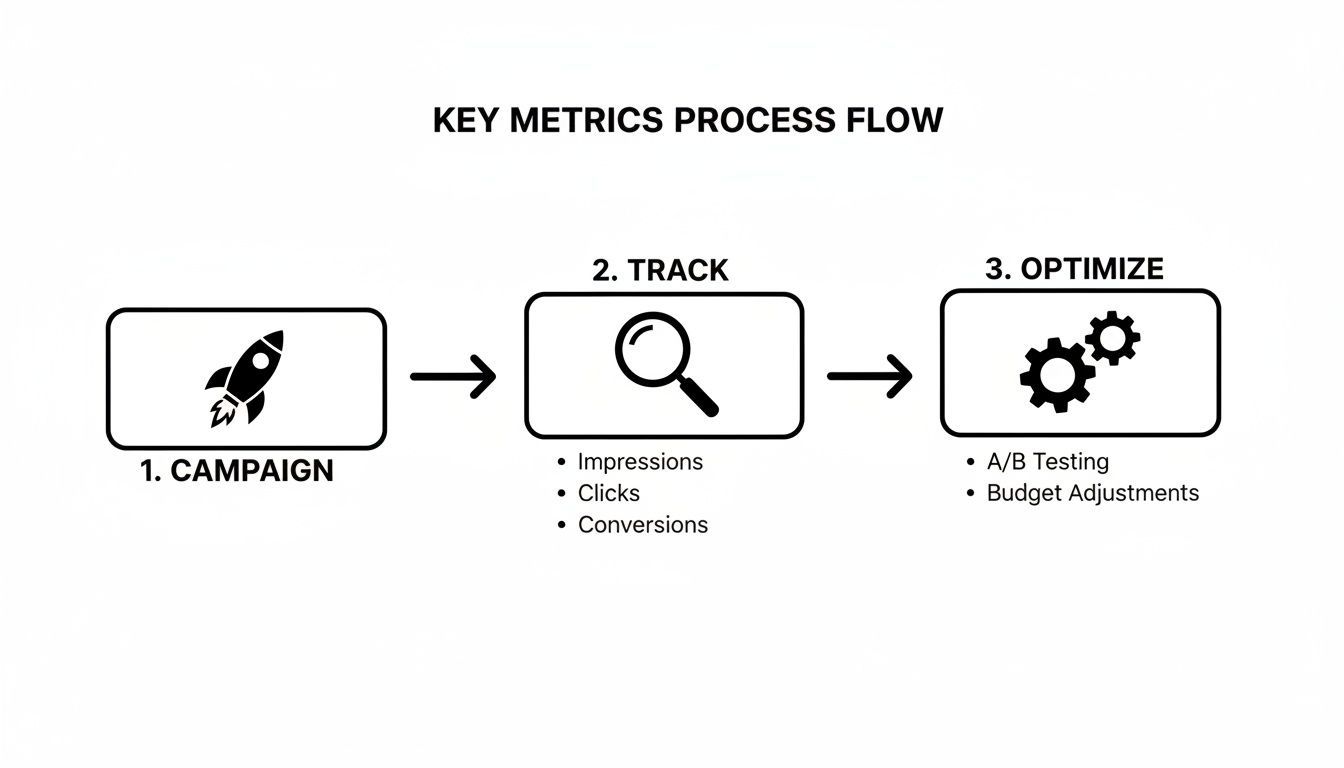
The image above shows that a campaign is never really "finished." It's an ongoing cycle of testing and improving based on what the data tells you.
The Core Loop: Test, Measure, Optimize
Once your campaign is live, the real work begins. The magic of performance marketing is that it’s never static. You have to constantly keep an eye on your KPIs, looking for clues. Is your click-through rate in the gutter? Maybe your ad creative isn't grabbing attention. Is your cost per acquisition through the roof? Your landing page could be the culprit.
Your initial campaign isn't a final product; it's a hypothesis. The data you get back is the result of your experiment, telling you exactly how to tweak that hypothesis for the next round.
This is the rhythm of success in performance marketing: Test, measure, optimize, and scale. You test a few different ads, you measure how they do, you put more money behind the winners while turning off the losers, and then you scale up the strategies that are proven to deliver a positive Return on Ad Spend. It's that simple.
Why Great Creative Is Your Secret Weapon
In the world of performance marketing, it's easy to get tunnel vision. We obsess over targeting parameters, bidding strategies, and audience segmentation. And while those things are absolutely essential, the most perfectly aimed campaign will fall completely flat if the ad creative is boring.
Think of it this way: your targeting gets you to the right neighborhood, but your creative is what you say when you knock on the door. If that message doesn't connect, the door gets slammed shut. On platforms like TikTok and Instagram, where people scroll at the speed of light, you have less than three seconds to grab someone's attention. That’s why a killer creative isn’t just a nice-to-have; it’s your single biggest advantage.

Combating Ad Fatigue with Rapid Testing
People get bored. Fast. The ad that crushed it last week might be totally invisible today. This is called ad fatigue, and it’s a constant battle for every marketer. The only way to win isn't by finding one "perfect" ad and running it into the ground, but by building a system for non-stop creative testing and iteration.
This means you have to be constantly experimenting to see what actually gets your audience to stop, watch, and click. A solid testing framework involves breaking down your ads and trying out different versions of each part:
- Hooks: Those first few seconds are everything. Try opening with a question, a bold statement, or a weird visual. See what actually stops the scroll.
- Visuals: Test different styles. Does polished product footage work better than raw, user-generated content (UGC)? What about a quirky animation?
- Calls-to-Action (CTAs): Don't just stick with "Shop Now." Test it against "Learn More" or "Get 20% Off." You'd be surprised how a tiny wording change can dramatically lift your conversion rate.
The whole point is to shift creative from being a slow, painful process to a quick, data-driven cycle of improvement.
The Rise of AI in Creative Production
Not too long ago, this level of rapid testing was a massive resource hog. It meant tying up designers, copywriters, and video editors for weeks just to produce a handful of ad variations. Today, AI-powered creative tools have completely changed the game, letting performance marketers pump out a high volume of quality ad concepts in minutes.
This new wave of technology lets even a one-person marketing team operate like a full-blown agency. Instead of spending days on a single video, you can now use AI to generate multiple scripts, create unique UGC-style video scenes, and spin up different ad concepts from a few simple text prompts.
This is exactly what you see in the workspace below—a user can quickly generate and edit AI-powered video ads, turning rapid testing from a lofty goal into a daily reality.
This workflow means marketers can go from a spark of an idea to a live test almost instantly, helping them find winning creatives faster than ever before.
Creative isn't just an art anymore; it's a science. The best performance marketers treat their ads like hypotheses, using rapid A/B testing to let the audience's clicks—not their own opinions—decide what works.
Video, especially, is taking over the creative landscape. The data doesn't lie: short-form video was used by 60% of marketers, leaving other formats like blog posts in the dust. With engagement on platforms like TikTok through the roof, it’s no wonder that social media ad spend is projected to soar past $220 billion. To dig deeper, you can explore more about these performance marketing trends and see how video is shaping the industry's future. This all ties back perfectly to performance marketing, where a thumb-stopping video is often the quickest path to a conversion.
What's Next for Performance Marketing
If there’s one thing you can count on in performance marketing, it’s that the ground is always shifting beneath your feet. What works brilliantly today might be obsolete tomorrow as platforms change their rules and people find new ways to connect online. Staying ahead isn't just about tweaking bids anymore; it’s about seeing where the puck is going with technology, privacy, and user behavior.
The marketers who will win in the coming years are the ones who are ready to adapt. They're the ones looking at the major forces reshaping our industry and figuring out how to turn them into an advantage. Right now, three big trends are defining that future.
AI and Machine Learning are Taking the Wheel
Artificial intelligence is quickly becoming the engine of modern performance marketing. We’re moving past simple automation and into a world of predictive insights that once felt like science fiction. AI algorithms can now sift through mountains of data in the blink of an eye to predict which customer segments are on the verge of converting, giving us a much smarter, more proactive way to target.
This tech is also changing how we manage campaigns from the inside out. Automated bidding can adjust your spend in real-time to squeeze every last drop of value from your ROAS. Meanwhile, AI-powered creative tools like ShortGenius can churn out dozens of ad variations, letting you test and learn at a speed that was impossible just a few years ago. This frees up human marketers to do what they do best: think big, strategize, and come up with killer creative ideas.
Getting Ready for a Privacy-First World
The slow death of the third-party cookie is sending shockwaves through digital advertising. For years, these little trackers were the bedrock of how we targeted audiences and measured results. Their departure marks a fundamental move toward an internet where user privacy isn't just a feature—it's the main event.
In this new landscape, the most valuable thing you can own is your own customer data. The future of performance marketing belongs to brands that build real relationships with their audience and earn the right to use first-party data.
So, what does that mean for us? It means we have to adapt, and fast. The new gold rush is for first-party data—information that customers give you directly, like their email or purchase history. This requires building trust and offering real value, not just asking for data. At the same time, we're all having to get smart about new privacy-safe measurement tools, like conversion APIs and data clean rooms, to understand what’s working without creeping on our customers.
Performance Goes Beyond the usual Suspects
The core idea of performance marketing—paying for results—is so powerful that it's breaking out of its traditional search and social containers. That same data-driven, ROI-focused approach is now popping up in exciting new channels with massive, engaged audiences.
- Connected TV (CTV): Think Hulu, Roku, and other streaming platforms. As people cut the cord, advertisers can now run highly targeted and fully measurable campaigns on the big screen, paying for actual outcomes, not just estimated eyeballs.
- In-Game Advertising: The gaming community is enormous and incredibly passionate. New ad tech allows brands to integrate seamlessly into the gaming experience and track direct performance, reaching a demographic that's notoriously hard to pin down.
These new frontiers prove that the fundamental question of what is performance marketing has an answer that's more relevant than ever. It's about driving measurable results, and the marketers who can apply that principle to these emerging channels are the ones who will find a serious competitive advantage.
A Few Common Questions About Performance Marketing
Even after you've got the channels and metrics down, some practical questions always pop up. Let's tackle the big ones so you can see how these concepts play out in the real world.
How Is Performance Marketing Different From Brand Marketing?
Think of it like this: performance marketing is the sprint, while brand marketing is the marathon. They’re both races, but they have completely different goals and timelines.
Performance marketing is all about immediate, measurable results. You're trying to get someone to click, buy, or sign up right now. The beauty of it is that you typically only pay when that specific action happens, so you can track your success with crystal-clear metrics like CPA and ROAS. It’s direct, accountable, and fast-paced.
Brand marketing, on the other hand, plays the long game. It's about building a reputation, creating an emotional connection, and becoming the name people think of first. Success here is measured more broadly through things like brand recall, customer loyalty, and overall market share. The two aren't enemies; in fact, they’re the ultimate power couple. A strong brand makes every single dollar you spend on performance marketing work that much harder.
What Budget Do I Need to Start?
This is one of the best parts about performance marketing—you don't need a massive bankroll to get in the game. You can start dipping your toes in the water on platforms like Facebook or Google Ads with as little as $10–$20 per day.
The real secret isn't how much you start with, but how closely you watch your profitability. Keep your eyes glued to your Cost Per Acquisition (CPA) from day one. If your CPA is profitable, you can scale up with confidence, knowing that every extra dollar you put in is bringing more back.
This method lets you collect real-world data and find what works before you start spending big. It’s about scaling based on proof, not just hope.
Can Performance Marketing Work for Any Business?
Absolutely. Its flexibility is what makes it so powerful. Whether you're running an e-commerce store, a SaaS platform, a B2B service, or a local coffee shop, performance marketing can be molded to fit. The key is simply defining what "performance" means for your business.
- For an e-commerce store: Performance is a sale, so you'll measure Cost Per Sale (CPS).
- For a B2B company: It's likely a qualified lead or a demo request, measured by Cost Per Lead (CPL).
- For a mobile app: The goal might be an installation, tracked with Cost Per Install (CPI).
Because the payment models are so adaptable and the channels so diverse, you can build a strategy that directly fuels your specific business goals, no matter what industry you're in.
Ready to create high-performing video ads that stop the scroll and drive conversions? ShortGenius helps you generate dozens of unique ad concepts, scripts, and UGC-style scenes in minutes, making it easy to test and scale your creative. Start building your next winning campaign with ShortGenius today.