What is multi channel marketing: A Practical Guide to Growing Your Reach

Explore what is multi channel marketing and how to craft a strategy that reaches customers across their favorite platforms.
So, what's multi-channel marketing all about?
Think of it like a musician trying to get their music out there. They might play a gig at a local coffee shop, post a live session on Instagram, and have their album on Spotify. Each one is a separate "channel" to reach people, and while the music is the same, the experience and the audience in each place are totally different.
That’s the essence of multi-channel marketing. You’re not putting all your eggs in one basket.
What Is Multi-Channel Marketing, Really?
Let's break it down. Multi-channel marketing is about giving your customers options. It’s a strategy built on being present wherever your audience hangs out, whether they're scrolling TikTok, checking emails, using your mobile app, or even walking into your physical store.
The big idea is to cast a wide net. You want to make sure your message is available on the platforms your customers already know and love.

Imagine each channel is its own standalone storefront. Your Instagram profile is one shop, your email newsletter is another, and your brick-and-mortar location is a third. A customer can pop into any of them, but the experience in one doesn't necessarily link up with the experience in another.
The goal is simple: maximize your presence and connect with people on their terms.
To get a clearer picture, let's look at the core components that make up a multi-channel strategy.
Core Components of a Multi Channel Strategy
This table breaks down the essential elements that define this approach.
| Component | Description | Example |
|---|---|---|
| Channel Independence | Each marketing channel operates separately from the others. | A customer sees a Facebook ad but their interaction isn't tracked or referenced when they later receive an email promotion. |
| Customer Choice | The focus is on letting customers choose how they want to engage. | A user can decide to buy from your website, a social media shop, or a physical store, whichever is easiest for them. |
| Consistent Messaging | The brand's core message, tone, and visual identity are the same everywhere. | The logo, color scheme, and campaign slogan are identical across billboards, email, and social media posts. |
| Audience Reach | The primary goal is to maximize visibility by being on multiple platforms. | A brand runs simultaneous campaigns on Pinterest for visual discovery and on Google Ads for direct purchase intent. |
Ultimately, it all boils down to giving people flexibility and choice, which is a powerful way to put the customer first.
The Core Principle: Consistency Over Integration
What really sets multi-channel marketing apart is its focus on channel independence, not perfect, seamless integration. The channels don't necessarily "talk" to each other.
The real aim is to give customers a choice. You let them engage and buy whenever and wherever works best for them. This flexibility is the bedrock of a customer-first mindset.
While the brand’s message, voice, and look need to be consistent everywhere, the channels themselves work in their own silos. This actually has its advantages, as it allows you to create targeted campaigns that are a perfect fit for each platform’s unique audience and format.
This strategy is a winner for businesses looking to:
- Boost brand awareness by showing up in a variety of places.
- Reach different customer groups who prefer different kinds of media.
- Drive more engagement by meeting people on the platforms they use every single day.
The fundamental principle is to simply be where your people are. For a great breakdown of this concept in a different context, check out this practical guide to digital marketing for churches. It shows how foundational outreach strategies work by meeting the community where they are.
By building a strong presence across multiple fronts, you make it incredibly easy for customers to find and connect with you, one channel at a time.
How We Arrived in a Multi-Channel World
To really get a handle on multi-channel marketing, it helps to look at how we got here in the first place. Not too long ago, the marketing world was a much simpler place. Brands had a handful of go-to channels—think television commercials, radio spots, and glossy magazine ads—to reach their audience. The conversation was pretty much one-way: from the brand straight to the consumer.
That straightforward approach worked well because people's attention wasn't scattered across dozens of screens. But then the internet showed up and started to splinter that focus, setting the stage for a massive change in how brands and customers connect.
The journey from a few big channels to the endless digital touchpoints we have today didn't happen overnight. It was a slow burn that really caught fire around 2015 with the explosion of mobile and social media. All of a sudden, people weren't just watching TV; they were scrolling through Instagram, checking emails on their phones, and watching YouTube videos—sometimes all at once.
The Great Digital Acceleration
This fragmentation of attention hit a fever pitch during the global pandemic. People were at home and online more than ever, and digital adoption went through the roof. This period created new habits that have completely redrawn the customer journey. Now, people expect to find, research, and buy from brands across a constantly growing list of platforms and devices.
The modern customer journey is no longer a straight line from A to B. It's a complex web of interactions across different screens, apps, and platforms. A multi-channel approach is no longer a choice—it’s a direct response to this new reality.
This shift in behavior created a huge challenge for marketers: How do you reach an audience that's always on the move? The only answer is to meet them where they are. That necessity is precisely why multi-channel marketing has become so essential for businesses of every size.
The numbers back this up, big time. Today, the average person bounces between 5-7 devices daily, hopping from their email inbox to social media and back again. This constant movement makes being on multiple platforms a must. In fact, a recent study found that a whopping 86% of marketers say their multi-channel strategies are getting more effective every year.
With global internet users reaching 5.3 billion by 2023, the number of places to connect with customers just keeps growing. You can explore more channel marketing statistics to see just how deep this trend goes.
Relying on a single channel in this environment is like trying to catch fish with one hook in a massive ocean. To succeed, you have to cast a wide net across all the different waters where your audience actually spends their time. This is the world multi-channel marketing was built for.
The Real-World Payoffs of a Multi-Channel Approach

When you move to a multi-channel marketing strategy, you're not just trying out a new theory—you're unlocking real, tangible results that can completely reshape your brand's growth. The first thing you'll notice is a major jump in brand awareness. By showing up consistently where your audience lives online—whether that's their social media feed, their email inbox, or their search results—you give people more chances to see and remember you.
This isn't about just being loud; it's about building familiarity and trust through repeated exposure. Instead of crossing your fingers and hoping customers stumble upon your one channel, you're actively meeting them on their turf. The numbers back this up: marketers using three or more channels in a campaign see a staggering 287% higher purchase rate than those sticking to just one. It's a powerful reminder that being in multiple places at once really works.
Build Deeper Customer Engagement and Loyalty
Meeting customers on their favorite platforms is about more than just getting eyeballs on your brand; it's how you deepen the conversation. Think about it: when someone sees your content on Instagram and then gets a follow-up email that feels relevant and personal, they feel understood. It shows you're paying attention to their habits and you respect their time.
This kind of positive, seamless experience is a straight line to building real loyalty. Brands that nail their cross-channel engagement retain, on average, 89% of their customers. Compare that to the dismal 33% retention rate for companies with a weak or nonexistent cross-channel game. The takeaway is simple: more channels create more opportunities to connect and forge relationships that last.
A multi-channel approach is about casting the widest net to get maximum customer engagement. It acknowledges that your audience isn't in one place, so your brand shouldn't be either.
Drive Higher Conversion Rates
At the end of the day, marketing has to move the needle on sales. This is where a multi-channel approach truly shines, by building a more effective and resilient path for your customers to follow from "just browsing" to "just bought." Each channel gets to play to its strengths, guiding a potential customer along their journey.
Here’s what that looks like in the real world:
- Spark Interest: You kick things off with a short, snappy video on TikTok to introduce a new product. This is perfect for grabbing the attention of a huge audience. A powerful text to video generator can help you create this kind of scroll-stopping content in minutes.
- Nurture the Lead: The TikTok video has a clear call to action: sign up for our email list to get an exclusive look. Now, you can send a follow-up email with more details, glowing customer testimonials, and a special offer to turn that initial curiosity into genuine interest.
- Drive the Purchase: Finally, the email includes a direct link to the product page on your website, making it incredibly easy for that now-interested lead to make a purchase.
By letting each channel do what it does best, you create a connected pathway that gently guides customers toward conversion. This layered strategy means you're not losing potential sales just because someone isn't active on a single platform. You're building a robust marketing engine where every part works together to deliver stronger, more consistent results.
Multi Channel vs Omni Channel Marketing
As you dig into multi-channel marketing, you'll almost certainly bump into another popular term: omni-channel. They sound alike, and both obviously use multiple platforms to reach customers, but their core philosophies are worlds apart. Nailing this distinction is crucial if you want to build a strategy that actually works for your business.
Let's try an analogy. Multi-channel marketing is like a brand owning several different stores on different streets. You've got a boutique downtown, a big outlet mall location, and an online shop. Each one operates on its own, serving the customers that come to it. A shopper can pick whichever store they want, but the stores don't really talk to each other—they don't share inventory, customer history, or anything else. The whole point is to give people choice.
Omni-channel, on the other hand, is more like one single, interconnected retail experience. You can browse on your laptop, add something to your cart from your phone, and then go pick it up from a physical store. If you need to return it, any location can handle it because your customer profile is right there, accessible everywhere.
The Fundamental Difference Is Integration
The biggest difference comes down to a single idea: integration. Multi-channel marketing puts the brand at the center, pushing its message out across various independent platforms. Each channel is basically its own little island, optimized to do its job well but not necessarily concerned with the others.
Omni-channel marketing flips that script completely. It places the customer at the center of the strategy, building a single, unified experience that follows them seamlessly from one channel to the next.
What this really means is that in an omni-channel world, all the pieces are designed to work together. The website knows what the mobile app is doing, which knows what the in-store inventory system says. The goal is to make jumping between channels so smooth that the customer barely even thinks about it.
Multi Channel vs Omni Channel At a Glance
To lay it all out clearly, this table breaks down the core differences between the two approaches across the most important areas.
| Feature | Multi Channel Marketing | Omni Channel Marketing |
|---|---|---|
| Primary Focus | The brand and its products are the central focus. | The customer and their experience are the central focus. |
| Channel Integration | Channels operate independently, often in silos. | Channels are fully integrated and work together seamlessly. |
| Customer Experience | The experience is consistent on each channel but disconnected between them. | Provides a single, unified, and fluid experience across all touchpoints. |
| Overall Goal | Maximize reach by being present on as many channels as possible. | Create a holistic and frictionless journey that builds deep customer loyalty. |
At the end of the day, multi-channel is all about giving customers options on where to engage. Omni-channel is about creating one cohesive conversation that flows effortlessly across all those options.
How to Build Your First Multi-Channel Strategy
Alright, let's move from theory to action. Turning the idea of multi-channel marketing into a real, working plan is where the magic happens. Don't worry, building your first strategy isn't as complicated as it might sound. It’s really just a series of smart, deliberate choices that connect your marketing efforts to what you actually want to achieve as a business.
The whole process starts with a simple but critical question: who are you trying to reach, and where do they hang out online? Once you have a good handle on that, you can start building a framework that’s both manageable and effective, making sure every piece of content you create has a clear purpose.
Define Your Audience and Identify Key Channels
Before you post a single thing, you need a crystal-clear picture of your ideal customer. I mean, really get to know them. Go way beyond basic demographics and sketch out a detailed persona. What are their goals? What keeps them up at night? Where do they scroll when they're bored or looking for answers?
Once you know who you're talking to, you can figure out where to talk to them. This is key. Don't fall into the trap of thinking you need to be on every platform. In fact, research shows that 52% of marketers see the best results by focusing on just three to four channels.
- For B2C brands: Think visual. Platforms like Instagram, TikTok, and Facebook are goldmines for storytelling and building a community around your products.
- For B2B companies: The conversation is often more professional. LinkedIn, X (formerly Twitter), and well-crafted email newsletters can be incredibly effective for reaching decision-makers.
The goal here is to meet your audience where they already are. Spreading yourself too thin is one of the most common mistakes I see, and it just dilutes your impact. Focus your energy where it will actually make a difference.
Set Clear Goals for Each Platform
Every channel in your strategy needs a specific job. A one-size-fits-all approach is doomed to fail because people use each platform differently. Your goals for each one should be measurable and tie directly back to your bigger business objectives.
Let's break that down with an example:
- Instagram: Use Reels and Stories to grab attention, boost brand awareness, and get people into the top of your funnel.
- Email Marketing: This is your nurturing ground. Take the leads you've gathered from other channels and give them exclusive content and offers to guide them toward a purchase.
- YouTube: Go deep. Create detailed, educational videos to position yourself as an authority and build a base of loyal subscribers who trust you.
By giving each channel a clear purpose, you can create content that feels right at home on that platform and gently moves customers along their journey. It also keeps your efforts organized and makes it way easier to see what’s working and what’s not.
This diagram really highlights the core difference between a multi-channel and an omni-channel approach from the customer's point of view.
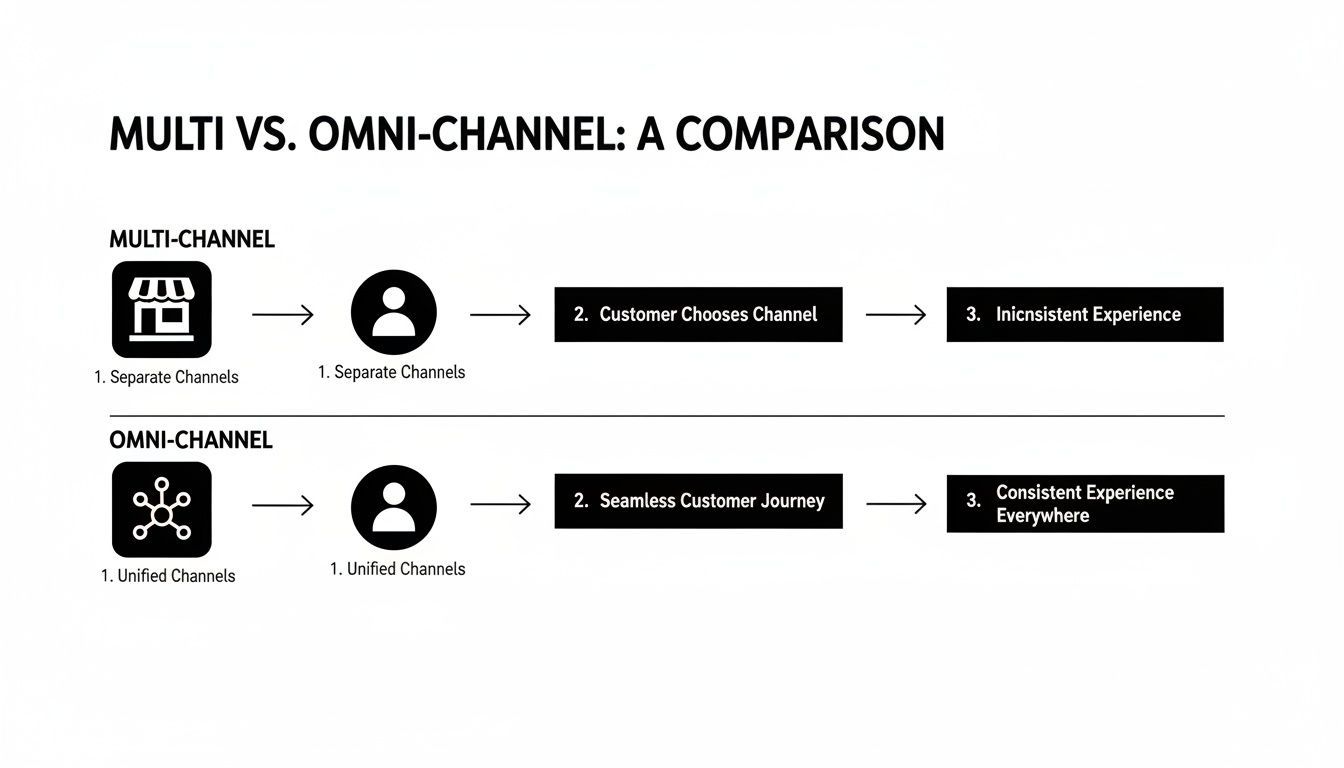
As you can see, multi-channel gives customers separate, independent paths to your brand. In contrast, an omni-channel strategy weaves everything together into a single, seamless web.
Craft a Consistent but Adapted Message
Your brand's core message—its personality, values, and look—has to be consistent no matter where people find you. That said, how you deliver that message needs to change based on the platform’s format and what its users expect to see.
Key Takeaway: Consistency builds brand recognition, while adaptation drives engagement. Your message should be instantly recognizable, but the content format should feel native to the platform.
Think about repurposing your content smartly. A single 10-minute YouTube video can be a goldmine for other channels. You could chop it up into:
- A few punchy, 60-second TikTok clips hitting the main points.
- An insightful carousel post for your Instagram feed.
- A detailed text summary for your next email newsletter.
As you build out your multi-channel plan, having a dedicated social media strategy is non-negotiable for keeping your message cohesive. For a great walkthrough on this, check out this guide on creating a practical social media marketing strategy. And if you're tapping into user-generated content, learning how to create effective AI UGC ads that feel authentic on each platform is a game-changer. Finally, make your life easier by picking tools that let you manage scheduling and analytics from one spot. It’s the best way to stay consistent without getting overwhelmed.
Putting Your Strategy into Action with the Right Tools
A brilliant multi-channel strategy is just a plan on paper until you can actually execute it consistently. Let's be honest—without the right setup, trying to create, adapt, and schedule content across a half-dozen platforms can quickly feel like a second full-time job. It’s a surefire way to burn out.
The secret isn't working harder; it's finding tools that get the friction out of your way.
This is where a unified platform completely changes the game. Instead of jumping between separate apps for scripting, editing, and scheduling, a single, centralized tool can turn a logistical nightmare into a simple, repeatable process. It’s what allows you to scale your reach without having to scale your workload to match.
From a Single Idea to Multi-Channel Presence
Think about it. You have a great idea for a short video. What happens next? With a tool like ShortGenius, that entire multi-channel journey becomes incredibly straightforward.
- Generate the Core Content: It starts with the basics. You can use AI to generate a solid script and a natural-sounding voiceover for your video.
- Create and Brand: From there, the platform assembles the video for you. With just one click, you can apply your brand kit—your logo, colors, and fonts—to give everything a polished, professional look.
- Adapt for Each Channel: Here's the magic. You can instantly resize that final video into the perfect formats for TikTok, Instagram Reels, and YouTube Shorts. No more manual re-editing.
This is what a unified dashboard looks like, letting you manage the whole process from one central hub.

This kind of workflow completely removes the tedious, manual work of repurposing content, which is often the biggest bottleneck. It frees you up to maintain a consistent presence everywhere.
The biggest barrier to successful multi-channel marketing isn't a lack of ideas—it's the operational drag of executing them. The right technology automates the repetitive tasks, freeing you up to focus on creating great content.
Once your videos and other assets are ready to go, a scheduling dashboard lets you automate all the posting across your chosen platforms. You can even take it a step further and build out entire campaigns with an AI ad generator to drive targeted traffic.
This is how you transform multi-channel marketing from an overwhelming chore into a manageable—and highly effective—growth strategy.
Still Have Questions About Multi-Channel Marketing?
Diving into a multi-channel strategy is exciting, but it’s natural to have a few questions pop up. Let's tackle some of the most common ones that marketers ask when they're getting started. Clearing these up can make the path forward a lot smoother.
How Do I Pick the Right Channels?
The goal isn't to be everywhere at once; it's to be exactly where your customers are. The first step is to really get to know your ideal customer. Where do they hang out online? What platforms do they trust?
A B2C fashion brand, for instance, will probably find its audience scrolling through Instagram and TikTok. On the other hand, a B2B software company is far more likely to connect with decision-makers on LinkedIn or through a well-crafted email newsletter.
Trying to master every channel at once is a recipe for burnout. Most research points to the same conclusion: focusing on three to four core channels is the sweet spot for delivering real results. Pick the platforms that feel like a natural fit for your brand's personality and where your team can consistently create great content.
How Can I Actually Measure If It's Working?
Measuring a multi-channel strategy means looking deeper than just surface-level numbers. To get a true picture of what’s working, you need an attribution model that shows you how each channel plays a role in getting a customer to convert. Don't just give all the credit to the last click—look at the entire journey.
It also helps to set specific goals for each channel. Think of it this way:
- Social Media: Is it driving engagement? Are more people aware of your brand?
- Email: How are those open and click-through rates looking? Is it effectively moving leads along?
- Website/SEO: Are you seeing more organic traffic? Are visitors taking the actions you want them to?
This approach lets you see the unique contribution of every platform and how they all work together to hit your main business goals.
Ready to turn your strategy into high-quality content without the burnout? ShortGenius unifies your entire video creation workflow, from AI scripting and voiceovers to one-click resizing and auto-scheduling. Create more, manage less, and master your multi-channel presence by visiting https://shortgenius.com.