What Is Direct Response Advertising and How Does It Drive Action

Learn what is direct response advertising and why it's built to drive immediate, measurable results. See proven examples and learn the core components.
Direct response advertising is all about getting someone to do something right now. Unlike the ads you see that are just trying to get a brand name to stick in your head, a direct response ad is designed to make you click a link, buy a product, or sign up for a list—and to do it immediately.
What Is Direct Response Advertising Really About?
Think of it this way: a massive billboard on the highway is like a passing wave. That’s brand advertising. It’s there to build recognition and maybe make you feel good about a company over time.
Direct response, on the other hand, is like a firm handshake that closes a deal. It’s a direct, personal invitation that asks for a specific commitment and aims for a clear result on the spot.
This style of advertising is ruthlessly focused on one thing: conversion. It doesn’t just hint that a product is nice to have; it makes a compelling case for why you need it now and gives you a dead-simple way to get it. The entire strategy is built on persuasion, creating a sense of urgency, and, most critically, being able to measure everything. Every dollar you spend is tracked, and every response is counted.
This data-first mindset is what makes it so powerful. You know exactly which headline, image, or offer drove the most sales. That means you can tweak your campaigns on the fly to get even better results. It’s a no-nonsense, pragmatic way to fuel business growth.
The Core Pillars of Direct Response
At its heart, this approach stands on three essential pillars that work in tandem to get your audience to act.
This diagram breaks down the three must-have components that make any direct response ad work.
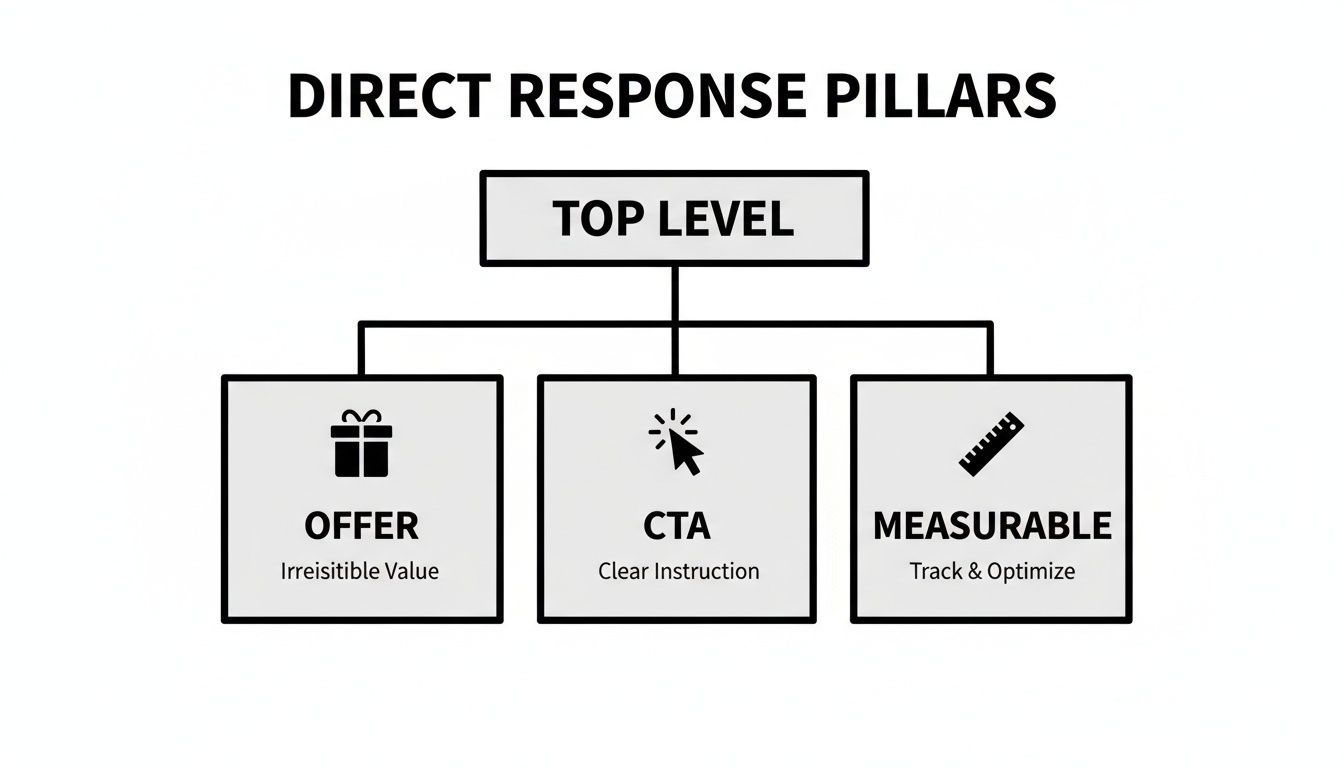
As you can see, a powerful Offer, a clear Call to Action (CTA), and the ability to Measure results are the non-negotiables for turning a passive viewer into an active customer.
The results speak for themselves. According to the 2023 ANA Response Rate Report, direct mail—one of the original direct response channels—boasts an average ROI of a whopping 161%. That figure crushes email’s 44% ROI, proving just how effective a direct ask can be. For anyone interested, you can dig deeper into direct mail marketing insights and see how this classic method continues to deliver.
To make the distinction crystal clear, here’s a quick side-by-side look at the two advertising philosophies.
Direct Response vs. Brand Advertising At a Glance
| Characteristic | Direct Response Advertising | Brand Advertising |
|---|---|---|
| Primary Goal | Generate immediate sales, leads, or sign-ups. | Build brand awareness, recognition, and loyalty. |
| Key Metrics | Cost Per Acquisition (CPA), Return On Ad Spend (ROAS), Conversion Rate. | Impressions, Reach, Brand Recall, Audience Sentiment. |
| Timeframe | Short-term; results are tracked instantly or within days. | Long-term; impact is measured over months or years. |
| Call to Action | Specific and urgent (e.g., "Buy Now," "Download Free Guide," "Shop 50% Off"). | Vague or non-existent (e.g., a slogan, a logo). |
| Targeting | Highly specific audience segments based on behavior or demographics. | Broad, mass-market audience. |
| Message | Focuses on the offer, benefits, and a reason to act now. | Focuses on telling a story, evoking emotion, and building a brand image. |
Ultimately, direct response is about getting an immediate and measurable return on your investment, while brand advertising is about building a long-term asset—your brand's reputation. Both have their place, but for driving tangible growth quickly, direct response is the engine.
The Anatomy of a High-Converting Direct Response Ad

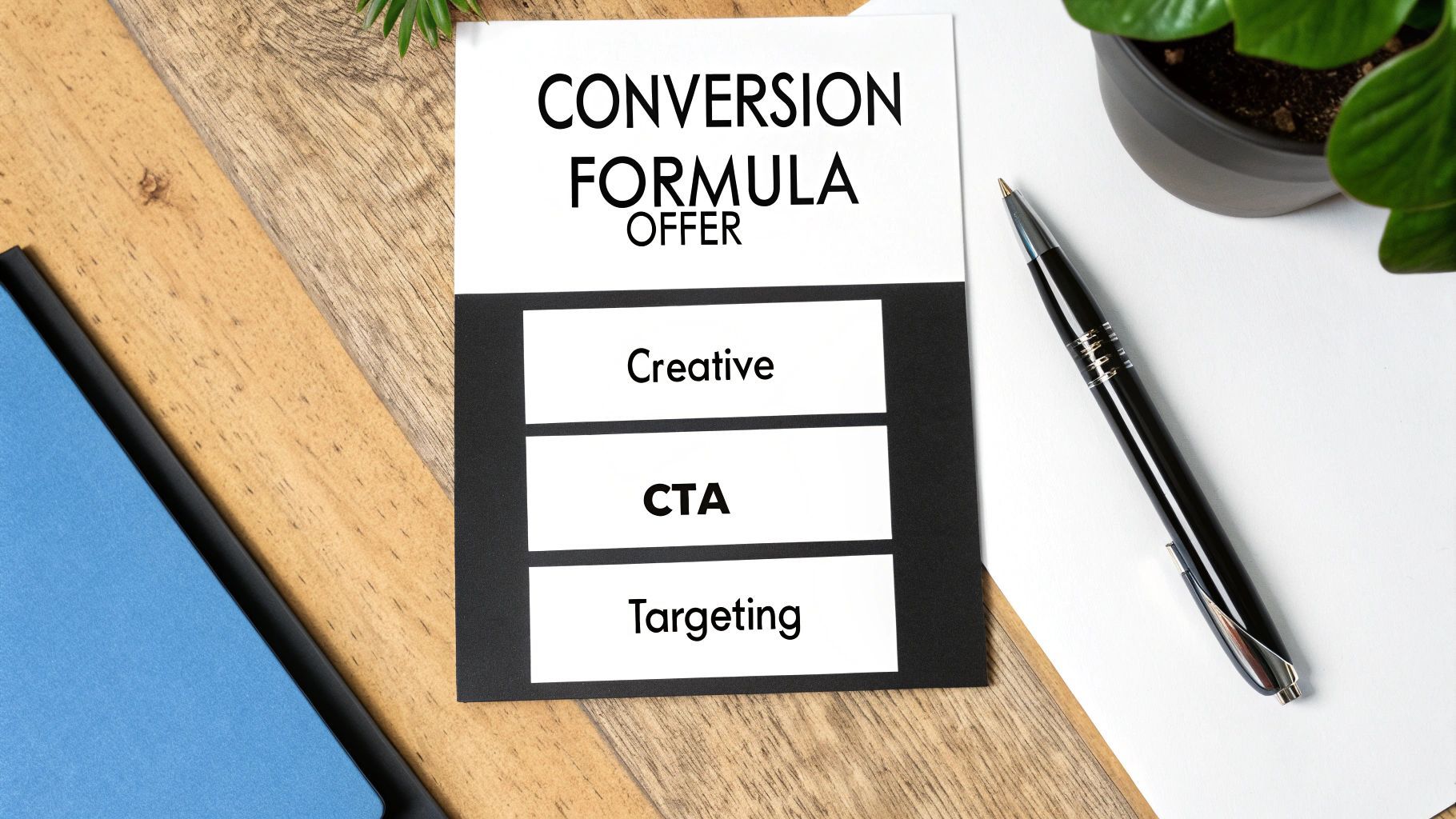
Ever wondered what separates an ad that gets scrolled past from one that racks up sales in minutes? It's not magic—it's a formula. A high-converting direct response ad is like a well-oiled machine with four crucial, interlocking parts. If even one piece is missing or weak, the whole thing grinds to a halt.
Let’s break down these core components. Think of this as the blueprint for building campaigns that don’t just earn impressions, but actually drive action and generate revenue. Each element has a specific job to do, guiding someone from a passive scroller to an active customer in a matter of seconds.
The Irresistible Offer
First things first: the offer. This is the heart and soul of your ad. It’s the juicy, can’t-miss deal that makes someone slam the brakes on their endless scrolling and actually pay attention. This isn't just about your product's features; it's about the specific value you're presenting right now.
A killer offer creates urgency and removes any friction or doubt. It directly answers the viewer's unspoken question: "What's in it for me, and why do I need to act now?"
- Scarcity: "Only 50 spots left for our live workshop."
- Urgency: "This 40% off flash sale ends at midnight."
- Bonus Incentives: "Buy one, get one free, plus a free gift with your order."
- Risk Reversal: "Try it risk-free with our 30-day money-back guarantee."
The stronger and more time-sensitive the offer, the more likely you are to trigger an immediate response. It’s the psychological hook that makes inaction feel like a missed opportunity.
Compelling Creative and Copy
Okay, you’ve grabbed their attention with the offer. Now, the creative and copy have to keep it. This is the one-two punch of eye-catching visuals and persuasive language that tells a story and proves your offer’s value. Your creative absolutely must feel native to the platform—what flies on YouTube Shorts will likely bomb as a Facebook In-Feed ad.
Beyond just slick videos, great creative can be anything that resonates. Sometimes, injecting a little humor with relevant marketing memes can be the very thing that stops the scroll and gets the click.
Your copy needs to be direct, benefit-focused, and crystal clear. Agitate a pain point they're feeling, then present your offer as the ultimate solution. Leave no room for doubt about what they stand to gain.
A Crystal-Clear Call to Action
This is where so many ads stumble and fall. A wishy-washy or buried Call to Action (CTA) just creates confusion and tanks your conversion rate. Your CTA needs to be a direct, unmissable command that tells the user exactly what to do next.
Don't make them think. If you want them to buy, your button and copy should scream "Shop Now." If you want them to register, it should say "Claim Your Free Spot." This single instruction should be plastered everywhere—in the text, on the visuals, and on the button itself—for maximum effect.
Hyper-Targeted Delivery
Finally, you could have the most amazing ad in the world, but if you show it to the wrong people, it's a complete waste of money. Successful direct response campaigns depend on getting your message in front of a super-specific audience that is primed to be interested in your offer.
This means digging deeper than basic demographics. You should be targeting based on:
- Behaviors: Users who have recently bought or engaged with similar products.
- Interests: People who actively follow related topics, influencers, or brands.
- Retargeting: Warm audiences of people who have visited your website but haven't yet purchased.
When you nail all four—a killer offer, engaging creative, a clear CTA, and precise targeting—you've built the complete formula for a direct response ad that actually converts.
Why Every Click and Conversion Must Be Measured
In direct response advertising, flying blind isn’t just risky—it’s a guaranteed way to waste your money. Unlike brand advertising, where success can be a bit fuzzy and measured in feelings, every single action in a direct response campaign has to be tracked. This relentless focus on data is the engine that drives the entire strategy.
Think of it like a chef constantly tasting and adjusting a recipe. Without tasting (or in our case, measuring), the chef is just guessing. Meticulous tracking gives you the power to understand precisely which ads are working, which are failing, and most importantly, why.
This data-first approach lets you make informed decisions instead of just going with your gut. You can see which headline got more clicks or which video drove more sales, empowering you to double down on what works and kill what doesn't. Simple as that.
From Data Points to Smarter Decisions
At the heart of all this measurement are Key Performance Indicators (KPIs). These aren't just buzzwords; they're the vital signs of your campaign's health. For direct response, two KPIs stand above the rest:
- Cost Per Acquisition (CPA): This tells you exactly how much you’re spending to land one new customer. If your CPA is lower than what that customer is worth to you over time, you've got a profitable campaign.
- Return On Ad Spend (ROAS): This is the ultimate bottom line. For every dollar you put into your ads, how many dollars do you get back? A ROAS of 3:1 means you’re making $3 for every $1 spent.
To really gauge how well your direct response efforts are doing on social media, a critical metric to watch is your Facebook conversion rate. This KPI shows the percentage of people who actually take the action you want after clicking your ad.
This intense focus on measurement isn't just for digital channels. U.S. direct mail, a classic direct response tactic, saw $39.36 billion in spending, with 59% of marketers planning to increase their budgets over the next five years. The response rates tell the story: direct mail often outperforms email, search, and social by 5-9x. In fact, 84% of consumers converted after getting mail in the last six months—a 27% jump from previous years.
The Power of A/B Testing
So, how do you find the absolute best-performing ad? You test everything. This process, known as A/B testing (or split testing), involves running two slightly different versions of an ad to see which one your audience prefers.
The core principle of direct response advertising is simple: if you can't measure it, you can't improve it. Data isn't just a report; it's your roadmap to profitability.
Imagine you're testing two headlines: one highlights a discount, and the other focuses on a key benefit. By running both and measuring the results, you let your audience tell you which message truly connects. This cycle of testing, learning, and iterating is what separates winning campaigns from the ones that burn cash. It turns advertising from a gamble into a calculated science.
Proven Direct Response Examples You Can Learn From
Theory is one thing, but seeing direct response advertising in the wild is where the lightbulb really goes on. Let's shift from the "what" to the "how" by breaking down some winning ad examples from the platforms you're likely using right now.
By dissecting these campaigns, you can see how the core components—the offer, the creative, and the CTA—all work together to get someone to act immediately. Think of these as a visual playbook you can borrow from for your own marketing.
The TikTok User-Generated Content (UGC) Demo
TikTok runs on authenticity. That's why content that looks like it was made by a real person (even if it's a paid ad) performs so well. Imagine a creator showing off a portable blender.
- The Hook: The video kicks off with a super relatable problem: "I hate lumpy protein shakes after the gym." It’s a simple line that instantly grabs the attention of the right audience.
- The Offer: A hard-to-miss text overlay with "50% Off + Free Shipping" stays on the screen, creating a constant sense of urgency.
- The Creative: We see a quick, no-frills demo of the blender making a perfect shake in just a few seconds. The raw, unpolished vibe builds way more trust than a slick, corporate-style ad ever could.
- The CTA: The ad closes with a direct command: "Don't wait, this deal ends tonight! Tap the orange shopping cart button below to get yours now."
This ad works because it feels less like an ad and more like a helpful tip from a friend. It perfectly matches the platform's culture while still pushing for that immediate sale.
An effective direct response ad doesn't just show you a product; it solves a problem right before your eyes, making the decision to buy feel both urgent and completely logical.
The Instagram Story Flash Sale
Instagram Stories are tailor-made for creating urgency. Their 24-hour lifespan is the perfect match for a limited-time offer. A fashion brand, for instance, could run a killer flash sale using a few quick story slides.
- Slide 1: A bold graphic hits the screen with a countdown timer ticking down. The text is simple and powerful: "24-HOUR FLASH SALE!"
- Slide 2: A fast-paced video shows off a few popular items from the sale, with the discount front and center (e.g., "$80" is crossed out and replaced with "$40").
- Slide 3: The final slide is a clear, unmissable call to action with Instagram's "Swipe Up to Shop" sticker or a big "Shop Now" button.
This whole sequence builds excitement and uses the platform’s native features to drive immediate clicks before the story—and the deal—vanishes. It's a classic DR tactic, just repackaged for today's social media.
The YouTube Pre-Roll Webinar Signup
If you're in the business of selling services or high-ticket products, getting someone to sign up for a webinar is often the main goal. A YouTube pre-roll ad is a fantastic way to capture those leads from a hyper-targeted audience.
Let's picture an ad for a financial planning webinar.
- The Hook (First 5 Seconds): To stop people from hitting "Skip Ad," the speaker looks right into the camera and asks a pointed question: "Are you making these three common investing mistakes?"
- The Offer: The ad promises a free, live training that reveals the solutions to those mistakes. This frames the webinar not as a sales pitch, but as exclusive, valuable information.
- The CTA: The speaker gives a clear instruction: "Click the link on this video right now to reserve your free spot. Seats are limited, so don't miss out."
This strategy uses education as the bait, trading valuable knowledge for a potential customer's contact info. It’s a textbook direct response value exchange.
And it’s not just video. The podcasting boom has supercharged audio-based direct response, too. In 2024, podcast DR ads generated a staggering USD 12,304.3 million globally. That number is projected to climb to USD 21,461.1 million by 2030, proving just how powerful a direct offer can be, even without any visuals. You can explore the growth of podcast advertising to see the full trend breakdown.
How AI Is Amplifying Direct Response Creative
One of the biggest headaches for any performance marketer today is the constant, nagging need for more ad creative. You know the drill: an ad is crushing it one week, and the next, performance falls off a cliff. The algorithms on platforms like Meta and TikTok demand novelty, and ad fatigue is very real. This puts you on a high-pressure creative treadmill that's almost impossible to keep up with.
This is exactly where artificial intelligence is stepping in to change the game. Think of AI-powered tools as a creative amplifier. They give small teams the ability to generate hundreds of ad variations—testing different hooks, swapping out headlines, and creating entirely new visuals—in minutes, not weeks.
Let’s be clear: this isn't about replacing human strategists. It's about supercharging them. By automating the most tedious and repetitive parts of ad production, AI frees you up to focus on what you do best: digging into audience insights, crafting high-level strategy, and making smart decisions based on the data.
Scaling Creativity Without Scaling Your Team
Imagine you want to test ten different hooks for a single product video. The old way meant ten separate, time-consuming video edits. It was a slow and expensive nightmare.
With AI, you can take one core video and instantly remix it with countless AI-generated hooks, unique voiceovers, and dynamic captions. This completely changes how you manage direct response campaigns.
- Massive Testing Volume: AI lets you test more ideas, faster than ever. You can finally figure out what messaging actually resonates with your audience by launching dozens of variations at once instead of just a handful.
- Rapid Iteration: As soon as an ad starts to fade, you can generate a fresh batch of alternatives in seconds. This keeps your campaigns running at peak performance and your ROAS healthy.
- Reduced Production Costs: The days of needing expensive video shoots or spending weeks in editing are disappearing. AI makes high-volume creative testing accessible, even for scrappy teams on a tight budget.
AI transforms creative production from a bottleneck into a strategic advantage. You’re no longer limited by how fast you can produce ads—only by how many ideas you want to test.
This speed is crucial to staying competitive. Platforms like TikTok reward a constant stream of fresh content, and AI finally gives you the engine to keep up. By using platforms that help you create high-performing short-form ads with AI, teams can ditch the slow, manual workflow and build a fast, scalable system designed for modern advertising.
Common Questions About Direct Response Advertising

Alright, even after getting the theory down, jumping into the world of direct response can feel a little daunting. That’s totally normal. A few practical questions always pop up when it's time to actually put money on the line.
Let's tackle some of the most common ones I hear. Think of this as the "ask an expert" section that will help you sidestep those early hurdles and launch your first campaigns with more confidence.
How Much Should I Budget for My First Campaign?
This is always the first question, and the honest-to-goodness answer is: it depends, but you can definitely start small. The great thing about direct response is that you get data back almost immediately. You don't need a Super Bowl-sized budget to begin. You just need enough to learn.
For most people, a starting point of $50 to $100 per day is plenty. That gives platforms like Facebook or TikTok enough runway to find some pockets of your audience and tell you which of your ads are actually getting clicks and conversions.
Your goal in the first week isn't to get rich; it's to gather intelligence. Once you find that magic combination of creative, copy, and targeting that delivers a positive ROAS, that's when you can start pouring more fuel on the fire.
The key isn't how much you spend, but how quickly you learn. Start with a budget you're comfortable using for data collection, find what works, and then reinvest your profits.
Can Direct Response and Brand Advertising Work Together?
Absolutely. In fact, they should. It's a classic one-two punch. Thinking they're enemies is one of the biggest misconceptions in marketing.
- Brand Advertising is the Jab: It builds familiarity and plants a seed of trust over time. It’s the subtle work that gets your name in front of people, so they know who you are and what you're about. It warms up the audience.
- Direct Response is the Knockout Punch: This is where you capitalize on that warmth. You show up with a specific, can't-miss offer that gives them a reason to act right now.
Think about it. When someone has already seen your brand around, they're much more likely to click and convert when they see a direct response ad. A strong brand presence almost always lowers your cost per acquisition (CPA) and makes every dollar you spend on performance marketing work harder.
What Kind of Offer Works Best?
There's no single silver bullet here, because the "best" offer depends entirely on your product and your audience. But the most powerful ones almost always tap into some fundamental human psychology.
Your job is to create a value exchange that feels like a total no-brainer for the customer.
Here are a few proven frameworks to get you started:
- Direct Discounts: Simple, clean, and effective. "40% Off Today Only" creates instant urgency and is easy to understand.
- Bonus Incentives: Sometimes, adding more value works even better than taking away cost. Think "Buy One, Get One Free" or "Get a Free Gift With Your Purchase." People love getting something extra.
- Risk Reversals: These are designed to crush doubt and hesitation. A "30-Day Money-Back Guarantee" or a "Free Trial" makes it easy for someone to say yes, especially for a new product or a higher-priced item.
- Lead Magnets: If your goal isn't an immediate sale, offer incredible value for an email. "Download Our Free E-book" or "Join Our Exclusive Webinar" are perfect for building your list.
The only way to know for sure is to test. You might be surprised to find your audience goes wild for a free bonus item but barely budges for a 20% discount. Let the data tell you what works.
Ready to stop guessing and start producing direct response ads that actually convert? With ShortGenius, you can generate hundreds of high-performing video and image ad variations in minutes. Stop the scroll, find your winners faster, and scale your campaigns with AI.