What are ai ugc ads? Learn How They Drive Authentic, High-Converting Campaigns

Discover what are ai ugc ads and how authentic, user-generated style campaigns boost engagement and conversions across TikTok, Instagram, and more.
AI UGC ads are a game-changer for anyone running paid social campaigns. In simple terms, they blend the genuine, relatable vibe of user-generated content (UGC) with the incredible speed and efficiency of artificial intelligence.
Think of it like getting a great product recommendation from a friend you trust. It feels real. Brands can now create that same authentic feeling in minutes, not weeks, which is a massive advantage when trying to cut through the noise on social media.
What Problem Do AI UGC Ads Actually Solve?
Let's be honest, we're all swimming in a sea of slick, over-produced corporate ads. We've become experts at scrolling right past them. The moment something looks or feels like a traditional sales pitch, our brains tune it out. What we actually stop for is content that feels real and relatable—the kind of stuff we see from creators and friends in our everyday feeds.
This is why traditional UGC became so popular. Brands quickly realized that content from real customers just performed better because it felt trustworthy.
The problem? Scaling real UGC is a nightmare. It's slow, wildly unpredictable, and can get expensive fast. You have to find the right creators, handle contracts, ship out products, and then cross your fingers hoping the content they send back is even usable. This old-school process makes it impossible to feed the beast—the constant demand for fresh creative on platforms like TikTok and Instagram.
Bridging the Gap Between Authenticity and Scale
This is where AI UGC ads step in to solve that fundamental conflict. They fix the scaling problem by automating the most painful, time-consuming parts of the creative process. Instead of juggling dozens of human creators, you can now use AI to generate videos that have the same look, feel, and tone as authentic, user-generated content.
This new approach offers a few powerful solutions:
- It fights ad fatigue. You can generate hundreds of creative variations to test, keeping your campaigns fresh and preventing your audience from getting bored.
- It slashes production costs. Forget about the high fees for multiple creators, product shipping, and endless back-and-forth. The entire workflow is simplified.
- It keeps the authentic feel. Because the AI is often trained on top-performing social content, the ads capture that casual, direct-to-camera style that people actually trust.
To give you a quick visual of how different these two approaches are, here's a simple breakdown:
Traditional Ads vs AI UGC Ads at a Glance
| Attribute | Traditional Ads | AI UGC Ads |
|---|---|---|
| Creator | Professional actors, influencers, or studio teams. | AI-generated avatars, voice clones, and scripts. |
| Production Time | Weeks or months of planning, shooting, and editing. | Minutes to a few hours. |
| Cost | High. Can range from thousands to millions of dollars. | Low. A fraction of the cost of a traditional shoot. |
| Scalability | Low. Each new ad requires a full production cycle. | High. Generate hundreds of variations with a few clicks. |
| Authenticity | Low. Often feels polished, scripted, and corporate. | High. Mimics the genuine, low-fi style of real users. |
| Testing Ability | Limited. High costs make it difficult to test many concepts. | Unlimited. Easily test hooks, scripts, and visuals. |
As you can see, the shift is dramatic. It moves creative production from a slow, costly bottleneck to a fast, agile part of your marketing strategy.
The performance numbers back this up, too. Ads that have a UGC feel can get 4 times higher click-through rates and cut cost-per-click by 50% compared to standard corporate-style ads. It's a simple formula: give people content that feels native to their feeds, and they’ll respond.
The rise of AI-powered creative is a major shift in the digital marketing world. To see how it fits into the bigger picture, it's worth exploring the 10 Best Digital Marketing Strategies to Dominate in 2025. This isn't just a fleeting trend; it’s a smart response to what modern consumers are demanding: genuine connection.
It might seem strange to talk about using artificial intelligence to create ads that feel genuinely human, but the process is actually pretty logical. It's not about one single AI "creator" making an ad from scratch. Instead, it’s more like a digital assembly line where different AI tools handle specific creative tasks to build an authentic-looking video.
Let's say a direct-to-consumer skincare brand wants to run a campaign for a new serum. Instead of finding and managing a human creator, they use an AI platform. They start with a simple brief: the product name, its key benefits (like boosting hydration and calming redness), and who they're trying to reach.
From there, the AI takes over. The flowchart below gives you a high-level look at how these raw ingredients get turned into a polished ad.
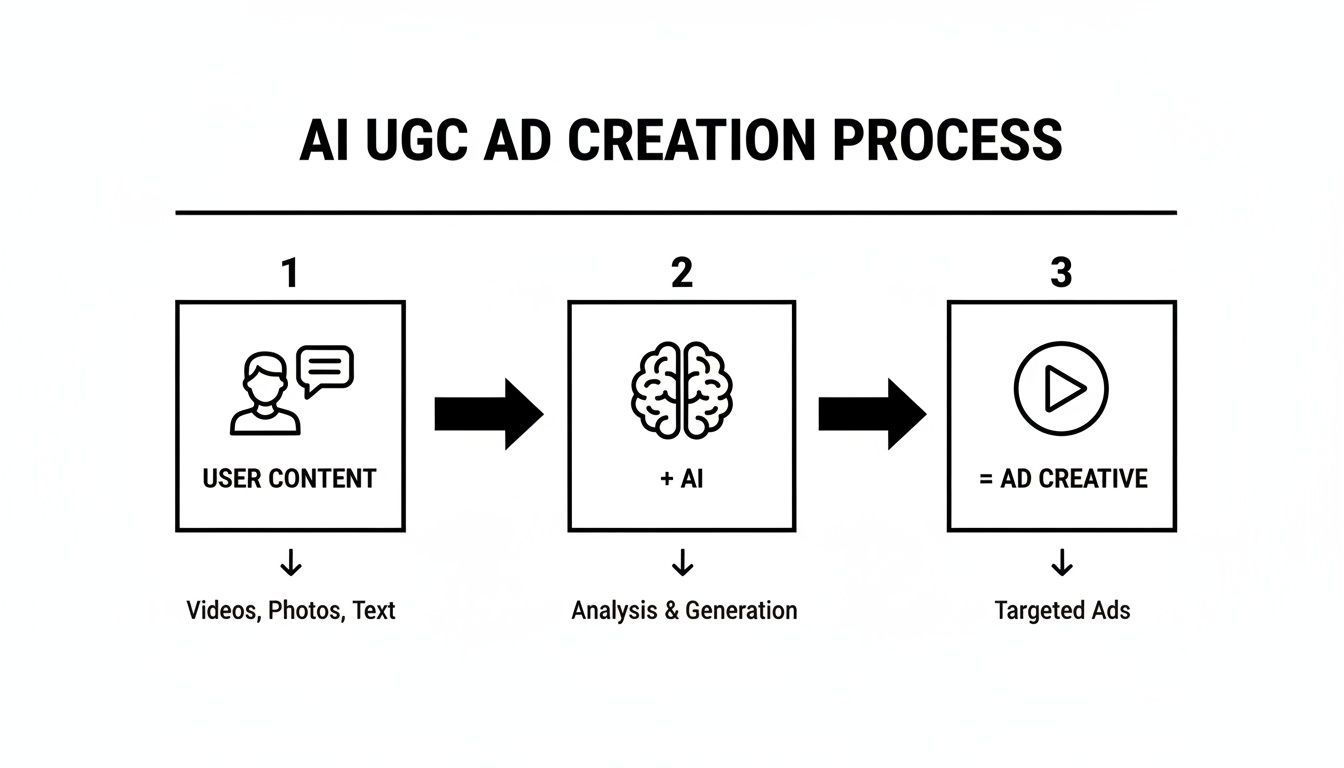
This workflow shows how you can go from basic inputs to ready-to-launch ad creative, all at a scale that would be impossible to do manually.
The AI Creative Assembly Line
That initial prompt kicks off a sequence of automated steps, with a specialized AI model tackling each part of the creative process. This is where the real magic happens.
-
AI Scriptwriting: First up, a language model trained on thousands of top-performing social media ads gets to work. It generates several script options, complete with scroll-stopping hooks, a natural, conversational body, and a clear call to action. In seconds, our skincare brand has five unique scripts ready to go, all written in a voice their audience will connect with.
-
AI Avatar and Voice Generation: Next, the brand chooses a digital avatar that looks like their ideal customer. A separate text-to-speech model then creates a natural-sounding voiceover for the script. These aren't the robotic voices of the past; modern AI includes realistic pauses and inflections. The brand can even generate the same script with several different voices to A/B test which one works best.
-
Automated Scene Assembly and Editing: In the final step, the system pieces everything together. It syncs the avatar's video with the voiceover, adds in product B-roll, and overlays dynamic captions. It even adds trending effects and royalty-free background music. Within minutes, the brand has a whole batch of unique video ads ready to deploy on TikTok and Instagram.
By automating the nuts and bolts of production, brands can stop worrying about the tedious logistics and start focusing on what really matters: creative strategy and performance. The end goal is always to create something that feels like it belongs in a user's feed.
To really nail the authentic feel, it helps to understand the fundamentals. Applying native advertising design principles is key, as it ensures the final ad blends in seamlessly while still getting the brand’s message across. This is what captures that true UGC vibe.
The 3 Big Wins of Using AI for UGC Ads
Switching to AI-powered UGC ads isn't just about playing with new tech. It’s a smart business move with real, measurable payoffs. The advantages are crystal clear, boiling down to three game-changing improvements: a massive leap in speed and savings, genuinely better ad performance, and the ability to scale your creative output like never before.
By handing off the heavy lifting of the creative workflow to AI, brands can finally sidestep the old-school bottlenecks that have made advertising so slow and expensive for so long.
1. Slash Your Costs and Production Time
The most immediate and obvious win is how much time and money you get back. Forget about the weeks spent haggling with creators, shipping out products, and then waiting around for them to film something. You can now spin up high-quality, authentic-looking ads in a matter of minutes. That kind of speed is essential if you want to stay relevant in today’s blink-and-you-miss-it social feeds.
Think about the old way of doing things. Sourcing, vetting, and paying a single creator for one video can easily run you hundreds, sometimes thousands, of dollars. Trying to produce the dozens of ad variations you need for proper A/B testing? The cost quickly balloons out of control for most companies.
AI completely flips that model on its head.
We're seeing creative testing costs plummet from an average of $7,500 down to just $99 for 20 unique videos. Teams using platforms like ShortGenius are launching entire campaigns in 16 minutes instead of the usual 2-3 weeks, saving them $10,000 or more every single month. To get a better sense of this shift, you can explore some detailed findings on UGC platform growth across the industry.
This is a massive unlock. You’re no longer burning your budget on logistics; you’re investing it in strategy.
To really see where the savings come from, let’s break down the production process step-by-step. The table below shows just how much more efficient things become when AI handles the grunt work.
Impact of AI on the UGC Ad Production Workflow
| Production Stage | Traditional Method (Time/Cost) | AI UGC Method (Time/Cost) | Efficiency Gain |
|---|---|---|---|
| Creator Sourcing | 1-2 weeks; platform fees, negotiation time | 2 minutes; select AI avatars | ~99% faster |
| Product Shipping | 3-5 days; shipping costs, potential loss | 0 minutes; no physical product needed | 100% cost/time savings |
| Content Creation | 1-2 weeks; creator fees, multiple takes | 5-10 minutes; AI generation | ~99% faster |
| Editing & Revisions | 2-4 days; editor costs, back-and-forth | 5 minutes; instant edits in-platform | Massive reduction in time/cost |
| Ad Variation | Hours per variation; added editing costs | 1 minute per variation; clone & modify | Near-instant scaling |
As you can see, AI doesn't just speed up one part of the process—it streamlines the entire workflow, turning a multi-week marathon into a short sprint.
2. Get Genuinely Better Performance and Conversions
Here's the secret sauce: AI UGC ads work so well because they don't look like ads. They’re designed from the ground up to feel like the native, organic content people actually want to see on social media. This is especially true for Gen Z and Millennial audiences, who have a finely tuned radar for polished corporate advertising.
That authentic vibe builds trust and encourages people to take action in a way that slick, overproduced commercials just can't.
The numbers don't lie. Ads that have that genuine, user-generated feel consistently blow their polished counterparts out of the water. In fact, simply adding UGC to product pages has been shown to boost conversions by a staggering 161%. The performance lift comes from connecting with viewers on a human level, making your brand feel less like a corporation and more like a friend’s recommendation.
It all comes down to a simple truth: content that feels real, performs better. AI gives you a reliable, systematic way to bottle that "real" feeling and produce it over and over again.
3. Scale Your Creative Output to Infinity
Finally, AI puts high-volume creative testing within reach for everyone. It used to be that only brands with bottomless budgets could afford to constantly test new hooks, scripts, and visuals to see what works and fight off ad fatigue.
Not anymore. Now, any business—from a one-person startup to a global corporation—can generate hundreds of ad variations with just a few clicks.
This opens up a whole new world of optimization. You can:
- Test dozens of different hooks to find out what really stops the scroll.
- Experiment with countless script variations and calls to action.
- Swap out AI avatars and voices to see which ones resonate best with specific audience segments.
With this capability, you're no longer guessing what your audience wants to see. You can let the data lead the way, ensuring every dollar of your ad spend is pulling its weight and delivering the best possible results.
Real World Examples of AI UGC Ads
It’s one thing to talk about the theory, but seeing how real businesses are putting AI UGC ads to work is where it really clicks. These aren't just hypotheticals. We’re talking about practical strategies that solve everyday marketing headaches, like how to scale up creative production without breaking the bank or how to drive down customer acquisition costs.
These examples show how AI is making high-volume, authentic-looking advertising accessible to everyone. You no longer need a massive team or a Hollywood budget to run a sophisticated creative strategy. The trick is using AI to capture the vibe of user-generated content, not just to automate a task.
Powering a TikTok Shop with Endless Demos
Imagine a direct-to-consumer (DTC) beauty brand launching a new product line on TikTok Shop. Their number one problem was feeding the algorithm with enough fresh video content to stay relevant. Trying to hire a creator for every single product variation was a logistical and financial nightmare.
So, they switched gears and used an AI UGC platform. They simply uploaded their product photos and wrote a few lines about the benefits. In just one afternoon, they had dozens of unique product demo videos ready to go. Each ad featured a different AI avatar with a slightly different script, spotlighting various features.
The result? They could finally A/B test creatives at scale to see what actually worked. This simple shift led to a 35% lower cost per acquisition (CPA) compared to the handful of ads they were running before.
Boosting Downloads for a Mobile Game
A mobile game developer had a different challenge. They needed ads that felt like genuine testimonials to get people to download their new soccer game. Standard banner ads were falling flat, and finding real gamers to create reviews was taking way too long.
Their solution was to use AI avatars that looked and sounded like real gaming fans. They produced a series of short, high-energy videos where AI actors raved about their "experience" playing the game, calling out cool features and competitive gameplay. The ads felt less like a sales pitch and more like a recommendation from a friend.
By embracing the testimonial format, the developer built instant social proof. The AI-generated ads pulled in a 20% higher click-through rate (CTR) than their typical animated ads, leading to a huge spike in downloads.
Seeing these stories in action helps make the benefits of AI UGC ads feel tangible. It gets the wheels turning on how you could apply the same thinking to your own campaigns.
Creating AI UGC Ads That Actually Convert
So, you understand the what of AI UGC ads. But knowing how to make one that truly converts is a completely different ballgame. The secret isn't just hitting a button and hoping for the best. Far from it.
The most successful campaigns come from a smart blend of human creativity and AI efficiency. Your job is to be the creative director, and the AI is your superstar production team, working around the clock.
This "human-in-the-loop" model is where the magic happens. You bring the strategy, the deep customer knowledge, and the brand's unique voice. The AI then takes your direction and handles the grunt work—spitting out scripts, generating avatars, and creating dozens of ad variations at a speed that's simply impossible for a human team. You guide, you review, and you refine.
Mastering the Art of the AI Prompt
The quality of your ad is a direct reflection of the quality of your prompt. A vague, lazy prompt will always lead to a generic, forgettable ad. To get that authentic, human-sounding script, you have to feed the AI the right ingredients.
- Zero In on the Pain Point: Always start with the customer's problem. A great prompt isn't "write an ad for skincare." It's, "Write a 30-second TikTok script about the sheer panic of getting a huge pimple the day before a wedding." See the difference?
- Set the Tone: Don't leave the vibe to chance. Be descriptive. Add instructions like, "in a casual, friendly, 'best friend giving advice' tone" or "with an upbeat, almost breathless and excited voice."
- Inject Real Language: Pull powerful phrases directly from your 5-star customer reviews. This is a game-changer. It grounds the AI script in the actual words your customers use, making it instantly more credible and relatable.
Think of your prompt as the creative brief you'd give to a human creator. The more detail and context you provide, the less it will sound like a robot wrote it and the more it will feel like it came from a real person's experience.
Choosing the Right Face and Voice
With a killer script in hand, your next big decision is the AI avatar and voice. The goal here is simple: pick a digital persona that your target audience will connect with instantly. This isn't the time to just grab the default option.
Who would your ideal customer actually listen to? A skincare brand targeting Gen Z might want an avatar with a fresh, natural look. A company selling a new gaming accessory, on the other hand, should probably look for a persona with more dynamic energy.
The voice is just as critical. Most AI tools let you test different voices with your script, so take the time to listen. Does it sound natural? Does the energy match the avatar's appearance? Most importantly, does it sound like a real person, not a text-to-speech robot from 2010?
Bringing the right script, avatar, and voice together is what makes these ads work. It’s a process of creation and constant testing, and platforms like ShortGenius are built to make that entire workflow faster and more effective.
Walking the Ethical Tightrope with AI Ads
Let's be real: the power behind AI UGC ads comes with some serious responsibility. When you're essentially automating authenticity, you have to be extra careful to build and maintain trust with your audience. That means facing the tricky ethical questions right from the start, from being transparent to respecting intellectual property.
A huge part of this conversation is about labeling. Should your audience always know they’re watching a digital avatar and not a real person? If you don't disclose it, you're wading into deceptive territory, which can completely backfire and destroy the very trust you're trying to earn.
The best, most long-lasting advertising is built on honesty. Tricking your audience might work once, but you’ll pay for it with long-term brand damage when that trust inevitably breaks.
Getting ahead of these issues isn't just about doing the right thing—it's just smart business.
Respecting Creators and Digital Representation
Beyond just being transparent, there are a couple of other major ethical pillars to think about. When you’re choosing a platform to create these ads, you need to make sure it respects intellectual property and is committed to using its tech responsibly.
Here’s what you need to look into:
- Copyright and Training Data: Ask how the AI was trained. The best platforms use ethically sourced data and fully licensed assets to create their voices and avatars. This is a big deal, as it protects you from getting tangled up in copyright headaches later.
- Diverse and Respectful Avatars: Creating any kind of digital person you can imagine is an incredible tool, but it also carries a duty to represent people respectfully. The goal should be to broaden representation and reflect the diversity of your audience, not to lean on tired stereotypes or create misleading personas.
In the end, successfully using this tech means committing to ethical ground rules. By making transparency a priority, respecting creator rights, and using AI avatars thoughtfully, you can innovate without risking your brand's reputation. That’s how you build a solid foundation for advertising that actually lasts.
Got Questions About AI UGC Ads? We've Got Answers.
As more marketers dip their toes into AI-generated ads, a few common questions always seem to surface. Let's clear up some of the biggest ones so you can move forward with a solid game plan.
Will AI UGC Ads Put Human Creators Out of a Job?
Not a chance. It's much more accurate to think of AI as a creative partner—a tool that handles the grunt work so human creators can focus on what really matters.
Think about it: AI is brilliant at churning out hundreds of ad variations for A/B testing, a task that would take a human team weeks. This frees up your creative talent to focus on bigger-picture strategy, brand messaging, and adding that final human polish that makes an ad truly connect. The future isn't about replacement; it's about humans and smart tools working together to get better results, faster.
How Do I Keep My AI Ads from Sounding Fake?
Authenticity isn't something the AI creates on its own—it's something you guide it toward. The secret is to feed the AI real, human-centric insights from the very beginning.
- Start with real customer language. Pull phrases, pain points, and scenarios directly from your product reviews and customer support tickets.
- Write prompts with personality. Don't just ask for an ad. Tell the AI to adopt a specific, relatable tone. Ask it to use conversational language and act out a scenario that your customers actually experience.
- You're the final editor. Never skip the human review. A tiny tweak to a script or a subtle shift in a voiceover's inflection can be the difference between an ad that feels robotic and one that feels completely genuine.
Your AI is like a brilliant but inexperienced actor. It can deliver the lines, but you’re the director who provides the motivation and soul.
What's the Best Way to Measure Success?
Of course, the classic metrics like Return on Ad Spend (ROAS) and Conversion Rate still matter. But because AI lets you test creative at a massive scale, you can get much smarter about how you measure performance.
Instead of just looking at the final sale, you can focus on metrics that tell you if your creative is actually working:
- Hook Rate: What percentage of people are actually watching the first three seconds? This tells you if your opening is strong enough to grab attention.
- Thumb-Stop Ratio: How many people who scroll past your ad actually stop to watch it? This is a direct measure of how compelling your visual is.
- Creative Fatigue Rate: How quickly does an ad start to lose its punch? Tracking this helps you know exactly when to swap in a fresh variation before performance tanks.
Looking at these numbers gives you a real-time window into why your campaigns are succeeding or failing, not just if they are.
Ready to stop guessing and start creating video ads that actually perform? With a tool like ShortGenius, you can generate hundreds of authentic, UGC-style ads in minutes. Try ShortGenius today and see what it can do for you.