Your Guide to a High-Converting AI Video Ad Maker

Stop guessing and start converting. Learn how to use an AI video ad maker to create ads that drive real results, from initial concept to final campaign launch.
Think of a video ad maker as a powerful toolkit that lets businesses and creators whip up video ads in a flash. Traditionally, these tools relied on templates and stock footage. But the new wave of AI-powered versions does the heavy lifting for you—from writing scripts and generating voiceovers to building entire scenes from scratch. This makes high-quality ad creation genuinely accessible, even if you don't have a film degree or a massive budget.
Why an AI Video Ad Maker Changes Everything
Let's be real for a moment—making video ads the old-fashioned way is a grind. You're constantly fighting against tight budgets, the never-ending need for new content, and the steep learning curve of professional editing software. For a small business or a solo marketer, these obstacles can feel like a brick wall, making it nearly impossible to keep up.
This is exactly where an AI video ad maker comes in and completely flips the script. It's not just about cool tech; it's about making video advertising fair game for everyone. These tools give you the power to create polished, professional ads that can compete with the big-budget campaigns, all without the headaches or the high costs.
Overcoming Traditional Production Hurdles
The classic video production workflow is a long, expensive road. It involves hiring scriptwriters, videographers, actors, and editors—a whole team that costs a small fortune. An AI-powered video ad maker takes that entire complex process and consolidates it into one intuitive platform.
Take a look at the common pain points that marketers constantly face, and how these AI tools directly solve them.
Key Challenges in Video Ad Production and AI Solutions
This table breaks down how AI tackles the biggest headaches of traditional video creation.
| Traditional Challenge | How an AI Video Ad Maker Solves It | Business Impact |
|---|---|---|
| Sky-High Costs | Replaces the need for a large production crew, actors, and expensive equipment with an affordable subscription. | Drastically lowers the barrier to entry for high-quality video advertising, freeing up marketing budget. |
| Painfully Slow Turnaround | What used to take weeks of coordination can now be done in hours, or even minutes. | Enables rapid campaign launches and allows teams to react quickly to market trends. |
| Creative Burnout & Writer's Block | Generates dozens of script ideas, hooks, and visual concepts from a simple prompt. | Eliminates creative bottlenecks and provides a constant stream of fresh ideas for testing. |
| Technical Skill Gap | Automates complex editing, animation, and voiceover tasks with user-friendly interfaces. | Empowers marketers without a video background to produce professional-grade ads independently. |
Ultimately, AI tools offer a powerful new way to get things done, turning what was once a major production into a manageable, creative task.
The real magic here is simple: speed and scale. You can finally test more ideas, faster, to see what actually connects with your audience—all without blowing your entire budget on a single, high-stakes video.
This isn't just a minor improvement; it's a necessary evolution. The global video advertising market is absolutely exploding, with ad spend expected to rocket past $190 billion. This massive growth is driven by video's undeniable grip on our attention, especially on social media. With video set to make up an incredible 82% of all internet traffic, having an efficient ad creation process isn't a luxury anymore. It's essential for growth. If you want to dive deeper, you can read more about these essential video marketing statistics and what they mean for your game plan.
It's a Strategic Shift, Not Just a New Tool
Bringing an AI video ad maker into your workflow is so much more than just adopting a new piece of software. It’s a fundamental change in your entire marketing approach. It allows you to be more agile and data-driven, creating a feedback loop where you constantly test, learn, and improve your campaigns.
Instead of putting all your eggs in one basket with a single "perfect" ad, you can build a whole portfolio of creatives. A/B test different hooks, experiment with various calls-to-action, or tailor visuals to hit different audience segments. In today's fast-moving digital world, this ability to iterate quickly is what separates the winning campaigns from the ones that get scrolled past and forgotten.
Nail Your Strategy Before You Even Think About Hitting ‘Generate’
An AI tool is only as good as the strategy you feed it. Seriously. Diving headfirst into a video ad maker without a solid game plan is a classic rookie mistake. You might get a video out of it, but I guarantee it won't be the scroll-stopping, cash-printing machine you're hoping for.
The real magic happens before you ever see a timeline or choose a template. This is where you separate the ads that actually make money from the ones that just burn through your budget. It's about taking a fuzzy goal like "I want more sales" and sharpening it into a precise, actionable brief that the AI can turn into gold.
What’s the One Thing You Want People to Do?
Before you write a single word, you have to answer this one, critical question: What is the single most important action you want someone to take after watching your ad?
Trying to get them to know your brand, visit your site, and buy your product all in 15 seconds is a surefire way to accomplish none of it. You have to pick a lane.
Focus your entire ad on one of these three core goals:
- Awareness: Your job here is simple: get on the radar of people who have no idea you exist. You're not going for the hard sell. The ad needs to be entertaining or intriguing enough to make them remember you. Success looks like high reach, tons of impressions, and good view duration.
- Consideration: This is for the folks who've heard of you but are still on the fence. Here, your ad needs to educate and build trust by showing them exactly why you're the best choice. Your key metric is the click-through rate (CTR) to your website or product page.
- Conversion: It's go-time. This audience is primed and ready to buy, and your ad is the final nudge. Be direct, create some urgency, and make the offer irresistible. You’ll be watching your conversion rates, add-to-carts, and, of course, your return on ad spend (ROAS).
Once you choose one clear objective, every other decision—from the script to the call-to-action—falls perfectly into place.
Stop Talking to Everybody and Talk to Somebody
Next, you need to get crystal clear on who you're talking to. "Everyone" is not a target audience. A truly great ad feels like it's speaking directly to one person about their specific problems, in their language.
Go deeper than just age and gender. What are their biggest frustrations? What kind of jokes do they find funny? Where do they hang out online? An ad that kills it with a 22-year-old on TikTok will completely bomb with a 45-year-old executive scrolling through LinkedIn.
It's so easy to fall into the trap of making an ad that you love. But the ad isn't for you. It's for your customer. You have to get inside their head and build the entire message around what they care about, not what you think is cool.
Your Message and Script: The 15-Second Formula
Okay, now that you know your goal and your audience, you can finally craft your message. You don't need a film degree to write a killer ad script; you just need a proven framework.
For almost any social platform, the simple Hook-Problem-Solution structure is your best friend.
- The Hook (First 3 Seconds): This is it. Your one shot to stop the scroll. You need to hit them with a bold question, a shocking statement, or a visual they can't ignore.
- The Problem/Story (4-10 Seconds): Quickly introduce the pain point your audience knows all too well. Then, position your product as the clear, obvious solution. Keep it fast and relatable.
- The Solution/Offer (Final 5 Seconds): This is your call-to-action (CTA). Be direct. Tell them exactly what to do next. "Shop Now." "Learn More." "Get Your Free Trial."
This framework is especially powerful for creating User-Generated Content (UGC) style ads, which blend in seamlessly with social feeds and feel incredibly authentic. If you want to go deeper on that style, our guide on crafting AI UGC ads shows you how to create content that feels real and gets people to act.
Let's see how this works in the real world.
Scenario: We're selling a subscription for eco-friendly coffee.
- Objective: Conversion (get those sign-ups).
- Audience: Millennials (25-35) who care about the planet but also love convenience.
- Core Message: Get incredible coffee delivered to your door without all the wasteful packaging.
- Our 15-Second TikTok Script:
- Hook (0-3s): A shot of someone guiltily throwing a massive bag of plastic coffee pods in the trash. Voiceover: "You think your morning coffee is harmless? Think again."
- Story (4-10s): Rapid-fire cuts showing the brand’s sleek compostable packaging and fresh, beautiful coffee beans. Voiceover: "Our coffee delivers award-winning taste right to your door in zero-waste packaging."
- Offer (11-15s): A shot of someone smiling and sipping their coffee, with bold text on the screen. Voiceover: "Your first bag is on us. Tap 'Shop Now' to get yours!"
See? This simple, strategic plan gives your AI video maker all the direction it needs to produce a focused ad that's built to convert from the ground up.
Bringing Your Vision to Life with AI
Alright, you’ve got your strategy and script ready to go. Now for the exciting part—actually making the video. This is where you jump into your chosen video ad maker and watch the AI turn your script into a thumb-stopping ad.
Think of it less like pushing a button and more like a creative jam session with the AI. You bring the strategy, the brand vibe, and the core message. The AI handles the heavy lifting, pulling together visuals, generating a voiceover, and syncing everything up.
Finding Assets That Feel Real
Your first job inside the tool is to pick the visuals. Most AI platforms have access to enormous stock footage libraries, which is both a blessing and a curse. The trick isn't just finding any content; it's finding clips that don't look like they came straight from a "cringey stock photo" catalog.
I’ve learned to avoid the generic search terms at all costs. If you type in "happy customer," you're going to get the same cheesy, overused clips everyone else is using. You have to get more specific and emotional.
Try prompts like these instead:
- Instead of "happy customer," try "woman laughing while drinking coffee on a rainy morning."
- Instead of "people talking," try "friends sharing a moment of quiet connection."
- Instead of "business person working," try "a focused entrepreneur sketching an idea at sunrise."
These more descriptive searches dig up unique, authentic-feeling clips that help build a genuine connection with your audience.
Nailing the Perfect AI Voiceover
Next up is the voiceover, which is honestly one of the most impressive features of modern AI video makers. We're long past the days of robotic, monotone voices. Today's AI can deliver a performance with genuine nuance and personality.
Picking the right voice is huge. Think back to your target audience. If you're selling that eco-friendly coffee to millennials, you’ll want a voice that’s warm and friendly, maybe a little passionate—not some booming, corporate-style announcer.
Pro Tip: Don't just pick a voice based on the short sample. Paste your actual script into the tool and listen to the preview. Pay close attention to the pacing and how it delivers key lines. A great voiceover feels like a conversation, not a script reading. Use punctuation in your script—commas for pauses, question marks for inflection—to help guide the AI's delivery.
For our coffee ad, let's go with a female voice in her late 20s with a confident but relatable tone. The AI will generate the audio and match it perfectly with the visuals. If you really want to get granular, a good https://shortgenius.com/ai-ad-generator can create multiple versions of your ad, letting you test which voice and visual combo resonates most with your audience.
This simple three-part flow is the strategic backbone for every creative choice you make from here on out.
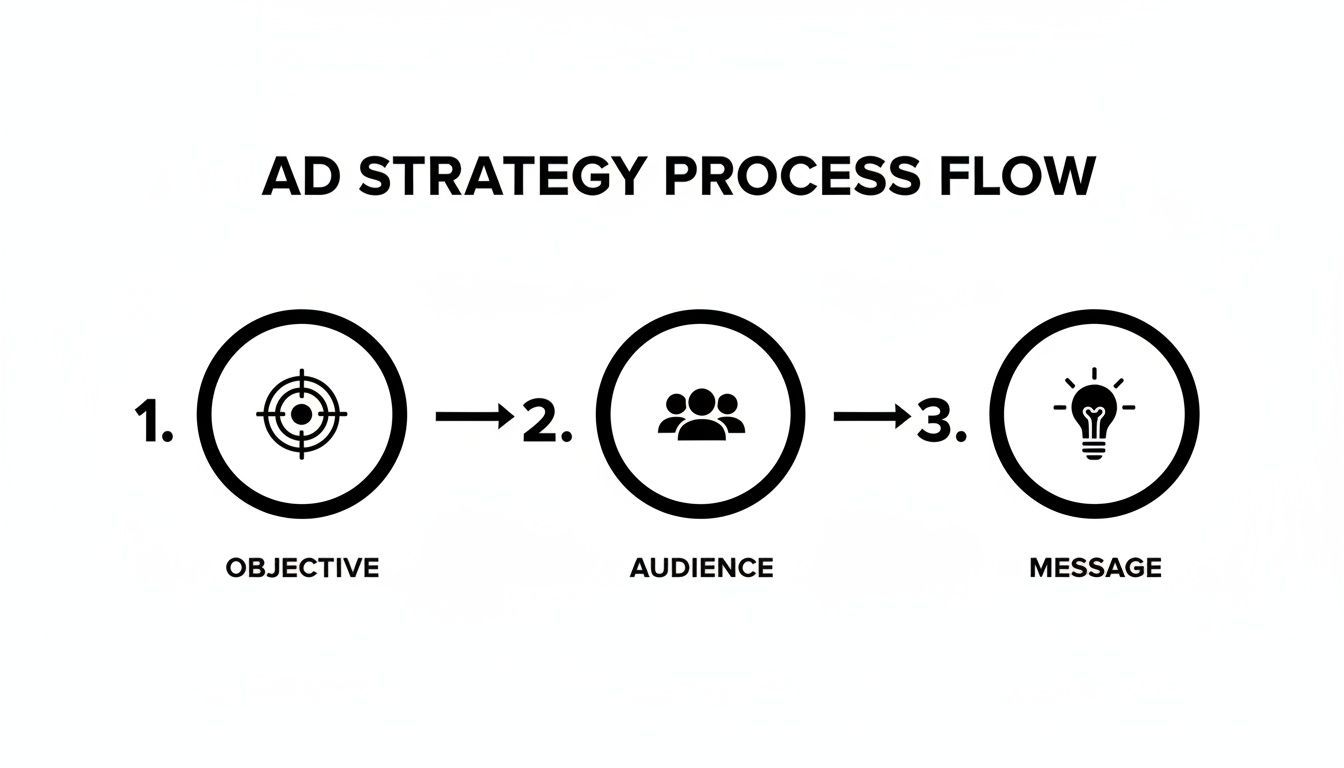
Defining your objective, knowing your audience, and nailing the message—this is the foundation every great AI-generated ad is built on.
Layering on Your Brand and Message
With your scenes and voiceover locked in, it's time to add the finishing touches that make the ad unmistakably yours. This means adding your branding, text overlays, and music to create a polished, professional video.
-
Branding: Get your logo and brand colors loaded in. Most tools have a "brand kit" feature that applies your branding to every video with a single click, which is a massive time-saver for keeping your campaigns consistent.
-
Text & Captions: Add bold, easy-to-read captions. Seriously, don't skip this. A huge chunk of social media video is watched with the sound off, so your main message has to come through visually.
-
Music: Pick a music track that matches the ad's vibe. Something upbeat and energetic is great for a product launch, while a calmer, more atmospheric tune might be better for a brand story.
The market for AI-generated video is projected to grow at an incredible 35% annually, on its way to hitting $14.8 billion by 2030. This isn't just hype; it's driven by real business needs. In fact, 95% of video marketers say that video is a critical part of their overall strategy.
If you want to see how these creative inputs come together in a real tool, check out platforms like Branditok's AI video ad maker. Playing around with a tool like that gives you a much better feel for how quickly you can turn a simple script into a high-quality ad that’s ready to drive results.
Optimizing Your Ad for Every Social Platform
You’ve used your AI video ad maker to create a killer ad. That’s a huge win, but the work isn’t over. The single biggest mistake I see marketers make is taking that one video and blasting it across every social channel. A masterpiece on YouTube can be a complete dud on Instagram if you don't tailor it to the unique vibe and technical specs of each platform.
This goes so much deeper than just resizing. True optimization means getting inside the user's head for each app. Someone mindlessly scrolling TikTok is in a totally different mental space than a professional browsing LinkedIn. Your ad has to respect that context to have any shot at working.
From Landscape to Vertical: A Deep Dive
The most glaring difference is orientation. That slick 16:9 landscape video you made for YouTube just looks sloppy and out of place in a 9:16 vertical feed on Instagram Reels or TikTok. While your AI tool can handle the technical resizing in a click, the real skill is in reframing the creative to feel native to its new home.
When you go vertical, your key action has to be front and center. What was a beautiful wide shot on YouTube might need to become a tight, in-your-face close-up for TikTok to have the same impact.
Here's how I think about platform-specific tweaks:
- TikTok & Reels: Your hook has to hit in the first one or two seconds, max. Captions need to be big, bold, and placed in the lower third so the app's UI doesn't cover them. The pacing has to be absolutely relentless—quick cuts every second or two are non-negotiable for holding attention.
- YouTube: You’ve got a little more room to breathe here. You can use the wider 16:9 frame for more detailed visuals and a slightly slower build. For any serious YouTube campaign, mastering YouTube SEO best practices is crucial for getting seen. Your title, description, and tags are just as important as the video itself.
- Facebook & Instagram Feeds: Square (1:1) or 4:5 vertical videos tend to work best in the main feed. People are in a more relaxed browsing mode, so you can tell a bit more of a story, but keep it tight. Under 30 seconds is a solid rule of thumb.
Customizing Your Hook and Call to Action
Beyond the visuals, you have to adapt your message. A one-size-fits-all call-to-action (CTA) almost never works. Each platform's audience is there for a different reason, with different expectations.
Let’s go back to our eco-friendly coffee brand example:
- On TikTok: The CTA could be a playful challenge like, "Tap 'Shop Now' & ditch plastic pods for good!" The hook needs to be an instant visual grab.
- On LinkedIn: The entire approach shifts. The hook might be a shocking stat about corporate coffee waste. The CTA becomes more professional, maybe "Download our guide to sustainable office solutions."
- On Facebook: Here, you can lean into community. The CTA could be, "Join our community of coffee lovers who care," and point them to a Facebook Group.
This is exactly why the video ad maker space is exploding. Marketers are under pressure to create multiple high-quality variations, fast. A staggering 95% of marketers see video as essential to their strategy, and 87% directly credit it with boosting brand awareness. This shift is fueling the demand for tools that can quickly adapt one great idea for every channel.
Don't just resize your video; reimagine it for each platform. Think about why a user is on that specific app and tailor your hook, pacing, and CTA to match their immediate intent. One ad does not fit all.
Harnessing AI for Rapid A/B Testing
This is where your AI tool becomes your secret weapon. Instead of spending days crafting one "perfect" version of an ad, you can generate a dozen variations in minutes and let the data tell you what actually works.
Put the AI to work by testing different elements on each platform:
- Test Your Hooks: Generate three different versions of the first three seconds. Run them as separate, low-budget campaigns and see which one gets the lowest skip rate and highest watch time.
- Test Your Visuals: Swap out the background footage or product shots. Does a raw, user-generated content (UGC) style clip outperform a polished studio shot on Instagram? Your AI tool lets you test that hypothesis in an afternoon.
- Test Your CTA: Try different offers and button text. Does "Get 50% Off" pull better than "Start Your Free Trial"? These small tweaks can lead to massive lifts in conversion.
By constantly testing and optimizing for each platform, you create a powerful feedback loop. You stop guessing and start knowing. This data-driven approach ensures every dollar of your ad spend is working as hard as it possibly can. Understanding these nuances is also why we dig into related topics, like exploring https://shortgenius.com/blog/how-much-does-tiktok-pay for creators.
Alright, your video ad is live and running. Take a moment to celebrate, but don't get too comfortable. This isn't the finish line—it's just the starting block. Launching the ad is the easy part. The real work starts now, shifting from creator to analyst to figure out what's actually working.
It’s incredibly tempting to get a rush from high view counts or a wave of likes. While those numbers feel good, they’re often just vanity metrics that don't tell you the whole story. Honestly, a video with a million views that doesn't generate a single sale is a complete failure. We need to cut through that noise and focus on the numbers that actually move the needle for your business.
Identifying Your Core KPIs
To measure success properly, you have to track Key Performance Indicators (KPIs) that connect directly to the business goals you set way back in the planning stage. If your main objective was conversions, then likes are pretty much irrelevant. Instead, you need to be laser-focused on the metrics that follow a customer’s journey from seeing your ad to making a purchase.
So, let's talk about the essential KPIs you should be watching like a hawk for any campaign where performance is the name of the game.
Essential Video Ad KPIs and Their Meanings
This table is your cheat sheet for the most critical metrics you'll use to evaluate how your video ad is truly performing. Think of it as the dashboard for your campaign's health.
| KPI (Key Performance Indicator) | What It Measures | Why It Matters for Your Business |
|---|---|---|
| Click-Through Rate (CTR) | The percentage of viewers who clicked your ad's link. | This is your first real signal of engagement. A high CTR means your hook and message are compelling enough to get people to act. |
| Conversion Rate | The percentage of clickers who completed a desired action (e.g., made a purchase, signed up). | This is the ultimate measure of your ad's effectiveness. It tells you if you're persuading the right people to follow through. |
| Return on Ad Spend (ROAS) | The total revenue generated for every dollar spent on advertising. | This is the bottom-line metric for profitability. If your ROAS is above 1, you're making more than you're spending. Simple as that. |
| Cost Per Acquisition (CPA) | The average cost to acquire one new customer through your ad campaign. | This shows you how efficiently you're bringing in new customers. Your goal is to keep this number as low as possible without sacrificing quality. |
These metrics don’t exist in a vacuum; they work together to paint the full picture of your campaign's health. They give you actionable data, not just feel-good numbers.
Reading the Story Your Data Tells
This is where experience really comes into play—learning to interpret what the numbers are telling you. Your data tells a story about what’s working and, more importantly, what’s broken. Your job is to listen and react.
Let’s run through a few common scenarios I see all the time and what they likely mean:
- High CTR, Low Conversion Rate: This is a classic. It means your ad is fantastic at grabbing attention, but your landing page is dropping the ball. The creative is doing its job, but something in the post-click experience—the page design, the offer, maybe even slow load times—is causing people to bounce.
- Low CTR, High Conversion Rate: This suggests you have a killer product and a great landing page, but your ad just isn't compelling enough to get people there. The few who do click are converting, which is a strong sign that your ad creative needs a better hook or a much clearer call-to-action to pull in a wider audience.
- High Viewer Drop-Off in the First 3 Seconds: If people are scrolling past almost immediately, your hook is failing. Plain and simple. Those first few seconds are the most valuable real estate in your entire ad. This is a clear signal to jump back into your video ad maker and test completely different opening scenes or scripts.
Don't get emotionally attached to an ad you personally love. The data is the only thing that matters. If the numbers say it isn't working, it isn't working. Be ruthless, kill the ads that underperform, and pour your budget into the ones that deliver.
This feedback loop is what makes a powerful video ad maker such a game-changer. The insights you get from campaign data can be translated into action almost immediately. You can take what you’ve learned, head right back into the tool, and spin up new variations in minutes—not weeks.
This cycle of testing, analyzing, and iterating is the real engine of long-term campaign success and, ultimately, profitability.
Common Questions About AI Video Ad Makers
Jumping into any new tech always brings up a few questions. Even after you've mapped out a solid strategy and figured out the creation process, some practical, real-world concerns can pop up. Let's run through some of the most common questions I hear from marketers when they first start using an AI video ad maker.
Think of this as a quick Q&A to clear up those nagging "what ifs" and "how tos" so you can move forward with confidence.
Do I Still Need Creative Skills to Make a Good Ad?
This is a big one. The honest answer? Yes, but the type of skill you need has changed. You no longer have to be a technical wizard who can wrestle with complex editing software or master motion graphics. The AI handles all of that heavy lifting.
Where you come in is the strategic side of creativity—that's more important than ever. The tool can't tell you who your customer is, what their deepest pain points are, or what unique angle will actually stop their scroll. Your real value is in providing the right strategic direction: the core message, the audience insight, and the compelling offer.
The AI is an incredibly powerful collaborator, but it's not the visionary. Your job is to be the creative director who guides the AI, not the technician who executes every tiny detail.
So, while you don’t need to be a filmmaker, you absolutely still need to be a smart marketer. The AI is there to amplify your strategic ideas, not replace them.
Can AI-Generated Ads Truly Match My Brand's Style?
Brand consistency is a completely valid concern. The last thing you want is a generic-looking ad that feels totally disconnected from the brand identity you've worked so hard to build. The good news is that modern AI ad makers are built with exactly this in mind.
Most platforms have what's often called a "Brand Kit." This is your central hub for uploading all your specific assets:
- Your company logo to make sure it's always placed correctly.
- Your exact brand colors (just pop in the hex codes for perfect consistency).
- Your preferred fonts to keep all the text overlays on-brand.
Once you have this kit set up, the AI automatically applies these elements to every video it generates. This ensures a consistent look and feel across all your campaigns. You can also guide the AI's choices for stock footage and voiceover talent to better match your brand's personality—whether you're going for playful and energetic or sophisticated and calm.
Are There Limits on What Kind of Products I Can Advertise?
This is a practical question that comes up all the time. Generally, AI video ad makers are incredibly versatile, but their strengths can vary a bit depending on what you're selling.
For things like software, courses, or services, these tools are a perfect fit. They're fantastic at creating compelling narratives and demonstrations without needing to show a physical item.
They're still extremely effective for physical products, but you might need to adjust your approach. The AI can generate amazing lifestyle scenes, voiceovers, and text overlays, but you'll probably want to supply your own footage or images of the product in action. You can then use the AI to weave that custom footage into a polished, professional-looking ad.
How Do I Avoid Making Ads That Look AI-Generated?
I get it. The goal is to create ads that feel authentic and human, not robotic. The key is to lean into the elements that build a genuine connection and sidestep the common pitfalls that can make content feel artificial.
Here are a few tips I've learned from experience:
- Prioritize Authentic Voiceovers: Spend extra time listening to the voice previews. Choose one that has natural-sounding pauses and inflections. A pro tip: use punctuation in your script to guide the AI's delivery and make it sound more human.
- Select Unique Stock Footage: Don't just grab the first clip you see. Dig deep into the stock library and use specific, emotional search terms to find footage that doesn't look like it’s been used a thousand times before.
- Humanize Your Script: Write your script in a conversational tone. Then, read it out loud. If it sounds like something a real person would actually say, you’re on the right track.
By carefully curating these human-centric elements, you ensure the final ad feels relatable and trustworthy, steering clear of that uncanny, obviously AI-generated feel.
Ready to stop guessing and start creating high-performing ads in minutes? ShortGenius is the all-in-one AI ad generator that helps you craft thumb-stopping video and image ads for every platform. From script to final cut, you can generate endless creative variations, test what works, and scale your campaigns with confidence. Explore ShortGenius today and see how easy it is to make ads that actually convert.