UGC Ads Generator: Create Authentic, High-Converting Video Ads

Discover how a ugc ads generator helps you craft authentic, high-converting video ads with practical tips for scripting, production, and scaling campaigns.
So, what exactly is a UGC ads generator? Think of it as an AI-powered tool that lets you create video ads that look and feel like authentic, user-generated content. It handles everything from scripting to realistic voiceovers and video editing, all in a matter of minutes. The goal is to produce ads that stop the scroll on platforms like TikTok and Instagram because they feel genuine and trustworthy, not like a slick corporate production.
The Shift to AI-Powered UGC Advertising

Let's be honest, the era of glossy, over-polished corporate ads is on its way out. Today's audiences are smart, skeptical, and have developed a serious case of ad blindness. What they want more than anything is authenticity.
This fundamental shift has made user-generated content (UGC) the new king of advertising. It’s not just about an ad looking a bit rough around the edges; it's about hitting that powerful psychological trigger of social proof.
When a potential customer sees an ad that looks like it was made by a real person, their "ad filter" doesn't even kick in. It registers as a recommendation from a peer, not a sales pitch from a brand. The problem? Sourcing real UGC is a massive headache—it's slow, expensive, and you never quite know what you're going to get. This is exactly where a UGC ads generator changes the game.
Bridging the Gap Between Authenticity and Scale
AI tools finally solve the classic marketing problem: how do you pump out a steady stream of fresh, engaging ad creative without blowing your budget or burning out your team? Platforms like https://shortgenius.com are built to close this gap, merging the high cost of traditional UGC with the relentless need for scalable video content.
This isn't just a time-saver; it’s a complete overhaul of the creative process. You can now spit out dozens of ad variations in the time it used to take to brief a single creator. In a world where ad fatigue can kill a campaign in days, that speed is everything.
The numbers back this up. The global AI in advertising market was valued at USD 8.6 billion in 2023 and is on track to hit a staggering USD 81.6 billion by 2033. This explosion is happening because brands desperately need hyper-relevant, authentic-looking ads. By the end of 2024, experts predict 60% of all digital ad spending will be touched by AI in some way.
Key Takeaway: An AI UGC ads generator's real superpower is its ability to produce content that feels authentic at the speed and scale that modern marketing demands, crushing the old bottlenecks of time and money.
Why Does This Matter for Your Brand?
To really get why this matters, you have to understand what UGC content is at its core. AI doesn't replace solid marketing principles; it just puts them on steroids. It gives your team the power to:
- Test and Iterate Like Never Before: Launch campaigns with 10 different hooks, 5 different visuals, and 3 different CTAs to quickly find out what actually works.
- Slash Creative Costs: Forget about hiring actors, renting studios, and enduring weeks of post-production. The overhead just disappears.
- Keep Your Brand on Point: Even when you're creating content at a massive scale, you can ensure every video aligns perfectly with your brand's voice and style.
At the end of the day, a UGC ads generator lets you speak your audience's language. You're building trust and driving action with content that simply feels real.
Your Hands-On Guide to Making High-Performing UGC Ads with AI
Alright, enough with the theory. Let's get into the weeds and actually build one of these things. Making a great UGC-style ad with an AI generator isn't a one-click magic trick. Think of yourself as the director and the AI as your super-efficient production crew.
I’ll walk you through the entire process, from a blank slate to a finished ad ready for your TikTok or Instagram feed. To keep this grounded in reality, we'll work with a real-world example: an e-commerce brand launching a new sustainable, spill-proof coffee mug. Our mission is to create an ad that feels like it came straight from a happy customer's phone.
First, Nail Down Your Concept and Script
Every killer ad starts with a solid idea. Before you even touch the UGC ads generator, you need a crystal-clear vision for the story you want to tell. The best way to do this is to lean on proven UGC formats that people already love.
For our coffee mug, a few classic hooks immediately come to mind:
- The Problem/Solution: Start with the all-too-relatable frustration of a coffee stain on a clean white shirt, then swoop in with our new mug as the hero.
- The Unboxing: Capture that first-impression excitement. You can highlight the eco-friendly packaging and the mug's sleek design as it's revealed.
- A Day in the Life: Show the mug in action. Think bumpy car commutes, a cluttered desk, or even at the gym—real scenarios where it proves its worth.
We’re going to run with the "Problem/Solution" angle. It’s direct, powerful, and gets straight to the point. With that decided, we can now use AI to help write the script. The secret here is giving the AI a very specific persona and super clear instructions.
My biggest tip? Your AI prompt is everything. Get descriptive. Don't just ask for "an ad script." Guide the AI with a detailed brief that sets the scene and establishes a tone people can connect with.
Here’s a prompt I’d actually use:
"Write a 30-second UGC-style video script for a TikTok ad. The person speaking is a 28-year-old professional who loves coffee but is so over spills. Start with her complaining about ruining another shirt with her old mug. Then, have her get really excited about her new 'EarthMug,' showing off its spill-proof lid and sustainable materials. The tone should start off a bit sarcastic and annoyed, then become genuinely enthusiastic. Finish with a clear CTA: 'You can get yours at [BrandWebsite].'"
The script the AI kicks back will be a solid foundation. From there, you just need to polish the wording a bit to make it sound perfectly natural for your brand.
Next, Generate Your Visuals and Build the Video
With a script ready to go, it’s time to create the visuals. A top-tier UGC ads generator rolls several powerful tools into one smooth workflow. You can generate scenes from text prompts, upload your own brand assets, or pull in stock footage that the AI can re-style to fit that authentic UGC vibe.
This is where a powerful text-to-video engine becomes your best friend. For our coffee mug ad, we could create our scenes using simple descriptions like these:
- A close-up of a dark coffee stain blooming on a white blouse. Make it look frustrating.
- A shot of a woman looking annoyed while holding a generic, leaky travel mug.
- A dynamic unboxing shot of the sleek, new EarthMug emerging from its packaging.
- A super satisfying slow-motion clip of the mug being tipped over, but nothing spills.
- A final shot of the same woman smiling and sipping from her new mug at her desk.
You literally just drag these clips onto a timeline, arranging them to match the script. The platform takes care of the transitions, so it feels more like putting together a puzzle than wrestling with complicated editing software.
Finally, Add a Natural Voiceover and the Finishing Touches
The voiceover is what makes or breaks an AI-generated ad. A robotic, flat voice is an immediate red flag for viewers. Thankfully, modern AI platforms offer a huge range of voices with different accents, tones, and natural-sounding inflections.
You can paste your script right into the voiceover tool and click through different options. Find one that truly matches the persona you imagined—in our case, someone who sounds genuinely relieved and happy. Pay attention to punctuation in your script! A question mark or an exclamation point can completely change the AI’s delivery and make it sound much more human.
Once the voiceover is synced up, it's time to add the final layers that make the ad stand out:
- Dynamic Captions: Add auto-generated, animated captions. This is a must for the 85% of people who watch videos with the sound off.
- Background Music: Pick an upbeat, royalty-free track from the platform’s library to set the mood.
- Brand Kit: Easily apply your brand’s logo and colors for a consistent, professional look.
Give it one last look, and then hit export. In just a matter of minutes, you've gone from a simple idea to a complete, high-quality UGC-style ad that's ready to grab attention and start bringing in sales.
Crafting Ads That Don't Look Like Ads
Anyone can spin up a video with a UGC ads generator in minutes. That’s the easy part. The real trick, and where so many campaigns miss the mark, is making that AI-generated content feel like it was made by a real person. It’s a delicate balance to avoid the "uncanny valley"—that slightly-off feeling that makes viewers instantly distrust what they're seeing.
The secret isn’t just a realistic AI voice or a perfect-looking video. It's about deliberately weaving in the small, human imperfections that define genuine user content. Without those little touches of realness, even the slickest AI ad will feel cold and unconvincing.
The whole process boils down to a few key stages.
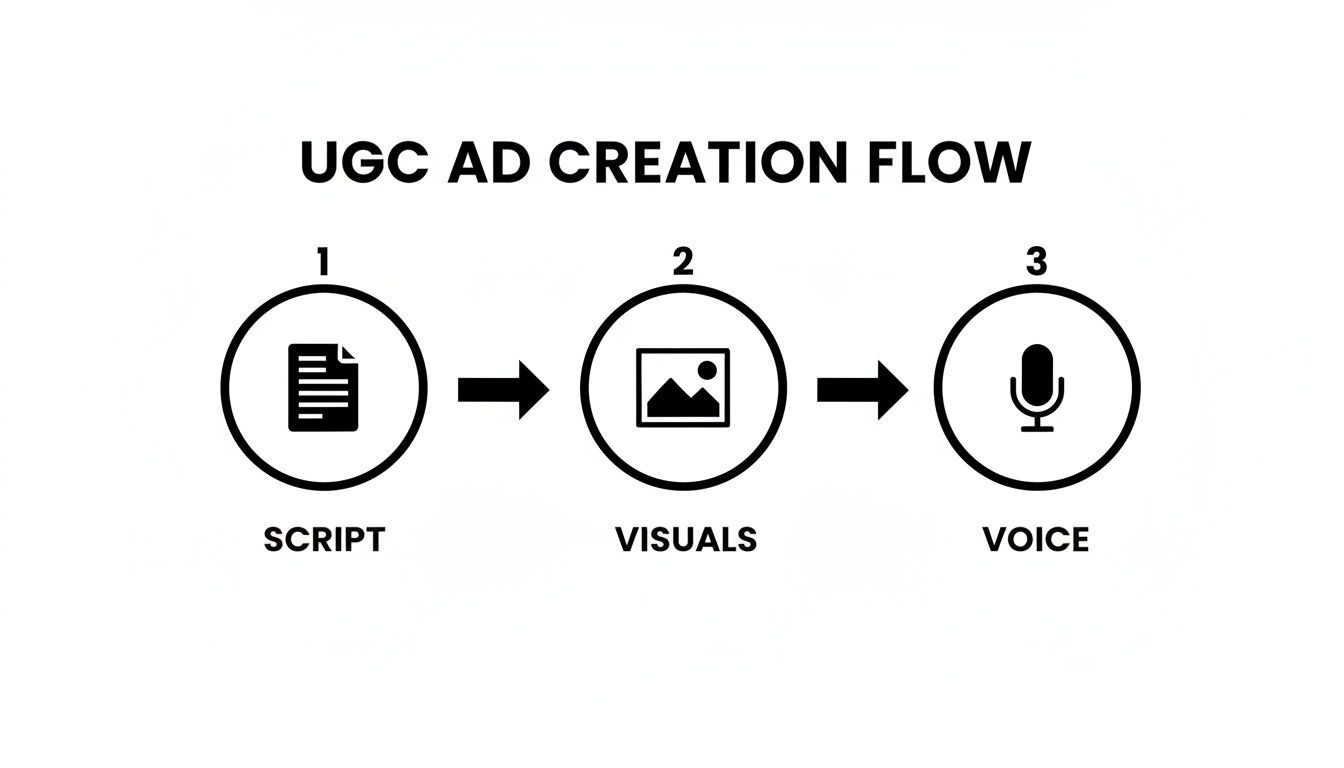
This workflow isn't just a series of steps; it shows how the script, visuals, and voice all need to work together to build a single, believable piece of content.
Infusing Humanity into Your AI Script
The script is the soul of your ad. If it sounds robotic, the final video will too, no matter how good your tools are. The first step is to write like people actually talk.
Write for the ear, not the eye. Use contractions. Throw in some casual slang. Don't be afraid of sentence fragments. Instead of scripting, "This product is incredibly effective," try something more natural like, "Okay, so this thing actually works."
Once you have that conversational base, start layering in human nuances:
- Realistic Pauses: Sprinkle ellipses (...) or commas into your script to signal where the AI voice should take a natural breath. It breaks up the rhythm and feels less rehearsed.
- Varied Inflection: Use exclamation points and question marks to guide the AI's tone. A simple punctuation change can turn a flat statement into a moment of excited discovery.
- Authentic Word Choice: Ditch the marketing jargon. Seriously. Think about how a real customer would rave about your product to a friend and use those exact words.
Simulating a Candid, "Shot-on-My-Phone" Style
Real UGC is almost never shot in a pristine studio. It’s filmed on a phone, probably with shaky hands and less-than-perfect lighting. You need to replicate this raw, organic feel using your generator’s editing features.
Perfection is the enemy of authenticity. Embracing small imperfections is what makes AI-generated UGC believable, helping it blend right into a user's social feed instead of sticking out like a sore thumb.
To get that candid look, start by adding subtle effects that mimic real-world filming. Most tools have presets for a slight camera shake or a quick, subtle zoom that makes a static shot feel more dynamic. Quick cuts are also your best friend here. Real UGC videos jump between scenes fast, so keep your clips short—just a few seconds each—to create a high-energy, scroll-stopping pace. Digging into a tool's image editing features can also help you add simple filters or tweaks that make AI visuals look less perfect and more like they were genuinely captured on a smartphone.
Balancing Brand Safety with a Raw Feel
As brands lean into AI, the way we create content is changing fast. A staggering 88% of marketers already use AI tools daily, and 92% of businesses are planning to invest more. This isn't just for efficiency; it's driving real results, with 93% reporting they create content faster and 81% seeing measurable lifts in brand awareness and sales. This shift makes it far easier to produce UGC-style ads at scale while keeping things on-brand.
Before we dive into that, it's worth seeing how the new AI workflow stacks up against the old way of doing things.
UGC Ad Creation Traditional Sourcing vs AI Generation
| Aspect | Traditional UGC Sourcing | AI UGC Generation |
|---|---|---|
| Cost | High (creator fees, contracts, shipping) | Low (subscription or per-video fees) |
| Speed | Slow (weeks to months) | Fast (minutes to hours) |
| Scalability | Difficult (requires individual outreach) | Easy (generate endless variations quickly) |
| Control | Limited (relies on creator's interpretation) | Total (direct control over script, visuals, voice) |
| Authenticity | Guaranteed (real person, real experience) | Simulated (requires skill to feel genuine) |
Ultimately, both paths have their place. Traditional UGC is unbeatable for pure, raw authenticity, while AI offers incredible speed and control for testing and scaling campaigns.
The final piece of the puzzle is layering in your brand elements without wrecking that raw aesthetic you've worked to create. Use your brand kit to add a subtle logo watermark, but skip the polished, animated intros and outros. For captions, stick to simple, clean fonts that look native to platforms like TikTok or Instagram. The goal is brand consistency, not a corporate takeover of the ad's style.
How to Optimize and Scale Your UGC Ad Campaigns
Creating that first compelling, authentic-feeling ad is a huge win, but honestly, it’s just the starting line. The real magic of using a UGC ads generator isn't just making one great video; it’s about having the power to rapidly produce enough variations to figure out what truly makes your audience click.
This is where you stop being just a content creator and start thinking like a campaign strategist.
Without a solid testing framework, you're basically just throwing spaghetti at the wall and hoping something sticks. But when you take a data-driven approach, your ad spend transforms into a powerful learning tool. Every dollar is an investment in finding creative that actually works. The goal is to move from, "I think this ad is good," to, "I know this ad works because the numbers prove it."
Now, let's get into the nitty-gritty of optimizing and scaling that initial creative into a high-performing, revenue-generating machine.
A Practical Guide to A/B Testing Your Ads
Systematic testing is, without a doubt, the fastest way to improve your return on ad spend (ROAS). The key is to test just one variable at a time. If you change the hook, the voiceover, and the CTA all at once, you’ll have no idea which change actually made the difference.
Thankfully, a good UGC ads generator makes this incredibly easy. You can just clone a project and swap out a single element in seconds.
Here's where I'd recommend you start, focusing on the components that have the biggest impact:
- The Hook: This is all about the first three seconds. Pit a question against a bold statement. Does a "problem-first" angle ("Tired of your phone dying by noon?") work better than a fun "unboxing" scene?
- The Voiceover: Try a casual, friendly tone against a more direct, authoritative one. You might be shocked to discover which persona actually connects with your target demographic.
- The Call-to-Action (CTA): Compare different closing lines. "Shop Now" is the old standby, but something like "Get Yours Before It's Gone" might create enough urgency to drive way more conversions.
- The Visuals: Test different background scenes. Does a clean, minimalist setting convert better than a chaotic, real-world environment?
By isolating these variables, you'll gather clean, unambiguous data that gives you a clear roadmap for your next batch of ads.
Tracking the KPIs That Actually Matter
When you're staring at your ad platform's dashboard, it's easy to get lost in a sea of metrics. To cut through the noise, you need to zero in on the key performance indicators (KPIs) that directly signal whether your UGC-style ad is doing its job.
Pro Tip: Don't just obsess over Click-Through Rate (CTR). For UGC-style video ads, your Hook Rate—the percentage of viewers who watch past the first three seconds—is a much better indicator of whether your creative is stopping the scroll.
These are the essential metrics I always monitor:
- Hook Rate: This is your number one metric for an ad's opening. A low hook rate tells you immediately that your first three seconds aren't compelling enough.
- Hold Rate: This measures how many viewers stick around to watch the entire ad. It's a great signal for how engaging your story is from start to finish.
- Click-Through Rate (CTR): While it's not the only metric, a high CTR is still a great sign that your message and CTA are motivating people to take the next step.
- Cost Per Click (CPC): This keeps you honest about the efficiency of your ad spend. Are you driving traffic at a sustainable cost?
Automating Your Distribution for Maximum Reach
Once you've identified a few winning ad formulas, the next challenge is getting them in front of the right people, consistently. Manually posting your winning ads across TikTok, Instagram Reels, and YouTube Shorts is a surefire recipe for burnout.
This is where AI-powered scheduling tools become your best friend. Many modern platforms, including ShortGenius, integrate scheduling directly into the workflow.
You can set up a full content calendar, automatically publishing your top-performing ads and their variations across all your key channels. This doesn't just save a ton of time; it ensures a steady stream of high-quality content that keeps your brand top-of-mind and builds a truly scalable, data-backed ad strategy.
Why Generative AI Is a Game-Changer for Ad Creatives
To really get why a UGC ads generator is such a big deal, you have to look at what’s driving it: Generative AI. This isn't the kind of AI that just sorts through data. This is AI that creates brand new, original content—text, images, and video—from a simple idea.
This is the tech that lets you type out a prompt and get a surprisingly realistic video ad back in just a few minutes. It's a massive leap forward, essentially putting a full production studio right at your fingertips. Suddenly, high-quality creative is no longer out of reach.
It's tough to overstate how quickly this is all happening. The technology at the heart of tools like ShortGenius is absolutely booming. Projections show that worldwide spending on this tech is expected to reach $14.2 billion by the end of 2025, and the market could explode to over $1.3 trillion by 2032.
With more than $33.9 billion in private investment already poured in, it’s clear the industry is betting big on these tools. That money is what's fueling the engine that allows a UGC ads generator to pull from web data and produce compelling ads that actually connect with people. You can dig deeper into these generative AI trends and their market impact if you want to see the numbers for yourself.
From Endless Concepts to Hyper-Personalization
So, what does all this tech firepower actually do for you on a practical level? It means you can finally blast through the creative roadblocks that always seem to grind campaigns to a halt.
Think about it:
- Infinite Ad Concepts: Forget brainstorming three or four ad angles. You can now generate dozens in the time it takes to grab a coffee, each with a different hook.
- No More Stock Photo Fatigue: You can create completely unique visuals that are specific to your brand. Your ads will finally look fresh and original, which is what it takes to stop someone's scroll.
- Personalization at Scale: Need to tweak an ad for different audiences? You can create variations for different demographics or interests without having to manually rebuild everything from scratch.
A good UGC ads generator levels the playing field. It takes incredibly complex technology and wraps it in a simple interface, letting you focus on strategy and results instead of getting lost in the weeds of video production.
This ability to generate, test, and personalize content at speed is what shifts your ad strategy from a slow, costly process into a nimble, data-backed operation.
Got Questions About UGC Ad Generators?
Diving into any new tool, especially one that uses AI, is bound to bring up some questions. When it comes to using a UGC ads generator, I’ve found that most people are curious about the same three things: authenticity, speed, and how hard it is to actually use.
Let's get those sorted out so you can jump in and start creating.
Can AI-Generated UGC Actually Feel Authentic?
This is the big one, and the answer is a resounding yes—if you do it right. The goal isn't to trick anyone. It’s to capture the vibe of real, user-shot content that people genuinely connect with on their feeds.
Modern AI generators are incredibly good at creating natural-sounding voiceovers and conversational scripts. But the magic really happens when you, the human, guide the process.
Here’s how you nail the authentic feel:
- Keep your cuts fast and punchy. Think about how people edit videos on their phones. It's not perfect, and that's the point.
- Add subtle camera shake or movement. This little trick instantly simulates that "shot on my phone" look.
- Write your script like you talk. Ditch the corporate buzzwords and use real, everyday language.
When you blend these elements, the final ad feels less like a polished commercial and more like a genuine recommendation from a friend. The authenticity is all in the execution.
How Much Time Can I Honestly Save?
The time savings are probably the biggest game-changer. Let’s be real: traditional UGC is a grind. You have to find the right creators, handle all the back-and-forth on contracts, ship out products, and then cross your fingers and wait for the content to come back. This whole dance can easily take weeks.
Now, contrast that with a UGC ads generator. You can literally go from a blank page to a finished ad, ready for launch, in under an hour.
For anyone running A/B tests (and you should be!), this is huge. What used to take days of production for a few ad variations now takes minutes. You can test more ideas, learn what works faster, and optimize your campaigns on the fly.
This isn't just about working faster. It's about making your entire advertising strategy more agile and letting you react instantly to performance data.
Are These Tools Too Complicated for a Beginner?
Not at all. The best platforms, like ShortGenius, are built for marketers, not professional video editors. They pull everything you need—scripting, video clips, voice generation, and editing tools—into a single, straightforward workflow.
You don't need a background in video production or copywriting to get fantastic results. The process is designed to be intuitive, with AI helping you at each stage. It empowers anyone on your team to create high-quality, UGC-style ads in minutes.
Ready to create scroll-stopping ads in minutes? Try ShortGenius and see how easy it is to generate high-performing, authentic-style video ads at scale. Get started today at shortgenius.com.