Social media content planning template to streamline scheduling and analysis

Download the social media content planning template to structure, schedule, and analyze posts quickly, boosting consistency and engagement.
Let's be real for a moment: having a solid social media content planning template is what separates a chaotic, always-playing-catch-up content strategy from one that's proactive and built for growth. It’s the blueprint that helps you organize ideas, schedule posts, and make sure every single thing you create has a clear purpose. This guide isn't just about handing you a document—it's about giving you a complete system.
Building Your Blueprint for Content That Actually Works
The relentless pressure to churn out fresh social media content is exhausting. I’ve seen so many marketers get stuck in a never-ending loop of last-minute brainstorming, which leads to inconsistent posting and, ultimately, burnout. This frantic approach almost never gets meaningful results because it lacks the strategic foresight needed to build momentum and genuinely connect with an audience. A structured plan is the only way to hop off that content treadmill for good.
The whole point is to shift from being reactive—posting whatever pops into your head today—to becoming proactive and, eventually, scalable. As detailed in this guide to building a modern church social media strategy, developing a clear plan first is non-negotiable. This simple change can turn a stressful, messy process into a smooth-running operation.
The Shift from Reactive to Proactive Planning
So many creators are stuck in a state of constant urgency. A recent survey found that a shocking 38% of marketers only plan their content one week in advance. Think about that. It leaves them scrambling to keep up with trends and algorithm changes, creating a huge barrier to sustainable growth and audience connection.
A proactive content plan does more than just organize your posts; it organizes your thinking. It forces you to define your goals, truly understand your audience, and create with intention, making sure every video, image, and caption contributes to your bigger picture.
This workflow visualizes the journey from a chaotic process to a structured, repeatable one.
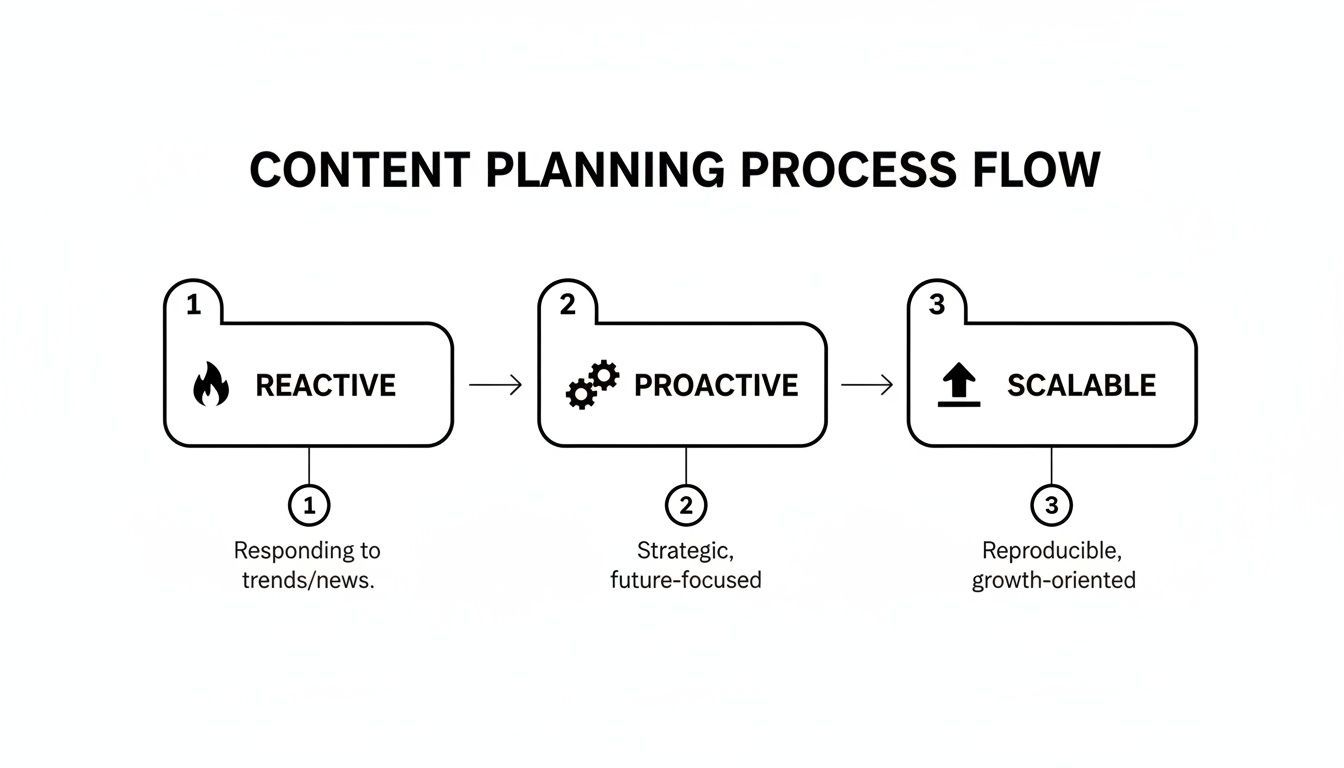
This evolution—from reactive to proactive and finally to scalable—is exactly how top creators and brands achieve consistent growth without burning themselves out. Our social media content planning template is built to guide you through this exact journey.
Core Stages of a High-Impact Content Workflow
Our social media content planning template is built on an essential workflow that provides a clear roadmap for the entire process. Here are the core stages you'll move through.
| Stage | Objective | Key Outcome |
|---|---|---|
| Strategy & Ideation | Define content pillars, goals, and core topics. | A clear content direction and a backlog of relevant ideas. |
| Production | Create all content assets (videos, images, graphics). | High-quality, platform-specific content ready for publishing. |
| Scheduling | Plan and schedule posts across all platforms. | A consistent posting schedule that optimizes for engagement. |
| Repurposing | Adapt existing content for different formats and platforms. | Maximized content value and extended reach with less effort. |
| Analysis | Track performance metrics and gather insights. | Data-driven adjustments to improve future content strategy. |
By building a system around these stages, you'll start to see some incredible benefits.
Putting a system like this in place allows you to:
- Maintain Consistency: Keep a steady flow of high-quality content going out, which algorithms and audiences love.
- Improve Quality: With planning, you have more time for creative brainstorming and polished production instead of rushing.
- Measure What Matters: Align your content directly with business goals and track your performance in a way that makes sense.
- Save Valuable Time: Batch-producing content is a game-changer, freeing you up to focus on strategy and engaging with your community.
This guide gives you both the framework and the tools to make it happen.
Laying the Foundation: Your Core Content Pillars
A fancy social media template is great, but it's useless without a solid strategy behind it. Before you even think about filling in that calendar, you need to nail down your content pillars—the 3-5 core themes your brand will own. These are the bedrock of your entire social media presence, making sure every post, Reel, and Story you create has a clear purpose.
Think of your pillars as the main sections of your own brand magazine. They give your audience a reason to follow you because they know what to expect, and frankly, they make your life a whole lot easier when it comes to brainstorming. Without them, you're just throwing content at the wall and hoping something sticks. With them, you start building real authority and a brand people remember.

How to Find Your Pillars
Figuring out your pillars is a two-way street: you have to look at what your brand is all about and what your audience actually wants to see. The magic happens right where your unique expertise meets their biggest questions and interests. Don't just guess what they care about; you have to do a little digging into their real-world problems and curiosities.
Kick things off by asking yourself these three questions:
- What problem are we actually solving? Every pillar should, in some way, tie back to the core solution your business offers.
- What does our audience geek out about? Dive into Reddit forums, spy on your competitors' comment sections, and check keyword data to find the topics that keep popping up.
- What's our unique angle? What part of your brand story or perspective can you share that no one else can?
Going through this exercise is what separates you from being just another account in the feed. It’s how you become a trusted resource they actively seek out.
Let's See It in Action
Imagine you're running a direct-to-consumer coffee brand. Your main goal is to sell more beans online, and you want to do that by building a community of people who love great coffee as much as you do.
After some research, you discover your audience is really into ethical sourcing and they're desperate to brew better coffee at home. Boom. That's your starting point.
From there, you could land on pillars like these:
- Brewing Guides: All about the how-to. Think tutorials, tips for different methods (AeroPress vs. French Press), and the common mistakes everyone makes.
- Bean-to-Cup Stories: This is where you go behind the scenes. Show off the farms you work with and talk about your ethical practices.
- Coffee Lifestyle: Content that celebrates the culture around coffee. This could be anything from pairing ideas to beautiful cafe shots or featuring your customers' own photos.
- Product Spotlights: Showcasing your roasts in creative ways, not just as a product on a white background. This is also where new product announcements live.
Now, with these pillars in place, the brand has a clear roadmap. An idea under "Brewing Guides" isn't just a random post; it can become a snappy TikTok showing the perfect pour-over, a longer YouTube deep-dive, and an Instagram carousel with step-by-step photos. The pillar gives every idea focus and a ton of mileage.
Once you have a draft of your pillars, run them through a quick check on a tool like Google Trends. This simple validation step confirms that people are actually searching for these topics, turning your social media content planning template from a simple organizer into a strategic growth machine.
Matching Your Content to the Right Platforms
Okay, you've nailed down your content pillars. Now for the most important part: you have to break the habit of cross-posting the exact same message everywhere. It's a tempting shortcut, but it just doesn't work.
Every social platform has its own DNA—a different audience, a unique algorithm, and a specific set of features that people expect to see. A truly effective social media content plan isn't about creating more content; it's about thoughtfully adapting your core message for each of these distinct environments.
This doesn't mean you need to dream up brand-new ideas for every channel. Think of it more like translating a single message into different languages. The core idea stays the same, but you tweak the delivery to fit the native culture of each platform.
A Real-World Example of Platform Strategy
Let's say you're a fitness coach, and one of your content pillars is "Mastering Foundational Movements." A great topic under that pillar is teaching perfect squat form. Instead of just filming one video and blasting it across all your profiles, a savvy coach would adapt it.
Here’s how that single idea can be strategically repurposed:
- TikTok: A high-energy, 30-second video highlighting the three most common squat mistakes. Use quick cuts and on-screen text for visual corrections. The goal here is fast, educational entertainment that gets people to share.
- YouTube: A deep-dive, 10-minute tutorial titled "A Beginner's Guide to Perfect Squat Form." This format is perfect for explaining muscle engagement, breathing techniques, and variations. It serves the audience that came to YouTube to learn something in detail.
- Instagram: A clean, visually appealing carousel post. The first slide could be a hooky graphic, followed by slides that break down each step of the squat with clear photos and concise, actionable tips. It's designed to be saved and referenced later.
Boom. One idea becomes three unique pieces of content, each one perfectly optimized for how people actually use that platform.
Why This Approach Works So Well
Adapting your content isn't just about gaming the algorithm; it's about respecting your audience. People are on different platforms for different reasons. Someone killing time on TikTok wants a quick hit of dopamine, while a person on YouTube is often ready to invest more time to get a deeper understanding.
By meeting your audience where they are—with content formatted for their specific context—you drastically increase the chances of engagement, shares, and saves. It shows you understand the culture of the platform, which builds credibility and trust.
This is especially true for video. Research consistently shows short-form video is a powerhouse for ad recall and effectiveness. With users spending an average of 2 hours and 21 minutes on social media daily, you have to post frequently to stay top of mind. But it absolutely has to be the right content for the right channel. If you want to go deeper on this, check out Hootsuite’s comprehensive research on social media usage.
Using your social media content planning template to map out these platform-specific variations is the key to working smarter. You can build a powerful, multi-channel presence without the burnout that comes from trying to reinvent the wheel for every single post.
Using AI to Batch Produce Your Content
Alright, you've got your content pillars and you know which platforms you're targeting. Now for the fun part: actually making the content. This is where your social media content planning template becomes your production bible, helping you turn ideas into a real library of assets.
The secret to doing this without completely burning out is batch production. It's a simple but powerful concept: create a huge chunk of your content all at once in a single, focused block of time.
Instead of waking up every morning thinking, "What am I going to post today?", you can spend one afternoon knocking out a week's or even a month's worth of videos. This method is an absolute lifesaver. Not only does it free up your schedule, but it also helps keep your content looking and feeling consistent. It's how solo creators can punch way above their weight class and compete with big teams.
When you group similar tasks together—like writing all your scripts, then recording all your audio—you get into a creative flow. The process just feels smoother and way more efficient.
How AI Tools Make Batching Easier
AI video generators have completely changed the game for batch production, especially if you're not a professional video editor. These tools can take a basic idea from one of your content pillars and do all the heavy lifting to create a polished video that's ready to go. This is a massive advantage for short-form video, where you need a steady stream of content to stay on people's radar.
For instance, with a tool like ShortGenius, you can take one long-form piece of content—say, a blog post or a podcast—and spin it into dozens of short video clips. The AI is smart enough to find the best hooks, generate visuals to match, add a natural-sounding voiceover, and even burn in automatic captions. This is huge, especially when you consider that 85% of social media videos are watched on silent.
This is what it looks like inside ShortGenius. You can keep your different video projects organized by series, which makes your batching workflow clean and easy to manage.
Each one of those cards is a separate content series, so you can jump right into producing videos that line up perfectly with your core content pillars.
A Real-World Batching Workflow
Let's walk through a practical example. Imagine you're a solo entrepreneur trying to create content for both TikTok and YouTube Shorts. Your goal is to make 20 short videos to cover the next month.
Here’s how a batching session with an AI tool might play out:
- Generate Scripts: First, you take your core video ideas straight from your content planner and feed them into the AI. It quickly generates 20 unique scripts, each with a solid hook, key talking points, and a clear call to action.
- Create Visuals & Audio: Next, the tool gets to work creating relevant visual scenes for every script, pulling from stock footage or even generating new AI images. While it's doing that, it's also producing a consistent, high-quality voiceover for all 20 videos.
- Final Assembly & Branding: Finally, the AI puts it all together—the visuals, the voiceover, and the captions. With a single click, you can apply your brand kit (your specific colors, fonts, and logo) across all the videos to make sure every single one looks like yours.
This entire workflow can be wrapped up in just a few hours. A process that used to involve days of manual scripting, filming, and tedious editing is now crunched into one highly productive session. That kind of efficiency is a game-changer. It frees you up to focus on the bigger picture: strategy, engaging with your community, and figuring out what content is actually working.
Getting Your Content Out There: Scheduling, Repurposing, and Tracking
Creating killer content is a huge victory, but your job isn't over when you hit the export button. The final leg of the race—distribution and analysis—is what really separates good content from a true growth engine. This is where your social media content planning template evolves from a production checklist into your strategic command center.
The first move is to get your content published consistently without the last-minute panic. I can't stress this enough: auto-scheduling tools are essential. They help you maintain that steady publishing rhythm that keeps you on the good side of both your audience and the platform algorithms. By loading all your finished assets into a scheduler, you escape the daily grind of manual posting and can finally focus on the bigger picture.
Squeeze Every Drop of Value from Your Content
Beyond just scheduling, the real magic to scaling your output lies in repurposing. It’s the art of taking one core piece of content and slicing it into dozens of smaller assets, massively extending its lifespan and reach. That one long-form YouTube video you spent a week on? It's a goldmine.
Diving into smart content repurposing strategies is one of the best ways to maximize the reach of everything you create.
Just think about what you can get from a single 10-minute video:
- Short-Form Clips: Easily snip out 5-10 of the most engaging moments for TikTok, Instagram Reels, and YouTube Shorts.
- Quote Graphics: Pull out the most powerful statements and turn them into shareable quote graphics for Instagram and Facebook feeds.
- Audiograms: Strip the audio to create compelling audiograms for platforms where visuals aren't the main event.
- Carousel Posts: Break down the core concepts into an educational, step-by-step carousel post for Instagram or LinkedIn.
With this mindset, you can fill your content calendar with high-value posts that all stem from a single production effort. It’s the key to working smarter, not harder.
Track the Metrics That Actually Matter
Finally, to make your next content plan even more effective, you have to track performance. It’s easy to get distracted by vanity metrics like likes and follower counts, but they don't tell the whole story. You need to zero in on the key performance indicators (KPIs) that signal genuine audience engagement and align with your actual business goals.
The most successful content plans are built on a feedback loop. You create, you distribute, you analyze, and then you use those insights to shape your next batch of ideas. This is how you stop guessing and start creating content you know your audience wants.
Here are the metrics I always keep a close eye on:
- Saves & Shares: These are massive signals. They tell you your content is so valuable that people want to save it for later or share it with their own network.
- Watch Time & Completion Rate: For video, these are the ultimate measures of how engaging your content really is. A high completion rate means you hooked them and held their attention.
- Click-Through Rate (CTR): If your goal is to drive traffic to your site or a product page, this is your north star. It shows how well your call-to-action is working.
By diligently tracking these KPIs right in your social media content planning template, you’ll get a crystal-clear picture of which content pillars, formats, and topics are hitting the mark. This data is your roadmap, ensuring every new piece of content you create is more strategic than the last.
Got Questions? Let's Get Them Answered
Adopting a new workflow always brings up a few questions. Trust me, I've been there. Getting clear on the details from the start is the difference between a system that saves you a ton of time and one that just adds more to your plate.
Here are some of the most common questions I hear from creators and marketers when they first get serious about planning their social media content.
How Far Out Should I Actually Plan My Content?
The sweet spot for most people is two to four weeks in advance. This gives you enough breathing room to batch-produce great content without that last-minute panic, keeping your posting schedule consistent.
But more importantly, it keeps you nimble. You can still jump on a new trend or react to something timely without having to scrap your entire plan.
Planning just a week ahead is a recipe for burnout and mediocre posts. On the flip side, planning more than a month out can make your feed feel stale and disconnected from what's happening right now. A good compromise? Schedule your main "pillar" content a month out, but use your social media content planning template to leave a few open slots each week for those spontaneous, reactive posts.
What Metrics Actually Matter?
It's so easy to get obsessed with vanity metrics. But if you want to grow, the numbers you track have to connect directly to your goals. Don't just watch your follower count; focus on the metrics that prove your audience is actually connecting with what you're doing.
- Growing Brand Awareness? Keep an eye on your reach and impression growth. This tells you how many new people are discovering your stuff.
- Building a Community? Forget likes. Focus on saves and shares. These actions are a huge signal that your content is valuable enough for someone to keep or pass on to a friend.
- Trying to Drive Action? This is all about click-through rate (CTR) and conversions. Are people actually leaving the app to visit your site or buy your product?
These are the KPIs that tell you what’s really working. They give you the hard data you need to confidently double down on certain topics or formats.
The goal isn’t just to collect data; it's to create a feedback loop. Use these insights to make your next batch of content even smarter and more effective than the last.
Can AI Tools Help If I'm Terrible at Video Editing?
Yes, one hundred percent. Modern AI video tools like ShortGenius were built for creators and marketers, not professional film editors. They're designed to do the heavy lifting for you.
All the technical stuff—piecing together clips, adding a voiceover, generating captions—is handled by the AI. You just need to bring the idea. It turns what used to be an intimidating, time-consuming task into something you can knock out in a few minutes.
How Do I Stop My Content From Feeling So Repetitive?
A template is a guide, not a cage. It's there to give you structure, not to stifle your creativity. The secret to keeping your feed fresh is to introduce variety within your content pillars.
Let's say one of your pillars is "Behind the Scenes." Instead of posting the same type of photo every week, you can mix it up with different formats.
For example, you could try:
- A quick time-lapse video of your workspace getting set up for a project.
- An "Ask Me Anything" session on Instagram Stories.
- A detailed carousel post walking through your creative process step-by-step.
- A simple poll asking your audience to vote on a new product design.
The pillar keeps you on-brand and focused, but the formats you choose are what keep your audience engaged and excited to see what's next.
Ready to stop scrambling and start scaling your video content? ShortGenius unifies your entire workflow—from scriptwriting to scheduling—so you can produce weeks of high-quality content in a fraction of the time. Start creating with AI today.