How to Write a Script for an Advertisement That Converts

Learn how to write a script for an advertisement that drives real results. Our guide covers proven frameworks, platform-specific tips, and AI tools.
A killer script for an advertisement isn't just a document—it's the strategic DNA of any campaign destined for success. It’s what takes a raw idea and shapes it into an ad that actually stops the scroll, tells a story people remember, and gets them to click.
Why Your Ad Script Is Your Most Valuable Creative Asset

Here’s a classic mistake I see all the time: marketers get obsessed with fancy visuals and high production value before they’ve even locked down the message. They fall for the look of an ad instead of the story. That’s a backward—and very expensive—way to work.
A powerful script is the real foundation of an ad that converts. It’s the blueprint that guides every other creative choice.
Without a tight script, your entire production is just a shot in the dark. You'll burn time and cash on scenes that don't move the story forward, leaving you with a muddled message and wasted ad dollars. The script is what forces you to get crystal clear on your value prop, nail your audience's pain point, and map out the most compelling way to introduce your solution.
Ultimately, your ad script is the blueprint for creating effective promotional videos that demand attention.
The Financial Impact of a Strong Script
Let’s talk money. The line between a great script and your return on ad spend (ROAS) is direct and undeniable. The digital ad space is ridiculously crowded—global spending is expected to blow past $750 billion by 2025.
And with mobile video ads pulling in 1.8x more engagement, a script that hooks someone in the first three seconds isn't a "nice-to-have." It's a survival tactic.
A well-architected script makes every single second count, pulling the viewer along a carefully planned journey from "what's this?" to "I need this." You're literally engineering a specific emotional and psychological response.
A great ad script doesn't just sell a product; it sells a feeling, a solution, and a transformation. It’s the difference between an ad that gets skipped and one that gets shared.
How Key Script Elements Drive Ad Performance
Here’s a breakdown of essential script components and how each one directly contributes to crucial advertising metrics.
| Script Element | Primary Goal | Impact on Metrics |
|---|---|---|
| The Hook | Grab attention in the first 3 seconds | Boosts View-Through Rate (VTR) and lowers Cost Per Mille (CPM) |
| Problem/Agitation | Create resonance and relatability | Increases Watch Time and Audience Retention |
| Solution/Demo | Showcase the product's value | Drives Click-Through Rate (CTR) and Conversion Rate |
| Call to Action (CTA) | Tell the viewer exactly what to do next | Directly improves Conversions and Return on Ad Spend (ROAS) |
As you can see, each part of the script has a specific job to do when it comes to performance. Neglecting any one of them can sink your entire campaign.
Start with Strategy, Not Aesthetics
Think of your script as the strategic anchor for your entire project. It’s the one thing that keeps everyone grounded and focused.
With a solid script, you can:
- Align Your Team: The director, editor, and marketing manager are all on the same page, working toward the same goal.
- Budget Effectively: You know exactly what shots and assets you need from day one, which means no more expensive, last-minute reshoots.
- Test and Iterate: A script makes it easy to create different versions to A/B test your hooks, CTAs, or core value propositions.
At the end of the day, investing real time and thought into writing a great script for an advertisement saves you a ton of resources and massively stacks the odds in your favor. It's how you create an ad that doesn't just get views, but gets results.
Deconstructing a High-Converting Ad Script
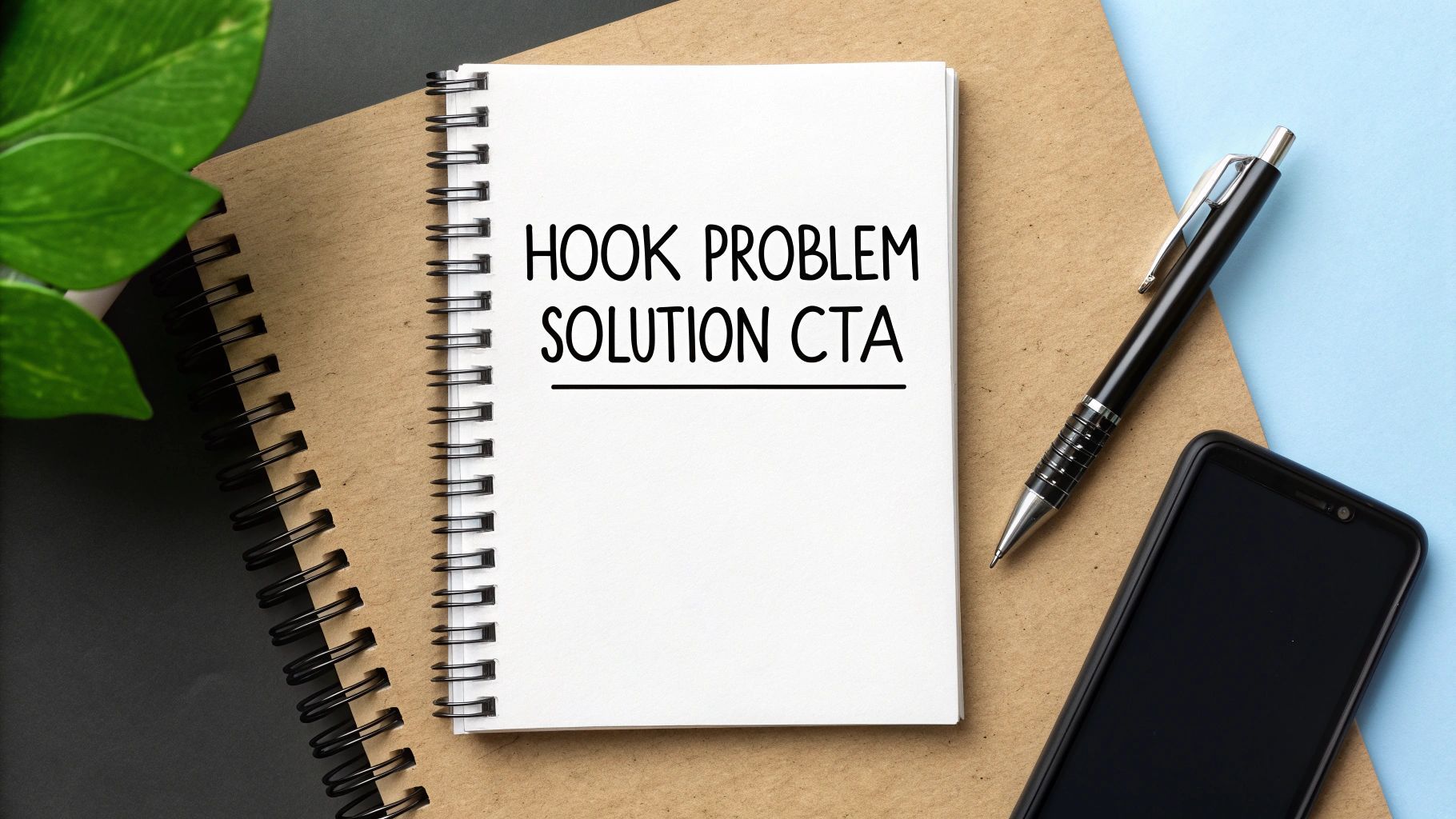
Let's move past the theory. A script that actually converts isn't just a clever bit of writing; it’s a meticulously engineered four-part sequence. Each piece has a very specific job, all working together to pull a viewer out of their mindless scrolling and nudge them toward taking action. Once you get this framework down, writing ad scripts that deliver becomes second nature.
Think of it less like a sales pitch and more like a psychological roadmap. You're not just showing off a product. In just a few seconds, you’re creating a connection, building a little tension, and then offering a perfect resolution.
Let's unpack the essential building blocks.
The Three-Second Hook
You get maybe three seconds to stop the scroll. That's it. Your hook is your one shot at a first impression, so it has to hit hard and fast. Slow, meandering intros are the kiss of death in social feeds.
Your hook needs to be sharp, direct, and make someone curious. Try one of these approaches:
- A Provocative Question: "Still wasting hours on manual data entry?" This immediately grabs the attention of a specific audience struggling with a known pain point.
- A Bold Statement: "This is the last project management tool you'll ever need." It's confident and makes a huge promise that people will stick around to hear.
- A Surprising Visual: Open with an unexpected or visually jarring scene that forces people to pause and figure out what’s going on.
Articulating the Problem
Okay, you've got their attention. Now you have to make them feel like you get them. This is where you bring up the problem your product or service solves. Don't just state the problem—twist the knife a little. Use the kind of language your audience uses in their own head to describe their frustrations.
For example, instead of a flat statement like, "Our software saves time," try something that hits closer to home: "You know that feeling when it's 5 PM and you're still stuck copying and pasting between spreadsheets? That's not just tedious; it's costing you." This creates an emotional link and makes the need for a fix feel much more urgent.
A great script doesn't just present a problem; it makes the audience relive it for a brief moment. This emotional resonance is what keeps them watching.
Presenting the Solution and Demo
Now that the problem feels real, it’s time to bring in your product as the hero. This isn't the moment to rattle off a laundry list of features. Your job is to present a clean, direct, and satisfying answer to the pain you just agitated.
Clarity and simplicity are everything here. Show, don't tell.
- Selling software? Show a quick screen recording of the exact feature that solves the problem. No fluff.
- Selling a physical product? Show it in action. Make the benefits so obvious that they speak for themselves.
Your script should frame the solution as an "aha!" moment. It needs to look easy, feel intuitive, and directly resolve the frustration you built up just seconds before.
The Unmistakable Call to Action (CTA)
You’ve done all the hard work, so don't fumble at the goal line. You must tell the viewer exactly what to do next. Any confusion or hesitation here kills the momentum you've built. A weak CTA is a wasted ad.
Be specific, clear, and compelling. "Learn More" is lazy. Instead, use action-packed language that promises a clear, immediate benefit:
- "Get your free trial and automate your first task in 5 minutes."
- "Shop the collection now and get 20% off your first order."
- "Download the guide and unlock 10 new strategies today."
This final command is the bridge between someone just watching your video and them becoming a potential customer.
How to Adapt Your Ad Script for Different Platforms
A killer ad script is never a one-size-fits-all document. The creative genius that crushes it on YouTube will almost certainly fall flat on TikTok. Why? Because every platform has its own unwritten rules, its own culture, and its own audience expectations. Forcing the same script everywhere is like wearing a tuxedo to a beach party—you'll just look out of place.
To get results, you have to think like a native user on each platform. That means tweaking your script's tone, pacing, and structure to fit how people actually watch videos there. This isn't optional; it's the key to getting a real return on your ad spend.
Matching Your Script to the Platform's Vibe
While your core message might stay the same, the way you deliver it needs a total rethink for each channel. The best ads don't feel like ads at all; they feel like they belong in the feed.
Let’s break down the unique DNA of the big players:
- TikTok: It’s all about speed and authenticity. Your script needs to be lightning-fast, often under 15 seconds, and should tap into current trends, sounds, or popular memes. Think raw, vertical video shot on a phone. It has to feel like a real creator made it, not a corporation.
- Instagram (Reels & Feed): This is a visual-first platform, often with an aspirational feel. Your script should be a supporting actor to stunning visuals, whether it's a quick, punchy Reel or a more polished video ad in the main feed. Telling a story through beautiful aesthetics is what wins here.
- YouTube: People on YouTube are often leaning back, ready to consume longer content. Your script can afford to be more narrative-driven, but those first five seconds are everything. If you don't hook them immediately, they'll hit that "Skip Ad" button without a second thought.
- Facebook: Most Facebook users are scrolling on their phones, often with the sound off. Your script has to get to the point instantly and deliver a clear benefit. The problem-solution framework is incredibly effective here, and you absolutely need on-screen text to get the message across.
The challenge here is massive. Global ad spending is projected to hit $1.19 trillion in 2025, with a staggering 56.1% of that going to giants like Meta and Alphabet. You can dig into these advertising trends in WARC's latest report. These platforms demand a constant flow of fresh, native-feeling creative, making manual script adaptation a huge bottleneck for any team trying to scale.
Should You Go for UGC or a Polished Production?
Beyond the platform, your script also has to match a specific creative style. The two main paths you can take are User-Generated Content (UGC) and a more polished, professional production. Each has its place.
A UGC-style script is all about raw authenticity and social proof. It needs to sound like a real person talking, using natural, conversational language. The goal is to capture a genuine moment or a personal story with your product. This approach is fantastic for building trust, especially on platforms like TikTok where users are skeptical of anything that looks too corporate.
A great UGC script doesn't feel scripted at all. It feels like a genuine recommendation from a friend, which is why it's so powerful for driving sales.
On the flip side, a professionally produced script is designed to build brand authority and create a premium feel. These scripts are more carefully crafted, with intentional pacing and language that supports high-quality, often cinematic visuals. This is a great approach for big brand-awareness campaigns or for high-ticket products where trust is built through quality and expertise. The path you choose will completely change the tone, dialogue, and direction of your script.
Practical Ad Script Examples You Can Steal
Theory is great, but seeing a script in action is where the magic really happens. Let's move past the frameworks and dive into some finished examples you can actually adapt for your own campaigns.
Below you’ll find templates built for the platforms that matter most right now. I’ve included notes on visual cues and on-screen text to help you see the final ad in your head.
Think of these as creative launchpads, not rigid rules. The goal is to show you how the core principles—hook, problem, solution, CTA—morph to fit different formats, tones, and lengths. Use them to get past that dreaded writer's block and start making ads that feel like they belong on each platform.
UGC vs. Polished Productions
First, a quick but crucial point: the visual style of your ad completely changes how you should write your script. Are you going for that raw, user-generated feel or a polished, professional production?
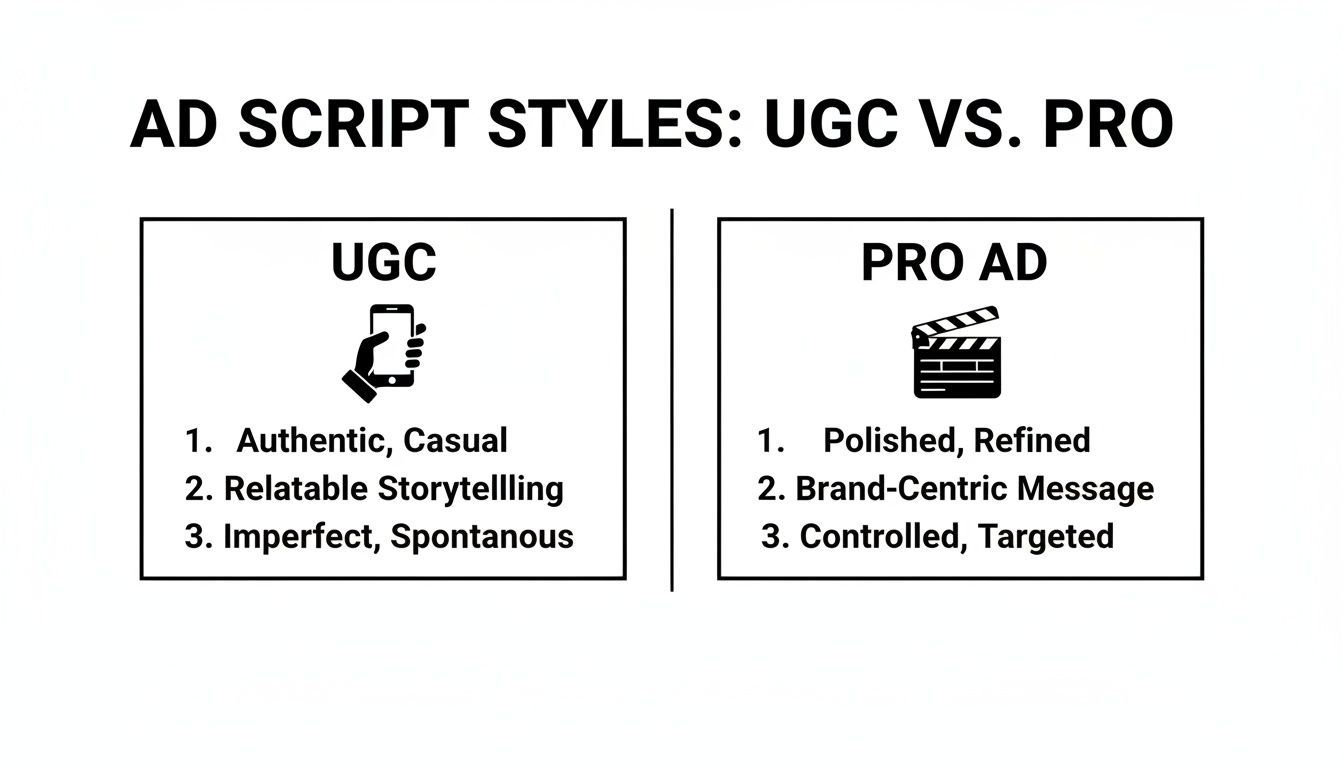
This isn't just about aesthetics. A UGC script needs to lean into authenticity and relatability—it’s a conversation. A professional script, on the other hand, is about building authority and a premium brand image. The words you choose have to match the vibe.
15-Second TikTok UGC Script
This format is all about hitting hard and fast. You need to be authentic and tap into a common frustration. It should feel less like an ad and more like a real person just discovered something amazing and had to share it.
- Hook (0-2s): (Creator looks totally stressed, staring at a messy desk) "Okay, my workspace has been an absolute disaster zone."
- On-screen text: From chaos...
- Problem (2-5s): (Whip-fast cuts of tangled cables, scattered papers, general clutter) "I could never find anything, and it was absolutely killing my productivity."
- Solution (5-12s): (Creator’s mood instantly shifts. They smile, holding up a sleek desk organizer. Quick, satisfying shots of them easily placing items into it) "Then I found this modular organizer. Everything has its own spot now, and it’s so satisfying."
- On-screen text: ...to calm.
- CTA (12-15s): (Creator points directly to the link-in-bio area, with the product visible in the background) "Seriously, if your desk is stressing you out, you need this. Link in bio!"
30-Second Instagram Product Showcase
On Instagram, you can often aim for a more aspirational, visually polished feel. This script focuses on beautiful aesthetics and a crystal-clear demonstration of value.
A key lesson from the trenches: The script's tone has to match what users expect on that platform. An ad that feels out of place gets scrolled past instantly, no matter how great the offer is.
- (0-4s): [Elegant, slow-motion shot of a high-end coffee machine brewing rich espresso into a glass cup]
- VOICEOVER: "Tired of mediocre morning coffee?"
- (4-10s): [User quickly flashes their old, clunky coffee maker on screen, looking annoyed]
- VOICEOVER: "The bitterness, the cleanup... it's a frustrating start to your day."
- (10-25s): [A beautiful montage of the new machine in a sparkling clean kitchen. We see close-ups on the sleek design, one-touch buttons, and the perfect, rich crema on the espresso]
- VOICEOVER: "Experience barista-quality espresso at home. The [Product Name] delivers the perfect cup, every single time, with zero hassle."
- On-screen text: Perfect Crema. One Touch. Zero Mess.
- (25-30s): [Final shot of someone genuinely enjoying their coffee, smiling into the camera]
- VOICEOVER: "Upgrade your mornings. Shop now and get 20% off your first order."
- On-screen text: Shop Now - 20% Off
Getting this right is more important than ever. The retail media network space is absolutely booming, projected to blow past $190 billion globally in 2026. This means brands are pouring money into reaching high-intent shoppers on platforms like Amazon and Walmart. Your social ads have to be just as sharp and targeted to compete. If you want to dig deeper into this trend, there are some great recent market analyses on advertising growth.
Using AI to Scale Your Creative Workflow
Let’s be honest: manually writing every single ad script is a one-way ticket to burnout. The demand for constant, fresh content is relentless, and the old way of doing things just can't keep pace. This is exactly where AI tools are making a huge difference for performance marketers and creators.
Instead of battling a blank page, you can now generate dozens of hooks, angles, and full script variations in a matter of minutes. This isn't about replacing creativity—it's about supercharging it. Think of AI as your tireless brainstorming partner, helping you sidestep creative fatigue and scale your testing like never before.
Generating Variations for A/B Testing
So, you've got a winning ad concept. Great. But manually writing five different hooks and three different CTAs for that one idea is a time-sink. With an AI platform, you can knock out all those variations almost instantly.
This kind of speed is what lets you get really granular with your data. You can finally test all those small changes at scale to figure out precisely what makes your audience tick.
- Test different emotional angles: Generate one script that frames your product as the solution to a major frustration and another that focuses on achieving a positive goal.
- Experiment with hooks: Instantly create five hooks—maybe one is a question, another is a bold claim, and the other three jump on a current trend.
- Vary the call to action: A/B test a CTA that pushes a discount against one that highlights a free trial or an immediate download.
By automating the repetitive parts of scriptwriting, you free up your mental energy to focus on big-picture strategy and performance data, not just the production grind.
To get the most out of these tools, it helps to understand a bit about what's going on under the hood. Getting a handle on the basic AI Text Generation Process will help you give the AI better prompts, which always leads to higher-quality, more effective scripts.
From Script to Scene in Seconds
The real magic of modern AI tools is that they don’t just stop at the text. The best platforms now handle the entire creative workflow, from that first script idea all the way to a finished video. This is a massive leap in efficiency.
This screenshot shows how a tool like ShortGenius can take a simple prompt and spit out multiple ad concepts, complete with scripts and even visual scene suggestions.
What you're looking at is the journey from a rough idea to a concrete creative asset that's ready for production. Platforms like this often let you go even further, with AI features that can generate natural-sounding voiceovers straight from your script or suggest B-roll that actually matches your message.
This all-in-one approach means you’re not just writing a script anymore; you’re building an entire ad concept from the ground up. The time and money you save are enormous. If you want to see it in action, you can check out the workflow on platforms like ShortGenius, which are built specifically for this.
Got Questions? Let's Talk Ad Scripts
Even with a solid plan, you're bound to hit a few roadblocks when writing an ad script. That's perfectly normal. Let's walk through some of the questions that come up time and time again so you can get unstuck and move forward.
Think of this as your go-to cheat sheet for the little details that can make a massive difference in how your ads perform.
How Long Should My Ad Script Actually Be?
This is the classic "it depends" question, but I'll give you the real-world breakdown. The right length is all about where your ad will live and how people behave there.
- TikTok & Instagram Reels: You have seconds, not minutes. Aim for a tight 15-30 seconds. Get in, make your point, and get out.
- YouTube Pre-Roll: Those first 5 seconds are everything. You have to earn the viewer's attention to stop them from hitting "Skip Ad." If you can hook them, you can go longer, but don't waste that initial window.
- Facebook & Instagram Feed: Here, you have a bit more breathing room. The sweet spot is usually between 30 and 60 seconds. Just remember, many people are scrolling with the sound off, so your script needs strong visual support with on-screen text.
The name of the game is efficiency. Deliver your message in a way that respects the viewer's time on that specific platform.
What's the One Thing I Absolutely Can't Mess Up?
The hook. No question. Your first 3-5 seconds will make or break the entire ad. If you don't grab their attention right away, the rest of your amazing script might as well not exist. It's that simple.
Your hook is your first impression. It could be a provocative question, a shocking statement, or a visual that just stops the scroll. Spend a good chunk of your creative time just on the hook—brainstorming, writing, and testing different versions is never a waste of effort.
How Do I Avoid Sounding Like a Cheesy Salesperson?
This is a big one, especially if you're aiming for that authentic, User-Generated Content (UGC) vibe. The secret is to shift your mindset from "selling" to "sharing."
Talk like a human being, not a marketing department. Ditch the corporate-speak and just explain things like you would to a friend. Instead of rattling off a list of features, tell a story about a real problem your product solves. A personal anecdote or a quick, honest demo connects on a level that a hard pitch never will.
AI script generators can be a fantastic starting point here, giving you a natural, conversational foundation that you can then tweak to make it truly your own.
Tired of the blank page staring back at you? ShortGenius uses AI to whip up dozens of hooks, concepts, and full-blown scripts for any platform you can think of. It's the perfect way to scale your creative process and get better results without the headache. Try ShortGenius today!