Unlock: performance benchmarks of ai ugc ads vs traditional ads

Discover performance benchmarks of ai ugc ads vs traditional ads: KPI, costs, and engagement insights.
When you stack AI-generated UGC ads against traditional ads, the performance data tells a compelling story. At its heart, the difference is this: AI-generated UGC thrives on authenticity, driving higher engagement and click-through rates, which almost always leads to lower acquisition costs. On the other hand, traditional ads still have a firm grip on controlled, high-polish brand messaging.
So, the choice you make really comes down to your campaign goals. Are you after immediate, trust-based conversions, or is your main objective broad, top-of-funnel brand awareness?
Understanding the New Advertising Playbook
We're standing at a fork in the road in the advertising world, with two powerful, yet very different, strategies in front of us. In one lane, you have traditional advertising—the glossy, professionally produced content that has been the bedrock of marketing for decades. In the other lane, a new challenger is picking up serious speed: AI-generated User-Generated Content (UGC), which uses technology to create authentic, relatable ads faster than ever before.
This isn't just a tech conversation; it's about what actually works. As a marketer, you now have to make a strategic call between the carefully controlled messaging of a traditional ad and the genuine, data-backed appeal of AI UGC. Getting a handle on the key differences between these two is your first step to building a campaign that truly connects with today’s audiences and, most importantly, delivers a real return.
Defining the Core Ad Formats
Traditional ads are all about high production value. They are painstakingly planned, scripted, and shot by creative agencies and production teams. Picture a Super Bowl commercial or a slick magazine ad—every single element is there to project brand authority and a very specific, curated message.
AI UGC ads, by contrast, are built to look and feel like content made by regular people. They trade polish for authenticity, using AI to whip up scripts, voiceovers, and scenes that blend right into a social media feed. This strategy taps directly into the power of social proof, making the ad feel less like a pitch from a company and more like a genuine recommendation from a friend.
The critical distinction lies in how the audience sees it. Traditional ads are clearly brand communications. AI UGC is designed to be seen as authentic social proof, which has a massive impact on trust and engagement from the get-go.
Foundational Differences at a Glance
To really get a feel for how they fit into a marketing strategy, it helps to see them side-by-side. This table breaks down the core DNA of each format, showing what makes them tick and where they shine.
| Feature | AI UGC Ads | Traditional Ads |
|---|---|---|
| Primary Goal | Drive conversions & engagement | Build brand awareness & recall |
| Key Strength | Authenticity and social proof | High production value and control |
| Content Style | Raw, relatable, and native | Polished, professional, and aspirational |
| Production Speed | Hours or days | Weeks or months |
| Cost Per Creative | Significantly lower | Substantially higher |
| Ideal Platform | TikTok, Instagram, YouTube Shorts | Television, print, YouTube (pre-roll) |
With these fundamentals in mind, we're ready to dive deeper. This guide will move beyond the basics to explore the specific performance benchmarks of AI UGC ads vs traditional ads, giving you the hard data you need to pick the winning strategy for your next campaign.
Setting Up a Fair Fight: How to Genuinely Test Ad Performance
To get a real read on how AI-generated UGC stacks up against traditional ads, we need to create an even playing field. This isn't about just throwing a slick studio ad against a quick AI video. It's about making sure the creative is the only thing that's different, so you know exactly what’s driving performance.
The whole process kicks off with a simple question: what’s the goal? Are you chasing brand awareness at the top of the funnel, trying to get people to consider your product, or pushing for hard sales at the bottom? The answer dictates which metrics actually matter. Without that focus, you're just looking at a pile of confusing data.
Focus on the KPIs That Actually Matter
For any test to be worth your time, you have to track the numbers that directly tie back to your campaign goals. It's easy to get distracted by vanity metrics like likes and shares, but they often don't tell you much about your bottom line.
Instead, zero in on these core indicators:
- Return on Ad Spend (ROAS): This is the big one. It’s a direct measure of profitability, showing you exactly how much revenue you’re making for every dollar you put into ads.
- Cost Per Acquisition (CPA): This tells you the average cost to land a new customer. A lower CPA is your ticket to scaling your campaigns without breaking the bank.
- Click-Through Rate (CTR): Your CTR shows what percentage of people who saw your ad actually clicked on it. It’s a fantastic barometer for how well your creative is connecting with your audience.
These three KPIs give you a solid foundation for real performance analysis. They let you look past the fluff and see what’s actually moving the needle for your business.
Keep Your Variables Locked Down
A good A/B test is all about control. The only thing you want to change is the ad creative itself. If you start messing with the audience, budget, or placements at the same time, you'll have no idea whether it was the AI-generated video or something else that caused the shift in performance.
For your results to mean anything, your AI UGC and traditional ad variations have to run under identical conditions. That means the same target audience, the same daily budget, the same ad placements, and for the same amount of time.
Let's say you're running this test on Meta. You'd set up two ad sets targeting the exact same saved audience. To make sure the comparison is truly fair, you should also measure your traditional ad against known benchmarks and the best practices for optimising Google Ads campaigns. This gives you a properly optimized baseline to compare against.
By creating this disciplined testing environment, you remove the guesswork. The data you get back will give you a clear signal on which creative style—the raw feel of AI UGC or the polish of a traditional ad—is the true winner for your brand and your goals. This data-driven approach is the key to understanding the benchmarks we’ll cover next and making smart calls for your ad strategy.
Analyzing Cost Efficiency and Conversion Metrics
When the conversation turns from engagement to the bottom line, the financial performance of AI-generated UGC ads versus traditional ads shows a pretty stark difference in efficiency. We all know the traditional ad production pipeline is slow and incredibly expensive—think agencies, film crews, and long lead times. That high overhead directly inflates key metrics like your Cost Per Acquisition (CPA), because every single conversion has to help pay back that massive upfront investment.
AI-driven workflows completely flip that cost structure on its head. By automating things like scriptwriting, generating scenes, and even producing voiceovers, platforms such as ShortGenius can crush production timelines from weeks down to a matter of hours. This speed is a huge deal in performance marketing, where ad fatigue can tank your returns almost overnight. It lets you iterate on creative quickly and cheaply.
Breaking Down the Cost Per Result
The ability to generate a dozen ad variations for what you'd spend on a single traditional ad is a game-changer for allocating your budget. Instead of putting all your chips on one high-production concept and hoping it works, you can test a whole slate of AI-generated UGC ads to find a clear winner. This drastically lowers your financial risk and seriously improves your odds of launching a high-performing campaign.
This isn't just theory; the numbers back it up. We've seen AI-generated UGC ads deliver major cost savings in paid social campaigns, making them a go-to for performance marketers with tight budgets. In one recent head-to-head test, AI-generated video ads achieved a 28% lower cost per result and a 31% lower cost per click compared to even the top-performing human-created UGC.
The real financial win with AI UGC isn't just making ads for less money. It's about enabling a high-volume testing strategy that was just too expensive before, which systematically drives down your customer acquisition costs.
This infographic breaks down the essential advertising KPIs—ROAS, CPA, and CTR—that are at the core of this analysis.
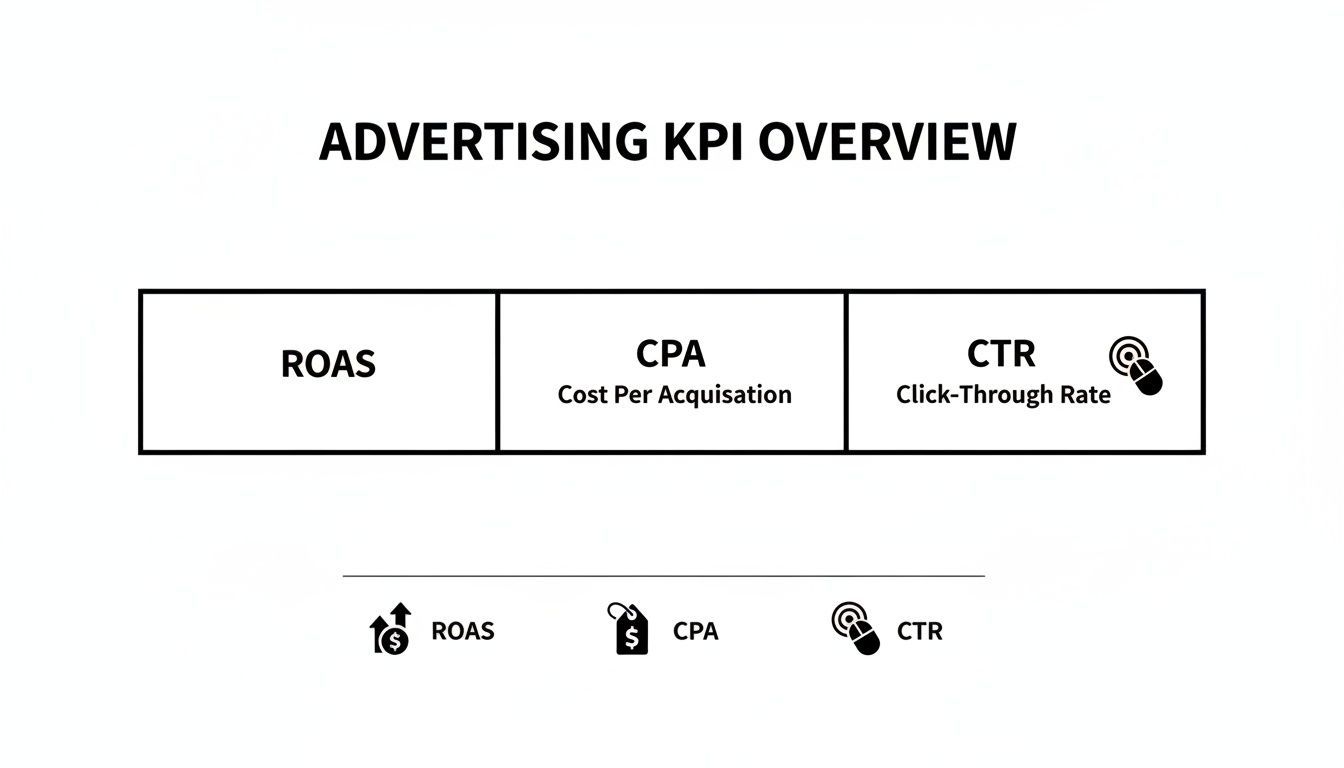
As you can see, these three metrics really give you the full picture of an ad's financial health, from how efficiently it grabs attention (CTR) all the way to its ultimate profitability (ROAS).
To really see how these ads stack up, here’s a look at some aggregated industry data.
Comparative KPI Benchmarks AI UGC Ads Vs Traditional Ads
This table provides a side-by-side comparison of key performance indicators for AI-generated UGC ads and traditional ads based on aggregated industry data.
| Key Performance Indicator (KPI) | AI UGC Ads (Benchmark) | Traditional Ads (Benchmark) | Key Insight |
|---|---|---|---|
| Return on Ad Spend (ROAS) | 3.5x - 5.0x | 2.0x - 3.0x | The authenticity of UGC builds trust, leading to higher-intent clicks and better conversion, boosting overall profitability. |
| Cost Per Acquisition (CPA) | $15 - $30 | $40 - $70 | Drastically lower production costs and rapid testing capabilities directly reduce the cost to acquire each new customer. |
| Click-Through Rate (CTR) | 1.5% - 3.0% | 0.5% - 1.2% | AI UGC ads blend into social feeds, feeling less like an ad and more like native content, which encourages more clicks. |
| Conversion Rate (CVR) | 4.0% - 6.5% | 2.0% - 3.5% | Users who click on UGC-style ads often arrive with higher purchase intent, leading to better landing page performance. |
These benchmarks highlight a clear pattern: AI UGC consistently drives better efficiency and returns by combining low production costs with high-impact, authentic creative.
Conversion Rates and Return on Ad Spend
Lower upfront costs are great, but the real measure of an ad's worth is its ability to turn viewers into paying customers and deliver a solid Return on Ad Spend (ROAS). This is where the native, authentic vibe of AI-generated UGC gives it another major leg up on polished, traditional ads.
Because these ads look and feel like they belong in a social feed, people see them as more trustworthy and less of an interruption. This authenticity naturally leads to higher click-through rates and, crucially, stronger conversion rates once someone hits your landing page. Viewers clicking from a UGC-style ad are often better qualified because the ad has already started building a foundation of trust.
Here’s a quick rundown of how that usually works in a live campaign:
- Higher Initial Engagement: The ad's native look stops the scroll and earns a click for a lower Cost Per Click (CPC).
- Increased Landing Page Conversion: The visitor lands on your page with more intent because they were persuaded by what felt like a real person's recommendation.
- Improved ROAS: When you combine lower acquisition costs with a higher volume of conversions, you get a much healthier ROAS.
When you're running AI UGC campaigns, knowing how to accurately measure your return is everything. For a solid guide on calculating social media ROI, this is a great resource. It will help you quantify the direct financial impact you're making.
A Practical Comparison of Financial Outcomes
Let's ground this in a real-world scenario. Picture an e-commerce brand launching a new product with a $10,000 ad budget.
- Traditional Ad Approach: The brand might burn $5,000 just to produce a single, polished video ad. That leaves only $5,000 for the actual media spend. If that one ad doesn't hit the mark, half the budget is gone before the campaign even gets going.
- AI UGC Approach: The brand uses a tool to generate ten different UGC-style video ads for less than $500. Now they have $9,500 left for media spend. They can test all ten variations, find the top two performers, and then pour the rest of the budget into the ads they know are working.
This strategic shift in how you allocate resources is at the heart of why AI UGC ads outperform traditional ads financially. The AI-powered approach is just more resilient and data-driven. It creates a direct path to higher profits by cutting out creative waste and making every dollar you spend work harder.
Diving Into Audience Trust and Engagement
Clicks and conversions are great, but they don't tell the whole story. The real magic happens when you build a genuine connection with your audience, and that's where the comparison between AI UGC and traditional ads gets interesting. It stops being about technology and starts being about human psychology.
The fundamental difference comes down to one word: authenticity. We've all been trained to spot a polished, high-production ad from a mile away. The moment we recognize it as a corporate message, our mental guards go up. This is the fast track to "ad fatigue," where audiences just tune out slick, impersonal ads, and engagement tanks.

AI-generated UGC flips the script. It's built to look and feel native to the platforms people are scrolling through every day. By mimicking the style of content from friends, family, and favorite creators, it disarms that initial skepticism. The message lands less like a sales pitch and more like a genuine recommendation.
The Power of Social Proof
At its core, AI UGC is a machine for creating social proof at scale. We’re all wired to follow the crowd; it’s a psychological shortcut where we assume the actions of others are the right ones for a given situation. When an ad looks like it was made by a real person, it taps directly into this powerful instinct.
Traditional ads have to spend a ton of time and money building brand authority from scratch. AI UGC takes a shortcut by borrowing the credibility of a peer. The narrative shifts from "Our company promises this is a great product" to "Someone just like you is telling you this product is great." That's a game-changer for building trust and driving action.
Think about it: a perfectly lit studio shot of a skincare product might communicate quality, but it feels distant. An AI UGC ad showing someone with a real-world skin issue explaining how that same product helped them? That communicates results and forges an immediate, empathetic connection.
How Trust Shows Up in the Data
This difference in trust isn't just a feeling—it shows up in the numbers. People overwhelmingly prefer authentic, peer-driven content over polished brand ads. In fact, an incredible 92% of consumers trust UGC more than traditional advertising, and 79% say it heavily sways their purchasing decisions. That trust gap has a direct, measurable impact on campaign performance. For more on this, check out these insights on how UGC drives engagement rates.
When people trust what they're seeing, they engage with it more deeply. That's why brands using UGC in paid campaigns often see 4x higher engagement rates compared to standard branded content. Viewers are simply more willing to watch, comment, and share something they feel is authentic.
This isn't just a vanity metric. Higher engagement is a strong signal to platform algorithms that your ad is relevant. In return, you can get rewarded with lower CPMs and even broader organic reach. In short, building trust makes your ad budget work harder.
Creating Long-Term Brand Assets
Another key difference is longevity. Most traditional ad campaigns have a short shelf life. The moment you turn off the spend, the ad vanishes, and its impact begins to fade. AI UGC, however, lets you build a library of authentic content that becomes a long-term brand asset.
Here's what that looks like in practice:
- Evergreen Social Proof: A compelling testimonial-style video can be used for months across different channels, constantly reinforcing trust.
- Community Building: Ads that feel like organic content invite more interaction, helping you cultivate a loyal customer base that sticks around long after the first purchase.
- Fighting Creative Fatigue: The sheer variety of formats you can create with AI UGC—from unboxings and tutorials to day-in-the-life clips—keeps your campaigns feeling fresh and stops your audience from tuning out.
By shifting your focus to content that builds a real connection, you move beyond chasing short-term clicks. You start building a more resilient brand that people not only buy from but also champion. That's where you'll find the true performance gap between AI UGC and traditional advertising.
Grappling with How People Actually Feel About AI in Ads
There's no denying that AI-generated UGC is fast and cheap to produce. But those advantages run headfirst into a major hurdle: people are wary of it. As we dig into the performance data of AI UGC versus traditional ads, we have to talk about how audiences perceive content made by machines. It all boils down to a tricky balancing act between automation and authenticity.
The moment a viewer even suspects an ad is AI-generated, a little red flag goes up. That feeling of unease or outright distrust can completely kill the authentic vibe that makes user-generated content work so well in the first place. This isn't a small detail; it's a critical new variable we have to manage if we don't want to alienate our audience and torch our brand's credibility.
The Uncanny Valley of Authenticity
The problem isn't AI itself. It's bad AI. Audiences are getting incredibly savvy at spotting the tell-tale signs of a clumsy AI execution—the robotic voiceovers, the slightly-too-perfect visuals, or scripts that just feel...off. When those elements creep in, the ad loses the human connection that makes UGC so powerful.
This isn't just a hunch; the data backs it up. A major 2023 report found that over 30% of U.S. adults said that seeing AI in ads makes them less likely to buy from a brand. Even more telling, 37% develop a negative view of brands that use AI in their advertising. With nearly two-thirds of consumers feeling uneasy about AI-generated ads, the message is loud and clear. You can dig into more of this data on audiences preferring UGC on emarketer.com.
The bottom line is this: consumers don't want to be duped. The whole point of using AI should be to help scale human stories, not to manufacture fake ones. If an ad feels synthetic, it's already failed.
This means the AI UGC campaigns that actually win are the ones where you don't even notice the AI. It's working behind the scenes as a production assistant, not trying to be the star of the show.
How to Make AI-Powered UGC Feel Genuinely Human
To get the most out of AI without sacrificing trust, you have to stay laser-focused on creating content that feels real. The goal is to use AI to enhance the human experience, not fabricate it from scratch.
Here are a few practical ways to keep your AI-generated ads from feeling cold and robotic:
- Build on Relatable Problems: Use AI to generate scripts and scenes that mirror real-life struggles and solutions. Instead of a bland product pitch, frame the story around something like, "Here's how I finally fixed [common pain point] with this."
- Invest in Quality Voiceovers: Nothing screams "AI" faster than a monotone, text-to-speech voice. Either use AI voice cloning from a real human actor or pick a premium AI voice that is truly indistinguishable from natural speech. This is non-negotiable for credibility.
- Embrace a Little Imperfection: Polished, flawless ads are the old way. Real UGC thrives on the little quirks—the slight pauses, the casual slang, the unscripted moments. Let your AI-assisted content have some of that raw, un-rehearsed energy.
- Show, Don't Just Tell: Whenever you can, build your AI scenes around real photos or video clips of your product being used. Grounding the ad in reality with tangible proof makes the entire message more believable.
Let’s make this concrete with an example for a new coffee maker.
Where AI Goes Wrong: An AI-generated avatar is standing in a perfectly sterile kitchen. A robotic voice recites a list of product specs with flawless pronunciation. The scene is too clean, the person isn't real, and the script sounds like it was pulled from the user manual. It feels fake.
Where AI Gets it Right: The ad opens with a real smartphone video of someone groaning at their old, sputtering coffee machine. An AI-generated but completely natural-sounding voiceover kicks in: "Tired of waiting for your morning coffee?" Then, the ad transitions to AI-generated visuals showing the new coffee maker in a realistic—even slightly messy—kitchen, brewing a perfect cup in seconds. The focus is on solving a genuine, relatable problem.
By keeping the focus on human stories and using AI as a tool to tell them better and faster, you can sidestep consumer skepticism. This approach lets you get all the speed and cost benefits of AI without sacrificing the trust that makes UGC a true performance driver. The best AI UGC doesn't feel like AI at all—it just feels like great UGC.
Choosing the Right Ad Strategy for Your Goals
After digging into the performance benchmarks, the real question is: how do you turn all this data into a smart decision? It’s not about crowning one ad format as the "winner." It's about picking the right tool for the job, aligning your ad type with your specific campaign goals, target audience, and budget.
Honestly, the most powerful approach I’ve seen is a hybrid one. You use each ad type where it truly shines. Traditional ads, with their slick production, are fantastic for building brand awareness at the top of the funnel and cementing your place as a market leader. But when it comes to driving sales and testing ideas quickly, the raw, authentic feel of AI UGC is hard to beat.
When to Deploy AI UGC Ads
AI-generated UGC is your secret weapon for performance campaigns where speed, authenticity, and getting a direct response are everything. It just feels native on platforms where users want genuine content, not a polished sales pitch.
Think about using AI UGC ads in these situations:
- Driving Direct Conversions: If you need sales, sign-ups, or app installs now, the social proof baked into UGC-style content builds the trust you need to get someone to act immediately.
- Rapid A/B Testing: Need to test a dozen different hooks, value props, or visuals? AI tools like ShortGenius let you pump out variations for a tiny fraction of what a single traditional ad shoot would cost.
- Targeting Younger Demographics: Let’s face it, audiences on platforms like TikTok and Instagram Reels can smell a corporate ad from a mile away. AI UGC fits right in, helping you avoid the ad fatigue that kills so many campaigns.
- Limited Budgets: For startups or any brand trying to make every dollar count, the cost savings are huge. You can put more money into your media buy and run more tests to find what actually works.
When to Invest in Traditional Ads
Even with the UGC boom, don't count traditional advertising out. It still has a vital role, especially for established brands with big-picture marketing goals. Its biggest advantage is the ability to deliver a controlled, high-impact message that builds long-term brand value.
Traditional ads are still the best call for:
- Major Brand Building Campaigns: For those massive initiatives meant to build brand recall and shape how the public sees you, the polish of a traditional ad is essential.
- Establishing Premium Positioning: High production value screams luxury, quality, and authority. Sometimes, a raw, user-shot style just can’t send that same message.
- Complex Product Storytelling: When you have a technical or detailed product to explain, a scripted and professionally produced ad makes sure your message lands with perfect clarity.
The best strategy isn't an either/or choice. It's about building a balanced media mix where AI UGC drives efficient conversions while traditional ads build the rock-solid brand foundation that makes those conversions happen in the first place.
Ultimately, the data gives us a clear playbook. Use AI UGC to win the daily battle for clicks and conversions with speed and authenticity. Then, deploy your big-gun traditional ads for the strategic, long-term campaigns that build a brand that lasts. By playing to the strengths of each, you’ll create a much more effective and resilient advertising machine.
Answering Your Top Questions
Getting into the weeds of AI UGC ads versus traditional ads always brings up a few key questions. If you're a performance marketer trying to figure out where to put your budget, these are likely the same questions on your mind. Here are some straight answers based on what we've seen in the field.
What’s the Real Performance Difference Between Them?
The biggest difference comes down to where they shine in the marketing funnel. AI UGC ads are absolute workhorses at the bottom of the funnel. Their authentic, native feel on social media leads to a lower Cost Per Acquisition (CPA) and higher Click-Through Rates (CTR). They lean heavily on social proof to drive immediate action, making them perfect for direct-response goals.
Traditional ads, on the other hand, tend to own the top of the funnel. Their high-production quality is built to establish brand authority, create brand recall, and deliver a polished, controlled message. Think brand awareness and building long-term equity.
How Should I Test AI UGC Ads Against My Current Creatives?
The only way to know for sure is to run a clean A/B test. The whole point is to make the creative the only thing that's different between your campaigns.
Here’s a simple setup:
- Keep your audience targeting, budget, and campaign objective identical for both.
- Pit a few of your best AI UGC variations against your current top-performing traditional ad.
You'll want to track your main KPIs—like ROAS, CPA, and conversion rate—for a solid 7-14 days. That's usually enough time to get statistically significant data and see which creative style is a clear winner for your campaign.
Does AI-Generated UGC Actually Work on Every Platform?
Yes, but it's a home run on platforms where authentic, user-first content is king. We're talking about TikTok, Instagram Reels, and YouTube Shorts. On these feeds, AI UGC just fits. It looks less like a disruptive ad and more like the organic content people are already there to watch.
It can still perform well on places like Facebook, but its natural advantage is most powerful where the algorithm rewards raw, unpolished, and relatable video. On fast-paced, content-driven platforms, a slick, traditional ad can stick out like a sore thumb and get scrolled right past.
Ready to create high-performing AI UGC ads in minutes? With ShortGenius, you can generate ad concepts, scripts, and multiple creative variations for testing without a big production team. Start building ads that convert today at shortgenius.com.