Boost ROI with performance benchmarks of ai ugc ads vs traditional ads

Discover the performance benchmarks of ai ugc ads vs traditional ads and see CTR, CPA, and ROAS differences to optimize your strategy.
The core difference boils down to this: AI-generated User-Generated Content (UGC) ads consistently bring in lower costs and get you to market faster. On the other hand, traditional ads often stick in people’s minds longer, boosting brand recall, but they come with a much steeper price tag. When you look at the performance data, AI UGC is a powerhouse for efficient customer acquisition, while traditional ads are best saved for those big, splashy brand-building campaigns.
The New Advertising Frontier: AI UGC vs. Traditional Ads
The ad world is in the middle of a major shake-up. For years, the recipe for a winning campaign was a polished, high-production ad shot in a studio. That approach always meant big budgets, long timelines, and a whole army of creatives to make it happen.
But the game has changed, thanks to social media and the nonstop demand for authentic, real-world content. People now spend an average of 141 minutes per day scrolling through social feeds, where they’re far more likely to trust a video from a real person than a slick corporate spot. This is what opened the door for User-Generated Content (UGC), which just feels more genuine and naturally pulls in higher engagement.
The AI-Powered Creative Revolution
Now, artificial intelligence is adding a whole new dimension to this shift. AI-generated UGC takes the authenticity of user-shot video and combines it with the sheer speed and scale of technology. Instead of coordinating with creators and waiting for content, brands can now spin up dozens of high-performing, UGC-style ads in just minutes.
This is more than a time-saver. It's a complete overhaul of how brands can test, learn, and grow their ad campaigns. The power to create endless creative variations on the fly makes rapid A/B testing a reality, uncovering performance insights that used to be too expensive or time-consuming to find.
This guide will break down the real performance differences between AI UGC and traditional ads, going way beyond the obvious. We'll get into the key performance indicators (KPIs) that actually matter to marketers and agencies, including:
- Cost Per Acquisition (CPA): How much you're really paying to get each new customer.
- Return on Ad Spend (ROAS): The direct profit you're making from every dollar spent on ads.
- Click-Through Rate (CTR): A measure of how well your creative grabs initial attention.
Tools like ShortGenius are leading this charge, giving marketing teams the ability to create ads that connect with today's audiences without the old-school production headaches. As we go through the data, you'll see how this technology gives you a serious advantage in a very crowded market.
At-a-Glance Comparison: AI UGC vs. Traditional Production
To get a quick sense of how these two approaches stack up, this table breaks down their core differences. It’s a handy reference for understanding where each one shines.
| Attribute | AI-Generated UGC Ads | Traditional Studio Ads |
|---|---|---|
| Production Speed | Minutes to hours | Weeks to months |
| Average Cost | Low (Subscription-based) | High (Thousands to millions) |
| Primary Goal | Direct Response, A/B Testing | Brand Awareness, Authority |
| Authenticity | High (mimics native content) | Low (highly polished, staged) |
| Scalability | Extremely high (infinite variations) | Very low (resource-intensive) |
| Best Use Case | TikTok, Instagram Reels, FB Ads | TV Commercials, Super Bowl Ads |
Ultimately, the table highlights a clear divide: AI UGC is built for the fast-paced, test-and-learn environment of social media advertising, while traditional production remains the go-to for high-stakes, brand-defining moments.
The Metrics That Really Matter for Ad Performance
To get a real, apples-to-apples comparison between AI UGC ads and traditional ads, we need to speak the same language. In advertising, success isn't just a vibe; it's a number. We measure it with a specific set of Key Performance Indicators (KPIs) that tell us exactly what's working, what isn't, and how much money we're making.
Think of each metric as a different chapter in your campaign's story. Understanding them is the only way to move past gut feelings and make smart, data-backed decisions that actually grow your business.
The Core Metrics You Need to Know
I like to break down the most important metrics into three buckets: engagement, efficiency, and profitability. Each one answers a critical question about your ad's performance.
Engagement Metrics
These tell you if people are even paying attention.
- Click-Through Rate (CTR): This is simple: what percentage of people who saw your ad actually clicked on it? A high CTR means your creative did its first job—stopping the scroll and sparking curiosity.
- Engagement Rate: This goes a little deeper than a click. It includes likes, comments, shares, and saves. This metric shows how much your ad truly connected with the audience, indicating strong creative resonance.
Efficiency Metrics
These tell you if you're spending your money wisely.
- Cost Per Mille (CPM): This is what you pay for 1,000 impressions (views). CPM is your baseline for understanding how expensive it is to get your ad in front of people on a given platform.
- Cost Per Acquisition (CPA): This is the holy grail for many advertisers. It's the total amount you spent to get one new customer. For performance marketers, CPA is the ultimate measure of financial efficiency.
Profitability Metrics
These tell you if you're actually making money.
- Conversion Rate (CVR): Of the people who clicked your ad, what percentage took the action you wanted (like buying something)? A healthy CVR means your ad and landing page are working together seamlessly.
- Return on Ad Spend (ROAS): This is the big one. For every dollar you put into ads, how many dollars in revenue did you get back? ROAS is the bottom-line metric for measuring the direct profitability of your campaigns.
This entire framework is the heart of performance marketing, which is all about driving measurable results. The guide on What Is Performance Marketing? from Virtual Ad Agency breaks down how this goal-oriented approach makes these KPIs so essential.
Why Context Is Everything
Here's the thing: no single metric ever tells the full story. A sky-high CTR looks great on paper, but if your CVR is in the gutter, it means your ad is writing checks your landing page can't cash. That disconnect is costing you money.
A low CPA might feel like a victory, but if those customers never buy from you again, it's not a sustainable way to grow. The real goal is to find the right balance between all these metrics to build profitable, long-term success.
A brand awareness campaign might focus on keeping CPM low to get as many eyeballs as possible. On the other hand, a direct-response campaign lives and dies by its CPA and ROAS.
As we dig into the head-to-head comparison of AI UGC and traditional ads, we’ll be looking at their performance through this exact lens. This is how modern advertisers find their edge.
A Head-to-Head Performance Benchmark
When you get down to it, the numbers tell the real story of ad performance. To give you a clear, practical comparison, let's break down how AI UGC ads stack up against traditional ads across the three metrics that truly matter for growth: Click-Through Rate (CTR), Cost Per Acquisition (CPA), and Return on Ad Spend (ROAS).
This isn't about crowning a single winner. It's about figuring out which approach works best for your specific goals and under what conditions.
Here's a quick look at the core metrics that drive performance marketing decisions.
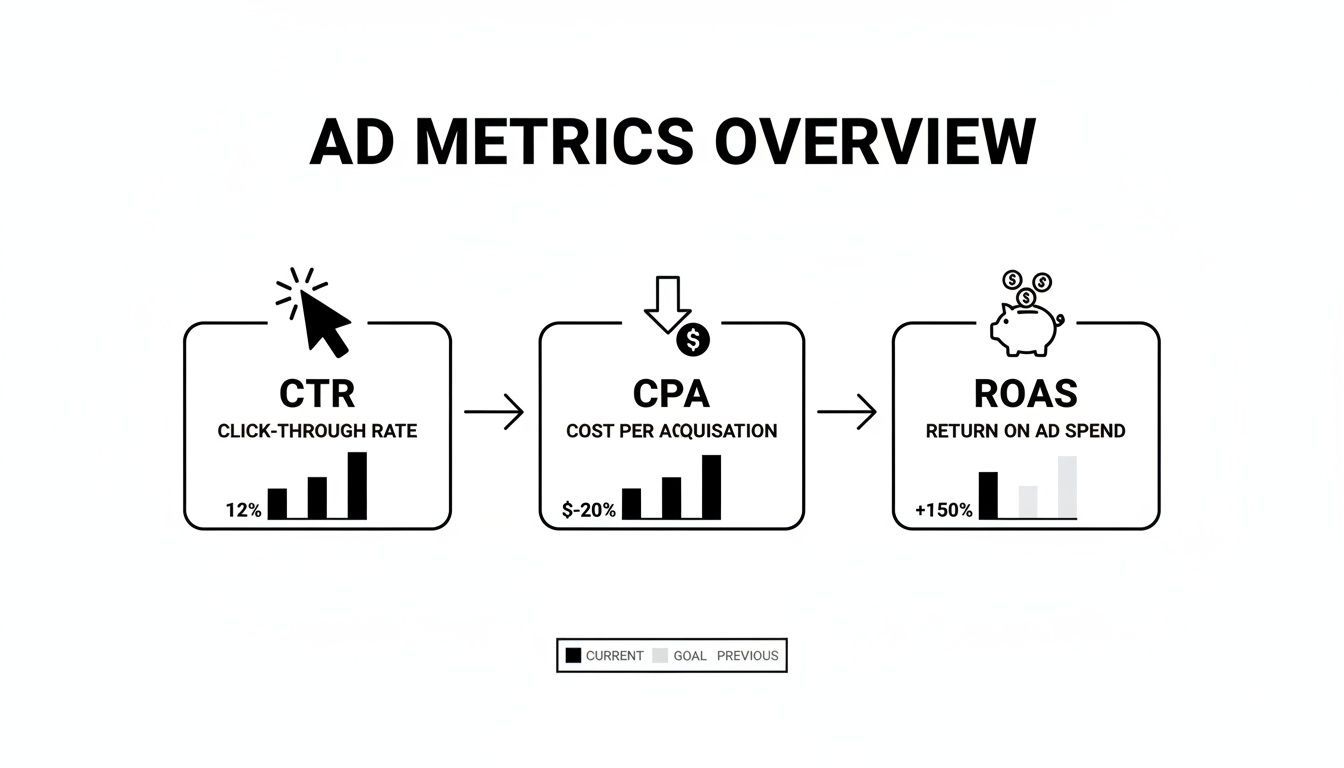
The dashboard cleanly separates CTR, CPA, and ROAS, highlighting their unique roles in measuring audience engagement, cost efficiency, and overall profitability.
Click-Through Rate: The Battle for Attention
Your Click-Through Rate (CTR) is the first major hurdle. It's a direct measure of your creative's ability to stop the scroll and earn that initial click. While it’s a top-of-funnel metric, a weak CTR is often the first sign of a disconnect between your ad and your audience, which almost always leads to higher costs down the line.
AI-Generated UGC Ads
The superpower of AI UGC ads is their ability to blend in. They're designed to look and feel like the native content people are already watching in their social feeds, which is a huge advantage. Because they don't immediately scream "I'm an ad!", they often sidestep the ad-blindness that plagues so many campaigns.
The data consistently shows this native feel leads to much better engagement. On platforms like TikTok and Instagram, where authenticity rules, a UGC-style creative can easily pull a CTR 2-4x higher than a polished, traditional ad. For instance, a D2C skincare brand might see its AI UGC ads hitting a 1.5% CTR, while its glossy, studio-shot ads are stuck below 0.5%.
This performance gap is even wider with younger audiences. Gen Z, especially, gravitates toward content that feels real and unscripted. If you're targeting that demographic, AI UGC isn't just an option—it's practically a requirement to cut through the noise.
Traditional Ads
High-production traditional ads can still grab attention, but they do it in a completely different way. Their strength is in pure visual stopping power—think stunning cinematography, slick art direction, and powerful brand messaging. This approach works incredibly well for luxury brands or products where aesthetics and perceived quality are everything.
But in the chaotic, fast-paced world of a social feed, that polished look can be a double-edged sword. It immediately signals an interruption, and users are conditioned to scroll right past before the message has a chance to sink in. Because of this, traditional ads often land a lower CTR, usually somewhere between 0.4% and 0.8% on social platforms unless they're backed by massive brand recognition.
Cost Per Acquisition: The Efficiency Showdown
For most performance marketers, CPA is the metric that matters most. It cuts through the vanity metrics and asks the most important question: how much did it cost to land this new customer? This is where the gap between AI UGC and traditional ads really starts to widen.
A low CPA is the direct result of an efficient ad funnel, which is influenced by everything from your CTR and conversion rates to the cost of making the ad itself. AI UGC almost always has a major edge here for a few key reasons:
- Higher Relevance Scores: Platforms like Meta reward ads that people actually engage with. The higher click and engagement rates from UGC-style content often lead to better relevance scores, which directly lowers your cost of impressions (CPM).
- Lower Production Costs: This is a massive factor. While it's not a direct campaign metric, the fact that you can generate dozens of AI UGC ad variations for the cost of a single traditional ad shoot is a game-changer. It lets you find a winning creative faster and for a fraction of the budget.
Real-world results back this up. An e-commerce apparel brand, for example, might find their AI UGC campaigns hitting a CPA of $25, while their traditional ad campaigns, despite looking more "professional," are averaging a CPA of $45 for the exact same product.
With their higher production costs and often lower CTRs, traditional ads naturally lead to a higher CPA in direct-response campaigns. Their value is often found over a longer timeline through brand building, not immediate, cost-effective sales.
Return on Ad Spend: The Final Verdict on Profitability
ROAS is the ultimate bottom line. It measures the total revenue you generate for every dollar you spend on ads. The analysis here gets a bit more nuanced because the highest ROAS doesn't always come from the lowest CPA.
AI-Generated UGC Ads
For most direct-to-consumer products in low-to-mid-range price brackets, AI UGC ads are ROAS machines. Their ability to drive efficient conversions at scale is tough to beat. That powerful combination of a high CTR and a low CPA is a proven formula for profitability.
It's very common for brands to see a 3x-5x ROAS from well-optimized AI UGC campaigns, especially for products that benefit from demonstrations, testimonials, or a strong dose of social proof.
Traditional Ads
This is where traditional ads can make a comeback. For high-ticket items—think luxury cars, designer fashion, or premium tech—the perceived value and trust communicated by a high-production ad can lead to a much higher Average Order Value (AOV) and, in turn, a fantastic ROAS.
Think about it: a customer might be willing to buy a $50 product after seeing a UGC ad, but they'll likely need the reassurance of a polished, professional ad before they commit to a $2,000 purchase. In these cases, a traditional ad might achieve a 6x ROAS or higher, easily justifying its higher upfront cost by attracting higher-value customers. The goal shifts from cost-efficiency to communicating premium value.
Metric-by-Metric Performance Benchmark Data
To make this even clearer, here's a table that breaks down the typical performance ranges for both ad types. This is based on aggregated industry data and our own observations from real-world campaigns.
| Performance Metric | Typical AI UGC Ad Benchmark | Typical Traditional Ad Benchmark | Key Strategic Considerations |
|---|---|---|---|
| CTR | 1.2% - 3.5% | 0.4% - 0.8% | AI UGC wins on native platforms (TikTok, Reels) by feeling authentic. Traditional ads rely on visual "shock and awe" to stop the scroll. |
| CPA | 20% - 50% Lower | Baseline | Lower production costs and higher relevance scores give AI UGC a significant efficiency advantage, especially for D2C brands. |
| CVR | 3% - 6% | 1% - 3% | The social proof and "real person" feel of UGC often builds trust faster, leading to higher conversion rates at the point of sale. |
| ROAS | 3x - 5x | 2x - 6x+ | AI UGC excels for volume and efficiency. Traditional ads can deliver a higher ROAS on high-ticket items where brand trust is paramount. |
These benchmarks provide a solid starting point, but remember that your own results will depend heavily on your industry, audience, and the quality of your creative. The key is to test both approaches to see what resonates with your specific customers.
Gaining Efficiency with Production Speed and Cost

Strong performance benchmarks are only part of the equation. A winning ad strategy is also measured by how much time and money you pour into getting those results. This is where AI-generated UGC delivers a knockout punch to traditional ad production, completely rewriting the playbook for performance-focused teams.
The difference is night and day. A traditional ad shoot is a massive undertaking. You're looking at weeks, sometimes months, of planning, casting, location scouting, shooting, and editing. The costs can easily climb into the tens or even hundreds of thousands of dollars, all for just a few finished ads.
AI-driven platforms like ShortGenius, on the other hand, work in minutes and are built for a budget that scales. This isn't just a minor tweak; it's a fundamental change in how we create and launch ad campaigns.
The True Cost of Creative Production
When you think about costs, don't just look at the final invoice from the production house. The real investment in traditional ads includes the huge opportunity cost of moving so slowly. If that one big-budget ad you spent two months creating flops, you're back to square one, weeks behind your competition.
AI UGC flips this entire model on its head. Instead of one high-stakes gamble, you can place hundreds of small, low-risk bets. This sheer velocity is an incredible competitive edge, letting you pump out a high volume of creative without needing a massive budget.
The ability to generate dozens of ad variations—testing different hooks, visuals, and calls-to-action—in the time it takes to set up a single traditional shoot is a game-changer. It unlocks continuous, rapid-fire A/B testing that finds you winning formulas much, much faster.
This accelerated learning cycle has a direct impact on your bottom line. You stop wasting time and money on creative that doesn’t work and start scaling what does, making every dollar of your ad spend more efficient.
How Speed Translates to Savings and Scale
The financial upside of moving this fast is huge. AI-generated UGC has consistently shown better cost efficiency across the board, proving that faster production directly leads to better campaign economics.
A case study from November 2023 found that AI-generated video ads achieved a 28% lower cost per result (CPR) and a 31% lower cost per click (CPC) compared to even the best-performing traditional UGC. This was accomplished with production speeds about four times faster than old-school methods, averaging just 16 minutes to create a single ad. If you want to get into the weeds, you can check out the complete AI UGC comparison data.
This is a clear example of how platforms designed for AI-driven ad creation, like ShortGenius, directly connect production speed to real campaign savings.
For mobile apps, the cost benefits can be even more dramatic. ChargeHub, an EV charging app, saw its cost per install drop by 46% after switching to AI UGC. For any performance marketer juggling multiple accounts, that kind of efficiency means higher profit margins and smarter, leaner operations.
Ultimately, the combination of speed and low cost lets you be more agile and data-driven. It removes the creative bottleneck that has held marketing teams back for years, finally enabling them to test, learn, and scale campaigns at a pace traditional production could never hope to match.
An Actionable Playbook for Testing and Optimization
Knowing the benchmarks is one thing, but actually putting that knowledge to work is what turns a decent campaign into a real growth engine. Let's walk through a clear, step-by-step playbook for running structured tests to find your creative winners and consistently push your results higher.
The idea is to move from guesswork to a disciplined, data-driven approach. This isn't just about making ads; it's about building a system that predictably improves performance over time.
Establishing a Strong Testing Foundation
Before you even think about launching a test, you need a solid hypothesis. A vague idea like, "Let's see if AI UGC works better," is a recipe for confusing results. You need to get specific.
A strong hypothesis sounds more like this: "We believe that AI-generated UGC video ads with a direct-to-camera testimonial hook will achieve a 20% lower Cost Per Acquisition (CPA) than our current polished studio ad for Product X among females aged 25-44 on Instagram Reels."
See the difference? This version clearly defines the:
- Variable: AI UGC testimonial vs. polished studio creative.
- Target Metric: Cost Per Acquisition (CPA).
- Expected Outcome: A 20% reduction.
- Audience and Placement: Females 25-44 on Instagram Reels.
With a hypothesis this sharp, you know exactly what success looks like. It ensures your test gives you actionable insights, not just a pile of ambiguous data.
Structuring Your A/B Test for Accurate Results
If you want trustworthy results, you have to isolate your variables. It’s a classic mistake: testing a new creative, a new audience, and a new headline all at once. When the numbers come in, you have no clue what actually caused the change.
Stick to this simple framework for clean A/B tests:
- Duplicate the Control Ad Set: Find your current best-performing ad set—your "control." Duplicate it so the budget, audience, and placement settings are identical.
- Isolate One Variable: In the new, duplicated ad set (your "challenger"), change only one thing. This could be swapping the traditional ad for an AI UGC video, trying a different hook for the first three seconds, or tweaking the call-to-action.
- Ensure Statistical Significance: You have to let the test run long enough to collect meaningful data. A good rule of thumb is to aim for at least 1,000 impressions and 100 conversions for each ad variation. Ending a test too early is an easy way to make a bad call based on a random data spike.
The secret to effective A/B testing is methodical patience. Fight the urge to pick a winner after 24 hours. Let your campaigns run for at least 4-7 days to smooth out the daily bumps in user behavior and platform auction dynamics.
Scaling Creative Variations with AI
Here’s where the speed of AI gives you a massive advantage. A traditional production process might give you one or two new ads to test in a month. With an AI ad generator like ShortGenius, you can pump out dozens in a single afternoon.
This completely changes the game. Your testing playbook goes from a slow, one-at-a-time process to a rapid-fire, parallel operation. Instead of testing one new hook, you can test ten at the same time.
Here’s a practical workflow to get you started:
- Generate Core Concepts: Use an AI scriptwriter to brainstorm five different ad angles for your product, each hitting a different pain point or benefit.
- Produce Visual Variations: Once you have a winning script, use AI to create multiple visual hooks. Pit a product demo against an unboxing video or a user testimonial.
- Iterate on Winners: When a creative starts to pull ahead, don't just set it and forget it. Make it your new control and start testing small variations—different voiceovers, caption styles, or background music—to see if you can squeeze even more performance out of it.
To keep pushing performance, mastering AI prompt optimization strategies is essential. This cycle of continuous iteration, supercharged by AI, is how you systematically drive down acquisition costs and increase your ROAS.
Common Questions on AI UGC vs. Traditional Ads
When you're weighing AI-generated UGC against traditional ads, a lot of questions pop up. Getting solid answers is key to building a smart creative strategy, spending your budget effectively, and making moves that actually grow your business. Let's dig into the most frequent questions marketers ask when comparing these two approaches.
My goal here is to give you straightforward, practical advice so you can move forward, whether you're just dipping your toes into AI UGC or trying to nail down a hybrid ad strategy.
Can AI UGC Ads Completely Replace Traditional Ads?
Not really, and they shouldn't. AI UGC is a game-changer for cost-effective, high-volume direct response campaigns, but it plays a different role than a big-budget traditional ad. The smartest play is almost always a balanced, hybrid model.
Think of AI UGC as your agile, always-on workhorse. It’s perfect for rapid-fire A/B testing, fueling your customer acquisition engine, and keeping your social feeds filled with fresh, authentic-looking content. It was built for the fast, data-obsessed world of performance marketing.
On the other hand, high-production traditional ads are still your go-to for major brand-building moments. You save those bigger budgets for high-stakes plays, like a flagship product launch or a campaign meant to cement you as a market leader.
Ultimately, the right choice always comes down to your specific campaign goals, what your audience expects to see, and how much you have to spend.
How Do I Get a Statistically Significant Benchmark Result?
Getting to statistical significance is everything. Without it, you’re just guessing with your ad spend. The amount of data you'll need depends on your current conversion rate and how much of a lift you expect to see from the new creative.
As a rule of thumb, aim for at least 1,000 impressions and a bare minimum of 100 conversions for each variation in your test. Hitting these numbers helps ensure your results aren't just a fluke.
Most ad platforms today have tools that tell you when you've hit statistical significance. It's also critical to let your tests run long enough to get past the early jitters—usually 4-7 days is a good window before you call a winner and start pushing more budget its way.
How Do AI Tools Improve These Performance Benchmarks?
This is where it gets interesting. AI tools like ShortGenius are built to solve two of the biggest headaches in advertising: creative fatigue and the slow pace of testing. By changing how fast and cheap it is to make new ads, these platforms directly boost your core performance metrics.
Instead of waiting weeks and dropping thousands of dollars on one ad concept, you can now spin up dozens of high-quality, UGC-style variations in just a few minutes. This unlocks a cycle of continuous, data-backed improvement.
This new workflow leads to steady gains in metrics like CPA and ROAS because you can finally:
- Test More Ideas: Quickly find out which hooks, visuals, messages, and calls-to-action actually work.
- Beat Creative Burnout: Keep your campaigns feeling new by constantly swapping in fresh ad variations before your audience gets bored.
- Scale Winners Instantly: Once you identify a top-performing ad, you can generate new versions of it on the spot to maximize your momentum.
This is how AI turns ad optimization from a slow, expensive chore into an agile system for growth.
Ready to see how fast you can create ads that actually perform? ShortGenius lets you generate endless UGC-style ad variations in minutes, helping you test faster, slash your acquisition costs, and scale what works. Start creating ads that convert.