How to Make TikTok Ads That Actually Convert

Learn how to make TikTok ads with our definitive guide. Discover how to create high-converting video ads using UGC-style concepts, AI tools, and smart testing.
Making TikTok ads that actually convert isn't about just slapping a product video online. It’s a craft. You need a reliable process for turning a spark of an idea into a short, punchy video that feels like it belongs on the platform. The whole game is about crafting a killer hook, producing authentic, user-generated-content (UGC) style videos, and optimizing every pixel for a phone screen. When you get this right, you stop the scroll and start seeing results.
The Framework for High-Performing TikTok Ads
First things first: throw out your old playbook for traditional advertising. On TikTok, you’re not just trying to sell something. You're aiming to entertain, connect with people, and weave your brand into the cultural conversation. The best ads don't even look like ads. They blend right into a user’s "For You" page, grabbing attention because they feel real and offer something of value.
The foundation for a winning campaign is a simple but incredibly effective three-part framework: Idea, Create, and Convert.
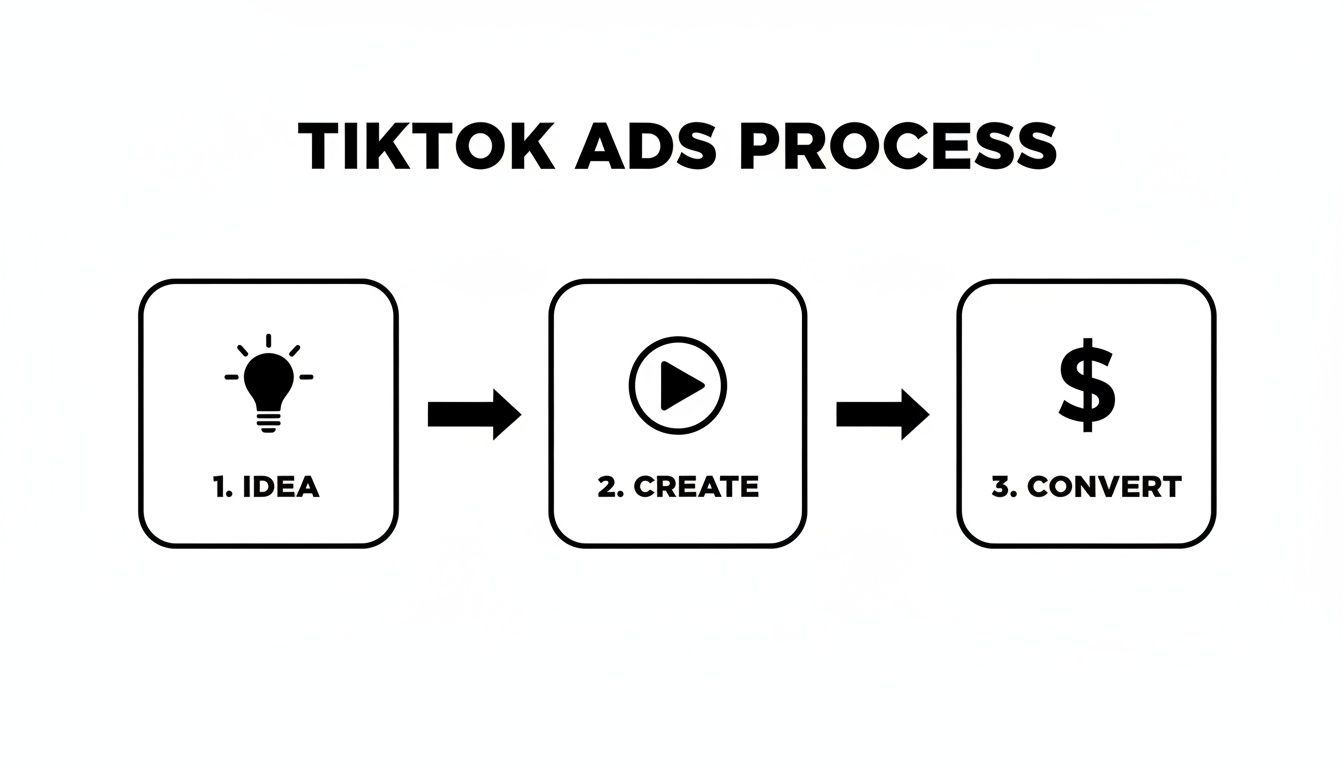
Think of it as a production line. Each stage builds on the one before it, methodically turning a simple concept into a tangible business outcome. Let's dig into what makes this approach work so well.
Adopt a Mobile-First Mindset
This might sound obvious, but you’d be surprised how many brands get it wrong. Every single part of your ad—from the video itself to the text overlays—has to be designed for a vertical screen.
We're talking about shooting in a 9:16 aspect ratio, using text that's big and easy to read, and making sure your visuals pop on a small display. People are holding their phones right up to their faces, so every little detail is magnified. Please, don't just crop your horizontal TV commercial and call it a day. Create content that’s born to live on TikTok.
Why UGC-Style Creative Is King
If you want to succeed, you need to embrace the look and feel of user-generated content (UGC). This style is the gold standard on TikTok because it comes across as genuine, relatable, and trustworthy. It perfectly mimics the organic videos that users are already watching and creating themselves.
Overly polished, high-budget commercials stick out like a sore thumb—and usually get skipped instantly. I’ve seen it time and time again: an ad shot on a smartphone, with real people in normal settings, will almost always crush a slick, corporate-looking video.
The numbers back this up. TikTok's global ad revenue is on track to hit somewhere between $32 billion and $37 billion in 2025, and that growth is fueled by ads that feel authentic. For performance marketers, the platform is a goldmine. The average Cost Per Click (CPC) on TikTok is just $1.80, which is the lowest among the major social platforms. Even better, its conversion rates can hit 2.14%—the highest in the game. You can find more details in these TikTok advertising statistics.
The real secret to a great TikTok ad is making it feel like it isn't an ad. It should feel like a cool discovery, a life hack, or just an entertaining clip from a fellow creator. Authenticity isn't just a buzzword here; it's your most powerful tool.
The Critical Three-Second Hook
You have three seconds. Maybe less. That's your entire window to convince someone not to flick their thumb and scroll past your ad.
Your opening has to be absolutely magnetic. It could be a controversial question, a totally unexpected visual, or a bold claim that speaks directly to a viewer's problem. Without a strong hook, the most amazing ad concept is dead on arrival because no one will stick around long enough to see it. That first moment is everything; it’s where you win or lose the battle for attention.
When you're creating ads, it's crucial to know what "good" looks like. Keeping an eye on key performance indicators helps you understand if your creative is hitting the mark or if it's time to test something new.
Key Metrics for High-Performing TikTok Ads
This table breaks down the essential performance benchmarks you should be aiming for with your TikTok campaigns.
| Metric | Industry Benchmark | Why It Matters |
|---|---|---|
| Hook Rate (3s Views / Impressions) | 30%+ | Measures if your opening is strong enough to stop the scroll. A low rate means your first few seconds aren't working. |
| Hold Rate (6s Views / 3s Views) | 50%+ | Shows if you're keeping the attention you've earned. This tells you if the middle of your ad is engaging. |
| Click-Through Rate (CTR) | 1%+ | Indicates how compelling your call-to-action is. Are people interested enough to learn more? |
| Cost Per Click (CPC) | Under $1.50 | A measure of ad efficiency. A low CPC means you're reaching your audience cost-effectively. |
| Conversion Rate (CVR) | 2%+ | The ultimate goal. This tells you if your ad is actually driving the desired action, like a purchase or sign-up. |
Tracking these numbers gives you a clear picture of what's working and what isn't, allowing you to make smarter decisions instead of just guessing.
Crafting Ad Concepts That Actually Stop the Scroll
Long before you hit record, a killer TikTok ad starts with a great idea. The ads that truly perform aren't the ones that look like polished, big-budget commercials. They’re the ones that feel native to the For You Page—the kind of content you’d stumble upon organically. This means you have to shift your mindset from "selling" to "storytelling" and focus on entertaining or providing value first.
Before you even think about a script, you need to become a student of the platform. Seriously, get in there and scroll. What sounds are blowing up? What video formats are creators leaning into? Understanding the current culture of TikTok is absolutely non-negotiable if you want to create ads that blend in before they stand out.
This native-first approach is the not-so-secret sauce to success. TikTok completely changed the advertising game by demanding content that doesn't feel like a hard sell. It's a strategy that’s propelling its ad revenue from $13.2 billion in 2023 to an expected $33.1 billion by 2025. With In-Feed Ads pulling an average 2.1% CTR, the opportunity for creators and startups is massive. To really get a handle on this, check out the latest TikTok advertising trends and see what’s working right now.
Brainstorming with Proven Frameworks
Waiting for a lightning bolt of inspiration is a surefire way to fall behind. Instead, I rely on structured frameworks to systematically generate and test ad concepts. This keeps the creative pipeline full.
One of my go-to methods is the classic Problem-Agitate-Solution (PAS) framework. It’s simple but incredibly effective. You start by highlighting a real pain point your audience feels, then you poke at that frustration a bit, and finally, you present your product as the hero that saves the day.
Imagine a skincare brand: The ad opens with someone wincing at a new pimple in the mirror (Problem). The next few cuts show them trying all the useless DIY remedies they found online (Agitate). The final shot? They’re using the brand’s spot treatment, and you see the blemish fading away (Solution). It just works.
Key Takeaway: The best ad concepts tap into a viewer's existing emotions or problems. Don't invent a need; identify a real one and show how your product or service elegantly solves it.
Another powerful angle is leveraging social proof with User-Generated Content (UGC) style testimonials. This isn't about getting a scripted, polished review on camera. It's about creating an ad that looks and feels like a real customer genuinely excited to share their experience.
From Concept to Script with a Little Help from AI
Once you’ve got a solid concept, it’s time to script. This is where a lot of people get stuck staring at a blank page. Tools like our own ShortGenius can be a game-changer here, helping you speed up the workflow dramatically. You can go from a single idea to dozens of script variations and hook ideas in just a few minutes.
You just plug in your product details and target audience, and it can spit out scripts for different proven ad formats:
- Unboxing Videos: Capture that raw excitement of opening a product for the first time.
- "Before and After" Demos: Nothing shows a transformation better than seeing it with your own eyes.
- Trend-Based Content: Hop on a popular TikTok trend and weave your brand into it seamlessly.
For example, you could ask for "five hooks for a productivity app targeting overwhelmed college students." The AI might give you gold like, "Stop procrastinating with me," or "The only app that actually got me through finals week." Suddenly, you have multiple creative angles ready to test.
Nailing Your Story Structure and CTA
Every TikTok ad, no matter how short, needs a clear beginning, middle, and end: the hook, the body, and the call-to-action (CTA). Your hook has to grab them in the first three seconds. The body delivers the goods—the demo, the story, the value.
But the CTA is where so many ads drop the ball. A generic "Shop Now" can feel jarring and break the native feel you've worked so hard to create. Instead, think of your CTA as the next logical, helpful step for the viewer.
Instead of the default, try one of these:
| CTA Type | Example | Best For... |
|---|---|---|
| Benefit-Oriented | "Get your flawless skin back" | Ads that are focused on solving a specific problem. |
| Question-Based | "Ready to upgrade your routine?" | Engaging viewers and getting a small "yes" in their head. |
| Urgency-Driven | "Grab yours before it sells out again" | Products with high demand or when running a limited offer. |
By using these frameworks and tools, you’re building a repeatable system for developing scroll-stopping ads. You move from guesswork to a strategic process, ensuring you’re not just making ads, but crafting compelling stories that get people to act. The result is a steady flow of creative ideas, ready for production and testing.
Bringing Your TikTok Ad to Life: Production and Editing
You've got a solid script. Now for the fun part: turning those words on the page into a dynamic, scroll-stopping video. This is where the real magic happens.
And let's be clear—you don't need a Hollywood budget or a professional film crew to knock this out of the park. Some of the highest-performing ads on TikTok are shot on nothing more than a smartphone. The trick is to create something that feels like it belongs there. Forget the polished, corporate-style videos. Your goal is to make an ad that looks and feels like it just popped up on a user's "For You" page. That means embracing the authentic, user-generated content (UGC) style that TikTok users know and love.
Nail the Technical Specs First
Before you hit that record button, you need to know the rules of the playground. TikTok is a vertical-first world, so your ad has to be optimized for a mobile screen. Getting these specs right isn't just a suggestion; it's essential for making your ad look professional and render correctly.
- Aspect Ratio: Always, always shoot and edit in a 9:16 aspect ratio. This is the full-screen vertical format that fills the entire phone.
- Resolution: Go for at least 1080x1920 pixels. This keeps your video looking sharp and clean, even on the latest high-def screens.
- File Format: Stick with .MP4 or .MOV. They're the most widely accepted and reliable formats.
- File Size: Keep your final video file under 500 MB to avoid any frustrating upload issues.
Trust me, getting these basics right from the start will save you a massive headache later. There's nothing worse than a killer ad concept being ruined by ugly black bars or pixelation just because the formatting was off.
Edit Like a Creator, Not a Corporation
Editing is where you inject the high-energy, fast-paced feel that TikTok users expect. Slow, lingering shots are a one-way ticket to getting scrolled past. Your editing style needs to be quick, dynamic, and visually interesting enough to keep thumbs from moving.
Quick cuts are your secret weapon here. A new scene or a different camera angle every 1-2 seconds keeps the viewer’s brain firing and prevents them from getting bored. This rapid pacing mirrors the style of the platform's top creators, helping your ad blend in seamlessly.
Motion is just as important. Don't rely on static shots. Play with zooms, pans, and other camera movements to add visual flair. Even a simple "zoom in" on a key product feature can make a huge difference in holding someone's attention.
My Two Cents: Keep your editing fast, but make sure your message stays crystal clear. Every single cut should serve a purpose—whether it’s showing a new benefit, a different angle, or an emotional reaction. The goal is energetic pacing, not visual chaos.
Work Smarter with Modern Tools
The old-school production workflow—shooting tons of footage, painstakingly editing clips, recording voiceovers, and manually creating captions—can eat up a ton of time. Luckily, today's tools are completely changing the game.
Platforms like our own, ShortGenius, can automate a huge chunk of this process. You can learn more about how tools like this can speed up your content creation and help you churn out more creative variations to test.
You can also use a powerful AI video generator to create dynamic scenes from just a script, apply your brand's unique style automatically, and even add a natural-sounding voiceover without ever stepping into a recording booth. This kind of efficiency is a lifesaver when you need to test multiple ad concepts quickly to find what really works.
Add the Final Polish with Text and Effects
Your video isn’t truly done until you’ve added those final layers that make it pop. Text overlays and captions are non-negotiable, especially since so many people watch videos with the sound off.
- Use Bold, Simple Fonts: Pick fonts that are super easy to read on a small screen. No one’s going to squint.
- Highlight Key Words: Make important words or phrases stand out with a pop of color or a size increase.
- Keep It Short and Sweet: On-screen text should be brief and punchy. Think headlines, not paragraphs.
Finally, don’t shy away from playing with TikTok’s native effects, stickers, and filters. When used thoughtfully, they can add a layer of personality that makes your ad feel more authentic. Tapping into a trending sound or a popular effect can be the final touch that helps your ad resonate with the audience, turning a simple video into a seriously high-impact ad.
Crafting Ad Copy and Captions That Actually Convert
You can shoot the most incredible video, but without the right words, it's just eye candy. Your ad copy—the headline, the on-screen text, the caption—is the supporting cast that makes your video a star. It’s what frames the story, tells people what to do next, and makes sure your message gets through, even when the sound is off.
Think of your text as the narrative glue. It adds context, personality, and, most importantly, a clear call to action. On TikTok, we're not writing essays. This is a game of micro-copy, and every single character has a job to do.
Headlines That Reinforce Your Hook
The headline is that bold text overlay you see in the first few seconds. It has one job: to work hand-in-hand with your visual hook to stop the scroll. It needs to be painfully short and incredibly punchy.
Here are a few angles that consistently work:
- Ask a provocative question: "Tired of boring lunches?"
- Drop a bold claim: "This gadget will change how you cook."
- Scream the main benefit: "Finally, a foundation that actually lasts."
Make this text big, easy to read, and place it where it won’t cover up the most important part of your shot. It’s the very first thing people will read, so make it count.
Using the Caption to Add Context and a CTA
Down in the caption area, you’ve got a little more room to breathe—but not much. While you can write a novel here, don't. For ads, one to two sentences is the sweet spot. This is your chance to add a little extra intrigue and push people to act.
A solid ad caption usually accomplishes one of these things:
- Adds context: Shares a key piece of info the video doesn’t show.
- Asks a question: Sparks comments and gets the algorithm humming.
- Drives to a CTA: Tells them precisely what to do next. "Tap the link to get yours!"
Your caption should feel like part of the video, not a clunky sales pitch. Aim for a conversational tone with a clear directive. You’re trying to nudge them toward the next step, not shove them.
If you’re stuck staring at a blank caption box, a TikTok Caption Generator can be a great way to kickstart some ideas and get the words flowing.
Designing for a Sound-Off World
Get this through your head: a huge number of people are watching your ad with the sound off. If your entire message is in the voiceover, you're talking to a brick wall. This is exactly why on-screen text and automated captions are absolutely essential.
Sprinkle text overlays throughout your video to call out key features, highlight benefits, or just emphasize a point as it happens on screen.
A few pro tips for on-screen text:
- Keep it short. We’re talking phrases, not paragraphs.
- Sync it up. The text should appear exactly when the action happens.
- Make it readable. Use clear, bold fonts and add a contrasting outline or background.
- Stay in the safe zones. Keep text away from the very top, bottom, and sides where the TikTok UI can cover it up.
And please, always turn on auto-captions for your ad. It’s an accessibility win and guarantees your message is understood, sound on or off. It’s a tiny click that can make a huge difference in how well your ad performs.
Launching and Testing Your TikTok Ad Campaign
So, you’ve scripted, shot, and edited a TikTok ad you’re proud of. That’s a huge step, but the real work is just beginning. Getting the video made is only half the battle. Now it's time to set it live, see what actually works, and start methodically tweaking it for better results. This is where a smart, data-driven approach separates the ads that fizzle out from the ones that become a genuine growth engine for your brand.
The road to a successful TikTok ad doesn't just end in your editing software. It continues inside the TikTok Ads Manager, where you’ll make some critical decisions about your campaign's goals, audience, and budget. Think of these settings as the launchpad for your creative—they determine exactly who sees your ad and what you want them to do next.
Setting Up Your Campaign for Success
First things first, you have to tell TikTok what you’re trying to achieve. The platform gives you a few campaign objectives, which fall into three main buckets: Awareness, Consideration, and Conversion. If you're like most performance marketers, you're chasing a specific action, which means you'll almost always be working within the Consideration or Conversion objectives.
For example, if you just want to get people to your product page, the Traffic objective is a solid choice. But if you’re aiming for something more concrete like a newsletter signup or a purchase, you'll want to go with the Conversions objective. Picking the right one is crucial because TikTok’s algorithm is going to work its magic to find users most likely to perform that specific action.
Next, it’s time to define your target audience. TikTok's targeting options are surprisingly powerful, letting you get really specific about who you want to reach. You can dial in your audience based on:
- Demographics: The basics like age, gender, location, and language.
- Interests: Hobbies and the kind of content users are already engaging with.
- Behaviors: How users have interacted with other videos or ads on the platform.
You can also create Custom Audiences by uploading your own data (like an email list) or by retargeting people who’ve already visited your website. This is a fantastic way to reconnect with warm leads who already know who you are.
Finally, you’ll set your budget and bidding strategy. You can choose a daily budget or a lifetime budget. A good rule of thumb for a new campaign is to start with a modest daily budget, let it run, and see how it does. Once you find a winning combination of creative and targeting, you can confidently start scaling up.
The Power of Relentless Creative Testing
Here’s a hard truth every seasoned TikTok advertiser learns: your first ad is almost never your best one. The real secret to unlocking massive ROI is to test everything. This means running constant A/B tests to figure out which hooks, visuals, captions, and calls-to-action actually connect with your audience.
Never assume you know what will work. The TikTok audience is notoriously unpredictable. An ad you thought was a masterpiece might totally bomb, while a quick, lo-fi video you almost didn't run could end up being your top performer. You have to let the data guide you.
Start by creating several variations of your ad. You don’t need to do a full reshoot every time. AI-powered tools like ShortGenius make it incredibly easy to generate multiple versions by just swapping out the first three seconds (the hook), trying out a different voiceover, or testing new text overlays. This approach lets you keep your campaigns fed with fresh creative, preventing ad fatigue and helping you continuously discover new winning angles.
When you test, be methodical. Change only one variable at a time so you can clearly see what’s making the difference. For instance, run the exact same ad but with three different hooks and see which one gets the highest 3-second view rate. Once you've found a winning hook, you can then test it with different calls-to-action to see which one drives the most clicks.
A/B Testing Variables for TikTok Ad Optimization
To get the most out of your ad spend, you need to focus your tests on the elements that can have the biggest impact. The table below breaks down what to test, the metrics you should be watching, and why it matters.
| Element to Test | Key Metric to Monitor | Potential Impact |
|---|---|---|
| The Hook (First 3 Seconds) | 3-Second View Rate | A strong hook stops the scroll and dramatically increases the number of people who actually see your message. |
| Visuals & Scenes | Watch-Through Rate, Engagement | Different visuals or a new scene order can keep viewers hooked longer, making the entire ad more effective. |
| Call-to-Action (CTA) | Click-Through Rate (CTR) | The right CTA can significantly boost how many users visit your landing page or download your app. |
| Ad Copy & Caption | Engagement Rate, CTR | A compelling caption adds context, sparks conversation, and can be the final nudge someone needs to click. |
| Sound or Music | Watch-Through Rate, Shares | Using a trending sound makes your ad feel more native to the platform, potentially increasing its viral reach. |
By constantly launching, testing, and iterating on your ads, you’re doing more than just running a campaign—you’re building an intelligent feedback loop. You learn what your audience truly responds to, you refine your messaging, and you begin to turn your TikTok advertising into a predictable and reliable source of growth. This methodical process is the secret sauce behind the most successful campaigns on the platform.
Got Questions About TikTok Ads? We've Got Answers.
Diving into TikTok advertising for the first time? It's natural to have a ton of questions. Let's break down some of the most common things marketers and creators wonder about when they're getting started.
So, How Much Do I Actually Have to Spend?
This is the big one, right? The honest answer is that your budget is entirely up to you. The TikTok Ads Manager is built to be flexible, letting you set either a daily budget (what you spend on average each day) or a lifetime budget (the total you'll spend for the whole campaign).
To get in the game, the minimum spend at the campaign level is $50 per day, and for an ad group, it's just $20 per day. This setup is perfect for starting small, running some tests to see what resonates, and then confidently putting more money behind the ads that are actually working. Your final cost per click (CPC) or cost per thousand impressions (CPM) will ultimately depend on your audience, your industry, and how good your creative is.
Do I Need a Ton of Followers to Run Ads?
Not at all. This is one of the best things about advertising on TikTok. Your organic content might lean on your follower count, but ads are a different beast entirely. They're served directly to your target audience, no matter how many followers you have.
You could literally start an account with zero followers today and launch a campaign that reaches millions of the right people tomorrow. The algorithm cares about one thing above all else: engagement. A killer ad from a brand-new account can easily crush a mediocre ad from a huge brand. It's all about the quality of the ad itself, not the vanity metrics on your profile.
The beauty of TikTok's ad system is that it's a meritocracy. A great idea and a well-executed creative can win, period. You don't need a blue checkmark to get conversions.
What’s the Secret Sauce for a Good TikTok Ad?
The best TikTok ads don't feel like ads. They feel native to the platform, like something you'd stumble upon scrolling your "For You" page. You're not trying to interrupt the experience; you're trying to add to it.
So what does that look like in practice? A few things are non-negotiable:
- A Killer Hook: You have 1-3 seconds to stop the scroll. Seriously. Hit them with a bold claim, a weird visual, or a question that speaks directly to a problem they have.
- An Authentic Vibe: Slick, over-produced commercials often fall flat. The user-generated content (UGC) style reigns supreme here. Ads that look like they were shot on a phone by a real person almost always perform better.
- A Clear Value Prop: What's in it for them? Your ad needs to deliver value, whether it's through pure entertainment, helpful information, or a solution to a nagging problem.
- A Strong Call-to-Action (CTA): Don't be vague. Tell people exactly what you want them to do next, whether it's "Shop Now," "Learn More," or "Download the App."
How Long Should My Ads Be?
TikTok lets you upload videos up to 10 minutes long, but for advertising, that's a trap. Shorter is almost always better.
From what we've seen, the sweet spot for most ad campaigns is somewhere between 15 and 30 seconds. That gives you just enough time to land your hook, show off your product or service, and hit them with a clear CTA before their thumb gets twitchy. The attention span on this platform is notoriously short. Be quick, be clear, and get out.
Ready to stop guessing and start creating high-performing TikTok ads in minutes? ShortGenius uses AI to generate everything you need—from scroll-stopping hooks and scripts to complete UGC-style videos with voiceovers and captions. Eliminate the guesswork and streamline your entire creative workflow. Start building ads that actually convert by visiting https://shortgenius.com today.