How to Increase Social Media Engagement: A Quick Guide

Discover how to increase social media engagement with proven tips, templates, and examples to boost interactions, reach, and growth.
Want to boost your social media engagement? It really comes down to three things: knowing your audience inside and out, creating content they actually find valuable, and interacting like a real human being. It's not about gaming the system for vanity metrics; it’s about building a real community that genuinely wants to hear from you.
Building Your Foundation For High Engagement
Before we get into the nitty-gritty tactics, let’s lay some groundwork. Too many brands and creators jump straight into chasing likes and comments without stopping to think about why people engage in the first place. Sustainable engagement isn't an accident—it’s the direct result of a smart strategy built on a deep understanding of your audience.
This goes way beyond basic demographics like age and location. You need to dig into what really makes your followers tick. What are their biggest frustrations? What kind of content makes them stop their endless scrolling and actually pay attention? What makes them laugh, or what inspires them?
Understand What Drives People
At its core, people use social media for a handful of fundamental reasons. Research consistently shows the top motivations are keeping up with friends and family (50.8%), killing time, and catching up on news (over 35%). This tells us that engagement is fueled by connection, entertainment, and relevance.
To really move the needle on your engagement, your content has to tap into these basic human needs. Before you post, ask yourself if it achieves one of these goals:
- Does it connect people by sparking a conversation or sharing a relatable experience?
- Does it entertain them with a bit of humor, an incredible story, or something visually stunning?
- Does it inform them with a genuinely useful tip, some important news, or an educational insight?
If your post doesn't serve at least one of these purposes, it’s probably just adding to the noise. Great content is a magnet for interaction; everything else gets lost in the scroll.
To help you map this out, here’s a quick breakdown of how user motivations can directly inform your content strategy.
Core Engagement Drivers on Social Media
| User Motivation | Content Strategy Alignment | Example Tactic |
|---|---|---|
| Connection & Belonging | Foster a sense of community and shared identity. | Create a poll asking followers to vote on a new product feature or share their own experiences in the comments. |
| Entertainment & Escapism | Provide a fun, humorous, or inspiring break from the everyday. | Post a behind-the-scenes blooper reel, a funny meme relevant to your industry, or a visually stunning travel video. |
| Information & Self-Improvement | Offer practical knowledge, tips, or insights that help your audience. | Share a quick tutorial, a checklist, or a "myth-busting" post that clarifies a common misconception in your field. |
| Self-Expression & Identity | Give users a chance to share their own opinions and personality. | Ask an open-ended question like, "What's the one piece of advice you'd give to someone starting out in [your industry]?" |
Thinking this way turns content creation from a guessing game into a strategic process.
Define Your Brand Voice and Goals
Your brand’s personality is what makes you stand out from the crowd. Are you the witty, playful friend, or the trusted, authoritative expert? A consistent voice builds familiarity and trust, making your content instantly recognizable in a crowded feed.
Finally, you need clear goals. "More likes" isn't a goal; it's a wish. A real goal sounds like this: "Increase comments by 20% by asking a direct question in every other post," or "Boost shares by creating more infographics that are easy to save and reference."
Putting in this foundational work is non-negotiable, no matter the platform. If you're looking to apply these principles with platform-specific tactics, these strategies for increasing engagement on TikTok are a great next step. By truly understanding what drives your audience and defining your unique voice, you set yourself up to create content that doesn't just get seen—it gets felt.
Creating Content That Sparks Real Conversations
Let's be honest—great engagement isn't just about posting polished videos or perfectly filtered photos. It’s about creating something that stops the scroll. Something that makes a person feel an emotion, whether that’s curiosity, a good laugh, or even a strong opinion. The real goal is to turn your passive viewers into active participants.
This requires a mental shift from broadcasting a message to actually starting a conversation. Stop telling your audience what to think and start asking them. Instead of just showing off your brand, invite them to become a part of its story. This approach is the cornerstone of learning how to increase social media engagement in a way that actually matters.
Ask Questions That Demand An Opinion
The easiest way to get a response? Ask for one. But not all questions are created equal. A simple "yes" or "no" question usually falls flat and kills the conversation before it even starts. The real magic happens when you ask open-ended questions that invite people to share personal stories, opinions, and genuine thoughts.
Think about the difference between, "Do you like our new feature?" versus "How would our new feature change the way you tackle your biggest weekly task?" The second one requires a real answer and gives you incredibly valuable insight.
Here are a few prompts I’ve seen work wonders:
- "What's the best advice you've ever received about [your industry topic]?" This puts your audience in the expert seat, inviting them to share their own wisdom.
- "If you could only choose one, which would it be and why?" This classic "This or That" format is perfect for polls, carousels, or a simple image post.
- "Share your unpopular opinion about [relevant trend]." Get ready for some passionate (but hopefully civil!) debate in the comments. This kind of post can really take off.
When you ask better questions, you’re sending a clear signal: you actually care about what your audience has to say. That’s how you build a community.
Leverage The Power Of User-Generated Content
One of the most powerful engagement tactics is to put your audience in the spotlight. User-generated content (UGC) campaigns are brilliant because they turn your followers from passive consumers into active creators and advocates for your brand. It’s the ultimate form of social proof.
A great example is a travel company asking followers to share their best vacation photo using a branded hashtag for a chance to be featured. This not only gives them a steady stream of authentic, beautiful content but also gets people excited to participate.
Key Takeaway: When you feature a follower's content, you're doing more than just filling a spot on your content calendar. You're validating that person's experience and showing the rest of your community that you see and appreciate them.
Diversify Your Content Formats
If you only post one type of content, your audience will eventually tune out. To keep people interested and engaged, you have to mix things up. A smart content strategy uses different formats to appeal to different tastes and, frankly, to please the ever-changing platform algorithms. If you want to dive deeper, you need to understand how to create engaging content that connects on a human level.
Try weaving some of these highly-engaging formats into your weekly plan:
- Interactive Polls and Quizzes: These are built right into platforms like Instagram Stories and LinkedIn. They’re low-effort for your audience to participate in and give you instant feedback. It’s a win-win.
- Behind-the-Scenes Glimpses: Show the messy, human side of your brand. Share some bloopers, film a "day-in-the-life" video, or walk people through how a product gets made. Authenticity is what builds trust and a real connection.
- Educational Carousels: Take a complex idea and break it down into easy-to-digest, swipeable slides. This format is a magnet for saves—a crucial engagement metric that tells the algorithm your content is high-value.
By constantly varying your approach, you keep your feed feeling fresh and give people more reasons to interact, share, and keep coming back for more.
Think Mobile, Not Just Mobile-Friendly
Let's be blunt: if you're still creating content for a big desktop monitor first, you're already behind. The days of designing for a wide screen and just hoping it squishes down nicely onto a phone are over. To really crack the code on how to increase social media engagement, you have to build your entire creative strategy around that small, vertical screen where your audience spends most of its time.
This isn't just a trend; it's the reality of modern social media. With an estimated 80% of all social activity happening on mobile devices, a mobile-first mindset is the only one that makes sense. Vertical video, eye-catching visuals that stop a thumb mid-scroll, and using platform-native features aren't just nice-to-haves anymore—they're the price of entry. If you want to dive deeper into how mobile has reshaped marketing, Dreamgrow offers some great insights.
Your Content Lives in a Vertical World
From Instagram Reels and TikTok to YouTube Shorts, every major platform is built around a vertical experience. Your content needs to feel like it belongs there. A horizontal video that's been awkwardly cropped with black bars on the top and bottom just screams, "This wasn't made for you," and that’s an instant invitation for users to swipe away.
So, how do you make your content feel native to the vertical scroll?
- Shoot in a 9:16 aspect ratio. Always. Filming vertically from the get-go means you won't have to deal with clunky editing or cropping out important details later. It ensures your subject is perfectly framed from the start.
- Keep the good stuff in the middle. Think about where platforms place their user interface elements—usernames, captions, like buttons, and share icons. They’re usually at the top and bottom. By keeping your key visuals, text, and faces centered, you prevent them from getting covered up.
The Art of the Thumb-Stop
You have a tiny window—maybe three seconds, if you're lucky—to convince someone to stop scrolling. Your content needs a hook so powerful it literally stops their thumb from moving. This isn't about being clickbaity; it's about making an immediate, compelling promise from the very first frame.
I can't stress this enough: if the first three seconds of your video don't grab someone, the rest of it is pointless. No one will stick around to see your brilliant message if the opening is weak.
Here are a few proven ways to create that crucial thumb-stopping moment:
- Lead with bold text overlays. Start your video with a question or a hook that piques curiosity. A chef, for example, could open with a video of a sizzling pan and the text, "You're making your steak wrong."
- Jump right into the action. Forget long, cinematic introductions. Your video should start at the most exciting part. Show the reveal, the "aha!" moment, or the most dynamic shot right away.
- Use the platform's own toys. Get comfortable with the features that make each platform unique. Use Instagram's interactive poll stickers in your Stories, add a trending sound to your TikTok, or try a new filter. Using these native tools makes your content feel more authentic and organic, which encourages interaction and gives you a nice little nod from the algorithm.
Nail Your Timing and Let AI Do the Heavy Lifting
You can create the most amazing content in the world, but if you post it when no one's around to see it, it's like throwing a party and forgetting to send out the invites. Getting a real handle on how to increase social media engagement means getting serious about your timing.
Forget the generic advice you've seen a million times, like "post at 9 AM on Tuesdays." Your audience is not a global statistic. The absolute best time to reach them is when they are actually scrolling, and the only way to know that is to look at your own data.
Jump into your native analytics on platforms like Instagram, TikTok, or Facebook. Most of them give you a surprisingly clear breakdown of the days and even the hours when your followers are most active. This isn't just a nice-to-have; it's your roadmap. Hitting these peak windows means your content gets in front of the most eyeballs right away, which is exactly the kind of early traction the algorithms love.
Let AI Sharpen Your Strategy
Your platform's built-in analytics are a fantastic starting point, but AI is where things get really interesting. Modern social media tools powered by AI can dig into your past performance with a level of detail that's nearly impossible for a human to replicate. They go way beyond simple activity charts to spot subtle patterns you’d likely miss.
For instance, an AI tool might notice that while your overall audience is most active at 8 PM, your educational carousels consistently get more saves and shares when posted at 7 AM. Why? People might see them on their morning commute and save them for later. These are the kinds of specific insights that let you tailor your timing not just to your audience, but to the type of content you're sharing.
The infographic below outlines a simple, mobile-first creative process—a non-negotiable approach for grabbing attention today.
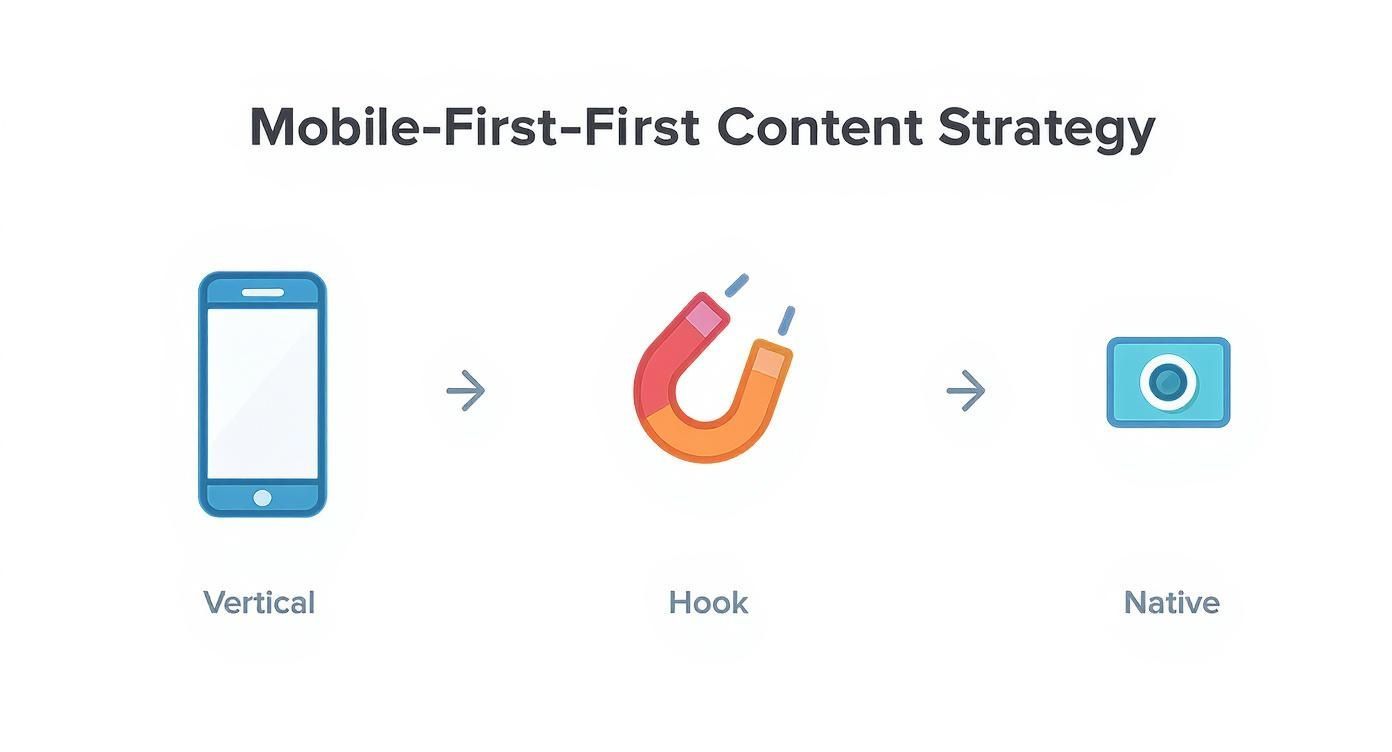
It all comes down to thinking vertically, hooking your viewer in the first few seconds, and using the platform’s native features to look and feel like you belong there.
AI Is Way More Than Just a Scheduler
The real magic of AI isn't just about finding the perfect time to post. It's about working smarter, not just harder. The Hootsuite Social Media Trends 2025 Survey revealed something huge: organizations that use AI for their strategic planning are seeing up to 1.6x higher engagement rates. They're not just scheduling posts; they're making faster, data-driven decisions. You can dive deeper into these AI-driven trends on hootsuite.com.
So, what else can AI do for you?
- A/B Test Creatives: Stop guessing which headline or image will perform better. AI can automatically test different versions to give you definitive answers on what resonates with your audience.
- Simplify Data Analysis: Instead of drowning in spreadsheets, AI can distill thousands of data points into simple takeaways, telling you precisely what’s working and, more importantly, why.
- Predict Viral Potential: Some advanced tools can even analyze your content before you post it, giving you a sense of its potential to take off. This helps you know where to focus your creative energy for the biggest payoff.
When you pair your own human creativity with the analytical muscle of AI, you stop guessing and start knowing. It's about making smart, data-backed decisions that consistently get your content the visibility and impact it deserves.
Turning Followers Into An Engaged Community
Here's a hard truth: killer content alone won't cut it. If you're just pushing out posts and then logging off, you're missing the whole "social" part of social media. The brands and creators who truly win are the ones who understand engagement is a conversation, not a monologue.
This is where active community management makes all the difference. It’s the hands-on work of turning a passive audience into a thriving hub where people feel seen, heard, and genuinely connected to you.
Think about it. When someone leaves a comment, they're extending a hand. Ignoring it is like leaving them hanging. A prompt, authentic reply shows there's a real human on the other side of the screen who actually cares what they have to say. That simple act can turn a casual scroller into a loyal fan.
Go Beyond Just Replying
A quick "Thanks!" is better than nothing, but it's a conversation-killer. The real magic happens when you keep the dialogue going. This is a fundamental shift in mindset you need to make if you want to learn how to increase social media engagement for real.
Start treating your comments section less like a feedback form and more like a lively forum.
- Ask Follow-Up Questions: Someone says they love your new product? Don't stop there. Ask what they love about it or how they're planning to use it. Get specific.
- Acknowledge Them by Name: A simple "@[username], that's a great point..." makes the interaction feel personal, not like a copy-pasted response.
- Connect People: If one person asks a question you know another follower can answer, tag them! You're not just the host; you're the connector, fostering a true peer-to-peer community.
Remember, every comment is an opportunity. It’s your chance to add more value, build a relationship, and signal to the algorithm that your content is sparking meaningful conversations. Don't waste it.
Reactive vs Proactive Community Management
Being a great community manager means more than just playing defense on your own posts. You have to go on offense, too. That means getting out there and actively finding conversations to join, not just waiting for them to come to you.
Here's a breakdown of what that looks like in practice:
| Tactic | Reactive Approach (Basic) | Proactive Approach (Advanced) |
|---|---|---|
| Comment Handling | Responding only to comments on your own posts. | Replying to comments and asking follow-up questions to extend the conversation. |
| Listening | Monitoring your own brand mentions and tags. | Actively searching keywords and hashtags to find and join relevant external conversations. |
| Community Building | Hoping followers interact with each other. | Actively connecting followers by tagging them in relevant comment threads and encouraging peer support. |
| DM Strategy | Answering questions as they come in. | Reaching out to new followers with a personalized welcome message or sending a thank you to someone who frequently engages. |
This proactive mindset is a game-changer. It shows you're a genuine participant in your industry's ecosystem, not just a brand broadcasting from an ivory tower.
Finally, every great community needs clear ground rules. Pin a comment or create a Story Highlight with your community guidelines. This sets the tone for respectful interaction and makes it clear that spam, hate speech, or abuse has no place on your page. By creating a safe space, you empower people to share their real thoughts, which is the bedrock of a truly engaged community.
Got Questions? We've Got Answers
Even the best social media plans run into a few hurdles. Let's dig into some of the most common questions I hear from people trying to crack the code on social media engagement.
So, How Do I Actually Measure Engagement?
It's tempting to just count likes, but that's only scratching the surface. True engagement is about looking at the whole picture of how people interact with what you post. You're looking for signs of genuine interest, not just a quick double-tap.
A great starting point is calculating your engagement rate for a post. Here’s a simple formula most people use:
- (Total Likes + Comments + Shares + Saves) / Total Followers x 100
This gives you a clear percentage showing how many of your followers actually engaged. But don't stop there. The real story is also in the metrics that show people took an extra step, like click-through rates on your links, how many DMs a post sparked, or how often people are using your custom hashtags.
Realistically, How Long Until I See a Difference?
This is the big one, isn't it? Everyone wants results yesterday, but building a community that genuinely cares about your brand is a marathon, not a sprint. You won't see a massive shift overnight.
You'll probably see small victories within a few weeks—maybe a post that really takes off or a sudden bump in comments. But to see a real, lasting increase in your baseline engagement, you should plan on putting in three to six months of consistent work. That means showing up regularly, talking with your community, and constantly tweaking your strategy based on what's working and what's not.
My Two Cents: Don't chase a single viral hit. The real win is building a loyal core audience that sticks around and interacts with you consistently. Patience truly is your best friend here.
Which Platform Should I Focus On?
There's no single "best" platform—the right one is wherever your people are hanging out online. Trying to be everywhere at once is a surefire way to burn out.
Here’s a quick breakdown from my experience:
- Instagram: A must for visual-heavy brands. If you're in fashion, food, travel, or e-commerce, this is your playground. The mix of Reels, Stories, and photo carousels gives you so many creative ways to connect.
- TikTok: If you're trying to reach Gen Z and millennials, you need to be here. It’s all about short, fun, and creative video content. Don't be too polished; authenticity is everything on TikTok.
- LinkedIn: This is the spot for B2B, industry experts, and anyone building a professional brand. People here want to see industry insights, career advice, and meaningful company updates.
- Facebook: It's still a giant, especially for connecting with local communities or if your target audience is a bit older. It’s fantastic for local businesses that want to build a neighborhood following.
My advice? Pick one or two platforms where you know your audience lives and go all-in on mastering them.
Ready to create stunning, engaging video content without the headache? ShortGenius uses AI to handle everything from scriptwriting and voiceovers to editing and scheduling, so you can focus on building your community. Turn your ideas into a consistent stream of high-quality shorts for every platform at https://shortgenius.com.